“You May Leave,” the Duke Said Coldly — She Did, and She Took His Peace With Her
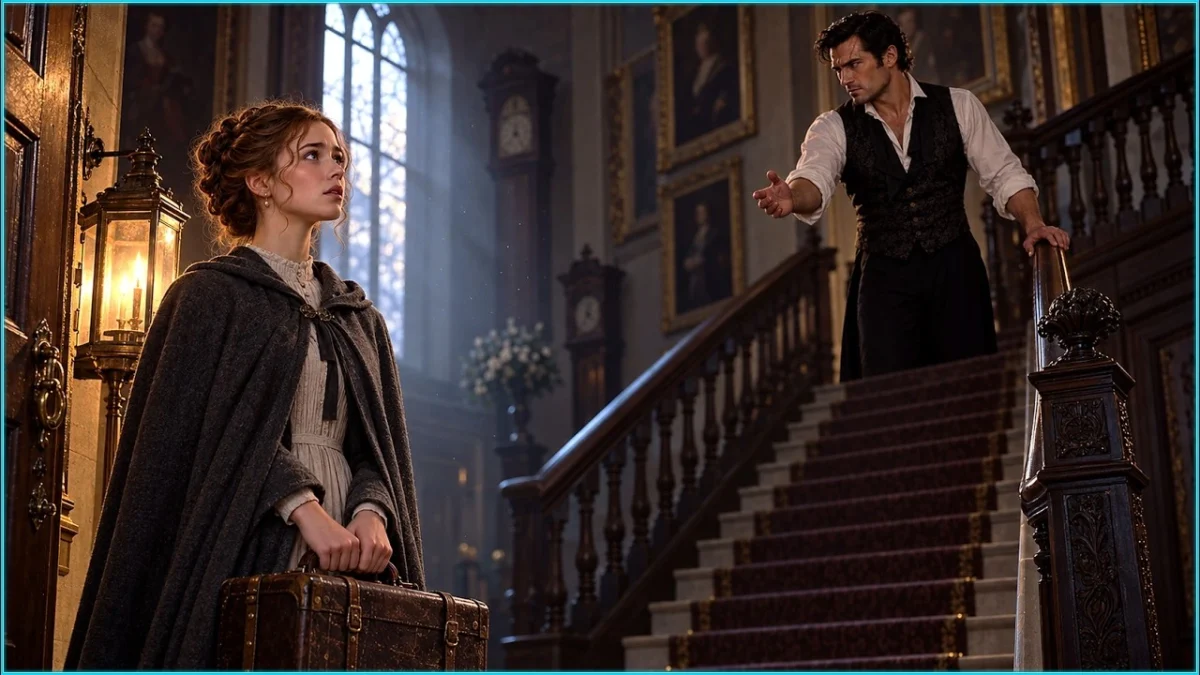
“You May Leave,” the Duke Said Coldly — She Did, and She Took His Peace With Her
You may leave,” the Duke said coldly, not lifting his eyes from the ledger before him, and something in the room went as still as a held breath.
Quinn old Airingham did not move at first. She had been standing at the corner of his desk for the better part of an hour, the candle guttering low between them, a stack of correspondents sorted into neat, waiting piles by her own hand, and she had thought foolishly that the evening had been a good one.
He had laughed once briefly at something she had said about the miller’s account. He had let his fingers brush hers when she passed him the seal.
She had let herself believe for the length of one candles burning that the wall he kept around himself had a door in it after all, and that she stood nearer to it than she had ever stood before.
Then Lady Ansford’s voice had come from the corridor. Sharp with delight at having something to carry to London.
Something about the Duke and his little secretary thick as thieves at all hours, and Fucher, Duke of Drebear, had gone white to the lips, and then read at the jaw, and had said, “You may leave in a voice so flat and so final that it did not sound like the voice of the man who had laughed an hour before.”
“Your grace,” Quinnald said, and her own voice did not shake, though her hands folded before her had gone cold.
If I have given offense, you have given nothing, he said. That is precisely the difficulty.
Take the morning, collect your wages from Parata. I will have no further need of your services.
She looked at him a moment longer. He would not meet her eyes. He was staring at a column of figures he had already added twice.
She saw, because she had spent three years learning to see what he’d not wish seen, that his hand upon the ledger’s edge was not quite steady, and that a muscle worked once hard at the corner of his jaw, and was mastered.
“Very well,” she said. “Good night, your grace.” She did not slam the door. She had never in her life slammed a door, and she was not going to learn how on the last night she would ever stand in that particular room.
She closed it with the same quiet care she gave to everything at Drebear, the same care that had over 3 years turned a house of cold corridors and colder silences into something that almost breathed.
And she walked down the long gallery with her spine straight and her chin level, past the portraits of de@dbears, who had never once looked kindly on anyone, and did not let a single tear fall until she had gained the privacy of her own small room above the still room, where she sat on the edge of her narrow bed, and pressed both hands over her mouth, and wept without a sound, because even now, even undone, she would not let the house hear her.
Fucher sat alone in his study a long while after the door had shut. He told himself he had done what was necessary.
Lady Ansford, his aunt by marriage and his most reliable source of gossip, had all but promised to carry a tale of impropriy to three counties by Tuesday next.
And a duke with debts to settle and a family name to mend could not afford to be the subject of such a tale.
Not now, not with the Fenwick match so near to being sealed. He told himself this three times in nearly the same words the way a man repeats a sum he does not trust.
He did not tell himself the truth which was that he had heard his aunts laughing insinuation and felt for one unguarded instant something close to terror because it had not been false.
He had sat across from Quinnold Epingham a h 100red evenings in that room. Watching candlelight move over the crown of her bent head as she untangled his correspondence and his accounts with a quickness that shamed his own steward.
And he had begun somewhere in the second year to count the hours until she came and to resent the hours after she had gone.
He had not permitted himself to call it what it was. A duke did not fall in love with his secretary.
A duke above all a duke burdened with his father’s debts and his father’s disgrace and the weight of restoring a name that had been dragged low did not fall in love with anyone at all.
Not if he meant to do his duty by it. So when the truth had come too near the surface, spoken lightly and cruy in his aunt’s careless voice.
He had reached for the coldest words he owned and used them on the one person in the house who had never once deserved them.
He told himself this was strength. He sat with the ledger open before him until the candle burned to nothing and did not write another figure and did not sleep.
Quinnald rose before dawn because she had always risen before dawn. Three years of habit not easily broken in a single night.
She washed her face in cold water and looked at herself a long moment in the small spotted glass above the basin.
And what she saw was not a ruined woman, not a woman undone, but a woman who had been dismissed unjustly, and who did not intend to let the injustice make her small.
Her father had taught her that Josia Pingham had been a country clergman with more Greek than gold, and he had tutored a difficult, grieving 12-year-old boy named Fucher through two long winters after the old duke’s death.
In the years before the boy came into his title and his father’s ruin both at once, and he had said to his daughter more than once, “Watching that boy learn to hide his sorrow behind silence,”
“Dignity, my dear, is the one inheritance no one can take from you, because you carry the whole of it inside yourself.”
She had been 11 years old when he said it and had not understood it.
She understood it now, folding her three gowns into the trunk that had been her mother’s, checking the small bundle of her father’s books, the single unfinished translation she had been permitted to work at, in her rare free hours the letters he had left her.
She had come to Drebear four years past, a girl of 1 and 20, newly orphaned, with nothing to recommend her but a fine hand, three languages, a head for figures that would have shamed a bank clerk, and a letter of introduction that reminded the young duke gently, that her father had once been kind to him, when kindness was scarce in that house.
Futcher had hired her without ceremony, more out of a vague debt of memory than any particular hope, and had been, she suspected, faintly astonished within a month to discover that she had made herself indispensable.
She had reorganized his library. She had caught two errors in his agents accounts that would have cost him dear.
She had learned without being told which letters he could bear to answer himself and which he could not, and had begun, quietly answering the second sort in his name and his voice so well that no correspondent ever guessed the difference.
She had also somewhere in that slow accretion of ordinary days fallen in love with him, which she had known from the first to be a foolish and hopeless thing, and had never once let show, because a woman in her position could afford exactly nothing else.
She finished packing before the house stirred. She left a note for Mrs. Petta, the housekeeper, who had been kind to her, and a shorter one for the cook, and she went down the back stair with her trunk carried between her own two hands, because she would not wake a footman at that hour to carry it for her, not after the manner of her leaving.
She did not see the Duke again before she went. She had thought in some small unckillable corner of her heart that he might come down, that he might at least say something less final than the words he had used the night before.
He did not come. She stood a moment at the great iron gate at the end of the drive, looking back once at the gray bulk of Drebe rising against a sky just beginning to pale at its eastern edge.
And then she turned her face toward the village road and walked. Because she had decided in the night that she would not wait for the cart pareta had offered to send round at 7, she would not wait for anything from that house again.
She had gone perhaps a mile when the miller’s boy, driving his father’s cart in early with the first flower of the day, drew alongside and offered her a place on the seat beside him, and she thanked him and climbed up and did not look back again.
Fer, watching from the window of his own bed chamber, which happened by no accident of architecture, to command a clear view of the drive, saw the small figure and the larger trunk dwindle down the road in the gray light, saw her stop once at the gate, and look back.
Saw her turn away and not look back again, and felt something in his chest that he did not have a name for, because he had spent 20 years teaching himself not to feel the things that required names.
He told himself it would pass. He had felt many things pass in 20 years of practice.
Grief for his mother, who had died before he could properly know her. Grief for his father, which had come tangled so thoroughly with shame and anger that he had never untangled it.
The cold, closed off age of a house that had taught him from his earliest years, that warmth shown was warmth exploited, and that a drear who wept was a drear who would be devoured by the very relations circling his inheritance like gouls over a wreck.
He went down to breakfast at his usual hour. He ate nothing. He went to his study at his usual hour and found the desk exactly as she had left it the night before.
Every letter sorted, every account balanced, a small stack of correspondence in her clear hand awaiting only his signature.
Because even in the last hour of her employment, she had not let a single task go undone.
And the sight of that competence, that quiet, unbroken care laid out for a man who had just turned her from his house, struck him with a force he had not anticipated and could not immediately master.
He sat down. He picked up his pen. He found that he did not know for the first time in 3 years where any single thing in his own correspondence was kept, because he had never needed to know.
He had only ever needed to ask her. By noon, Lady Ansford had called ostensibly to inquire after his health.
In truth to see what had come of her carefully dropped remark the evening before, and found her nephew shorter with her than she had ever known him, and left within the half hour, faintly satisfied at having stirred something, though she could not have said precisely what.
By evening, Paretta had come to him twice with questions Quinnold would have answered without being asked, and the Duke had answered both Curtly and both, he suspected wrongly.
By the second day, he had begun, without quite admitting it to himself, to listen for a step in the corridor that did not come.
By the end of the week, he understood, with the particular clarity of a man forced at last to look directly at a thing he has spent years refusing to see, that he had not merely dismissed an excellent secretary.
He had in one cold sentence spoken to protect a name and a fortune and a pride that had never once kept him warm at night, sent away the only person in 10 years who had made Drebe feel for even a single evening at a time like something other than a mosoleium with excellent plumbing.
He did not go after her, not yet. A man does not undo 20 years of discipline in a week, however loudly the silence in his own house has begun to speak to him.
He told himself there was still the Fenwick match to consider. Still his family’s fortunes to mend.
Still every reasonable argument he had used the night he sent her away. And he held to those arguments the way a drowning man holds to a spa he privately suspects will not bear his weight much longer.
In the village of Holloware, 3 mi distant, Quenold Epingham set her trunk down inside the small whitewashed cottage of Mrs.
Aldis, who had been her mother’s dearest friend, and who took one look at her face and asked no questions at all that first night.
Only put the kettle on and let her sit by the fire until the shaking in her hands had stopped.
“He turned you off,” Mrs. Alder said at last gently, when the tea had gone cold in both their cups.
“He did,” Quinnald said. “I do not think he meant to be cruel.” “I think he was frightened and had no other way of showing it.
That is a generous reading of a hard thing. It is the only reading that lets me sleep tonight, Quinnald said and managed to her own faint surprise something almost like a smile.
Tomorrow I will be angry. Tonight I am only tired. She slept in the end more soundly than she had expected in the small back room of the cottage with its sloped ceiling and its window looking out over Mrs.
Alder’s kitchen garden. And if she dreamed of a lit study and a low fire and a man’s dark head bent over a ledger.
She did not remember it clearly by morning and told herself quite firmly that she did not wish to.
She rose the next day and began in the only way she knew to build a life that did not depend upon Drabe for its shape.
Mrs. Aldis kept the only school in Holloware worth the name. A single long room behind the Chandler’s shop where two dozen children of tenant farmers and tradesmen learned their letters between planting and harvest.
And within a fortnight, Quinnald had made herself as useful there as she had ever been at Drebear.
Though for wages that would not have covered a month of candles at the great house, she taught the elder children Latin declenions in the mornings and helped the younger ones with their letters in the afternoons and in the evenings when the children had gone home to their suppers.
She took in translation work for the wool merchants who came through Hollow on market days and needed their French and Dutch correspondence rendered into plain English.
And she found to her own quiet astonishment that she was not unhappy. She missed him.
She would not pretend otherwise not to herself, lying awake in the small back room with the window open to the sound of Mrs.
Aldis hens settling for the night. She missed the particular quality of the silence in his study when he was absorbed in a problem and had forgotten she was in the room, which had always felt to her less like being overlooked than like being trusted.
She missed the rare unguarded moment when something amused him, and the corner of his mouth moved before he could stop it.
She missed absurdly the sound of his voice reading aloud a passage of some report he found tedious, in the dry, dry tone he used for nothing else.
She did not miss being sent away in a single cold sentence after 3 years of faithful service, and she held to that fact with both hands whenever the missing threatened to become something larger.
Word of her circumstances reached Dre Bear, as word of everything in a small country neighborhood eventually does by way of the Vikar, who called upon the Duke about a matter of the church roof, and mentioned in passing that Mrs.
Elders had taken on a new assistant at the school, a Miss Pingham, and that the woman had a positive gift with the difficult boys, and that the wool merchants at market spoke very well of her French.
Futcher had said nothing at the time beyond a civil word about the roof. He had thought of nothing else for the rest of the day.
It was not, he told himself that he begrudged her the position. He was glad of it in the abstract, glad that she had not been left destitute by his own coldness.
Glad that Mrs. Alders had taken her in. What he could not master was the particular ache of learning that she had gone on, that the world had simply closed over the space she had left in his house the way closes over a dropped stone, that she was teaching Latin to farmers sons and translating wool contracts, by every account thriving.
While he sat in a study that had somehow become the coldest room in England, despite the fire target kept building higher and higher in the great, he found her hand everywhere still.
A note in the margin of an old account book, a small correction in her clear script, a book of Italian poetry she had once recommended, left on the shelf where she had shelved it, which he took down one evening and found, tucked inside the cover, a slip of paper in her writing, a translation of a stanza he had once idly wondered aloud about, done for her own practice, and forgotten there.
Three lines about a heart that keeps its own counsel too long and is undone by its own silence.
He read it perhaps a dozen times before he put it away, and did not examine too closely why his hands were not quite steady when he did.
His aunt, Lady Ansford, called again within the month, this time with purpose rather than idle gossip, and settled herself in his drawing room with the particular satisfaction of a woman who believes she has arranged matters very well.
The Fenick match wants only your word now, she informed him. Lord Renmore has all but said as much to my husband.
Lady Cordelia is a sensible girl, well dowered, and the connection would do a great deal to settle the talk about your father’s debts once and for all.
I cannot think what you are waiting for. I have not yet called upon Lord Renmore.
Futcher said, “You have had a month to call upon him. I have had a great deal of correspondence to see too, he said, which was true, and which was also, he was aware, even as he said it, an admission of the very difficulty he refused to name aloud.
He had in fact spent the better part of the month failing to answer letters that Quinnald would have dealt with in an afternoon.
Letters that sat now in disordered stacks because he’d not bring himself to hire another secretary.
Could not bring himself to sit across the desk from a stranger and watch a stranger’s unfamiliar hand move over the papers where hers had always moved before.
You dismissed that girl a month ago, Lady Anford said, watching him with more shrewdness than he generally credited her.
One would think that would have simplified your correspondence considerably, not complicated it. It has not, he said shortly, and would say nothing further on the subject, and his aunt, for all her love of a good tale, had the sense to let it lie for the moment, though she filed the observation away with the particular care of a woman who suspects she has found the shape of a much better story than the one she had originally set out to tell.
He did call upon Lord Renmore in the end three days later because a duke with debts and a name to mend cannot indefinitely avoid the sensible course simply because his own heart has become inconveniently attached elsewhere.
And Lady Cordelia Ashcom received him in her father’s drawing room with perfect composure and perfect propriety, a handsome, well-mannered young woman of three and 20, who spoke intelligently of the harvest and the state of the roads and asked him nothing about himself that he did not wish to answer, which he understood, even as he sat there, to be precisely the quality that made her so eminently suitable, and so entirely unlike the woman he could not stop thinking of.
You are very quiet this afternoon, your grace, Lady Cordelia observed, without any particular reproach in her voice.
I beg your pardon. I have had a great deal on my mind, so I understand.
My father tells me the two families are all but decided upon the match. She said this with the same composure she had used to discuss the harvest, and it struck him watching her that she did not look at him as a woman looks at a man she loves or even hopes to love.
She looked at him as one looks at a sound investment correctly assessed. He did not resent her for it.
He suspected with an honesty he had denied himself for a month that he had asked for nothing more than that from her because he had not intended to give anything more than that in return.
Are you content with the arrangement, Lady Cordelia? He asked somewhat abruptly, surprising them both.
She considered the question with the same careful seriousness she gave to everything. I am content that it is sensible, she said at last.
I do not know that I have asked myself whether I am content beyond that.
Should I have? I do not know, he said, which was the truest thing he had said to anyone in a month.
And Lady Cordelia looked at him with the first real flicker of interest he had seen cross her face all afternoon.
Not because she loved him any better for it, but because she recognized, with the shrewdness of a woman who had been raised to make a good match, and had never once been asked whether her heart had anything to say on the matter, that she had just met a man wrestling with the very same question she had never permitted herself to ask.
He left Renmore house without having spoken a single word that could be construed as a proposal, and told himself, riding home in the fading light, that he had simply run out of time that afternoon, and would remedy the emission at the next opportunity.
He did not remedy it at the next opportunity, or the one after that. At Holloware, Quinald’s small triumphs continued to accumulate, quiet and unremarked by any grand notice, but felt nonetheless in the shape of her days.
A farmer’s son, who had been thought too slow for letters, proved under her patient instruction, to have a genuine gift for numbers, and she wrote to a school in the county town on his behalf, securing him a scholarship place that his father had never dared to hope for.
A merchant cheated by a Dutch supplier who had assumed no one in so small a village could read his contracts closely found in Quinnold the one person for three counties who could and she caught the fraud before a single Guinea changed hands and the merchant told the tale at every market for a month after so that within weeks she had more translation work than she could easily manage in her free evenings Dr.
Nathaniel Thorne, the village physician, a quiet, capable man some 10 years her senior, who had buried a wife two winters passed and raised his small daughter largely alone since, began calling at Mrs.
Aldis’ cottage with a regularity that even Quinnold, absorbed as she was in her new life, could not entirely fail to notice.
He brought books he thought she might enjoy. He asked her opinion on his daughter’s education with a seriousness that flattered her without demanding anything she was not ready to give.
He was by every reasonable measure exactly the sort of steady decent man a sensible woman in her position ought to have welcomed without hesitation.
And Quinald, walking home from the school one evening in the lengthening light of early autumn, found herself thinking not for the first time that she ought to try harder to welcome him.
She found also not for the first time that some stubborn unhealed corner of her heart declined to cooperate.
“You think of him still,” Mrs. Elder said one evening, not unkindly, watching her young friend stare into the fire with a mending basket untouched in her lap.
“I think of a great many things,” Quinnald said. “You think of the Duke,” Mrs.
Aldis said. “And it does you no credit to deny it to a woman who has known you since you were in short skirts.
He wronged you, my dear, badly. And publicly in his own house in front of his own servants.
A woman is entitled to some anger over that. I have had my anger,” Quinnald said quietly.
“I had it the first week, and it did not make me feel better, only tired.
What I have now is something else. I do not think it has a tidy name.”
“Grief, perhaps,” Mrs. Aldus suggested. “Perhaps,” Quinald aloud, though grief implies the thing is finished, and I do not know that it is.
I only know that I built my whole self around being useful to him for 3 years, and I do not yet know how I am when I am not being useful to anyone in particular.
I am learning it here a little at a time. I find I like a good deal of what I am learning.
I only wish it had not required so much unhappiness to begin the lesson. She picked up her mending at last, and said nothing further on the subject that night, though she lay awake a long while after the candle was out.
Listening to the wind move through the thatch and thought as she often thought in the dark of a low fire and a bent dark head in a room that had for three years felt more like home than any place she had lived before or since and wondered without quite meaning to whether he ever thought of her at all or whether she had already become in the great cold house at Drebear nothing more than a name struck from a ledger and forgotten.
She would have been considerably comforted had she known by how very wrong that last thought was.
The old duke had died when Future was two and 20, leaving behind a title, a mountain of gaming debts no one had suspected until the solicitors began their grim accounting, and a son who had spent the whole of his boyhood learning by hard and repeated example.
That his father regarded any softness in a Drebear man as a weakness to be beaten out of him before the wider world could exploit it first.
Fucher remembered with a vividness he generally kept locked away behind 20 years of discipline the winter he was 9 years old and had wept openly and without shame at the death of a favorite spaniel and how his father had found him at it in the stable and had said in a voice utterly without warmth tears will not bring the dog back and they will teach every man who sees you shed them that you are a creature to be used a drear does not weep future a drear endures and says nothing of the enduring and lets the world believe he feels nothing at all because the world is a pack of wolves and wolves do not pity the wounded.
They finish them. He had been sent to his room without supper for the crime of grieving a dog and had learned the lesson so thoroughly that he did not weep again, not at his mother’s death 2 years later, not at his father’s own funeral 13 years after that.
Not once in the whole of his adult life until a night some three months into Quinald’s absence when he had sat alone in his study with her forgotten translation of an Italian stanza in his hand and had for the first time since he was 9 years old allowed himself to weep without anyone in the world there to see it and judge him weak for the doing.
It was that same evening, sitting alone with the small betraying dampness on his cheeks, that he was almost ashamed to acknowledge even to himself, that he had begun, however dimly, to understand that his father’s lesson had cost him a great deal more than I had ever purchased him in return.
He had built a fortress of silence and cold competence around himself for 20 years, and the fortress had kept out a great many, many things he had feared, gossip, exploitation, the particular vulnerability of being known too well by anyone at all.
But it had also, he was beginning to see, kept out the one thing he had wanted more than any of it, without ever permitting himself to say so plainly, even in the privacy of his own thoughts.
He thought often in those raw early weeks of Josia Herpingham, who had come to Drebeer as his tutor in the two winters directly after his mother’s death, a gentle, unhurried scholar, who had never once told the grieving boy to master his feelings, had instead simply sat with him through the worst of the grief, reading aloud from whatever book came to hand.
Latin poetry or a farmer’s almanac or once memorably an entire volume on the migratory habits of English birds until the boy’s tears had spent themselves naturally and he could return to his lessons with something like peace restored.
It had been the old clergyman and not the boy’s own father who had first shown Fucher that a man might feel a thing entirely and still remain at the end of the feeling whole and capable and entirely himself.
And Future understood now, turning that old kindness over with a clarity three months of misery had finally afforded him, that he had spent 20 years unlearning the very lesson that gentle man had tried to teach him, in favor of a harder, colder one his own father had beaten into him with considerably more persistence.
He had hired Quinnald four years past in some measure because her father’s name had summoned the old buried memory of warmth.
Though he had never once admitted as much even to her, he understood now that he had gone on through 3 years of her quiet, competent presence in his study.
Slowly relearning the lesson her father had first tried to teach him, a little at a time, without either of them ever naming what was happening between them, until his own aunt’s careless remark had forced the truth into the open before he was ready to meet it honestly.
And he had answered that unreadiness with the only weapon his own father had ever properly armed him with, a cold sentence delivered to protect himself at the cost of the one person who had never once given him cause for such treatment.
The household, meanwhile, continued its own quiet reckoning with the change that had come over its master.
Ferris, the new secretary, competent and correct and entirely without imagination, found himself increasingly at a loss to understand a duke who snapped at him for organizing a bookshelf sensibly, who left correspondence unanswered for days at a stretch, and then demanded it be found and dealt with at once, who seemed by every observation Ferris was too discreet to voice aloud.
To be a man haunted by some absence he refused to name. Mrs. Paraga, watching all this from her own vantage in the housekeeper’s room, took it upon herself, some 6 weeks into Quinald’s absence, to do what she considered a housekeeper’s proper duty in a house gone quietly to ruin around its master’s unspoken grief.
She sought out Par one evening and said, with the particular bluntness 30 years of marriage had earned her the right to use, “You must speak to him, husband, not of household matters, of her.
Someone in this house must have the courage to say her name aloud in his hearing, or he will go on pretending he has simply mislaid a competent secretary rather than lost the one thing that ever made this house feel like something other than a very grand and very cold museum.
Paretta, who had served two generations of Drebears, understood better than most the particular perils of overstepping with a proud man’s private grief, nonetheless took his wife’s council to heart, and found his opportunity some days later when Futcher, reviewing the estate’s accounts, discovered an error in the quarterly tenant rents that Ferris had failed to catch, and that would have cost the estate a considerable sum had it gone uncorrected another month.
Miss Epingham would have caught this within the hour of its first appearing, Futcher said more to himself than to Parageta, staring at the offending column of figures with an expression of weary frustration that had become over the past two months entirely familiar to the whole household.
She would have your grace, Paretta said carefully, seizing the small opening his wife had urged him toward.
She had a rare gift for figures and for a great many other things besides, if your grace will forgive my saying so.
The house has not run so smoothly since her leaving, and I do not believe I am the only one in it who has noticed the difference.”
Fcher looked up sharply, and Paretta braced himself for a rebuke that did not come.
Instead, the Duke was silent a long moment and then said with a rawness that stalled the old steward considerably, “No, you are not the only one who has noticed.”
Petta, “I have noticed rather more than I know how to properly address. If your grace will forgive an old servant’s presumption, Paretta said, encouraged by the admission, the whole household was very fond of Miss Urpingham, and would welcome her return most heartily, should your grace ever find occasion to arrange it.
I do not say this to press your grace toward any course you have not already considered.
I say it only because I believe your grace has been carrying this particular weight rather too much alone these past weeks and a household that loved her as we did might in some small way ease the carrying of it.
It was, Future reflected later that evening, a remarkably bold speech for a steward to make to his employer, and he found, somewhat to his own surprise, that he was grateful rather than offended by the boldness, because it had given voice plainly and from an unexpected quarter.
To a truth, he had spent two months circling without quite landing upon squarely himself.
He did not act upon it immediately. The habit of caution, of measuring every step against the family’s fortunes, and the family’s name, had been too thoroughly bred into him to be shed in a single evening’s honest conversation with a loyal old steward.
But he found that Paretta’s words stayed with him in the weeks that followed, resurfacing at odd hours, in the quiet of his study, in the saddle on his increasingly frequent rides toward Holloware, a small steady counterweight against every argument his pride still occasionally raised in favor of continued silence.
At Hollow itself, Quenald had begun in those same weeks a habit of her own that she did not fully examine until much later of keeping in a small worn notebook that had once been her father’s a private record of the small victories that marked her new life, not for anyone else’s reading, but simply so that she might on the harder evenings remind herself of the ground she had gained, Tommy Hartwell’s scholarship secured, the wool merchants fraud uncovered, and a family’s savings preserved.
A shy girl of 12, thought hopeless at her letters, reading her first full sentence aloud without stumbling, her face alike with an astonished pride that Quinnald treasured more than any compliment she had ever received at Drebe, she wrote these small things down in her father’s old notebook.
In the same clear hand she had once used to manage a duke’s correspondence and found that the recording of them, however modest each victory seemed set against the scale of a great house’s fortunes, gave her a steadiness she had not expected grief to leave room for.
She did not write down in that same notebook how often she thought of him, because some things she had decided early in her exile were better carried silently than recorded where even her own eyes might later find them and be undone by the finding.
By the second month, Drebear Hall had become, in the estimation of its own long-suffering staff, a house under siege by its master’s temper.
Parida the steward, a patient man who had served two generations of drees, and thought he had seen every humor a duke could produce, confided to Mrs.
Paretta one night that he had never known his grace so short, so restless, so entirely unlike himself.
And Mrs. Para who had watched Quinnold Epingham come and go from that house for three years with a particular fondness a housekeeper reserves for the one member of the upper household who never once spoke sharply to a maid said only it is not a mystery husband if you would only think on it a moment and would say no more because she did not consider it her place to instruct a duke in the management of his own heart however much she might wish someone would had hired a who secretary in the sixth week, a competent young named Ferris, recommended by his solicitor, thorough and correct, and entirely without imagination, and had found within a fortnight that Ferris’s very correctness maddened him.
Ferris asked before he acted. Ferris waited to be told which letters required an immediate answer, and which could stand a week, wherewald had simply known, by some instinct, Focher had never troubled to examine exactly which correspondence could be trusted to wait and which could not.
Ferris organized the library by a system of his own devising that made perfect sense to Ferris, and none whatever to Fucher, who found himself one evening standing before shelves that had been rearranged out of the order Quinnald had given them.
Feeling a loss so disproportionate to its cause that he was obliged to leave the room before he said something to the blameless Ferris that he would regret.
He rode out one gray October afternoon under the pretext of inspecting a tenant’s drainage, a matter could have handled perfectly well without him, and found the road without any particular decision on his part, curving toward Holloware rather than away from it.
Told himself he wished only to see how the village fared, that a landlord owed his tenants that much attention, and he told himself this quite firmly, and he came within sight of the small schoolhouse behind the Chandler’s shop, and saw through the open door on that mild afternoon, a room full of children bent over their slates, and at the front of the room a woman he would have known by the set of her shoulders alone in a crowd of a thousand, speaking to a boy of perhaps 10, with a patience and a warmth in her face, that struck Futcher, watching unseen from the road with something very close to physical pain, because he had seen that same warmth turned toward himself a hundred times across a desk, and had never once properly understood until this moment of seeing it given so freely to a stranger’s son, how much of a gift it had been.
She looked up. He did not know what alerted her, whether some sound of his horse or some older instinct entirely, but her eyes came to the doorway and found him there.
And for one long moment neither of them moved. She recovered first. She always had, he thought, the quicker composure of the two of them, though he had once mistaken her stillness for coldness and knew better now.
“Your grace,” she said, coming to the door, her voice perfectly even, perfectly correct, the voice of a woman who had rehearsed exactly this moment in her mind more than once, and was determined not to be caught unprepared by it.
“You are a long way from Drebe.” I was inspecting the Hartley drainage, he said, which was true, and which sounded even to his own ears, like the thinnest excuse a man had ever offered.
I did not expect to pass the school. The road does run past it, she agreed with the ghost of something that might, in a kinder light, have been called a smile.
How does your grace go on? Well enough, he said, and could not for the life of him think what else to say.
Though he had rehearsed a hundred conversations with her in the privacy of his own sleepless nights.
Conversations full of apology and explanation, and every one of them deserted him now. Standing 3 ft from her in the mild gray light with a school room full of children watching the exchange with unconcealed curiosity.
“You are well.” “Very well,” she said. “I have found a great deal of use for myself here.
The children are quick, most of them, and glad of the teaching. I am glad of it, he said, and meant it and heard in his own voice an awkward formality that he despised even as he could not escape it.
I hope you find the position agreeable. I do, she said, and something in the simple firmness of it, the plain fact that she had built a life that did not require him at all, struck him harder than any reproach could have done.
Was there some particular matter your grace wished to raise? There was everything he wished to raise, and he could not raise a word of it.
Not in a schoolyard, not with children watching, not with the memory of his own cruelty stand between them as solid as a stone wall, he said.
No particular matter. I am glad to find you well, Miss Urpingham. Good day. He touched his hat and turned his horse and rode away without once looking back.
And it was only when he had gone perhaps half a mile that he permitted himself to acknowledge, with the particular self-loathing of a proud man, forced at last to see his own cowardice plainly, that he had ridden three mi out of his way for the chance to speak to her, and had said nothing, nothing at all, of any of the things that mattered.
Quinnald watched him go from the schoolroom doorway a good deal longer than she meant to and did not notice Miss Alders had come to stand beside her until the older woman spoke.
That was the Duke it was. He came a long way to inspect a drain.
He said as much. And you said nothing to him of the manner of your leaving his house.
What would I say? Quinnald asked and heard to her own surprise. A thread of real feeling bring break through the careful composure she had maintained for two months.
That he wounded me. He knows it. That I loved him and he threw me out for the crime of being loved carelessly at the wrong hour in front of the wrong relation.
He knows that too, or ought to, if he has any wit left in that proud head of his.
I will not beg him to feel what he does not feel, Mrs. Aldus. And I will not perform my hurt for his benefit in a schoolyard.
If he has come to say something to me, he may find the courage to say it plainly, or he may stay away.
She went back to her pupils with a briskness that fooled no one who knew her well, and taught the remainder of the lesson with perfect competence and a heart that achd quite unreasonably for the rest of the day.
Future did not stay away, though he told himself, riding home, that he would. He found reasons over the following weeks to pass near Hollare with a frequency that his own steward began discreetly to remark upon, though never to his master’s face.
He did not stop again at the school. He saw her once at the market, choosing thread at a draper’s stall, and did not approach, only watched her a moment from across the green before making himself turn away.
He saw her once walking with Dr. Thorne, the two of them deep in some conversation that made her laugh, a genuine, unguarded laugh that Fer had heard perhaps three times in three years of her employment, and had treasured each time as a rare and private gift.
And the sight of that laugh given so easily to another man struck him with a jealousy so fierce and so unfamiliar that he had to sit along while in his own library that evening, staring into the fire, before he could master it enough to trust his own voice at dinner.
It was his cousin, Major Edmund Hail, arriving for a fortnight’s visit in the third month of Quinnald’s absence, who finally said aloud what the whole household had been too discreet to say.
“You are impossible company these days,” Edmund observed over Brandy one evening, the two of them alone in the small drawing room, a friendship of 30 years, giving him license that no one else in that house would have claimed.
You were impossible before Waterloo took my leg and taught me a proper appreciation for the days a man simply survives.
And I did not think you capable of becoming more impossible still. But here we are.
I have a great deal on my mind, Futcher said, which had become he was aware, a phrase he reached for the way another man might reach for a familiar coat worn thin with use.
You have exactly one thing on your mind, Edmund said, “And it is not the Fenwick match.
Whatever you have told your aunt. I have watched you turn down two invitations to dine with Lord Renor’s family in a fortnight, and I have watched you ride toward Hollow three times on errands that any competent steward could have managed without you, and I am neither blind nor a fool.
Future, whatever else I may be. What happened with the Herpingham girl? Futcher was silent a long moment, turning his glass in his hand.
I dismissed her, he said finally. Badly. Cruy, if I am honest, which I am trying rather late to become, my aunt made an insinuation about the two of us that was unfortunately considerably nearer the truth than I was prepared to have spoken aloud in my own house, and I answered it by turning the truth of the matter out into the road before dawn with a single trunk and no proper notice.
And you have spent 3 months regretting it. I have spent 3 months telling myself I have not, Futcher said.
I am beginning to find the telling less convincing than I would like. Edmund studied his cousin a long moment, the fire cracking low between them.
“You loved her,” he said. “It was not a question. I do love her,” Futcher said, and the admission spoken aloud for the first time in his own hearing seemed to cost him something enormous, as though a wall he had spent 20 years building had finally, in that quiet room, begun to give way at the foundation.
I have loved her, I think, for a very long time, and I was too great a coward, and too proud a fool to say so before I had already ruined every chance of her believing it.
“Then go and tell her so,” Edmund said, with the particular bluntness of a man who had watched enough good men die for want of a plain word ever spoken to waste patience on his cousin’s remaining hesitations.
Before some sensible country doctor beats you to it and you spend the next 40 years exactly as miserable as you have made yourself these past 3 months only with considerably less excuse.
There is still the Fenwick match to consider. There is no Fenwick match to consider if your heart is elsewhere.
Edmund said, “Lady Cordelia deserves a husband who will look at her the way you looked at that schoolroom door 3 weeks ago when you thought no one was watching you do it.
I was watching Futcher. I have known you since we were boys throwing stones at the mill pond, and I have never once seen you look at anything the way you looked at her.
Fucher said nothing for a long while, staring into the fire. And when he spoke, at last his voice was low and rough with something that had been suppressed a very long time.
I do not know how do three months of silence with a single visit, he said.
I do not know that she would even receive me after what I did to her.
You will not know, Edmund said, until you have the courage to ask. He did not go the next morning, nor the morning after that, told himself each time that the delay was prudence and not cowardice, though he had begun in the privacy of his own conscience, to lose faith in the distinction.
What checked him in the end was not doubt of his own feeling, which had become, since the conversation with Edmund, a fixed and steady thing in his chest, but doubt of his own worthiness to act upon it.
He had turned her out of his house with a single cold sentence. In front of servants who had loved her, without a word of explanation, without even the courtesy of a proper notice or a character to take with her.
And he understood, turning the matter over through another sleepless night, that a man did not undo such an injury by simply riding to Hollir and declaring himself she had built a life there.
She had, by every account that reached him, built it well and built it happily, and he had no right whatever to ride in and unbuild it merely, because his own three months of misery had finally taught him what he ought to have known from the first.
He wrote her a letter instead three times, and burned all three, because each one read on rereading, either too cold or too presumptuous, a man asking to be forgiven while offering nothing of substance in exchange for the asking.
He was still turning the problem over unresolved when his aunt arrived at Drebear with the particular briskness of a woman who has decided a matter is settled and means to see it acted upon before anyone has the chance to unsettle it again.
Lord Renmore gives a ball at the end of the week. Lady Ansford announced, seating herself without invitation in his study in the very chairwald had so often occupied across his desk.
A fact Fua noted with a small private wsece he did not permit to show on his face.
The whole county is invited. Lady Cordelia’s mother has as good as told me it is to be the occasion of the formal announcement if you have the sense to make it.
I have delayed this matter as long as delicacy allows Futcher. But I will not stand by and watch you throw away a match that would settle your father’s debts and restore this family’s name in a single stroke out of some misplaced sentiment for a secretary you turned off 3 months past.
You are the one who occasioned her turning off, Futcher said, more sharply than he had spoken to his aunt in years with a remark you dropped in that corridor purely for the pleasure of dropping it.
And I would ask you not to speak of her as though she were an inconvenience I have failed to properly dispose of.
Lady Ansford blinked genuinely startled by the force of it. I meant no particular unkindness by the remark, she said somewhat defensively.
I only observed what half the household had already observed. That you spent an unaccountable amount of time in that girl’s company for a man with a duchess to choose.
You observed the truth, Futcher said. And I answered it with a cruelty I have regretted every day since.
And if you have any genuine affection for me, aunt, you will cease pressing me toward Lady Cordelia, until I have had the chance to set right what I broke, whatever the cost to this family’s fortunes in the meantime.
His aunt was silent a long moment, studying her nephew with an expression he had not seen on her face before, something between astonishment and a grudging dawning respect.
You mean to go after her? She said at last, the Urpingham girl. I mean to try, Futcher said.
I do not yet know that I will succeed. I have given her very little reason to receive me kindly.
She is a clergyman’s daughter with no fortune and no name. Lady Ansford said, though with considerably less conviction than she had brought to the observation 3 months before.
The county will talk. The county has talked of worse and recovered. Futcher said, “I find rather to my own surprise that I have grown tired of arranging my whole life around what the county will say.
I arranged three years of silence around it, and it cost me the one thing in that time I valued above every ledger and every debt and every ducal obligation I have ever carried, and I will not make the same arrangement twice.”
Lady Ansford rose, gathering her shawl about her with the air of a woman who has come prepared for one conversation and found herself unexpectedly in the middle of quite another.
You will still attend Lord Renor’s bore, she said. Whatever you mean to do about the irrpingham girl, you cannot simply fail to appear after having called upon Lady Cordelia twice this autumn.
It would be a public insult to the whole family, and I will not have it said that a drear behaved so shabily to a young woman who did nothing to deserve it.
I will attend, Futcher said, because it was in fact the only sensible course, and because he understood, with a clarity he had lacked three months before, that Lady Cordelia deserved better than to learn of his change of heart through gossip rather than his own plain word, spoken to her directly, with whatever grace he could still muster after months of poor conduct on every front.
I will speak to Lady Cordelia myself, honestly, before the evening is out. She deserves that much and more.
Lady Antsford left without further argument, and Future sat alone a long while after she had gone, turning over at last the shape of the thing he meant to do, and finding somewhat to his own surprise that the fear of it had begun to matter less than the fear of continuing, as he had continued for three empty months at Hollow that same week.
Dr. Nathaniel Thorne called upon Mrs. Aldis’ cottage on a fine crisp evening with a bunch of late chrysanthemums from his own garden and a gravity in his manner that Quinnald opening the door to him recognized at once for what it was.
Having watched enough anxious fathers bring their ailing children to him over the past months to know the particular set of a man’s shoulders when he has rehearsed a difficult speech and means to deliver it whether or not the moment welcomes it.
Miss Epingham, he said once Mrs. Elders had discreetly withdrawn to the kitchen on the pretext of the kettle.
I hope you will forgive me for speaking plainly, as I am not a man with much gift for saying things by halves.
I have come to know you these past months as a woman of uncommon sense and uncommon kindness, and my daughter has grown fonder of you than of any woman since her own mother died, and I have begun to hope, though I know I have very little right to hope it, that you might consider a match between us.
I can offer you a settled life, a good home, a man who would try every day to deserve your good opinion.
I cannot offer you the sort of grand passion the novels speak of. I am too plain a man for that.
But I can offer you steadiness and respect, and a genuine affection that I believe would only grow with time.
Quinnald sat very still a long moment, the chrysanthemums bright and homely in her lap, and felt, watching this good, decent, entirely undeserving of refusal man across the small parlor, a wave of gratitude so large it very nearly carried her past her own better judgment into an answer she would have regretted for the rest of her days.
“Dr. Thorne, she said carefully, “You do me a very great honor, and I hope you will believe that I say what follows with the deepest respect for you, and not the smallest particle of the coldness with which I was once treated by another.
I cannot give you the answer you deserve tonight, because I would be dishonest to accept a good man’s offer while some part of my heart remains fixed elsewhere, however hopelessly, however foolishly.
You deserve a wife who comes to you whole, Dr. Thorn, and I am not at present a whole woman to give.”
He was silent a moment, and when he spoke again, his voice held no bitterness at all, only a rofful gentle understanding that made her admire him a great deal more than she had before.
“The Duke,” he said, it was not a question. “The Duke,” she admitted, I had wondered, he said, “I have seen the way you go quiet sometimes of an evening in a manner that has nothing to do with anything in this room.
I will not press you further tonight, Miss Epingham, and I hope you will not think less of my regard for having offered it honestly, whatever the answer.
But I will say this as a friend, if you will permit me the word.
A man who could turn you out of his house without a word of proper cause, does not deserve 3 months of your grief, however grand his title.
If he comes to his senses, he had better come to them soon and come to them properly, or he will have thrown away the finest woman in this county for the sake of a pride that will keep him very cold company in his old age.
He took his leave shortly after with a courtesy that cost him something and showed it not at all.
And Quinnold sat alone by the fire a long while after he had gone, turning his kindness over in her mind alongside the ache she could not quite dislodge, and thought with a bleakness she rarely permitted herself, that she might have just refused the shest happiness she was ever likely to be offered, for the sake of a man who had shown no sign in three long months of wanting her back at all.
She did not know sitting there in the fire light with the crosanthemums forgotten in her lap that some 30 mi distant a ball was being prepared at Renour house and that the man she could not stop grieving had spent that same evening writing and burning and writing again a letter he had finally resolved to deliver in person rather than trust to paper and that within the week the whole quiet shape of her carefully rebuilt life was about to be entirely irrevocably undone.
The letter came two days after Dr. Thorne’s quiet, dignified proposal, addressed in an unfamiliar hand, and bearing the seal of a seminary for young ladies in the county of Renmar, some 40 mi distant, and Quenald raid it twice through at Mrs.
Aldis’ kitchen table, before she could quite credit what it offered. Mrs. Ashworth, who kept the seminary, and had heard of Miss Epingham’s abilities through a chain of acquaintance that ran from the wall merchant she had saved from fraud, through his sister, who was married to a clergyman in Renar, to Mrs.
Worth herself, who was in want of a senior mistress capable of teaching Latin French, and the elements of accounting to daughters of good family, who might otherwise be sent no further than the piano fort, and a smattering of watercolors.
Wished to offer Miss Epingham the position at a salary that would have seemed three years before at Drebear, an impossible fortune, with lodging provided and a standing in the establishment second only to Mrs.
Ashworth’s own. She required an answer within the week, as the position must be filled before the winter term began.
“It is a very great opportunity,” Mrs. Elder said when Quinnald had passed her the letter without a word, her own face carefully neutral in a manner that told Quinnald, she had already guessed at some of what the offer would cost her to consider.
It is, Quenile agreed. More than I could reasonably have hoped for, teaching farmers sons their letters in a village school room, a settled position, real wages, a household of my own standing rather than a borrowed room above your kitchen, however gladly you have given it.
You have never once been a burden in this house, and you know it, Mrs.
Aldus, said somewhat sharply before softening, but I will not pretend I do not see what troubles you in the accepting of it.
Ren Marsh is 40 mi distant, my dear. It might as well be the moon, for what chance it would leave you of ever crossing paths with a certain gentleman again.
That gentleman turned me out of his house with a single cold sentence, and has not written me a single line in 3 months, Quinnald said.
More sharply than she had intended, and then more quietly. I do not say that to wound you, Mrs.
Eldus, only to remind myself of it, because I find I need reminding rather more often than I would like to admit.
I cannot build a life on the hope that a man who has shown no sign of wanting me back will one day change his mind.
I owe myself more sense than that, whatever the h of it. Then you mean to accept the position?
I mean to consider it seriously, Quinnald said, which is not quite the same thing, though I grant you it is very near it.
She folded the letter carefully and set it on the mantel, where it remained through the following days like a small, quiet ultimatum, visible from every chair in the room, impossible entirely to forget, even in the ordinary business of preparing lessons or mending stockings by the fire.
She wrote to Mrs. Ashworth within two days to say she would give her answer by the end of the week, which bought her a little time without committing her to anything, and spent the days that followed in a state of divided attention that her pupils, sharper than most adults credited children with being, could not help but notice.
You are sad, Miss Epingham, said little Tommy Hartwell, the farmer’s son with the gift for figures, looking up from his slate with the particular directness of an 8-year-old who has not yet learned that some observations are better left unspoken.
“Are you going away?” “I do not know yet, Tommy,” she said, and found to her own surprise that the boy’s plain question had crystallized something she had been avoiding examining too closely in her own private thoughts.
I have been offered a very good position some distance from here. I do not want you to go, he said with the same directness, and returned to his figures as though the matter were now settled by the simple fact of his having stated his preference.
And Quinnald found herself obliged to turn away for a moment and compose her face before the rest of the class noticed anything a miss.
She thought of the Duke constantly in those days, though she did their best to occupy her mind with the practical business of the school, and found that the seminary’s offer, rather than settling her feelings, had instead thrown them into sharper relief than 3 months of quiet grief had managed on its own.
If she accepted the Renar position, she would be settled, respected, entirely independent of any man’s regard for the whole of her working life, and she understood, turning the prospect over in the small hours when sleep would not come, that a sensible woman, a woman who had learned the lessons her three months at Hollow had so painfully taught her, would accept it without a second thought, and consider herself fortunate to have been offered such security at all.
She was not. She admitted to herself on the fourth night, entirely certain she was that sensible woman yet, however much she wished to be.
Lady Ansford, meanwhile, had begun a private reckoning of her own, one she confided to no one, least of all her nephew, though it had begun the very evening she left his study after their sharp exchange over the Fenwick match.
She had gone home that night, turning over with a discomfort she was not accustomed to feeling, the plain fact that her own careless remark in a corridor, dropped for the small pleasure of having something amusing to carry to her her next card party, had set in motion a chain of consequence that had cost a young woman her home, her position, and very nearly, if her nephew’s grim mood these three months passed, was any indication her own happiness.
Besides, she had never troubled herself over much in the whole of her comfortable life, with the notion that her words might carry weight beyond the moment of their speaking, she found, examining the matter now with an honesty she had rarely applied to herself before, that she did not care for what that carelessness had revealed about her own character, and she resolved without saying as much to a living soul, that she would find some way to make what amends she could, whatever form they might eventually take.
She did not yet know that her opportunity would come sooner than she expected, and in a form that would require rather more courage of her than she had ever previously been called upon to summon Fucher, for his part, spent that same week in a state very near to torment, having resolved, after his conversation with Edmund, that he would go to Hollir and speak plainly, and having then discovered in the days that followed that resolving a thing and finding the courage to execute it were two very different labors entirely.
He rode out twice toward the village and turned back both times before he reached it, telling himself the hour was wrong, or the errand insufficiently prepared, and cursed himself soundly each time for a coward dressed in a duke’s clothing.
It was Paraggeter of all people who finally forced the matter, coming to him on the Thursday before Lord Renor’s bore with a piece of news gathered, as household news generally was, from the kitchen gossip that traveled between great houses and villages faster than any formal correspondence ever managed.
Begging your grac’s pardon, Paretta said, with the particular care of a servant raising a delicate matter.
But it is said in the village that Miss Herpingham has received an offer of a fine position at a seminary someway distant, and means to give her answer within the week.
I thought your grace would wish to know it, whatever use you make of the knowing.”
Fucher sat very still a long moment after the steward had withdrawn, and understood, with a clarity that cut through three months of hesitation, like a blade through old rope, that whatever careful timing he had imagined he still possessed had just been taken from him entirely.
If she left for Ren Marsh, 40 mi distant, settled into a position of real standing and real independence, he understood that he would very likely never see her again, and that whatever chance remained to him of setting right the wrong he had done her would close quietly and permanently.
The moment she signed her name to Mrs. Zashworth’s letter. He resolved that same evening that he would go to Renmore House first, because Honor demanded he settle the matter with Lady Cordelia before he pursued any other course, but that he would ride to Hollir the very morning after, whatever the ball’s late how cost him in rest, because he had already let three months of caution cost him nearly everything, and he would not let a single further day’s delay cost him the rest.
Renorse blazed with candle light on the night of the ball, every window golden against the early dark of late autumn, and Future arrived precisely on time, correctly dressed, and utterly unable to keep his mind on a single word spoken to him in the crush of the receiving line.
He found Lady Cordelia within the half hour, standing near the long windows of the ballroom in pale blue silk, and asked her, with a formality that felt, even to himself, like the last performance of a role he no longer had any wish to play, whether she would grant him a few minutes private conversation before the dancing began in earnest.
She studied him a moment with the same careful assessing calm she brought to everything and said, “You mean to release me from an understanding that was never quite formed, your grace.”
You need not look so grave about it. I have suspected as much for some weeks.
They withdrew to a small ant room off the main gallery out of the worst of the crowds notice, and Future, finding himself unexpectedly grateful for her composure, spoke as plainly as he knew how.
I owe you an honesty I have not offered before now. Lady Cordelia, I called upon your family with every intention of making you an offer because it was the sensible course and because I believed I had no better claim on my own heart to set against it.
I have since learned that I was wrong. I have given my affection sometime before I ever called at Renmore House to another woman entirely, and I will not insult you by asking you to accept a husband whose heart is already spoken for elsewhere.
However inconvenient the timing of my discovering it, “The Operingham girl,” Lady Cordelia said without any particular surprise, and at his startled look, she permitted herself the faintest dry smile.
“You are not so subtle as you believe yourself your grace. Half the county has remarked upon your rides toward Hollir this autumn, though I will say in fairness that no one has remarked upon them to my face until now, out of some misplaced notion of sparing my feelings.
I am sorry, he said. You deserved better conduct from me than three months of half-hearted courtship while my heart was engaged elsewhere.
You need not apologize so extravagantly, she said, and there was beneath the composure something almost like relief in her voice, which caught him entirely offguard.
I will confess to you your grace, since you have been so honest with me, that I have found myself rather more occupied this autumn with your cousin’s company than with yours.
Though I did not think it my place to say so while our families were arranging matters between us as though we were parcels of land to be joined by a good hedge.
Major Hail has a gift for making a dull evening bearable that I have found I value a great deal more than a title now that I have had leisure to consider the matter honestly.
Fucher stared at her and then for the first time in 3 months laughed, a real laugh, startled out of him by the sheer unexpected mercy of the moment.
“Edmund,” he said, “for he has said nothing to me of it. He is too proper to speak before your own matter with me was settled,” Lady Cordelia said.
You may tell him, if you like, that the matter is now entirely settled, and that I would not object to his calling upon my father, should he find himself inclined to do so before the year is out.
I will tell him tonight, Fcher said, gladly, and I thank you, Lady Cordelia, for a generosity I had done nothing this evening to earn.
You earned it by being honest, she said, rising and shaking out her skirts with brisk finality.
Go and find your misspingham, your grace, and do try to say something better to her than whatever it was you said before.
From what little the county gossip has let slip, you have a good deal of ground to make up.
He found Edmund within a quarter hour. Standing near the punch table with the particular studied indifference of a man trying very hard not to watch a young lady in pale blue silk across a crowded room and delivered Lady Cordelia’s message with a satisfaction that momentarily eclipsed even his own turbulent business watching his cousin’s carefully composed face crack into an expression of undisguised boyish delight that 30 years of friendship had rarely been privileged to witness you are certain Edmund said, “You are entirely certain she said so and did not merely permit you to construe it so out of pity.
I have never in my life heard Lady Cordelia say anything she did not mean precisely,” Foucher said.
“Go and dance with her, Edmund, before some lesser man claims the set, and stop wasting the good fortune life has for once simply handed you without your having to bleed for it on some foreign field.”
Edmund clapped him once on the shoulder, hard and went, and Fucher stood alone a moment at the edge of the ballroom floor, watching his cousin Bo before Lady Cordelia, with a lightness in his step that the war had not managed to steal after all, and felt something in his own chest that was equal parts gladness for them, and a fresh sharpened ate for himself, because he had just watched two people step without hesitation, into a happiness he had spent three cowardly months failing to claim for his own.
He did not stay for the rest of the ball. He made his excuses to his hostess with what grace he could summon, called for his horse, and rode out from Renmore house into a night gone hard and clear and cold, the stars bright overhead and his own breath white in the darkness, and he did not turn toward Drebear.
He turned toward Holloware. It was near midnight when he reached the outskirts of the village, and every window dark save one, and he understood, coming to his senses somewhat as the cold aired the ballroom’s heat, and his own churning thoughts from his head, that he could not indecency go knocking at Mrs.
Aldis’ door at this hour, however urgently his heart demanded it. He drew rain at the small stone bridge over the millstream at the village’s edge and sat there a long while on his blowing horse in the cold starlight turning over at last properly and without the excuse of pride or timing or convenient half measures.
Exactly what he meant to say to her when morning came. He thought of his father de@d these 15 years a hard closed man who had taught his son that love shown was love that would be used against you.
That a dre bear who wept was a dre beer devoured. And Fucher understood, sitting alone on that bridge in the cold, that he had spent his whole life since obeying a lesson given by a bitter, frightened man who had himself been made bitter and frightened by some earlier cruelty long since lost to memory, and that he had very nearly let that lesson cost him the one person who had ever made him believe warmth might be given without being punished for it.
He thought of Josia Herpingham. The quiet clergyman who had tutored him through two winters of grief without once demanding he perform a courage he did not feel and who had said to him once an old memory surfacing now with a clarity it had not possessed in 20 years the strongest men I have known your grace were not the ones who felt nothing they were the ones who felt everything and had the courage to say so plainly to the person who deserved to hear it he had been perhaps 13 when the old clergman said it and had not understood stood it and understood it now with a force that nearly undid him on that cold bridge in the dark.
He thought at last of Quinnald herself, not the composed, correct woman who had met him at the schoolroom door with perfect propriety, and told him nothing of her own heart, but the young woman he had watched across a desk for 3 years, quick-witted and quietly funny, and endlessly unfailingly kind, who had never once asked anything of him beyond fair treatment, and had received, in the end, considerably less than that.
He rode on into the village at first light, and did not go to Mrs.
Aldis’ cottage first. He went instead to the small schoolhouse behind the Chandler’s shop, because he knew, with the certainty of a man who had learned her habits over 3 years, without ever quite admitting he was learning them, that she would be there before the children arrived, preparing the day’s lessons in the quiet of an empty room, exactly as she hunts come early to his study, to prepare the day’s correspondence, before he had risen.
He was not wrong. He found her there in the gray early light, a single candle burning against the dimness.
Her dark head bent over a stack of slates, and he stood a moment in the open doorway, exactly as he had stood weeks before on his horse, and this time, before she could compose her face into the careful correctness she had shown him at their last meeting, he spoke.
Quen, he said, and it was the first time in 3 years he had ever called her by her Christian name.
I have come to beg your forgiveness, and I find now that I am standing here that I do not know how to do it in fewer words than the whole of what I have done wrong deserves.
Will you hear me out, whatever it costs us both, before you send me away again?”
She stood very still at the front of the small room, the candle guttering between them, and for a long moment she said nothing at all, and he could not, watching her face in that uncertain light, tell whether what he saw there was hope or grief, or simply the exhausted weariness of a woman who had been wounded once already by this same man’s words, and had no wish to be wounded a second time by a repentance that might prove in the end no sturdier than the cruelty it sought to undo.
I will hear you, Quinnald said at last, setting down the slate she had been holding with a care that betrayed how tightly her hands had gripped it.
I think I’ve earned the right to hear you say whatever it is you have written here at this hour to say, “Your grace, though I confess, I do not know what words you imagine could undo a morning I have not managed to forget in 3 months of trying.”
He said, “I do not imagine any words can undo it. I have spent 3 months learning that some things once said cannot be unsaid, only answered for, and I have come to answer for mine, whatever the cost, and however little I deserve the hearing.
He came a step further into the small room. The candle throwing long shadows across the rows of empty benches.
I dismissed you because my aunt spoke a truth I was not brave enough to hear spoken aloud.
And I answered that fear with cruelty because cruelty was the only language my father ever taught me for handling anything that frightened him.
He taught me from the time I was old enough to understand him. That a drear who loved openly was a drear who would be robbed of it.
That warmth shown was warmth exploited. And I believed him because I was a boy with no one else to teach me otherwise.
Until your father spent two winters teaching me something gentler that I was too well trained by then to properly hear.
I heard it at last, Quinnald, 3 months too late, standing in an empty study, looking at a desk you had left in perfect order on the very night I turned you out of it, and I have not had a single day’s peace since.
You might have written,” she said, and there was beneath the composure a rawness in her voice now that she had not permitted herself to show him at the schoolroom door weeks before.
“You might have sent word, some acknowledgement, some small sign that you regretted the manner of it, if not the substance.”
I waited your grace. I will not pretend to you now that I did not wait foolishly for a letter that never came for weeks after I told myself I’d stopped expecting one.
I wrote three letters, he said. I burned all three because each one seemed either too cold to be worth sending or too presumptuous to be born.
A man who had wronged you asking to be forgiven while offering nothing of substance in return for the asking.
I told myself I would come in person instead, and then told myself I was not yet ready, and then told myself the delay was prudence rather than the plain cowardice it was.
And I let three months pass in that manner, Quenald, while you built a life here that has made you, by every account that reached me, happier than I ever managed to make you at Drabe.
And I have no right at all to walk into that life now and ask you to set it aside for a man who let it come to this before he found the courage to act.
She was silent a long moment, and when she spoke again, her voice had steadied, though something in her eyes had not.
Do you know? She said, what it cost me to be turned out of the only home I had known since my father died, without a character, without a proper wage settled.
In front of servants who had shown me every kindness, because a duchess’s careless remark in a corridor frightened you more than 3 years of faithful service earned any consideration at all.
I did not fall apart. Your grace. I want you to know that whatever else you take from this morning, I did not fall apart cuz my father taught me that dignity was the one inheritance no one could take from me.
And I held to that teaching with both hands and I built something here slowly out of very little.
And I am proud of what I have built. But I will not pretend to you that it did not cost me a great deal to build it, or that I have not lain awake more nights than I care to count, missing a man who had, by every reasonable measure, given me no cause whatever to miss him.
You have every right to refuse me, Fcher said quietly. I have thought of little else on the ride here.
I have no claim on your forgiveness, and I will not press you for an answer you are not ready to give.
I came only to say what I ought to have said 3 months ago in that study, instead of the cold sentence I gave you instead.
I love you, Quinnald. I have loved you, I believe, for longer than I permitted myself to admit even to my own private thoughts.
And I was a coward and a fool who mistook silence for safety, and I would spend whatever remains of my life trying to earn back what I threw away in a single careless moment of fear.
If you would only grant me the chance to try.” The candle guttered between them, and outside faintly the first sounds of the village waking carried on the cold morning air, a cart’s wheels, a dog’s bark, the distant clang of the smithy’s forge.
And Quinnald stood very still amid the small rooms rows of empty benches, looking at the man who had once been the whole quiet center of her days, and who stood before her now stripped of every duke or formality she had ever known him to wear, offering her nothing but the plain truth of his own long failure, and the hope, however slight, that she might still find some use for it.
I do not know that I can simply say yes to you this morning. Your grace, she said at last, and watched something in his face brace itself against the words even before she finished them.
Not cuz I do not believe you. I think watching you now that I believe you entirely, and that frightens me nearly as much as your coldness once did, because I do not know how to trust a happiness I have already once seen taken from me in a single sentence.
I have spent three months learning to be whole without you. I am not certain I know how to risk that wholeness again, even for the chance of something I wanted for longer than I ever let myself admit.
Then take whatever time you need, he said, though it cost him visibly to say it, standing there with his hat still in his hand and his whole bearing that of a man holding himself very carefully in check.
I will not press you, Quinnold, and I will not vanish again the moment the answer proves difficult.
I will come back tomorrow if you will permit it and the day after and every day after that for as long as it takes not to wear down your resistance but simply so that you may see for yourself over time that I mean what I have said this morning and that it was not merely the courage of a single desperate night that brought me here.
She looked at him a long moment, and something in her face, some careful guard she had held in place since the moment he appeared in the doorway, seemed to loosen very slightly, though she did not yet let it fall entirely.
“The children will be arriving within the half hour,” she said, which was not an answer, and which they both understood in that moment to be something very near one.
“I have a lesson to prepare your grace.” Of course, he said, and bowed correctly, exactly as he might have bowed to her three years before across his own desk, and turned to go, and had nearly reached the door when her voice stopped him.
Fcher, she said, and it was the first time in three years of acquaintance that she had ever called him by his given name, and he turned back to find her standing exactly where he had left her, but with her chin lifted now in a manner he remembered well from a hundred small moments of her quiet, unbreakable dignity.
Come tomorrow, if you mean what you have said, I make no promise beyond that.
Become.” He rode back toward Drebeer in the full light of morning with something loosening in his chest that had been clenched shut.
He understood now for the better part of 20 years. And if the ride offered him no certainty of the answer he most wanted it offered him, for the first time in three long months, something he had nearly forgotten how to recognize in himself, hope plain and unguarded, and entirely without the coldness he had once mistaken for strength.
Quennel did not sleep that night, though for once the wakefulness held more hope in it than grief.
She sat a long while by Mrs. Aldis’ fire after the children had been dismissed, and the schoolroom shuttered for the day, turning over every word Fcher had spoken in that gray morning light, and found that she believed him cautiously, in the particular guarded way of a woman who has learned the cost of believing too readily, but believed him nonetheless.
“You are very quiet this evening, Mrs. Eldess observed, watching her young friend stare into the fire with a piece of mending forgotten entirely in her lap, exactly as she had watched her do some weeks before, though the quality of the silence, she noted, had changed considerably since then.
“He came,”Wena said simply, this morning to the schoolhouse. He asked my forgiveness and offered no excuse for himself beyond the truth of his own fear and asked leave to return tomorrow and the day after for as long as it might take.
And what did you tell him? I told him to come, Quinnald said. I made him no promise beyond that.
I do not know, Mrs. Aldos, whether I have the courage to promise more than that yet.
However much some part of me wishes I could simply say yes to him this evening and be done with three months of grief in a single breath.
Courage is rarely a single breath’s business. Mrs. Elder said gently. It is more often a great many small breaths taken one after another until one has walked further than one believed possible when one began.
You need not have the whole of your courage ready tonight, my dear. You need only enough to see tomorrow through and then the day after that and so on for as long as the seeing through requires.
There is still Mrs. Ashwit’s letter, Quinnald said, glancing at the folded paper still resting on the mantel, where it had sat now for the better part of a week.
I owe her my answer by Saturday. Then you have two days to discover which answer your own heart truly wishes to give, Mrs.
Ald said. And I would advise you, whatever you decide, to make certain the deciding is entirely your own, and not something borrowed from fear of being disappointed a second time.
You have built a good life here, Quinald. Whatever comes of the Duke’s repentance, Ren Marsh, would be a fine position, and Hollmer a fine one besides, and a man’s return, however welcome, ought not to be the only measure by which you judge your own worth or your own future.”
Quinnald sat with that counsel a long while after the fire had burned low and understood, turning it over, that her old friend had put her finger on the very heart of the difficulty.
She had spent 3 years measuring her worth by her usefulness to a man had in the end discarded her over a single careless remark, and she had spent 3 months since learning slowly and at real cost to measure it instead by what she herself had built unaded out of very little.
Whatever answer she gave the Duke, whatever answer she gave Mrs. Ashworth, she resolved that night that it would be given from that hard one ground, and not from the old familiar fear of being left with nothing again, she wrote to Mrs.
Worth the following morning. Thanking her warmly for the offer and declining it, not because a duke had come to her schoolroom door with a handful of fine words, but because she had examined her own heart honestly through a sleepless night, and found that she did not wish, at present to trade the life she had built at Holloware, nor the chance now opening before her, however uncertain, for a settled security 40 mi from everything that had come to matter to her.
It was, she understood, as she sealed the letter, the first decision of real consequence she had made in three years that owed nothing at all to what any man, however grand his title, might think of the choosing.
Fucher, for his part, spent that same day in a state of restless waiting that Edmund, still lingering at Drabe in the golden aftermath of his own settled happiness with Lady Cordelia, found considerably more amusing than his cousin appreciated.
You look, Edmund observed, watching Futcher pace the length of the library for perhaps the 10th time in an hour, very much like a man awaiting sentence, rather than a man who has already, by his own account, been granted leave to call again.
She made me no promise beyond the leave to call, Futcher said. I do not know what tomorrow will bring, Edmund, and I find I have very little patience left for not knowing.
You have 3 months of patience already behind you, Edmund said dryly. Surely one more day cannot undo the whole store of it.
One more day, Futcher said, feels a great deal longer than the three months that preceded it, now that there is an actual answer within reach, rather than merely the abstract hope of one.
He was still turning over that particular misery when a caller was announced who surprised him a good deal more than any answer from Hollmer could have done.
His aunt, Lady Ansford, arrived unannounced, and unusually for her, entirely without the brisk self asssurance she generally carried into every room she entered.
I have come, she said, once seated and refusing, for once, the tei offered, to say something I ought to have said 3 months ago, and have lacked the courage to say until now.
I dropped a careless remark in a corridor that cost that young woman her home and her position, and cost you by every evidence of these three miserable months, a great deal more besides, and I have never once in all that time troubled to say I was sorry for it.
I am sorry, Fcher. Not merely sorry that it inconvenienced your Fenwick match, which was my chief concern at the time, and which I am now heartly ashamed to admit govern my thinking so entirely.
Sorry for plain unkindness of it, spoken for nothing better than my own amusement, with no thought at all for what it might cost a young woman with no fortune and no family to shield her from the consequence.
Futcher regarded his aunt a long moment, genuinely startled by the admission, and found beneath his own surprise, a warmth toward her he had not expected to feel again so soon after their sharp exchange over the ball.
“I thank you for saying it,” he said. I will confess I did not expect to hear it, Aunt, and I am glad to have been wrong in the expecting.
I mean to say it to her as well, if she will receive me, Lady Ansford said, though I understand I have very little right to expect a warm welcome, and will not press the matter if she prefers to have nothing further to do with me.
But I find I cannot rest easy, leaving the apology unspoken to the one person who most deserves to hear it, whatever else comes of your own suit toward her.”
She called at Mrs. Aldis’ cottage the following afternoon, while Fucher was engaged in his second visit to the schoolhouse, and delivered her apology to Quinald with a plainness and a genuine humility that surprised them both.
And Quinnald, who had never been a woman inclined to hold a grudge past its usefulness, found herself, by the end of the short visit, offering Lady Ansford tea, after all, and a forgiveness that cost her rather less than she had expected it to, once the older woman’s regret proved as sincere as it appeared.
“You have raised a good man in your nephew, whatever his faults,” Quinald said, as Lady Ansford rose to take her leave.
“I do not say that to flatter you, Lady Ansford. I say it because I have watched him these past six weeks work harder at becoming better than his own worst habits than I believe I have ever seen any man work at anything.
And I think that effort owes something, whatever its arrival, to a family that did in the end teach him to recognize when he had done wrong, and to set about mending it properly.
Lady Ansford left that cottage a good deal moved, and told her husband that evening, with a wonder in her voice he had rarely heard there before.
That she had just spent an hour in the company of the finest young woman she had met in 20 years of London seasons and county assemblies combined, and that her nephew, whatever his early foolishness, would be the luckiest man in England, if he managed in the end not to lose her a second time.
He did not lose her a second time. The visits continued through that autumn and in into the first hard frosts of early winter, patient and unhurried exactly as he had promised, until the day came some 6 weeks after that first gray morning in the schoolroom.
When Quinnald found herself waiting for the sound of his horse on the village road with an eagerness, she no longer troubled to disguise, even from herself.
He came the next day, as he had promised, and did not come empty-handed in any grand or presumptuous way.
But with a small bundle of slate pencils for the school room bought quietly at the Chandler’s shop, because he had noticed, standing in that room the morning before, that half the children’s slates showed pencils worn down nearly to nothing, and he had thought riding home, that it was a small enough thing to do for a place that mattered so much to her, without asking anything in return for the doing of it.
He did not stay long that first day, only long enough to deliver the pencils to Mrs.
Aldis at the cottage door with a civil word and no request to see Quinnald at all, though he knew and suspected she knew that he had timed his visit for the hour when the children would be at their midday meal and Quinnald would be at the schoolhouse alone, preparing the afternoon’s lessons, exactly as she had been the morning before.
He did not go to the schoolhouse that day. He had told her he would not press her, and he had meant it.
And so he rode home to Drabe with the small satisfaction of a promise kept and nothing more, and told himself that was enough for one day’s beginning.
He came again the day after, and the day after that, each visit small and unremarkable in itself, a book left with Mrs.
Aldis that he thought Quennel might enjoy a query about the school’s roof that led within a fortnight to his quietly arranging for his own estate carpenter to mend it at his own expense.
A habit gradually resumed, of riding through Holloware on his way to and from whatever legitimate estate business he could find, or increasingly in vent, so that he might pass the schoolhouse at the hour the children were led out and catch a glimpse of her standing in the doorway, tallying her small charges home, and receive, more often than not, as the weeks wore on, a nod, and then a word, and then by the fourth week, something that must almost been called a smile.
He did not press her for an answer. He had given his word on that score, standing in the gray morning light of the schoolroom, and he found, to his own quiet surprise, that keeping it cost him less than he had feared, because the daily patience of simply showing himself again and again reliable and unhurried, and entirely without the coldness she had once known in him, had become its own kind of courtship, gentler and truer than any grand declaration could have been.
Mrs. Valdis, watching the pattern of his visits with the shrewd, affectionate eye of a woman who had known Quinnald since her cradle, said to her one evening, “He has not missed a week yet, my dear, not since that first morning.
I have known men to court a woman with roses and poetry, who showed less constancy than that man has shown with slate pencils and a mended roof.
He is trying to prove something,”Wena said, though without the guarded edge such an observation would have carried a month before.
I do not know that I have decided yet whether I believe the proof. You believe it, Mrs.
Aldus said comfortably, returning to her mending. You have believed it since the second week.
Whatever you tell yourself of an evening, you only deciding now whether you have the courage to say so.
Quinnel did not answer that directly, but she thought of it a great deal in the days that followed, watching him from the schoolroom window some afternoons, a tall, dark figure on horseback pausing at the edge of the green with no apparent purpose beyond the pausing itself, and she found, turning the matter over with the same careful honesty she brought to everything, that Mrs.
Aldis was very likely right, and had been right for some time. The turn came when it came not with any great drama, but with a small crisis that revealed, more plainly than any declaration could have done, the true measure of the man he had become.
One of her pupils, a boy of eight named Tommy Hartwell, the son of a tenant farmer on Drebear’s own land, fell gravely ill of a fever in the sixth week of Future’s quiet courtship, and Dr.
Thorne called in the middle of the night, pronounced the case serious enough to require a specialist from the county town, a journey of some hours that the boy’s father, a man of very limited means, had no way of arranging on such short notice, no carriage of his own quick enough, no funds to summon a physician of that standing at any hour, let alone in the de@d of night.
Quinald sent for by the boy’s frantic mother because the whole village had come over the autumn months to regard her as the person one turned to in any difficulty requiring a clear head and a quick pen.
Arrived at the Hartwell cottage before dawn and found the situation as grave as reported and did the only thing she could think to do.
She wrote swiftly, a note to Drebear, not knowing whether it would reach its intended hand in time to matter, and sent it by the miller’s boy at a gallop, and then sat with the frightened mother and the feverish child, and waited, with no real hope that help would come quickly enough or come at all.
Futcher had the note within the hour, roused from his bed by an anxious pareter, and did not hesitate a single moment over what needed doing.
He had his own fastest carriage brought round within a quarter hour, sent his own groom riding ahead to warn the county town’s finest physician to be ready, and rode to Hollmer himself, rather than waiting at Drebear for word, because he understood with a clarity that surprised even him, that whatever else this crisis demanded, it demanded that he be present for it, not merely useful from a comfortable distance.
He arrived at the Hartwell Cottage as the sky was graying toward morning and found Quinnold there exactly as he had expected, calm and steady amid the family’s terror.
And he did not waste time on greeting, but set immediately about arranging the boy’s transport to the county town in his own carriage with Dr.
Thorne accompanying and paid without being asked and without any mention of the payment afterward for every expense the specialists visit would incur.
The boy recovered in the end within the week, and the whole village knew within a day how it had come about, and Future found himself regarded for the first time in his life, not as a distant and faintly forbidding figure at the great house on the hill, but as a man who had written out himself.
In the middle of a cold night, for the sake of a tenants’s child he had never before had occasion to notice, he did not seek the credit for it.
He returned to Drebear that same week and said nothing of the matter beyond a breit to Para regarding the specialist’s fee.
And it was Quinald, calling upon him unannounced at Drebear for the first time since her dismissal, who finally forced the matter into the open.
She found him in his study, the same room where he had once said three cold words that had changed the whole shape of her life, and he rose at once when she was announced, something in his face betraying, for just a moment, an anxiety he could not entirely master before he mastered it.
“You did not tell me you had gone yourself,” she said, without preamble, standing just inside the doorway, with a directness he had rarely seen from her, even in 3 years of daily acquaintance.
The whole village speaks of nothing else, and I had to hear it from Mrs.
Hartwell rather than from you. It did not seem a matter requiring particular mention, he said.
The boy needed help. I was in a position to provide it. I would have done the same for any child on this land or none.
That is not entirely true, she said. And we both know it is not entirely true.
And I have come here this afternoon your grace cuz I find I am tired of pretending otherwise to either of us.
She came further into the room, stopping at the very corner of the desk where she had once stood a h 100red evenings sorting his correspondence, and something in the familiarity of the gesture, the plain unconscious ease of a woman returning to a place that had once been in every way that mattered her own, struck him with a force he had to steady himself against.
You did not ride out in the middle of the night for any child on this land.
Fcher, you rode out because it was my note that summoned you, and because some part of you has been waiting 6 weeks for a reason to prove to me without my having to ask it of you, that the man who stood in that schoolroom doorway was not merely a man performing repentance for a single desperate morning.
No, he admitted, I rode out because it was your note. I would like to believe I would have gone regardless, and I hope that is true, but I will not pretend to you that it was not your hand on that letter that had me dressed and mounted before Paretta had finished delivering the message.
She was silent a moment, studying him with an expression he could not entirely read, and then she said quietly, “I have watched you for 6 weeks now, fear.
Slate pencils and amended roof and patience I did not know you possessed. And now a boy’s life very possibly saved because you did not hesitate a single moment when I needed you to be the man I always believed beneath all that coldness you truly were.
I think I’ve had my answer for some time now. I think I have simply been too afraid to trust it the way I was afraid to trust Dr.
Thorne’s kindness for the very same reason. Because I had already once believed myself secure in a man’s regard and found the ground taken from beneath me in a single sentence.
“I cannot promise you I will never fail you again,” Futcher said, coming around the desk to stand before her.
Close enough now that he could see the particular flex of gray in her eyes that he had spent 3 years pretending not to notice.
“I am not a man remade overnight,” Quenald, whatever 6 weeks of pencils and a mended roof might suggest.
I will likely be too proud again some future day over some matter that does not deserve it.
But I promise you this. I will never again answer my own fear with cruelty toward you.
And I will never again let a single cold sentence stand as the whole of what I owe you without first fighting as hard and as long as it takes to say something truer instead.
That is a better promise than most men manage, she said. And there was in her voice something unguarded and warm that he had not heard directed him since the night before his aunt’s careless remark had undone everything between them.
I find I am inclined to accept it your grace along with whatever else you mean to offer alongside it.
He did not need a clearer invitation than that. He took her hand, the same hand that had passed him a thousand letters and a thousand seals across that very desk, and pressed it, and said, with a plainness that held nothing back at all, “Marry me, Quinnald.”
Not because I have a name to mend, or a fortune to settle, though I have both, and neither ways with me now beside this.
Marry me because I have spent three months learning that this house, this whole cold inheritance, I was so afraid to risk for your sake, is worth nothing at all to me without you in it.
And because I love you plainly and entirely, and mean to spend whatever years I am given proving it, one small unremarkable kindness at a time, for as long as you will let me.
Yes, she said, and the word came without hesitation, now without the careful guardedness of 6 weeks before, because she had watched him earn it patiently and without demand, one slate pencil and one mended roof, and one desperate mid-midnight ride at a time, until the answer had simply become the truest thing left to say.
Yes, Fer, I will marry you. They were married in the small stone church at Hollare the following spring at Quinnald’s own quiet insistence.
Rather than in the grander chapel at Drebear that convention would have expected, and half the village turned out to see it.
Mrs. Aldus weeping openly in the front pew. Dr. Thorne standing near the back with his small daughter’s hand in his and a genuine unbegrudging gladness on his face.
Tommy Hartwell fully recovered, ringing the church bell with more enthusiasm than skill, Lady Anford present, and for once, entirely without gossip to carry away from the occasion, having discovered over the intervening months a real fondness for the young woman she had once so carelessly wronged, Major Edmund Hail stood as groomsman with Lady Cordelia, now his own wife of some months, seated beaming in the second pew.
And if the match struck any of the assembled county as unusual, a duke marrying a clergyman’s penalist daughter out of a village schoolroom, no one present that day had the poor taste to say so aloud, because the plain devotion visible on both their faces made the question.
Whatever answer it might once have demanded, entirely beside the point. Futcher took his bride back to Drebear that same evening, through the same iron gate she had walked out of alone in the cold gray light of a dawn near a year before, and stood with her a moment at that gate before they passed through it together, remembering, without needing to speak of it, the morning he had watched her small figure dwindle down that very road, and had felt for the first time in his adult life the true weight of what his own coldness could cost him.
I once told you that you might leave, he said quietly. And it was the crulest and the truest mistake of my life, but I did not understand until you had gone that you had never merely been useful to this house.
You had been its heart the whole time, and I let my own pride nearly cost me the chance to ever say so.
Then say it now, Quinnald said, and mean it, and I will believe you, because I have watched you earn the right to be believed.
I love you, he said. And this house and every year I am given in it will be warmer for your having come back to stay in it.
I will not say those words carelessly again, I will not let a single cold season pass without saying them plainly, whatever pride once cost me the courage to speak them at all.”
She smiled and took his arm, and together they walked through the great iron gate of Drebear into the golden lost light of that spring evening, and the house behind them, which had stood cold and silent through so many hard winters of proud men’s making, seemed to every servant watching from its lit windows, breathing again for the first time in a generation, warm at last, and settled and entirely treasuredly at peace.








