“We Need a Child,” the Apache Woman Said — The Cowboy Froze Then Everything Changed
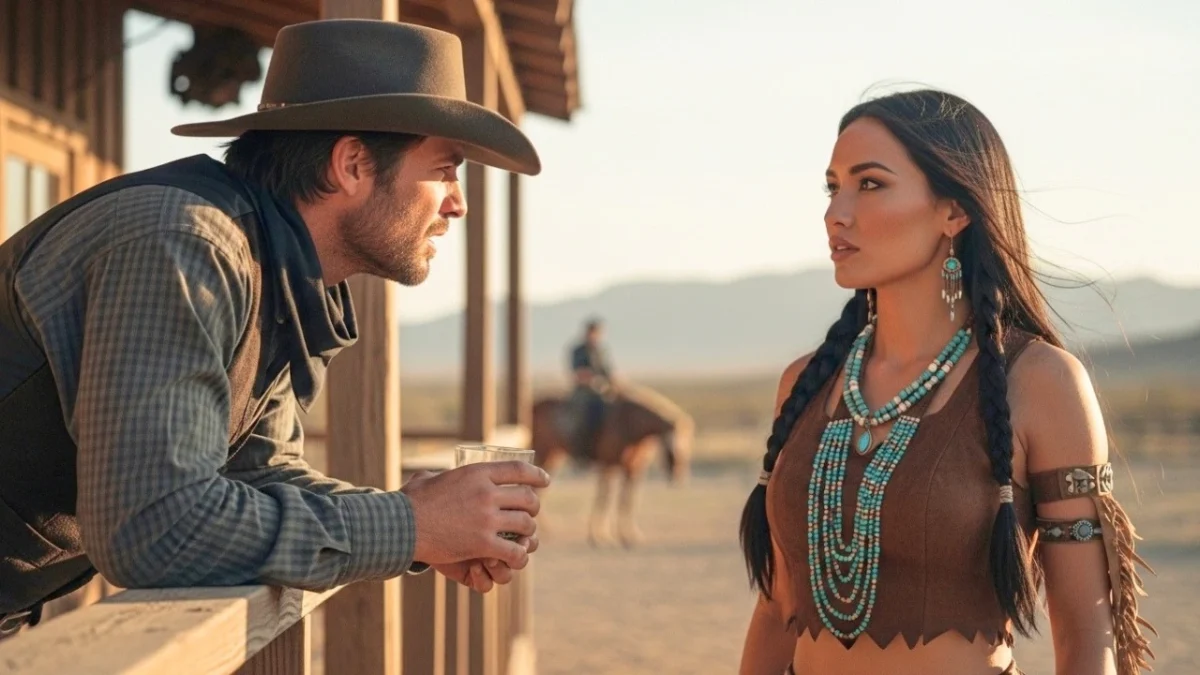
“We Need a Child,” the Apache Woman Said — The Cowboy Froze Then Everything Changed
The desert wind carried the stench of blood and whiskey as Ethan Cross watched the Apache woman refuse to move.
Three miners had her cornered against the saloon wall, laughing like it was all some kind of joke.
He’d spent 5 years keeping his head down, trading horses, and asking no questions. But when the biggest one grabbed her throat, something ancient and furious woke up inside him.
What happened next would cost him everything he’d built in this god-for-saken town and force him to become the man he swore he’d buried in the sand.
If you’re watching from anywhere in the world, drop your city in the comments below and hit that like button.
Let’s see how far this story travels. The sun hammered down on Prescott like divine punishment, turning the dirt streets into shimmering waves of heat that made the buildings look like they were breathing.
Ethan Cross stood in the shade of Murphy’s general store, arms crossed, watching the town move around him like he wasn’t even there.
That’s how he preferred it. Invisible, forgettable, just another drifter who traded horses and kept his mouth shut.
He’d been in Prescott for 3 years, long enough that people stopped asking questions. Not long enough that anyone called him friend.
The Apache woman appeared at the end of the street like a crack of lightning in a clear sky.
She walked alone, which was her first mistake. Her second was walking proud, head up, eyes forward, like she had every right to be there.
Maybe she did. Ethan didn’t care much for rights or wrongs anymore. He cared about staying alive and staying forgotten, but he watched her anyway.
She moved past the hardware store, past the boarding house, past the cluster of men loitering outside the Lucky Dollar Saloon.
They watched her, too, but their watching was different. Hungry, mean. Ethan shifted his weight.
Not his problem. That’s one of them savages from the canyon, a voice said beside him.
Ethan glanced over. Frank Donner, the store owner, stood in the doorway chewing tobacco, his gut straining against a filthy apron.
Didn’t ask, Ethan said. She’s got nerve. I’ll give her that. Coming into town like she owns it.
Her people been raiding supply wagons north of here. Killed two drivers last month. Ethan said nothing.
He’d heard the stories. He’d also heard stories about what the miners did to Apache women when they caught them alone.
Both sides had blood on their hands. The frontier didn’t run on justice. It ran on who had the bigger gun and the faster trigger finger.
The woman stopped in front of the saloon. Three men stepped out to meet her.
Ethan recognized them. Miners from the Copper Ridge operation. Big, drunk, and mean even when they weren’t.
The one in front, a bullshouldered man named Crey, grinned like he’d just found money in the street.
“Well, hell,” Cried drawled loud enough for half the street to hear. “Look what wandered into town.”
The woman didn’t flinch. She said something in Apache, her voice calm and cold. Pred laughed.
“I don’t speak your devil tongue, sweetheart, but I know what you came for. You people always want something.
Food, whiskey, mercy.” He stepped closer, refreshed out of all three. Ethan’s jaw tightened. Still not his problem.
He’d learned that lesson the hard way. The second minor, a wiry man with a scar across his nose, circled around behind her.
The third, younger and dumber, just stood there grinning. “Maybe she’s here to apologize,” Scarno said.
“For what her people did to them wagon drivers.” “Is that it?” Cried asked, leaning in close.
“You here to say sorry?” The woman spat in his face. Everything stopped. Crey wiped the spit away slowly, his grin fading into something much worse.
Big mistake. He grabbed her by the throat and slammed her back against the saloon wall.
She didn’t scream, didn’t beg, just clawed at his hand, her face going red. Ethan’s hands curled into fists.
He told himself to walk away. Told himself he’d seen worse and done nothing. Told himself she was probably as guilty as they were.
He told himself a lot of things. Then Credi pulled a knife. Ethan moved. He crossed the street in long, fast strides, his boots kicking up dust.
By the time Krey registered someone coming, Ethan’s fist was already connecting with his jaw.
The crack echoed like a gunshot. Crey dropped like a sack of grain, the knife clattering onto the boards.
Scarnos spun around, reaching for his pistol. Ethan was faster. He caught the man’s wrist, twisted hard, and drove his knee into the man’s stomach, scarse folded with a wheezing gasp.
The young one just stood there, eyes wide, hands up. “I wasn’t going to get lost,” Ethan said.
The kid ran. Ethan turned to the woman. She was rubbing her throat, breathing hard, but her eyes were sharp and furious.
She didn’t say thank you, didn’t even nod, just stared at him like she was deciding whether to trust him or stab him.
You should go, Ethan said quietly. Why did you help me? Her English was perfect, her accent barely there.
Doesn’t matter. Leave now. Behind him, Krey groaned and started pushing himself up. Ethan didn’t look back.
He just waited until the woman finally turned and walked away, disappearing into the maze of alleys behind the saloon.
When Ethan turned around, half the street was staring at him. Frank Donner shook his head slowly.
You just bought yourself a whole mess of trouble, Cross. Ethan didn’t answer. He walked back to the store, grabbed the supplies he’d come for, and paid in silence.
When he rode out of town an hour later, he could feel eyes on his back the whole way.
Bulockant. The ranch sat 8 mi outside Prescott, nestled in a shallow valley where the scrub brush gave way to cracked earth and stunted cottonwoods.
It wasn’t much. A small house, a barn, a corral. Ethan had built most of it himself, one board at a time, trying to hammer together something that looked like a life.
It didn’t. He unsettled his horse, a gray mare named Smoke, and led her into the barn.
The sun was setting, painting the sky in shades of orange and purple. Ethan stood in the barn door for a moment, watching the light fade.
That’s when he saw her. The Apache woman stood near the corral, arms at her sides, waiting.
Ethan’s hand dropped to the revolver on his hip. How’d you find me? I followed you for 8 miles.
Yes. Ethan exhaled slowly. You’re either brave or stupid. Both. She stepped forward, her face unreadable in the dying light.
My name is Aya. I don’t care. You should because I need your help. Ethan laughed, sharp and bitter.
Then you came to the wrong man. I don’t think so. She moved closer and he saw something in her eyes.
Desperation maybe or determination. Hard to tell the difference. You fight like a soldier. You move like someone who’s seen war.
And you helped me when you didn’t have to. That was a mistake. No, it was a choice.
And now I’m making one. She stopped a few feet away, her voice steady. My people are dying.
Not from bullets or disease, from time. We are too few. The men who remain are old or broken.
If we do not bring new blood, we will vanish. Ethan stared at her. What’s that got to do with me?
I want you to father my child. The words hung in the air like smoke.
Ethan blinked. Then he laughed again, harder this time, shaking his head. You’re crazy. I am desperate, Aya said.
There is a difference. Find someone else. There is no one else. The men in town would use me and kill me.
The soldiers would do worse. You are different. You don’t know a damn thing about me.
I know you are alone. I know you carry grief like a stone. I know you want to be forgotten.
She took another step. But you cannot bury what you are. You are a protector, a warrior.
That is why I came to you. Ethan turned away, his jaw tight. Get off my land.
I will stay here for 90 days, Aya said, her voice calm. You will teach me to survive what is coming.
In return, I will give you what every man wants, a legacy. Something that outlasts you.
I don’t want a legacy. Then you are a coward. Ethan spun around, anger flashing in his eyes.
You don’t get to walk onto my land and you helped me because you could not stand by and watch me die.
Ayah interrupted. That same instinct will get you killed. So teach me. Teach me to fight, to shoot, to survive.
And when the 90 days are done, I will leave. You will never see me again.
Ethan stared at her for a long moment. Then he said, “You’re asking for a war.
The war is already here. You just haven’t admitted it yet.” She was right. 3 days later, Colonel Vance came calling.
Ethan was repairing the barn door when he heard the horses. Six riders moving slow and deliberate across the valley.
He recognized the man in front, tall, gay-haired, with a face like carved stone. Colonel Thaddius Vance, former Union officer, current commander of the Arizona Territorial Militia, and a man Ethan had spent 5 years avoiding.
Vance rained his horse to a stop 20 ft from the barn. His men fanned out behind him, hands resting on their weapons.
“Ethan, cross,” Vance said, his voice smooth and cold. “It’s been a long time.” “Ethan set down his hammer.”
“Not long enough.” Vance smiled. “Still carrying that chip on your shoulder? I see. Can’t say I blame you.
Losing your family the way you did, tragic. Truly tragic.” Ethan’s hands curled into fists, but he said nothing.
I hear you’ve been making friends, Vance continued, defeating savages in the street. Interesting choice for a man trying to disappear.
She wasn’t doing anything wrong. She’s Apache. That’s wrong enough. Vance leaned forward in his saddle.
Here’s the situation, Cross. That woman is a problem. Her people have been raiding supply lines, killing good men.
I’ve been authorized to deal with the threat permanently. She’s one person. She’s a symbol, and symbols are dangerous.
Vance’s smile faded. I’m giving you a courtesy out of respect for what you used to be.
Hand her over, and we’ll forget this ever happened. You can go back to rotting out here in peace.
Ethan met his eyes. And if I don’t, then you’re harboring an enemy combatant, and I’ll treat you like one.
The silence stretched. One of Vance’s men shifted in his saddle, the leather creaking. You’ve got until sundown tomorrow, Vance said.
After that, I’m coming back with more men and less patience. He turned his horse.
Think carefully, Cross. You’ve already lost everything once. Don’t make me take what’s left. The writers disappeared over the ridge.
Ethan stood there, staring after them, his heart pounding. Behind him, Ayah stepped out of the barn.
You should have let them take me. Probably. Why didn’t you? Ethan picked up his hammer.
Because I’m tired of running. That night they sat by the fire outside the house.
Ayla cooked some kind of stew over the flames, the smells sharp and unfamiliar. Ethan watched her work, her movements efficient and practiced.
“Vance isn’t bluffing,” Ethan said. He’ll come back and when he does, he’ll burn this place to the ground.
Then we fight. There’s six of them, maybe more. Then we fight smart. Ethan shook his head.
You don’t know what you’re asking. I know exactly what I am asking, and I know what you are afraid of.
She looked at him across the fire. You think if you fight again, you will become what you were, a killer, a weapon?
I was never a weapon. I was just a soldier and now Ethan stared into the flames.
Now I’m nothing. You are wrong. Ayah’s voice was quiet but firm. You are a man who chooses to protect when it would be easier to abandon.
That is not nothing. That is everything. Ethan didn’t answer. Teach me, Aya said. Teach me to fight.
Teach me to survive. And when they come, we will stand together. Ethan looked at her, this fierce, stubborn woman who had walked into his life like a storm and refused to leave.
He thought about Vance, about the past, about the blood he tried so hard to wash from his hands.
And then he thought about the alternative, running again. He was so damn tired of running.
90 days, Ethan said finally. Aya nodded. 90 days. And if you can’t learn fast enough, we’re both de@d.
Then I will learn faster. Ethan almost smiled. Almost. Get some sleep, he said. We start tomorrow.
Guess the training began at dawn. Ethan led Aya out into the open ground behind the house where the earth was hard and flat.
He handed her an old Colt revolver, the weight of it heavy in her palm.
“You ever fire a gun?” He asked. Once a rifle I missed. Good. That means you’re honest.
Ethan stepped behind her, adjusting her stance. Feet shoulder width apart, knees bent. You’re not a statue.
You’re a spring. Aya shifted her weight, her jaw set in concentration. Both hands on the grip, firm, but not strangling it.
Breathe. Aim. Squeeze. Don’t pull. Squeeze. She fired. The shot went wide, kicking up dust 10 ft to the left of the target.
Again, she fired. Missed again. Missed again. This time, the bullet clipped the edge of the wooden post Ethan had set up.
“Better,” Ethan said. “But you’re flinching.” Anticipating the recoil. “Stop thinking. Just shoot.” They worked for hours.
By midday, Aya’s hands were shaking, her arms aching, but she didn’t complain. Didn’t ask to stop.
Just kept firing until the cylinder was empty, then reloaded and fired again. When the sun was high and brutal, Ethan finally called a break.
Aya sat in the shade of the barn drinking water from a canteen, her face flushed and sweating.
“You’re a terrible shot,” Ethan said. “I know, but you don’t quit. That’s worth more than aim.”
She looked at him, surprised. “Tomorrow, we work on hand to hand.” Ethan said, “If they get close, the gun won’t save you.
You need to know how to break a man’s nose, crush his throat, take his weapon.
You need to be mean.” I can be mean. I know. I saw you spit in Krady’s face.
Ethan almost smiled again. “That was stupid, but it took guts. My mother used to say, “Courage and stupidity look the same until the end.
Your mother was smart.” She was, and she died anyway. Ba’s voice was quiet. They all did.
The fever took most. The soldiers took the rest. I am what remains. Ethan didn’t know what to say to that.
So, he said nothing. The days blurred together. Ethan taught Aya how to move in a fight, how to use her size and speed against bigger opponents, how to stay low, stay fast, stay alive.
He taught her how to reload a rifle in the dark, how to set a trip wire, how to turn everyday objects into weapons.
She learned quickly, faster than he expected. And in the evenings after the training, they would sit by the fire and talk.
Not about the past, not about what was coming, just small things, the weather, the horses, the way the stars looked different out here than they did anywhere else.
It was strange having someone around. Ethan had spent so long alone that he’d forgotten what it felt like to share space with another person.
To hear someone else breathing in the next room. To wake up and know he wasn’t the only living thing for miles.
He didn’t hate it. On the 20th day, Ayah finally hit the center of the target.
Ethan didn’t say anything, just nodded. That night, she asked him the question he’d been waiting for.
Who were they? The ones you lost. Ethan stared into the fire. For a long time, he didn’t answer.
Then quietly he said, “A wife, a daughter. They were in Kansas. I was fighting in the territories.
When I came home, the house was ash. They told me it was raiders.” “Apache,” they said, “burned the whole settlement.”
Ayah’s face went still. And you believed them. For a while, Ethan’s voice was flat.
Then I started asking questions, started digging. The more I dug, the less the story made sense.
No survivors, no witnesses, just ash and bodies and a militia patrol that happened to arrive 5 minutes too late.
Vance. Vance. Ethan’s hands tightened. I can’t prove it, but I know. I know the way you know a storm’s coming before the first drop of rain.
He burned them out to make room for the railroad. Called it collateral damage. Why did you not kill him?
Because I wanted to. And if I started killing everyone I wanted de@d, I’d never stop.
He looked at her. So I ran, built this place, tried to bury what I was, and it worked until you showed up.
Aya was quiet for a long moment. Then she said, “I’m sorry. Don’t be. You didn’t do it.
I am sorry you had to choose between vengeance and peace. No one should have to make that choice.”
Ethan looked at her and for the first time in 5 years he felt something crack open inside him.
Not forgiveness, not healing, just space, a little bit of room to breathe. Tomorrow, he said, we work on explosives.
Alo raised an eyebrow. Explosives? If Vance comes with 20 men, we’re not winning a straight fight, so we don’t fight straight.
We fight dirty. She smiled sharp and fierce. Good. Then on the 30th day, Vance’s men came.
Not Vance himself, just a scout, a young soldier on a fast horse, watching the ranch from the ridge.
Ethan saw him through the spy glass, and knew exactly what it meant. They were out of time.
He spent the next 3 days preparing, digging trenches, setting traps, moving supplies into the cellar beneath the house.
He sent Ayah into town under cover of darkness to buy black powder and fuses from a smuggler named Ortiz, a half-mad Mexican who asked no questions and took no sides.
When she returned, Ethan showed her how to pack the charges, how to bury them, how to rig them to blow with a single pull of a wire.
“This is your plan?” Aya asked, staring at the explosives. “Blow them up? Part of it.
What is the other part?” “Don’t die.” She laughed. A real laugh, bright and unexpected.
It startled him. “What?” He asked. “You are a very strange man,” Ethan Cross. “Yeah, I get that a lot.”
On the 35th day, the horizon filled with dust. 20 riders, maybe more, armed with repeating rifles and grim determination.
Ethan stood on the porch, watching them come. Ayah stood beside him, a rifle in her hands.
Last chance to run, Ethan said. No, Ayah said simply. It is not. Ethan looked at her.
This woman who had walked into his life with nothing but courage and desperation and somehow changed everything.
All right then, he said, “Let’s give them hell.” The writers were coming, and Ethan Cross was done running.
The dust cloud grew thicker as the writers approached, their silhouettes bleeding through the heat shimmer like ghosts materializing from bad memories.
Ethan counted them through the spy glass. 23 men, all armed, all wearing the gray and brown uniforms of Vance’s militia.
They moved in formation, disciplined and deliberate, spreading out as they neared the property line.
Vance rode at the center, straightbacked and calm, like he was heading to Sunday dinner instead of a killing.
There are more than you said, Aya observed from beside the window. I was being optimistic.
Ethan lowered the spy glass and checked his rifle for the third time. The Winchester was loaded, the action smooth.
Six more rifles leaned against the wall, each one cleaned and ready. You remember the plan?
I remember. Say it back to me. Ayla’s jaw tightened, but she didn’t argue. When they get within range of the first charge, I pull the wire.
The explosion will scatter them. You fire from the window. I fire from the door.
When they regroup and push forward, we fall back to the cellar through the kitchen.
We seal the hatch and wait. And if they breach the cellar, we use the tunnel, come up behind them.
She looked at him, her dark eyes steady, and we finish it. Ethan nodded. It was a bad plan, but it was the only plan they had.
The writer stopped 200 yd out, just beyond effective rifle range. Smart. Vance wasn’t rushing this.
He was letting the fear build, letting Ethan think about what was coming. Ethan had spent 5 years trying not to think about moments like this.
Moments where violence was inevitable and all you could do was choose how you met it.
He told himself he was done with that life. Done with the waiting, the adrenaline, the six certainty that some men were going to die today, and you just had to make sure you weren’t one of them.
But standing here now, watching Vance’s men fan out in a slow half circle, Ethan felt something he hadn’t felt in a long time.
Clarity. He’d made his choice, and there was a strange kind of peace in that.
Vance urged his horse forward alone, stopping 50 yards from the porch. He sat tall in the saddle, his gray hair catching the sunlight, his face as calm as carved stone.
“Ethan Cross,” he called out, his voice carrying easily across the distance. “I’m disappointed. I gave you a choice.
You made the wrong one.” Ethan stepped onto the porch, the Winchester loose in his hands.
“Funny, I was just thinking the same about you.” Vance smiled cold and thin. “This doesn’t have to be complicated.
Send the woman out. You have my word she’ll be treated fairly under military jurisdiction.
Your word? Ethan spat into the dust. That’s worth about as much as a $3 bill.
Careful, Cross. You’re talking to a commissioned officer of the territorial government. I’m talking to a murderer who hides behind a uniform.
The smile faded. Vance’s hand rested on the pommel of his saddle. Casual but ready.
You want to have that conversation? Fine. Let’s have it. Your family died because they were in the way of progress.
The railroad was coming through. The land was needed and your wife refused to sell.
Accidents happen on the frontier. People get caught in the wrong place at the wrong time.
Ethan’s hands tightened on the rifle, but his voice stayed level. You burned them alive.
I gave the order to clear the settlement. What happened after that wasn’t my concern.
You’re a coward. Vance’s eyes went flat and dangerous. And you’re a fool. You think hiding out here with some Apache makes you righteous?
Makes you clean? He leaned forward. You’re just another broken man clinging to a losing cause.
And in about 10 minutes, you’re going to be a de@d one. Ethan raised the rifle, sighting down the barrel at Vance’s chest.
The range was long, but not impossible. One shot. That’s all it would take. Vance didn’t flinch.
Go ahead, pull that trigger. My men have orders to burn everything if I fall.
The house, the barn, the woman. They’ll make sure there’s nothing left but ash. Just like Kansas.
Ethan’s finger hovered over the trigger. Every instinct screamed at him to fire. To end this now, consequences be damned.
But Alo was counting on him. And this wasn’t about revenge anymore. It was about survival.
Ethan lowered the rifle. Get off my land. Vance straightened. Last chance, Cross. Walk away.
Leave the woman and go. I’ll even give you a horse. No. Then you’ve chosen death.
Vance pulled his horse around, trotting back toward his men. When he reached the line, he turned in his saddle and raised one hand.
“Burn them out!” He shouted. “No survivors!” The militia surged forward with a roar, rifles raised, voices howling like wolves.
Ethan stepped back inside and slammed the door. “Now!” Aya grabbed the wire buried in the floor and yanked hard.
The explosion was massive. The first charge detonated in a fountain of dirt and fire right in the center of the advancing line.
Men and horses screamed, bodies flying through the air like ragdolls. The shockwave rattled the windows and for a moment the world was nothing but smoke and noise.
Then the shooting started. Ethan moved to the window, sighting through the frame. The militia was scattered.
Some riders thrown from their horses, others trying to control panicked mounts. He picked his targets carefully.
Center mass. Exhale. Squeeze. The Winchester barked and a man toppled backward off his saddle.
Another shot. Another body. Across the room. Ayah fired through the doorway, her hand steady despite the chaos.
She missed her first shot, adjusted and hit the second. A rider clutched his shoulder and fell.
They’re regrouping. She shouted over the gunfire. Ethan saw it, too. Vance was already rallying his men, pulling them back behind a low rise where the ranch’s defenses couldn’t reach.
Smart bastard. He wasn’t charging blind into the kill zone. He was adapting. “Fall back,” Ethan ordered.
“Kitchen now.” They moved fast, grabbing rifles and ammunition as they went. The kitchen was small and cramped, dominated by a heavy wooden table and an iron stove.
In the corner, hidden under a threadbear rug, was a trap door leading down to the cellar.
Ethan hauled it open. Below, a ladder descended into darkness. “Go,” he said. Aya didn’t argue.
She slung her rifle over her shoulder and climbed down. Ethan followed, pulling the trap door shut behind him.
The darkness swallowed them whole. The cellar smelled like earth and old potatoes. Ethan lit a lantern, the flame casting jagged shadows on the dirt walls.
The space was narrow, barely 8 ft across, with crates of supplies stacked against one wall and a low tunnel mouth on the other.
They will burn the house, Aya said, her voice tight. Let them. We’re not in it.
Above the sound of boots thundered across the floorboards. Shouts echoed. Orders barked. Then came the crash of furniture being overturned, glass shattering, the heavy thud of doors being kicked in.
Ethan crouched near the tunnel entrance, rifle ready, listening. “Spread out!” Vance’s voice called from somewhere above.
“Check every room. Find them.” Footsteps moved through the house, slow and methodical. Someone entered the kitchen.
Ethan heard the scrape of a chair being shoved aside, the clatter of pots being thrown.
Then silence. Ayla’s breathing was shallow beside him. Ethan raised a hand signaling her to stay quiet.
The footsteps moved away. Voices faded. Then came the smell. Sharp and acrid smoke. They’re burning it.
Aya whispered. “Good. Let them think we’re still inside.” The smoke thickened quickly, seeping through the cracks in the trap door.
The temperature in the cellar climbed. Ethan could hear the fire spreading above, wood crackling and popping as the flames consumed the house he’d built with his own hands.
He felt nothing, just cold, hard focus. “How long do we wait?” Ayah asked. “Until they stop watching.
Until they think we’re de@d.” Minutes dragged past. The heat became unbearable. Sweat poured down Ethan’s face, soaking his shirt.
The air tasted like ash. Above the house groaned and shuddered, timbers collapsing, the roof caving in with a thunderous crash.
Finally, the voices outside began to fade. Orders were given to pull back, to regroup at the ridge.
Ethan moved to the tunnel entrance. Stay close. Stay quiet. If anything goes wrong, you run.
Don’t stop. Don’t look back. Understand? I am not leaving you. If I fall, you run.
That’s not a request. Aya glared at him, but she nodded. The tunnel was narrow and low, forcing them to crawl on hands and knees.
Ethan had dug it himself over the course of two weeks, 20 ft long, angling up toward the surface behind the barn.
The walls were shored up with scrapwood, the ceiling braced with planks. It wasn’t pretty, but it held.
They crawled in silence, the lantern light flickering behind them. Ethan’s shoulders scraped the walls, dirt raining down with every movement.
His breathing was loud in the confined space, echoing back at him. After what felt like an hour, but was probably only minutes, they reached the exit.
Ethan pushed against the wooden cover, lifting it slowly, just enough to see out. The barn was still standing, untouched by the fire.
Beyond it, the militia had gathered near the remains of the house, watching it burn.
Most of them had dismounted, rifles lowered, talking among themselves. They looked tired, satisfied. Vance stood apart from the others, staring at the flames with his arms crossed.
Ethan counted. 18 men still standing. Five were de@d or wounded, scattered across the property.
Not good odds, but better than 23. He turned to Aya, kept his voice barely above a whisper.
We circle around the barn, come up on their flank. I’ll draw their fire. You take the ones on the right.
That is a terrible plan. You have a better one. She didn’t answer. Ethan crawled out of the tunnel, staying low, moving through the scrub brush toward the barn.
Aya followed, silent as a shadow. They reached the corner of the building and paused, catching their breath.
The militia was still distracted, focused on the burning house. Ethan checked his rifle. Six rounds.
He had two more rifles slung across his back, each loaded. Aya carried one rifle in a revolver.
It would have to be enough. Ethan met her eyes. She nodded, her face set and grim.
Then he stepped around the corner and opened fire. The first shot dropped a man on the far left.
The second hit another in the leg, sending him sprawling. The third went wide, but it didn’t matter.
The militia was already scattering, diving for cover, shouting in confusion. Ethan moved fast, dropping the empty rifle and pulling up the second one.
He fired three more shots in quick succession, forcing the militia to stay down, keeping them pinned.
Ayla appeared on the right, her rifle barking sharp and precise. She hit a man trying to flank them, then another, scrambling for his horse.
But the militia was recovering fast. Return fire erupted, bullets slamming into the barn, splintering wood, kicking up dirt.
Ethan ducked behind a water trough as a round winded past his head. “There!” Someone shouted.
“Behind the barn!” Vance’s voice cut through the chaos, cold and clear. “Converge on the barn.
Kill them both. The militia surged forward, a dozen men advancing in a ragged line.
Ethan fired twice more, but there were too many. He pulled back, yanking Ala with him.
“The horses,” he said. “We need the horses.” They sprinted toward the corral where smoke and two other horses were tied.
Bullets chased them, cracking through the air. One round grazed Ethan’s arm, a hot line of pain that he ignored.
He reached the corral, vaulted the fence, and cut Smoke’s tether with his knife. Ayla was already on one of the other horses, a big ran that danced nervously under her.
Ethan swung onto Smoke’s back. No saddle, just raw muscle and desperation. “Ride!” He shouted.
They exploded out of the corral, the horses stretching into a full gallop. The militia fired after them, but the range was growing, the shots falling short.
Ethan leaned low over Smoke’s neck, urging her faster, the wind tearing at his face.
Behind them, Vance’s voice roared in fury, “After them! Don’t let them escape!” But the militia’s horses were scattered, panicked by the explosions and gunfire.
By the time they mounted up, Ethan and Ayah were already vanishing into the scrub, the desert swallowing them whole.
They rode hard for an hour, pushing the horses until foam flecked their necks. When Ethan finally slowed, they were deep in the canyon country, surrounded by red rock walls and twisted juniper trees.
He listened, but there was no sound of pursuit. Not yet. Aya pulled up beside him, her face streaked with soot and sweat.
Where do we go? North? There’s a canyon I know, deep, hidden. We can lose them there.
Then after Ethan didn’t have an answer for that. They rode in silence for another mile, following a dry creek bed into the heart of the canyon.
The walls rose around them, sheer and towering, blocking out the sun. It was cooler here, shadowed, almost peaceful.
Ethan found a spot where the canyon widened into a small clearing, sheltered by an overhang of rock.
He dismounted, his legs shaking, the adrenaline finally draining away. His arm throbbed where the bullet had grazed him, blood soaking through his sleeve.
Ayah saw it and moved toward him. You are hurt. It’s nothing. Let me see.
He didn’t have the energy to argue. She tore a strip from her shirt and wrapped it around his arm, her hands quick and efficient.
The pressure hurt like hell, but he didn’t flinch. “Thank you,” he said quietly. “You saved my life again.
You saved mine. We’re even. She finished tying the bandage and sat back, studying him.
Your house is gone. Everything you built and still you fought. Didn’t have much choice.
You always have a choice. You could have run. You could have given me to them.
Ethan looked at her. This fierce, impossible woman who had upended his life in 35 days.
No, I couldn’t. Something passed between them then, unspoken and fragile. Ayla looked away first, her jaw tight.
What happens now? She asked. Vance won’t stop. He can’t. If word gets out that two people held off his entire militia, he’s finished.
He’ll hunt us until one of us is de@d. Then we kill him first. With what?
We’ve got two rifles and maybe 30 rounds between us. He’s got 20 men and enough firepower to level a town.
Ayah stood pacing the small clearing. My people, they are 3 days north of here.
If we can reach them, you think they’ll help after what just happened? I think they will help me.
I am blood and you are with me. Ethan considered it. It was risky. The Apache had every reason to hate white men, and showing up on their doorstep asking for help was a good way to get killed, but they were out of options.
3 days, he said. Can we make it that long without Vance catching us? We will have to.
That night they made a cold camp under the overhang. No fire, no light. Ethan took the first watch, sitting with his back against the rock, rifle across his lap.
Ayla lay a few feet away, wrapped in a blanket, her breathing slow and even.
He watched her sleep and thought about the last 35 days. Thought about how quickly everything had changed.
A month ago, he’d been alone, half de@d inside, going through the motions of a life that didn’t mean anything.
Now he was alive, terrified and bleeding and running for his life, but alive. He’d forgotten what that felt like.
Around midnight, Aya woke and took over the watch. Ethan tried to sleep, but couldn’t.
His mind kept replaying the fight, analyzing every mistake, every missed shot. He kept seeing Vance’s face, calm and cold, giving the order to burn.
“You should rest,” Ayah said softly. “Tomorrow will be hard.” Every day is hard. Some more than others.
Ethan sat up, rubbing his face. You ever regret it coming to me? No. Not even a little.
She looked at him, her eyes reflecting the starlight. I regret that you lost your home.
I regret that we must run. But I do not regret choosing you. You are a good man, Ethan Cross.
Even if you do not believe it. I’m a killer. So am I. We do what we must to survive.
That does not make us evil. It makes us human. Ethan didn’t know what to say to that.
So, he just nodded and lay back down, staring up at the ribbon of stars visible through the canyon opening.
He didn’t sleep, but he rested. And for now, that was enough. They left at dawn, riding north through the canyon system.
The landscape was brutal and beautiful. Red rock spires, narrow passes, dry riverbeds choked with sage.
Ethan knew this country. He’d spent months out here after Kansas, wandering aimlessly, trying to outrun his grief.
He knew the water sources, the game trails, the places where a man could disappear if he needed to.
He needed to now. By midday, they were 20 mi north of the ranch. Ethan found a spring hidden in a side canyon, and they stopped to water the horses and refill their cantens.
Aya scouted ahead while Ethan checked the back trail. No sign of pursuit yet, but Vance was coming.
Ethan could feel it. When they mounted up again, Ayah said, “Tell me about your daughter.”
The question caught him off guard. “Why?” “Because I want to know. Because you carry her with you like a weight, and maybe talking will make it lighter.”
Ethan rode in silence for a long moment. Then quietly, he said, “Her name was Emma.
She was four. She loved horses. Used to follow me around the corral asking a thousand questions.
Why do horses sleep standing up? Why do they have such big eyes? Can I ride one by myself?
He smiled, faint and sad. She had her mother’s laugh, loud and bright. You could hear it across the whole damn farm.
She sounds wonderful. She was. And your wife, Sarah, she was tough. Had to be married to a soldier.
She didn’t complain when I was gone for months at a time. Just kept the farm running.
Kept Emma safe. Or tried to. His hands tightened on the res. I should have been there.
Should have protected them. You cannot protect people from the past, only from the future.
Ethan looked at her. Is that some kind of Apache wisdom? No, it is something my mother told me before she died.
She said, “Grief is a chain. You can carry it forever. Or you can set it down and walk forward.
The choice is yours. And if I don’t want to let it go, then you will drown in it.
And everything you could have been will drown with you. They rode on. That night, camped in another hidden canyon, Ethan cleaned his rifle by fire light while Aya prepared a meal from the supplies they’d salvaged.
Jerky, hardtac, wild onion she’d found near the spring. It wasn’t much, but it was food.
How much farther to your people? Ethan asked. 2 days, maybe less if we push hard.
And you’re sure they’ll help? I am not sure of anything. But my cousin Nishoba is one of the elders.
He will listen what he decides after that. She shrugged. We will see. Ethan finished cleaning the rifle and set it aside.
You never told me why you really came to me. The real reason. Aya was quiet for a moment, staring into the fire.
I told you my people are dying. There’s more to it than that. She sighed.
You are right. There is. She looked up, meeting his eyes. When I was young, maybe 10 or 11, soldiers came to our camp.
They said we had to leave, go to a reservation. My father refused. So they burned our homes, killed our horses.
My father fought back. They shot him in front of me. Her voice was steady, but her hands trembled slightly.
My mother took me and ran. We survived. But I watched her break piece by piece, year by year.
She stopped singing, stopped smiling. She became a ghost. And when the fever came, she let it take her.
She did not fight. I’m sorry. I do not want your pity. I want you to understand I will not become a ghost.
I will not let my people fade into nothing. I will fight and I will survive whatever it takes.
Ethan saw it then. The fire in her, the same fire that had driven him to build the ranch, to keep going even when every part of him wanted to quit.
She wasn’t broken. She was burning. You’ll make it, he said, one way or another.
We will make it, she corrected. Together. The next morning, they found the first body.
It was a militia scout sprawled face down in a dry wash, an arrow through his back.
The body was still warm. Ethan dismounted, crouching beside it. The arrow was Apache made, the fletching unmistakable.
“Your people?” He asked. Aya studied the arrow, her face grim. Yes, they are close.
And they’re hunting Vance’s men. Good. They left the body and rode on faster now.
Within an hour, they found two more. Both militia, both killed in ambush. The Apache had hit them hard and fast, then vanished.
Ethan felt a glimmer of hope. If Ayah’s people were already fighting Vance, maybe they’d be willing to finish it.
By late afternoon, they reached the edge of Apache territory. The canyon opened into a wide valley dotted with pinion and juniper.
A small creek running through the center. Smoke rose from somewhere ahead. Cook fires maybe.
Or camp. Ethan rained in. We should announce ourselves. Last thing we need is an arrow in the back.
Ayla nodded. She dismounted and walked forward, calling out an Apache, her voice carrying across the valley.
For a long moment, nothing. Then figures appeared from the rocks. Four warriors armed with rifles and bows.
Their faces painted for war. They moved toward Ayah, speaking rapidly in Apache. Ethan couldn’t understand the words, but he caught the tone.
Suspicious. Angry. One of the warriors pointed at Ethan, his voice sharp. Ayla answered, her tone firm, gesturing between Ethan and herself.
The argument went on for several minutes. Ethan sat still on smoke, hands visible, rifle slung across his back.
He didn’t reach for it, didn’t move, just waited. Finally, one of the warriors, older with a scar across his cheek, stepped forward.
He looked Ethan up and down, then spat something at Aya. She replied, her voice hard as iron.
The warrior studied Ethan for another long moment. Then he nodded and turned, gesturing for them to follow.
Iso walked back to Ethan. They will take us to Nshoba, but they do not trust you.
Can’t say I blame them. They followed the warriors deeper into the valley. The camp appeared slowly, hidden among the rocks and trees, maybe 30 people, mostly women and children, a handful of men too old or too young to fight.
They watched Ethan with hard, silent eyes as he passed. Nshoba waited near the largest shelter, a leanto built against the canyon wall.
He was tall and lean, his hair streked with gray, his face lined with age and hardship.
When he saw Ayah, his expression softened slightly. They spoke in Apache, rapid and intense.
Nishoba’s eyes kept flicking to Ethan, assessing, judging. Finally, Aya turned to Ethan. He will hear you, but if he does not like what you say, we both die.
So speak carefully. Ethan dismounted and approached Nishoba. He met the older man’s eyes, kept his voice steady.
I know what you’ve lost, Ethan said. I know what they’ve taken from you, and I know you have no reason to trust me.
But we have a common enemy. Vance, he burned my home, killed my family, and now he’s hunting both of us.
If we fight together, we can end him. If we don’t, he’ll pick us off one by one until there’s nothing left.
Nshoba listened without expression. When Ethan finished, the old man spoke, his English slow but clear.
You are white. Your people have taken everything from us. Why should I believe you will not do the same?
Because I don’t have people anymore. I’m alone, just like you. Nishoba stared at him for a long, tense moment.
Then he smiled sharp and cold. You are not alone. You have her. He gestured to Ayah.
And she has you. That is more than most. He paused. We have been killing Vance’s scouts, taking their weapons.
We know they are coming and we will be ready. How many warriors do you have?
12. Maybe 15 if the boys fight. Vance has 20 men. Maybe more by now.
Then we will need a better plan than numbers. Ethan felt the tension ease slightly.
I’ve got some ideas. Nshoba’s smile widened. Good. Then we fight together, and when it is done, you and I will talk about what comes after.
Fair enough. That night, Ethan sat with Nishoba and the warriors planning the ambush. The Apache knew this land better than anyone.
They knew where Vance would ride, where he’d camp, where he’d be vulnerable. Ethan contributed what he knew about militia tactics, how they moved, how they thought.
By midnight, they had a plan. It was brutal. It was desperate and it just might work.
Aya found Ethan later sitting alone near the creek, staring at the water. She sat beside him, saying nothing at first.
“They trust you,” she said finally. “That is rare.” “They trust you? I’m just the guy you brought along.
You are more than that. You’re the man who chose to stand when it would have been easier to run.
That matters.” Ethan looked at her. “You really believe we can win this? I believe we have no choice but to try.
He nodded. Then let’s make sure it counts. Ayla reached out and took his hand.
Her grip was strong, calloused, warm, and in that moment, sitting beside the creek under a sky full of stars, Ethan Cross felt something he hadn’t felt in 5 years.
Hope. They moved before dawn, shadows slipping through the canyon like smoke. Ethan rode beside Nishoba, their horses picking their way carefully over loose rock and hardpacked earth.
Behind them, 15 Apache warriors spread out in a wide formation, silent and invisible in the pre-dawn darkness.
Ayla rode near the rear with two younger warriors, her rifle across her saddle, her face set and calm.
The plan was simple in theory, brutal in execution. Vance’s militia would be coming north through de@d Man’s Pass, the only route wide enough for horses and wagons.
The pass was a natural kill zone. High walls on both sides, narrow throat in the middle, no room to maneuver.
The Apache would take the high ground, Ethan would draw Vance in, and when the militia was committed, trapped in the bottleneck, they’d hit them from above with everything they had.
Simple, except for the part where Ethan had to stand alone in the middle of the pass and wait for 20 armed men to ride straight at him.
“You are certain about this?” Nshoba asked, his voice low. “No,” Ethan said. “But I’m doing it anyway.”
“That is either brave or foolish.” “Probably both.” Nhoba almost smiled. “I am beginning to understand why Aya chose you.”
They reached the pass just as the first gray light touched the eastern sky. The walls rose steep and jagged on either side, maybe 60 ft high, studded with boulders and scrub pine.
Good cover, good firing positions. Ethan studied the terrain with a soldier’s eye, marking sight lines and angles, calculating how long it would take for the militia to realize they were under fire and where they’d try to run when they did.
There was nowhere to run. That was the point. Nishoba’s warriors disappeared into the rocks like ghosts, taking positions on both sides of the pass.
Ethan watched them go, impressed despite himself. The Apache moved through terrain like water, finding paths where none seemed to exist, vanishing into shadows that shouldn’t have been deep enough to hide a man.
Within minutes, the high ground was theirs. Ethan dismounted in the center of the pass, exactly where Nishoba had told him to stand, the narrowest point, the place where Vance would have to stop or ride him down.
He checked his rifle one more time, then his revolvers. Everything was loaded, clean, ready.
Now came the hard part, waiting. The sun crept higher, turning the sky from gray to pink to hard, bright blue.
The temperature climbed fast. Ethan stood in the middle of the pass, exposed and alone, the heat pressing down on him like a hand.
Sweat soaked through his shirt. His mouth was dry. He didn’t move. An hour passed, then another.
Ethan’s legs started to ache. He shifted his weight, rolled his shoulders, kept his breathing steady.
Above, hidden in the rocks, the Apache waited with inhuman patience. Ethan had seen soldiers who could wait like that.
Men who’d learned stillness in war. But this was different. This was born into them, taught from childhood, as natural as breathing.
He envied them that. Around midm morning, the horses smelled at first. Smoke tensed beneath him, ears flicking forward, nostrils flaring.
Ethan’s hand moved to his rifle. They were coming. The sound reached him next. The low rumble of hoof beats, the creek of leather, the metallic jingle of bits and spurs.
It grew louder, echoing off the canyon walls, multiplying until it sounded like an army instead of 20 men.
Ethan stood his ground. The militia appeared at the southern end of the pass, a dark mass of riders moving in loose formation.
They saw him immediately. The column slowed, then stopped 50 yards out. Vance rode to the front.
He sat his horse like a statue, staring at Ethan across the distance. For a long moment, neither man moved.
Then Vance urged his horse forward, slow and deliberate, until he was 30 yards away.
“Well,” Vance said, his voice calm and almost amused. “This is unexpected,” Ethan said nothing.
“I have to admit, Cross, I’m impressed. Most men would have kept running, but here you are standing in the middle of nowhere looking like you’ve got something to say.”
Vance tilted his head. So say it. You murdered my family, Ethan said, his voice flat and cold.
You burned them alive and called it progress. And now you’re going to answer for it.
Vance smiled. That’s quite an accusation. You have proof? I don’t need proof. I know.
Knowledge without evidence is just paranoia, cross, and paranoia gets men killed. Vance’s hand rested casually on his pistol.
This is your last chance. Walk away. Disappear. I’ll even forget you were here. Or stay and die where you stand.
Your choice. Ethan raised his rifle, sighting down the barrel at Vance’s chest. I’m done running.
Then you’re done breathing. Vance’s hand dropped to his pistol. Ethan fired. The shot went wide intentionally.
The bullet cracked past Vance’s head close enough to make him flinch. And in that moment, everything exploded.
The Apache opened fire from both sides of the pass. A thunderous barrage that turned the canyon into chaos.
Militia men screamed. Horses reared and bolted. Bodies fell. The high walls amplified every sound.
Every shot echoing and re-echoing until it was impossible to tell how many guns were firing.
Ethan dove for cover behind a boulder, working the lever on his Winchester, firing up at the riders.
He saw Vance wheeling his horse, shouting orders that no one could hear over the gunfire.
The militia tried to form up, tried to return fire, but they couldn’t see their targets.
The Apache were firing from behind rocks, from shadows, appearing just long enough to shoot and then vanishing again.
It was a slaughter. A rider charged straight at Ethan, pistol raised, face twisted with rage.
Ethan shot him out of the saddle at 10 yards. Another came from the left.
Ethan’s rifle clicked empty. He dropped it, drew his revolver, fired twice. The man fell.
The pass was filling with smoke and dust, bodies, and panicked horses. Ethan moved fast, staying low, using the chaos for cover.
He grabbed a fallen rifle, checked the load, kept firing around him. The Apache pressed the attack, their war cries cutting through the noise like knives.
Vance’s voice rose above it all, furious and desperate. Fall back. Fall back to the mouth of the pass.
The militia tried to retreat, turning their horses spurring hard. But the Apache had blocked the southern exit with a rock slide.
Boulders Nishoba’s men had positioned days ago, held in place with ropes, waiting for this moment.
Now they cut the ropes, and the rocks came down in a roaring avalanche, sealing the path.
The militia was trapped. Some of them tried to scale the walls. The Apache shot them down.
Others dismounted and tried to make a stand, using their de@d horses for cover. It bought them minutes, nothing more.
Ethan moved through the smoke, hunting for Vance. He caught glimpses. Gray hair, that damned uniform, always moving, always shouting.
The man was a fighter. Ethan had to give him that. Even trapped and dying, Vance kept his men together, kept them firing.
A bullet whined past Ethan’s ear. He spun, saw militia men aiming at him from behind an overturned supply wagon.
Ethan fired first. The man’s head snapped back. Then something hit Ethan from behind. A body crashing into him, driving him to the ground.
He rolled, twisting, his hand reaching for his knife. A face loomed over him, snarling, a knife of its own descending toward his throat.
Ethan caught the man’s wrist, muscles straining. The blade hovered inches from his face. They were locked together, strength against strength, neither giving ground.
Then an arrow sprouted from the man’s neck. He made a gurgling sound and collapsed sideways.
Ethan shoved the body off and looked up. One of Nshoba’s warriors stood on a boulder above, bow in hand, already knocking another arrow.
Ethan nodded his thanks. The warrior was already gone, moving to the next target. The fight lasted maybe 20 minutes, maybe less.
Time lost meaning in the smoke and blood and noise. When it finally ended, the silence was almost worse than the gunfire.
Ethan stood slowly, ears ringing, breathing hard, bodies lay everywhere, militia men, horses, blood soaking into the dirt.
The Apache warriors were climbing down from the rocks, checking the de@d, finishing the wounded with quick, brutal efficiency.
Ethan scanned the carnage, looking for one face, Vance. He found him near the northern end of the pass, backed against the canyon wall with three surviving militia men.
They’d formed a tight defensive circle, rifles raised, faces pale and desperate. Nishoba appeared beside Ethan, his rifle pointed at Vance.
“It is over. Tell your men to lay down their weapons.” Vance’s eyes were wild, but his voice was still steady.
“You think this changes anything? I’m a commissioned officer. Kill me, and the territorial government will send a hundred men.
200. They’ll burn every Apache camp from here to the border.” Then they will burn,” Nishoba said calmly.
“But you will already be de@d.” One of the militia men broke. He threw down his rifle and raised his hands.
“Don’t shoot. Please, I’m done. I’m done.” The other two followed, weapons clattering to the ground.
Vance stood alone. Ethan stepped forward, his revolver leveled at Vance’s chest. “It’s over.” Vance looked at him, and something shifted in his expression.
The calm facade cracked, revealing the rage beneath. “You self-righteous bastard. You think you’re better than me?
You think this makes you clean?” He laughed harsh and bitter. “You’re a killer, Cross.
Same as me. The only difference is I don’t pretend otherwise.” “The difference,” Ethan said quietly, “is I know what I am, and I’m trying to be something else.”
“There is no something else. There’s just blood and dirt and men doing what they have to do to survive.
You didn’t survive. You murdered. Vance’s hand twitched toward his pistol. Ethan shot him. The bullet took Vance in the shoulder, spinning him around and slamming him against the canyon wall.
He slid down, leaving a red streak on the stone, his pistol falling from nerveless fingers.
Ethan walked over and kicked the weapon away. Vance stared up at him, blood soaking through his uniform, his breathing ragged.
You should have killed me, Vance gasped. Clean shot right between the eyes. That’s how a real soldier does it.
I’m not a soldier anymore, Ethan said. And you don’t get a clean death. He turned to Nishoba.
He’s yours. Do what you want with him. Nshoba studied Vance for a long moment.
Then he looked at Ayah, who had appeared from the rocks. Her face stre with soot and blood.
What do you say? Ayla walked forward until she stood over Vance. She looked down at him with cold, hard eyes.
My father died because of men like you, my mother. My people. You talk about survival, but all you do is take.
You are a parasite. Vance spat blood. And you’re a dying race. A year from now, no one will even remember you existed.
Aya raised her rifle and shot him through the heart. The echo faded. Vance’s body slumped, his eyes staring at nothing.
No one spoke. After a moment, Nishoba placed a hand on Ayah’s shoulder. It is done.
She lowered the rifle, her hand shaking. Yes, it is done. The Apache warriors began the grim work of searching the bodies, collecting weapons and ammunition.
The three surviving militia men sat with their hands bound, silent, and terrified. Nshoba would decide their fate later.
Ethan walked away from the carnage, needing distance, needing air that didn’t taste like smoke and blood.
He climbed partway up the canyon wall and sat on a flat rock, staring out at the valley beyond.
Ayla found him there an hour later. She sat beside him without speaking, and they watched the sun climb higher, burning away the last of the morning coolness.
“Are you all right?” She asked finally. “I don’t know,” Ethan said honestly. “I thought I’d feel something.
Relief. Maybe or satisfaction. But I just feel tired. That is because revenge does not heal.
It only ends. Then what does heal? Time. And choosing to build instead of destroy.
She looked at him. You saved my life. You saved my people. That is something worth building on.
Ethan turned to her. What happens now? The territorial government will come looking for Vance eventually.
When they find out what happened here, they will find nothing. We will bury the bodies, scatter the horses.
This pass will look like it always has, empty, silent. Ayah’s voice was calm. And we will disappear like we always do.
And me? You can disappear with us or you can go back. Try to rebuild.
She paused. Or you can stay. Help us survive the winter. Teach our warriors what you know, be part of something.”
Ethan looked at her, really looked at her. This woman who had walked into his life with an impossible request and somehow given him a reason to fight again, to live again.
“I’ll stay,” he said. “For a while, anyway.” Ayah smiled, small but genuine. “Good.” They sat in silence for a while longer, watching the Apache warriors finish their work below.
The bodies were being dragged to a ravine on the far side of the pass where they’d be buried deep and forgotten.
The weapons were being sorted and distributed. The horses, those that hadn’t run off or been killed, were being rounded up.
It was efficient, brutal, necessary. Noba climbed up to join them, moving with surprising agility for a man his age.
He sat on Ethan’s other side, breathing hard but steady. It was a good plan, he said.
Risky but good. It worked, Ethan said. That’s all that matters. No, what matters is what comes after.
Noba looked at him. You’re welcome in our camp for as long as you wish, but know this.
If you stay, you will not be a guest. You will be one of us.
That means you share our burdens, our risks, our enemies. I understand. Do you? Because our enemies are not just men like Vance.
They are hunger, disease, winter, the slow death of a people who have nowhere left to run.
Nshoba’s voice was hard. We are not fighting for victory. We are fighting to survive one more season, one more year.
That is all we have. Then I’ll help you survive. Noba studied him for a long moment.
Then he nodded. We will see. They climbed down together and rejoined the others. The warriors had nearly finished their work.
The three surviving militia men were being marched away at gunpoint, probably to be released miles from here with no horses and a stern warning about what would happen if they ever came back.
Ethan didn’t ask, didn’t need to. He found smoke grazing near the northern end of the pass and checked her over.
She was skittish but unharmed. He stroked her neck, murmuring quietly until she calmed. One of the younger Apache warriors approached, a kid, maybe 16, with bright, intelligent eyes and a rifle that looked too big for him.
He said something in Apache, gesturing at smoke. Aya translated. He says, “You ride like one of us, fast and low.”
“Where did you learn?” “Kansas, fighting raiders.” Ethan looked at the kid. “What’s his name?”
Keel. It means sparrow. Ethan nodded at Keel. “You fight well. I saw you take down two men.
Kale grinned clearly pleased and said something rapid fire in Apache. Aya laughed. He says you fight like an angry bear.
Loud and clumsy but effective. Tell him thanks I think. They rode out of the pass together.
The Apache warriors leading the way. Ethan and Ayah bringing up the rear. Behind them the pass was silent and empty.
The only evidence of the battle, a faint smell of smoke and the buzzards already circling overhead.
By the time they reached the Apache camp, the sun was setting, painting the canyon walls in shades of orange and red.
The people came out to meet them. And when they saw the warriors returning alive, carrying captured weapons and supplies, a cheer went up.
Children ran forward. Women embraced their men. Old voices sang songs Ethan didn’t understand, but felt in his bones.
Nishoba raised his hand and the camp fell silent. He spoke in Apache, his voice carrying to every corner of the gathering.
Ethan caught his own name once or twice and Ayah’s. When Nhoba finished, the people erupted in another cheer.
What did he say? Ethan asked. He said the enemy is defeated, the immediate threat is gone, and that you are now under the protection of the people.
Ayah looked at him. That is not a small thing. It means they will defend you as one of their own.
I don’t deserve that. You earned it. Whether you deserve it or not is a different question.
That night, the camp celebrated. Someone produced a bottle of whiskey taken from the militia supplies, and it made the rounds while drummers played and voices sang.
Ethan sat near the fire watching, feeling both part of it and separate from it.
Kale sat down beside him, offering a piece of roasted rabbit. Ethan took it, nodding his thanks.
The kid said something in Apache, then mimed shooting a rifle. “He wants to know if you will teach him to shoot better,” Ayla translated from across the fire.
Ethan looked at Kayla’s eager face and thought about Emma, about how she used to beg him to teach her to ride, to shoot, to do everything he did.
He’d always told her later. “When you’re older, when I get back,” he’d run out of.
Yeah, which Ethan said to Kale. I’ll teach you. Kale’s grin could have lit up the whole canyon.
The celebration went late into the night, but Ethan slipped away after a few hours, needing quiet.
He walked to the edge of the camp, where the fire light faded into darkness and stood looking up at the stars.
The Big Dipper hung low on the northern horizon. Ethan had used it to navigate a hundred times during the war and after, when he was lost in more ways than one.
It was constant, reliable, always there, even when everything else fell apart. “You did well today,” Ethan turned.
Nshoba stood a few feet away, a blanket wrapped around his shoulders against the desert cold.
“We got lucky,” Ethan said. “Luck is what you call skill when you do not want to seem arrogant.”
Nishoba moved to stand beside him. “You fought like a man who has seen much war.
Too much. There is no such thing as too much. Only war that teaches you and war that breaks you.
Nshoba looked at him. You are not broken. Bent perhaps, but not broken. I was before Aya.
And now Ethan thought about it. Now I don’t know what I am. Then you are fortunate.
Most men die never questioning it. Nishoba pulled the blanket tighter. I will tell you something.
When I was young, I believed I knew everything. The world was simple. The people were good.
The white men were evil. And all that mattered was survival. Then I grew older.
I watched good men do evil things. Evil men do good things. I watched the world refused to be simple.
He paused. And I learned that the only thing that matters is the choice you make in the moment.
Not the past, not the future, just the choice. And what if you make the wrong choice?
Then you make another and another until you are too old or too de@d to choose anymore.
Nhoba smiled slightly, but you are neither, so keep choosing. He walked away, leaving Ethan alone with the stars.
Ethan stood there for a long time, thinking about choices, about Kansas and the ranch and Vance, about Ayah and her impossible request and the 90 days that had turned into something else entirely.
He thought about Emma’s laugh and Sarah’s strength and all the things he’d lost and would never get back.
And then he thought about Kale’s eager face and Nishoba’s wisdom and Ayah’s fierce, stubborn refusal to become a ghost.
Maybe Nishoba was right. Maybe the past didn’t matter as much as the next choice.
And maybe, just maybe, Ethan was finally ready to make a different one. He walked back to the fire where Aya sat talking with some of the women, her hands moving as she told some story that made them laugh.
When she saw him, she smiled and Ethan felt something shift inside him. Not healing, not yet, but something close.
The next morning, Ethan woke before dawn to find half the camp already moving. The Apache were packing up, breaking down shelters, loading supplies onto Travoa.
It was organized chaos, everyone knowing their role without needing to be told. Ayah appeared beside his bedroll, already dressed and ready.
We are moving. Why? Vance may be de@d, but others will come. The militia will want to know what happened to their men.
So, we move deeper into the canyon country. Somewhere they cannot find us. In the winter, we will survive it.
We always do. She held out a hand. Come. Nishoba wants to speak with you.
Ethan followed her to where Nishoba stood with three other elders, two men and one woman, all gay-haired and weathered, all carrying the weight of hard years in their eyes.
Nishoba gestured for Ethan to sit. We have been talking about you, about what comes next.
All right. You are a warrior, a good one. But you are also white. That makes you dangerous.
Not to us necessarily, but to our survival. Nishoba’s voice was calm, but firm. If the soldiers find you here with us, they will use it as an excuse to attack.
They will say, “We are harboring fugitives, consorting with the enemy.” Ethan felt his stomach sink.
“You want me to leave?” “No, we want you to understand the risk. If you stay, you put all of us in danger.
Not from your actions but from what others will believe about your presence. Nhoba leaned forward.
So I ask you, why do you want to stay? What are you running from or toward?
Ethan looked at Ayah, then back at Nishoba. I’m not running anymore. I’m staying because this is the first place in 5 years that feels like it might become something.
Not home, not yet, but something. And when the soldiers come, because they will come, then I’ll fight same as you.
The woman elder spoke for the first time, her voice sharp and clear. You will fight, yes, but will you die?
Because that is what we are asking. If you stay, there is a good chance you will not see another summer.
I know, and you accept this. I do. She exchanged glances with the other elders.
Then Nishoba nodded. Then you stay, but not as a guest. You will train our young men.
Teach them to fight like soldiers. Teach them tactics, strategy, how to think like the enemy.
Can you do this? Yes. Good. We leave in 1 hour. Be ready. The meeting was over.
Ethan stood, feeling both relieved and terrified. He’d just committed to staying with a hunted people in a dying land, teaching kids to fight a war they’d probably lose.
But for the first time in years, he’d chosen something instead of just letting life happen to him.
That had to count for something. They moved north, deeper into the labyrinth of canyons and messes that made up the heart of Apache country.
The terrain was brutal. Steep climbs, narrow passes, dry creek beds that could flood without warning.
But the Apache moved through it like they’d been born knowing every rock and turn.
Ethan struggled to keep up. His horse stumbled on loose scree. He got turned around twice in identical looking canyons.
By the time they stopped for the night, he was exhausted and humbled. Kale found him sitting by the fire, rubbing his sore legs.
The kid said something that sounded sympathetic and handed him a water skin. Ethan drank gratefully.
“Thanks.” He mindd riding a horse, then falling off, then getting back on. The message was clear.
Keep trying. Yeah, Shem, Ethan said. I’ll get better. Over the next few days, he did slowly, painfully, but he learned.
He learned to read the land the way the Apache did, looking for signs invisible to untrained eyes.
He learned which plants held water and which would make you sick. He learned to move quietly, to step where the rock was solid, to trust his horse’s instincts when his own failed him.
And in the evenings, he started teaching. It began with Keel and two other young men barely old enough to fight.
Ethan showed them how to clean and maintain the captured rifles, how to sight properly, how to control their breathing.
He taught them the basics of cover and concealment, how to use terrain to their advantage, how to think three moves ahead.
Word spread. Sunni had eight students, then 12. Even some of the older warriors showed up, skeptical at first, but willing to learn.
Nishoba watched from a distance, his face unreadable. One evening after a particularly grueling training session, Ayah sat beside Ethan while he cleaned his rifle.
You’re good at this. At what? Teaching. Leading. The young men respect you. They respect the rifle.
I’m just the guy holding it. No, they respect you because you do not treat them like children.
You treat them like warriors. That matters. Ethan thought about that. I keep thinking about what Nishoba said about how this is a war they can’t win.
Teaching them to fight feels like preparing them to die. It is. But it is also giving them a choice.
They they can die running or they can die standing. You are teaching them to stand.
And that’s supposed to make it better. It does not make it better. It makes it bearable.
She looked at him. You know this. You have been standing your whole life. Even when you wanted to run.
Ethan set down the rifle. I ran after Kansas. I ran for 5 years. No, you survived.
There is a difference. They sat in silence for a while, watching the fire burn down to embers.
Around them, the camp was settling in for the night. Voices fading, children being tucked into bed rolls, guards taking up positions on the high ground.
“Ala,” Ethan said quietly. About your original request, the 90 days, the child. She stiffened slightly.
What about it? I just wanted to say I don’t think that’s why I’m here anymore or why you wanted me to stay.
No, she agreed. It is not. So, what is this? She looked at him, her eyes reflecting the fire light.
I do not know, but I think we are building something. And I think that is enough for now.
Ethan nodded. Yeah, I think so, too. 3 weeks later, the scouts brought word of soldiers, a patrol, maybe 30 men, moving through the southern canyons, asking questions, looking for the missing militia unit.
They were 2 days away, moving slow, being careful. The camp went quiet when Nhoba announced it.
Not panicked, just quiet. The kind of quiet that comes when bad news is expected.
But still unwelcome. That night, Nishoba called a council. The elders gathered along with Ethan, Ayah, and the senior warriors.
They sat in a circle, a small fire burning in the center, and talked strategy.
“We cannot fight them,” one of the elders said. “Not head on. 30 soldiers with repeating rifles and cannon.
We would be slaughtered. So, we run.” Another said, “Move deeper. Let them search. They will find nothing and leave.
And if they do not leave, Nishoba asked, if they decide to make camp to wait us out?
Silence. Ethan spoke up. They’re looking for Vance for answers. If we give them answers, they’ll leave.
What answers? We make it look like Vance’s unit was ambushed by a different Apache band.
One that doesn’t exist anymore. Plant evidence. Bodies in militia uniforms. Lead the patrol to a fake massacre site.
Let them draw their own conclusions. Nshoba considered it. That could work. If they believe it, they’ll believe it because it’s what they want to believe.
That Vance died fighting savages, not that he was killed by his own incompetence. Ethan leaned forward.
We give them a story. A neat, simple story that lets them close the case and go home.
And where do we find bodies in militia uniforms? We kept the uniforms from Vance’s men.
We dressed some of our own de@d in them, staged the scene. The idea hung in the air, ugly and practical.
The woman elder spoke. It is disrespectful to our de@d. It is survival, Nishoba countered.
And our de@d would understand. After a long debate, they agreed. It was risky, but it was better than fighting a battle they couldn’t win.
They spent the next day preparing. Ethan led the effort, choosing a box canyon 10 mi south of their current location.
He and a dozen warriors dragged bodies, militia de@d they’d kept for exactly this purpose, into the canyon, arranging them to look like they’d made a desperate last stand.
They scattered spent shell casings, broke rifles, burned a supply wagon. It looked real because most of it was real.
They were just rearranging the truth. When they finished, Ethan stood back and surveyed the scene.
It looked like a massacre, a brutal one-sided fight where the Apache had overwhelmed a militia patrol and left nothing but corpses.
“It is good,” Nishoba said beside him. “Convincing?” “Yeah, too convincing. War is ugly. This is just a different kind of ugly.”
They left the canyon and returned to camp. The next day, they moved again, putting another 20 mi between themselves and the false massacre site, and then they waited.
The patrol found the canyon 2 days later. Ethan and two warriors watched from a distant ridge through a spy glass as the soldiers picked through the bodies, took notes, said words over the de@d.
The officer in charge looked grim but satisfied. He’d found what he came for. By sunset, the patrol was riding south back toward civilization, carrying news of Colonel Vance’s heroic last stand against savage hostiles.
It worked. Ethan felt sick about it, but it worked. That night, alone in his bed roll, he stared up at the stars and wondered how many more lies he’d have to tell, how many more lines he’d have to cross before this was over.
He didn’t have an answer, but he knew one thing for certain. He was done running.
Whatever came next, he’d face it here with these people in this hard and dying land.
And maybe, just maybe, that was enough. The first snow came early that year, dusting the canyon rims with white and turning the morning air sharp enough to bite.
Ethan stood outside his shelter, watching the flakes drift down. Each one disappearing the moment it touched the still warm earth.
Winter in the Arizona territory wasn’t like Kansas winter. No deep drifts, no weeks of being snowed in, but it was cold enough to kill if you weren’t prepared.
And the Apache were always prepared. He’d been with them for 2 months now. Long enough that the children no longer stared at him like he was some kind of strange animal.
Long enough that he could follow most conversations in Apache, even if he couldn’t speak at worth a damn.
Long enough that when he looked around the camp, he didn’t feel like an outsider anymore, just a man trying to figure out where he belonged.
Kill appeared beside him, bundled in a heavy blanket, his breath misting in the cold air.
He said something in Apache, gesturing at the snow. “I don’t know what that means,” Ethan said.
Kale tried again, slower, then finally gave up and mimed, shivering dramatically. Ethan smiled. “Yeah, it’s cold.
You going to make it, or should I find you another blanket?” Kale puffed up his chest and said something that sounded defiant.
Right, tough guy. Ethan clapped him on the shoulder. Come on, let’s get the training started before we both freeze.
They’d established a routine over the past weeks. Every morning, weather permitting, Ethan worked with the young warriors on marksmanship, tactics, and hand-to-hand combat.
The progress was slow but steady. Kale had gone from barely hitting the target to grouping shots within a hand’s width at 50 yards.
The others were improving too, learning to think like soldiers instead of just fighters. But today, as they assembled in the training area, a flat stretch of ground near the eastern edge of camp, Ethan noticed something different.
Nshoba was there along with several of the senior warriors and two of the elders.
They watched in silence as the young men went through their drills. Ethan ignored them and focused on the training.
He had Kale and another boy named Takakota working on reloading under pressure while the others practiced transitioning from rifle to pistol.
It was basic stuff, but basic kept you alive. When they finished, Nishoba approached. Walk with me.
It wasn’t a request. They walked away from the camp, following a deer trail up into the rocks.
Neither man spoke until they were well out of earshot. Then stopped and turned to face him.
You have done well with the young men, Nishoba said. They listen to you. They learn.
They’re good students. They are also very young, and what you are teaching them will get them killed.
Ethan felt his jaw tighten. You asked me to train them. I asked you to teach them to survive, not to fight like soldiers.
Nshoba’s voice was calm, but firm. There is a difference. Is there? Because from where I’m standing, survival and fighting look pretty much the same.
That is because you are still thinking like a soldier, like a man who believes the right tactics and enough bullets can win any fight.
Nhoba shook his head. We cannot win this fight. Not with guns, not with tactics.
The white men will always have more of both. Then what do you want me to do?
Teach them to be Apache, to use the land, to strike and vanish, to survive when the enemy thinks they are already de@d.
Nshoba looked out over the canyon. You fought at de@d Man’s Pass because you wanted revenge.
And you won because we had the high ground in surprise. But what happens the next time when there is no high ground?
No surprise. When it is just tired men with empty rifles against an army, you run.
Yes, we run and we keep running and we teach the next generation to run faster and hide better.
That is how we survive. He turned back to Ethan. So I am asking you, can you teach that or can you only teach them to stand and die?
The words hit harder than Ethan expected. He thought about the past weeks, about the pride he’d felt watching Kale improve, about the satisfaction of seeing the young men become more disciplined, more de@dly, and he realized Nishoba was right.
He’d been training them to fight his war, not theirs. I can learn, Ethan said quietly.
If you’ll teach me, Nishoba studied him for a long moment. Then he nodded. Good.
We start tomorrow. They walked back to camp in silence. Ethan’s mind was churning, rethinking everything he’d been doing, everything he thought he understood about this place and these people.
He found Ayah near the cookire, grinding corn into meal with two other women. She looked up when he approached, reading something in his face.
What happened? Nishoba just reminded me that I don’t know everything. That must have been painful.
It was. Ethan sat down beside her. He’s right, though. I’ve been teaching them to fight like soldiers.
That’s not what they need. What do they need? I don’t know yet, but I’m going to figure it out.
Ayla set down the grinding stone and wiped her hands on her skirt. You’re trying too hard to fix everything to save everyone.
Some things cannot be fixed. Some people cannot be saved. All you can do is stand beside them while they fight their own battles.
Is that what I’m doing? Standing beside you? I think so. I hope so. She looked at him, her dark eyes serious.
The 90 days are over. You know, they have been for weeks. You do not owe me anything.
I know. Then why are you still here? Ethan thought about it. Really thought about it.
Because I don’t have anywhere else to be. And because for the first time in 5 years, I don’t want to be anywhere else.
Something shifted in Ayah’s expression. Surprise, maybe? Or something deeper. She reached out and took his hand, her grip warm and calloused.
“Then stay,” she said simply. And that was that. The next morning, Nishoba woke Ethan before dawn.
They left the camp on foot, climbing into the high country, where the air was thin and cold, and the only sound was wind moving through the pines.
They walked for hours, Nishoba setting a brutal pace, never looking back to see if Ethan was keeping up.
By midday, they’d climbed high enough that Ethan could see three different valleys spread out below.
The landscape vast and empty and beautiful in a way that hurt to look at.
Nishoba finally stopped at the edge of a cliff. He sat down, his legs dangling over the drop and waited for Ethan to catch up.
Ethan collapsed beside him, breathing hard, his lungs burning. “You are out of shape,” Nishoba observed.
“Yeah, well, I’ve been busy.” Uh, not busy enough if you cannot keep up with an old man.
Nishoba pulled out a water skin and took a long drink, then passed it to Ethan.
Look, tell me what you see. Ethan looked. He saw mountains and canyons and the thin silver line of a river cutting through the valley floor.
He saw clouds building on the western horizon promising more snow. He saw empty land that went on forever.
I see wilderness, he said. Wrong. You see home, our home, every rock, every tree, every shadow.
We know it. We are part of it. That is what you must teach the young men, not how to fight on this land, how to become this land.
I don’t understand. A soldier fights to take ground, to hold it, to claim it.
Nshoba gestured at the expanse below. We do not claim it. We belong to it.
And when the enemy comes, we do not stand and defend. We fade into the rocks and the trees and the wind.
We become impossible to find, impossible to kill. That is how we survive with gorilla tactics.
I do not know that word, but if it means we refuse to fight on their terms, then yes.
Nishoba stood, his knees cracking. Come, I will show you something. They descended into the valley, following game trails invisible to Ethan’s eyes.
Nshoba moved like water, flowing over obstacles, never breaking stride. Ethan stumbled and sweated and tried to keep up.
After an hour, they reached a narrow slot canyon. Nshoba led him inside, the walls closing in until they were walking single file through a passage barely wide enough for a man’s shoulders.
Then the canyon opened into a hidden chamber maybe 20 ft across, the walls soaring up to a patch of blue sky far above.
In the center of the chamber was a spring, clear water bubbling up from the rocks and forming a small pool before disappearing into a crack in the stone.
This is a sacred place, Nishoba said quietly. My grandfather showed it to me when I was Kayle’s age.
His grandfather showed him. It has kept my people alive for generations. The white men have maps.
They have compasses. They have scouts. But they will never find this place because they do not know how to see.
Ethan knelt by the spring and cupped water in his hands, drinking deeply. It was ice cold and tasted like stone and sky.
This is what you must teach, Nishoba said. Not how to shoot straight, how to see what others cannot, how to survive when survival seems impossible.
They spent the rest of the day in the high country. Nshoba showed Ethan how to read tracks in hard ground, how to move without leaving sign, how to find water in places that looked bone dry.
He showed him which plants could be eaten and which would kill you, how to start a fire without smoke, how to build a shelter that was invisible from 10 ft away.
It was exhausting, humbling, and absolutely necessary. By the time they returned to camp, Ethan’s head was spinning with information, his body aching from the long hike.
But he felt something else, too. A kind of clarity he hadn’t experienced in years.
He’d been trying to teach the Apache to fight like white men, but what they needed was for him to learn to think like them, to see the world the way they did, and then maybe, just maybe, he could help them survive it.
The training changed after that. Ethan still taught marksmanship and tactics, but he also started teaching the things Nishoba had shown him.
He took the young men into the canyons and made them find water, build shelters, move without leaving tracks.
He taught them to use the terrain not as a battlefield, but as an ally.
Kill took to it immediately, his young eyes sharp and his instincts good. Some of the others struggled, especially the ones who wanted to fight, who wanted revenge for what had been taken from them.
Ethan understood that hunger. He’d felt it himself, still felt it if he was honest.
But he also understood that hunger would get them killed. One afternoon, 3 weeks after his walk with Nishoba, Ethan was working with Takakota on tracking when Aya appeared.
Her face was pale, her movement stiff. What’s wrong? Ethan asked immediately. Nothing. I am fine.
You’re not fine. What happened? She looked at him for a long moment, then said quietly, I am pregnant.
The world seemed to stop. Ethan stared at her, his mind blank, unable to process the words.
What? I’m pregnant with your child. But we never I mean, we didn’t. We did once 3 weeks ago.
Do you not remember? He remembered. They’d been sitting by the fire late one night talking, and something had shifted between them.
It had been quiet and unexpected and over quickly, neither of them speaking about it afterward.
I remember, Ethan said. I just didn’t think, neither did I. But here we are.
Aya wrapped her arms around herself. I’m telling you because you deserve to know, not because I expect anything from you.
What do you want to do? I want to have this child. I want them to live.
I want them to see a world where we are not always running, always hiding, always one step from dying.
Her voice cracked slightly. I do not know if that world exists, but I want to try to find it.
Ethan reached out and took her hand. Then we’ll find it together. You do not have to.
I know I don’t have to. I want to. He pulled her closer, wrapping his arms around her.
I want this. I want you. I want to build something that lasts. Aya buried her face in his chest, and for a moment, she was just a woman, scared and hopeful and human.
“We will try,” she whispered. “We’ll do more than try.” That night, Ethan lay awake long after a fell asleep beside him.
He stared up at the stars visible through the smoke hole in the roof and thought about the future, about the child growing inside Aya, about the world they would be born into, a world of violence and hunger and constant flight.
He thought about Emma, the daughter he’d lost, and wondered if he deserved a second chance at fatherhood.
Wondered if he could be the kind of man a child needed, the kind who protected instead of avenged, who built instead of destroyed.
He didn’t know, but he knew he had to try. Winter deepened. The snow came more frequently, blanketing the high country and making travel nearly impossible.
The camp hunkered down, focusing on survival, rationing food, keeping fires small and smokeless, staying warm and dry and alive.
Ethan threw himself into preparing. He and the other men hunted every day the weather allowed, bringing back deer and rabbit and whatever else they could find.
He helped repair shelters, strengthened them against the wind and cold. He split firewood until his hands bled, then wrapped them and kept splitting.
At night, he sat with Ayah and talked about the future, about names and traditions and what kind of life they wanted for their child.
The conversations were equal parts hopeful and terrifying. If it is a girl, Ayah said one night, I want to name her after my mother, Amma.
And if it’s a boy, I was thinking Ethan. He shook his head. No, that name’s got too much blood on it.
Pick something clean. Something that doesn’t carry ghosts. Then you pick. Ethan thought about it.
How about Daniel? That was my brother’s name. He died when we were kids. Before the war, before any of the bad things.
It’s a good name, Daniel. Ayah said it slowly, tasting it. I like it. Good.
Then it’s settled. Amma or Daniel? You make it sound simple. It is simple. Everything else is complicated, but this part’s simple.
She smiled, resting her head on his shoulder. I hope you are right. In late December, a scouting party returned with grim news.
A new military outpost was being built 30 mi southeast of their position. Not a temporary camp, but a permanent fort with walls and barracks and a full garrison.
The territorial government was serious about pacifying the region, and that meant hunting down every Apache band they could find.
The council met that night. The mood was dark. We cannot stay here, one of the elders said.
The soldiers will find us. It is only a matter of time. Where do we go?
Another asked. North. The weather will kill us. South, we run into the fort. East or west, we leave our sacred lands.
Sacred lands do not matter if we are de@d,” Nhoba said bluntly. “We move north into the deep mountains.
It will be hard. We will lose people, but we will survive.” “For how long?”
The woman elder demanded. “Another season, another year. We are dying slowly. This is just choosing how we die.”
“Then what do you suggest?” Nishoba’s voice was sharp. Should we surrender? Walk into the reservation and let them destroy what is left of us?
I suggest we stop pretending we have a choice. We are the last free band, the last one still fighting, and we are losing.
The argument went on for hours, voices rising and falling, tempers flaring. Ethan sat quietly, listening, watching the old fault lines of fear and pride and desperation crack open.
Finally, Nhoba turned to him. You have been silent. What do you think? Ethan chose his words carefully.
I think you’re both right. Staying gets you killed. Running gets you killed slower. But there’s a third option, which is you make the fort’s life so miserable they abandon it.
Hit their supply lines, steal their horses, make every patrol that leaves the walls a gamble.
Not enough to provoke a full retaliation, just enough to make the cost too high.
Eventually, they’ll decide it’s not worth it and pull back. And if they do not pull back, then you’ve bought time, and time is all anyone ever gets.
Nshoba considered it. It is risky. If we provoke them too much, you’re already at risk.
At least this way, you’re choosing the terms. The council debated deep into the night.
In the end, they voted to try Ethan’s plan. They would move north to a more defensible position, but they would also start hitting the fort’s supply lines, making the military’s presence as costly as possible.
It was a long shot, but it was something. Over the next month, they put the plan into action.
Small raiding parties hit supply wagons, stealing food and ammunition, scattering horses, disappearing before the soldiers could respond.
They ambushed patrols, not to kill, but to harass, firing a few shots and then vanishing into the canyons.
They cut telegraph lines and destroyed bridges, forcing the military to rebuild and repair constantly.
It was working. The fort’s morale was suffering. Soldiers were requesting transfers. Supply shipments were being delayed because drivers refused to make the run.
But it came at a cost. Three warriors were killed in a botched ambush. Two more were badly wounded.
And the military was adapting, sending out larger patrols, fortifying their supply routes, offering bounties for Apache scalps.
The pressure was building. Ethan felt it every day in the tight faces around the camp, in the way people jumped at sudden sounds, and the exhaustion that never quite went away.
They were surviving, but just barely. And then the worst happened. Kale disappeared. He’d been part of a scouting party, checking the southern approaches.
The other scouts returned at dusk, but Kale didn’t. They gotten separated during a brief skirmish with a patrol, and when they circled back to find him, he was gone.
Ethan organized a search party immediately. They rode out that night following the route the scouts had taken, looking for sign.
They found blood on the rocks near where the skirmish had happened, but it was impossible to tell whose.
They searched for two days, found nothing. On the third day, a soldier rode into view carrying a white flag.
He stopped a 100 yards from the camp and shouted that he had a message from the fort commander.
Nishoba and Ethan rode out to meet him. The soldier was young, nervous, his hand never far from his pistol.
He handed over a sealed envelope and rode away without a word. Nshoba opened it, his face went hard as stone.
“What does it say?” Ethan asked. “They have kale. They are offering a trade. Him for you.”
Ethan felt his stomach drop. Me. They know you are here. They know you trained Vance’s men.
They want you for murder. Nishoba looked at him. They say if we hand you over, they will release Kale unharmed and pull the patrols back from our territory for 6 months.
If we refuse, they will hang him at dawn tomorrow. It’s a trap. Of course, it is a trap, but it is also Kale’s life.
Ethan stared at the letter, his mind racing. They wanted him. Vance’s death had made him a wanted man.
And now the military was using Keel as bait. I’ll go, he said. No, it’s not your decision.
That kid trusted me, followed me. If he dies because I’m hiding here, then he dies a warrior.
Better that than you dying for nothing. Noba’s voice was firm. They will hang you both.
You know this. Maybe, but I can’t let them kill him without trying. Trying what?
Walking into their fort and asking nicely. Ethan looked at Nishoba. I’m going tonight alone.
You can try to stop me or you can help me. Nshoba held his gaze for a long moment.
Then he sighed. You are a stubborn, foolish man. Yeah, I get that a lot.
And if you die, then Aya raises our child and tells them their father was an idiot who got himself killed trying to save a friend.
At least it’s better than the truth. Nshoba smiled grimly, which is that their father was an idiot who got a lot of people killed trying to run from his past.
They rode back to camp in silence. When Ethan told Ayah what he was planning, she didn’t argue, didn’t try to talk him out of it.
She just looked at him with those dark knowing eyes and said, “Come back. I will.
Promise me. I promise.” It was a lie. They both knew it, but sometimes a lie was all you had.
That night, under cover of darkness, Ethan rode south toward the fort. He carried no weapons except a knife hidden in his boot.
His hands were raised in surrender before he even reached the gates. The century saw him coming and raised the alarm.
Within minutes, he was surrounded by a dozen rifles, all pointed at his chest. “My name is Ethan Cross,” he said clearly.
“I’m here to trade myself for the Apache boy you’re holding. Let him go and I’ll come quietly.
The fort commander was a thin man with wire- rimmed glasses and the permanent expression of someone who’d bitten into something sour.
His name was Captain Morrison, and he listened to Ethan’s offer with barely concealed amusement.
You think we’re going to honor a deal with a murderer? Morrison asked. I think you’re a military officer who gave his word.
Unless that doesn’t mean anything anymore. Morrison’s smile faded. You killed Colonel Vance, a decorated officer and a personal friend.
Vance murdered my family and burned my home. If that’s decorated behavior, then you’ve got bigger problems than me.
Your family died in an Apache raid. That’s documented. Your documentation’s a lie, and you know it.
Morrison stood abruptly. I should hang you right now. Save the territory the cost of a trial.
But you won’t because you want me to stand trial. You want the spectacle, the headlines, the warning to anyone else thinking about resisting.
Ethan leaned forward. So, let’s stop wasting time. I’m here. Let the boy go and do whatever you’re going to do.
Morrison stared at him for a long moment. Then, he nodded to a guard. Bring the prisoner.
They brought Kale in 5 minutes later. His face was bruised, his hands bound, but he was alive.
When he saw Ethan, his eyes went wide. Do not do this, Kale said in broken English.
Not for me. Too late, kid. Ethan looked at Morrison. Let him go. After you’re secured.
They chained Ethan’s hands and feet, locked him in a cell, and only then did they release Kale outside the fort with a canteen and a warning never to come back.
Ethan sat in the dark cell, and wondered if he’d just made the worst decision of his life, or the first good one in years.
The cell was 8 ft x 6, carved from stone, with a single barred window too high to reach and too narrow for a man to fit through even if he could.
Ethan sat on the wooden bench that served as both seat and bed, listening to the sounds of the fort settling in for the night, boots on wooden planks, voices calling passwords, the jingle of a horse’s bridal somewhere in the distance.
He’d been in worse places during the war. He’d spent 3 weeks in a Confederate prison camp where men died standing up because there wasn’t room to fall down.
This was luxury by comparison, but it was still a cage, and somewhere beyond these walls, Aya was carrying his child into an uncertain future while he sat here waiting to hang.
The thought should have terrified him. Instead, it brought a strange kind of peace. He’d made his choice, walked into this, knowing the likely outcome.
For once in his life he’d chosen something other than survival or revenge. He’d chosen to protect someone who trusted him.
That had to count for something. Morning came gray and cold. A guard brought thin grl in water, sliding it through a slot in the door without speaking.
Ethan ate mechanically, forcing the tasteless mush down because his body needed fuel, even if his mind didn’t care.
Around midm morning, Captain Morrison appeared outside the cell, flanked by two guards. On your feet, Cross.
Ethan stood. The chains on his ankles rattled. Morrison studied him through the bars. I’ve been reviewing the records.
It’s interesting. There’s no official documentation of you anywhere. No military service records, no land claims, nothing.
It’s like you didn’t exist until 5 years ago. Maybe I didn’t. Or maybe you’re very good at hiding.
Morrison pulled a folded paper from his jacket. This is a warrant for your arrest signed by the territorial governor.
Murder, conspiracy, harboring fugitives. The trial is scheduled for 2 weeks from today in Prescott.
You’ll hang 3 days after the verdict. Seems like you’ve already decided the verdict. The evidence is clear.
Vance’s men identified you as the shooter. We found your ranch burned to the ground.
Apache tracks everywhere. It’s an openandsh case. Vance burned my ranch after he murdered my family.
That’s the evidence you’re ignoring. Morrison’s expression didn’t change. Colonel Vance was a war hero and a decorated officer.
You’re a drifter with a grudge. Who do you think a jury will believe? Doesn’t matter what they believe.
It matters what’s true. Truth is what we make it cross. And right now, the truth is that you’re a criminal who sided with savages against your own people.
Morrison turned to leave, then paused. The Apache boy you traded yourself for? We found him this morning shot by one of our patrols about 5 mi from here.
Apparently, they didn’t recognize him in the dark. Ethan’s blood went cold. You’re lying. I wish I were.
It would make the paperwork simpler. Morrison’s voice was flat, indifferent. Your sacrifice meant nothing.
The boy died anyway. I thought you should know. He walked away, his boots echoing down the corridor.
Ethan stood frozen, Morrison’s words echoing in his head. Kale was de@d. The kid who’d followed him around asking questions, who’d worked so hard to become a warrior, who’d trusted Ethan to teach him how to survive.
de@d because Ethan had trusted the word of a military officer. The rage came slowly, building like a storm.
He grabbed the bars of his cell and shook them, the metal cutting into his palms, his voice rising in a wordless roar that made the guards come running.
They stood outside his cell with rifles raised, shouting at him to calm down, to get back.
Ethan didn’t calm down. He threw the bowl and cup against the wall, shattering them.
He kicked the bench until his foot went numb. He shouted until his voice gave out and his throat was raw.
And when the rage finally burned itself out, he collapsed on the floor and stared at nothing.
Kale was de@d, and it was his fault. The hours crawled past. Ethan sat in the corner of his cell, knees drawn up, head resting against the cold stone.
He thought about Keel’s eager smile, about the way the kid had tried so hard to learn English just to talk to him, about the pride in his eyes when he’d finally hit the center of the target.
All of it gone, snuffed out by a soldier’s bullet in the dark. Around sunset, Ethan heard commotion outside the fort, shouting, the sound of running feet, bells ringing.
He pulled himself up to look through the high window, but he could only see a slice of sky now turning orange and purple with the dying light.
A guard appeared at his cell. We’re moving you now. Why? Because the savages are attacking the supply depot 2 mi south.
Captain’s orders are to get you out of here before they get any closer. They unlocked his cell and marched him outside at gunpoint.
The fort was in controlled chaos. Soldiers running to positions on the walls. Officers barking orders, horses being saddled in a rush.
Through the open gate, Ethan could see smoke rising in the distance. They loaded him onto a wagon, still chained, and surrounded him with six mounted guards.
The wagon lurched forward, heading north toward Prescott, away from the fighting. Ethan watched the fort disappear behind them, and felt nothing.
No hope, no fear, just emptiness. They’d been riding for maybe an hour when the first shot rang out.
One of the guards jerked in his saddle and fell, blood blooming across his chest.
The others wheeled their horses, searching for the shooter, rifles raised. Another shot, another guard down.
“Ambush!” Someone screamed. Take cover. But there was no cover, just open ground and scattered rocks and darkness falling fast.
The guards fired wildly into the shadows, their shots echoing uselessly. One by one, they fell.
The wagon driver tried to whip the horses into a run, but an arrow took him in the shoulder and he toppled off the seat.
The horses bolted, the wagon careening wildly over the rough ground. Ethan was thrown against the side, the chains biting into his wrists and ankles.
He couldn’t brace himself, couldn’t protect his head. The wagon hit a rock and flipped, throwing him clear.
He landed hard, the impact driving the air from his lungs. When he could breathe again, he looked up and saw figures emerging from the darkness.
Apache warriors, maybe a dozen of them, moving quickly and silently through the carnage. They checked the fallen guards, finishing the wounded with quick efficiency.
Then Nishoba was there kneeling beside him, a knife in his hand. “You are a very stupid man,” Nishoba said, cutting through the chains.
“Kale,” Ethan gasped. “Morrison said, Kale is alive. He is back at camp. Morrison lied to break you.”
The relief was so overwhelming that Ethan almost wept. He’s alive? Yes. Bruised and angry, but alive, Nishoba hauled Ethan to his feet.
Can you ride? I can barely stand. Then you will ride badly. Come. They got him onto a horse, one of the guards mounts, and rode hard into the night.
Behind them, the overturned wagon burned, set a light by the Apache to cover their tracks.
By the time the soldiers realized what had happened and organized a pursuit, the raiders would be long gone.
They rode for hours, changing direction frequently, doubling back, using every trick Nisha had taught Ethan and a dozen more he hadn’t.
By dawn, they were deep in the canyon country, the fort far behind. When they finally stopped to rest, Ethan slid off the horse and collapsed.
His body was one massive bruise, his wrists and ankles raw from the chains. But he was alive, and Kale was alive.
That was enough. Nshoba sat beside him passing over a water skin. Why did you do it?
Trade yourself for the boy? Because it was the right thing to do. The right thing got you captured?
Nearly got you killed. Yeah, well, seems to be a pattern with me. Ashoba almost smiled.
You are not wrong. He was quiet for a moment, then said, “The boy thinks of you as family now, as a father.
You know this. I’m not his father.” No, but you are the man who traded his life for Kales.
In our culture, that creates a bond, a responsibility. Ethan looked at him. I don’t know how to be a father.
I failed the first time. You did not fail. You were not there. That is different.
Nisha’s voice was firm. Emma died because evil men did evil things, not because you failed her.
You must stop carrying that weight. I don’t know how. Then learn because your child will be born in a few months and they will need a father who is here present, not a ghost haunted by the past.
The words hit hard. Ethan knew Nishoba was right. He’d spent 5 years drowning in guilt and grief, using it as an excuse to hide from life.
But he couldn’t hide anymore. He had people depending on him now. A woman he loved, a child on the way, a kid who looked up to him, a people who’d risked everything to save him.
He owed them more than ghosts. They reached the camp by midafter afternoon. Aya was waiting at the edge, her face tight with worry.
When she saw Ethan, something broke in her expression. She ran to him, and he caught her, holding on like she was the only solid thing in a world that kept trying to pull him under.
“I thought you were de@d,” she said into his chest. “Not yet. Do not joke.
I’m not. I’m just stubborn. She pulled back, looking him over, her hands checking for injuries.
You are hurt. I’ve been worse. That is not comforting. Kale appeared then, limping slightly, his face still showing the bruises from his captivity.
When he saw Ethan, his whole face lit up. He said something in Apache, rapid, and emotional.
He says, “You are the bravest man he has ever known,” Aya translated. And the most foolish and he is honored to call you brother.”
Ethan looked at the kid, this fierce, loyal, impossible kid, and felt something shift inside him.
“Tell him the honor is mine, and tell him if he ever gets captured again, I’m going to be really annoyed.”
Kale grinned and threw his arms around Ethan in a crushing hug. The camp celebrated that night, a small fire and quiet songs.
The kind of celebration people have when they’ve survived something terrible and know more terrible things are coming.
Ethan sat with Ayah, his arm around her shoulders and watch the flames dance. “Morrison will send more soldiers,” Aya said quietly.
“They will not stop until they find us.” “I know. So, what do we do?”
We disappear deep into the mountains where they can’t follow. And we wait for winter to do what we can’t.
Drive them back to their warm barracks and leave us alone. And in the spring, in the spring, I’m going to Prescott.
She stiffened. Why? Because Morrison and men like him need to be stopped. And the only way to do that is to expose what they’ve done, what Vance did, all of it.
They will kill you. Maybe. Or maybe I’ll find someone who cares about the truth more than the convenient lie.
He looked at her. I can’t keep running, Aya. And I can’t let my child grow up in a world where monsters like Vance and Morrison go unpunished.
You cannot fight the whole territorial government. I’m not trying to fight them. I’m trying to make them fight each other.
There are good people in Prescott, people who believe in law and justice. If I can get the truth in front of them, they will ignore it.
They always do. Then I’ll make so much noise they can’t ignore it. Ethan’s jaw set.
I’m done hiding. I’m done letting other people decide what happens. I’m going to stand up and make them look at what they’ve done.
And if that gets me killed, at least I’ll die on my feet. Aya was quiet for a long time.
Then she said, “Then I’m coming with you. No, you’re pregnant. You’re staying here where it’s safe.
Nowhere is safe. You know this.” Her voice was still. And if you are going to do something this stupid, you will not do it alone.
They argued about it for days. Ethan insisted she stay. Ayla refused. Nshoba sided with Ayah, pointing out that a white man walking into Prescott alone would be arrested on site.
But a white man with an Apache wife would be harder to dismiss, harder to silence.
In the end, Ethan gave in. Not because he thought it was a good idea, but because he recognized the same stubborn fire in Aya that had brought her to his ranch all those months ago.
She wasn’t asking permission. She was informing him of her decision. They spent the winter preparing.
The camp moved deeper into the mountains to a hidden valley where the snow drifted deep and the wind howled like a living thing.
It was brutal. Three of the elders died, their bodies too frail to withstand the cold.
Two children got sick with fever, though both survived. Food was scarce. Every day was a battle.
But they survived. And in those long, dark months, Ethan learned something he’d forgotten. That survival wasn’t just about staying alive.
It was about finding reasons to keep living. And he found them in Ayah’s growing belly, in Kay’s determination to master every skill Ethan taught him.
In Nshoba’s quiet wisdom, in the community that had taken him in and made him one of their own.
He found them in small moments, a shared meal, a fire on a cold night, the sound of laughter cutting through despair.
He found them in the knowledge that even in the hardest times, people could choose kindness over cruelty, hope over despair, togetherness over isolation.
That was the lesson the Apache had been trying to teach him all along. Not how to fight, not how to survive, how to live.
Spring came late that year, the snow lingering well into April before finally melting. When the passes cleared and the world turned green again, Ethan and Ayah prepared to leave.
Noba walked with them to the edge of the valley. This is dangerous. You know this.
I know. And you will do it anyway. Yes. Nishoba nodded slowly. Then I will give you something.
He reached into his shirt and pulled out a small leather pouch. Inside are papers, letters written by soldiers who served under Vance.
Men who were ordered to burn settlements, kill civilians. They wrote these before they died.
Confessions of guilt. I have kept them hidden for years, waiting for the right time.
Ethan took the pouch, feeling its weight. Why didn’t you use these before? Because without a white man to present them, they are meaningless.
The courts would dismiss them as forgeries, but if you bring them forward, if you testify, Noba shrugged.
Maybe someone will listen. Thank you. Do not thank me. Just make it count. They left at dawn, riding east toward Prescat.
Isa sat her horse easily despite her swollen belly, now in her seventh month. She insisted she was fine, and Ethan had learned not to argue.
The journey took 5 days. They traveled slowly, avoiding patrols, staying off the main roads.
When they finally saw Prescott in the distance, its building shimmering in the heat haze, Ethan felt his stomach tighten.
This was it. No going back. They rode into town in the late afternoon, drawing stairs from everyone they passed.
A white man and a pregnant Apache woman, dusty from travel, heavily armed. It wasn’t a common sight.
Ethan headed straight for the courthouse, a squat brick building at the center of town.
He dismounted, helped Ayah down, and walked inside. The clerk behind the desk looked up, his eyes widening.
“Can I help you? I need to see the territorial judge now. Judge Harrison is in session.
He can’t be disturbed.” Ethan pulled the leather pouch from his coat and dropped it on the desk.
Tell him Ethan Cross is here with evidence of war crimes committed by Colonel Thaddius Vance.
Tell him if he doesn’t see me in the next 5 minutes, I’m going to stand on the courthouse steps and read these letters to every person in this town.
And then I’m going to send copies to every newspaper from here to Washington. The clerk stared at the pouch like it might explode.
Then he scrambled to his feet and disappeared through a door. 3 minutes later, Judge Harrison appeared.
He was an older man, gay-haired and dignified, with sharp eyes that missed nothing. Mr.
Cross, I’ve heard about you. Come in. They sat in his chambers, a woodpanled room lined with law books.
Harrison read through the letters slowly, his expression growing darker with each page. When he finished, he sat them down and looked at Ethan.
These are serious accusations. If true, they implicate not just Vance, but several other officers, members of the territorial government.
They’re true. I can testify to it. So can others. Do you understand what you’re asking?
Opening this investigation will make you enemies. Powerful enemies. I’ve already got enemies. At least this way they’ll have to fight me in court instead of in the dark.
Harrison studied him for a long moment. Then he looked at Ayah. And you, ma’am, you’re willing to testify as well.
I am, Ayah said quietly. My people have suffered under Vance’s orders. We deserve justice, too.
Justice is a difficult thing to deliver in the territories, especially when it involves the military.
Then make it easy, Ethan said. Do the right thing. Harrison was quiet. Then he nodded.
I’ll convene a grand jury. We’ll review the evidence, hear testimony. If there’s enough to proceed, I’ll issue indictments.
He stood. But I need you to understand this won’t be quick, and it won’t be safe.
The men implicated in these letters will do everything they can to silence you. Let them try.
I admire your courage, Mr. Cross. I just hope it’s enough. The investigation took 3 months.
Months of testimony, of reviewing evidence, of fighting legal battles against military lawyers who tried to dismiss the case at every turn.
Ethan and Ayah stayed in Prescott, renting a small room above a dry goods store, living on borrowed money and stubborn determination.
The town was divided. Some people saw Ethan as a hero, a man standing up for justice.
Others saw him as a traitor, consorting with savages, dishonoring a decorated officer’s memory. There were threats.
Someone threw a rock through their window. Another time, three men cornered Ethan in an alley and beat him bloody before the sheriff broke it up.
But Ethan kept showing up to court, kept testifying, kept pushing, and slowly the truth came out.
Letters from soldiers confessing to atrocities, land records showing Vance had profited from settlements he’d destroyed, testimony from survivors who’d watched their homes burn.
The evidence was overwhelming. In late July, Judge Harrison issued indictments against four officers and six government officials, all connected to Vance’s crimes.
The territorial governor tried to interfere, but Harrison refused to back down. The case would proceed.
It was a victory. Small, incomplete, but real. And for Ethan, it was enough. Aya went into labor on a hot August night.
Her water breaking just after sunset. Ethan carried her to the doctor’s office, his heart pounding, terror and hope waring inside him.
The labor lasted 14 hours. Ethan paced outside the room, listening to Ayah’s cries, feeling helpless and useless.
Finally, just after dawn, he heard a different sound, a baby’s cry. The doctor appeared in the doorway, tired, but smiling.
You have a daughter. Both mother and child are healthy. Ethan stumbled into the room.
Aya lay in the bed, exhausted and radiant, holding a tiny bundle wrapped in cloth.
She looked up at him and smiled. “Meet Amma,” she said softly. Ethan knelt beside the bed, staring at his daughter.
She was impossibly small with dark hair and Ayah’s eyes and perfect tiny fingers that wrapped around his thumb when he offered it.
“She’s beautiful,” he whispered. She is ours, Kayla said. Our future. Ethan felt tears on his face and didn’t care.
He’d lost so much. Emma, Sarah, years of his life to grief and anger and guilt.
But here, in this moment, holding his daughter’s hand while her mother watched with proud, tired eyes, he felt something he thought he’d never feel again.
Wholeness. The trial concluded in September. The judge found three of the officers guilty of conspiracy and murder.
They were sentenced to prison, their careers destroyed, their reputations in ruins. The other defendants were acquitted for lack of direct evidence, but their names were ruined anyway.
It wasn’t perfect justice, but it was justice, and it sent a message that crimes would be punished, that power didn’t make you immune, that the truth mattered.
After the verdict, Ethan and Ayah stood on the courthouse steps. Amma asleep in her mother’s arms.
A crowd had gathered, reporters, towns people, the curious, and the angry. They shouted questions, hurled insults, demanded statements.
Ethan raised his hand, and slowly the crowd quieted. “I’m not a hero,” he said clearly.
“I’m just a man who got tired of running from the truth. Colonel Vance murdered my family.
He destroyed homes and lives in the name of progress and profit. And for years, no one held him accountable.
He paused. I can’t bring back the de@d. I can’t undo what was done. But I can make sure people remember.
Make sure it’s harder for the next Vance to do the same thing. He looked out at the crowd.
That’s all any of us can do. Stand up. Speak truth. Refuse to let evil hide in the shadows.
He didn’t wait for a response. Just took Ayla’s hand and walked away through the crowd toward the future.
A year later, Ethan stood in front of a small office in Prescott, reading the sign painted on the window, Ecross, Territorial Marshall.
Judge Harrison had appointed him to the position 3 months ago, citing his courage, his knowledge of the territory, and his ability to work with both settlers and natives.
Ethan had tried to refuse, but Harrison had been insistent. The territory needs men who believe in justice, not just law.
Harrison had said, “You’ve proven you’re that kind of man.” So Ethan had taken the badge and the responsibility that came with it.
He spent his days mediating disputes between ranchers and Apache bands, tracking down actual criminals instead of scapegoats, trying to build something that looked like peace in a land that had known too much war.
It was hard work, frustrating work. There were setbacks and failures and days when he wanted to throw the badge in the dirt and walk away.
But he didn’t because Aya was teaching their daughter to walk in the yard behind their house.
Because Kale had come to live with them, learning to read and write, preparing to become a voice for his people.
Because Nishoba visited every few months, bringing news from the mountains, building bridges between two worlds that desperately needed to learn to coexist.
Because every morning, Ethan woke up next to a woman he loved in a home that wasn’t haunted by ghosts, doing work that mattered.
One evening in late autumn, Ethan sat on the porch watching the sunset over the distant mountains.
“Amma played at his feet, babbling nonsense while she stacked wooden blocks. Ayah sat beside him, her hand in his.
“Do you ever regret it?” She asked quietly. “Everything that happened, everything you lost?” Ethan thought about Kansas, about Emma and Sarah, about the ranch and the years of running and the man he used to be.
I regret what was taken, he said slowly. But I don’t regret where I ended up or who I became getting here.
And if you could go back, change it. I’d save my family, but I wouldn’t change meeting you.
Wouldn’t change Amma? Wouldn’t change any of this? He squeezed her hand. The past happened.
All we can do is decide what we build with what’s left. Aya leaned her head on his shoulder.
You are wiser than you were. I’m older. That’s different. She laughed soft and warm.
Kale appeared in the doorway holding a book. Ethan, this word. How do you say it?
Ethan looked at the page, pointed out the syllables, helped him sound it out. Kale repeated it carefully, committing it to memory, then went back inside to practice.
He will be a leader someday. Bya said, “He has the intelligence, the courage, and you are teaching him to use both wisely.
He’s teaching me just as much. But that is how it should be.” The sun touched the horizon, setting the sky on fire.
Amma abandoned her blocks and crawled over to Ethan, pulling herself up using his leg, demanding to be held.
He lifted her onto his lap, and she immediately grabbed his nose, giggling. You are happy, Ayla observed.
Ethan looked at his daughter, at his wife, at the land stretched out before them.
Still hard, still dangerous, but filled with possibility. “Yeah,” he said. “I am.” Years later, when people asked Ethan Cross to tell his story, he’d always start the same way.
Not with the violence or the loss or the revenge, but with a woman who’d walked onto his land with an impossible request and refused to take no for an answer.
He’d tell them about learning to see the world through different eyes. About the Apache, who’ taught him that survival wasn’t just about strength, but about community, about wisdom, about knowing when to fight and when to fade into the rocks and wait for a better moment.
He’d tell them about Kale, who grew up to become a negotiator between the Apache and the territorial government, using words instead of bullets to protect his people.
About Nishoba, who lived to see his great-grandchildren born into a world where Apache children could attend school and own property and live without constant fear.
He’d tell them about Ayah, who became a healer and a teacher, who raised Amma and two more children after her, who built a life out of determination and love and sheer stubborn refusal to disappear.
And he’d tell them about himself, about a man who’d spent years running from grief until he learned that the only way through it was to stand still and let it wash over you, to feel it fully and then choose to keep living anyway.
That was the real story. Not the gunfights or the courtroom drama or the heroic last stands.
Just people choosing every single day to build instead of destroy, to protect instead of avenge, to hope instead of despair.
It wasn’t a perfect story. There were losses and failures and compromises. Good people died.
Bad people got away. Justice was incomplete and slow and frustratingly human. But it was enough because in the end, Ethan learned that you don’t get to control what happens to you.
You only get to control what you do with it. And whether you let it break you or forge you into something stronger, he chose stronger, and that made all the difference.
On a spring morning, 20 years after that first meeting, Ethan stood on a hill overlooking Prescott, now grown into a proper town with schools and churches and electric lights.
Ayla stood beside him, her hair stre with gray, her hands still fitting perfectly in his.
Below, Amma was walking with her own children, teaching them the same lessons her parents had taught her, about courage and kindness.
About standing up for what’s right, even when it’s hard, about building bridges instead of walls.
Kale rode past on horseback, tipping his hat on his way to another negotiation. Another attempt to make the world a little more just.
And somewhere in the mountains, Nishoba’s grandchildren were learning the old ways, preserving traditions, keeping their culture alive for future generations.
The world hadn’t been fixed. Evil still existed. Injustice still happened. But there were more people fighting it now, more voices refusing to stay silent, more hands building the kind of world worth living in.
“What are you thinking?” Ayah asked. Ethan looked at her at the woman who’d changed everything and smiled.
I’m thinking we did all right. Just all right. Better than all right. We built something real, something that lasts.
Yes, Aya said, squeezing his hand. We did. They stood together, watching the sun climb higher, watching their legacy unfold in the people they’d raised and the choices they’d made and the simple, stubborn fact that they’d refused to give up.
Even when giving up would have been easier. Even when hope seemed impossible. Even when the future looked like nothing but ash and blood and loss, they’d chosen to believe in something better.
And then they’d spent their lives making it real. That was the story. Not perfect, not easy, but true.
And in the end, truth was the only thing that really mattered.








