Trapped In a Blizzard With Apache Girls, the Cowboy Heard a Whisper That Changed Everything
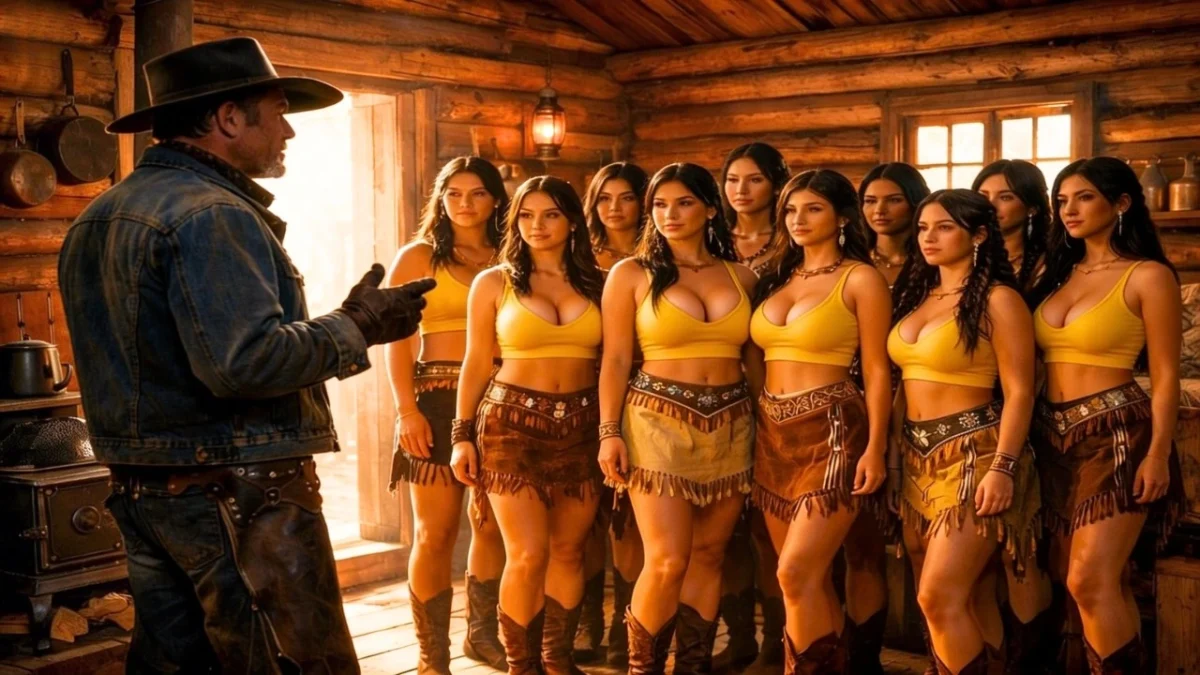
Trapped In a Blizzard With Apache Girls, the Cowboy Heard a Whisper That Changed Everything
My name is Cole Ashford. Today I will die or I will kill the 10 women I am trying to protect.
To understand why, you need to know. The story began 3 days ago when I found the first bodies.
The Arizona desert in spring of 1876 was a furnace that showed no mercy to the weak or the foolish.
I had learned that lesson young, back when I still believed the world had room for heroes.
That belief died the same day I watched innocent people burn because I had led their killers to them.
But that story comes later. First, you need to understand what brought me to that cabin, to those 10 Apache women, to the moment everything changed.
3 days before the storm, I was tracking a gang of outlaws who had robbed a merchant convoy near the Mexican border.
The merchants hired me because I used to be good at finding people who did not want to be found.
I was a Pinkerton detective once before I became nothing but a man on a horse with too many ghosts riding behind him.
The trail led me deep into disputed territory where the maps ended and only the Apache knew the way.
I followed wagon tracks through red sand and broken rock, through canyons that looked like the earth had been split open by God’s own axe.
My horse Judah was steady beneath me, a dappled gray stallion with more sense than his rider.
He had carried me through worse places than this. On the third day, Judah stopped without warning.
His ears went flat against his head. He smelled something I could not yet see.
I dismounted slowly, drawing my rifle from its scabbard. The wind carried a scent that made my stomach turn.
Death. Not fresh, but not old enough to be bones yet. I tied Judah to a Joshua tree and walked forward on foot.
Following that terrible smell, I found them in a shallow ravine where someone had tried to bury them but given up halfway through.
Three Apache men, their bodies partially covered with sand and rocks. They had been de@d maybe 2 weeks, maybe a little more.
The desert sun had done its work, but I could still see enough to know this was wrong.
I knelt beside the first body, covering my nose with my bandana. The man had been young, maybe 25.
His fingers were curled into claws. His lips were pulled back from his teeth in a grimace of agony.
But it was his fingernails that told me the real story. They were black, not from dirt or decay, but from something else.
Something I had seen before in my Pinkerton days when we investigated a case of a businessman who poisoned his partner for insurance money, arsenic.
These men had not died from disease or violence. They had been murdered with poison.
Someone had fed them death slowly, watching them suffer. I checked the other two bodies.
Same signs, same black nails, same rus of pain frozen on their faces. Whoever did this had not wanted a quick death.
They had wanted these men to suffer. I stood up looking around the ravine. No other tracks except mine.
The outlaws I was tracking had not come this way. This was something else entirely.
Something that made the hair on the back of my neck stand up. That was when I heard it.
A sound like the world ending. A roar that started as a whisper and built to a scream that drowned out every other noise.
I looked to the western horizon and felt my heart drop. The sandstorm was a wall that stretched from earth to sky, a churning mass of ochre and brown that swallowed everything in its path.
I had seen bad storms before, had survived more than one by finding shelter and waiting them out.
But this one was different. This one looked like the devil himself had decided to scour the desert clean of everything that lived.
I ran back to Judah. The horse was already panicking, pulling at his res, his eyes rolling white.
I untied him and swung into the saddle in one motion. We need shelter. We need it now.
I gave Judah his head and let him run. Horses have instincts that humans have forgotten.
Senses that can smell water from miles away and feel danger before it arrives. I trusted Judah more than I trusted myself.
The storm chased us like a living thing. The wind hit first, a blast that nearly knocked me from the saddle.
Sand began to pelt my back. Thousands of tiny needles that cut through my shirt and found skin.
I pulled my hat down low and wrapped my bandana over my face, squinting into the brown haze that was rapidly becoming all I could see.
Judah ran as if hell itself was behind us, his hooves pounding the hard pan desert floor.
I did not try to steer him, just held on and let him choose the path.
My eyes were nearly shut against the sand, tears streaming down my face from the cutting wind.
Then through the brown merc I saw it, a structure, a cabin made of adobe and weathered wood, sitting in a small hollow between two rocky outcroppings.
It looked abandoned, windows dark and empty, but it was shelter, and shelter was the only thing that mattered.
I pushed Judah toward it. The storm was so loud now, I could not hear his hooves anymore.
Could not hear anything but that terrible roaring. We were maybe 50 yards from the cabin when I heard something else.
Something that cut through even the storm’s fury. Gunfire, a rifle shot, then another coming from inside the cabin.
Judah reared, nearly throwing me. I fought to control him. My mind racing. Someone was in that cabin.
Someone with a gun. And they were shooting at something or someone. I had no time to think, no time to plan.
The storm was seconds away from burying us both. I spurred Judah forward straight toward the cabin.
The door was closed. I could see shadows moving behind the dirty windows. Another gunshot, the flash visible even through the storm’s darkness.
Someone screamed. A woman’s voice. I did not knock. I did not call out. I threw my weight against the door and it burst inward.
Rotten wood giving way with a crack. I stumbled inside, Judah crowding in behind me, and found myself staring down the barrels of 10 rifles.
10 Apache women stood in a semicircle around the door, every one of them pointing a weapon directly at my chest.
They were young, most of them, ranging from maybe 20 to 30 years old. They wore traditional leather dresses decorated with beads and shells, their long black hair hanging loose or braided.
Their faces were hard with fear and anger, eyes burning with a hatred that hit me like a physical blow.
In the center stood their leader. I knew she was the leader because the others looked to her.
Because she held her rifle steady while some of theirs shook, because her eyes held no fear at all, only a cold calculation that said she was deciding whether to kill me now or in 30 seconds.
She was maybe 29, with high cheekbones and a scar that ran from her left eyebrow to her temple.
Her leather dress was stained with dirt and something darker that might have been blood.
She looked like she had not slept in days, had not eaten in longer, but her hands on the rifle were rock steady.
“Who are you?” She said in perfect English. “Why have you followed us?” The storm hammered the cabin walls, sand finding every crack and gap pouring in like water.
“Judah winnied behind me, his massive body blocking the doorway. I was not following you,” I said, keeping my hands visible, keeping my voice calm.
I was running from the storm. I did not know anyone was here. Liars always say that.
She took a step forward, the rifle barrel now inches from my chest. The last white man who said that poisoned our water and killed our men.
Give me one reason I should not shoot you where you stand. Behind her, one of the younger women said something in Apache, her voice high and frightened.
The leader shook her head without taking her eyes off me. My horse will die if you leave him in that storm, I said, and I will die with him.
If you want to kill me, do it after the storm passes. At least then you will be able to bury the body properly.
It was not much of an argument, but it was all I had. The woman studied me for a long moment.
The storm screamed outside, the cabin walls groaning under the assault. Sand was already piling up against the far wall, pouring through gaps in the roof.
If they kept me in the doorway much longer, we would all be buried alive.
Then she lowered her rifle. 1 in two. Close the door, she said. Put your weapons on the floor.
All of them. If you reach for a gun, you die. Do you understand me?
I understood. I turned slowly, moving Judah inside and wrestling the broken door closed behind him.
The storm fought me every inch, the wind trying to rip the door from my hands.
One of the women came forward to help me, a young girl with frightened eyes.
Together, we forced the door shut and barred it with a heavy beam. The sudden quiet was shocking.
The storm still raged outside, but the cabin walls muffled it to a dull roar.
I could hear people breathing now, could hear my own heart pounding. I faced the women again.
10 pairs of eyes watched me, unblinking. 10 rifles still pointed in my direction, though some were lowering now.
“Your weapons,” the leader said again. I unbuckled my gun belt slowly, showing them every movement.
The Colt revolver in its holster, the knife on my left hip, the smaller boot knife in my right boot.
I laid them all on the dirt floor, then stepped back with my hands raised.
The rifle in my saddle scabbard, I said, and a Winchester behind the saddle. That is everything.
One of the women moved to Judah and took the rifles, checking them with practiced hands.
She nodded to the leader. Sit, the leader said, pointing to a corner of the cabin.
In the corner where we can see you. Do not move. Do not speak unless I ask you a question.
If you do anything I do not like, I will shoot you myself. I sat.
The floor was hardpacked dirt, cold despite the heat outside. I could feel sand grinding under me, getting into my clothes and boots.
Judah stood nearby, his head hanging low, exhausted from the run. The cabin was small, maybe 20 ft on a side.
It had been abandoned for some time, the furniture broken or missing, spiderw webs thick in the corners.
But someone had been living here recently. Bed rolls lined one wall. A small fire pit sat in the center, cold now.
Supplies were stacked near the back, bags of cornmeal and dried meat, a few precious water barrels.
And in the far corner, wrapped in blankets, I saw a young woman lying motionless.
Even from across the cabin, I could see she was sick. Her skin was pale, her breathing shallow and rapid.
She was maybe 20, maybe younger, pretty once, but fever had hollowed her cheeks and dulled her eyes.
The leader followed my gaze. Her name is Kimmy Mela, she said. She has been sick for 3 days.
If you have medicine, I will trade you water and food for it. I do not have medicine, I said.
I am sorry. Then you have nothing we need. The leader turned away, dismissing me.
She spoke to the other women in Apache. Quick, sharp words that I did not understand.
They began to move around the cabin, checking the walls and roof, looking for leaks where the storm might get in.
I watched them work, watched how they moved together with the ease of long familiarity, how they communicated with glances and small gestures, sisters maybe, or something like it.
My eyes kept going back to the sick girl in the corner, Kimla. Even from here, I could see she was getting worse.
Her breathing was too fast, too shallow. She needed clean water and rest and probably medicine I did not have.
Without thinking, I stood up. 10 rifles swung toward me instantly. Sit down, the leader barked.
Your friend is cold, I said, not moving. She is shaking. I have a blanket in my saddle bags.
She needs it more than I do. The leader stared at me. Behind her, the other women whispered to each other in Apache.
One of them, a woman with a round, kind face, said something urgent to the leader.
“Why would you give us your blanket?” The leader asked. “Because she is dying,” I said.
“And I have seen enough people die.” The silence stretched. Outside, the storm raged. Inside, 10 women watched me to see if I was telling the truth or laying a trap.
Slowly, the leader nodded. Get the blanket,” she said. “But if you reach for a weapon, you will not have time to regret it.”
I moved carefully to Judah, opened the saddle bag, and pulled out my wool blanket.
It was thick and warm, the only thing I owned that was worth anything. I had carried it for 5 years since the day I left the Pinkertons, since the day I decided I could not be part of that life anymore.
I walked across the cabin and held the blanket out to the leader. She took it, studying my face.
Then she turned and brought the blanket to Kimla, wrapping it around the shivering girl with gentle hands that did not match the hardness in her eyes.
“Thank you,” the kind-faced woman said to me in English. “You did not have to do that.”
“Yes, I did,” I said. The leader stood and walked back to me. She was not tall, maybe 5’4″, but she carried herself like someone used to being obeyed.
My name is Hokki, she said. These are my sisters, not by blood, but by choice.
Two weeks ago, we were 20 people, 10 men, 10 women. We were traveling north to join another band near Montana.
We stopped here to rest and refill our water. Within 5 days, all our men were de@d.
I felt something cold settle in my stomach. Disease? I asked. Hokki’s eyes were black and hard as obsidian.
That is what we thought at first. Fever, stomach pains, stomach. They died one by one and we could do nothing to stop it.
We buried them on the hill behind this cabin, said prayers over their graves, and prepared to continue our journey.
But then, Shappa found something. She gestured to one of the women, tall and lean with watchful eyes.
Shoppa came forward and held out her hand. In her palm lay a small cloth bag stained and torn.
“We found this at the bottom of the well,” Hokki said. “In the bag was white powder.”
Ayasha, who knows medicine, tasted a tiny amount. She said it was arsenic, poison. Someone put it in our water deliberately.
Someone wanted our men to die slowly and in pain. I thought about the three bodies I had found in the ravine, the black fingernails, the twisted faces.
I looked at Hokki and saw in her eyes that she knew what I was thinking.
“You found bodies,” she said. It was not a question. “Three men,” I said, “About 2 weeks de@d, in a ravine maybe 5 miles west of here.
They had been poisoned too. Same signs.” Hokki nodded slowly. Three of our men went hunting the day before the sickness started.
They never came back. We were too weak to search for them. “Now I know why.”
“Who would do this?” I asked. “Who would poison 13 men?” Hoki was quiet for a long moment.
When she spoke again, her voice was soft, but filled with a rage that made my skin crawl.
“There are many people who want Apache de@d,” she said. Many who would kill us for the color of our skin, for the land we walk on, for revenge over things that happened years ago.
The question is not who would do this. The question is which one of them actually did.
Outside the storm reached its peak. The cabin shook, dust and sand pouring through every crack.
One of the windows shutters tore loose with a bang that made everyone jump. Two women rushed to secure it, fighting against the wind that tried to rip it away.
I studied the 10 faces watching me. 10 women alone in the desert with no men to protect them, no family to turn to.
They had every reason to hate white men, every reason to shoot me and leave my body for the buzzards.
But they had not. Hoki had chosen to let me live. “Why did you not kill me?”
I asked her. Hokki looked at me with those hard black eyes. “I am still deciding if I made the right choice,” she said.
The storm raged through the night. I sat in my corner, watching the women move around the cabin, listening to them speak in their language.
They ignored me mostly, treating me like a piece of furniture, or a potentially dangerous animal they had chosen not to kill yet.
Hokki assigned watches, two women at a time, one near the door and one near me.
The shifts changed every few hours. I noticed they were careful never to leave me unguarded, never to turn their backs on me for long.
I did not sleep, partly because I knew they would not trust me if I did, and partly because my mind would not stop turning over what Hokki had told me.
Someone had poisoned 13 Apache men. Someone had done it deliberately, carefully, making sure they would die slow and painful deaths.
That kind of hate did not come from nowhere. It came from something personal, something that burned hot enough to plan murder and carry it through.
Around midnight, the kind-faced woman who had thanked me earlier brought me water and a piece of dried meat.
She set them down just within my reach, then stepped back quickly. “My name is Namid,” she said quietly.
You should eat. You will need your strength. Thank you, I said, taking the food.
I noticed her hands were shaking slightly. May I ask you something? She hesitated, glancing toward where Hok sat across the cabin.
You can ask, she said. I may not answer. The men who died, were they all warriors, fighters?
Namud shook her head. Some were. My husband Casa was a hunter, not a warrior.
He never raised his hand in anger except to protect me once from a drunk white man in town.
Chanoa’s husband made pottery, beautiful things decorated with symbols of birds and rain. Aayasha’s husband was a storyteller who could make children laugh until they cried.
She stopped, wiping her eyes quickly. They were just men, she said. She good men trying to live in a world that did not want us to exist.
And someone killed them for it. I am sorry, I said. And I meant it.
Namid looked at me for a long moment. Hoki thinks you are a soldier, she said.
She thinks you fought against our people. Is that true? I was quiet. Outside the storm howled.
Inside, I could feel the weight of that question pressing down on me. I was a detective, I said finally.
Pinkerton Agency. We took all kinds of jobs. Sometimes those jobs involved tracking people. Sometimes those people were Apache.
Did you kill any of our people? Namid asked. The question was simple, direct, without accusation.
No, I said, but I helped others find them. And some of those others did kill.
I carry that weight every day. Nammed nodded slowly. At least you are honest, she said.
That is more than most white men would give us. She started to turn away, then stopped.
“The blanket you gave to Kimmela,” she said. “That was kind.” “We have not seen much kindness from white men.
I gave it because she needed it,” I said. “Not because I am kind.” Nammed’s expression softened.
“Those are the same thing,” she murmured. “I ate the dried meat slowly, making it last.
It was venison seasoned with herbs I did not recognize. Good food generously given. I drank the water carefully, knowing it was precious.
Across the cabin, Hokki sat with her rifle across her knees, watching me. She had not moved from that spot since the storm began.
I wondered if she had slept at all in the past 2 weeks, or if grief and anger had burned sleep out of her.
Dawn came slowly, the howling wind gradually fading to a low moan. By midm morning, the storm had passed, leaving behind an eerie stillness.
Dust hung in the air inside the cabin, making everything hazy and dreamlike. Hoki stood and stretched, her joints popping audibly.
She spoke to the other women in Apache, and they began to move with purpose, checking supplies, tending to Kimmya, preparing for whatever came next.
“You,” Hokki said, looking at me. Cole Ashford, “That is your name?” Yes. Yes. You can leave now.
The storm is over. Take your horse and go. I stood up slowly, joint stiff from sitting all night on the cold floor.
The well, I said. The one that was poisoned. Did you clean it out? Hokki’s eyes narrowed.
We tried. But it is deep and filled with sand from the storm. We do not have the tools or the strength to clear it properly.
You have water barrels, I said. How much water is left? 3 days, maybe four if we ration.
Then we will have to leave or die of thirst. Then I should clean the well before I go.
Why would you do that? Because you need water. And because I saw what that poison did to the men who drank it.
No one should die that way. Hokki stared at me for a long moment. I could see her weighing the offer, looking for the trap, trying to decide if I was genuine or playing some game she could not see yet.
One of the other women spoke up, the tall, lean one Hokki had called Shappa.
She said something in Apache, her tone urgent. Another woman joined in, then another. A debate broke out, voices rising.
Finally, Hokki held up her hand for silence. She looked at me. “If you try anything,” she said.
“If you make one move that looks like a threat, I will put a bullet through your head.
Do you understand?” “I understand.” “Then you may clean the well. Shoppa will watch you.
If she comes back inside and says you did anything suspicious, you will not live long enough to explain yourself.
That is fair. Hokki studied me a moment longer, then nodded. The tools are in the shed behind the cabin, she said.
Work fast. I do not trust you, Cole Ashford, but I trust thirst even less.
I walked outside into the transformed world. The storm had reshaped everything, piling sand into new dunes, uncovering rocks that had been buried for years.
The sky was heartbreakingly blue, empty of clouds, empty of anything but that merciless sun already climbing toward its zenith.
The well was behind the cabin, exactly where said it would be. It was old, built of stacked stone that had been mortared together generations ago.
The wooden frame above it was weathered but solid, and it was indeed half filled with sand.
Shappa followed me silently, her rifle held loosely, but ready. She said nothing, just watched as I found a bucket and shovel in the shed, and began the work of clearing the well.
It was brutal labor under the climbing sun. The sand was heavy and wet, near the bottom, where water still pulled.
Each bucket I hauled up weighed 40 lb or more. My shoulders began to ache after the first dozen buckets.
After two dozen, they were screaming. After four dozen, I lost count. Just focused on the rhythm of fill, lift, dump, repeat.
Shappa watched without expression. Once I stopped to catch my breath and looked at her.
Did you love him? I asked. Your husband. Her face hardened. Every day of my life, she said, and I will hate whoever killed him every day until I die.
I nodded and went back to work. The sun climbed higher. Sweat soaked through my shirt, mixing with the sand that coated everything.
My hands started to blister. Then the blisters broke and bled. I kept working. Around noon, Namid brought me water and more dried meat.
Shapa took it from her and handed it to me, making sure I was never close enough to grab her.
“Thank you,” I said to Namid. She smiled sadly and went back inside. I was pulling up the last bucket of sand when I saw it.
Something that was not sand, not stone, something that glinted dully in the sunlight as I dumped the bucket.
A small cloth bag identical to the one Shappa had shown me the night before, but this one was empty, or nearly so, just a residue of white powder in the bottom.
I held it up for Shappa to see. Her expression did not change, but I saw her grip tighten on her rifle.
Show haloki, she said. We went inside. The cabin was cooler than outside, shaded and still.
The women had been busy while I worked, reorganizing supplies, tending to Kimla. The sick girl was awake now, sitting up slightly, the blanket still wrapped around her shoulders.
She looked at me with fever bright eyes. Hokki took the bag from me and examined it carefully.
Her face revealed nothing, but I saw her jaw clench. This is the same, she said quietly.
The same kind of bag. Someone put at least two of these in our well, maybe more, which means, I said, whoever did it had to get close.
Had to know where you were and wait until you were not watching. This was not random.
This was planned. Hoki looked up at me. You think like a detective, she said.
Is that what you still are? I shrugged. I think like someone who has seen a lot of bad things done by bad people.
The patterns are usually the same. And what pattern do you see here? Someone wanted your men de@d specifically.
Not all of you, just the men. If they wanted everyone de@d, they would have poisoned all the water, but they only poisoned the well.
Which means they knew or guessed that the men would drink from the well, and the women would not.
Several of the women had gathered around now listening. One of them, a young woman with fierce eyes, said something sharp in Apache.
Muna wants to know, Hoki translated. If you are working with whoever did this, she thinks you might be here to finish the job.
If I wanted you de@d, I said calmly, I would not have cleaned your well and shown you evidence.
I would have waited for you to die of thirst or rode away and left you to your fate.
The fierceeyed woman, Muna, said something else louder this time. She says white men lie.
Hoki said. She says trusting you will get us all killed. She might be right.
I said about white men lying about me getting you killed. I cannot promise I am any different.
All I can tell you is I helped because it was the right thing to do.
Whether you believe that or not is your choice. Hokki looked at me for a long moment.
Then she looked at the other women one by one. An entire conversation seemed to happen in those glances.
A weighing of options and risks that I was not part of. Finally, Hokki nodded.
You can stay until tomorrow, she said. Rest your horse. Rest yourself. In the morning, you leave and we never see you again.
That is the deal. That is fair. I said,” she added, her voice dropping lower.
If I find out you had anything to do with killing our men, I will skin you alive and leave you for the buzzards.
Do we understand each other? We do. Good. Sit, eat, then sleep if you can.
Shappa will watch you. I sat back down in my corner. Namid brought me more food.
This time a bowl of stew made from dried meat and wild onions. It was good, better than I had eaten in weeks.
I ate slowly, savoring every bite. Across the cabin, Kimmy Mela was watching me. Her fever had broken somewhat.
I could see color returning to her cheeks. When she caught me looking, she smiled shily, then looked away.
I finished eating and leaned back against the wall, closing my eyes. Sleep pulled at me, heavy and irresistible after the long night and the brutal work in the sun.
But I could not let myself sleep deeply. Not yet. These women had every reason to kill me in my sleep.
Trust only went so far. So I dozed lightly, aware of every sound, every movement in the cabin, aware of Shappa sitting nearby with her rifle across her knees, never taking her eyes off me.
I was half asleep when I felt it, a prickling at the back of my neck, an old instinct from my Pinkerton days that said someone was watching me with more than casual interest.
I opened my eyes just to crack, not moving. In the far corner of the cabin, mostly hidden behind the others, a young woman sat perfectly still.
She was maybe 22, with delicate features and long hair that fell past her shoulders.
I had barely noticed her before. She was so quiet, so still. But now she was staring at me with an intensity that made my skin crawl.
And in her hands she was doing something with a piece of charcoal in a flat piece of wood, drawing something.
I watched through slitted eyes as she drew. Quick, sure strokes the work of someone who had drawn many times before.
She was not looking at the wood as she drew. She was looking at me, at my face, at my arms, at the scar on my right forearm.
Visible where my sleeve had pulled back while I worked. The scar was old, a puckered line of white tissue running from my wrist to my elbow.
I had gotten it 5 years ago in a fight with a man who came at me with a broken bottle.
Or that was the story I told anyone who asked. The truth was more complicated.
The truth was something I tried very hard not to think about. The young woman finished her drawing and set it aside.
Then she did something that made my blood run cold. She opened her mouth as if to speak, pointing at me, pointing at the drawing, but no sound came out.
She tried again, her face contorting with effort. Still nothing. She was mute. Could not speak, could not call out, but she had seen something that frightened her, something about me that she recognized, and I had a terrible feeling.
I knew what it was. Hokki noticed the commotion and walked over to the mute girl.
She looked at the drawing, then at me. Her expression did not change, but I saw her hand move closer to the knife on her belt.
Ayana wants to know, Hokki said quietly. Where you got that scar? A fight? I said 5 years ago.
A drunk with a broken bottle. Hokki studied me. Ayana does not believe you, she said.
She thinks she has seen that scar before. She thinks she saw it on a man in a blue cavalry uniform.
The day soldiers came to her village and burned it to the ground. The cabin went silent.
Every eye turned to me. I could feel the weight of their stares. The sudden tension that made the air feel thick and hard to breathe.
I looked at Ayana at her young face twisted with old pain. At her eyes that said she knew what I was, what I had been.
And I knew with absolute certainty that everything was about to fall apart. I never wore a cavalry uniform, I said carefully.
But I did work with the cavalry sometimes. The Pinkertons contracted with the army. I was there when they raided villages.
Yes, I helped them find those villages. The temperature in the cabin dropped 20°. Hands moved to weapons.
Muna said something vicious in Apache. Hokki held up her hand for silence, but her eyes never left my face.
“Which villages?” She asked softly. “I do not remember all of them,” I said. It was 5 years ago.
“There were several.” “Try,” Hokki said. Her voice was ice. “Try very hard.” “There was one near the Little Creek River,” I said.
“In the spring of 1871, the cavalry said it was harboring warriors who had attacked a merchant convoy.
They said the warriors had killed 12 people, including women and children. And did the village harbor warriors?
Hokki asked. I thought so at the time. Later I found out the warriors had left 3 days before.
The cavalry killed 37 people anyway. Mostly women and children because their orders were to send a message.
Hokki’s face had gone still as stone. When she spoke again, her voice shook. That village was my home, she said.
My husband led the warriors who attacked that convoy. He killed those people to avenge the Apache children who died when white settlers poisoned our water holes.
He thought he was at war. He thought he was protecting his people. She took a step toward me.
You led soldiers to my village. You are the reason my father died, my mother, my two younger brothers.
You are the reason I spent 5 years hating myself for not being there to die with them.
I had no words. There were no words that could make this right. I did not know, I said finally.
I did not know they would kill everyone. I thought we were tracking dangerous men.
I was lied to. I was used. Does that make it better? Hoki asked. Does that bring back my family?
No. Then what good is your regret? What good is your guilt? She raised her rifle, pointing it at my chest.
Her finger moved to the trigger. I should kill you right now, she said. I should make you feel what my family felt.
Yes, I said. You should. And I meant it. Every word. We stood there frozen in that moment.
Hoki with her rifle pointed at my heart. Me with my hands at my sides, making no move to defend myself.
The other women watching, waiting to see if their leader would pull the trigger. Then Kimmy spoke.
The sick girl still wrapped in my blanket said something in Apache. Her voice was weak but clear.
Hoki did not lower the rifle, but she glanced toward the girl. Kimmy Mela says, Hokki translated that you gave her your blanket when you knew we might kill you.
She says you cleaned our well when you could have ridden away. She says if you wanted us de@d, you have had many chances.
She asked if maybe you are trying to make up for the past by helping us now.
I am, I said. Every day I wake up and try to be less of a coward than I was then.
Most days I fail, but I keep trying. Hokki’s hands trembled on the rifle. For a long moment, I thought she would shoot me anyway, and I would not have blamed her.
Then slowly, one inch at a time, she lowered the gun. “I do not forgive you,” she said.
“I will never forgive you.” But Kimmy is right. We need water more than we need revenge.
You live for now, but if I find out you are lying about anything, if I discover you had any part in poisoning our men, I will kill you slowly.
Do you understand? I understand. Hoki turned away, her shoulders rigid. Everyone, back to your work, she said to the other women.
We have a long journey ahead and much to prepare. The women dispersed slowly, but I could feel their eyes on me, heavy with new knowledge and old hatred.
I sat back down in my corner. My hands were shaking now, reaction finally setting in.
I had been so close to death. I could taste it, but I was still alive.
And these 10 women, who had every reason to kill me, had chosen not to.
It was more than I deserved. Night fell again, and with it came a new sound, distant at first, then closer.
The sound of hoof beatats. Multiple horses moving fast. Shappa, who was on watch near the window, hissed a warning.
Everyone froze. Hokki moved to the window, peering out through a crack in the shutter.
I saw her face go pale. “Riders,” she said. “Four of them coming straight toward us.”
“Who are they?” Namid asked. Hokki was silent for a moment. Then she said three words that made my blood run cold.
They found us. The four riders stopped about 200 yards from the cabin, just visible in the fading light.
They sat on their horses without moving, watching, waiting. Hoki moved away from the window and began speaking in rapid Apache to the other women.
They scattered to positions around the cabin, some taking up rifles, others grabbing knives and makeshift weapons.
The transformation from cautious survivors to prepared fighters took less than 30 seconds. I stood up slowly, keeping my hands visible.
My weapons, I said to Hokki, “If those men are hostile, you will need every gun you can get.”
She looked at me, calculating. Then she gestured to Shappa who retrieved my gun belt from where it had been stored.
She tossed it to me along with one of my rifles. “If you shoot any of us,” Hokki said, “you will die before you can chamber another round.”
“Understood.” I buckled on the gun belt, feeling the familiar weight of the colt against my hip.
It did not make me feel safer. Nothing could make me feel safe when four armed men were watching a cabin full of women in the middle of nowhere.
The writers still had not moved. The sun was setting behind them, making them into silhouettes, impossible to identify.
What are they waiting for? Muna asked. They are deciding if there are enough of us to be worth the risk, I said.
Or they are waiting for full dark to attack. How do you know? Hoki asked.
Because it is what I would do. She studied me for a moment, then turned back to the window.
“We wait,” she said. “No one shoots unless they come closer or unless I give the order.”
Minutes crawled by. The sun sank lower, painting the desert in shades of red and gold.
Beautiful colors for an ugly situation. Still, the writers did not move. Then, one of them did something that made my stomach drop.
He raised a rifle, aimed carefully, and fired. The bullet struck the doorframe, sending splinters flying.
Everyone ducked. A second shot followed. This one through the window shutter, punching a clean hole and slamming into the back wall.
But then silence. No more shots. No charge. Just those four riders sitting there watching.
They are pinning us down. I said they want us to know we cannot leave.
They will wait out there until we run out of water or food or courage or until we kill them first.
Hoya said she was the fierce one, the one Hokki had to keep controlled. Give me a rifle in 5 minutes.
I will show them what Apache women can do. You will die in the first 10 seconds, I said bluntly.
Whoever that shooter is, he hit exactly what he aimed at. Both shots. That is not luck.
That is skill. Then what do we do? Namid asked. Her hand moved unconsciously to her belly.
And I remembered Hoki mentioning she was pregnant. “Just wait here and let them starve us out.
We need to know what they want,” I said. “And we need to know who they are.”
“I know who they are,” Hokki said quietly. Everyone turned to look at her. She was still at the window, staring out at the distant riders.
“One of them is Victor Hargrave.” “Who is Victor Hargrave?” I asked. The son of the man whose wife and daughter my husband killed.
Hokki said her voice was flat, emotionless. Five years ago, my husband Kuruk and his warriors attacked a convoy carrying gold.
They killed 12 people. Among them were the wife and young daughter of Benjamin Hargrave, who was a territorial governor at the time.
She turned to face us. Hargrave spent 5 years hunting down everyone involved in that attack.
He found Kuruk two years ago and killed him. He found three of the other warriors and killed them too.
Now he has found me, or rather his son has. Victor would have been 16 when his mother and sister died.
Now he is 21 and has spent the last year tracking me. Why did your husband attack the convoy?
I asked. Hokki’s eyes flashed. Because one week before that attack, Governor Hargrave ordered his cavalry to clear Apache families from land that had gold deposits.
30 women and children died when they burned the village. Kuruk was at war. He thought he was defending his people.
He did not know he was killing innocents. And when he found out, it destroyed him.
He died full of guilt and hate and regret. Just like you, Cole Ashford. The words hit like a physical blow.
Before I could respond, another shot rang out. This one hit the water barrel near the door, punching a hole that began leaking precious water onto the floor.
Namid rushed forward with rags to plug it, but the damage was done. “We had just lost maybe a gallon.
They are going to pick us apart,” Shappa said, one shot at a time, destroying our supplies, our shelter, making us desperate enough to do something stupid.
Can we sneak out the back? Aasha asked. Wait until full dark and run for it.
They will have someone watching the back, I said. Four riders means they can cover all approaches.
The moment anyone steps outside, they will be shot. So, we are trapped. Muna said.
She was trying to sound angry, but I could hear the fear underneath. Hoki was silent, staring at the floor.
I could see her mind working, turning over options, discarding them one by one. She was a good leader.
I realized she did not make rash decisions even when fear demanded action. I moved to the window and looked out carefully, keeping most of my body behind the wall.
The writers were still there, black shapes against the darkening sky. As I watched, one of them dismounted and began walking a slow circle around the cabin, staying well out of rifle range.
He was scouting, looking for weaknesses. That one knows what he is doing. I said he has military training or something close to it.
Victor was in the territorial militia for 2 years. Hokki said his father made sure he learned to fight, made sure he learned to hate.
The circling writer stopped. Even at this distance, I could see he was young, lean, moving with the confidence of someone who believed he was on the right side.
He raised his rifle again. Everyone down! I shouted. The shot came through the damaged shutter, this time hitting one of our supply bags.
Flour exploded in a white cloud. Before anyone could react, a second shot hit another bag.
Cornmeal this time. “He is destroying our food,” Namid said, her voice breaking. “He is going to kill us slowly.”
Let out a scream of rage and ran for the door. She had a rifle in her hands and murder in her eyes.
Shappa and I both dove for her, grabbing her before she could get the door open.
Let me go, Waya snarled, fighting us. Let me kill him. He will shoot you the moment you step outside, I said, holding her arms.
He is baiting you. That is what he wants. I do not care, said. But her struggles were weakening.
I do not care anymore. We care, Hokki said firmly. She crossed the cabin and put her hand on’s shoulder.
We survive together or we die together, but we do not give them easy targets.
Do you understand me? Sagged, the fight draining out of her. She nodded slowly. I released her and stepped back.
My heart was pounding, adrenaline singing in my veins. This was exactly what the men outside wanted to make us panicked, desperate, willing to make fatal mistakes.
We need a plan, I said. We cannot just sit here. You are welcome to suggestions,” Hokki said.
Her voice was sharp with stress. I thought about it, looking around the cabin. 10 women, most with no real combat training, one man with rusty skills and a guilty conscience, against four men who had been planning this for months, who had the advantage of position and firepower.
“The well,” I said suddenly. “How deep is it?” “Maybe 30 ft,” Shapa said. “Why?”
Because we need water and they know it. They will be watching the well, waiting for someone to try to get water.
But if we can get to it without being seen, we can refill our barrels before they realize what we are doing.
The well is 20 yard behind the cabin. Hokki said, “We would be exposed for at least 30 seconds.
That shooter would kill anyone who tried. Not if he cannot see them.” I said, “Wait for full dark.
No moon tonight, and the storm stirred up enough dust that visibility will be almost zero.
Send someone small and fast, someone who can move quietly. All eyes turned to Ayana, the mute girl.
She was the smallest of them, barely over 5t tall, and I had seen how quietly she moved around the cabin.
Ayana nodded before anyone could ask. She understood what was needed. She will need cover, I said.
When she goes out, I will fire from the window. Make them think we are trying something from the front.
It might buy her a few extra seconds. Or it might get her killed, Muna said.
Everything might get us killed, shot back. At least this way we are doing something.
Hokki looked at Ayana, then at me, then back at Ayana. Are you sure? She asked the girl.
Ayana nodded again more firmly this time. Then we do it, Hokki said. We wait until full dark.
Cole fires from the front window. Ayana goes out the back with two empty water skins.
She fills them as fast as she can and comes back. Everyone else stands ready in case this goes wrong.
It will go wrong, I said. Plans always do, but maybe we can make it go wrong in a way that helps us.
Full dark came an hour later. The desert night wrapped around us like a black blanket.
Stars emerging one by one in the vast sky above. I could barely see the riders anymore, just occasional movements that told me they were still out there, still watching.
I positioned myself at the front window with my rifle. Hoki crouched beside me with hers.
The other women spread out around the cabin, ready to react to whatever happened. Ayana stood at the back door, two empty water skins slung over her shoulders.
Her face was calm, but I saw her hands shaking slightly. She was terrified, but she was going anyway.
That took a kind of courage I had rarely seen. On my signal, Hokki whispered to her in Apache.
Ayana nodded. I took a deep breath, cited on where I thought the writers might be, and fired three quick shots.
The muzzle flash lit up the cabin for an instant, then plunged us back into darkness.
I moved immediately, knowing the flash had given away my position. Return fire came instantly.
Three bullets smashed through the window so close I felt the wind of their passage.
Splinters exploded from the frame. Someone behind me gasped in pain. “Keep firing!” Hoki shouted.
We both opened up, shooting at muzzle flashes, not really trying to hit anything, just making noise and light to distract the men outside.
Behind us, the back door opened silently. Ayanna slipped out into the darkness and was gone.
I stopped firing and dropped below the window. My ears were ringing from the gunfire in the enclosed space.
The smell of gunpowder was thick and acurid. “Is everyone all right?” Hoki called out.
Hayasha took a splinter in her arm. Namid reported. But it is not deep. She will be fine.
How long do we give her? Shapa asked. 5 minutes. Hokki said. If she is not back in 5 minutes, we assume the worst.
Those were the longest 5 minutes of my life. We sat in the darkness listening to our own breathing, to the small sounds of the desert at night, to the terrifying silence from outside.
No gunfire, no shouts, nothing. Either Ayana had made it to the well undetected or she was lying de@d in the sand.
4 minutes. I started counting seconds in my head to keep from imagining all the ways this could go wrong.
4 and 1/2 minutes. My hands were sweating on the rifle stock. 5 minutes. Hoki opened her mouth to speak.
The back door opened. Ayana stumbled in. Both water skins full and heavy. Her chest heaving from exertion.
She had made it. Relief flooded through me so strongly I almost laughed. Almost. Secure the door, Aoki ordered.
Everyone back to positions. The women moved quickly, barring the door, distributing the water carefully into barrels and cantens.
Ayana sat on the floor, shaking with delayed fear and exhaustion. Kimmela crawled over to her and held her, whispering words I could not hear.
“We did it,” Ned said, wonder in her voice. “We actually did it. We bought ourselves time,” I corrected.
“Three, maybe four more days, depending on how we ration.” “But those men out there are not going away.
Eventually, we will have to deal with them. Or they will deal with us,” Waya said darkly.
She was right, but I did not say so. The night dragged on. The men outside took turns shooting at random intervals, never letting us relax, never letting us sleep properly.
Each shot made everyone jump, made hands reach for weapons, made hearts race. It was psychological warfare, and it was working.
Around midnight, Hokki called me over to where she sat near Kimla. The sick girl was awake, looking better than she had that morning.
The fever had broken completely. Now tell me about the man who hired you. Hokki said quietly.
The Pinkerton job 5 years ago. Who wanted the Apache villages found? Governor Benjamin Hargrave.
I said he came to our office in Santa Fe with maps and rumors. Said there were warriors raiding settlements killing innocent people.
Said the army needed help tracking them down. It was a standard contract. We had done dozens like it.
But this one was different. I did not know that at the time. I thought I was helping stop killers.
I thought I was one of the good guys. Hoki was silent for a moment.
What changed your mind? She asked. I saw the village after the cavalry was done with it.
I saw children who had been shot. Elders who had been bayonetted, women who had been violated before they were killed.
I saw that it was not a military action. It was a massacre. And I had led them there.
She studied my face in the darkness. What did you do then? I quit the Pinkertons that day, walked away and never went back.
Spent the last 5 years drifting from town to town, taking whatever work I could find, trying to figure out how to live with what I had done.
I never found an answer, but I kept looking. Kimmy reached out and touched my hand.
Her fingers were warm and soft. She said something in Apache, her voice gentle. She says, Hokki translated that guilt can be a prison or a path.
You choose which one it becomes. She says you are trying to make it a path.
That is more than most men would do. I do not know if that is enough.
I said, “It is more than you gave us before.” Hokki said, “And for now, that will have to be enough.”
She started to say something else, but stopped. Her head turned sharply toward the door.
“Do you hear that?” She whispered. I listened. At first, I heard nothing but the normal night sounds of the desert.
Then I caught it. A faint scraping sound like something being dragged across sand. It was coming from the north side of the cabin, the side without windows.
“Someone is out there,” Shapa said. She had heard it, too. The scraping continued, slow and methodical.
Then it stopped. “Everyone away from that wall,” I said urgently. “Now.” We had just enough time to move before the wall exploded inward.
Not the whole wall, just a section about 3 ft wide. Someone had used an axe or something similar to chop through the old adobe.
Dust and debris filled the cabin. Through the hole, I could see movement in the darkness outside.
Then something came flying through the hole. A burning torch landed in the middle of the cabin floor, scattering sparks across the dry wood and our supplies.
Fire. They were trying to burn us out. Namid and Aayasha scrambled to put out the small fires before they could spread.
Another torch came through the hole, then another. The cabin was filling with smoke, making it hard to see, hard to breathe.
Get those torches out, Hokki shouted. Muna, cover that hole. I ran to the hole in the wall, rifle ready.
Through the smoke, I could see a figure running back toward where the other riders waited.
I brought my rifle up and fired. The recoil slammed into my shoulder. Brass casings ejected and clinkedked against the floor.
Through the smoke, I saw my target stumble, but he kept running. Another miss. The darkness and chaos made accuracy nearly impossible.
“We cannot stay here,” I said. If they keep this up, they will smoke us out or burn us alive.
Then we fight, said. She grabbed her rifle and ran for the door. This time, no one tried to stop her.
She threw the door open and charged out into the night, screaming a war cry that raised the hair on the back of my neck.
She fired as she ran, shooting at shadows and muzzle flashes. For one heartbeat, I thought she might make it.
Then I saw the flash from the darkness, heard the sharp crack of the rifle shot.
Stumbled, fell, tried to get back up. A second shot put her down permanently. “No!”
Hoki screamed. She started for the door, but Shappa grabbed her, held her back. “She is gone,” Shapa said, tears streaming down her face.
“She is gone, and you will die, too, if you go out there.” Hoki collapsed to her knees, a sound of pure anguish tearing from her throat.
Around the cabin, the other women were crying, holding each other, trying to process the loss of one of their sisters.
I moved to the door and looked out carefully. I could see body lying in the sand, maybe 10 yards away, no movement, de@d or dying, and I could do nothing to help her.
Then I saw something else. Movement in the darkness, closer than the writer should be.
Someone was approaching the cabin on foot, using the smoke and confusion as cover. I raised my rifle and waited.
The figure came closer, moving with the confidence of someone who thought they had won.
When he was 20 ft away, I recognized him, young, maybe 21, with the lean build of someone who had spent years training to fight.
Victor Hargrave, the son who wanted revenge for his mother and sister. Behind him, three more men appeared, older, harder looking, professional killers or soldiers.
I could not tell which in the darkness. Four against nine now with one of us already de@d.
The odds were not in our favor. Victor stopped just outside the pool of light cast by the burning torches inside the cabin.
“Hello,” he called out. His voice was younger than I expected. Still had some boy in it despite the man’s body and man’s rifle.
“Hello Red Feather, I know you are in there. I know you are listening.” Hokki pushed herself to her feet.
She moved to the door, standing beside me, her rifle gripped so tight her knuckles were white.
“What do you want, Victor Hargrave?” She shouted back. “I want you to know,” Victor said, that everything that happens tonight is because of what your husband did.
“Every woman who dies, every drop of blood spilled, it is on him, on you, on everyone who helped him kill innocent people.
My husband paid for his crimes. Hokki said, “He died two years ago alone in pain, knowing he had destroyed everything he loved.
Is that not enough vengeance for you?” Victor laughed, but there was no humor in it.
“No,” he said. “It is not even close.” He raised his rifle and fired. The bullet struck the doorframe inches from Hokki’s head.
She did not flinch. “I want you to surrender,” Victor said. Come out with your hands up, all of you.
I promise you will die quickly. I will even let you say your prayers first.
That is more mercy than you showed my mother and sister. And if we do not surrender, Hokki asked.
Then I burn you out and shoot you as you run. Either way, you all die tonight.
The only choice you have is how much you suffer first. I turned to Hokki, saw the calculation in her eyes, the terrible math she was doing.
How many of her women could escape if some stayed behind to fight? How many lives she could save by sacrificing her own?
She opened her mouth to answer Victor. I put my hand on her arm. There is another option, I said quietly.
What option? She asked. Me. I stepped out of the cabin before she could stop me.
My rifle held loosely in my right hand, left hand raised to show I was not an immediate threat.
Victor’s rifle swung toward me instantly. “Who are you?” He demanded. “My name is Cole Ashford,” I said, walking slowly forward.
“I used to be a Pinkerton detective. 5 years ago, I was the one who found Hokki’s village.
I was the one who led the cavalry there. If you want someone to blame for what happened to your mother and sister, blame me.
I gave your father the information he needed.” I could see Victor’s face now in the dim light.
Young. So young, barely more than a boy playing at being a killer. My father told me about you, Victor said.
He said you quit. Ran away like a coward. Said you did not have the stomach for real justice.
Your father lied to me. I said he told me we were hunting dangerous warriors.
He did not tell me he planned to massacre everyone in that village regardless of guilt.
He used me just like he is using you now. You know nothing about my father, Victor snarled.
I know he turned his son into a murderer, I said. I know he taught you to hate so deeply you are willing to kill innocent women to satisfy it.
I know your mother and sister would be ashamed of what you have become. Victor’s face twisted with rage.
He raised his rifle. You do not get to talk about them, he screamed. You do not get to say their names.
Then shoot me, I said, spreading my arms wide. I am standing right here. Kill me if it will make the pain stop, but let the women go.
They have done nothing to you. For a long moment, I thought he would do it.
I could see his finger tightening on the trigger. Could see the hate burning in his eyes.
This was it. This was how I would die. Shot by a boy I had helped create.
Killed by consequences I had set in motion 5 years ago. It seemed fitting. But Victor did not fire.
Instead, he smiled. A cold, terrible smile that made my blood freeze. “You think I came alone?”
He said. “You think it is just me and these three men.” “The words hit me like a punch to the gut.”
“No,” I said. “No, please.” Victor’s smile widened. “My father is here too,” he said, “with men.
They are surrounding the cabin right now. You never had a chance.” Behind me, I heard Hokki’s voice.
Broken and defeated. God help us all. I turned and ran back toward the cabin.
Victor’s laughter following me through the darkness. Behind me, I could hear him shouting orders to his men.
Could hear the sound of more horses approaching from multiple directions. Inside the cabin, chaos rained.
The women were frantically trying to barricade the doors and windows, piling up anything they could move.
Aloki stood in the center, her face ashen, but her voice steady as she directed the defense.
How many? She demanded as I came through the door. At least 16 men, I said.
Maybe more. They have us completely surrounded. Chenoa, the oldest of the women, let out a sob.
It was the first time I had heard her make any sound of despair. She sank down against the wall, her hand pressed to her chest.
Her breathing was labored, pained. Aayasha rushed to her side. Her heart, Aayasha said urgently.
She has been sick for weeks. The stress is too much. We gathered around as Chenoa struggled to breathe.
Her lips were turning blue. Aayasha tried everything she knew, but we had no real medicine, no way to help beyond holding her hand and telling her we were there.
Chenoa reached up and grabbed Hokki’s shirt, pulling her close. She whispered something in Apache, urgent and intense.
Then her hand fell away. Her breathing stopped for a moment. No one moved. Then Hokki gently closed Genanoa’s eyes.
She said, Hokki’s voice broke. She said that you are keeping secrets, Cole Ashford. She said, “You know more than you have told us.”
She said, “You know who poisoned our men.” I felt every eye in the cabin turn toward me.
“I have suspicions,” I said carefully. But I do not have proof. Tell us, Hokki demanded.
Now we have nothing left to lose. Outside, we could hear Victor’s men taking up positions, the sound of rifles being loaded, orders being shouted.
They were preparing for the final assault. I looked at the nine women still alive.
Nine faces watching me, waiting to hear if their deaths would at least have meaning, if they would at least know why.
Your men were not poisoned because they were Apache. I said they were poisoned because someone wanted to draw you out.
Someone wanted you isolated and vulnerable. Someone who knew that if all your men died, you would be easy targets.
But why? Namid asked. What did we do? Not you, I said. Haloki. This is all about her.
About her husband’s attack on that convoy 5 years ago. Benjamin Hargrave has spent 5 years hunting down everyone involved.
He killed Kuruk. He killed the other warriors. Now he wants Hokki. But he is smart.
He knew if he just attacked your group, the men would fight and probably kill some of his people.
So he poisoned them first. Made it look like disease. Left you weak and defenseless.
Hokki was staring at me, horror dawning on her face. He has been following us for weeks, she whispered.
Since before we even found this cabin. He poisoned the well and waited for the men to drink.
Then he waited for them to die. Then he waited for us to be desperate enough that we would make mistakes.
And we did, Shappa said bitterly. We stopped here. We stayed here. We made ourselves easy targets.
You had no choice, I said. You needed water and shelter. Hargrave planned it that way.
Outside, Victor’s voice rang out again. Final warning, he called. Surrender in the next 5 minutes or we come in shooting.
There will be no mercy, no quarter. You will all die. Hoki looked at me.
Can we fight our way out? She asked. No, I said bluntly. They have too many men in too many positions.
The moment we step outside, we will be cut down. Then what do we do?
Kimla asked. Her hand found mine in the darkness. Squeezed it tight. I squeezed back, wishing I had something more to offer than empty comfort.
We make them come to us, I said. Make them fight for every inch. They want a massacre, but we make it cost them.
Make them bleed for it. Maybe we take enough of them with us that Victor starts to question if his father’s revenge is worth dying for.
That is not a plan, Muna said. That is suicide. Yes, I agreed. But it is all we have.
Hokki was silent for a long moment, her face unreadable. Then she began to speak in Apache, her voice low and intense.
I could not understand the words, but I understood the tone. She was saying goodbye.
She was releasing them from any obligation to follow her further. She was giving them permission to surrender if they chose.
When she finished, Shappa was the first to respond. She said something short and sharp, lifting her rifle.
The others followed one by one. Muna, Aayasha, Namid, despite her pregnancy. Even Kimmy Mela still weak from her fever.
And Ayana, the mute girl who had not spoken in 5 years, but who raised her knife and nodded fiercely.
They were staying. They were going to fight. I felt something break open in my chest.
Something that had been frozen for 5 years. These women owed me nothing. Had every reason to hate me.
But they were going to fight beside me anyway, not because they trusted me, but because they trusted each other.
It was more than I had ever given anyone. Time is up, Victor shouted. This is your last chance.
Hoki walked to the door. She threw it open and stood silhouetted against the darkness beyond.
“Come and get us,” she shouted back. “If you want us, you come in here and take us.
But I promise you, we will not die quietly. We will not die easily.” And we will take as many of you with us as we can.
Then she stepped back inside and slammed the door shut. For five heartbeats there was silence.
Then the shooting started. They came from all sides at once. Rifles firing, bullets punching through the thin walls, ricocheting off the floor and ceiling.
We dropped flat, crawling to positions we had hastily assigned. I took the front door.
Hoki the front window. Chopa the hole in the north wall that they had chopped earlier.
The others spread out to cover the other weak points. I waited until I saw a muzzle flash, then fired at it.
Someone screamed. Whether I hit them or just scared them, I did not know and did not care.
The assault was ferocious, but disorganized. Hargra’s men had numbers, but not coordination. Some were shooting high, some low.
They were hitting each other’s fields of fire, getting in each other’s way. Whoever trained them had not trained them well.
That gave us a chance. Small but real. I fired methodically, conserving ammunition, picking targets carefully.
Beside me, Hokki was doing the same. I could hear her breathing, steady and controlled despite the chaos.
A natural fighter. The shooting went on for maybe 2 minutes, though it felt like hours.
Then it stopped as suddenly as it began. In the ringing silence that followed, I could hear men shouting orders outside.
Someone was hurt, crying for help. Another voice was cursing, demanding to know who had shot him.
“We hurt them,” Shapa said, satisfaction in her voice. “They expected us to fold immediately.”
“They will learn,” I said. “Next time they will be smarter. Next time they will coordinate better.”
“Then we hurt them worse next time,” Muna said. Before anyone could respond, something came flying through the broken window.
A glass bottle with a burning rag stuffed in the neck. A Molotov cocktail. It shattered on the floor, flames spreading instantly across the dry wood.
Aayasha lunged for it with a blanket, trying to smother the fire before it could spread.
Another bottle came through the hole in the wall, then another through a gap in the roof.
They are burning us out, Namid screamed. The cabin was filling with smoke and flames.
We could not stay here. If we did, we would roast alive. But the moment we went outside, they would shoot us down like dogs.
The back, I shouted. Everyone to the back door. We go out together, firing as we go.
Make for the rocks to the east. It is 30 yards. Some of us might make it.
It was a terrible plan, but it was the only one left. We gathered at the back door, coughing from the smoke, eyes streaming.
Hoki kicked the door open. She went through first, rifle blazing. I followed immediately after, shooting at anything that moved.
The night erupted in gunfire. I saw two of Hargra’s men go down under Hokki’s fire.
Shappa got another one before a bullet grazed her shoulder. She stumbled but kept running.
Behind us, Muna suddenly cried out and fell. Nammed tried to help her up, but Muna was de@d.
Shot through the chest. Named had to leave her behind or die herself. We ran through hell.
Bullets kicking up sand at our feet. The cabin burning behind us, lighting up the night, making us perfect targets.
I fired until my rifle was empty, then drew my revolver and kept shooting. Someone tackled me from the side.
I went down hard, my revolver flying from my hand. A man was on top of me, hands going for my throat.
I smashed my forehead into his nose, heard bone crunch. He reared back and I rolled, grabbing a rock and bringing it down on his skull.
Once, twice. He stopped moving. I looked up and saw the rocks ahead. 15 yards.
The women were almost there. Hoki turned back, saw me on the ground, and ran back toward me.
No, I shouted. Keep going. She ignored me, firing over my head at someone I could not see.
The man dropped. She grabbed my arm and hauled me to my feet. Together, we ran the last 10 yards and dove behind the rocks just as a volley of shots chewed into the stone where we had been standing.
“Sound off,” Hokki gasped. One by one, the voices came back. Shappa, Aayasha, Namid, Kimla, Ayana.
Six of us left. We had lost, Chenoa, and Muna in the space of an hour.
I peered over the rocks. The cabin was fully engulfed now, flames reaching for the sky.
In the fire light, I could see Hargra’s men regrouping. At least a dozen of them, maybe more in the shadows beyond the light.
But I also saw something else. Bodies on the ground. Four, maybe five of them not moving.
We had given better than we got. Not much better, but better. Victor stood in front of his men, gesturing angrily.
Even from here, I could see he was furious. This was not going how he planned.
He had expected easy targets and had gotten a fight instead. Then another figure stepped forward, older, moving with the stiffness of age, but still commanding respect just by his presence.
Benjamin Hargrave, the territorial governor, the man who had set all of this in motion five years ago.
He looked toward our position, and even across the distance, I felt the weight of his stare.
He was evaluating us, calculating our chances, deciding how to finish this. He said something to Victor.
His son shook his head, arguing. Hargrave said something else sharper. Victor’s shoulders slumped in defeat.
He nodded. Hargrave turned and walked toward us, hands raised to show he was unarmed.
Victor tried to follow, but his father waved him back. “Hello,” he called out. His voice was cultured, educated.
The voice of someone used to giving speeches and being obeyed. “I know you can hear me.
I am coming forward to talk. I am unarmed. I ask for parlay under flag of truce.
It is a trap,” Shapa hissed. Of course it is a trap, I said. But we need to know what he wants.
He wants us de@d, Muna spat. Then he already has that, I said. The question is whether he can be convinced to settle for something less.
Hokki looked at me, then at the other women, then back at Hargrave, approaching slowly in the firelight.
I will talk to him, she said. Alone. If he kills me, you run. Do not try to fight anymore.
Just run, and maybe some of you will live. You are not going alone, I said.
Yes, she said. I am. This is between him and me. It always was. Before I could argue, she stood up and walked out from behind the rocks.
She moved with her head high, her shoulders back, showing no fear, even though she had to be terrified.
Hargrave stopped 10 ft away from her. They stood facing each other in the firelight.
Two people who had lost everything because of a cycle of violence. Neither of them had started, but both had perpetuated.
“Your husband killed my wife and daughter,” Hargrave said. “His voice was conversational, almost gentle.
They were innocent. They had done nothing to your people. They were just in the wrong place at the wrong time.
Your soldiers killed 30 Apache women and children one week before that,” Hokki said. “For a gold mine you wanted to claim.
They were innocent, too. They had done nothing to you except exist on land you wanted.
Hargrave was silent for a moment. That was war, he said finally. Brutal, ugly, but war nonetheless.
What your husband did was murder. What you did was also murder, Hokki shot back.
You just hide behind a uniform and call it justice. Hargrave nodded slowly. Perhaps you are right, he said.
Perhaps we are both murderers. Perhaps this entire thing is just murder chasing murder in an endless circle.
But I do not care about philosophy or morality anymore. I only care that my wife and daughter are de@d and the man who killed them got to live for two more years after I finally found him.
Two years that they did not get. So what do you want? Hokki asked. What will satisfy you?
I want you to watch your sisters die. Hargrave said every one of them. I want you to feel what I felt.
I want you to know that you are the reason they are de@d. And then when you have suffered enough, I will let you join them.
Hoki did not flinch. If I surrender, she said, will you let them go? No.
Then we have nothing to discuss. She turned to walk away. Hargrave moved faster than any man his age should have been able to.
He pulled a daringer from his coat and fired point blank at Hokki’s back. I was already moving h already shouting, but I was too far away.
The bullet took Hokki high in the shoulder, spinning her around. She fell to her knees.
Behind the rocks, Kimla screamed. She burst out from cover, running toward Hoki. I tried to grab her, but she was too fast.
She threw herself over Hokki’s body, shielding her with her own. Hargrave pointed the daringer at Kimmy Mela’s head.
“No!” I shouted, finally reaching them. I put myself between the gun and the two women.
“Stop, please. This has gone far enough.” Hargrave looked at me with eyes that were completely empty of anything human.
“It will never be far enough,” he said. Then he pulled the trigger. The daringer clicked empty.
Argrave stared at it in disbelief, then at me. He had fired both barrels at Hokki.
There were no bullets left. He had gambled everything on those two shots and lost.
I hit him. Not hard enough to kill, but hard enough to put him on the ground.
The daringer flew from his hand and disappeared into the darkness. Around us, chaos erupted.
Victor and his men opened fire, but they were shooting toward us, toward their own leader on the ground.
They had to stop or risk killing him. “Get back to the rocks!” I shouted at Kimmy Mela.
She was pulling Hokay to her feet. The older woman’s shoulder bleeding but not critically.
They stumbled back toward cover as I grabbed Hargrave and used him as a shield.
My revolver pressed against his temple. Tell them to stop shooting, I said. Now Hargrave smiled.
Even with a gun to his head, even on his knees in the dirt, he smiled.
They will not stop, he said. They know what they are fighting for. They know it is bigger than my life.
Then you will die for nothing. I have been de@d since the day my family was killed.
Hargrave said, “Death holds no fear for me anymore. Only purpose.” Victor was screaming orders, trying to get his men organized for a charge.
They were going to rush us all at once, overwhelming our position through sheer numbers.
Some of them would die, but they would kill us all. We had maybe 30 seconds before they came.
I glanced back at the rocks where the women huddled. Five faces watching me. Hoki bleeding but alive.
Kimmela crying. Shappa ready to fight. Aayasha and Namid holding each other. And Ayana silent as always, her eyes locked on mine.
They deserved better than to die in this god-for-saken desert because of choices made by men they had never met.
They deserved to live, to have children, to grow old, to see their grandchildren play.
I made my choice. I am Cole Ashford, I shouted, my voice carrying across the battlefield.
Five years ago, I was a Pinkerton detective who helped Benjamin Hargrave find Apache villages.
I led soldiers to those villages knowing people would die. I carry that guilt every day.
I deserve whatever punishment you think is right. What are you doing? Hoki hissed from behind the rocks.
I ignored her. These women had nothing to do with any of it, I continued.
They are widows and sisters. They are trying to survive in a world that wants them de@d.
If you need someone to die tonight, take me. Let them go. Give them horses and water and a chance.
Please, I am begging you. Victor had stopped giving orders. He was staring at me, his young face twisted with confusion and rage.
You think we care about your guilt? He shouted back. You think your life balances the scales?
No, I said. Nothing balances the scales. Your mother and sister are de@d. Hokki’s family is de@d.
My soul is de@d. We are all carrying corpses inside us. But killing these women will not bring anyone back.
It will just add more weight to what we already carry. I pushed Hargrave forward, sending him stumbling toward his son.
There, I said, “You have him back now. Let us go. For a moment I thought it might work.
I thought Victor might be young enough, human enough to choose mercy over revenge.” Then Hargrave laughed.
It was a terrible sound, like bones breaking. He pushed himself to his feet and turned to face me, his old face illuminated by the burning cabin behind him.
“You pathetic fool,” he said. “Do you really think any of this was about justice?
Do you think I spent 5 years hunting Apache because I loved my wife and daughter?”
The words hung in the air like a curse. “I did this,” Hargrave continued, “because I could, because it amused me.
Because this territory is full of weak men who think they can stop me. And I wanted to show them what happens when they try.
His voice was rising now, taking on a manic edge. My wife was a drunk who embarrassed me at every social function.
My daughter was simple-minded, barely able to read. When Kuruk’s warriors killed them, I felt relief.
Finally, I was free of them. Finally, I could do what I wanted without anyone questioning me.
Victor took a step back, his face going pale. “Father,” he whispered. “What are you saying?”
“I am saying I use their deaths as an excuse,” Hargrave said. “An excuse to kill Apache, to take land, to build an empire on the corpses of everyone too weak to stop me.”
“And you, my dear boy, you I molded into the perfect weapon. I taught you to hate so purely that you would do anything I asked without question.”
He turned to look at his son, and there was nothing in his eyes but cold calculation.
“You think I love you,” he said. “You are a tool, nothing more. When this is done, when I have taken everything the Apache have, I will discard you too, just like I discarded your mother.”
Victor stood frozen, his rifle hanging loose in his hands. His entire world was collapsing around him.
Everything he had believed, everything he had killed for was a lie. One of Hargrave’s men, an older soldier with sergeant stripes on his coat, suddenly raised his rifle and pointed it out at Hargrave.
“You son of a bitch,” the sergeant said. His voice was shaking with rage. “My brother died raiding that village.
You told us we were avenging innocent women and children. You told us it was righteous work.
It It was necessary work,” Hargrave said dismissively. “Your brother died for profit, as did all the others.
Now put the gun down before I have you hanged for insubordination. The sergeant’s finger tightened on the trigger.
The rifle cracked once, sharp and final. The impact spun Hargrave halfway around before his legs gave out.
A dark stain bloomed across his shirt front, spreading fast. He looked down at the spreading blood stain with an expression of mild surprise.
“Well,” he said, that was unexpected. He sat down heavily, his legs giving out. Blood was coming fast now.
Too fast. The bullet had hit something vital. Victor dropped his rifle and ran to his father, falling to his knees beside him.
“Why, Victor said, tears streaming down his face. Why did you lie to me? Why did you make me into this?”
Hargrave reached up and touched his son’s face with a bloody hand. “Because I could,” he said.
“Because you let me.” Then his eyes went distant and empty. Benjamin Hargrave, territorial governor, murderer of innocence, architect of so much suffering, died in the dirt like everyone else.
The silence that followed was profound. No one moved. No one spoke. We were all trying to process what had just happened, trying to understand how everything had changed in the space of 30 seconds.
Victor knelt beside his father’s body, his shoulders shaking with sobs. The man who had hunted us across the desert, who had killed three of our number, who had burned our shelter and tried to murder us all, was crying like a lost child.
The sergeant lowered his rifle slowly. He looked at me, then at the women behind the rocks.
“I am sorry,” he said. His voice was thick with emotion. We thought we were doing right.
We thought we were avenging murdered women and children. If we had known it was all lies, all just one man’s greed and madness, we never would have come.
I know, I said. I believe the same lies once. The sergeant turned to his men.
Anyone who wants to keep fighting, step forward now. Anyone who has had enough of dying for a de@d man’s ambitions, put your weapons down and walk away.
Not a single man stepped forward. One by one, they laid down their rifles and pistols.
Some walked away immediately, heading for their horses without looking back. Others stayed, uncertain what to do now that their purpose had evaporated.
Victor finally looked up from his father’s body. His face was destroyed. Every illusion stripped away, leaving only raw pain.
“I killed people for him,” he said to no one in particular. “I killed, and I thought it was right.
I thought I was honoring my mother and sister, but I was just murdering for a monster.
He looked at me, then at Hokki behind the rocks. I cannot take back what I did, he said.
I cannot bring back the women I killed tonight. I do not deserve forgiveness. I do not deserve to live.
He picked up his rifle and put the barrel under his chin. “No,” a voice said.
Everyone turned. Ayana had stepped out from behind the rocks. The girl who had not spoken in 5 years, who had lost her voice to trauma and grief, was walking toward Victor.
Her mouth was working, struggling to form words that had not been spoken in so long.
She reached Victor and gently pushed the rifle barrel down away from his face. “Killing yourself,” she said, her voice rough and broken, but clear, “does not help anyone.
It does not bring back the de@d. It does not heal the wounded. It just adds one more body to the pile.
Her words came slowly, painfully, each one costing her something. My village was burned when I was 17, she continued.
I watched my parents die. I watched my younger brother try to save them and die, too.
I was so angry, so full of hate. I wanted to kill every white person I saw.
I wanted to make them hurt like I was hurting. Tears were streaming down her face now.
But then I realized that if I did that, I would become the same as the people who killed my family.
I would be adding to the suffering instead of ending it. So I chose silence.
I chose to watch and learn and wait until I could find a better way.
She looked at Victor with eyes that held no hate, only a bone deep weariness.
You have a choice now, she said. You can die and let your father win.
Let him turn you into his final victim. Or you can live and try to be better.
Try to do something good with the life you have left. It will not erase what you did.
Nothing ever will. But it is better than adding your death to all the others.
Victor stared at her, this Apache girl offering him mercy he had not earned. Compassion he did not deserve.
Something broke inside him. He dropped the rifle and buried his face in his hands, his whole body shaking with sobs.
Ayana stepped back, swaying slightly. Kimmela rushed forward to catch her before she fell. Speaking those words after 5 years of silence had cost her everything she had left.
I walked over to Hoka, who had managed to stop the bleeding from her shoulder.
“We should go,” I said quietly, before anyone changes their mind. She nodded, but her eyes were on the cabin still burning, consuming everything they had managed to salvage, consuming’s body, consuming the supplies they had gathered, consuming any hope of staying here.
We do not have enough water to make it to the next town. She said, “We do not have enough food.
We have five horses for six people. Most of us are wounded. How do we survive this?”
“I do not know,” I admitted. “But we survived tonight. That has to count for something.
Shapa limped over to us, her shoulder wound, bleeding through the makeshift bandage Aasha had applied.
“We should take their horses,” she said, gesturing to the animals Hargra’s men had left behind in their retreat and their supplies.
They owe us that much. It was practical. It was also theft from men who had just chosen not to kill us.
But survival did not have the luxury of perfect morality. Do it. Hokki said, “Take what we need.
We leave in 10 minutes before they come back with reinforcements or regret.” The women moved quickly despite their exhaustion and injuries.
They gathered horses, saddles, water, ammunition, dried food, everything we would need to make it to the next town, maybe 50 mi north.
I walked over to where Victor still knelt beside his father’s body. The sergeant had left along with most of the other men.
Only two remained, standing guard over their former employer’s corpse, unsure what else to do.
“You should bury him,” I said to Victor. “Why?” Victor asked without looking up. “He does not deserve burial rights.
He does not deserve anything but to be left for the scavengers. He is still your father, and you will regret it later if you leave him like this.”
Victor laughed bitterly. I regret everything already. One more regret will not matter. Then do it for yourself, not him.
Do it so you can start letting go of what he made you. Victor was silent for a long moment.
Then he nodded slowly and stood up, wiping his eyes. “Will you help me?” He asked.
“I do not think I can do it alone.” We buried Benjamin Hargrave in a shallow grave behind what was left of the cabin.
It took us 20 minutes with the tools we found in the shed. The two remaining soldiers helped without being asked, paying their respects to a man who had betrayed everything they thought they were fighting for.
When it was done, Victor stood over the grave and said nothing. There were no words adequate for this moment, no prayer that could sanctify what had happened here.
“What will you do now?” I asked him. “I do not know,” he said. “Go back to Santa Fe.
Tell the authorities what my father did. Try to make some kind of amends, though I know it is impossible.
Then maybe go east, start over somewhere no one knows my name or what I have done.
That might be wise. He looked at me, his young face aged a decade by grief and revelation.
Will they forgive me? He asked. The women hyena. I do not know, I said honestly.
Forgiveness is not something you can earn or demand. It is something other people choose to give or withhold.
All you can do is try to be worthy of it someday. Victor nodded, accepting the hard truth.
I am sorry, he said, for everything. I know it does not help, but I need you to know I am sorry.
I know, I said. Now go before I change my mind about letting you live.
He walked away toward his horse, moving like a man carrying a mountain on his back.
The two soldiers went with him. Within minutes they were gone, swallowed by the darkness and distance.
I turned back to find the women ready to leave. Six of us now where there had been 22 weeks ago Hokki, Kimla, Chappa, Aayasha, Namid, Ayana, and me, the man who had helped start this cycle of death five years ago.
We rode through the night, putting distance between ourselves and that cursed place. No one spoke.
We were all too tired, too hurt, too full of grief for words. Dawn found us 10 mi north, resting near a small spring that Shappa had remembered from her childhood.
The horses drank gratefully. We refilled our water skins and ate a cold breakfast of dried meat and hard bread taken from Hargrave supplies.
In the growing light, I could finally see the full extent of our injuries. Hokki’s shoulder was going to need proper treatment soon.
Shappa’s graze was infected, the flesh around it red and angry. Aayasha had a deep cut on her arm from flying glass.
Even Namid, who had avoided direct injury, looked gray and exhausted, her pregnancy making every hardship twice as difficult.
We need to reach a town, I said. Get you all to a doctor. Get proper supplies.
The nearest town is Fort Defiance, Hoki said. Maybe 40 mi northeast, but they do not welcome Apache there.
They barely tolerate us, even when we have done nothing wrong. Then we will tell them the truth.
We will tell them what Hargrave did. We will make them listen. Hokki smiled grimly.
You have more faith in white justice than I do. Maybe, but we have to try.
We mounted up again and continued north as the sun climbed higher. The desert stretched endlessly in all directions, beautiful and terrible in equal measure.
Red rocks and white sand. Blue sky and black shadows, a land that demanded everything and gave back only what you could take.
Around midday, Namid suddenly cried out and slumped in her saddle. Aayasha caught her before she could fall.
The baby, Namid gasped. Something is wrong. We made camp immediately in the shade of a massive boulder.
Hayasha examined Namid while the rest of us formed a protective circle, watching for any threats.
She is bleeding, Aayasha said quietly to Hokki. Not much, but any bleeding at this stage is dangerous.
She needs complete rest. She needs medicine. I do not have. She needs a real doctor.
How long do we have? Hoki asked. I do not know. Maybe days, maybe hours.
Her body has been through too much stress. The baby is trying to come early.
Can we move her? Not safely. Every movement increases the risk. Hokki looked at me, her face tight with worry.
You need to go ahead, she said. Ride to Fort Defiance. Bring back a doctor if they have one.
Bring back help. That will take at least a day, I said. Maybe more. You will be vulnerable here.
We are vulnerable everywhere, Hokki said. But Namud needs help we cannot give her. You are the only one who can get it.
I do not want to leave you, I said, surprised by how much I meant it.
I know, but this is how you start making amends, by choosing their lives over your comfort, by doing what needs to be done even when it is hard.
She was right. She was always right. I will bring help, I said. I promise.
Do not make promises you cannot keep, Hokki said. Just do your best. That is all anyone can ask.
I rode hard for Fort Defiance, pushing my horse as fast as I dared across the broken terrain.
The sun beat down mercilessly, turning the world into a furnace. I stopped only to let my horse drink and rest, then pressed on again.
I reached the fort just as the sun was setting. My horse latherthered and exhausted.
The guards at the gate tried to turn me away, said the fort was closed to civilians for the night.
I did not argue. I just told them I needed to see the commander immediately, that it was a matter of life and death.
Something in my face must have convinced them. They let me through. The fort commander was a captain named Morrison, a career soldier with gray in his beard and skepticism in his eyes.
He listened to my story without interruption, his expression never changing. When I finished, he sat back in his chair and studied me.
“So you are telling me,” he said slowly, “that Benjamin Hargrave, the territorial governor, spent 5 years murdering Apache based on a personal vendetta that had nothing to do with actual crimes committed.”
Yes. And that you were complicit in those murders because you helped him find his victims.
Yes. And now you want me to send a doctor and supplies to help the very people you helped condemn.
Yes. Morrison was quiet for a long moment. Why should I believe any of this?
He asked. Why should I not arrest you right now for admitting to crimes against the territorial government?
Because Hargrave is de@d, I said. His son, Victor, shot him after Harrave admitted everything.
There are witnesses. There are survivors. The truth is going to come out whether you help me or not.
The only question is whether you are on the right side when it does. Morrison stood up and walked to the window, looking out over the fort.
I knew Ben Hargrave, he said quietly. Served with him in the Mexican War. He was a good soldier then.
Brave, honorable. I do not know what happened to him over the years. What turned him into the man you describe?
Power, I said. Ah, power and grief and the freedom to indulge his worst impulses without consequences.
Morrison turned back to me. I will send a doctor, he said, and an escort of five men, but they will bring those women back here to the fort where they will be safe and can recover properly.
And you will stay here as well until I can sort out what charges, if any, need to be filed against you.
Do you agree to those terms? I agree. Good. Get yourself to the mess. Eat something, rest.
You look like death warmed over. Thank you, I said. Do not thank me yet, Morrison said.
This is far from over. He was right. But for now, I had done what I could.
I had kept my promise to Hokki. The doctor, a grizzled old army surgeon named Porter, set out at dawn with five soldiers and enough medical supplies to treat a small war.
I rode with them, despite my exhaustion, despite Morrison’s suggestion that I stay at the fort.
We made good time reaching the boulder where I had left the women by early afternoon.
My heart was in my throat as we approached, terrified of what we might find, but they were alive, all of them.
Hoki, standing guard, rifle ready. The others gathered around Namid, who lay on a blanket in the shade.
The doctor dismounted and went to work immediately, examining Namid with practice deficiency. The rest of us waited, hardly daring to breathe.
After what felt like hours, but was probably only minutes, Porter stood up and nodded.
“She will live,” he said. “And the baby will live if we can get them both to proper facilities quickly.
She needs bed rest for at least a month. Needs good food and clean water and warmth, but she is strong.
She will make it.” The relief that swept through the group was palpable. Hayasha actually laughed, a sound of pure joy that seemed impossible after everything we had been through.
The soldiers helped us pack up the camp and prepare for the journey back to Fort Defiance.
They were professional and courteous, treating the Apache women with a respect I had rarely seen from white soldiers.
As we rode, Hokki brought her horse alongside mine. “You came back,” she said. “You kept your word.
I said I would. Most white men say many things they do not mean. I am trying to be better than most white men.
She smiled slightly. You have a long way to go, but you are making progress.
We reached Fort Defiance 3 days later. Captain Morrison had prepared quarters for the women, separate from the main barracks.
Clean beds, hot food, medical care. It was more comfort than they had known in weeks.
Nammed was taken directly to the infirmary where Porter and his assistant kept watch over her around the clock.
The rest of us were given time to rest, to heal, to begin processing what had happened.
I was sitting outside my quarters on the fourth evening when Hokki found me. Her shoulder was bandaged properly now, and some color had returned to her face.
“Captain Morrison wants to see us,” she said. “Both of us. He says he has made a decision about what happens next.
We walked to Morrison’s office together. The captain was waiting with several documents spread across his desk.
“I have spent the last 4 days,” he said without preamble, “investigating your claims,” I sent men to the cabin.
“They found Governor Hargra’s body where you said it would be. They found the bodies of the three Apache women.
They found evidence of the fire, the battle, everything you described.” He picked up one of the documents.
I also interviewed Victor Hargrave, who returned to Santa Fe and turned himself into the authorities.
He corroborated your story in every detail. He has confessed to multiple murders carried out under his father’s orders.
He will stand trial. Morrison looked at me, “As will you.” I felt my stomach drop, but I nodded.
I had expected this. However, he continued, I have also received testimony from five survivors who state that you saved their lives, that you fought beside them, that you risked your own life repeatedly to protect them.
He set the document down. Given the extraordinary circumstances and given that your crimes were committed while under the employment of a man who systematically deceived you about the nature of the work, I am recommending that charges be dropped with the provision that you never work as a detective or law enforcement officer again.
The territorial court will make the final decision, but I believe they will follow my recommendation.
What about the women? I asked. Morrison looked at Hokki. You and your sisters are free to go wherever you wish.
You have committed no crimes. You are survivors of a massacre and the territory owes you compensation for what was done to you, though I know no amount of money can make up for your losses.
We do not want money, Hokki said quietly. We want to live in peace. We want to bury our de@d properly.
We want to make sure nothing like this ever happens again. I cannot promise that last part.
Morrison said, “But I can promise that what happened here will be documented. The truth will be recorded.
Benjamin Hargrave’s crimes will become public knowledge. That may not prevent future atrocities, but at least the next generation will know what happened and why it was wrong.”
“It is better than nothing,” Hokki said. Morrison nodded. “There is one more thing.” He looked at me.
Several of the Apache women have petitioned me to allow you to accompany them when they leave.
They say you have proven yourself trustworthy. They say they need someone who understands both worlds to help them navigate what comes next.
What do you say? I looked at Hok. She was watching me with an unreadable expression.
Is that what you want? I asked her. She was quiet for a moment. My husband Kuruk made a terrible mistake, she said finally.
He thought violence was the answer to violence. He thought killing innocent people would somehow avenge our de@d.
But all it did was create more grief, more pain, more reasons for people to hate each other.
She took a breath. You also made terrible mistakes. You helped murder innocent people because you believed the lies you were told.
But then you tried to make it right. You stood with us when you could have walked away.
You risked your life for women who had every reason to kill you. She paused again, choosing her words carefully.
I do not forgive you for what you did 5 years ago. I may never forgive you, but I respect what you are trying to become.
And yes, we would welcome your help if you choose to give it. I felt something loosen in my chest, something that had been knotted tight for 5 years.
Then I will come with you, I said, for as long as you need me.
Good. Morrison said, “You leave in 3 days after Namid is stable enough to travel.
I will provide horses, supplies, and letters of introduction to other forts along your route.
Where you go from there is up to you.” 3 days later, we rode out of Fort Defiance.
Seven of us now. Hoka, Kimla, Chappa, Aayasha, Namid, recovering but strong enough to ride with help.
Ayana and me. We headed north toward the territories where other Apache bands had settled, looking for a place where these women could rebuild their lives, could find community, could start healing from everything they had lost.
It took us two months. Two months of hard riding, of sleeping under stars, of slowly learning to trust each other fully.
Two months of Ayana practicing her voice, her words coming more easily each day. Two months of watching Namid’s belly grow, her baby fighting to be born despite everything working against it.
We finally found what we were looking for in a valley in northern New Mexico.
A small Apache community led by an elder named Tahoe who welcomed Hokki and her sisters without question.
They had land. They had water. They had peace. Namid gave birth 3 weeks after we arrived.
A boy healthy and strong. She named him Chennoa after the old woman who had died trying to protect them all.
I helped them build cabins, showed them techniques for storing food, and managing livestock that I had learned in my years of drifting.
In return, they taught me their language, their customs, their way of seeing the world.
6 months after we arrived, Hoki called a council. The entire community gathered around a fire as the sun set behind the mountains.
She spoke in Apache first, then translated for me. “We came here broken,” she said.
“We came here carrying our de@d. We came here with a white man who helped destroy us and who then tried to save us.
Many of you questioned why we brought him, why we trusted him.” She looked at me across the fire.
“In our tradition, a chief is not chosen for strength or wealth or heritage. A chief is chosen because they put the community before themselves, because they lead by sacrifice, not by command, because they carry the burdens of others without complaint.
She stood and walked around the fire until she was standing in front of me.
Cole Ashford, she said, you have proven yourself through your actions. You have bled with us.
You have grieved with us. You have worked beside us to build something new from the ashes of what was destroyed.
And so we ask you now, will you be our chief? Will you lead us not as a white man or as an Apache, but as someone who belongs to both worlds and can help us navigate them?
I looked around the circle at faces I had come to know and respect at women I had fought beside at children who had been born into this fragile peace we were trying to build.
This is more than I ever hoped for. I said quietly more than I earned through any action of my own.
Perhaps Hokki said but we are giving it to you anyway. The question is will you accept?
I thought about the man I had been 5 years ago. The man who had followed orders without asking questions.
The man who had helped bring death to innocent people because it was easier than standing up and saying no.
That man was de@d. He had died in that cabin in the desert. Had burned up in the fire along with Benjamin Hargra’s lies and Victor’s innocence.
The man I was now was different. Broken in some ways, but maybe stronger in others.
Maybe capable of doing better. Maybe worthy of a second chance. I accept. I said, “I will do my best to be worthy of your faith in me.”
The community erupted in acknowledgement. Some shouted approval, others beat drums. Ayana sang a wordless song that filled the valley with haunting beauty.
Hok placed her hand on my shoulder. “Do not let us down,” she said quietly.
“I will do everything I can not to,” I promised. As the celebration continued around us, Kimmy Mela appeared at my side.
She had grown stronger over the months, had blossomed from a sick girl into a vital young woman full of life and determination.
So, she said, smiling up at me. Now, you are our chief. Does that mean you have to marry someone in the tribe?
It is tradition, you know. Is it? I asked, trying not to smile. Absolutely, she said with complete seriousness.
Very important tradition and I volunteer to be the first candidate. I laughed, really laughed, for the first time in longer than I could remember.
I will keep that in mind, I said. You do that, she said, and walked away with a swing in her step that said she knew exactly what she was doing to me.
Hokki had watched the exchange with amusement. She has been waiting months to make that move.
Hokki said, “You know that, right? I am starting to figure that out.” Yes. And what will you do about it?
I have no idea. I am supposed to be leading you all and I cannot even figure out my own heart.
That sounds about right for a chief. Hoki said. Welcome to leadership. The fire burned late into the night.
Stories were told. Songs were sung. The de@d were remembered with honor and grief. The living were celebrated with joy and hope.
As I sat there surrounded by people who had become my family, I thought about the long road that had brought me to this moment.
The mistakes, the guilt, the violence, the redemption earned through blood and sacrifice, and the simple act of choosing to stay when I could have walked away.
I thought about Benjamin Hargrave buried in an unmarked grave in the desert. About Victor Hargrave facing trial for murders he committed in his father’s name about Muna and Chenoa gone but not forgotten and I thought about the future about the children who would grow up in this valley about the community we were building Apache and White working together proving that maybe just maybe there was another way forward it would not be easy there would be setbacks there would be people who wanted to destroy what we were creating there would be days when the old hatreds rose up and threatened to tear everything apart.
But we would face those challenges together as a family, as a community, as proof that redemption was possible, that change was real, that the past did not have to determine the future.
In the distance, I could hear horses moving in their corral. Judah was among them, the faithful gray, who had carried me through hell, and somehow found his way back to me three days after the battle.
Shappa had found him wandering near Fort Defiance, still wearing his saddle, still waiting for me.
Some bonds, I was learning, could not be broken by fire or violence or distance.
Soon only a few of us remained. Hoki, Ayana, Shapa, and me. Thank you, I said to them, for giving me a chance I did not earn, for trusting me when you had no reason to.
Do not make us regret it, Shapa said. But she was smiling. I will do my best not to.
That is all anyone can ask, Hokki said. That is all anyone can do. We sat in comfortable silence as the stars wheeled overhead and the desert breathed its ancient rhythms around us.
Somewhere in the valley, a child laughed. Somewhere a mother sang. Somewhere life continued despite everything that had tried to stop it.
And for the first time in 5 years, I felt something I had thought lost forever.
Hope. Not the naive hope of someone who has never seen the worst of humanity.
But the harder, deeper hope of someone who has stared into that darkness and chosen to believe that light is still possible, still worth fighting for, still worth the cost.
The desert wind whispered through the valley, carrying with it the promise of mourning. We would be ready.
The end.








