Trapped Apache Woman—She Expected Death, Yet the Cowboy Made Her His Wife
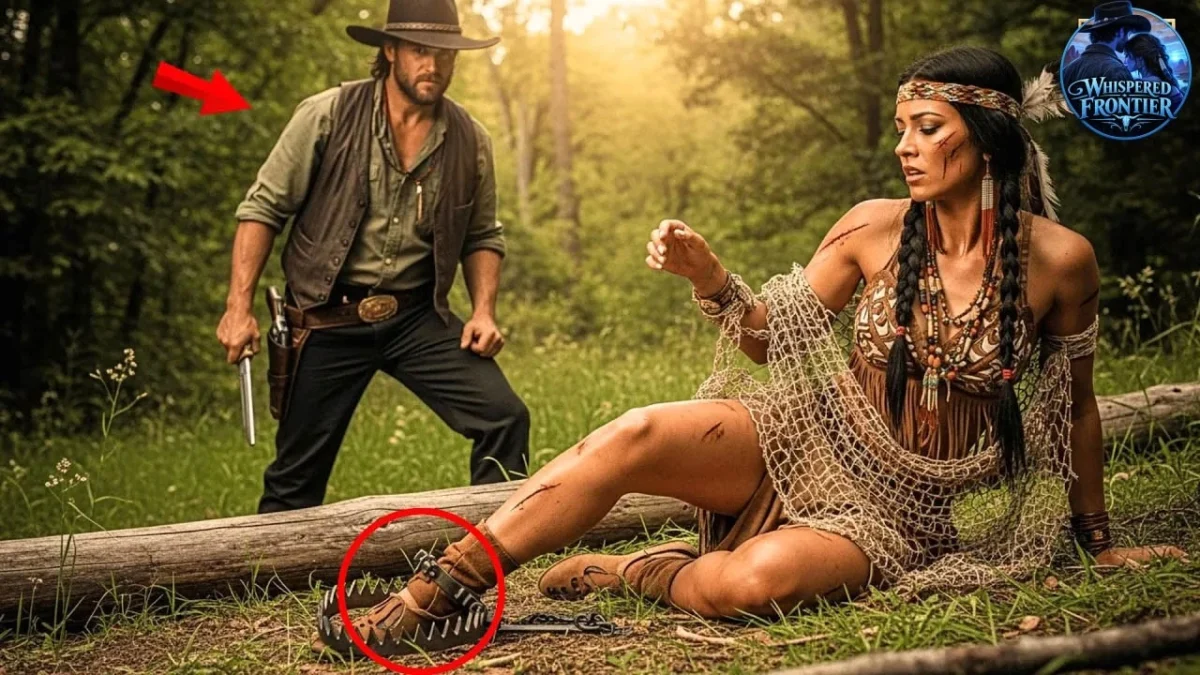
The jaws of the iron trap snapped shut with a harsh crack echoing through the pines.
Isa fell hard into the dirt, pain ripping up her leg as steel teeth clamped her ankle.
Her hands scraped raw against bark and soil. For a moment she froze, chest pounding before panic surged.
She knew this sound made for deer or wolves, not people. Yet here she was, caught like prey.
She pulled at the iron, but it only cut deeper. She bit back a cry any sound could carry.
Her people had been driven south weeks ago, scattered by soldiers. She had stayed behind, still searching for her younger brother, lost after a raid.
Now alone, without horse or food, she was trapped with no escape. Then came the crunch of boots through brush.
Her head whipped up. A man stepped out of the shadows, tall, broad- shouldered, a rifle slung low.
His hat shaded his face, his stride unhurried. That calm unsettled her more than a charge.
He looked like he belonged here. She thought he’d set the trap. He was here to finish what it started.
It was Telon, a cowboy who turned trapper to survive after frost ruined his crops.
He’d been running trap lines for weeks, hoping for rabbit or deer. Never a person, never an Apache woman.
He stopped a short distance away, his gaze steady, weighing the moment. He’d seen soldiers drag people from these hills, seen towns folk spit at the sight of an Apache.
He knew what she thought, that he was no different. Slowly, he set his rifle on the ground, raised both hands, palms open.
His voice came low, steady. It’s for game, not for you. I’ll get you out.
Isa’s eyes narrowed, her body tense, fists pressed to the dirt. She wanted to spit words back, but fear sealed her throat.
She watched every move, ready to fight if he came too fast. Talone crouched slowly, keeping his hat low so she didn’t have to meet his eyes.
His hands worked at the spring. It’ll sting,” he warned gently. The jaws released.
Pain shot through her leg, but she clenched her teeth, and held back a cry.
Talon tore a strip from his shirt, bound her swollen ankle with careful, steady hands.
No lingering touch, only respect. Isa studied him with suspicion, but confusion, too. If he’d wanted harm, he’d already lost his chance.
She gave her name in a whisper, testing him. He nodded, repeated it, not perfectly, but with care, then gave his own.
Talon. The forest seemed to hold its breath. She could limp away, risk the wilderness alone, or follow the stranger who had freed her.
Neither choice felt safe. She studied his face, creased by sun and wind, jaw set like a man who’d seen too much and carried it quietly.
He offered her his canteen, holding it out without pushing. Thirst one over fear, she drank with trembling hands.
He rose, rifle back on his shoulder. “Cabins not far,” he said. “You can walk.”
Testing her weight, Isa winced, but nodded. Fear still gripped her, but beneath it lay a fragile thread of trust.
He’d freed her when he didn’t have to. That mattered. Together, they started down the trail.
Talon walked just close enough so she wouldn’t stumble alone, but never near enough to crowd her.
Silence stretched between them, heavy with calculation. Her wondering if he’d betray her. Him wondering if she’d bolt.
Two strangers bound by survival, walking into uncertainty. Neither could escape. Isa wanted answers. Who this man really was, why he hadn’t taken her life when he had the chance, and if walking beside him meant freedom or a slow walk into captivity.
She had seen men who called themselves settlers drag women away. Had seen soldiers take even worse.
Her mind twisted with dark images of what might come. But the other path was worse, limping alone into hills where both wolves and men hunted.
Each step, she chose to keep following him, testing if his words matched his actions.
Talon knew exactly what churned in her thoughts. He carried his own shame. He’d ridden with cattle outfits that treated men like expendable tools, watched a family of Apaches driven from their canyon after soldiers set fire to their homes.
He hadn’t lifted a hand then. That memory still burned. But today, at least, he had made one different choice.
He had freed her. That mattered even if it could never wipe the slate clean.
They followed the creek, water sliding over rocks, the air sharp with pine and damp earth.
Finally, he broke the silence, his tone flat and plain. Cabin small, just me there.
Nobody else. She studied his face, searching for lies. Seeing none, she gave a slight nod.
When her ankle gave way on a slope of loose stone, his hand shot forward instinctively.
She jerked back, bracing. He raised his palms and stepped away. You lean if you want.
If not, don’t. It’s your choice. Her anger cooled as quickly as it had risen.
For the first time, she believed maybe he meant what he said. She hissed against the pain, pushed herself upright without his help, and he let her.
Unspoken questions hung in the air. She wanted to ask why he lived out here in solitude.
He wanted to ask why she wandered alone, separated from her band. Neither spoke. When the cabin roof finally broke through the trees, Isa’s voice cracked the silence.
Why trap, cowboy? Her suspicion laced every word, but so did a trace of curiosity.
Telon didn’t flinch. Winters mean out here. Frost killed my corn. Mayor went lame. I hunt to eat, to keep a roof over me.
His voice carried no pride, only the weight of survival. They stepped into the clearing.
The cabin stood rough and worn, smoke curling from a crooked stove pipe, fences sagging with age.
Not the home of a soldier, not the fort of a conqueror, just a place where a man scraped by.
It surprised her. He looked more like a survivor than an enemy. He swung open the gate and stepped aside.
“Go on,” he said, letting her pass first. “It was a small thing, but she noticed.”
He had spent the entire walk giving her choices. She didn’t thank him, but she walked through the yard.
Inside the air smelled of smoke and old wood. One room only, bare shelves, a single bed, no hidden weapons, no other people.
That answered at least one question. He lived alone. Truly alone. Talon leaned his rifle against the wall.
“You can sit,” he said. “I’ll cook. Rest that ankle.” He didn’t move closer.
Didn’t try to close the distance. He knew trust had to be built with deeds, not talk.
For the first time since the trap snapped shut, Isa exhaled a breath she hadn’t realized she was holding.
The edge of fear dulled into something else. Cautious watchfulness, the first step toward believing this stranger might not be danger.
The cabin itself was plain rough pine walls, low ceiling, dirt floor packed hard from years of boots.
A single stove scarred black. A plank table. One narrow bed covered with a wool blanket.
Nothing hidden, no tricks, just the life of a man who had cut and built with his own hands.
Talon saw her studying it. He spoke without pretense. Ain’t much. Everything you see, I built myself.
He moved slowly, pulling a tin of beans and a strip of salt pork from the shelf.
Survival food, not a feast. But it was honest. Telon didn’t ask if Isa wanted food.
He simply set to work because hunger didn’t wait for permission. He sliced the salt pork into pieces, dropped them into a black iron pan, and poured in beans.
Soon, the cabin filled with the smell of grease and smoke, sharp and comforting all at once.
Isa lingered near the wall, her ankle throbbing, eyes never leaving him. She thought about staying on her feet, ready to bolt if danger showed itself.
But her body reminded her she wouldn’t make it far if she tried. Talone noticed her hesitation.
He nodded toward the chair. “Sit if you like. Chair won’t bite.” His attempt at humor was stiff, but deliberate, a gesture to show he wasn’t her jailer.
After a pause, she lowered herself onto the chair, her gaze sharp, testing him. He stayed at the stove, stirring, giving her distance.
When the food was simmering, he pulled a small cedar box from a shelf and unwrapped a bundle of herbs.
Kneeling by the table, he showed her for swelling. Old man taught me years back.
He didn’t force it on her. He left it in reach, letting her decide. She studied it, then gave a faint nod.
When he crouched by her ankle, his movements were slow, every step clear. She tensed, ready to shove him away, but his hands were steady, careful.
The cool herbs dulled the ache as he bound them with cloth. He leaned back quickly, no lingering touch.
Suspicion remained in her eyes, but so did relief. The silence pressed heavy while the beans softened.
Finally, she broke it. Why alone? Her voice was quiet, edged with caution. This wasn’t idle curiosity.
It was survival. Talone set two tin plates on the table, his voice flat, the tone of a man telling an old truth.
Worked cattle near all my life. Rode with outfits that didn’t care if a man dropped de@d so long as the herd kept moving.
Saw men shot for less than a dollar. Got tired of it. Found this patch of land, built what I could.
Don’t belong much in town. Folks, don’t sit easy with me, so I stay out here.”
His blunt honesty caught her offguard. She had expected pride or arrogance, but instead it was bare survival.
She weighed his words against the patched roof, the worn tools, the simple table.
He wasn’t lying. He set the plate before her and waited until she took the first bite before sitting with his own.
The pork and beans were plain, but hunger claimed her, and soon her plate was clean.
He said nothing, only refilled her tin cup with water before eating his own share in silence.
When the meal was over, he cleared the dishes and stoked the stove. That left the unspoken question hanging.
Where would she sleep? There was only one bed. Her eyes flicked toward it, then back at him, searching.
He noticed. Floor’s cold. Bed’s the only real place to sleep. If it’s too much, I’ll take the floor.
But it’s one or the other. There was no command in his voice. Only plain fact.
She weighed him again. His restraint on the trail, his quiet at the table, his care with her ankle.
He hadn’t acted like the men she feared. Slowly, she gave a stiff nod. “Same bed,” she said, her voice tight.
More survival than choice. Telon didn’t smile or gloat. He only nodded. “All right then.”
That night, as the cabin sank into darkness, Tone lay on one side, facing the wall.
Isa lay rigid on the other, every muscle ready for danger. But he never reached for her, never shifted closer.
Only the faint tick of the stove and the rhythm of his breathing filled the silence.
Little by little, her body gave in. Though her mind still raced, exhaustion finally dragged her under.
For the first time since the trap had snapped shut, she felt something close to safety.
Not trust yet, but the faintest proof this man might be different. The night stretched long.
The stove kept the air warm, but tension filled the space between them. Isa lay awake for a time, eyes open in a faint glow, listening to every sound he made.
Talon stayed still at the far edge, his back turned as if he’d drawn a clear line she could see.
He moved only once, pulling the blanket higher, never crossing into her space. That mattered.
It told her more than words that he’d keep his distance unless she allowed otherwise.
Still, her breathing was shallow, nerves strung tight. A woman sharing a bed with a stranger was never without risk.
Her thoughts drifted to her brother, the one she had been searching for before the trap.
Would he have trusted a cowboy like this? Or called her a fool for staying?
The warnings of her people echoed in her head, built on real blood and loss.
Yet here she was, her ankle bound with his cloth, her belly filled with his food, lying in his one bed.
Every reason said she should not feel safe. But weariness crushed her doubts. Against her will, her body loosened, and sleep finally pulled her under.
Talon lay awake long after Isa’s breathing had settled into the soft rhythm of sleep.
His eyes stayed fixed on the ruffune wall, replaying choices he hadn’t spoken of.
He told her some truth earlier, but not all of it. He hadn’t mentioned how many outfits he’d walked away from, how many saloon fights he’d stumbled through, or the nights he drowned himself in whiskey to quiet the ghosts of the trail.
Out here, with no one to answer to, he could keep those parts buried. Yet, he could feel the weight of her mistrust in every glance.
The way her body stiffened at his smallest movement, he couldn’t fault her. If he were her, he wouldn’t trust him either.
The only way forward was time. Consistency. At some point in the night, her breathing deepened, steady, and heavy.
He risked a glance over his shoulder. In sleep, her face softened, suspicion gone, leaving her younger, almost unguarded.
Relief tugged at him. If she could sleep under his roof, even wearily, then maybe he had done something right.
Only then did he let exhaustion take him. Morning crept in through the cracks, pale light cutting across the cabin.
The stove fire had burned low, the air cool but not biting. Telon stirred first.
He rose quietly, careful not to wake her, slipped on his boots and set water to boil.
The rich scent of coffee soon filled the room. Isa stirred, blinking, her body stiff from yesterday’s strain.
For a moment, confusion flickered until memory returned and she saw him, not watching her, but tending to simple chores.
That steadied her faster than any words. When she finally sat up, he slid a rough slice of cornbread across the table.
“Eat,” he said plainly. “Easier on a full stomach.” She hesitated only a breath before taking it.
The bread was coarse but filling. He poured coffee into a tin cup and placed it before her with steady hands.
She sipped cautiously, the bitterness sharp, but she didn’t put it down. After breakfast, Talon brought out the herbs again and checked her ankle in the daylight.
The swelling had eased a little, the skin still red, but not as angry. “You’ll walk better today,” he said, rewrapping it with the same steady care as before.
This time, she didn’t recoil from his touch. Her voice came quiet, curious rather than accusing.
Why didn’t you send me away? He met her eyes for the first time without looking away.
You were caught in my trap. That makes you my responsibility. At least till you can walk steady.
Sending you out there alone would have been the same as killing you. I’ve seen enough killing.
She studied him hard, searching for any flicker of falsehood. There was none. His words carried no mockery, no pretense, only plain conviction.
For the first time, she gave him a faint nod. It wasn’t trust. Not yet, but it was a start.
Talon only returned to his coffee. The rest of the morning unfolded in quiet rhythm.
He chopped wood outside. She swept the packed dirt floor with slow, deliberate strokes, determined to prove she wasn’t a burden.
He noticed but said nothing, giving her the dignity of silence. By midday, the shape of their uneasy truce had formed.
She was no longer just the woman he’d freed from a trap, and he was no longer only the cowboy who’ caught her.
They were two people forced to share a roof by circumstance, both weighing the others choices, both wondering what tomorrow might hold.
The days that followed began to take on a rhythm neither of them would have called easy.
Each morning, pale light cut through the cabin walls, and Talon moved quietly so as not to startle her.
He set water to boil, brewed coffee, fixed simple meals of beans, cornmeal, dried venison.
She noticed the way he avoided sudden gestures, the way he let her choose whether to sit at the table or stay on the bed, the way he never pushed her to speak before she was ready.
Those small mercies mattered more than the food itself. Her ankle was still swollen, but with herbs and rest, it began to hold her weight.
When she tried to step past the cabin door, she stumbled once. Talon’s hand moved instinctively to steady her.
She caught herself before his touch landed and straightened sharply, glare sharp as a blade.
He stopped, nodded, and stepped back, letting her recover on her own. That choice mattered most of all.
That moment settled one question Isa hadn’t dared speak. Would this man use her weakness to control her?
His choice not to prove more than any promise. It quieted a fear she carried deep.
She began noticing things inside the cabin that didn’t fit the image of a man who meant harm.
The walls bore patches where gaps had been sealed with clay and moss. On the shelf beside a worn Bible rested a small carving, a wooden horse smoothed by hand.
It wasn’t a tool, wasn’t a weapon. It was something someone had made with care.
One afternoon, while Talon was splitting wood, Isa picked it up. When he stepped back inside, he saw it in her hand.
He didn’t grab it away or look ashamed. He only said, “Made that years back for a boy who never got to keep it.”
Figured I’d hold on. He didn’t explain more. She didn’t press, but the words stayed with her.
In time, she too let slip small pieces of herself. While sweeping the dirt floor with willow twigs, she murmured, “My brother used to do this in camp.
He was younger, too small for a spear, but he wanted to help.” Her voice faltered, then broke off.
Talon didn’t force her to go on. He only asked, “How long since you saw him?”
She shook her head, unwilling to answer, and he let it be. That restraint mattered more than anything.
Still, one question weighed heavy. Was she free to leave? She hadn’t asked, but she thought of it every time she looked at the door.
Talon must have sensed it. One evening over venison traded from a passing hunter. He said flatly, “When your ankles healed, you can go if that’s what you want.
No one’s keeping you here.” She studied his face, searching for deceit. There was none.
Their days filled with survival work, and silence shaped into something almost steady. Talon showed her his snares, how the trigger worked, how the scent carried on the wind.
At first, she only listened, cautious. Soon she asked questions. Why bait near rock instead of open ground?
Why set some loops higher than others? He answered plain without pride. When she suggested moving one closer to a deer trail, he considered then agreed.
That surprised her. He treated her voice as useful, not decoration. She gave back in kind.
At the creek, she showed him which roots could be crushed into paste for wounds, which leaves eased sickness boiled as tea.
He listened closely, memorizing. Out here, knowledge meant survival. By the fifth night, the way they moved around each other had shifted.
She no longer flinched when he set food near her hand. He no longer watched the door as if she might bolt.
They circled one another in quiet understanding, two people who couldn’t last long in such a land if they stayed at odds.
Still, questions lingered. She wondered why he truly lived apart away from towns folk.
He wondered what had scattered her and her brother. Neither asked, “Not yet.” But both knew the answers would surface one day.
For now, the truce was enough. The cabin, once sharp with fear, carried a different weight, still fragile, but livable.
By the sixth day, her ankle had healed enough for her to step outside without clinging to the door frame.
The limp remained, but she could stand on her own. That changed everything. She was no longer confined.
She could see his land for herself. For days, she’d wondered if he meant to keep her hidden, like a bird in a cage.
But now she saw the truth. There were no fences, only endless woods and hills stretching in every direction.
If she left, nothing stopped her but her limp and the dangers of the wild.
Talon seemed to know the thought was coming. You can walk farther now, he said.
I’ll show you the ridge line, the traps I set. Best way to see what this place really is.
His voice carried no pressure, only an invitation. She waited, then chose to follow. She wanted to see how far his words held true.
They set out after midday, the sun high, the ground damp from melted frost. Talon walked a few steps ahead, rifle on his shoulder, scanning the treeline.
Isa followed at her own pace. He never turned to rush her, never offered his hand unless the slope grew steep.
When her ankle slipped on a loose stone, he stopped and waited for her to steady herself, never touching.
That choice told her everything. He would not take what wasn’t offered. The trail led them through a stand of pale aspen, their leaves already fading with the turn of season.
In a clearing stood an old pine, its trunk split in two by lightning. Talon pointed at the scar marker means we’re close to the first snare.
Talon showed Isla how the snare lay hidden beneath brush, the bait set just right, and how the wind carried scent to the animals.
She crouched, testing the wire with careful fingers, her questions sharp. What if the wind shifts?
What if a coyote comes first? He answered plain, the way one survivor speaks to another, not like a man teaching someone beneath him.
When she suggested raising the loop higher to match a buck’s stride, he paused, considered, and adjusted it just as she had said.
That startled her. Few men she’d met had ever given weight to a woman’s knowledge, let alone acted on it.
On the way back, they found fresh tracks pressed deep in the damp earth.
Two sets of horse prints, sharp-edged, less than a day old. “Thom crouched, running his hand along the soil.”
Not mine, he said quietly. Isa’s stomach tightened at the edge in his tone.
Not fear, but calculation. Law men, she whispered. He shook his head. Too sloppy for that.
Could be drifters. Could be trouble. Her chest tightened. Was she safe here? Or would she face the same danger she’d fled before?
As if reading her thought, Talon spoke as they turned back toward the cabin. If men ride through, they’ll see the smoke.
They’ll ask questions. You don’t know the answers. I’ll handle it. He didn’t promise safety.
No man could on this frontier, but his steady voice gave her something to measure.
Back at the cabin, she tested the truth of her freedom by stepping past the gate and down toward the creek.
Talon watched from the porch but didn’t follow. That choice mattered. He wasn’t keeping her penned in.
She knelt by the water, rinsed her hands, and for the first time since the trap had snapped shut, she felt like more than prey.
She felt like she had a choice. That night, over venison stew, she finally asked what had weighed on her since the start.
Why not go to town? You trade. How do you keep talone? Chewed slow, then answered.
Go when I’ve got hides to sell. Don’t linger. Town’s not for me. Folks ask questions I don’t care to answer.
Out here, I do enough to get by, and no one asks who I was before.
His words were flat, but she felt the weight behind them. He wasn’t alone just by choice.
He carried something he hadn’t spoken of. She didn’t press, but the silence afterward was thick, filled with questions neither dared to lay bare, about his past, about her brother, about whether their fragile truce could survive the outside world pressing in.
By then her ankle was strong enough to bear weight. She walked without clinging to the doorframe, a faint limp, but free to move.
There were no fences, no chains, nothing to hold her but the wild itself. And Talon let her go as far as she pleased.
In that balance between freedom and restraint, something fragile had begun to take shape. Not trust yet, not safety, but the bones of both.
Two evenings later, the riders came. The sun sagged low, painting long shadows across the clearing, when the sound of hooves broke the stillness.
Talon was by the shed, chopping kindling. Isa sat near the creek, ankle nearly healed.
At the first echo of horses, her body went rigid, memories flooding back, soldiers demanding water, traitors with cruel eyes.
She stood fast, wideeyed, turning toward Telon. He had already set the axe aside, his rifle in hand, moving with the calm focus of a man who expected trouble, but refused to show panic.
Two riders emerged from the trees with the lazy confidence of men too used to taking what they wanted.
Dust coated their coats, pistols slung low, and their crooked grins looked more like threats than greetings.
They called out before reaching the porch, voices figning friendliness, but their eyes roamed over the cabin, the shed, the thin line of smoke from the stove pipe.
They weren’t looking for kindness. They were measuring what could be stolen. Talone stepped onto the porch, rifle held low, but ready.
His stance was easy, but his voice was steady as stone. Evening dot. Inside, Isa slid to the window, hidden but watching.
She gripped the iron skillet in both hands, her pulse hammering in her throat.
One thought cut sharp through her fear. Would he hand her over to save himself.
The taller rider leaned forward in his saddle, eyes fixed on Telon’s rifle. Heard there’s water here.
Creeks ran dry where we came from. Telon’s reply came calm and even. Creek runs clear yonder, he said, nodding toward the trees.
“Plenty there. You’ll find it easy,” the younger rider said with a smirk, his voice dripping arrogance.
“We could use more than water, maybe a meal, maybe a bed for the night.”
His eyes flicked toward the cabin door, and though he didn’t say the words, his meaning was clear.
Telon’s jaw tightened. Foods counted. Cabin’s mine. Best you move on. His voice wasn’t raised, but it carried the weight of stone.
The writers shared a look. The younger one let out a dry laugh. That rifle of yours.
$50. Fair enough. Tone shook his head once. Rifles not for sale. The taller rider leaned back in his saddle, spit dark into the dirt, his hand drifting close to the pistol on his hip.
50s a bargain compared to what it might cost you otherwise. The words hung sharp, meant to test his nerve.
Inside, Isa’s grip on the skillet tightened until her knuckles achd. Her thoughts spun. If bullets started flying, could she fight?
Or would she be dragged out before she had a chance to swing? Her ankle still weak, her chest tight with the knowledge her fate balanced on Telon’s next move.
Telon’s reply came steady, calm, but with steel under it. Not looking for a fight.
But you’ll find one if you push me. This lands hard enough without men making it worse.
The rifle stayed pointed at the dirt, but his stance shifted, feet braced, a line of cover only a step away.
Every part of him said, “Ready.” The moment stretched thin as a trigger wire. The riders weighed their chances, two against one, but the quiet certainty in Talon’s tone cut through them.
He wasn’t bluffing. And men like them knew the difference. The younger one muttered, tugging at his reigns.
The tall rider spat once more, scowlling. Plenty of easier pickings down the trail. With that, they turned their horses.
Not quick enough to show fear. Not slow enough to hide retreat. When the sound of hooves finally faded, Isa let out a breath she hadn’t realized she was holding.
Her hands shook as she lowered the skillet. She had half expected him to hand her over to use her as a shield.
But he hadn’t. He had stood firm, never once giving her name or face to them.
Something deep inside her shifted. Talon stepped back into the cabin, set the rifle against the wall, and poured her a tin cup of water.
He said nothing about the riders, nothing about her trembling hands. He only placed the cup near her and went back to the stove, feeding the fire.
His silence was its own answer. He hadn’t stood his ground for thanks. He had done it because it was right.
That night, as the wind rattled against the cabin walls, Isa lay awake long after him, listening to his slow, steady breathing.
For the first time since the trap, the sharp edge of fear dulled into something else.
Not trust, not yet, but the start of believing he might not betray her when danger came close.
The cabin was still after the riders left, but the silence carried weight. The heavy memory of what could have happened.
Isa sat at the table, fingers wrapped tight around the tin cup he’d given her, though the water was gone.
Her chest tightened at the thought of camps long ago, strangers walking in with smiles, leaving with more than they were given, sometimes with people who never came back.
The skillet rested at her feet, heavier now that her hands were empty. Talone stoked the stove, checked the rifle, and set it back in its place.
He’d seen her eyes through the crack in the door earlier. The fear she tried to hide.
He knew better than to ask if she was all right. She wasn’t. Words wouldn’t mend what scars kept alive.
Instead, he spoke of something else. Something that carried weight for him. Preacher out of Santa Fe comes through once in a while.
Carries a ledger, writes names, marriages, births, things lawmen will honor. I got a paper from him years back.
Never used it. Isa frowned. Unsure why he told her this. For what? Was meant for a woman I quartered once.
Fever took her before the preacher came again. Kept the paper anyway. Figured maybe I’d need it someday.
His tone was steady, but under it lay Ronis. He didn’t meet her eyes, just stared at the lantern flame.
Her suspicion stirred. Was this his way of claiming her, binding her without her word?
But when she looked at his face, she saw no possession there. He hadn’t said, “You will.
He had only spoken of what was, of something he carried, but had never used.”
Talon was sharing, not claiming. That difference mattered. Isa set the cup down, leaned forward, and finally gave him something of her own.
My brother, she said, her voice rough. Last I saw him was before the soldiers drove us south.
He rode out on a raid and never returned. I searched. No body, no sign, just gone.
Her words caught in her throat, heavy as stones. Every trail ended empty. Every camp I found was ash.
Still I looked. Then came your trap. Talone listened without a single interruption. He didn’t fill the silence with false comfort or wasted promises.
He gave her what she needed most, his full attention. When she finished, he said quietly, “You’ve still got time to find him.
Maybe not here. Maybe not today. But time hasn’t run out yet.” She stared at him, torn between anger at the hope in his tone and a deep yearning to believe it.
That night, as the stove flickered low and they lay once again in the same bed, something had shifted.
She no longer clung to the farthest edge. He didn’t move closer, but the space between them wasn’t born of fear anymore.
It was choice. Her breath came uneven, still raw from speaking her grief. His steady breathing beside her grounded her.
The question that had haunted her from the start returned. If danger came, would he stand firm?
Tonight, she believed he would, not because of the rifle at his side, but because he had already proven he would not betray her when it would have been easier to do so.
That choice weighed more than any vow. Before sleep claimed her, she whispered a single word in her own tongue, quiet, uncertain if he’d understand.
It meant not enemy. Talon didn’t answer, but she heard his breath ease, felt the weight of silence change, and knew he had heard.
Their bond, fragile as the thin glass of ice on the creek, was beginning to take shape.
Not love, not safety, but something in between. The first snow came sooner than either of them expected.
Only a thin veil that melted by midday, but enough to warn of the season’s teeth.
Talone stepped out that morning, saw White clinging to the fence rails, and came back inside with a look that said more than words.
We’ll need to get things right before the real cold comes. From that day, work filled their hours.
Talon patched the chinks in the cabin walls with moss and clay, packing it tight so the wind wouldn’t snake through.
Isa bundled kindling into neat ties, tucking them beneath the bed to keep dry. When she limped less, she carried split logs to the stack by the door, refusing to be useless.
Talon noticed but said nothing, letting her earn her own place in the work. Food came next.
Talon sliced strips of venison, hung them from the rafters to dry, and showed her how to turn the meat with a stick so the smoke would cure it even.
Isa added herb she’d gathered at the creek, teaching him which kept sickness away in lean months.
He listened with the same care he gave to bullets because both meant survival. One night while sorting herbs by the fire, she asked directly, “When the snow runs deep, do you stay here alone all winter?”
Her tone was part curiosity, part suspicion. He didn’t flinch. “Always have easier than answering to folks in town.
Cabin’s quiet, and quiet’s what I know,” he paused, then added, not saying it’s the best way, just the way I’ve managed.
Isa lowered her eyes to the fire. My people don’t winter here anymore. Soldiers push.
Food runs thin. They move south. I stayed behind. When snow comes, I’ve no one left to follow.
Saying it out loud cut sharper than she expected. For the first time, she admitted she was truly alone.
That evening, Talon drew a small cedar box from under the bed. Inside lay a folded paper, smudged but intact with blanks for names and dates.
Beside it, a ring hammered from a horseshoe nail, polished smooth. He set the box on the table, not pushing it toward her, but not hiding it either.
Preacher out of Santa Fe rides through sometimes, he said. Carries a book, writes down names, marriages, births, makes it official when law men come asking.
I got this paper years ago. Held on to it. Isa frowned. For what?
Was meant for a woman I quartered once. Fever took her before the preacher came back.
Kept it anyhow. Figured maybe one day I’d need it. His voice stayed steady, but there was rawness under the words.
He didn’t look at her, only stared into the lantern flame. Her suspicion flickered. Was this a way of binding her?
Of taking without her choosing. But when she studied his face, she saw no claim there.
He hadn’t said, “You will.” He had only spoken of something he carried, something he offered without demand.
He wasn’t demanding, and he wasn’t bargaining. Talon was offering, and that made all the difference.
Isa stepped outside into the bite of the evening air, frost crunching under her feet.
She followed the creek to the flat rock where she often went to think. Sitting there, she turned over everything she had seen since the trap.
The way he held back when others would have pressed, the way he’d stood between her and the writers, the way he listened as though her words mattered.
None of it erased the dangers of trusting him. But it proved he wasn’t the kind of man her people had warned her about all her life.
When she returned, the cedar box still sat open on the table. Talon didn’t move toward it, didn’t even look up.
He left the choice squarely in her hands. She sat down across from him. “When the preacher comes,” she said, her voice steady.
“I’ll write my name.” Talon gave a single nod. No celebration, no claim, only quiet relief in his eyes.
He closed the box and slid it back beneath the bed. That night, as the wind pressed against the walls, they lay side by side as before.
But the space between them no longer belonged to fear. It was choice, and both of them knew it.
Weeks later, the preacher finally came, rattling into the clearing behind a tired mule. As snow drifted heavy through the ridge, his beard was white with frost, his shoulders stooped from miles of lonely road.
Talon stepped outside to greet him, rifle slung at his side out of habit.
Isa stood in the doorway, arms folded, wary as always. But this traveler looked more weary than threatening.
The preacher climbed down, satchel tucked under his coat. Evening, he said, voice rough but kind.
I carry a ledger if you still aim to use it. His eyes passed from Talon to Isa, making sure both were part of the bargain.
Talon nodded. We do inside. At the table, the preacher opened the ledger and lit a lantern.
His pencil stub scratched across the page as he asked names. Talone spoke his slow and clear.
Then came her turn. Isa hesitated for only a breath, then gave her name strong, steady, as if daring the world to deny it.
The preacher wrote it exactly as she said. For the first time, her name stood beside his on paper, by choice, not by force.
From the cedar box, Talon brought out the ring he had hammered from a horseshoe nail.
No ceremony, no flourish, just a plain gesture forged with his own hands. He slid it onto her finger.
The weight of it carried every silence they had endured, every meal shared, every danger weathered side by side.
Isa laid her hand over his, not from obligation, but from her own decision. The preacher closed the book, tucked it away, and said simply, “It’s done.”
He stayed just long enough to share a bowl of stew, spinning a story about a stray cat in Santa Fe that hunted rabbits bigger than itself.
The tale was so absurd it dragged a rare smile from both of them. Then he climbed back onto his cart and vanished into the snowy night.
Inside the cabin felt smaller but warmer. Talon stoked the stove. Isa traced the edge of the ring with her thumb, her face calm but unreadable.
One question still lingered, and she was the one to speak it. When spring comes, I’ll still search for my brother.
I haven’t given up. Talon met her eyes, his answer steady. Then we’ll look together.
You won’t do it alone. That promise settled everything she hadn’t dared to ask. He hadn’t bound her to keep her in the cabin.
He had chosen to stand beside her. They spoke of smaller things, too. She promised to show him where berries hid under snow.
He promised to finish her second pair of moccasins before the deep freeze. Simple plans stacked like the wood pile by the door.
Necessary theirs. That night when they lay down, the distance between them was no longer brittle.
It was steady like the rhythm of the fire. She slept knowing she would not be handed over.
He slept knowing he was no longer alone. By morning, snow lay deeper outside, but inside the cabin, nothing felt unresolved.
Fear had become choice. Suspicion had turned into partnership. What began in a steel trap now bound two lives together by decision, not chance.








