‘The Ugly One Will Do,’ the Duke Said Coldly – The Court Gasped When She Lowered the Plain Hood
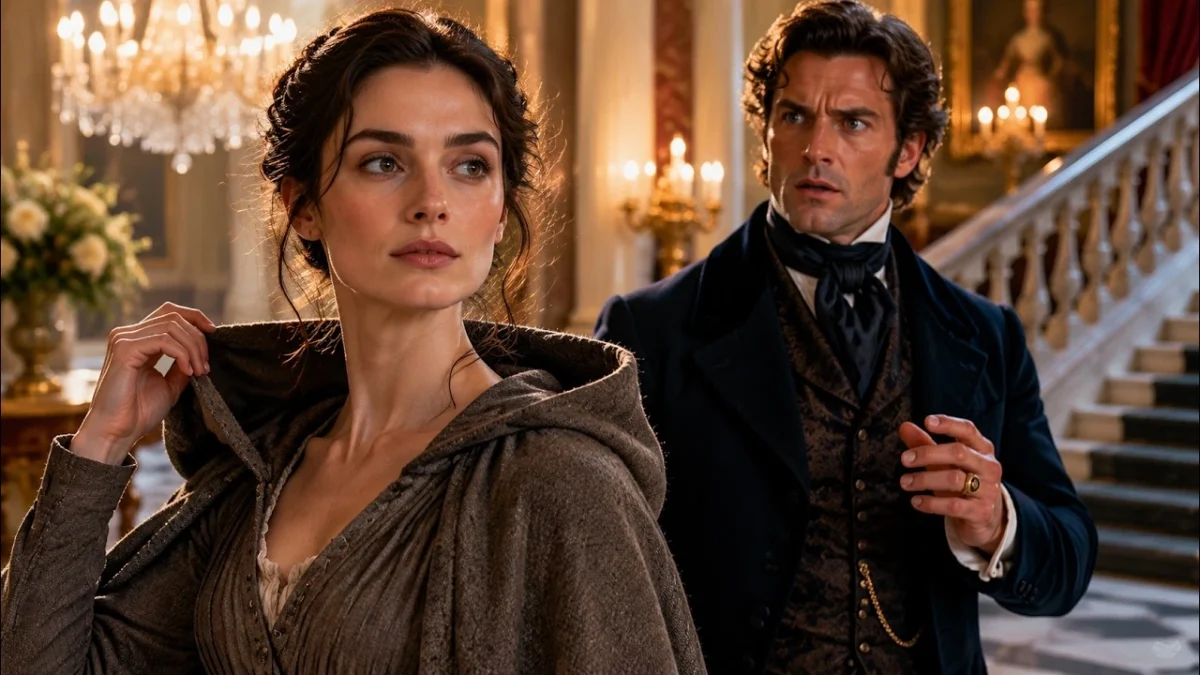
‘The Ugly One Will Do,’ the Duke Said Coldly – The Court Gasped When She Lowered the Plain Hood
The ugly one will do. He said it without looking up. He was leaning back in the leather chair behind the mahogany desk of Ashcraftoft Hall’s great study, one ankle crossed over his knee, a decanter of port at his elbow, and a ledger open before him that he was not reading.
His solicitor, a narrow man named Fellows, who had served the duche of Ashcraftoft for 22 years, stood across from him with a paper extended in a slightly trembling hand.
The paper listed in neat columns the five daughters of the recently deceased Viccount Havsley, their ages, their portions, their reported accomplishments, and at the end of each line a single adjective, your grace, fellows began.
The eldest, Lady Cornelia, is considered quite I did not ask which was considered quite anything.
The Duke of Ashdraftoft, Rowan Aldrich Blackwell, 2 and 30, looked up then, and it silenced the room in the efficient way his looking up always did.
He had gray eyes, the precise shade of slate after rain, and they had the quality remarked upon by persons who had been examined by them, of seeing more than was meant to be shown.
I asked which one would cause me the least difficulty, which one no one else wants, which one will remain grateful and quiet.
I have no interest in beauty or accomplishment. I have interest in legal settlements and an uncontested heir.
Find me the one the tan has already given up on. Fellows glanced at the paper.
He ran his finger to the fifth entry and cleared his throat. Lady Emiline, he said, 5 and 20.
No portion. The estate is deeply entailed. No season. She has not been presented. She has been managing the household account since her father’s first illness 3 years ago.
She is. He paused. She is not described as a beauty, your grace. Rowan Blackwell returned his gaze to the decanter.
Send for her. What no one in that room yet understood was what the ledger in Emiline Havsley’s own hands told a different story entirely.
She was 5 and 20. It was true, and she had not been presented, and she was not a beauty.
The world had been very consistent on that last point since she was approximately 14 years of age, when her younger sister, Cornelia, had come into her own, and the household had shifted its attention accordingly.
Emiline was brown-haired, where Cornelia was gold, seriousfaced, where Cornelia was dimpled, and inclined to spend her evenings in her father’s library, rather than at the piano forte, where Cornelia played with effortless, widely praised grace.
The world had looked at Emiline Havsley, assessed what it saw, and moved on. She had been left, as a consequence, with a great deal of time.
She had used it. The study at Havsley Park smelled of old leather and her father’s pipe tobacco, faint, now fading since his death 14 weeks ago, and of the beeswax she applied to the shelves herself each Sunday.
She was seated at his old desk the morning fellows arrived, and she did not rise when the butler announced him, because she was in the middle of a column that would not balance, and she had learned long ago that columns that would not balance were more urgent than men who arrived unannounced.
Lady Emiline, fellow said somewhat thrown, he had expected someone younger looking. He had expected someone with less stillness.
One moment, she said. She was not rude. She was precise. There is a difference, and Emiline Havsley had always understood it.
She set down her pen, blotted the page, and looked at him. She was not plain exactly.
Fellows would revise his memory of this moment many times in the years that followed.
She was angular where society preferred softness, composed where society preferred animation, and she wore a brown wool gown that she had not selected for its advantages.
Her eyes were dark and they were steady, and they assessed him with a thoroughess that reminded him disconcertingly of his employer.
“The Duke of Ashcraftoft,” she said before he could begin. She had been expecting this or something like it for 3 weeks, ever since she had finished working through her father’s papers and understood exactly what had been done and what had been concealed and what would happen next if no intervention occurred.
He requires a wife. He has specifically declined the three daughters who have been put forward this season.
He prefers someone without prospects or alternative offers. Is that approximately correct? Your ladyship, I am not offended, she said.
I am practical. I have four sisters. This estate is entailed to a cousin in Darbisha who has already written twice to discuss his plans for the parkland.
If the Duke of Ashcraftoft requires someone no one else wants, then I am by the tons accounting the most qualified candidate.
She paused. I have one condition, fellows, who had not sat down yet. A condition?
He repeated. I would like to review the settlements myself before signing, not my solicitor me.
I have been managing this household’s accounts for 3 years. I would like to know what I am agreeing to.
She folded her hands on the ledger. You may tell him that, fellows, told him.
There was a silence in the great study at Ashcraftoft Hall that lasted by Fellows’s careful count 11 full seconds.
Then Rowan Blackwell said agreed and returned to the decanter. He did not in those first weeks pay her a great deal of attention.
That was the arrangement. That was precisely the arrangement’s purpose. She arrived at Ashcraftoft Hall on the 14th of March 1814 in a hired coach with two trunks and her father’s old ledgers packed carefully among her clothes.
He met her in the entrance hall, assessed her in the 4 seconds he found sufficient for most assessments, and said, “You know the terms, I will require an heir.
In exchange, you will have the management of this household, an annual allowance, and my name.
There will be no further negotiations. He said this the way one reads a contract aloud.
Dispassionately, as a formality, with no expectation of objection, she said, “I understand.” She did not weep.
She did not protest. She did not ask him anything that he would have found tedious.
He had expected from previous experience, from the experience of Lady Clarissa Vain in particular, who had been goldenhaired and devastating, and who had two years ago declined his proposal in the same breath that she had accepted the Marquest of Rothfales in the ballroom at Almax.
With an earshot of 40 people who remembered it. He had expected difficulty. He had expected performance.
He had expected the precise theater that beautiful women in his experience conducted with every interaction, the arch look, the calculated sigh, the quiet demand that you notice them noticing you.
Emiline Havsley did not perform. She observed. She took the household books from the housekeeper, a woman named Mrs.
Door, who had been expecting to dislike her on the third morning, and she sat in the smaller of the two studies for 4 hours.
When she emerged, she had a list. She brought it to Mr. Fellows, who had stayed on through the month of transition, and she said, “The sellar accounts have been embezzled.”
Not grossly. It is a careful embezzlement by someone who understood the system approximately £47 over two years.
I would like your permission to address it quietly. He went to the Duke. She found it in a day, he told his employer.
Rowan Blackwell looked at the list. He did not say anything. He folded the paper and put it in his coat pocket, which was his way of filing things that required further consideration, and he did not bring it up again.
But he began after that to leave the study door open when he worked in the evenings.
It was not an invitation. He would have been irritated by the suggestion that it was an invitation.
He left the door open because the house was warm, and because the evenings had become, in some way he had not anticipated, quieter, in a manner that was not empty, that was rather occupied.
He could hear her sometimes from his desk, the scratch of her pen, or the lowvoiced conversation she had with Mrs.
Door about the linen stores, or nothing at all, which was also somehow a presence.
He had lived in this house alone for 3 years and had not found the silence uncomfortable.
He now found it occasionally too large. He told himself it was the adjustment to domestic arrangement.
He was not a sentimental man. He had arranged his feelings in the useful way since he was approximately 12 years old.
When his father, the previous juke the fifth, a man of immense precision and no warmth, had told him that a Blackwell juke was not a man who permitted his circumstances to make him weak.
Rowan had chosen accordingly not to be weak. He had chosen it with some discipline and a considerable amount of success, and he considered Lady Clarissa Vain’s public rejection the last time he had failed at it, and intended it to remain so.
He was not therefore watching Emiline halfly. He was simply aware of her in the manner that one is aware of a well functioning mechanism with a kind of disinterested appreciation.
Had anyone been watching closely, they might have noticed that this distinction was becoming more difficult to maintain.
The crisis arrived as crises at Ashcraftoft Hall tended to through the formal channels of a social call.
Lady Hanoria Forset arrived on the 22nd of April when the moors were beginning to soften from their winter severity into something merely stark.
She came with her mother, the countess of Forset, a woman of elaborate hair and an ability to convey social judgment without altering her expression.
And she came in the way that persons of considerable beauty and considerable confidence come places with the assumption that the place would rearrange itself for them.
She had been before Lady Clarissa Vain had descended upon the season the most discussed young woman in the northern counties.
She was goldenhaired, wide-mouthed, and very skilled at appearing to not be assessing her competition.
She assessed Emiline in approximately 3 seconds, which was 1 second faster than the Duke had managed, and arrived at a verdict that showed with the very faintest compression of her lips that she found the verdict satisfying.
“Your grace,” she said to Rowan, and her curtsy had the quality of a gift bestowed.
To Emiline, she offered the second rank curtsy, the one that said, “I see you are here, and I am acknowledging that fact no more.”
And she said, “Lady Ashcroft. What a restful arrangement you have made here.” Emilion said, “Thank you.”
She offered tea. She arranged the drawing room with the efficiency she brought to all arrangements.
She said nothing that was not correct. She was wearing, as she nearly always wore, a plain gown, dark blue today, high- necked, practical in its cut, without the ornamented sleeves and pinched waist that Lady Hanora’s cherry red walking dress employed to considerable effect.
She had also, it was cold in the hall when they arrived, come from outside, and her hair, which she wore simply without the fashionable ringlets Lady Honoria favored, was wind disordered.
She had pushed it back from her face with one hand, and had not thought further about it.
Emiline did not, as a rule, think about her appearance in the way that she thought about columns of figures.
Anoria found this satisfying for a reason that went beyond simple aesthetics. She had been watching the Duke of Ashcraftoft for 3 years.
She had calculated in the methodical way she conducted all calculations that he would eventually require a wife and that she was the appropriate candidate, more beautiful than Lady Clarissa, more socially careful, more patient.
She had waited while he did not come to London. She had waited while he declined the introductions arranged through mutual connections.
She had not waited for him to select someone from a list of women no one wanted.
She had not therefore planned for Emiline. She had also not planned for the open study door.
The visit lasted 2 hours. Lady Forset praised the hall which she had wished to see since its renovations, and Anoria praised the hall more precisely and with greater knowledge of the renovation’s specific details, which required that she had reviewed the information beforehand.
She asked the Duke a series of questions about his plans for the grouse season, his plans for London in June, his plans in general, in the delicate way that ensures the person being asked understands the questioner’s interest.
Rowan answered in the precise economical way. He answered everything. He was not cold. He was contained, but he was also, Hanoria noticed, not attending to her with the quality of attention she had expected.
He was attending to Emiline. He was not watching her. He was never watching her.
He was speaking to Lady Forcet. He was answering Anoria’s questions. He was entirely correctly present.
But when Emiline rose to summon the footmen, his attention tracked to her briefly, and away again.
When she rose to refill the teapot herself, rather than waiting for the footman, who was slower than she found necessary, there was a fraction of a pause in whatever the Duke had been saying.
“Honora said as they were leaving with her bonnet being tied and the carriage being brought, “Your wife is very capable, your grace,” Rowan said.
“Yes.” Anoriel looked at him and found that he was not looking at her. The letter arrived on a Thursday morning in the first week of May.
Emiline was at the small desk in the housekeeper’s sitting room, which she had claimed on the grounds that the light was better than in the study fellows had assigned her when Mrs.
Door brought it a letter forwarded from Havsley Park in an envelope that had been opened and resealed with a different wax.
The address was in a hand she recognized, the Darbisher cousin, who had written twice, and who had, it now appeared, written to someone else as well.
She read it. She read it again. She set it on the desk with the precise flatness of someone who has found a discrepancy in a column that should have been correct.
Then she went to find the Duke. He was in the east stable speaking to his headgroom about a horse with an injury to its near forleg, which he was examining himself rather than delegating.
She had learned early that he was that kind of man, the kind who looked at things directly rather than receiving reports.
She waited until he had finished. She did not hover or fidget. She stood at the stable door with her hands folded and her face arranged in the expression that Mrs.
Door had learned to recognize as the one that preceded information the Duke would find either useful or alarming.
There is something you should see, she said when the groom had gone. She gave him the letter.
The letter was from the Darbashar cousin to Lady Anorio Forcet. It was not. It was careful not to be an explicit document.
It was instead the kind of letter that conveyed its meaning through implication through the specific shape of what it did not say.
The cousin, one Thomas Havversley, 38, who had been writing twice about the parkland, wrote to inquire whether Lady Hanoria had found the household at Ashcraftoft Hall to be everything she hoped, and whether certain inquiries the cousin had made with the duchy solicitor regarding the settlements had proved fruitful, and whether the matter of the documents was likely to be resolved in the anticipated manner.
Rowan read it once, he folded it. He was quiet for a moment that lasted the length of the stable row.
Three long heartbeats, or perhaps four. Emiline was standing 6 ft from him, watching him in the way she watched things, with the quality of observation that asked nothing, and offered everything, and which was, he had found, the most useful species of attention.
The settlements, he said, not a question. My father’s estate had a secondary entail, she said.
I found it three weeks ago going through the old papers. If I married and my husband could establish the secondary entail, the Havsley estate does not revert to the Darbisher cousin, it reverts to my direct heir.
She paused. The cousin has known about it for longer than I have. He would need the marriage to fail or to be dissolved before an heir was established.
Rowan looked at her. There was in the gray eyes a quality she had not seen there before, something that was not warmth precisely, but was the border territory where warmth becomes possible.
And you knew this when you agreed to the arrangement. You agreed anyway. I did not have another viable option, she said.
And I believed. She stopped. What did you believe? She looked at him steadily. She had the habit of meeting a question with its full weight rather than deflecting it, which he had also noticed.
I believed that the Duke of Ashcraftoft was the kind of man who reviewed his own ledgers, who looked at things directly.
Who was not easily managed? She folded her hands. I believed that if I told you the truth when you had it from me, you would receive it correctly.
The stable smelled of hay and leather, and the cold mineral edge of the moors coming in under the door.
The horse in the near stall shifted and was still. Outside a wind came across the parkland and pressed briefly against the old stone.
He said, “You should have told me at the beginning. You would not have listened at the beginning.”
She said, “You needed to see me work first.” The silence that followed this was of a different species than the silence that had preceded it.
He looked at her in the unhurried way that she had come to understand was his real form of attention.
Not the contained formal attention he offered the world, but the one he permitted himself in the moments when he forgot to be careful about it.
It was the look, she thought, that had been trained out of him by someone who considered it a weakness, and which had been coming back in small increments since the 14th of March, in the way that a shoulder, once injured, remembers the motion it was built for.
“The cousin has been in correspondence with Lady Forset for some time,” she said, returning to the practical, because they both needed the practical, and she was better at it than sentiment.
Long enough that the inquiry with the duche solicitor was arranged. I believe he hoped to introduce her as an alternative after the marriage failed.
He did not account for the secondary entail producing a different outcome. The settlements stand.
Rowan said the documents were filed 3 weeks ago. I know she had been the one to review them.
Thomas Havsley’s path to the parkland is closed. He was still looking at her. Then, in the way of a man who has made a decision that was not, properly speaking a decision so much as an acknowledgment of what had already been decided.
He said, “I owe you an apology.” She did not ask what for. She waited.
I described this arrangement in the beginning as a transaction. I conducted it that way.
I assessed you the way one assesses a line item. He did not say it with self- condemnation.
He said it the way he said everything flatly and without ornamentation. But the flatness had a quality to it now that she recognized it was the flatness of something that has cost something to say.
You were not in any part of this treated as I should have treated you.
She said I am not injured by it. No. He looked at her. You managed it too well to be injured by it.
That is perhaps the thing I should have seen. She had been right. On the 14th of March, when she had looked at him across the entrance hall and thought, “This is a man who is very welldefended and very tired of it.”
She had thought it in the practical way that she thought about most things as an observation, not an investment, but it had persisted in the months since.
The way that a correct observation tends to persist, she said, “What will you do about the cousin?
What needs to be done?” He said, “Fellows will see to it.” He tucked the letter into his coat pocket, then after a pause, I would like to show you something.
He led her through the east stable and out into the parkland, and then across the parkland to the far terrace that looked north over the moors, where the heather was beginning in the cold May light, to show the first bronze purple of its coming season.
He stood beside her at the stone railing and he said, “This estate has been in my family for 200 years.
I have been its juke for nine. I have managed it.” He stopped. “I have managed it the way I was taught to manage it, which is to say, alone, without consultation, without acknowledgment that there was anything here that required more than one person’s attention.”
Another pause. I have found in the past six weeks that I was incorrect about that.
The moors stretched north and west, vast and bare and very ancient, under a sky that was the particular silver gray of a Yorkshire spring.
The wind had the smell of rain in it, cold rain coming from the coast.
The sandalwood and leather of him was at her shoulder. Familiar now in the way that things become familiar when you have spent six weeks learning to read the silences of someone who does not speak carelessly.
She said nothing. She had learned with him that silence at the right moment was more useful than any available sentence.
He said, “I would like to know.” And then stopped again. “Yes,” she said quietly.
He looked at her the way he had looked at the horse’s injured forleg directly without evasion with the full intention of seeing what was there.
Whether this has been for you, only a practical arrangement. Emiline was quiet for a moment.
The rain was coming now. She could see it on the western horizon, a gray curtain moving across the moore.
The light was changing, softening, and the heather below them had darkened to the color of old port.
She said, “No, she said it the way she said everything she meant, without elaboration, without theater, as a simple statement of a true thing.
He did not say anything.” He turned and looked at the rain coming in, and she stood beside him, and they watched it arrive, the way two people watch something from the same place when they have, without entirely meaning to come to occupy the same ground.
It would be many weeks before he said what she already knew, and before she answered it in full in the formal drawing room of Ashcraftoft Hall, with fellows present, as witness to a thing that did not require a witness, being already entirely certain in the hearts of both people in the room, he said, “I believe I would like this to be a marriage rather than an arrangement.”
He said it with the same studied formality he brought to everything. But there was something beneath it, audible, unmistakable, that was the sound of a man who has put down a considerable weight and found the air lighter.
She said, “I believe I would like that as well.” The cousin in Darbisha received in July of that year a letter from the office of the duche of Ashcraftoft informing him that the secondary entail of the Habsley estate had been reviewed, confirmed, and formally recorded in his grace’s name in anticipation of the forthcoming heir, and that any further correspondence on the subject should be directed to the duche solicitor.
Lady Hanoria Forset was engaged before the following season was out to a baronet from Somerset who was very handsome and had no interest in ledgers.
The Countess of Forset was heard to remark at a card party in March of 1815, that the Duchess of Ashccraftoft had a remarkable quality about her, something she could not quite place, something that made one feel one was being very accurately seen.
She was not wrong. Emiline Havsley had been accurately seeing things for most of her life and had been waiting with her characteristic patience for the moment when being seen in return would matter.
It mattered, as it turned out, very considerably. Years later, when the Havsley estate had been returned to its proper order, when Ashcraftoft Hall had the quality of a house correctly inhabited by people who had earned each other, when the two daughters and the son who carried the secondary antale were old enough to understand the family history, the story was told as a lesson, not a warning.
Their mother, who was gray at the temples by then, and still precise, told it directly, without sentiment, a practical arrangement entered into carefully, which had become, through the ordinary operations of two people who paid close attention to what was true.
The son, who had his father’s gray eyes and his mother’s habit of looking at things until he understood them, asked, “Were you afraid?”
Emiline said, “I was prepared. There is a difference. She looked at her husband, who was across the room with a book, listening in the way that he still listened, utterly still, missing nothing.
Your father, she said, is the kind of man who rewards preparation. Rowan Blackwell looked up from his book.
There was something in his face that was not, by the strict standards of the tongue, a warm expression.
It was contained, calibrated, and very old, but it had the quality of light through glass, which is a different thing from darkness.
He said, “You prepared rather better than I deserved.” She said, “I know. The moors were very dark outside by then, the way they get in November.
And the fire was high, and the room smelled of beeswax and sandalwood and old leather.
And the wind pressed against the stone walls and found them solid and went








