The Last Apache Woman Sold for Six Silver Dollars — Until a Broken Stranger Set Her Free.
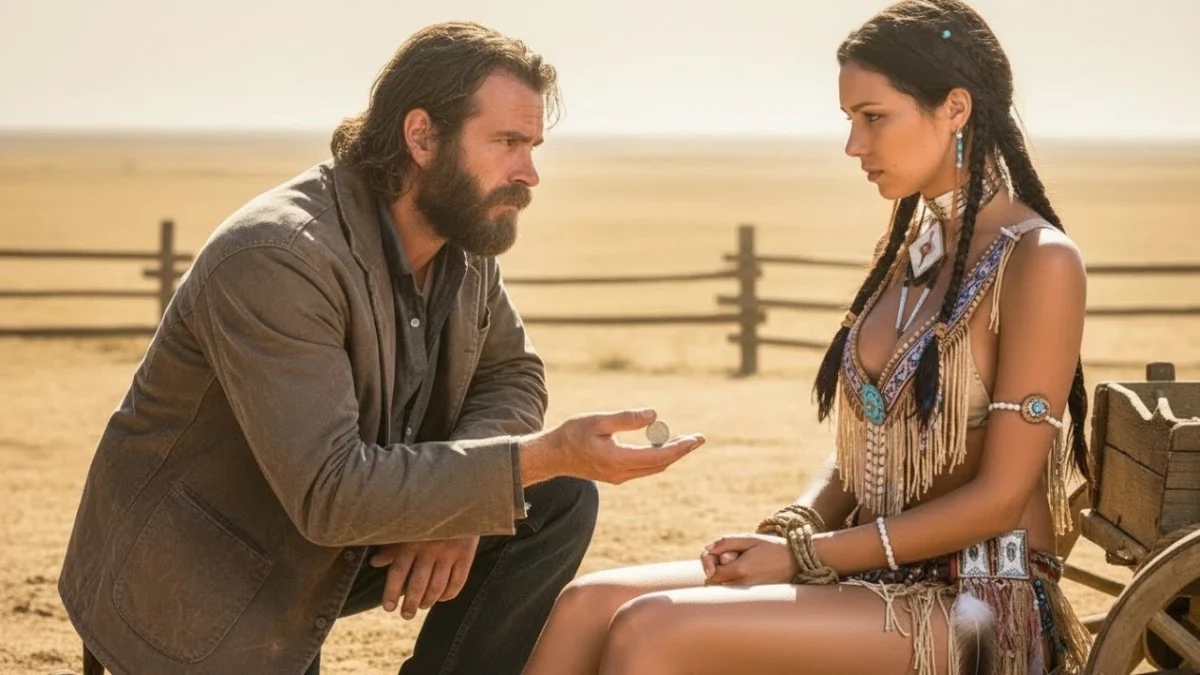
The Last Apache Woman Sold for Six Silver Dollars — Until a Broken Stranger Set Her Free.
Can you walk? [groaning] You sleep now. I stay. The last Apache woman sold for six silver dollars until a broken stranger set her free.
The auctioneer’s hammer came down with a crack that echoed off Red Willow’s false front buildings.
Six silver dollars. The price of three bottles of whiskey or one half starved Apache woman with an infected leg.
Silas Walker counted the coins twice with shaking hands before shoving them across the pine board around him.
Men laughed at her at him at the whole sorry transaction. A one-legged drunk buying damaged goods.
The town’s two biggest mistakes sold to each other. He didn’t look at her face.
Couldn’t just grabbed the rope around her wrists and limped toward his horse, his bad leg dragging a furrow in the dust.
This wasn’t rescue. This was two people drowning, grabbing onto each other on the way down.
Red Willow, Colorado territory, October 1,876. The wind that morning carried the smell of alkali dust and horse piss, mixing with the sour sweet stench of last night’s whiskey, still seeping from Silus Walker’s pores.
He sat on an upturned crate outside Mcmurphy’s general store, watching the crowd gather at the auction block with the detached interest of a man who’d stopped caring about most things 3 years ago.
His left leg throbbed it, always throbbed when weather was coming in, and the iron gray clouds piling up over the Rockies promised the first real cold snap of autumn.
The leg had been torn up by Confederate grapeshot at Kennesaw Mountain in ‘ 64, put back together by a field surgeon who was either drunk or didn’t give a damn, probably both.
Now it was held together with anger and whiskey in that order. Lot 17. The auctioneer, a railthin man named Hixon with tobacco juice, staining his gray beard, gestured at the platform.
Apache may be 20 years old. Captured during the Red River campaigns. She’s been with four different owners.
None of them could make her work right, but hell, she’s still breathing, and that’s more than you can say for most.
Laughter rippled through the crowd of miners, ranch hands, and townsmen. Silas squinted at the figure on the platform.
She wasn’t standing so much as propping herself upright against the post. Dark hair hung in matted ropes around a face the color of old leather.
Her calico dress some missionaries charity no doubt was torn at the shoulder and crusted with mud along the hem.
But it was her left foot that caught his attention. Even from 30 ft away he could see the swelling, the angry red streaks climbing up from her ankle.
Blood poisoning. She had maybe a week too if she was tough as leather. Do I hear $3?
Hixon spat a brown stream over the edge of the platform. Come on, boys. $3 for a working woman.
She ain’t going to be working much with that foot rotting off. Someone called out.
More laughter. The woman’s eyes were half closed, her breathing shallow. Fever. Silas thought. Bad fever.
He should walk away. He had $17 to his name, owed 12 of it to three different men, and winter was coming.
The smartest thing would be to buy ammunition, maybe a side of bacon and hole, up in his shack until spring.
Instead, he heard his own voice rough from disused $6. The crowd went quiet for a heartbeat, then erupted.
Wolf whistles. Cat calls. Someone slapped his back hard enough to make him stumble. Well, I’ll be damned.
Hixon grinned, showing brown teeth. Silas Walker’s got himself a bride, boys. Maybe old one leg ain’t as de@d as we thought.
$6 says he is de@d, someone muttered. de@d from the waist down anyway. Why else would he want something that can’t run away?
Silas ignored them. He’d learned to ignore most things. He counted out the coins, his last coins, and shoved them at Hixon.
Then limped up the three steps to the platform. Up close, she looked worse. The fever had her shaking despite the heat.
Her lips were cracked, bleeding at the corners. That foot, Christ, that foot was going to kill her if he didn’t do something tonight.
He cut the rope around her wrists with his belt knife. Her eyes opened briefly, focusing on his face with an expression he couldn’t read.
Not gratitude, not fear either, just calculation. Like she was measuring him for a coffin.
Can you walk? He asked. She didn’t answer. Probably didn’t speak English or didn’t trust it if she did.
Right. He grabbed her arm. She was burning up and half dragged half carried her down the steps.
His bad legs screamed in protest. Behind them. The auction moved on to lot 18, a pair of mules.
His horse, a rangy buckskin geling named Chester, stood hipshot at the hitching rail. Silas looked at the woman, then at the saddle, then back at the woman.
No way she could sit upright. No way he could hold her upright, either not for the 8-mile ride home.
Sorry, he muttered, then hoisted her across Chester’s withers like a sack of grain face down.
She didn’t make a sound, didn’t fight. That worried him more than if she’d screamed.
He pulled himself into the saddle, every movement, a negotiation with his ruined leg, and turned Chester’s head toward home.
Behind him, Red Willow dissolved into dust and distance. The ride took 3 hours. The woman hung limp across the horse’s neck, occasionally shuddering with fever chills.
Twice. Silus thought she’d stopped breathing. Twice he checked and found a pulse faint but steady.
What the hell was he doing? He couldn’t save her. He couldn’t even save himself.
He was a 42-year-old who lived in a two- room shack and drank away the screaming in his head every night.
He had no business taking responsibility for another life. But he’d made the bid, counted out the coins.
So now she was his problem. Same as his bad leg, same as the nightmares, same as everything else he couldn’t fix.
The sun was low and red when they reached his place, a squat cabin of rough cut pine logs, chinkedked with mud, sitting in a hollow between two low hills, a lean to shed housed chester and a milk cow.
A chicken coupe sagged against the east wall. Behind everything, the Rockies rose up like broken teeth against the sky.
Silas half carried half dragged the woman inside and dropped her on the floor near the iron stove.
She sprawled their eyes closed, breathing fast and shallow. He lit a lantern, got a fire going, put water on to boil.
Then he knelt beside her and looked at that foot. Worse up close. Much worse.
The whole ankle was swollen to twice its normal size, modeled purple and red. The infection had spread up to midcfe.
When he touched the skin, she jerked awake with a gasp. I’ve got to clean this, he said.
She stared at him. He repeated it slower using hand gestures, feeling like an idiot.
She said something in a patchy sharp clipped syllables. It didn’t sound friendly. Yeah. Well, he retrieved a bottle of whiskey from the shelf, his last bottle, god help him, and a clean rag.
This is going to hurt like hell, but if I don’t do it, you’re de@d by Sunday.
He didn’t wait for permission. Just grabbed her ankle, yanked the cork out with his teeth, and poured.
The whiskey hit the infected tissue, and she came up off the floor, screaming a sound like something dying in a trap.
She tried to pull away, but he held on, pouring more whiskey, watching it foam and bubble in the wound.
She fought him with surprising strength, cursing in Apache English and what might have been Spanish.
When the bottle was empty, he let her go. She scrambled backward until she hit the wall, chest heaving, eyes wild.
“Done,” he said quietly. He felt sick. His hands were shaking. “That’s that’s done.” He found a blanket and tossed it at her.
She caught it one-handed, still watching him like he might attack. Silas retreated to his own corner, pulled off his boots, and lay down on the rope bed.
His leg was on fire. His head was pounding, and he just used his last whiskey on a woman who probably wanted to kill him.
He closed his eyes and waited for the nightmares to come. When they did the smoke, the screaming the boy in gray clutching his opened belly, he woke to find her watching from under the table.
She had her hand wrapped around a broken piece of pottery sharp edge out. He almost laughed almost.
Instead, he rolled over and stared at the ceiling until dawn. 3 days passed. The woman’s fever broke on the second night he woke to find her drinking from the water bucket, her eyes clear and hard.
He’d expected thanks, or at least acknowledgment. What he got was silence and a stare that could freeze whiskey.
Fine. He wasn’t much for conversation anyway. On the fourth morning, he woke to find her gone.
Panic hit him first had she died run off. Then he heard noise from the lean tube.
Metal scraping, wood creaking, the distinctive sound of Chester stamping and blowing. He limped outside to find her standing next to Chester, her hands working at the bridal with focused intensity.
No, not working at it. Taking it apart. Hey. He moved faster than his leg wanted, stumbling over a rock and nearly going down.
The hell are you doing? She glanced at him one quick measuring look, then went back to unwinding the leather cheek pieces.
Her fingers moved with practiced efficiency, loosening buckles, sliding straps free. The bit expensive steel with copper rollers bought in Denver for four whole dollars lay in the dirt at her feet like discarded trash.
That cost me $4, his voice cracked with outrage. You can’t just That’s good tac.
Do you have any idea? As she cut him off with a stream of Apache gesturing sharply at Chester’s mouth, then at the bit on the ground.
Her tone was harsh, contemptuous even. The horse stood quiet through it, all ears relaxed, not fighting her touch, the way he sometimes fought Silus’s.
Then she held up one finger, weight disappeared into the shed, and came back with a length of old rope he’d been saving for fence repair.
Silas watched anger building like steam in a kettle as she examined the rope, testing its strength by pulling hard at both ends.
Apparently satisfied, she made a simple loop in one end. Then she stepped up to Chester’s head, moving carefully, still favoring that bad foot despite the healing, and slipped the loop around the horse’s lower jaw right behind where the bit had been sitting.
Her hands moved quickly now, tying a specific knot, something complicated with doubled loops that twisted back on themselves.
He’d never seen anything like it. The rope seemed to flow through her fingers like water.
“That’s not going to work,” he said flatly. “A horse needs a proper bit, or he’ll just,” she ignored him completely.
In one fluid motion, she swung onto Chester’s back. No saddle, no stirrups, no mounting block.
Just gripped the mane with one hand, jumped and settled herself on the horse’s bare back like she’d been born there.
Her posture was different from any rider he’d ever seen. Not the straightbacked military seat, but something more fluid, more connected to the animal beneath her.
Then she did something with her right hand, the smallest twitch of fingers against the rope, and Chester pivoted left so sharply, Silas took a step back.
Another tiny movement, barely visible, and the horse backed up four precise steps. She shifted her weight forward, slightly squeezed with her calves, and Chester moved into a smooth trot.
Silas stood there, mouth hanging open, watching her ride his horse in a tight figure eight pattern around the yard.
She made it look effortless. The rope bridal looked like nothing, just a loop and a knot, but Chester responded to the barest whisper of pressure.
His head relaxed, his gate smooth, and she rode one-handed, her left hand resting casually on her thigh, her balance perfect, she guided Chester through a series of increasingly complex maneuvers.
Tight circles, sudden stops, backing up in a straight line, even a few steps of what looked like a sideways walk.
The horse’s ears were forward relaxed. He wasn’t fighting her. He was listening to her, working with her.
Finally, she brought Chester to a stop directly in front of Silas and slid down with the same effortless grace.
She pointed at the war bridal, then at his shoulder, the right one, the one that gave him hell.
Every time he had to saw at Chester’s mouth to get the stubborn beast to turn.
Then she mimed, riding one-handed her right hand free, moving it as if holding something.
Free to hold a rifle, Silas realized with a jolt. Free to shoot, free to rope, free to do anything except fight your own godamn horse for control.
He looked at the war bridal, then at her, then back at the bridal. His anger had evaporated, replaced by grudging curiosity and something that might have been respect.
“Show me again,” he said quietly. “The knot.” Something flickered in her eyes. Not quite a smile, but close.
A softening around the edges, a hint of approval. She showed him three times slowly until his clumsy fingers could follow the pattern.
The loop, the twist, the double back that locked it in place. She guided his hands with hers when he got it wrong, her touch impersonal but patient.
When he finally got it right, she nodded once. Then she picked up the expensive Denver bit from the dirt walked over to the fence and hung it on a nail with an air of finality that said it would never touch Chester’s mouth again.
Silas looked at the bit gleaming in the morning sun. $4 gone. Wasted. Except it wasn’t wasted, was it?
His shoulder already felt better just thinking about not having to muscle the horse around anymore.
All right, he said to her, retreating back. We’ll try it your way. She didn’t acknowledge him, but he saw her shoulders relax slightly as she walked back toward the cabin.
By the second week, they’d fallen into a rhythm. She still didn’t speak English or pretended not to, but they’d developed a language of gestures and grunts that worked well enough.
He pointed at things she nodded or shook her head. She mimed actions he tried to follow.
It was clumsy and frustrating, and somehow it worked. The ankle was healing slowly but steadily.
She could walk without limping now, though she still favored it when she thought he wasn’t looking.
The angry red had faded to pink, then to white. The infection was gone, replaced by new scar tissue that pulled tight when she flexed her foot.
The food situation was getting desperate. Silas had been living on beans and the occasional rabbit since late summer.
He was a decent shot, but ammunition cost money. He didn’t have, and he couldn’t bring himself to waste a bullet on anything smaller than a deer.
Problem was, deer were scarce this close to winter and getting scarcer. The smart ones had moved down to the valleys.
The ones that remained were spooky, ghostlike, gone before you could draw a bead. He was down to three bullets and half a sack of beans when he woke one morning to find her gone again.
This time he didn’t panic, just waited. Sipping chory coffee and watching the treeine. She came back at noon, moving quiet through the scrub oak-like smoke through branches.
She had mud smeared on her hands and arms up to the elbows, and she rire of sage, that sharp, clean smell that made his sinuses clear.
Her hair was tied back with a strip of cloth, and there was a look of concentration on her face he was starting to recognize.
It meant she was working on something, solving a problem in her head. Without a word, she collected several straight branches from the wood pile, testing each one for strength and flexibility.
Some she kept, others she tossed aside. Then she gathered rocks from the creek bed.
Not just any rocks he noticed, but flat ones of specific sizes and weights. Finally, she retrieved a length of spare rope he’d been meaning to fix, and some strips of rawhide left over from mending tack.
She spent the afternoon crafting something at the edge of the clearing where the open ground met the scrub.
Silas watched from the cabin door, curious, despite himself nursing his coffee and trying to figure out what she was building.
The first construction looked like a miniature gallows or maybe a de@dfall mine prop. She arranged three sticks in a complex pattern, two uprights and one horizontal piece that seemed to balance on nothing.
Then she carefully positioned a flat rock on top the size of a dinner plate and probably weighing 15 lb.
The whole thing looked precarious, like it would collapse if you breathed on it wrong.
The second construction was simpler, but no less strange. She stripped long fibers from a yuca plant he hadn’t even known you could do that and braided them into a thin, strong cord.
Then she tied it into a running noose and staked it low across what looked like a game trail, a faint path through the grass where rabbits probably ran at dawn and dusk.
The loop hung about 6 in off the ground, almost invisible unless you knew to look for it.
When she was done, she caught his eye and made a simple gesture. Wait. He nodded.
Waiting he could do. The next morning, she checked her traps before dawn. Silas heard her moving around outside quiet as a ghost and dragged himself out of bed to watch through the window.
The de@dfall had killed a fat ground squirrel cleanly the stone crushing its skull without damaging the meat or pelt.
She reset the trap with quick efficient movements, adjusting the trigger stick by a fraction of an inch.
The snare held a jack rabbit strangled and still its back legs already stiffening. She brought them back and began the work of skinning and cleaning at the table outside.
Silas watched her hands quick, efficient, no wasted motion. She worked the way his mother had worked back before the war, when making a chicken last three days was just part of staying alive.
Like this was just what you did, no different from drawing water or splitting wood.
The squirrel’s pelt came off in one piece, turned inside out like a sock. She scraped it clean of fat and tissue, then stretched it on a frame to dry.
The rabbit took longer. She was more careful with it, saving the senus from the back legs, setting aside the soft belly fur separately from the coarser stuff.
That night, they had meat. Real meat roasted over the fire until the fat dripped and sizzled in the coals, filling the cabin with a smell that made Silus’s mouth water.
She’d rubbed the rabbit with sage and some other herbs he didn’t recognize. And somehow it tasted better than anything he remembered eating.
Rich and savory and real. Silas hadn’t tasted anything so good in months, maybe years.
Certainly not since before he’d started drinking his dinner instead of eating it. He made coffee, real coffee, not the chory he usually drank, and poured her a cup.
The good cup, the one without chips or cracks. She took it without acknowledgement, but she drank it.
Sat across from him at the table, eating rabbit and drinking coffee. And for the first time since Red willow, the cabin didn’t feel quite so much like a tomb.
It wasn’t much, but it felt like something, like maybe they were becoming partners instead of just two people surviving under the same roof.
A week later, she’d set up a network of snares and de@dfalls in a/4 mile radius around the cabin.
Silas discovered them by accident while checking the boundary fence she’d placed them with precision.
Each one positioned along a game trail or near a burrow entrance. She checked them twice a day, morning and evening, moving through the brush like she was part of it.
They were eating rabbit three times a week now. Squirrel once a raccoon that had been raiding the chicken coupe and had met its end in one of her de@dfalls.
She showed him how to prepare it properly, removing the scent glands that could ruin the meat if you didn’t know what you were doing.
Silas’s shoulders stopped aching from wrestling with rains. He could ride one-handed now, smooth and easy the way she’d shown him.
His right hand was free to carry the rifle across his lap, free to point at things, free to just rest, instead of constantly fighting Chester for control.
The war bridal worked like magic. The smallest pressure translated into immediate response. Not that he’d needed to fire the rifle.
The three bullets stayed in his pocket, and he started saving the ammunition money. Started thinking about winter supplies.
Maybe a new coat. Maybe some real coffee beans, not the cheap stuff. Maybe he could trade some of the pelts she was accumulating for flour and sugar and red willow.
He started thinking in terms of maybe instead of probably not. Maybe he could make it through the winter after all.
Maybe they could make it through together. The first snow came in late November. Three days of heavy wet flakes that turned the world white and silent.
Silas woke on the second morning to find the woman gone truly gone. This time, no tracks leading away from the cabin.
His first thought was that she’d finally run. His second was that he’d been a fool to think she’d stay.
He stood in the doorway, scanning the white expanse. Nothing moved. The world had been erased, reduced to snow and gray sky, and the skeletal fingers of bare aspens.
Even her traps were buried. Chester and the cow stood huddled in the lean to their breath, steaming in the frigid air.
She’d taken nothing. Her few belongings, the moccasins, the spare dress, the knife he’d given her, still lay in her corner.
That should have reassured him. Instead, it made his chest tighten. Maybe she hadn’t planned to come back.
Maybe she’d just walked out into the snow and kept walking, choosing the clean death of freezing over another day in this cabin with a crippled drunk who could barely take care of himself.
He spent the day in a black mood, feeding the stove too much wood rationing beans he had no appetite for.
He checked the traps, the ones he could reach through the drifts, and found nothing.
The animals had gone to ground smarter than humans, about surviving winter. He’d gotten used to her presence, he realized, used to the sound of someone else moving around, breathing, the way she hummed sometimes while working leather.
The particular rhythm of her footsteps favoring that left ankle just slightly. The cabin felt too quiet now, too empty, like the space after an amputation where something vital used to be.
By afternoon, he’d convinced himself she was de@d. By evening, he’d started drinking the cooking whiskey, the rot gut he saved for when the pain got unbearable.
That night, the cold came down hard. The kind of cold that found every crack in the walls, every gap in the chinking, the kind that killed.
The stove glowed red, but the heat barely reached the corners. Frost formed on the inside of the windows, intricate patterns like frozen ferns.
His bad legs seized up completely around 10:00, the muscles locked in a spasm that made him gasp and curse.
He tried to work it loose, kneading the twisted tissue with his thumbs, but it was like trying to massage stone.
The cold had reached into the old wound and taken hold. He gave up and just lay there, hurting, staring at the ceiling beams, wondering if this was how it would end, frozen solid in his own bed, alone, unmissed.
Around midnight, he heard something outside. At first, he thought it was wind or a branch breaking under the weight of snow.
Then it came again, a deliberate sound. Footsteps muffled but purposeful. He grabbed the rifle, hobbled to the door on his good leg, the bad one dragging useless behind him.
His hands shook as he lifted the latch. Could be a drifter desperate and dangerous.
Could be something worse. He pulled the door open. Nothing visible in the darkness. Just swirling snow and the vast silence of winter.
Then a sound closer now and a shape materialized from the white chaos like something conjured.
She materialized out of the snow like a ghost. Her hair was frozen solid, hanging in stiff ropes crusted with ice.
Her lips were blue, her face the color of old bone. She swayed slightly as if standing required all her remaining strength, but her eyes were alert focused and in her arms she carried something wrapped in cloth.
Jesus Christ. He grabbed her shoulder and pulled her inside, slamming the door against the wind.
Snow cascaded off her in chunks. Where the hell? She didn’t answer. Just stumbled toward the stove and collapsed beside it, still clutching the bundle.
Her whole body shook with violent shivers. He could hear her teeth chattering. “You’re half frozen,” he said, anger masking the relief flooding through him.
“What were you thinking?” She unwrapped the bundle with clumsy frostned fingers. “Inside were several thick roots, dark brown, and twisted like arthritic fingers, giving off a sharp, almost acurid smell that cut through even the wood smoke.”
She held one up to show him. Then mime digging with her hands. He recognized it from old trader talk from conversations overheard in Denver saloons.
Osher root bear root the medicine plant that grew high in the mountains in places so remote that only the desperate or the dying bothered to look for it.
She’d climbed up into the high country in a blizzard. For this for him the realization hit him like a fist to the chest.
She could have died. Should have died. The temperature up there would have been 20 below, maybe colder.
One wrong step, one missed handhold on the icy rocks, and she’d have been just another body the spring thaw would reveal.
She knelt by the stove, her movement still jerky from cold, and pulled out his knife, began scraping one of the roots into fine shavings over a tin plate, mixed them with a generous scoop of bacon grease from the jar.
The smell intensified harsh medicinal reminiscent of campfor and pine resin, but not entirely unpleasant.
It made his sinuses clear and his eyes water. Then she turned to him and gestured at his leg.
“It’s fine,” he lied the words automatic. She gave him a look that said she knew exactly how fine it was and that he was an idiot for pretending otherwise.
It was the same look his mother used to give his father when he claimed he wasn’t tired after working 18-hour days.
The look that said, “I see you. I know you. Stop lying to both of us.”
Then she reached for his pant leg. He let her roll it up. Let her see the twisted mess of scar tissue, the old shrapnel tracks like frozen lightning across the muscle, the place where the surgeon had simply given up and sewn what was left back together in a crude approximation of a leg.
The muscle that didn’t quite work right anymore, that seized and spasomemed and hurt every single day.
She didn’t flinch, didn’t recoil, just scooped up the OSHA mixture still warm from the stove and began working it into the damaged tissue with strong sure strokes.
The heat was instantaneous, not burning something deeper, like warmth spreading from the marrow outward, reaching parts of him that had been cold for so long, he’d forgotten they could be warm.
His muscles began to unlock slowly, grudgingly, like ice breaking up in spring. The spasm eased.
The pain receded from a scream to a whisper. She worked in silence, her hands moving with practiced efficiency, finding every knot and tight spot coaxing the damaged tissue back toward something approaching normal.
Her own hands were still red from cold, the fingernails edged with blue. But she didn’t stop until she’d covered every inch of the scar.
When she was done, she wiped her hands on a rag, then cut a piece off another root about the size of a thumb and handed it to him.
“Chew,” she said in English. “First word” she’d spoken to him. He was so surprised, he just took it and bit down.
The taste was terrible, bitter, and sharp and overwhelming, like eating pure medicine mixed with tarpentine.
He nearly spat it out, but within seconds he felt warmth flooding through his chest, spreading to his extremities like liquid fire.
The shaking stopped. The deep cold that had lived in his bones since Kennesaw Mountain since that terrible day, when the world exploded, and took his leg with it.
That cold eased back a fraction. She watched him, her expression unreadable. Then she spoke again, slower this time, in careful English.
You sleep now. I stay. Not a question, not an offer, a statement of fact, a promise.
Silas nodded. He didn’t trust his voice. Didn’t trust what might come out if he tried to speak gratitude or relief or something else he didn’t have words for.
She settled by the stove, pulling a blanket around her shoulders. Through the window, he could see snow still falling, piling up in drifts against the cabin walls.
By morning, they’d be buried to the eaves. They were snowed in, cut off, just the two of them, and the cold and whatever this thing was growing between them.
Not love, not yet, maybe not ever, but something real, something that mattered. Silas lay back on his bed, the warmth from the ocean root still spreading through his damaged leg.
For the first time in three years since before the war, since before everything broke, he felt the nightmares recede.
Felt himself sink into real sleep. The kind without screaming, without blood, without the boy in gray crying for his mother.
Outside, winter raged inside for one night at least, there was peace. Winter locked down hard.
For two months, they barely saw another living soul. The snow came up past the windows.
Silus and the woman he still didn’t know her name, and she still wouldn’t say fell into a routine that felt less like survival and more like something else, something he didn’t have a word for.
She tended the traps somehow, finding game, even in the deep snow. He kept the fire going, repaired gear-minded the animals.
Evenings they sat on opposite sides of the stove, not talking much, but the silence felt companionable now.
Safe. His legs still hurt, but she taught him to use the OSHA route when it got bad.
Her ankle had healed completely, leaving only a faint network of scars. They were healing, both of them.
Then in March, the thaw came, and with it trouble. Silas heard the horses before he saw them.
Three riders picking their way up the muddy track. He recognized the lead horse belonged to Samuel Gaines, the land agent from Red Willow.
The other two were the sheriff and his deputy. His gut clenched. Nothing good came from three men riding together with official business in their eyes.
Walker Gaines dismounted a leather folder tucked under his arm. Need a word? Say it from there, Silas called back.
He stood in the cabin doorway rifle, not quite pointed at anyone, but not quite not pointed either.
Now, Silas, the sheriff, a heavy man named Tomkins, spread his hands in a peaceful gesture.
Let’s be civilized. We’re here about your back taxes. Paid them in November. You paid last year’s.
These are this year’s plus penalties. Comes to $48. Gains pulled papers from the folder.
You got until end of day to pay or were authorized to seize property. $48 might as well have been 400 or $4,000.
I don’t have it, Silas said flatly. Then we’re going to have to gain started, but stopped when the woman appeared in the doorway beside Silas.
She looked at the three men for a long moment. Then she went back inside.
That the you bought the deputy, a young man with a thin mustache, grinned. “Heard about that.”
“$6 for shut up?” Silas said quietly. The deputy’s grin faded. The woman came back out carrying a small leather pouch, one Silas had never seen before.
She walked past him past the porch and stopped 5 ft from Gaines. She upended the pouch into her palm.
Gold dust poured out glittering in the weak spring sunlight. Maybe 2 ounces, maybe more.
Where the hell did you Silus started? She ignored him, turned to Gaines. Enough, she asked in English.
Gaines stared. So did Tomkins. The deputy’s mouth hung open. That’s Yes, ma’am. Gaines finally managed.
That’s enough and then some. She poured the dust back into the pouch and handed it over.
Gaines took it like it might bite him. “We’re square?” Silus asked. “Your Square Tomkins confirmed.
He was already turning his horse. Come on, boys.” They rode away, glancing back twice like they couldn’t quite believe what had just happened.
Silas waited until they were out of sight. Then he turned to her. “Where did you get that creek?”
She gestured downstream. I find I save. How long have you since snow melt? Every day I look.
She met his eyes. This home I keep home. Something in Silas’s chest cracked open.
Not painfully, more like ice breaking up in spring. Ayana, she said suddenly. What my name?
Ayana? She pointed at him. You, Silas, he managed. Silas Walker. She nodded once like that settled something important.
Then she turned and went back into the cabin, leaving him standing in the mud.
That night, a late storm blew in. Not snow, but rain mixed with sleet drumming on the roof.
Silas sat at the table working on a piece of leather he’d been softening for weeks.
Ayana sat across from him, mending a tear in her dress with neat, small stitches.
The wind howled outside, rattling the shutters. Inside the stove radiated warmth. The coffee pot gurgled.
Silas finished what he was working on. A pair of moccasins made from deerhide and lined with rabbit fur.
He’d been watching how hers were wearing through. Had measured her feet one day while she was checking traps.
He set them on the table between them. She looked at them, then at him, “Picked them up, turned them over in her hands, testing the stitching.”
“Good work,” she said finally. “Put them on. They fit perfectly.” She reached into her pocket and pulled out something wrapped in cloth.
“Set it on the table.” Silus unwrapped it, a hunting knife in a new sheath she’d made from scrap leather.
The sheath had a simple geometric pattern burned into it. Not decoration, he realized, but Apache symbols.
Protection maybe, or luck. Good work, he echoed. The corner of her mouth twitched, almost a smile.
Outside the storm raged. Inside they sat in comfortable silence, drinking coffee, listening to the wind try and failed to find its way through the walls they’d shored up together.
It wasn’t much. There was no dramatic confession of love, no sweeping romance, just two broken people who’d found a way to fit their jagged edges together.
Two survivors who’d learned that sometimes the strongest bonds weren’t forged in passion, but in the quiet determination to face one more winter, one more storm, one more day.
Together, spring came fully in late April. The aspens leafed out pale green against the dark pines.
Grass sprouted in the meadow.








