The Duke’s Fiancée Pushed Her Into the Lake at the Garden Party — She Rose and Everything Changed
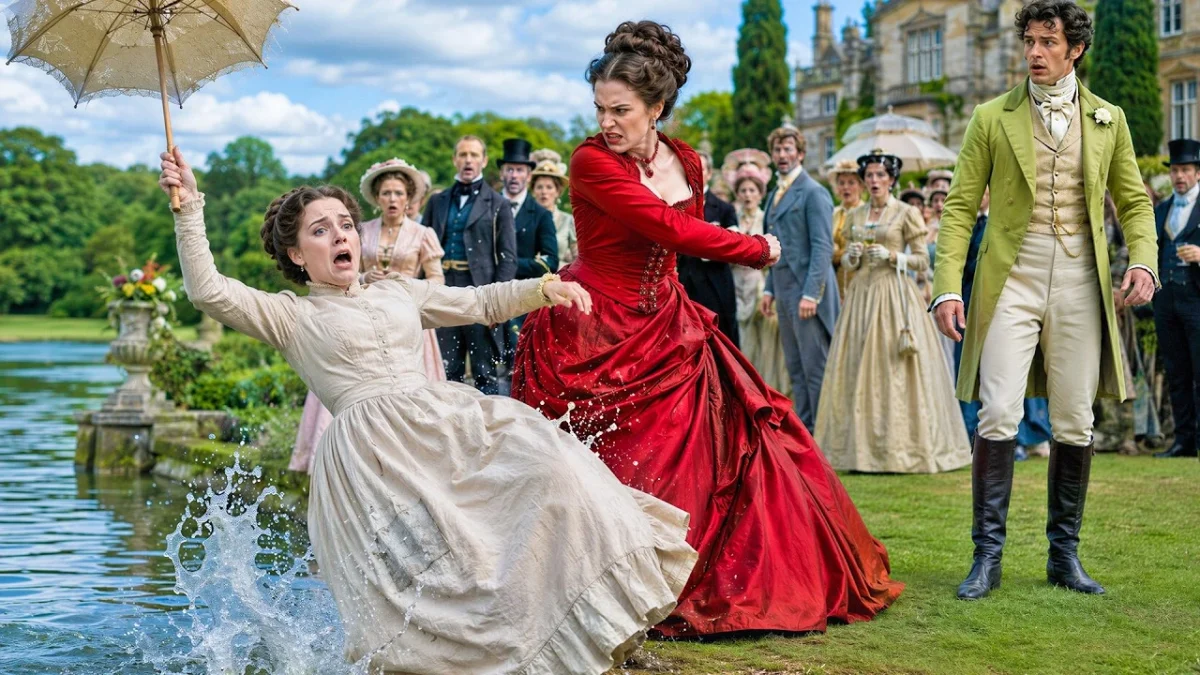
The Duke’s Fiancée Pushed Her Into the Lake at the Garden Party — She Rose and Everything Changed
Society loves a victim. They adore a weeping, fragile girl they can pity from a safe distance, tossing her crumbs of sympathy while clutching their pearls.
But what happens when the girl doesn’t weep? When she refuses, the hand offered to save her spits out the muddy water and decides she is entirely done playing by their polite, suffocating rules.
This is the story of a garden party. A petty push and a ruined dress that tore down a dukedom.
If you’ve ever been pushed too far, listen closely. The august heat was an insult.
It sat heavy over the manicured lawns of the Penhalagon estate, pressing down on the bare shoulders of young women and trapping the scent of crushed grass and expensive rose water in the stagnant air.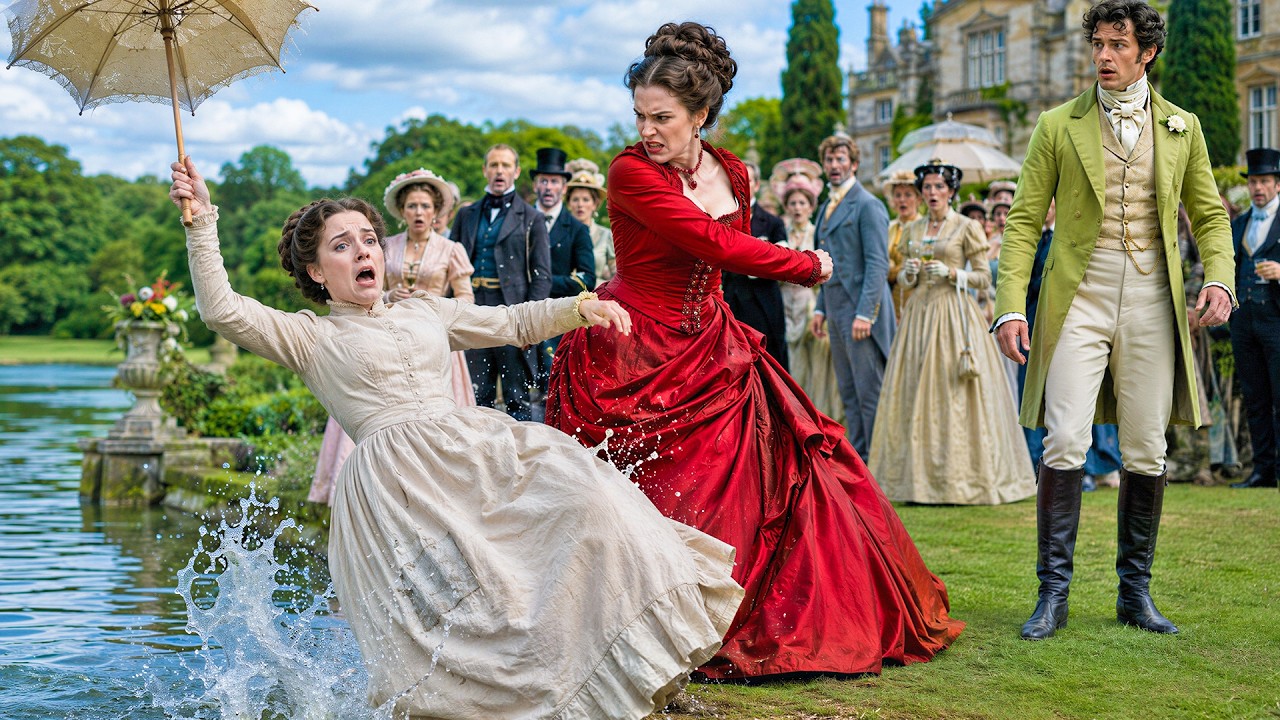
Wasps hovered lazily over towers of melting lemon tarts. Laughter rang out high and brittle, shattering the afternoon hum.
Norah Lynfield stood precisely two paces behind Victoria. That was the rule. Unspoken but ironclad.
Two paces close enough to hold the parasol, fetch the lemonade, and catch the sharp hissed complaints.
Far enough away to fade entirely into the background. Norah’s gown was wool dyed a serviceable, unremarkable gray.
It was mended at the left seam. She felt the sweat gathering at the base of her spine beneath the unforgiving corset her aunt had pulled tight that morning.
“You are a companion, Nora,” her aunt had snapped, yanking the laces. “You must look neat, but you must never look noticeable.”
Victoria, conversely, was a vision of expensive fragility. She wore a confection of pale yellow sil silk that looked as though it might dissolve if a strong wind blew.
She was beautiful in the sharp, hungry way of a falcon. And today the falcon was restless.
“He is late,” Victoria murmured, snapping her ivory fan shut. The sound was like a bone breaking.
“He is purposely late to humiliate me. The Duke has matters of estate, I am sure, Norah replied smoothly.
It was a reflex. Appease, soothe, deflect. Don’t patronize me, Norah. Victoria’s knuckles were white.
She turned, her pale eyes narrowing as they swept over Norah’s damp forehead and plain face.
You look flushed. It is incredibly unappealing. Stand further back. Norah took a half step backward.
The grass crunched beneath her worn leather boots. Henry, the Duke of Rothford, was the prize of the season, and Victoria had caught him.
It wasn’t a love match. No one in this garden was foolish enough to believe in such things.
It was an alliance of massive, sprawling wealth. Victoria brought a massive dowy. Henry brought the oldest title in the county.
They were to be married in 6 weeks, and Henry was currently 30 minutes late to his fiance’s garden party.
When he finally arrived, the atmosphere shifted. The polite chatter halted, then resumed at a frantic, buzzing pitch.
Henry walked down the stone terrace steps with the slow, measured gate of a man who knew he owned the ground beneath his boots.
He did not look like a man in love. He looked tired. He was tall, broadshouldered, and entirely unsmiling.
His dark coat was perfectly tailored, yet he wore it as though it were a uniform he despised.
Victoria’s mask of rage melted instantly into a radiant practiced smile. She drifted forward, a yellow cloud over the green grass.
“Henry, we thought you had abandoned us to the heat. A carriage wheel cracked on the turnpike, he said.
His voice was a low bar tone, rough at the edges. He took Victoria’s offered hand, bowing over it, but his lips never touched her glove.
Norah stood perfectly still. She watched the exchange with the detached cynicism of someone who survives by observing.
She saw the tightness in Henry’s jaw. She saw the way his eyes flicked past his beautiful fianceé, scanning the crowd, seeking an exit strategy before he had even fully arrived.
Then his gaze snagged on Nora. It was a brief thing. A fraction of a second, but in this society, a fraction of a second was a deafening shout.
His eyes, a stark pale gray, met hers. He looked at her mended hem, her flushed face, and the rigid, exhausted line of her shoulders.
He didn’t smile, but one dark eyebrow twitched upward, a silent acknowledgement. “You look as miserable as I feel.”
Norah looked away instantly, staring hard at the gravel path, but Victoria had seen it.
The temperature around them seemed to drop despite the blazing sun. Victoria’s smile did not falter.
But the muscles in her neck pulled tight. She dropped Henry’s hand. “Let us walk down by the ornamental lake,” Victoria declared, her voice suddenly loud, carrying over the surrounding guests.
“It will be cooler there. Nora, come.” “It wasn’t a request.” Norah fell into step, returning to her designated two paces behind.
Henry walked beside Victoria, listening to her chatter about wedding fabrics and guest lists with a blank, polite expression.
They reached the edge of the water. The lake was artificial, a vanity project of the Penhalagon family.
It was deep, choked with ulgi at the edges, and surrounded by large, slippery stone blocks instead of a natural bank.
“The water looks dreadful,” Victoria said, pausing at the very edge of the stone. She snapped her fan open again, waving it languidly.
“Nora, stand closer. You are supposed to be holding my parasol. The sun is directly in my eyes.”
Norah stepped forward. The stone beneath her boot was slick with moss. “Closer, Nora, do you want me to burn?”
Norah stepped up to the very edge of the drop. The water was a dark, murky green, reflecting the glare of the sky.
She reached out, extending the silk canopy over Victoria’s head. Henry stood slightly to the side.
He was watching the swans on the far bank, clearly entirely detached from the conversation.
“You are casting a shadow on my gown, Nora.” Victoria hissed, her voice dropping so only the two of them could hear.
The venom in it was raw. “You clumsy, pathetic creature.” Before Norah could adjust her grip, Victoria shifted.
She didn’t stumble. She didn’t trip. With deliberate, terrifying speed, Victoria brought her elbow up and shoved it hard into Norah’s rib cage.
The world tilted. Norah tried to catch herself, her boots scrabbling against the slick stone, but gravity and the weight of her heavy wool dress had already made the decision.
She fell backward. The shock of the water was a physical blow. It wasn’t the clean, refreshing splash of a summer swim.
It was cold, thick, and tasted intensely of mud and rotting vegetation. Norah plunged under, the air punched from her lungs by the impact.
Instantly, her clothing became an enemy. The heavy wool of her gown, the layered cotton pettic coats, the stiff canvas of her corset.
They drank the lake water greedily. Within seconds, her garments weighed 40 lb. They dragged her down into the murky darkness.
Panic, raw, and animalistic seized her throat. She kicked her legs, but the soaked skirts tangled around her ankles.
A heavy net pulling her toward the silty bottom. Water rushed into her ears, drowning out the bright, sunny world above.
She opened her eyes but saw only a swirl of green and brown. I am going to drown, she realized.
The thought was icy and clear. I’m going to drown in a man-made pond because Victoria didn’t like the way her fianceé looked at me.
She felt her lungs scream for air. Her chest burned against the rigid stays of her corset.
Her hands clawed blindly at the water. Then a sudden, blinding rage cut through the panic.
It was a quiet, lifelong anger. The anger of eating cold leftovers in the kitchen, the anger of being spoken to like a slow, witted child, the anger of mending the same hem three times while watching girls like Victoria throw away silk gowns because of a spilled drop of tea.
She refused to die here. She absolutely refused to let the last thing she heard be the polite, horrified gasps of the aristocracy.
Norah stopped thrashing. She let herself sink for a split second, feeling the squelch of the muddy bottom beneath her boots.
She bent her knees, planting her feet firmly in the muck. Then, with every ounce of strength left in her starved, tightly laced body, she pushed upward.
She broke the surface with a violent, agonizing gasp. Water streamed from her hair, plastering it to her skull.
Algae clung to her cheeks. She was treading water frantically, her arms burning as she fought the immense weight of her ruined dress.
She sucked in breath after ragged breath, coughing up a mouthful of foul tasting lake water.
The garden party was de@d silent. The string quartet had stopped playing. A hundred pairs of eyes were fixed on the water.
No one moved. The men in their pristine coats, the women in their pastel silks, they stood frozen on the lawn like porcelain dolls.
Above her, on the stone bank, stood Victoria. Victoria’s hands were clamped over her mouth in a pantoime of absolute horror.
“Oh, heavens!” Victoria cried out, her voice echoing too loudly in the quiet. Nora, you clumsy fool.
You slipped. Help her. Someone fetch a gardener. Norah treaded water. She didn’t cry for help.
She didn’t weep. She simply looked up at Victoria. Norah’s gaze was de@d. It held no plea for mercy, no embarrassment, no shame.
It was the lookman who had just stared death in the face and realized the world she lived in was entirely devoid of value.
She turned her eyes to Henry. The Duke stood beside his fianceé. He was not frozen like the others.
His coat was already unbuttoned, his hands gripping the lapels, preparing to strip it off and dive in.
But when Norah met his eyes, he stopped. He saw what she was feeling. He saw the cold, furious humiliation and the absolute refusal to be rescued like a stray dog.
Norah turned away from them both. She paddled heavily toward the sloped muddy side of the bank, ignoring the stone ledge where Victoria stood.
Every movement was agony. The dress was a lead weight. But she reached the shallows, her boots finding purchase in the slime.
She dragged herself upward. The water cascaded off her in sheets, turning the dry dirt of the bank into instant mud.
She stood up. It was an ugly, wretched sight. Her gray wool gown was black with water and slime.
Her hair had come unpinned, hanging in dripping ratty strings down her back. A long strand of green pondweed was draped over her shoulder.
A footman rushed forward, holding out a long pole. His face a mask of panicked pity.
Norah slapped the pole away. The sound of her hand hitting the wood cracked through the silence like a pistol shot.
The footman recoiled. Norah didn’t look at the crowd. She didn’t try to ring out her skirts or hide her face.
She kept her chin parallel to the ground. She took a step. Her boot made a loud wet shuck in the mud.
Then another step. She walked straight through the center of the garden party. The crowd parted for her like the Red Sea.
Aristocrats recoiled, pulling their delicate silks out of her path, horrified by the smell of the pond and the sheer brazen audacity of a servant who did not know how to hide her shame.
She passed Victoria. Victoria opened her mouth. Perhaps to offer a chiding reprimand. Perhaps to maintain the illusion of an accident.
You pushed me, Norah said. She didn’t shout. Her voice was raw, rasping from the lake water, but it carried perfectly.
Victoria’s pale face flushed a violent, ugly red. “You are hysterical from the cold. You tripped.
You pushed me, Norah repeated, her voice de@d, flat and absolute. She didn’t wait for a response.
She kept walking. She passed the Duke. Henry was standing perfectly still, his half unbuttoned coat hanging loose.
He watched her pass. There was no pity in his eyes. There was only a sharp, intense focus.
He was looking at her as though he had never seen a real human being before this exact moment.
Norah walked up the grand stone steps of the estate, leaving a trail of black water and mud across the pristine white marble.
She entered the house. The heavy oak doors shut behind her, cutting off the stare of the world.
The servants’s corridors in the back of the Penhaligan estate were dark and narrow. Norah left wet footprints on the floorboards, her breathing echoing in the enclosed space.
She was shivering now. The adrenaline that had hauled her out of the water was receding, leaving behind a bone deep, violent chill.
She reached her small windowless room. She closed the door and leaned against it, sliding down until she hit the floor.
She sat there in the dark, water pooling around her. She was ruined. The realization settled over her, cold and heavy.
You do not accuse a wealthy airs of attempted murder in front of the county’s elite.
You do not walk away from your betters in dripping unrepentant silence. By nightfall, nightfall, she would be fired without a character reference.
She had no money, no family willing to take in a disgraced companion, and nowhere to go.
Her life, as she knew it, was over. A sudden, sharp laugh clawed its way up her throat.
It sounded terrifying in the small room. “Good,” she thought. “Let it be over,” she stripped off the ruined dress.
It took 20 minutes of shivering, agonizing effort to undo the wet, swollen laces of her corset.
She left the soden pile of wool and canvas on the floor like a de@d body.
She dried herself roughly with a thin towel and dressed in her only other garment, a faded highcoled morning dress she kept packed away.
It was slightly too large, but it was dry. She shoved her few possessions, a comb, two books, a meager coin purse into a small canvas satchel.
She did not bother to pin her hair back up. She simply braided the damp mass of it down her back.
She left the room and walked out through the kitchens. The servants stared at her, wideeyed and silent.
News traveled faster than water on a sloped roof. They knew what she had done.
Norah walked out the back door onto the gravel path that led away from the estate and toward the village.
She didn’t know where she was going. She only knew she was never going back.
She had made it perhaps a quarter of a mile down the shaded oaklinined avenue when she heard the sound of approaching hooves.
She didn’t stop. She moved to the side of the road to let the rider pass.
The horse slowed, the crunch of gravel loud in the quiet late afternoon. A large black geling stepped into her peripheral vision and stopped.
Norah stopped. She looked up. Henry, the Duke of Rothford, sat in the saddle. He had rebuttoned his coat.
He looked down at her, his expression unreadable. For a long moment, neither of them spoke.
The wind rustled the oak leaves above them. “You are leaving,” Henry said finally. “It wasn’t a question.”
“I am fired, your grace,” Norah replied. Her voice was steady, though her hands hidden in the folds of her dress, were shaking slightly from the lingering cold.
It saves time to depart before the carriage is called to throw me out. Henry dismounted.
He moved with a fluid, heavy grace. He tied the res to a low branch and turned to face her.
In the dappled sunlight, she could see the faint lines of exhaustion around his eyes.
“She pushed you,” he said. Norah stiffened. She expected a reprimand. She expected him to demand a retraction to protect his fiance’s honor.
I know what happened, your grace. If you have followed me to demand an apology on her behalf, you can save your breath.
I have nothing left to lose, which means I have no reason to lie. I didn’t ask for an apology.
Henry took a step closer. He was much taller than her, casting a long shadow.
I saw her shoulder drop. I saw the angle of her elbow. I know she pushed you.
Norah blinked. The absolute certainty in his voice threw her off balance. Then why are you here?
Go back to your garden party. Go back to your bride. My bride, Henry repeated.
The words tasted like ash in his mouth. He looked away, staring down the long empty road.
My bride threw a woman into a lake because she thought I looked at her for two seconds too long.
A valid concern, clearly. Norah snapped entirely out of patience. Since here you are, alone on a road with a disgraced companion.
Henry’s eyes snapped back to hers. A faint, bitter smile touched the corner of his mouth.
It transformed his face, making him look suddenly dangerous. You have a sharp tongue, Miss Lynfield.
I suppose nearly drowning washes away one’s manners. Manners are for people who can afford them.
Norah tightened her grip on her satchel. If you’ll excuse me, Duke, I have a long walk to the village.
She tried to step around him. He shifted, blocking her path, not threateningly, but immovably.
Where will you go? He asked. That is none of your concern. You have no money, no references.
The Penhaligans will ensure you never find employment in this county or the next. His voice was blunt.
He wasn’t being cruel. He was laying out the tactical reality of her situation. It was the same math Nora had been doing in her head.
I will manage. You will starve. Then I will starve honestly. Norah’s voice finally cracked, the anger flaring hot and bright.
She stepped into his space, tilting her head back to glare up at him. What do you want from me?
Did you come out here to mock me? To alleviate your own guilt? You are marrying a monster.
You know exactly what she is, and you are marrying her anyway because her father has land you want.
You are no better than she is. Now get out of my way. She braced herself, waiting for the aristocratic rage.
Men of his station did not tolerate being spoken to like that, but Henry didn’t yell.
He didn’t strike her. He looked at her with a profound, terrifying intensity. The cynical armor he wore at the party was entirely gone.
He looked at her wet, braided hair, her pale, furious face, and the rigid, unyielding line of her spine.
“You’re right,” Henry said quietly. Norah froze. “What?” “You are exactly right,” Henry stepped back, running a hand over his jaw.
“I am marrying a monster for land. I have spent the last 5 years playing a miserable, suffocating game, smiling at people I despise, ignoring cruelty because it is polite to do so.
He looked back at her. The gray in his eyes was like storm clouds. “Then I watched you climb out of that water,” he said, his voice dropping low.
“I watched you stand dripping in the mud and refused to cry. You shattered the entire illusion in 30 seconds.
It was the most beautiful thing I have ever seen. Norah’s breath hitched. She tightened her grip on her bag, her knuckles turning white.
You are mad. Perhaps. Henry untied his horse. He didn’t mount. He stood holding the rains, looking at her across the dirt road.
I am riding to the village. I will secure a room for you at the inn.
I will pay for it. I don’t want your charity. It isn’t charity. It is a delay.
Henry swung himself up into the saddle. He looked down at her, and for the first time he looked entirely alive.
Stay at the inn, Miss Lynfield. Do not leave the county. Give me three days.
Three days for what? Norah demanded, stepping forward as the horse shifted to tear it all down, Henry said.
He turned the horse and spurred it into a gallop, riding back toward the estate he had just claimed he was going to destroy, leaving Norah standing alone in the dust.
The room at the bore and whistle smelled of beeswax, old smoke, and the faint sour ghost of spilled ale.
It was small, tucked under the eaves of the roof, with a single window that looked out over the muddy main street of the village.
For two days, Norah had listened to the rain lash against the leaded glass. The inkeeper, a wide-hipped woman named Mrs.
Higgins, had asked no questions when Norah arrived, dripping wet and shivering. The Duke’s gold coin, handed to the woman by a tacetern groom an hour prior, had purchased absolute discretion, and a tin tub of hot water.
But hot water did not wash away reality. Norah paced the slanted floorboards. Three steps to the wall, turn.
Three steps to the bed, turn. She had washed her morning dress in the basin and hung it to dry, spending the first day wrapped in a scratchy wool blanket.
She felt like a ghost haunting her own life. Give me three days. The words echoed in her skull, alternating between a promise and a cruel joke.
Aristocrats did not tear down their lives for disgraced companions. They married their wealthy, vicious brides, secured their estates, and occasionally kept a mistress in a discrete townhouse.
Henry was a man trapped in a gilded cage of his own making. He might have rattled the bars on the road, but men like him didn’t break the locks.
They had too much to lose. By the morning of the third day, the rain stopped, leaving the village steeped in a thick, clinging fog.
Norah dressed. The black gown was stiff from the soap, the collar scratching her neck.
She walked downstairs to the tap room. The morning crowd was sparse, a few farmers drinking small beer, a merchant complaining about the roads.
The chatter died the moment her boot hit the bottom stair. Norah kept her spine rigid.
She walked to the counter. Mrs. Higgins, I require a seat on the male coach to London tomorrow morning.
The inkeeper wiped a rag across the scarred wood, not meeting Norah’s eyes. Coach is full, Miss Lynfield.
It is a Tuesday. The coach is never full on a Tuesday. Mrs. Higgins sighed.
A heavy, tired sound. She leaned over the bar. Word came down from the Penhalagan estate yesterday noon.
The steward himself wrote through, “Anyone who aids you, hires you, or transports you loses the Penhalagon business.
I took the Duke’s coin for your room, and I’ll honor the three knights. But I can’t sell you a ticket.
I have a family to feed.” The trap had sprung. Victoria had not merely fired her.
She was starving her out. It was a sterile, bloodless execution. “I understand,” Norah said.
Her voice did not shake. She would not give them the satisfaction of a tremor.
She turned and walked back up the stairs. In her room, she sat on the edge of the narrow bed and opened her canvas satchel.
She counted her coins. She had enough to walk to the next county and buy perhaps four loaves of bread.
She would leave at dawn. She did not need a carriage, and she certainly did not need a duke.
She was Norah Lynfield. She had survived cold houses, cruel ants, and the bottom of a lake.
She would survive the road. She spent the rest of the day packing her meager belongings, folding the damp towel, ignoring the hard, tight knot of betrayal forming in her chest as the sun began to set on the third day.
He was not coming. She was angry at herself for ever believing he would. Henry sat in the leather wing back chair in Lord Richard Penhaligan’s private study.
He did not lean back. His posture was impeccable, his expression entirely devoid of emotion.
Across the mahogany desk, Richard’s face was the color of bruised plum. Victoria stood by the fireplace, her hands twisted in the silk of her skirt, her pale eyes darting frantically between her father and her fianceé.
“You are breaking the contract,” Richard spart, slamming a fist onto the desk. The crystal inkwell rattled.
“Over a clumsy servant, over a hysterical misunderstanding by a pond? You are making a mockery of both our houses, Rothford.
I am breaking the contract, Henry said, his voice quiet, because the contract stipulates that the Penhallagan estate holds unencumbered deeds to the Cornwall mines.
My solicitors spent the last 48 hours examining those deeds. They are heavily mortgaged to a bank in Geneva.
Richard’s face drained of color. The violent purple faded into a sickly chalky white. Henry steepled his fingers.
He had not slept in two days. He had ridden his horse halfway to death, reaching his own estate, summoned his men of business, and tore through the financial agreements with a vicious, meticulous hunger.
He had been looking for a crack in the foundation. He found a sinkhole. “You lied, Richard,” Henry continued, his tone conversational.
You presented an illusion of immense wealth to secure a ducal title for your daughter.
In reality, you are three bad harvests away from DA’s prison. The dowy you promised does not exist.
Henry, please. Victoria stepped forward, her voice trembling. The aristocratic mask had shattered, revealing the desperate, frightened girl underneath.
It was a mistake. My father was going to tell you, “Do not speak to me,” Henry said.
He didn’t raise his voice. He didn’t even look at her. But the absolute zero temperature of your command struck Victoria like a physical blow.
She recoiled, pressing her back against the marble mantelpiece. “The servant,” Richard choked out, trying to rally.
“This is about the companion. You are using the minds as an excuse. The minds are the legal mechanism, Henry corrected smoothly.
He stood up. He buttoned his coat. An agonizingly slow, deliberate movement. The reason is that your daughter is a cruel, petty creature who lacks the basic humanity I require in a wife.
She pushed a woman into a lake to drown because of her own profound insecurity.
She is a nobody. Victoria shrieked, the panic finally giving way to venom. She is a penniless companion.
You would throw away a dukedom’s alliance for a gray mouse who cleans my shoes.
Henry finally looked at her. She looked death in the face and walked away with her spine straight.
You would weep if you broke a fingernail. You are not her equal, Victoria, and you will certainly never be mine.”
He reached into his breast pocket and tossed a thick envelope onto the desk. “My solicitors will file the breach of contract tomorrow morning,” Henry said to Richard.
“The news of your insolveny will hit the London clubs by Thursday. Your creditors will come calling by Friday.
I suggest you begin packing.” He turned and walked toward the heavy oak doors. “You are ruining us,” Richard bellowed.
You will destroy my family. Henry paused, his hand on the brass doornob. He looked back over his shoulder, his gray eyes flat and hard.
Yes, he said. He opened the door and walked out, leaving the Penhalagon Empire in ashes behind him.
The knock on the in room door came at 10 minutes 9. Norah was fully dressed, her satchel tied shut on the bed.
She had been staring at the candle flame, watching the wax pool and drip. When the wood rattled, she froze.
It was a heavy commanding knock, not the inkeeper. Norah walked to the door and pulled the latch.
Henry stood in the narrow, dim hallway. He looked terrible. His dark coat was wrinkled.
His creat was untied, hanging loose around his collar, and there was a streak of mud on his boots.
The exhaustion he had carried at the garden party had deepened, carving harsh shadows under his cheekbones.
He did not look like a duke. He looked like a man who had survived a shipwreck.
He looked at the satchel on the bed, then back to Nora. You were leaving.
The three days are up at dawn. Norah said she kept her chin high, though her pulse was hammering against her ribs like a trapped bird.
And your former fiance has made it impossible for me to buy a coach ticket.
I was preparing to walk. Victoria is no longer my fianceé,” Henry said. Norah stopped.
The silence in the small room stretched tight, vibrating with the weight of the words.
She searched his face for a lie, for a cruel punchline. She found nothing but stark, brutal honesty.
“You broke the contract. I tore it to pieces. Henry stepped into the room. He closed the door behind him, leaning against the wood as though his legs could no longer support him.
I found financial discrepancies. Lord Penhallagan is effectively bankrupt. The engagement is dissolved, and by tomorrow, society will be entirely too focused on their ruin to remember a ruined dress at a garden party.
Norah stared at him. Her mind, usually so sharp and pragmatic, struggled to process the sheer scale of the destruction he had just casually described.
“You destroyed a family to prove a point. I destroyed a family because they were rotten to the core,” Henry corrected, his voice raspy.
“I simply used the tools they handed me.” He rubbed a hand roughly over his face.
“I am entirely sick of the rot, Nora. It was the first time he had used her given name.
It slipped out naturally, devoid of title or station. He walked toward the single wooden chair in the corner of the room and collapsed into it, staring at the floorboards.
They expect us to be marble statues, he said, speaking to the empty air as much as to her.
They expect us to marry for land, smile at our enemies, and crush anyone who stands lower on the staircase.
I have done it for 5 years or since my father died. I played the game perfectly, and I was dying.
He looked up at her. The storm clouds in his eyes were gone, replaced by a desperate, grounding clarity.
“Then I saw you in the water,” he said softly. You were covered in mud and algae.
You were ruined. And you did not care. You looked at the entire aristocracy and decided they were not worth your tears.
They aren’t, Norah said fiercely. I know. Henry leaned forward, resting his elbows on his knees.
I am 28 years old. I possess three estates, a title that dates back to the conqueror.
And until three days ago, I had never made a single genuine choice in my life.
You freed me, Norah’s throat tightened. She took a step back, crossing her arms defensively.
I did nothing but refuse to drown. Do not make me a symbol of your rebellion, your grace.
I am a woman who needs employment and a hot meal, not a pedestal, Henry laughed.
It was a real laugh, rough and startled, breaking the tension in the room. God, you are pragmatic.
He stood up. He walked toward her, stopping exactly two paces away. The unspoken rule of her old life.
But this time it was a boundary of respect, not servitude. I am not making you a symbol, Henry said.
I am making you an offer. Norah narrowed her eyes. I will not be your mistress.
I don’t care how many estates you own. I would rather walk to London and scrub floors.
I am entirely aware of that,” Henry said. A faint smile touched his lips. “And you would be a terrible mistress.
You would correct my posture and complain about the cost of the wine.” “I absolutely would, Nora.”
The humor faded, leaving something intense and terrifyingly vulnerable in its wake. I am going to Scotland, to my estate in the Highlands.
It is cold. It is isolated, and society does not care to travel that far north.
I am leaving this circus behind. He reached into his pocket and pulled out a small folded piece of parchment.
He held it out to her. This is a special license, Henry said. Procured yesterday from a very expensive, very discreet bishop.
Norah looked at the paper, then up at his face, her breath hitched. “You are mad.
We established that on the dirt road 3 days ago. I am a companion,” she whispered, the reality of the world finally crashing against the walls of the tiny inn room.
“I have no dowy. I have no bloodline. The ton will tear you to pieces.
Let them try, Henry said, his voice hardening into steel. Let them talk in their drawing rooms.
We won’t be there to hear it. I need a partner, Nora, not a porcelain doll, to stand in the corner.
I need someone who knows how to survive. Someone who isn’t afraid of the mud.
He took the final step, closing the distance between them. He didn’t touch her, but his presence was overwhelming.
The heat of him, the scent of rain and horses, the absolute terrifying reality of what he was offering.
“Marry me,” Henry said. It wasn’t a question, and it wasn’t a command. It was a plea.
“Come to Scotland. Tear down the rest of the world with me. The church was entirely devoid of romance.”
It was a squat, damp stone building on the edge of the village, smelling sharply of mildew and old wax.
The sun had not yet risen, leaving the nave plunged in a cold, slate gray twilight.
Nora stood before the altar in her faded morning dress. She carried no flowers. Her hair was pulled back into a severe practical knot.
She looked less like a bride and more like a woman standing before a firing squad.
Beside her, Henry was a tall, dark shadow. He had paid the vicar double the exorbitant fee of the special license simply to get the man out of bed before dawn.
The vicar, a sleepy, nervous man with a terrifying combo, stumbled through the liturgy as though he were reading a grocery list.
Do you, Henry, take this woman? Norah stared at the cracked stone floor. The sheer absurdity of it tasted metallic in her mouth.
Less than a week ago, she was counting the coppers in her purse to see if she could afford a meat pie.
Now she was swearing an oath to the wealthiest man in the county. It felt like a trap.
It felt like standing on the edge of the ornamental lake all over again, waiting for the shove.
I do, Henry said. His voice was not loud, but it resonated in the empty church.
It was utterly devoid of hesitation. Norah looked up at him. The dim light caught the sharp angle of his jaw, the dark circles under his exhausted eyes.
He wasn’t looking at the vicar. He was looking at her. He didn’t look triumphant.
He looked like a man who had just severed his own leg to escape a bear trap.
He looked entirely free. And do you, Nora? She swallowed hard. She thought of Victoria’s vicious, triumphant sneer.
She thought of the cold, muddy water. She thought of the suffocating endless years of shrinking herself down to fit into the shadows of drawing rooms.
“I do,” Norah said. Her voice did not shake. He slid a heavy gold band onto her finger.
It was an antique piece pulled from a vault slightly too loose on her thin finger.
It felt incredibly heavy. They walked out of the church into the biting morning air.
A black traveling carriage waited by the iron gates, harnessed to four massive restless grays.
The coachman sat huddled in a heavy cloak. There was no crowd. There was no throne rice.
There was only the crunch of frost beneath their boots. We ride for 4 days, Henry said, opening the heavy wooden door for her.
We will stop only to change the horses and sleep. The goal is to cross the Scottish border before the news breaks in London.
Running away your grace. Norah asked dryly, lifting her dark skirts to step up into the carriage.
Henry climbed in after her, shutting the door with a solid final thud. Tactical retreat, your grace.
The carriage lurched forward. The first two days were a masterclass in silent endurance. They sat opposite each other as the rolling green hills of the south gave way to the rugged, broken terrain of the north.
They were strangers who had committed mutual social suicide. The adrenaline of the rebellion had faded, leaving behind the crushing weight of reality.
Norah stared out the window, watching the rain streak the glass. She felt the constant nagging urge to offer him a pillow, to ask if he required a drink, to shrink into the corner.
It was the muscle memory of servitude. Every time she caught herself doing it, she forced her spine straight and clamped her mouth shut.
Henry spent most of the time reading through a stack of leatherbound ledgers he had brought from his estate.
Occasionally he would look up and stare at her, not with malice, and not with the predatory hunger of an aristocrat with a new toy.
He studied her as though she were a complex mathematical equation he was trying to solve.
On the evening of the third day, the carriage hit a washed out section of the turnpike in Yorkshire.
The lurch was violent. The carriage pitched sideways with a deafening crack of splintering wood, throwing Norah hard against the upholstered wall.
The horses screamed. The carriage slid through deep, sucking mud, tilting precariously at a 45° angle before shuddering to a violent halt.
“Stay here,” Henry ordered, pushing himself off the floor. He kicked the door open, the wood scraping against the embankment, and climbed out into the pouring rain.
Norah did not stay. She waited exactly 10 seconds. Then she gathered her skirts, shoved the heavy door open wider, and climbed out into the deluge.
The scene was chaos. The right rear wheel was buried to the axle in thick red clay.
The lead horse was thrashing, its hooves slipping on the slick road, tangling the leather traces and threatening to pull the entire rig into the ditch.
The coachman, a young man named Thomas, was shouting uselessly, entirely overwhelmed. Henry was kneede in the mud, wrestling with the panicked lead horse, trying to grip the bridal while the animal reared.
Norah didn’t scream. She didn’t faint. She waded straight into the mud. The cold rain plastered her hair to her face instantly.
Her ruined boots sank deep into the clay. She walked directly to the second horse, the wheel horse that was feeding the panic to the leader.
She grabbed the heavy leather harness near the collar. “Hold steady,” she yelled over the wind.
She didn’t use a soothing, delicate voice. She used the sharp commanding bark of a woman who had grown up wrangling dogs and drunken stable boys before her aunt forced her into service.
She slapped the horse’s muscular neck hard. Stand stand still, you massive idiot. The horse snorted, shocked by the sudden violent authority.
It stopped thrashing. With the wheelhorse stilled, Henry managed to drag the leader’s head down, forcing it to plant its hooves.
The terrible rocking momentum of the carriage ceased. Panting, Henry wiped a hand across his face, smearing mud across his cheekbone.
He looked at Nora. She was a disaster. Her black morning dress was coated in thick red clay up to her knees.
Her knuckles were white where she gripped the harness. Rain streamed down her pale face.
She looked back at him. “Are you going to stare at me, Henry, or are you going to help Thomas unhitch the team before the axle snaps entirely?”
Henry blinked. A slow, incredulous grin spread across his face, entirely changing the architecture of his features.
“It made him look reckless. It made him look young.” “Yes, your grace,” he said.
They spent the next hour in the freezing rain. Henry and Thomas unhitched the horses and used a massive fallen branch as a lever to pry the wheel out of the sinkhole.
Norah did not go back inside the carriage. She stood in the mud, holding the bridles of two massive draft horses, murmuring to them in the dark to keep them calm.
When they finally dragged the carriage back onto solid road, they were soaked to the bone and shivering uncontrollably.
They climbed back into the dark cab. Thomas cracked the whip and the carriage lurched slowly forward.
Norah sat on the velvet bench. She was freezing. Her teeth were chattering so hard her jaw achd.
She crossed her arms, trying to generate a fraction of warmth. A heavy wet wool coat was thrown over her shoulders.
She looked up. Henry had taken off his overcoat. He moved across the carriage, abandoning his side, and sat directly next to her.
The carriage was not small. There was no need for him to sit that close.
“You will freeze,” Norah said, her voice shaking. “I run hot,” Henry replied bluntly. “He didn’t ask permission.”
“He reached over, grabbed her freezing, mudcaked hands, and folded them between his own large, calloused palms.
He wasn’t trying to be romantic. It was a purely practical attempt to transfer body heat Norah stiffened.
The intimacy of it, the sheer physical reality of sitting hip-to- hip with a duke in the dark, his hands wrapped around hers, was entirely overwhelming.
“You ruined another dress,” he noted softly, his thumb brushing over the dried clay on her knuckles.
“I seem to make a habit of it around you. I will buy you a 100 dresses, Nora.
I don’t want a hundred dresses, she said fiercely, pulling her hands back slightly. I don’t want silk, and I don’t want a maid to brush my hair, and I don’t want to host tea parties for women who would sell their own children for a better title.
Henry let her hands go, but he didn’t move away. He leaned his head back against the carriage wall, looking at her in the dim light.
“What do you want, then?” He asked. Norah stared at him. She thought about it.
She realized for the first time in her entire life, someone was asking her what she wanted, and they actually possessed the power to give it to her.
I want ground that doesn’t shift beneath my feet, she said quietly. I want to be looked at, not seen through.
I want a house where I don’t have to apologize for breathing the air. Henry held her gaze.
The cynicism in his eyes was completely gone. “Done,” he said. “They didn’t speak for the rest of the night, but he didn’t move back to his side of the carriage.
When Norah finally fell asleep from sheer exhaustion, her head drifted sideways, coming to rest against his shoulder.”
Henry didn’t move her muscle for the next 100 miles. Loavan was not a delicate, manicured country house.
It was a fortress built in the 16th century on a jagged cliff overlooking a vast black lock.
The estate was made of dark gray stone that seemed to absorb the weak Scottish sunlight.
The wind howled relentlessly around the turrets. Inside it was a maze of drafty corridors, massive fireplaces, and tapestries faded by centuries of woodsm smoke.
When the carriage pulled into the courtyard, there was no line of polished servants waiting to greet them.
There was only an elderly groom and Mrs. Gordon, the housekeeper. Mrs. Gordon was a formidable woman, built like a brick wall with iron gray hair and eyes that missed absolutely nothing.
She stood on the stone steps, her hands folded over a spotless white apron, staring at the mud splattered carriage with deep suspicion.
Henry handed Norah down. Norah’s boots hit the cobblestones. She was exhausted, filthy, and wearing a ruined morning dress.
She looked entirely feral. “Mrs. Gordon,” Henry said, his voice carrying over the wind. “This is Nora, the Duchess of Rothford.”
“My wife,” Mrs. Gordon’s eyes flicked from Henry to Nora. She didn’t gasp. She didn’t curtsy instantly.
She assessed. She looked at Norah’s mended muddy hem, the lack of a maid, and the severe unadorned braid down her back.
Then she looked into Norah’s eyes. Norah didn’t shrink. She didn’t try to look regal or apologize for her appearance.
She met the housekeeper’s hard gaze with equal flint. “We require hot water,” Mrs. Gordon, Norah said, her voice steady and clear.
A great deal of it. And whatever food can be prepared quickly. We have been on the road for 4 days.
Mrs. Gordon’s mouth twitched. It wasn’t a smile exactly, but it was an acknowledgement. She gave a short, crisp nod.
I Your grace. I’ll have the copper tubs brought up to the master suite. Separate rooms if you please, Mrs.
Gordon. Norah corrected smoothly. She felt Henry look at her, but she kept her eyes on the housekeeper.
We are both too exhausted to share quarters tonight. Very good your grace, Mrs. Gordon finally curtsied.
The first month at Lockavan was a quiet, brutal war of attrition. Norah had expected resistance from the staff.
She had expected sneers behind her back. But the Highlanders were pragmatic people. They didn’t care about the London season.
They cared that the roof leaked in the West Wing and that the Duke had neglected the estate for 5 years.
Norah didn’t play the delicate aristocrat. On her third day, wearing a simple woolen skirt and a heavy sweater, she walked into the steward’s office, sat down at the massive oak desk, and demanded the ledger books.
She spent two weeks deciphering the abysmal recordkeeping. She found discrepancies. She found where grain was rotting in improperly sealed silos.
She found tenants who had been overcharged for winter fuel. She didn’t scream or throw tantrums.
She simply called the men into the office and dismantled their excuses with cold, terrifying logic, backed by years of managing a household budget on practically nothing.
She was not feared because she was cruel. She was feared because she was competent.
Henry watched it all happen from a distance. He spent his days riding the boundaries of the estate, breathing the sharp, freezing air.
Letting the sheer silence of the Highlands bleed the poison of London out of his veins.
He had expected Norah to hide in her rooms. He had expected her to be overwhelmed.
Instead, he found her in the kitchens showing a scullery made a trick for getting rust out of cast iron.
He found her in the library, a smudge of ink on her nose, ruthlessly organizing a chaotic pile of legal documents.
They lived in the same massive house, but they circled each other like two solitary wolves, assessing a new pack structure.
The shift happened in late October on a night when the wind was shrieking off the lock, hurling sleet against the thick glass of the library windows.
Henry was sitting in a leather wingback chair by the massive stone fireplace, nursing a glass of amber whiskey.
Norah was at the desk, surrounded by papers, the light of a single candalabra catching the loose strands of hair that had escaped her braid.
The roof on the Mloud tenant farm needs replacing before the snow sets in,” Norah said, not looking up from her ledger.
“I have authorized the purchase of slate from the village quarry. You don’t need to ask my permission,” Norah.
“I wasn’t asking permission,” she replied flatly. I was informing you of an expenditure. It’s an expensive one.
It will drain the quarterly surplus. Henry took a sip of his whiskey. He watched the way the fire light cast shadows across her throat.
And what if I had wanted that surplus for something else. Norah finally dropped her pen.
She turned in the chair to face him. Her eyes were dark and tired, but the fire was still there.
Then you should have managed your own estate, Henry, she snapped. Because I will not allow people to freeze to death on your land while I sit in a warm house drinking imported tea.
She expected him to bristle. An aristocrat’s pride was a fragile, dangerous thing. Instead, Henry smiled.
He set his glass down on the side table. He stood up slowly. He crossed the heavy Persian rug, moving with that deliberate predatory grace that had terrified her at the garden party.
Norah’s breath hitched. She instinctively pushed her chair back a fraction of an inch. Henry stopped at the edge of the desk.
He leaned over, planting both hands flat on the oak surface, trapping her between his arms.
He was close enough that she could smell the woods smoke on his clothes and the sharp heat of the whiskey on his breath.
I am not Richard Penhaligan, Henry said, his voice dropping to a low, dangerous gravel.
And I am not your aunt. You don’t have to fight me for every inch of ground.
Nora, I gave it all to you the moment I put that ring on your finger.
Norah stared up at him. Her heart was hammering a frantic rhythm against her ribs.
I don’t know how to do anything else but fight. I know. He lifted his right hand.
He didn’t grab her. He slowly, deliberately brushed the back of his knuckles against her cheek.
The touch was electric. Norah gasped softly, her eyes fluttering shut for a fraction of a second.
She had been starved of human warmth for so long that the simple friction of his skin felt like a branding iron.
“You survived, Nora,” Henry whispered, his thumb trailing down her jawline. Resting against the frantic pulse in her throat.
The war is over. You can put the armor down. Norah opened her eyes. She looked at the man who had torn down an empire to pull her out of the mud.
She saw the absolute uncompromising hunger in his gray eyes. But beneath it, she saw a desperate need for the exact same thing she wanted, an anchor.
She reached up and grabbed the lapels of his coat. She didn’t wait for him to lean in.
She pulled him down to her. The kiss was not gentle. It wasn’t a polite drawing room brush of lips.
It was a collision. It was months of tension, anger, and suppressed adrenaline. Finally finding a release valve.
Henry made a low, rough sound in the back of his throat. He hauled her out of the chair, his arms wrapping entirely around her waist, lifting her feet off the ground as he backed her into the heavy oak desk.
Norah’s hands tangled in his dark hair. She kissed him with the same vicious, terrifying desperation she had used to drag herself out of the lake.
She tasted whiskey and smoke, and she felt the hard, unyielding muscle of his shoulders beneath his coat.
He wasn’t fragile. He wouldn’t break. He kissed her jaw, his mouth trailing down her neck, his breathing heavy and ragged in the quiet library.
“Nora,” he breathed against her skin. “My God, Nora, you said separate rooms,” she managed to gasp out, her hands gripping his shoulders as if he were the only solid thing in the world.
Henry pulled back slightly. His eyes were entirely black. I said that for Mrs. Gordon’s benefit.
I am rescending the order. Norah let out a sharp, breathless laugh. You are the Duke.
You can do as you please. No, Henry said softly, brushing a stray lock of hair from her face.
I am only doing what my duchess commands. By December, Lochavan was buried under 3 ft of snow.
The lock had frozen solid. A sheet of black ice reflecting the stark winter sky.
Inside the keep, the fires roared day and night. They had settled into a rhythm that was entirely their own.
There were no dinner parties. There was was no polite society. They spent their days managing the massive estate, arguing over crop rotations and tenant laws, and their nights tangled in the heavy wool blankets of the master bed, learning the geography of each other’s scars.
Norah had filled out. The hollows in her cheeks had faded, replaced by the sharp, healthy flush of the highland winds.
She wore her hair down more often than not, a dark mane that Henry spent hours running his hands through.
She was no longer a shadow. She was the absolute center of the house. The outside world intruded only once.
It was a cold, bright Tuesday. The post rider managed to force his way through the snow drifts, carrying a heavy leather satchel.
Norah was in the drawing room, sitting on the rug in front of the fire, reviewing a list of winter supplies.
Henry sat in the armchair behind her, reading a book, his hand casually resting on her shoulder.
Mrs. Gordon entered, carrying a silver tray. On it sat a single thick envelope made of expensive cream vellum sealed with red wax.
From London, your grace, the housekeeper said. Henry took the letter. He broke the seal, unfolded the heavy paper, and read.
Norah watched his face. She felt a sudden cold spike of dread. Was it Parliament?
Was it the crown? Was the scandal finally reaching out its long aristocratic claws to drag them back?
Henry finished reading. His expression remained entirely neutral. He handed the letter down to Nora.
She took it. The handwriting was sharp and looping, a society gossip he had once known.
The absolute scandal of the season, Henry. Richard Penhallagan has fled to Cal to escape his creditors.
The estate was auctioned last month. It was entirely pathetic. Victoria, left with nothing, has hastily married Baron Hemlock.
You remember him? The man with the gout and the three dreadful chins who lives in that damp manner in Sussex.
They say she cried through the entire ceremony. Norah stopped reading. She looked at the elegant script.
She thought about Victoria. She thought about the pale yellow silk, the vicious shove, the desperate, clawing need to be superior at all costs.
She pictured Victoria trapped in a damp Sussex manor with an old man, her youth and beauty rotting away in bitter poverty.
Revenge, Norah realized, was not hot. It was incredibly, profoundly cold. Do you feel sorry for her?
Henry asked quietly. Norah looked at the fire. No, I feel nothing for her at all.
She is a ghost. She took the heavy cream vellum, folded it carefully, and tossed it into the roaring hearth.
The flames licked the edges, curling the paper until the red wax melted, and the words turned to black ash, disappearing up the chimney.
Good, Henry said. He slid off the armchair, sitting on the rug behind her. He wrapped his arms around her waist, pulling her back solidly against his chest.
He rested his chin on the top of her head. “I don’t want ghosts in my house.”
Norah leaned back into him. The heat of him seeped through her woolen dress. She looked out the massive window at the frozen, wild landscape.
“Are you ever going back?” She asked. To London, to your seat in the house someday, perhaps, Henry murmured.
When I feel like arguing with fools, but not soon. I have everything I require right here, he turned her slightly, forcing her to look at him.
Do you miss it? The South? I miss absolutely nothing about the South, Norah said fiercely.
I spent my entire life trying to disappear so that they wouldn’t hurt me. I am done disappearing.
You couldn’t disappear if you tried, Nora. You take up the entire room. He kissed her deep and slow, tasting of tea and the sharp winter air.
It was a kiss anchored in absolute certainty. There was no desperation left in it, no frantic rebellion.
It was the kiss of a man who had built a fortress around the only thing he truly valued.
That afternoon, the snow stopped falling. The sky cleared to a piercing, brilliant blue. Norah threw on a heavy cloak and walked out the heavy oak doors, boots crunching through the deep snow.
She walked down the winding path toward the edge of the lock. The air was so cold it burned her lungs, but it was clean.
Henry walked beside her, their gloved hands linked together. They reached the shoreline. There were no manicured lawns here.
There were no towers of lemon tarts, no string quartets, no whispered judgments behind ivory fans.
There were only jagged black rocks, ancient pines bending under the weight of the snow and the vast, silent expanse of ice.
Norah walked right to the edge of the water. She stood on the stones. She remembered the suffocating weight of the algae, the panic of the corset, the taste of the mud.
She remembered looking up at the aristocrats who watched her drown without moving a muscle.
She looked at the frozen lock. It was wild, dangerous, and entirely beautiful. She turned to Henry.
He was watching her, the wind whipping his dark hair. He didn’t look like a duke standing on his estate.
He looked like a man standing beside his equal. Norah squeezed his hand. She didn’t need to say anything.
The silence between them was no longer a cage. It was an architecture they had built together.
She had been pushed into the dark, but she had risen, and she had dragged a king down to the earth to stand beside her.
Society loves a scandal, but they despise a survivor. They want you to drown quietly so they can mourn you beautifully.
Norah refused to play the victim, and in doing so, she shattered an empire and claimed a kingdom.
The mud washes off, but the spine you build at the bottom of the lake lasts forever.
If you’ve ever stopped shrinking to fit into rooms that don’t deserve you, hit that like button.
Share this story with someone who needs to remember their own strength. And subscribe for more deep, emotional dramas.
Your kingdom is waiting.








