The Duke Thought His Bride Brought Nothing—Then She Arrived With the Debt That Built His Estate
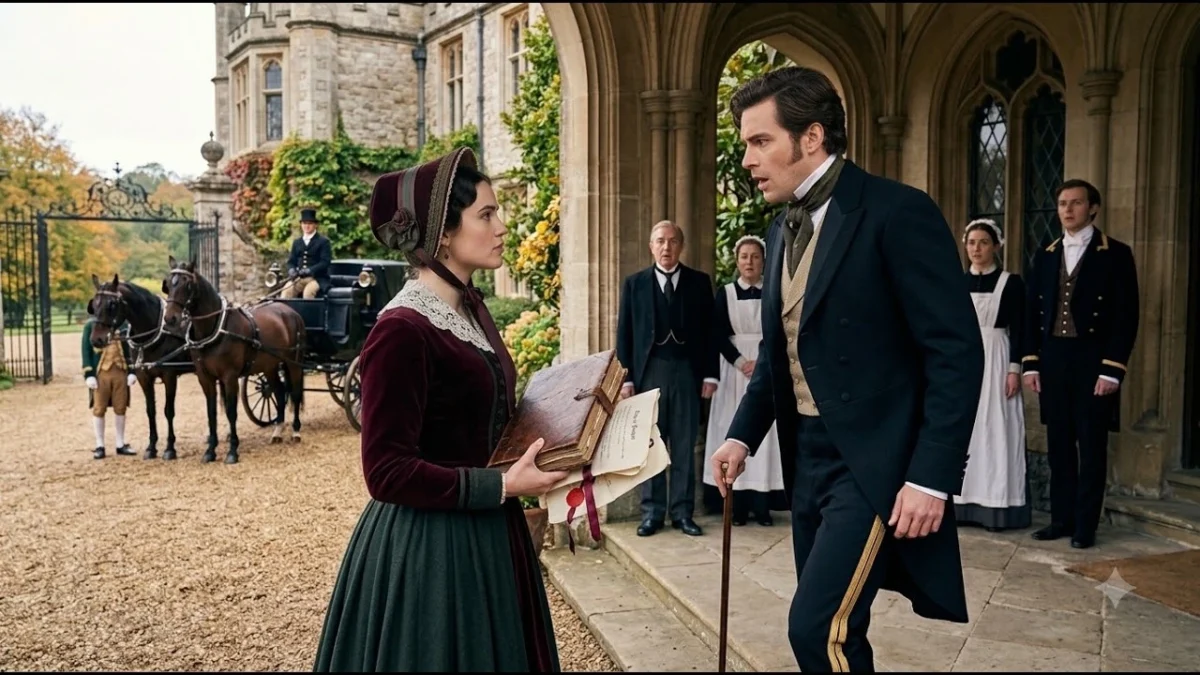
The Duke Thought His Bride Brought Nothing—Then She Arrived With the Debt That Built His Estate
Arthur married her for survival, assuming Hannah Croft was nothing more than a merchant’s daughter, desperate for a title.
A quiet, plain girl with a moderate dowy, just enough to patch the roof, just enough to keep his creditors at bay for one more miserable winter.
He thought he was doing her a favor. He was entirely, ruinously wrong, because when Hannah stepped out of her carriage at Oak Haven, she didn’t just bring her trunks.
She brought the mortgage. The ink on the marriage settlement took an agonizingly long time to dry.
Arthur Pendleton, the ninth Earl of Ashbborne, stared at the dark, wet letters of his own name until they blurred.
The solicitor’s office smelled of ceiling wax, damp wool, and the bitter tang of stale cherry.
It smelled like defeat. Across the heavy mahogany desk sat his future wife, Hannah Croft.
She was 24, an age the gossips of the ton considered dangerously close to Spinsterhood.
She wore a high collared dress of deep charcoal gray, entirely devoid of lace or ribbon.
Her hair, a heavy, unremarkable shade of brown, was pinned back with a severity that made Arthur’s scalp ache just looking at it.
She didn’t fidget. She didn’t cast shy, adoring glances at him from beneath her lashes.
She sat perfectly still, her gloved hands folded in her lap, watching the solicitor meticulously sprinkle sand over the parchment.
Arthur’s jaw tightened. He was selling his title. There was no softer way to put it.
His father, the eighth Earl, had been a man of grand appetites and catastrophic luck.
He had left Arthur in Eldom, a crumbling estate in Yorkshire, and a mountain of debts so staggeringly high they blocked out the sun.
Enter the late Josiah Croft, an industrialist, a man who made his fortune in northern mills and shipping, accumulating wealth with ruthless efficiency.
Croft had died 6 months ago, leaving his only daughter a staggering fortune. But a merchant’s fortune could only buy so much.
It could not buy an invitation to Allmax. It could not buy a periage. So the broker had arranged a match, £20,000 in dowry for the privilege of calling Miss Croft a countess.
The principal of the 20,000 will remain in a trust naturally. Mr. Finch, the solicitor, murmured, tapping the parchment.
The interest calculated at 5% annually shall be at your disposal, my lord, for the upkeep of the estate and the household,” Arthur nodded curtly.
“1,000 a year. It was enough to hold off the most aggressive creditors. Enough to keep the butchers and the tailor from dragging him to fleet prison.
It would not save Oak Haven, not truly, but it would buy him time, a year, perhaps two, and the remaining assets of the Croft estate,” Arthur asked, maintaining a tone of bored indifference.
“He had to retain some dignity administered by Miss Croft’s trustees,” Finch replied smoothly, as per her late father’s rigid instructions.
“The dowy is the extent of the marital transfer. Arthur looked at Hannah. Her expression remained entirely unchanged.
She wasn’t an ugly woman, he decided, merely an unadorned one. She had sharp, intelligent eyes, the color of cold tea, and a strong, definitive jaw.
She looked like a woman who knew exactly what she was buying. “Do you have any questions, Miss Croft?”
Arthur asked. The first words he had spoken to her in 20 minutes. None, my lord, Hannah said.
Her voice was low, lacking the affected, breathy quality favored by the debutants in London.
The terms are exactly as I dictated them. Arthur blinked, a flicker of irritation rising in his chest.
Dictated, not agreed upon. Dictated. He swallowed his pride. It tasted like ash. Then we are finished here, Arthur said, standing.
He reached for his hat and cane. I shall see you at St. George’s on Thursday, Miss Croft.
10:00. 10:00, she agreed, rising smoothly. She didn’t wait for him to open the door.
She simply turned and walked out, her leather boots clicking rhythmically against the hardwood floor.
The wedding, 3 days later, was a masterclass in grim efficiency. The morning was overcast.
The London sky a bruised purple that threatened rain but refused to deliver. The church was empty save for Arthur’s cousin who served as an unenthusiastic witness and Hannah’s aging aunt who wept silently into a heavily perfumed handkerchief.
Arthur wore his best coat, a midnight blue broadcloth that his valet had spent hours brushing to hide the fraying cuffs.
Hannah wore a traveling gown of dark navy. No white lace, no orange blossoms. When the vicar asked for the rings, Arthur slid a heavy gold band onto Hannah’s finger.
Her skin was cool to the touch. Her hand was steady. He realized with a sudden pang of hollow sadness that he didn’t know her favorite color, or if she preferred horses to dogs, or if she liked the country air.
He knew her bank balance. “I pronounce you man and wife,” the vicar in toned, his voice echoing in the cavernous empty church.
Arthur turned to her. He supposed he ought to kiss her. It was expected. He leaned in, aiming for her cheek.
Hannah turned her head a fraction of an inch, so his lips barely grazed her jawbone.
It wasn’t a rejection born of shyness. It was a physical boundary firmly drawn. “The carriage is waiting, Lord Ashborn,” she said quietly, stepping back.
“Lord Ashborn.” “Not Arthur.” “Right,” Arthur said, clearing his throat, his face flushing with a sudden irrational anger.
“Let us go home. The journey to Oak Haven took four agonizing days. The weather turned foul the moment they crossed into Yorkshire.
Rain lashed against the carriage windows, a relentless driving sheet of gray water that turned the roads to thick, treacherous mud.
Inside the carriage, the silence was suffocating. Arthur sat on one side, pretending to sleep, while Hannah sat opposite him, reading.
She possessed a seemingly endless supply of small, leatherbound books. They weren’t novels or volumes of poetry.
Arthur caught a glimpse of one title when she turned a page. A treatise on agricultural yields and crop rotation.
Is that a particularly thrilling romance? He asked on the third day, unable to stand the quiet any longer, Hannah looked up, marking her page with a slim ribbon.
It is a study on soil depletion written by a Scottish aronomist. It is quite informative.
I cannot imagine why you would care about soil depletion, madam. Because, my lord, I am told Oak Haven encompasses some 10,000 acres of arable land.
Land that, according to the ledgers I reviewed before our marriage, has seen a steady decline in output over the last decade.
Arthur bristled. His father’s neglect was an open wound, and he didn’t appreciate a merchant’s daughter poking at it.
The land has been farmed by the same families for generations. They know what they are doing.
Tradition is often a poor substitute for competence, Hannah replied mildly, opening her book again.
Arthur gritted his teeth and looked out the window. She is insufferable, he thought. Cold, calculating, and entirely without charm, they arrived at Oak Haven just as the sun began to set behind the jagged line of the moors.
Arthur felt the familiar tightening in his chest as the carriage turned onto the long, winding driveway.
The gravel had long since washed away, leaving deep, muddy ruts that made the carriage pitch violently.
The ancient oaks that gave the estate its name stood like dark sentinels, their branches wild and unpruned.
And then the house emerged from the gloom. It was a Palladian monstrosity built a century ago to project dominance and wealth.
Now it projected only decay. In the twilight the extent of the rot was painfully obvious.
Great patches of stucco had peeled away from the facade, exposing the dark brick underneath like rotting muscle.
Entire sections of the roof were missing slate tiles, looking like knocked out teeth. The massive front windows were dark, their frames warped by years of harsh winters.
Arthur stole a glance at Hannah, waiting for the inevitable reaction, the gasp of horror, the tears, the realization that her 20,000 had bought her a moraleum.
Hannah was leaning forward, her eyes scanning the structure, her face was entirely blank. The carriage lurched to a halt before the grandstone steps.
Hobbs, the elderly butler, stood waiting under a battered umbrella. He was flanked by a skeletal staff, two footmen whose liveries were visibly patched, and a housekeeper who looked terrified.
Arthur stepped out into the freezing rain and offered his hand to Hannah. She ignored it, stepping down gracefully under her own power.
“Welcome to Oak Haven, my lady,” Hobbs said, his voice trembling slightly as he bowed.
“Thank you, Hobbes,” Hannah said. She did not rush toward the open doors to escape the rain.
Instead, she stood on the gravel, looking up at the facade. The guttering on the west wing has collapsed.
The water runoff is pooling against the foundation. It will cause rising damp if it hasn’t already.
Hobbs blinked, entirely thrown. I Yes, my lady. The master, the late Earl that is, had meant to have it seen to see that a bucket is placed beneath the worst of the leaks tonight, Hannah ordered, finally moving toward the steps, and I will require a local builder to assess the roof on Monday.
Arthur followed her inside, feeling entirely displaced. This was his house, his crumbling, humiliating house.
He was supposed to be the one apologizing for it. The interior was no better than the exterior.
The grand entrance hall was freezing. A meager fire smoked sullenly in the massive hearth.
The air smelled of mildew and old dust. The portraits of past stared down from the walls, their paint cracking, their golden frames tarnished.
Dinner was a miserable affair. They sat at opposite ends of a dining table that could comfortably seat 30.
The silver candalabbras were tarnished black. The meal consisted of a thin watery mutton stew and stale bread.
Arthur picked at his food, his shame burning hot in his throat. He looked down the long expanse of mahogany.
Hannah was eating her stew with methodical precision, showing no outward sign of disgust. I apologize for the fair,” Arthur said stiffly, the words tasting like gravel.
“The household accounts have been constrained. I assure you, with the interest from your dowy, I will hire a proper cook and restock the ladders by the end of the week.”
Hannah dabbed her mouth with a frayed linen napkin. “Do not trouble yourself, Lord Ashbornne.
A heavy meal before bed disrupts the digestion anyway. She stood up. If you will excuse me.
The journey has been long. I will retire. I will have Hobbes show you to the countess’s chambers, Arthur said, pushing his chair back.
I have already instructed the housekeeper to prepare a smaller room on the second floor.
Hannah replied. The countess’s chambers are in the east wing. The east wing is directly beneath the collapsed roof section.
I prefer not to wake up to rainwater on my face. She gave him a brief impersonal nod and walked out of the dining room.
Arthur sat alone in the dim light of the smoking candles, listening to the rain beat against the warped window panes.
He had married a woman to save his pride. Instead, he had married a woman who made his pride feel entirely irrelevant.
Morning did nothing to improve Oak Haven. The rain had stopped, leaving behind a damp gray chill that seeped into the very marrow of the bones.
Arthur sat behind his massive oak desk in the library. The room was his sanctuary, though even here the signs of ruin were everywhere.
Whole shelves stood empty where his father had sold off first editions to pay gambling debts.
Opposite Arthur sat Mr. Hails, the estate steward. Hails was a nervous man with inkstained fingers and a perpetual sheen of sweat on his brow.
Right now he was sweating profusely. “It is worse than we feared, my lord,” Hail said, his voice dropping to a miserable whisper.
He pushed a stack of heavy ledgers across the desk. Arthur rubbed his temples. His head throbbed.
“Just give me the summary, Hails. Spare me the agony of reading every line.” Hails swallowed hard.
The tradesmen in the village have cut off our credit entirely. The butcher, the blacksmith, the coal merchant.
They demand immediate payment of Aras. That is roughly £800. Fine. We have the first quarter’s interest from the dowy.
Pay them. Yes, my lord. But that is the least of our worries. Hails pulled a single crisp piece of paper from his folio.
Lord Calthorp. Arthur’s stomach plummeted. Lord Calthorp was a London banker and one of his father’s most ruthless creditors.
What about him? He holds the primary mortgage on the estate, my lord.
A principle of £30,000. The interest is three years in a rears. Hails wiped his brow with a handkerchief.
His solicitors sent notice yesterday. If a payment of £5,000 is not made by the end of the month, he will begin foreclosure proceedings.
He means to take Oakhaven, my lord. The land, the house, everything. Arthur stared at the piece of paper.
The air in the room felt suddenly too thin to breathe. £5,000. He didn’t have £500.
The dowy interest was a trickle against a raging flood. “Can we borrow against the principle of the dowy?”
Arthur asked desperately. “No, my lord, Mr. Finch was very clear. The trust is ironclad.
You cannot touch the 20,000.” Arthur leaned back in his chair, a cold, creeping horror settling in his chest.
He had sold himself. He had endured the humiliation of marrying beneath his station, and it was all for nothing.
Oak Haven was de@d. He was de@d. A sharp knock at the library door shattered the heavy silence.
Before Arthur could speak, the door opened. Hannah walked in. She was dressed in another severe gown.
This one a dark forest green. Her hair was immaculate. Under her arm, she carried a thick black leather portfolio.
Arthur’s temper, frayed to the breaking point by fear and exhaustion, snapped. “What are you doing here?”
He barked, standing up. “I’m in a meeting with my steward. This is estate business, men’s business.”
Hannah didn’t flinch at his tone. She simply closed the door behind her and walked toward the desk.
Mr. The hail scrambled out of his chair, bowing awkwardly. “I am aware it is estate business,” Hannah said, pulling up a chair and sitting down without being invited.
“Which makes it my business as well.” “It most certainly is not,” Arthur snapped. “Your dowry secures your position here.
It does not buy you a seat at this desk. I will not have my wife meddling in affairs she cannot possibly comprehend.”
Hannah looked at him. Really looked at him. Her eyes were devoid of anger, but they held a sharp, calculating intelligence that made Arthur suddenly want to sit back down.
“Mr. Hails,” Hannah said, turning her attention to the trembling steward. “You were discussing Lord Calthorp’s notice of foreclosure, I assume.”
Hails shot a terrified look at Arthur, then nodded slowly. Ye. Yes, my lady. You You were listening at the door, Arthur demanded, appalled.
I didn’t have to, Hannah replied smoothly. She unbuckled the leather strap of her portfolio.
I have known about Lord Calthorp’s intent to forclose for 6 months. Arthur stared at her.
How could you possibly know that? The notice arrived yesterday. Because, Lord Ashborn, Hannah said, her voice dropping into a tone of quiet, absolute authority.
I did not come to this marriage blind. Before my father died, I had him investigate the exact nature of your financial ruin.
I knew precisely what I was buying. Buying? Arthur choked out. The word hung in the air, ugly and sharp.
Hannah opened the portfolio. She began pulling out papers. Crisp, heavy parchment documents covered in thick black script and heavy wax seals.
She didn’t hand them to Arthur. She laid them out on his oak desk side by side like a dealer laying out a winning hand of cards.
“The tradesmen in the village,” Hannah said, pointing to the first stack. “Their debts were purchased 3 weeks ago by a holding company in London, a company I own.
Hails made a small squeaking noise in the back of his throat. The outstanding loans with the Bank of England, Hannah continued, laying down another document.
Purchased at a discount last month, held by my trustees. Arthur’s eyes darted over the papers.
He recognized the seals. He recognized his father’s sprawling drunken signature. And finally, Hannah said, she pulled out the largest document.
It was bound in red ribbon. She placed it de@d center on the desk. Lord Calthorp’s mortgage on Oak Haven.
Arthur felt the blood drain from his face. The room spun slightly. What is this?
He whispered. Lord Calthorp is a greedy man, but he is a nervous one, Hannah said calmly.
He wanted hard currency, not a protracted legal battle over a decaying estate in Yorkshire.
6 days before our wedding, my solicitors approached him. I bought the mortgage in its entirety.
Silence fell over the library. Heavy, absolute silence. Arthur looked from the red ribboned document to his wife.
His mind refused to process the information. You you bought my debts. All of them, Hannah confirmed.
The £20,000 dowy. A misdirection, Hannah said without a hint of apology. A sum small enough to make you think you retained control, but large enough to secure the match.
The bulk of my inheritance was spent acquiring these. She tapped the mortgage document. Why?
Arthur asked, his voice cracking. He felt naked. He felt utterly dismantled. Why would you do this?
Why not simply pay the debts as my wife? Hannah sat back in her chair, folding her hands over her lap.
Because, Lord Ashborn, if I paid them as a dutiful wife, the debt would be forgiven.
You would be the master of Oak Haven again, and I would be nothing more than the merchant’s daughter who bought you your pride.
I would be at your mercy. She leaned forward, her eyes locking onto his. There was no cruelty in her gaze, only a terrifying, undeniable strength.
I have watched men like your father destroy legacies on a turn of a card.
I have watched men like you ignore the rot in your own house because you are too proud to pick up a hammer.
I did not marry you to be your savior, Arthur. I am not a charity.
She stood up, a dark green dress rustling softly in the quiet room. I own the debts.
I hold the mortgage. I am your sole creditor. Hannah looked down at him, her expression perfectly composed.
Oak Haven belongs to me. You belong to me. Now, if you will excuse me, I must speak to Hobbes about firing the cook.
We have work to do. For 3 days, Arthur did not speak to his wife.
He retreated to the stables, the only place on the estate that still felt vaguely like his own, though even that was an illusion.
He spent hours grooming an aging hunter named Brutus, brushing the horse’s dull coat until his shoulders achd, breathing in the smell of hay and ammonia.
It was better than breathing the air inside the house. Inside the house, Hannah was dismantling his family’s legacy.
She did not do it with malice. That was the most infuriating part. If she had gloated, if she had paraded her power over him, he could have hated her properly.
Instead, she moved through Oak Haven with the dispassionate efficiency of a surgeon removing a gangrous limb.
On Tuesday, she fired the housekeeper, the French chef, who hadn’t cooked a decent meal in 5 years, and the master of the hounds.
She paid them their back wages in crisp bank of England notes from her leather portfolio, and sent them packing before noon.
On Wednesday, she summoned Arthur from the stables. He found her in the great dining room.
The long mahogany table was entirely covered in silver. Candalabbras, serving trays, soup tines, and heavy goblets.
It was the Ashborne family silver accumulated over two centuries. Standing next to the table was a man with a jeweler’s loop and a ledger, a valuer from London.
What is the meaning of this? Arthur demanded, stopping in the doorway. His boots left muddy tracks on the hardwood floor.
Hannah looked up from a list she was checking against the valuer’s notes. She wore a heavywoolen shawl over her gray dress, her breath pluming faintly in the freezing room.
She had ordered the fires extinguished in the unused rooms to conserve coal. Mr. Higgins is assessing the silver, Hannah said flatly.
We are selling it. Arthur crossed the room in three long strides. He grabbed a heavy silver chalice from the table.
It bore the ashbor crest, a falcon in flight. You cannot sell this. It has been in my family for four generations.
It is heavily tarnished and entirely useless, Hannah counted. You do not host dinners, Lord Ashborn.
You have no guests. A crest on a cup does not mend a roof. It is my heritage.
Your heritage is a debt of £30,000. She snapped, her patience finally fracturing. The sharp edge in her voice shocked him into silence.
Do you know what this silver is worth, Arthur? Nearly £400. Do you know what £400 buys?
Arthur set the chalice down. His hands were shaking. He didn’t answer. It buys three state-of-the-art threshing machines from a foundry in Leeds, Hannah said, her voice dropping back to that terrifying calm cadence.
It buys enough quicklime to sweeten the soil in the lower valley fields, which haven’t yielded a profitable harvest of wheat in 8 years.
You cannot eat silver, my lord. But if you fix the soil, you can eat the grain.
She turned back to the valuer. Finish the inventory, Mr. Higgins. I want it boxed and on a carriage to London by morning.
Arthur stood there emasculated and redundant in his own dining hall. He wanted to throw the table over.
He wanted to rage against the injustice of it. But he couldn’t because the cold, brutal truth was staring him in the face reflected in the tarnished silver.
She was right. His father would have kept the silver and let the tenants starve.
His father would have polished the chalice while the roof collapsed. Arthur turned on his heel and walked out.
The next morning, two heavy wagons arrived from the north. They did not bring fine furniture or silk curtains.
They brought tools, pickaxes, shovels, bags of cement, and bundles of raw timber. Following the wagons were a dozen men.
They were not liverid footmen. They were rough-anded laborers with thick Yorkshire accents and mud on their boots.
Hannah met them on the front drive. She did not wear a bonnet. The damp wind whipped her brown hair around her face as she unrolled a set of architectural plans across the hood of a wagon.
Arthur watched from the window of the library. He watched his wife point to the collapsed gutters, the rotting window frames, the sinking foundation of the west wing.
The men nodded, hefted their tools, and went to work. Within an hour, Oak Haven sounded like a shipyard.
The echoing bangs of hammers, the scrape of trowels, the shouting of men. It was the sound of desecration.
It was the sound of salvation. Arthur poured himself a glass of cheap brandy. He sat at his desk and listened to his house being ripped apart.
He had never felt more useless in his life. He was the Earl of Ashbborne, and he was entirely irrelevant.
By November, Oak Haven was a battleground of mud and scaffolding. The relentless autumn rains had turned the estate grounds into a thick, sucking bog.
The northern laborers lived in a makeshift barracks in the old hunting lodge. They worked from dawn until dusk, driven by Hannah’s unyielding schedule and the promise of a double wage for finishing the roof before the first snow, Arthur began leaving the house simply to escape the noise.
He walked the perimeter of the estate, collar turned up against the biting wind. But even out here, Hannah’s presence was absolute.
He crested a low hill overlooking the lower valley one afternoon and stopped. Down in the fields, a crew of local tenant farmers was digging a massive trench drainage.
The land here had always been waterlogged, producing weak, stunted crops. Arthur’s grandfather had called it a curse.
Hannah called it poor water management. Standing on the edge of the trench, kneedeep in gray muck, was Hannah.
She was arguing with Elias Thorne, the oldest and most stubborn tenant on the estate.
Thorne was a large red-faced man who had openly scoffed at taking orders from a woman, let alone a merchant’s daughter from the city.
Arthur moved closer, staying downwind. I told you, lady ship, Thorne bellowed, crossing his thick arms.
We’ve never dug ditches this deep. It’s a waste of sweat. The water sits where the Lord intended it to sit.
The water sits because there is a layer of impermeable clay 3 ft down. Mr.
Thorne, Hannah shot back. Her dark wool skirt was caked in mud. She held a long wooden measuring stick.
If we don’t break through it and lay the tile drains, the roots will rot before July.
The trench needs to be 4 ft deep, not two. My father farmed this land, and his father before him, and both of them died with empty pantries, Hannah interrupted, her voice cutting through the wind like a whip.
Tradition does not pay the rent. 4 feet, Mr. Thorne, or you can pack your bags and find another landlord by nightfall.
Thorne’s face darkened to a deep plum. He stepped forward, looming over her. He was a foot taller and twice her weight.
A dangerous, ugly tension spiked in the air. The other men in the trench stopped digging, watching.
Arthur didn’t think. He reacted. He stroed down the hill, his long legs eating up the distance.
He didn’t run. Running was undignified, but he moved with a sudden coiled violence that made the nearest laborers step back.
He inserted himself smoothly between Hannah and the massive farmer. “Is there a problem here, Thorne?”
Arthur asked. His voice was low, devoid of a shout, but it carried the chilling, unquestionable authority of generations of aristocratic entitlement.
It was a voice he rarely used, because he had always felt like a fraud using it.
Today, he didn’t care. Thorne blinked, startled by the ear’s sudden appearance. My lord, the countest is demanding a 4-ft trench.
It’s madness. It’ll take weeks. Arthur didn’t look at Hannah. He kept his eyes locked on Thorne.
You are addressing the countess of Ashbborne. You will lower your voice, and you will remove your cap when you speak to her.
Thorne swallowed hard. He slowly reached up and pulled his flat cap from his head, crushing it in his massive hands.
As for the trench, Arthur continued smoothly, though he had absolutely no idea how deep a drainage ditch ought to be.
If the countest says it must be 4 ft, then you will dig until you hit China if she requires it.
Or, as she so eloquently stated, “You will be off my land by sunset. Do I make myself perfectly clear?”
The use of my land was a bitter irony, but it worked. Thorne broke eye contact, looking down at his muddy boots.
“Crystal clear, my lord,” Thorne muttered. “Good. Get back to work. Arthur turned. Hannah was looking at him.
Her face was smudged with dirt and her nose was red from the cold. For the first time since they met in the solicitor’s office, she looked surprised.
He expected a reprimand. He expected her to remind him that it was in fact her land.
Instead, she offered a very small, almost imperceptible nod. Thank you, Lord Ashbornne,” she said quietly.
“You’re welcome,” Arthur said stiffly. He looked down at the trench, then at the wooden measuring stick in her hand.
“Though if you intend to stand in the mud all day, you ought to wear proper boots.
Those leather slippers are ruined.” “I am aware,” she said, looking down at her mudcaked feet.
Arthur hesitated. He should walk away. He should go back to the stables and let her play at being a foreman.
But the wind howled across the valley, biting through his wool coat, and he looked at the sheer volume of earth that needed moving.
He stripped off his coat, folding it neatly and draping it over a nearby fence post.
He unbuttoned his waist coat and rolled up the sleeves of his white linen shirt.
The wind was immediately freezing against his arms. Hannah frowned. What are you doing? What does it look like?
Arthur said, stepping down into the shallow end of the trench. The mud instantly swallowed his expensive riding boots up to the ankles.
He reached out and took a heavy iron spade from a staring laborer. He drove the spade into the earth with his boot.
It hit the clay with a dull, heavy thud. I’m digging a 4-ft ditch, Arthur grunted, levering the heavy cloud of wet dirt over his shoulder.
He looked up at Hannah. Unless you prefer to dock my wages. A muscle twitched in Hannah’s jaw.
It took Arthur a second to realize she was suppressing a smile. “Just mind the angle of the grade, Arthur,” she said.
“Water doesn’t flow uphill.” He worked until his hands blistered and bled. He worked until his back screamed and his vision blurred with sweat despite the freezing temperature.
He worked alongside men who had despised his father and barely tolerated him. When the sun finally dipped below the horizon, Arthur hauled himself out of the trench.
His shirt was ruined, plastered to his skin with mud and sweat. He was shivering violently.
Hannah was waiting by the fence. She had not left. She handed him his wool coat.
They walked back to the mana house in silence. The great scaffolding around the west wing loomed in the dark.
For the first time in his life, Arthur’s muscles achd, not from riding or fencing, but from labor, and for the first time in years, the crushing weight in his chest felt marginally lighter.
He had not saved Oak Haven, but he had moved a ton of dirt, trying.
By January, the great house at Oak Haven was sealed against the winter. The new slate roof held firm beneath 2 ft of heavy snow.
The chimneys drew properly, sending thick plumes of wood smoke into the freezing sky. The scaffolding was gone.
The house was not fully restored. The east wing remained shut up and the grand ballroom was still stripped bare, but it was no longer dying.
It was stabilizing. The financial reality, however, remained razor thin. All of Hannah’s liquid capital, save a small emergency reserve, had been sunk into the repairs.
The new machinery and the seed for the spring planting. They were landriich, asset heavy, and entirely cash poor.
They lived like monks. Meals were hearty but simple. Root vegetables, tough cuts of beef and oats.
They spent their evenings in the library. It was the only room on the ground floor they kept heated.
They developed a quiet, functional routine. Arthur would sit in a leather armchair by the fire, reading his father’s old books on horse breeding or agricultural journals he now borrowed from Hannah.
Hannah sat at the massive oak desk, lit by a single oil lamp, endlessly calculating, adjusting, and projecting in her black ledgers.
The silence between them was no longer suffocating. It had become a structural thing, a loadbearing wall holding up their fragile partnership.
One night in late January, the wind outside was howling with a ferocity that rattled the newly glazed windows.
Arthur sat by the fire, nursing a glass of watered down whiskey. He looked over at the desk.
Hannah had stopped writing. Her head was resting on her folded arms over the open ledger.
Her breathing was slow and shallow. She had fallen asleep midcalation. Arthur set his glass down quietly.
He walked over to the desk. She looked utterly exhausted. The harsh lighting cast deep shadows under her eyes.
The severe bun she usually wore had loosened, allowing strands of dull brown hair to frame her pale face.
Without her iron posture and sharp gaze, she looked terrifyingly young. Arthur felt a strange tight ache in his throat.
He had spent the last 3 months watching her shoulder, the burden of andom that his own family had abandoned.
She negotiated with ruthless creditors, bullied stubborn farmers, and managed a workforce of 50 men.
And she did it entirely alone. He reached out, his hand hovering over her shoulder.
He wanted to touch her hair. He pulled his hand back, clenching it into a fist.
Instead, he carefully slid the heavy black ledger out from under her arms, replacing it with a soft woolen cushion from a nearby chair.
Hannah murmured softly, but didn’t wake, her cheek pressing into the wool. Arthur took the ledger to the small table by the fire.
He opened it to the page where the ink was still drying. 3 months ago, the columns of numbers would have meant nothing to him.
Now he read them with ease. It was the projection for the spring planting. Seed costs, labor wages, projected yield based on the new drainage systems.
He frowned. She was stuck on the final column, a discrepancy in the cost of hiring extra draft horses for the plowing.
She had overestimated the daily rate by two shillings ahead. Arthur knew this because he had negotiated the rate with the local livery himself last week.
Arthur picked up a quill. He dipped it in the inkwell. With precise, careful strokes, he crossed out her incorrect figure.
He wrote in the correct rate. He recalculated the column, carrying the sums over to the final total.
It saved them nearly £40, a fortune in their current state. He closed the ledger, leaving it on the table.
He took the heavy blanket off his own bed upstairs and draped it gently over her shoulders.
Arthur sat back in his armchair and watched the fire burn down to embers. He didn’t want to go to sleep.
He wanted to sit in the quiet warmth and guard the room. When Hannah woke the next morning, the fire was freshly stoked, and a pot of hot tea sat on the desk.
Arthur was gone, already down at the stables. She rubbed her stiff neck, the heavy blanket slipping from her shoulders.
She looked at the tea, then at the small table by the fire. The ledger was closed.
Hannah opened it. She saw the crossed out number. She saw the new figures written in Arthur’s elegant sloping handwriting.
She saw the bottom line, the £40 saved. She traced the dry ink with her fingertip.
For a long time she simply stared at the page. Then slowly she closed the book, poured a cup of tea, and allowed herself a small private smile.
It was the first time in her life someone else had balanced the books. Later that afternoon, Arthur was in the barn helping the farrier shoe the draft horses.
The wind outside was brutal, but the barn was warm with animal heat. The heavy wooden doors creaked open.
Hannah stepped inside. She wore her heavy cloak, a woolen scarf wrapped tight around her neck.
She walked over to the stall where Arthur was holding the horse’s lead. She didn’t say anything at first.
She just watched the farrier work, handing him a nail when he reached for one.
You found the ledger, Arthur said quietly, not looking at her. I did, she replied.
Your math is adequate. A glowing compliment coming from you. You negotiated a better rate for the horses than I anticipated.
The livery man in the village usually overcharges. He tries, Arthur said, rubbing the horse’s nose, but he used to buy his oats from my grandfather.
I reminded him of a few old favors, and I told him if he overcharged us, my wife would likely buy his business and fire him.
Hannah let out a sound. It was sharp, sudden, and entirely unpracticed. It took Arthur a moment to realize she had laughed.
It was a rusty, beautiful sound. A reasonable threat, she conceded. She stepped closer to the stall.
She wasn’t looking at the horse anymore. She was looking at him. I have finalized the contracts for the spring seed, Arthur.
She said it was the first time she had used his Christian name since the day she revealed the debts.
We require a signature to authorize the release of funds from the trust’s emergency reserve.
Arthur nodded. Bring it to the library tonight. I’ll watch you sign it. No, Hannah said softly.
The funds are drawn against the estate’s projected yield. Not the trust. She reached into her cloak and pulled out a folded document.
She held it out to him. It requires the signature of the Earl of Ashbborne.
Arthur stared at the paper. Then he looked up at her eyes. They were not cold tea today.
They were warm. They were asking him to step back into the role he had abandoned.
Not as a figurehead, not as a debtor, as a partner. Arthur wiped his dirty hands on his britches.
He took the paper. “Let’s go to the library,” he said. “I’ll sign it. March arrived not with the gentle Thor promised by the Almanacs, but with a vicious, biting cold.
The winter wheat they had planted in the newly drained lower valley had just begun to push through the soil.
It was a fragile, pale green promise. It represented every penny of the emergency reserve, every ounce of their credit, and the sheer exhausting physical labor of the past 5 months.
If the crop failed, there was no secondary trust to tap. There was no backup plan.
They would be ruined. Arthur woke a few hours past midnight. The fire in the great had burned down to cold ash.
He pulled his breath in, and it caught in his throat. The air in the bed chamber was sharp.
It tasted like iron. He threw off the heavy quilts and walked to the window.
The glass was entirely opaque, frosted over in jagged fernlike patterns of ice. He pressed his palm against the pain.
The cold bit into his skin like a needle, a hard freeze. Arthur didn’t bother calling for his valet, a luxury they had long since dismissed anyway.
He dragged on his thickest wool britches, a heavy sweater, and his mud stained riding boots.
He grabbed his coat and took the back stairs two at a time, moving through the pitch black mana house by memory.
Outside, the air was de@dly still. The sky was a terrifying pristine black, pinned with hard, glittering stars.
The temperature was plummeting. Down in the valley, the vulnerable wheat shoots were already stiffening.
In 3 hours, the cellular walls of the plants would burst. By sunrise, the crop would be black and de@d.
Arthur broke into a sprint toward the old hunting barracks. He kicked the heavy wooden door open.
The laborers were snoring in the thick, warm air of the crowded room. “Up!” Arthur roared.
His voice shattered the quiet, bouncing off the rafters. Everyone up. Get your boots on.
We have a freeze in the valley. Men groaned, rolling out of their cs, confused and sluggish.
Move. Arthur barked, grabbing a lantern from the wall and striking a match. Every man, wake the tenant farmers.
Wake the stable boys. We need every scrap of damp straw, green wood, and tar you can find.
We are building smudge fires. For the next 4 hours, Oak Haven was at war with the sky.
Arthur commanded the line. He directed the placement of the fires, spacing them precisely across the 10,000 acres of the lower valley.
They couldn’t heat the air, but they could create a thick, heavy blanket of smoke to trap the Earth’s residual warmth and block the settling frost.
It was brutal, choking work. Arthur hauled bundles of wet straw until his shoulders screamed.
He waded through the freezing mud, his hands cracked and bleeding from hauling rough timber.
The smoke stung his eyes, blinding him, filling his lungs with a bitter acrid taste.
But he didn’t stop. He couldn’t stop. He moved from fire to fire, a soot stained spectre in the dark, shouting encouragement, correcting the burn rates, refusing to let the line fail.
Up at the manor, Hannah stood by the window of the library. She had woken to the sound of shouting.
Now she watched the lower valley. It looked like a battlefield. Hundreds of small glowing orange fires dotted the landscape, fighting against the creeping lethal blue of the frost.
A thick layer of smoke was successfully forming over the fields, holding back the ice.
She pressed her hand to the cold glass. She looked for the tall, broadshouldered silhouette moving through the smoke.
Her father had been a man of ledgers and boardrooms. He had commanded men with coin.
Arthur was down in the freezing muck, choking on smoke, commanding them with his own sweat.
He was fighting for the land, not the title, the dirt. Dawn broke gray and sullen.
The temperature hovered agonizingly close to freezing, but the smoke had held. Arthur trudged up the gravel driveway to the manor, just as the sun cleared the eastern ridge.
He was entirely black with soot. His coat was singed. His hands were raw. He could barely put one foot in front of the other.
The heavy front doors opened before he could reach the steps. Hannah stood there. She held a basin of hot, steaming water and a clean linen towel.
She didn’t ask if the crop was saved. She had watched the smoke hold. She didn’t reprimand him for tracking mud onto the stone portico.
She simply set the basin on a small table by the door. “Take off your coat, Arthur,” she said quietly.
He was too exhausted to argue. He shrugged off the ruined wool, his muscles trembling violently with the sudden drop in adrenaline.
Hannah stepped close. She dipped the towel into the hot water, ringing it out. Carefully, she took his right hand.
Her fingers were warm. She wiped the thick, greasy soot and dried blood from his knuckles.
Her touch was methodical, but there was a distinct, undeniable gentleness to it. Arthur looked down at her.
Her hair was loose, falling over her shoulders. She smelled of the clean, sharp soap she used, cutting through the reek of smoke that clung to him.
You should have woken me, she said, focusing on his palm, scrubbing away a streak of tar.
You couldn’t have negotiated with the frost, Hannah. Arthur rasped, his voice roar from the smoke.
And you couldn’t haul timber. It was my job. She looked up at him. Her eyes searched his face, taking in the singed hair, the exhaustion, the quiet, unyielding pride that no longer felt hollow.
You saved the estate, she said. It wasn’t a compliment. It was a statement of fact.
We saved the estate. Arthur corrected softly. I just moved the dirt. You bought the shovel.
Hannah stopped washing his hand. She didn’t let go. For a long suspended moment in the freezing entryway, she simply held his battered hand in both of hers.
Go to bed, Arthur,” she whispered. “I will manage the morning ledgers.” By early June, the valley was a sea of thriving, vibrant green.
The gamble had paid off. The wheat was strong, the stalks thick and resilient, but success breeds scavengers.
Arthur was out inspecting the new boundary fences when the carriage arrived. It was a sleek black lacquered caracle bearing the crest of Lord Haddington, a neighboring Vic count whose lands bordered Oak Haven to the east.
Hadington was a man of immense wealth, inherited effortlessly, and he had spent the last decade waiting for Oak Haven to finally collapse so he could absorb its prime acorage.
Hadington did not wait for the butler. He stroed into the entrance hall, his pristine riding boots clicking sharply on the stone floor, his nose wrinkled at the distinct lack of liveried footmen.
Hannah met him in the library. She was in her working clothes. A simple navy day dress, her sleeves rolled up, her fingers stained with ink.
“Lord Haddington,” Hannah said, not rising from the desk. “To what do I owe the intrusion?”
Haddington offered a lazy, condescending bow. He was a handsome man, but his eyes were flat and predatory.
Lady Ashborn, I apologize for the unannounced visit, but I understand time is money for your sort.
I thought it best to be direct. Hannah carefully set her quill down. My sort industrialists, pragmatists, Haddington amended smoothly, though the sneer was evident.
He walked around the room, picking up a leather-bound book, inspecting it, and dropping it back on the table.
I have watched the renovations, the drainage, the new roof. You have poured a small fortune into this rotting carcass of an estate.
An estate that will turn a profit by September. Hannah countered coldly. Perhaps, Haddington chuckled.
But at what cost to you? You are a prisoner here, Lady Ashbornne. Bound to a penniless earlied you strictly to save his own skin.
A man who likely despises you for holding the purse strings. Hannah’s expression remained perfectly impassive, but her spine stiffened.
“State your business, Haddington, or find the door.” Hadington pulled a folded piece of parchment from his coat.
He dropped it on her desk. “I am offering you an exit,” Hadington said, leaning forward.
“A way to recoup your disastrous investment and return to London society without the de@d weight of a ruined aristocrat hanging around your neck.”
Hannah did not touch the paper. What is this? My terms, Haddington said. Immediate purchase.
I will buy the lower valley and the eastern woods for £35,000 in hard currency.
Assumption of debt. I will assume the remaining minor debts of the Ashborne estate. Legal severance.
My solicitors will arrange a quiet uncontested anulment citing non-conumation freeing you from Arthur Pendleton entirely.
£35,000. Hadington purred. A handsome profit for you. You take your money. You leave Oak Haven to me and you leave Arthur to rot in whatever debtor’s prison will have him.
We both know he is a weak, incompetent fool who brings nothing to this match.
The heavy oak door of the library opened. Arthur stood in the threshold. He had heard the carriage and ridden back.
He was covered in dust from the road, his shirt open at the collar, a heavy riding crop in his hand.
He had heard the last sentence. Hadington turned, looking mildly amused at having been caught insulting the man in his own house.
Ah, the Earl returns. We were just discussing the realities of your marriage, Pendleton. Arthur’s face was unreadable.
He stepped into the room, his eyes flicking to the paper on the desk, then to Hannah.
The old Arthur, the man from a year ago, would have flushed with shame. He would have felt the stinging, humiliating truth of Haddington’s words.
But Arthur just stood there waiting. He looked at his wife. Hannah looked down at the parchment.
Slowly, deliberately, she picked it up. She did not read it. She held it over the open flame of the oil lamp on her desk.
The thick paper caught instantly. Paddington gaped as the edges blackened and curled, the flame eating rapidly through the wax seal.
Hannah dropped the burning remnants onto a brass tray, letting it turn to ash. “You miscalculate terribly, Lord Haddington,” Hannah said.
Her voice was not loud, but it possessed a terrifying freezing density that seemed to suck the air out of the room.
“You burned £35,000 out of spite,” Hadington snapped, his composed veneer cracking. “I burn it because it is an insult.”
Hannah stood up. She did not look at Haddington. She looked directly at Arthur. You assume I view my husband as an investment.
You assume I measure his worth by the balance of a bank draft. She walked around the desk, stopping beside Arthur.
She did not cower. She stood shoulderto-shoulder with him. The Earl of Ashbborne is not weak.
He spent the winter digging trenches in the freezing mud alongside his men. He spent the spring breathing smoke to save the harvest.
He knows every acre of this land, every family on it, and he has bled to secure their future.
Hannah finally turned her fierce, burning gaze onto Hadington. He holds the earth, my lord.
I merely hold the paper. He is the master of Oak Haven. He is my husband, and if you ever step foot on his land again or speak his name with such disrespect, I will not just buy your debts.
I will buy your entire estate, dismantle it brick by brick, and salt the earth beneath it.
Get out.” Hadington stared at her, genuinely unnerved by the absolute glacial certainty in her eyes.
He looked at Arthur, who was watching Hannah with a look of profound, quiet awe.
Hadington swallowed his pride, snatched his hat from the side table, and stormed out of the library without another word.
The front door slammed. The carriage wheels crunched rapidly away on the gravel. Silence fell over the library.
The smell of burnt paper hung in the air. Arthur looked down at Hannah. His chest felt tight.
A strange overwhelming pressure building behind his ribs. “She had not defended her asset.” “She had defended him.”
“You would salt his earth?” Arthur asked, a faint, disbelieving smile touching the corners of his mouth.”
Hannah looked away, suddenly intensely interested in wiping a smudge of ash from the brass tray.
A faint dusting of pink colored her pale cheeks. Salt is quite cheap in bulk, she murmured.
Arthur stepped closer. He reached out, gently taking the brass tray from her hands and setting it down.
He lifted his hand, his calloused fingers brushing against the soft line of her jaw, forcing her to look at him.
“Thank you,” he said. The words felt utterly inadequate for the sheer weight of what she had just given him.
She had given him his dignity back. Hannah’s breath hitched slightly at his touch. You earned it, Arthur.
You brought more to this match than a title. He didn’t kiss her. Not yet.
The air was too charged, the realization too new, but he didn’t step away either.
He stood there, his hand against her cheek, finally understanding that the cold, calculating woman he had married in London was the most fiercely loyal creature he had ever known.
September brought the harvest, and the harvest brought salvation. The weather held. The new drainage systems had worked flawlessly, preventing the usual rot in the lower fields.
The threshing machines Hannah had purchased with the silver turned weeks of backbreaking labor into days of efficient processing.
Wagon after wagon rolled up from the valley, groaning under the weight of the wheat.
The graneries, empty for nearly a decade, were filled to the rafters. It was the highest yield Oak Haven had produced in 50 years.
When the final tally was calculated, the grain sold to the northern mills covered the operating costs, paid the laborers a handsome bonus, and left a staggering surplus.
It was late on a Friday night when the final ledger was closed. The library was warm, a steady fire crackling in the hearth.
Outside, a gentle autumn rain was falling, a sound that no longer brought dread of a collapsing roof, but merely a cozy, rhythmic drumming against the solid glass.
Arthur was pouring two glasses of port at the sideboard. He turned and walked over to the desk.
Hannah was staring at the open ledger. She had traced the final number, the net profit, so many times her finger had left a smudge on the paper.
Arthur set a glass down beside her inkwell. It is real, Hannah. You don’t have to keep checking the math.
The gold is in the bank. Hannah looked up. The deep shadows that had lived under her eyes for a year were gone.
She looked rested. She looked triumphant. It is real. She agreed softly, taking the glass.
She opened the bottom drawer of the heavy oak desk. She reached inside and pulled out the large, thick parchment document bound in red ribbon.
The mortgage. She laid it out on the desk between them. We have enough from the harvest surplus to cover the entire principle of the emergency trust draw, plus interest,” Hannah said, her voice dropping into that familiar business-like cadence, though it trembled slightly.
The estate is entirely solvent. She picked up her quill. She dipped it in the black ink.
At the bottom of the mortgage document, below Lord Calthorp’s original signature and her own trustees transfer seals, she wrote a single definitive line paid in full by the yield of Oak Haven.
She signed her name. She didn’t sign it Hannah Croft. For the first time on a legal document since their wedding day.
She signed it. Hannah Pendleton, Countess of Ashbborne. She pushed the document across the desk toward him.
The debt is cleared, Arthur, she said, looking up at him. Oak Haven belongs to you.
Entirely, Arthur looked at the red ribbon. He looked at her signature. A year ago, this was all he had wanted.
His freedom, his pride, his house. He didn’t touch the paper. “Ohaven belongs to us,” Arthur corrected quietly.
“Arthur, legally, the title and the lands.” “I don’t care about the law,” Arthur interrupted, stepping around the desk.
He closed the distance between them. The physical space they had so carefully maintained for 12 months vanished.
“I assumed you brought nothing to this match but a checkbook,” Arthur said, his voice dropping low, rich with a year’s worth of suppressed emotion.
“I thought you were buying a cage to put me in.” Hannah stood up, suddenly entirely enclosed in his space.
She had to tilt her head back to look at him. And what do you think I brought now?
You brought the foundation, Arthur said, lifting his hands and resting them gently on her waist.
He felt her breath catch. “You stripped away everything that was rotting in this house and in me.
You didn’t buy my debts, Hannah. You bought my life, and I have absolutely no desire to take it back.”
Hannah’s eyes widened, the sharp, calculating intellect momentarily giving way to a profound, vulnerable shock.
“Arthur, I love you,” he said. It wasn’t a sweeping, poetic declaration. It was grounded, heavy, and undeniable.
“I love the way you terrify my steward. I love the ink on your fingers.
I love you.” Hannah stared at him, her chest rising and falling rapidly. For a woman who always had an equation, a counter offer, or a perfectly timed rebuke.
She was entirely out of words, so she didn’t use any. She reached up, her hands tangling in the thick hair at the nape of his neck, and pulled him down.
Arthur caught her against him, his arms wrapping tightly around her back, lifting her slightly off her feet.
The kiss was not polite. It was not hesitant. It was a collision. It tasted of port wine, the faint metallic tang of the ink on her fingers, and a year of desperate, unacknowledged yearning.
Arthur kissed her until the lingering ghosts of his father’s failures vanished entirely from the room.
He kissed her until the cold transactional nature of their beginning was burned away by the heavy thrumming heat of the present.
When they finally broke apart, Hannah rested her forehead against his chest, her hands still gripping his shirt.
He could feel her heart racing against his ribs. She let out a long, shaky breath, a sound that was half a laugh and half a sob.
It seems, Hannah murmured against his collarbone, that my investment has yielded a rather unpredictable return.
Arthur smiled, resting his chin on the top of her head, holding her tight against the quiet warmth of the library.
“The best returns,” Arthur whispered, “are the ones you have to dig for.” On the desk behind them, the red ribboned mortgage lay entirely forgotten, the ink of her new name drying permanently in the warmth of the fire.
If you found yourself swept up in Arthur and Hannah’s journey from a cold transactional bargain to a fiercely devoted partnership forged in the mud and ledgers of Oak Haven, don’t let the story end here.
Hit that like button to show your support for grounded, slowb burn historical drama. Share this video with fellow romance lovers who appreciate a heroine with a sharp mind and a hero who isn’t afraid to get his hands dirty.
And make sure to subscribe and ring the bell so you never miss our next epic storytelling adventure.








