THE DUKE FORCED THE MAID ONTO HIS WILDEST STALLION TO HUMBLE HER… ONLY TO BE HUMBLED HIMSELF
THE DUKE FORCED THE MAID ONTO HIS WILDEST STALLION TO HUMBLE HER… ONLY TO BE HUMBLED HIMSELF
Dragging a half- wild stallion into the yard, Arthur Pendleton pointed a silver tipped riding crop at Claraara’s chest, demanding blood and a lesson taught.
The mud in the stables smelled of iron and old rain, a realness she welcomed, unlike the Duke of Westford.
Ordering a lowly maid onto a beast that had already broken three grown men. He expected her to scream, never anticipating he would be the one holding his breath by sunset.
November air in Somerset didn’t just chill you. It set up camp in your joints and stayed there until May.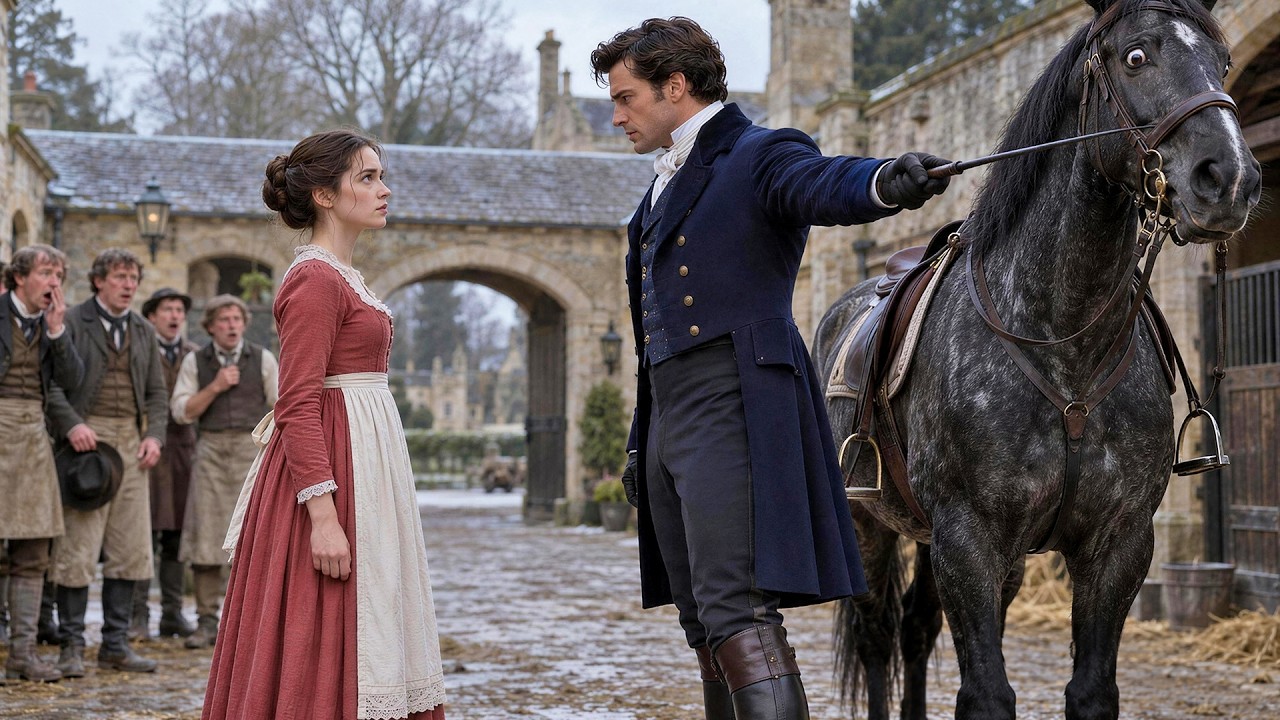
Claraara Hayes ignored the ache in her knuckles. She plunged the stiff bristles of her brush into the bucket of lie soap, scrubbing the grime from a leather saddle flap until her skin cracked.
The tack room was dim, smelling intensely of neat foot oil, horse sweat, and damp wool.
It was a good smell, honest. It was the only place on the vast, sprawling estate of Highfield where Claraara felt she could breathe without asking permission.
Outside of the courtyard was a symphony of chaos, or rather a chaotic mess of rich men realizing they couldn’t buy a horse’s compliance.
Arthur Pendleton, the ninth Duke of Westford, had returned from London with a new acquisition.
Claraara could hear the heavy, frantic thud of hooves against the cobblestones, followed by the sharp, angry shouts of the grooms.
Hold him down, you fools. Get a line on his halter. That was the Duke.
His voice was a baritone scrape, tight with the kind of exhaustion that came from spending too much money and getting too little sleep.
Claraara rung out her brush, wiped her raw hands on her canvas apron, and stepped out of the tack room into the biting gray light.
The animal in the center of the yard was massive, a black ran stallion, standing a full 17 hands, muscles twitching under a coat lthered in nervous white sweat.
His eyes were wide, rolling back to show the stark whites. The horse wasn’t malicious.
It was terrified. Three burly stable hands were hanging off a lunge line, their boots sliding through the freezing mud, trying to force the animals head down.
Arthur stood a few paces back. He wore a tailored riding habit of dark blue wool, pristine leather boots, and a look of pure, unadulterated contempt.
He was a man accustomed to the world bending to his exact specifications. When a chair was uncomfortable, it was replaced.
When a tenant complained, they were evicted. But this horse, bought for a staggering sum to race at New Market, was failing to recognize the hierarchy.
“Pull him in,” Arthur barked, stepping forward with his riding crop raised. “Your grace! He’s too hot!”
Mr. Finch, the headgroom panted, his heels digging into the muck. “The journey from the city.
He’s completely unnerved. Needs a dark stall and a day to settle. I did not pay a thousand guineies for a fragile flower, Finch.
I paid for a monster, and I will see him trot. Now Arthur stepped closer, raising the crop.
The sharp crack of the leather against his own tall boot echoed like a gunshot.
The stallion exploded. He reared up, four legs striking the air, snapping the heavy leather lunge line from the hands of the two younger grooms.
Finch was dragged forward, falling flat onto his stomach in the slop. The horse came down hard, pivoted, and bolted straight toward the tack room, straight toward Claraara.
She didn’t freeze. Panic was a luxury for the rich. Claraara had grown up on a tenant farm, dodging the brutal hooves of overworked draft horses before her father’s debts forced her into service at Highfield.
She knew the language of prey animals. Instead of turning to run, which would only trigger the stallion’s instinct to trample, Claraara stepped forward.
She threw her hands up, making herself as wide as possible, and let out a sharp guttural hiss from the back of her throat.
The stallion, expecting fleeing prey, was startled by the sudden obstacle. He hit the brakes, his massive hooves tearing deep trenches into the gravel and mud.
He slid to a halt barely 3 ft from her, snorting heavily, his chest heaving like a bellows.
Claraara stood perfectly still. She didn’t look at the horse’s eyes. She stared softly at his chest, keeping her posture relaxed but anchored.
Easy, she murmured, her voice barely carrying over the wind. Nobody’s killing you today. For a split second, the yard was de@d silent.
The giant beast lowered his head, blowing hot, wet air into Claraara’s face. She didn’t flinch.
Slowly, she raised one chapped, soapy hand, and pressed it flat against the horse’s neck, right where the pulse pounded beneath the slick coat.
Then the spell broke. What in God’s name do you think you are doing? Arthur’s voice sliced through the damp air, sharp enough to draw blood.
He was striding across the yard, his face pale with a mixture of shock and sheer rage.
To the onlookers, it looked as if a lowly housemaid had just tamed the devil.
To Arthur, it looked like blatant insubordination. He had been made to look like a fool by a beast, and now a servant in a dirty apron had embarrassed him further by handling the animal he could not.
Claraara dropped her hand. She stepped back, eyes lowering to the mud, adopting the invisible posture expected of her station.
“Apologies, your grace!” He was running toward the tack room. I did not ask for your apologies, nor your interference,” Arthur snapped, stopping mere inches from her.
He towered over her, smelling of expensive cologne, tobacco, and anger. “You are a maid, you dust porcelain.
You do not touch my horses.” Claraara kept her eyes on his pristine boots, which were now splattered with mud.
He was frightened, “Your grace! The shouting only makes it worse. The silence that followed was heavy, thick as a woolen blanket.
A maid did not offer advice to a duke. A maid did not speak unless spoken to, and she certainly did not critique the horsemanship of a peer of the realm.
Finch, picking himself up from the muck, groaned audibly, Arthur’s jaw tightened. He looked at the stallion, now standing relatively quiet near the wall, and then down at Claraara.
His pride was a raw, exposed nerve, and this dirty, slight woman had just poured salt directly onto it.
“Frightened,” Arthur repeated, his voice dangerously low. The syllables dripped with aristocratic disdain. You presume to know the mind of a thoroughb bread?
A creature worth more than your entire bloodline? Claraara said nothing. She knew the danger of an embarrassed man.
But her silence only seemed to enrage him further. Look at me when I speak to you, he commanded.
Claraara raised her chin. Her eyes were a flat stony gray. She looked at him.
She didn’t look defiant. She just looked entirely unimpressed. And somehow that was infinitely worse.
The wind picked up, rattling the iron latches on the stable doors. The dozen or so hands, grooms, and farriers in the yard had stopped moving entirely.
They were statues carved out of wool and dirt, waiting for the axe to fall.
Arthur stared into the maid’s face. He didn’t know her name. He didn’t know anything about the hundreds of people who kept his massive estate breathing, but he recognized the look in her eye.
It was the same look his creditors gave him in London when his debts mounted.
It was the look of someone tallying his worth and finding it lacking. He felt the sudden burning need to break it, to break her.
He was the Duke of Westford. He owned their land. She stood on the roof over her head, the clothes on her back.
He would not be judged by a servant who smelled of lie and horse manure.
“You have a remarkable sense of arrogance for a woman who cleans my floors,” Arthur said, his voice dropping into a register of cold, calculated cruelty.
“I meant no disrespect to your grace,” Claraara said flatly. “You meant exactly what you said.
You believe you know better. Arthur turned to look at the stallion who was pouring anxiously at the ground.
Then a dark, terrible idea formed in his mind. It was petty. It was beneath him, but the anger in his chest demanded an outlet.
Finch. Your grace. The headgroom rasped, limping forward. Saddle the rone. Finch blanched. “Your grace, he’s unbroken.
He threw the trainer in London. He broke a man’s ribs at the auction house.
Saddle him,” Arthur interrupted, his voice like cracking ice. “Put the heavy military saddle on him, the one with the deep seat.”
Finch swallowed hard and nodded to two of the braver hands. They moved slowly toward the horse, murmuring quiet reassurances, holding out grain.
It took them 10 agonizing minutes to get the heavy leather saddle over the beast’s back, tightening the girth while the horse pinned its ears and ground its teeth.
Claraara watched, a cold dread pooling in her stomach. She knew what was coming. She could see it in the rigid set of the Duke’s shoulders.
Arthur turned back to Claraara. He gestured toward the massive, volatile animal. The stallion looked like a bomb.
Waiting to go off, shifting its weight from side to side, eyes wide and white.
“You have such a profound understanding of this animal,” Arthur said. A cruel, mocking smile playing at the corners of his mouth.
“You calmed him with a touch, a veritable miracle worker in a canvas apron. “Your grace, please,” Finch interjected, genuinely horrified.
“She’ll be killed.” Silence. Arthur snapped, not taking his eyes off Claraara. Since you are so intimately acquainted with his temperament, you will ride him.
A collective gasp swept through the yard. It was a death sentence. The horse was a violent, unpredictable force of nature, and Claraara was a slight woman, wearing heavy wool skirts and aprons, lacking proper boots or riding gear.
Claraara stared at the Duke. Her heart slammed against her ribs, a frantic bird trapped in her chest.
She looked into Arthur’s eyes, searching for a bluff. But there was only the rigid, immovable wall of aristocratic pride.
He would watch her neck break before he backed down in front of his men.
“I am not dressed for the saddle your grace,” Claraara said, keeping her voice even.
“Do not let him see you shake. Then you will ride a stride in your skirts, or you will pack your bags and leave this estate without a letter of character,” Arthur replied smoothly.
“In the Regency era, a servant dismissed without a letter of character was a de@d woman walking.
It meant starvation. It meant the workhouses. It meant the streets of London, where survival was bought with pieces of one’s soul.”
He wasn’t just threatening her pride. He was holding a knife to her throat. Claraara looked at the horse.
“Goliath,” they had called him in the ledges. He was shifting anxiously under the unfamiliar weight of the saddle.
He was a creature acting purely on fear and instinct, just like her. “Very well,” Arthur’s smug smile faltered for a fraction of a second.
He had expected begging. He had expected tears. He had expected her to fall to her knees and apologize for her insolence.
Instead, she reached behind her waist, untied the heavy, wet canvas apron, and let it fall into the mud.
She walked toward the stallion. Every eye in the courtyard was glued to her back.
Arthur felt a sudden, sickening jolt in his stomach. The reality of what he had just ordered pierced through his anger.
She was tiny compared to the beast. If the horse reared and went backward, she would be crushed into the cobblestones.
If she was thrown, she would be trampled. The blood would be on his hands.
It wouldn’t be a matter for the magistrates. He was a duke above the law in many respects, but it would be a permanent stain on his conscience.
He opened his mouth to stop her, to call it off, to claim she had learned her lesson.
But Claraara had already reached the horse. She didn’t hesitate. She grabbed the heavy leather res near the bit, pulling the horse’s head down slightly.
She ran her hand firmly down his neck, her touch heavy and grounding. No light, fluttering pats, a firm, dominant pressure.
“Give me a leg up, Mr. Finch,” Claraara said, her voice steady. Finch looked at the Duke, his face pale and pleading.
Arthur said nothing. The words were trapped in his throat, suffocated by his own monstrous pride.
Finch stepped forward, cupping his hands. Claraara grabbed the pummel of the saddle. She placed her booted foot into Finch’s hands.
“On three,” she whispered. “One, two, three.” Finch heaved. Claraara sprang upward. She swung her right leg over the heavy leather, her wool skirts hiking up to her calves exposing heavy cotton stockings.
It was horribly unladylike, utterly scandalous, and wildly dangerous. She settled her weight deep into the saddle and gathered the rains in her scarred, chapped hands.
For a long, agonizing heartbeat, nothing happened. The world hung in suspension. The cold wind whipped a strand of dark hair across Claraara’s pale cheek.
Then the stallion realized there was a predator on his back. The explosion was immediate and violent.
The stallion didn’t just buck. He erupted. He dropped his head between his front knees and launched his hindquarters into the air.
The force of it snapped Claraara violently forward. Her teeth slammed together, jarring her skull.
She didn’t scream. She clamped her legs around the horse’s barrel, digging her heels in, dropping her center of gravity as low as humanly possible.
The horse hit the ground stiff-legged. The impact rattled the breath from Claraara’s lungs. Before she could inhale, he spun on his hind legs.
A tight, vicious pivot designed to throw the rider off balance. Clear the yard,” Finch screamed, grabbing the younger boys and pulling them behind the heavy wooden gates.
Arthur stood frozen. His riding crop slipped from his fingers, falling into the mud. He was watching a murder he had orchestrated, the ran reared up, a towering monument of black muscle and rage.
The winter sun caught the whites of his eyes and the froth of saliva flying from his jaws.
He stood so high, so straight that for a sickening moment Arthur was certain the animal was going to fall backward and crush the girl flat.
Hold on to the man. Lean forward. The thought flashed through Arthur’s mind, useless and silent.
Claraara did exactly that. She threw her upper body forward, pressing her chest to the horse’s neck, grabbing a fistful of coarse black mane to keep from sliding backward off the slick leather of the saddle.
When the horse’s front hooves slammed back into the earth, she immediately sat back, pulling the left rain hard, forcing the horse’s nose toward his shoulder.
It was a brutal, ugly maneuver, one she had learned watching rough riders break colts in the muddy fields of her childhood.
You take away their straight line. You take away their power. The horse spun in a tight circle, fighting the bit, fighting the weight on his back.
He bucked again, a twisted sideways contortion that nearly unseated her. Claraara lost her left stirrup.
Her leg swung free, her wool skirts riding up to her knee. She was slipping to the right.
Arthur took a step forward, his heart hammering against his ribs like a trapped bird.
“Stop!” He yelled, the command tearing from his throat, roar and desperate. “Get her off him!”
But nobody could get near them. The horse was a blur of violence. Claraara didn’t hear him.
The roaring of her own blood in her ears drowned out the wind, the shouting, the terror.
It was just her, the beast, and the unforgiving ground. She gritted her teeth, tasting the metallic tang of blood where she had bitten her tongue.
She grabbed the pommel of the saddle with her right hand, and violently hauled her weight back to the center.
“You will not break me,” she thought. The words a rhythmic chant in her mind sinking with the brutal thud of hooves.
You will not break me. She wasn’t just talking to the horse. She abandoned the right rain entirely, using both hands on the left, hauling the horse’s head around so tight that his chin nearly touched the stirup iron.
The animal grunted a deep hollow sound of frustration. He spun three more times, stumbling in the thick mud.
He couldn’t buck. He couldn’t rear. All he could do was spin. Claraara held on.
Her shoulders screamed in agony. The muscles tearing under the immense physical strain. Her hands were bleeding where the stiff leather res cut into her raw knuckles.
But she didn’t yield an inch. Finally, the horse’s frantic energy hit a wall. The mud was deep and the spinning was exhausting.
He stumbled, catching his balance, and came to a ragged, heavy halt. He stood in the center of the yard, his legs spread wide, flanks heaving like a bellows, dripping with white sweat.
He tossed his head, ringing the bit, but he didn’t move. Claraara sat upon his back, chest heaving in time with the animal.
Her hair had escaped its pins, falling in a wild, dark tangle around her face.
Her face was pale, smeared with dirt and sweat. But her eyes, Arthur looked at her eyes.
They were not the eyes of a defeated servant. They were the eyes of a conqueror.
They were burning with a quiet, terrifying defiance. The silence in the courtyard was absolute.
Even the wind seemed to hold its breath. Claraara slowly released the extreme pressure on the rain, giving the horse his head back.
The stallion lowered his neck, blowing a long, shuddering breath out through his nostrils. He was beaten.
Not by force, not by the whip, but by sheer, unyielding endurance. Claraara didn’t look triumphant.
She looked utterly exhausted, yet completely anchored to the earth. She slowly swung her right leg back over the saddle and slid down to the ground.
Her knees buckled the moment her boots hit the mud, but she caught herself against the horse’s shoulder, refusing to fall.
She stood up straight, wiping a streak of mud and blood from her cheek with the back of her hand.
She gathered the res, turned, and walked toward Arthur. The Duke of Westford stood completely still.
The anger that had fueled him minutes ago had evaporated, replaced by a cold, heavy shame that settled in his gut like lead.
He had tried to humiliate her. He had put her life on the line to soothe his bruised ego, and she had taken his punishment, survived it, and thrown it back in his face without saying a single word.
Claraara stopped 2 feet in front of him. She held out the leather res. Her hands were trembling slightly, the knuckles split and bleeding, but her grip was firm.
Your horse is ready to be stalled. Your grace, Claraara said. Her voice was quiet, horse, but steady as stone.
Arthur looked at the res, then at her bleeding hands, and finally up into her face.
He had spent his entire life surrounded by people who bowed, scraped, and flattered. He had never in 30 years felt so incredibly small.
As he slowly reached out and took the res from her, his fingers brushed against hers, cold, rough, and wet with blood.
Thank you, Arthur said. The words barely a whisper, completely devoid of their usual command.
Claraara didn’t bow. She didn’t curtsy. She simply turned her back on the Duke of Westford, walked over to where she had dropped her dirty canvas apron, picked it up, and went back to the tack room to finish scrubbing his saddles.
Father stood alone in the mud, holding the reinss of a broken horse, realizing for the first time in his life that power had nothing to do with a title.
The water in the tack room bucket had gone cold, Claraara plunged her hands into it anyway.
The lie soap bit into the raw split skin across her knuckles like shattered glass.
She bit the inside of her cheek until she tasted copper, scrubbing the stiff bristle brush over the leathers.
The rhythm of the work was the only thing keeping her upright. If she stopped, the adrenaline would crash, and the dull, throbbing heat radiating from her spine to her collarbone would paralyze her.
She had survived the saddle, but the horse had left his mark. Every violent contortion of the stallion’s spine had sent shock waves through her own.
Her ribs felt bruised, a tight, restrictive band around her chest that made deep breaths impossible.
The other servants avoided the tack room. News of the courtyard incident had spread through Highfield Estate faster than a grease fire.
A maid had shamed the Duke. A maid had survived Goliath. To associate with her now was to stand too close to a lightning rod during a storm.
Claraara preferred the isolation. Pity was exhausting, and she had no energy left to deflect it.
A mile away, in the east wing of the main house, Arthur Pendleton sat in a wingback chair by a roaring hearth.
The library smelled of old paper, beeswax, and expensive French brandy. He held a crystal snifter in his right hand.
He hadn’t taken a single sip in an hour. He was staring at his boots.
His valet, a meticulous man named Hughes, had already taken away the mud splattered pair from the courtyard and replaced them with polished indoor slippers.
The physical dirt was gone. The stain remained. Arthur closed his eyes, and the image flashed violently against the back of his eyelids.
The black horse rearing, the pale, dirt smeared face of the maid, the sickening realization that he had let his wounded pride drive a woman to the edge of death.
He was a peer of the realm, educated at Oxford, raised to lead men, and manage vast tracks of the country.
He was supposed to be a gentleman. Today he had been a butcher. He set the snifter down on the mahogany side table with a sharp click.
Hughes, Arthur called out. The word felt like ash in his throat. The valet appeared from the shadows of the corridor almost instantly.
Your grace. Send for Dr. Aris. Have him come to the estate. Hughes blinked. A rare crack in his professional veneer.
Are you unwell, your grace? Shall I prepare a draft? I am perfectly well, Arthur snapped, the defensive edge returning to his voice before he consciously forced it down.
He took a slow breath. The doctor is not for me. He is to go to the servant quarters.
Have him attend to the maid who was in the courtyard this afternoon. Ensure she is given whatever salves or bindings she requires.
Hughes bowed low. Right away, your grace. Shall I have the expense docked from her wages?
Arthur’s head snapped up, his eyes locked onto the valet with a sudden, startling ferocity.
If a single copper is removed from her ledger, Hughes, I will personally see you thrown into the tempames.
The estate covers the cost. Understand? Implicitly your grace, Hughes murmured, retreating quickly. Arthur was left alone with the fire.
He rubbed a hand over his face, feeling the harsh stubble along his jawline. He had paid for the doctor.
It was the correct thing to do. It was the gentlemanly thing to do. So why did it feel like a hollow, cowardly gesture, because paying away guilt was the oldest trick in the aristocrat’s handbook.
It cost him nothing. He looked toward the window. The sun had set, plunging the Somerset countryside into a bruised, freezing purple twilight.
Down in the valley, the stable lanterns were flickering to life. Arthur stood up. He couldn’t sit here.
The quiet of the library was suffocating. The stable block was cavernous, built of heavy stone and thick oak timbers that absorbed the sounds of the night.
It smelled warmly of sweet hay, oat mash, and the deep earthy scent of sleeping animals.
Claraara slipped through the heavyside door, a woolen shawl wrapped tightly around her shoulders. Dr.
Aris had come and gone. He had bound her ribs with thick cotton, and left a tin of arnica salve for her hands.
She had accepted the treatment in silence, ignoring the wide, curious eyes of the kitchen girls who shared her dormatory.
The binding helped the pain, but sleep had refused to come. Every time she closed her eyes, she felt the sickening sensation of falling backward.
She walked down the long shadowed aisle. The horses knickered softly at her passing, shifting their weight in the deep straw.
Claraara stopped in front of the last stall. Goliath. The heavy wooden door was bolted twice.
Inside the massive black stallion was standing in the corner facing the wall. He wasn’t sleeping.
His ears were pinned flat against his skull and his tail swished in agitated rhythmic strokes.
He was a prisoner in a strange place, locked in the dark, waiting for the next attack.
Claraara leaned her forehead against the cold iron bars of the stall grate. She didn’t make a sound.
She just stood there offering a quiet, non-threatening presence. Slowly, the horse’s ears flicked. He turned his massive head, one dark eye fixing on her in the dim light.
He snorted, a low rumbling sound, and took a tentative step forward. “You’re a long way from home, aren’t you?”
Claraara whispered. “As are you, I imagine,” Claraara stiffened. The voice came from the shadows near the tack room.
It was low, lacking its usual sharp command, but unmistakable. She turned slowly. Arthur Pendleton stepped into the weak pool of light cast by a single overhead lantern.
He was wearing a heavy wool great coat over his evening clothes, his hands shoved deep into his pockets.
He looked completely out of place among the hay and manure, a creature of velvet in a world of burlap.
Claraara immediately dropped her gaze and began a stiff, agonizing curtsy. Her bound ribs screamed in protest, a sharp intake of breath hissing through her teeth.
“Don’t,” Arthur said quickly. He closed the distance between them, stopping a few feet away.
“Don’t do that. Stand up.” Claraara straightened, keeping her eyes fixed firmly on the brass buttons of his waist coat.
Your grace. I apologize. I was unable to sleep. I will return to the quarters.
Stay, he commanded. It was a habit, the bark of an order, and he immediately winced.
Please stay. Claraara didn’t move. She didn’t speak. The silence stretched thick and uncomfortable. The stallion in the stall behind them shoved his nose against the iron bars, blowing hot air against the back of Claraara’s neck.
Arthur looked at the beast, then down at Claraara’s hands. He saw the white cotton bandages wrapped clumsily around her knuckles.
“Did the doctor see to you?” He asked. “Yes, your grace. Thank you.” Her voice was flat, devoid of any genuine gratitude.
It was the wrote response of a servant. Arthur hated it. He wanted her to yell at him.
He wanted her to call him a monster, a tyrant, a fool. Anything would be better than this suffocating polite wall she had built between them.
“I was angry,” Arthur said, the words heavy and foreign on his tongue. He was not a man who explained himself.
I lost control of the animal and the men were watching. I felt humiliated and I chose to make you pay the price for it.
Claraara looked up. Her gray eyes caught the lantern light steady and unblinking. You are the Duke.
You do not need a reason to give an order. Your grace. I am giving you a reason.
Arthur insisted his voice tight. I am telling you that I was wrong. It was a staggering admission.
A duke did not apologize to a maid. It upset the natural order of things.
It blurred the lines that kept their world functioning. Claraara felt a strange flutter of unease in her chest.
She knew how to handle a tyrant. A tyrant was predictable. A man with a conscience was dangerous.
The horse is not malicious, your grace, Claraara said, deliberately changing the subject. She turned slightly back to the stall.
He is terrified. They broke him with force, not trust. When he feels trapped, he fights.
He knows no other way. Arthur looked at the massive black profile of the horse.
“And how do you fix a creature that only knows how to fight?” Claraara looked back at Arthur.
For a brief second, the invisible barrier between master and servant vanished. They were just two exhausted people standing in the cold.
You stop hitting him, Claraara said quietly. And you wait for him to realize the war is over.
She didn’t wait for a dismissal. She gave a short, stiff nod of her head, gathered her shawl tightly around her, and walked away down the aisle.
Arthur stood alone by the stall, listening to the crunch of her boots fade into the night.
The war is over, he thought. But looking at the empty space she left behind, he felt like something entirely new had just begun.
The next morning, the Somerset sky was the color of a bruised plum, threatening snow.
Claraara woke to the sharp, unrelenting ache in her ribs. She dressed slowly, her fingers fumbling with the tiny horn buttons of her uniform, because her knuckles were stiff beneath the bandages.
When she arrived at the servants hall for the morning assignments, the usual dull roar of 50 people eating grl and shouting over one another, died down to a low murmur.
Mrs. Gable, the housekeeper, stood at the head of the long pine table. She was a formidable woman whose entire existence was dedicated to the smooth running of the estate.
“Haze,” Mrs. Gable barked, her eyes scanning a ledger. Claraara stepped forward. “Yes, Mom. You are relieved of stable and yard duties.
You are to report to the main house, the silver pantry. You will take over the polishing of the formal dining sets and assist in the library dusting.
Claraara froze. The silver pantry was a coveted position. It was warm. It involved sitting down.
It was usually reserved for older maids who had served the family for decades, a soft transition before retirement.
A girl of 20 did not get the silver pantry, especially not one whose primary skill was scrubbing mud off leather.
Mom, Claraara asked, confusion bleeding through her carefully neutral tone. I have not been trained for the house, Silva.
You have hands, don’t you? Mrs. Gable snapped, though there was a strange tight look around her eyes.
The Duke’s orders. He wants the tack room managed by the men. Claims it’s highly inappropriate for a woman to be elbowed deep in saddle soap.
You report to Mr. Carson in the pantry in 10 minutes. Mrs. As Gable moved on to the next name, Claraara stood rooted to the spot.
The other maids were staring, a toxic mix of jealousy and awe radiating from them.
They thought she had been rewarded. They thought she had won some secret favor. Claraara felt sick.
It wasn’t a reward. It was charity. It was the Duke paying off his guilt by moving her out of the freezing mud and into the warm heart of his house.
He was trying to buy his conscience clear. She didn’t go to the silver pantry.
Instead, Claraara walked straight through the heavy bay door that separated the servant quarters from the main house.
The transition was jarring. The floors changed from cold flagstone to thick Persian carpets. The smell of lie soap was replaced by beeswax and fresh winter pine.
She knew the Duke’s schedule. He spent his mornings in the estate office going over tenant ledgers.
She marched down the hallway, ignoring the horrified gasps of a footman who tried to intercept her.
She reached the heavy oak door of the office and without knocking pushed it open.
Arthur was seated behind a massive mahogany desk, a silver pen in his hand, a mountain of paper before him.
He looked up, a scowl forming on his face at the intrusion, but it vanished the moment he saw her.
Claraara stood in the doorway. She was pale, her dark hair pulled back severely, her gray dress stark against the opulent reds and golds of the room.
She was breathing hard, partly from the pain in her ribs, partly from the sheer audacity of what she was doing.
I cannot accept the silver pantry or grace, Claraara said. Arthur set his pen down slowly.
He sat back in his leather chair, watching her. You are refusing a direct order.
I am refusing charity, Claraara shot back, the heat finally breaking through her carefully constructed icy facade.
I am a yard worker. I know the stables. I know the tack. I do not know which fork is used for oysters, and I do not want to learn.
Arthur’s jaw tightened. It is winter. The yard is freezing. You were nearly killed yesterday, and you are visibly in pain.
The pantry is warm and the work is light. And it makes you feel better, Claraara said.
The words hung in the air, a fatal strike. Arthur’s eyes flared. He stood up, placing his hands flat on the desk, leaning forward.
“Do you enjoy the cold, Claraara?” He asked, using her first name for the very first time.
“It sounded strange in the quiet room. Do you enjoy scrubbing leather until your hands bleed?
Is your pride so immense that you would rather freeze in the mud than accept a comfortable position in my house?
My pride is all I have left. Your grace, Claraara said, stepping fully into the room and letting the door click shut behind her.
You own my time. You own the roof over my head. You own the food I eat.
But you do not get to break me in the courtyard and then tuck me away in a warm pantry, so you don’t have to look at the damage you caused.”
Arthur stared at her. The air in the room was suddenly charged, thick with attention that had nothing to do with master and servant.
He saw the fierce, unyielding spirit that had kept her on the back of a wild stallion.
He realized with a sinking feeling in his chest that he couldn’t buy her forgiveness.
A warm room and an easy job were insults to a woman like this. I am not trying to hide you, Arthur said, his voice dropping low, losing its anger.
I am trying to ensure you heal. I will heal in the tac room, Claraara replied stubbornly.
Where I belong. Arthur walked slowly around the desk. He stopped a few feet from her.
He was tall, imposing, completely in his element in this room of wealth and power.
Yet he felt entirely disarmed. “You do not belong in the mud,” Arthur said quietly.
“I belong where I can earn my keep. Honestly,” Claraara recounted, refusing to back down.
“Put me, put me back in the stables, your grace. Let me work with the ran.
I can settle him. Finch doesn’t have the patience for it. Arthur looked at at her for a long time.
She was asking to go back into the cage with the beast. She was asking for the hardest, most dangerous job on the estate.
If I allow this, Arthur said slowly, you will work under my direct supervision. You will not ride him again until I say so.
You will work him from the ground. And if I see you pushing yourself beyond what those ribs can handle, I will drag you to the silver pantry myself,” Claraara looked at him.
The corner of her mouth twitched, the very ghost of a smirk. “Is that an order, your grace?”
“That is a condition,” Arthur replied, feeling a strange, unfamiliar warmth bloom in his chest.
“Take it or leave it.” I accept, Claraara said. She gave a small, measured nod.
I will be in the yard. She turned and left the room. Arthur watched the heavy oak door close behind her.
He stood there for a long time, the silence of the massive house pressing in on him.
He had thought he was the one in control. He had thought he was dictating the terms.
But as he looked out the window toward the stables, Arthur Pendleton realized he had just handed the rains over to her.
December arrived with a bitterness that turned the Somerset mud into jagged ridges of frozen iron.
The cold didn’t just bite, it chewed. Claraara wrapped an extra woolen scarf around her neck and buried her hands in her pockets, her breath pluming in thick white clouds as she walked toward the round pen.
Inside the heavy wooden fencing, Goliath was already waiting. He was off the lead line, pacing the perimeter with the restless energy of a caged tiger.
His hooves rang sharply against the frozen earth. Arthur stood by the gate. He was bundled in a heavy charcoal greatcoat, a wool flat cap pulled low over his eyes.
True to his word, he was there every morning at dawn. He had stopped bringing Hughes to carry his hot tea.
He had stopped wearing the polished leather boots that scuffed so easily. He looked less like a duke and more like a man trying to remember how to be human.
Claraara unlatched the gate and slipped inside. She didn’t acknowledge Arthur with a curtsy, and he didn’t expect one.
The pleasantries of the mana house did not survive the frost. She walked to the center of the pen.
She carried no crop. She held only a coiled length of soft cotton rope. Goliath stopped pacing.
He turned his massive head, pinning his ears flat and snorted. It was a warning.
Come closer and I will strike. Claraara didn’t step forward. She stood perfectly still, her shoulders slouched slightly, her eyes fixed on the horse’s knees.
She made herself small, boring, unthreatening. Minutes ticked by. The cold seeped through the soles of Claraara’s boots, numbing her toes.
Arthur watched from the fence, his jaw clenched. He wanted to tell her to move.
He wanted to demand action. His entire life was built on immediate results. But he forced his mouth shut.
He was learning slowly and painfully that his authority meant nothing to a,000 lb of frightened muscle.
Finally, the horse blinked. The tight defensive posture in his neck softened just a fraction.
He took a hesitant, shuffling step toward the center of the pen, stretching his nose out to catch her scent.
Claraara exhaled. Slowly, deliberately, she uncoiled a few feet of the rope and tossed it lightly toward his front hoofs.
It didn’t hit him, but the sudden movement sent the stallion scrambling backward, his eyes wide.
“Why did you do that?” Arthur asked, his voice harsh in the quiet morning. “He was calming down.”
Claraara didn’t look at him. She kept her eyes on the horse. “He wasn’t calm, your grace.
He was tired. There’s a difference. He needs to learn that the rope won’t bite.
He needs to choose to stand his ground, not just freeze out of fear. She gathered the rope and stood still again.
They repeated the dance. Silence, waiting, a small movement, a panicked retreat. Arthur watched her face.
Her cheeks were raw from the wind, her nose bright red. Her knuckles, though healing, were still scarred and swollen.
Yet there was a profound, unshakable peace about her. She wasn’t fighting the animal. She was having a conversation with it, a conversation entirely devoid of force.
You never ask for more than he can give,” Arthur noted quietly, leaning against the frozen wood of the fence.
Claraara turned her head slightly. “If you ask for everything all at once, you get nothing.
You build a horse ounce by ounce. You ask for a step. If he gives it, you take the pressure off.
That’s the reward. The release of pressure.” Arthur looked at the ground. The release of pressure.
He thought of the heavy suffocating weight of his title, his ledgers, his debts, the endless expectations of a society that judged a man by the cut of his coat, and the obedience of his servants.
He had spent his entire life applying pressure to everything and everyone around him, including himself.
“Does it work on men?” Arthur asked. The words slipped out before he could catch them.
Cynical and sharp, Claraara finally looked at him. Her gray eyes were striking against the bleak winter landscape.
I wouldn’t know your grace. I’ve only ever been on the receiving end of the whip.
Arthur flinched as if she had struck him. He looked away, his jaw working silently.
He deserved that. He had built the wall between them with his own cruelty, and he couldn’t just tear it down because he suddenly felt guilty.
Goliath took another step forward. This time, he didn’t stop. He walked cautiously toward Claraara, his head lowered until his velvety muzzle brushed the coarse wool of her coat.
He let out a long, shuddering sigh, his breath warming her frozen hands. Claraara didn’t reach up to pet him.
She just stood there letting him investigate. “Good boy,” she murmured. Arthur watched them, a strange, heavy knot tightening in his chest.
He was the wealthiest man in the county. He owned thousands of acres, hundreds of horses, and the very ground Claraara stood upon.
Yet, looking at the two of them in the center of the freezing pen, he realized he was entirely locked out.
He was the outsider. Show me, Arthur said. Claraara looked up. Pardon? Arthur unlatched the gate.
He stepped into the round pen. The crunch of his boots on the frozen earth caused Goliath’s head to snap up, his ears swiveling backward.
“Show me how to do it,” Arthur repeated, his voice dropping the aristocratic draw, leaving only a raw, desperate sincerity.
“I don’t want to watch anymore. I want to learn. Claraara stared at him. She saw the Duke of Westford, a man who had ordered her to her death a month ago, standing in the freezing mud, asking a maid for instruction.
It was a trap, her survival instinct screamed. It was a whim. He would get bored.
But looking into his eyes, she didn’t see a Duke. She saw a man who was terrified of his own reflection.
“Take off your coat, your grace,” Claraara said flatly. “It flaps in the wind. It scares him.”
Arthur didn’t hesitate. He stripped off the heavy, expensive wool coat and draped it over the fence, standing only in his waist coat and shirt sleeves in the biting December cold.
He shivered, but he didn’t complain. Claraara held out the coiled cotton rope. Don’t look at his eyes.
Look at his shoulder. And if he runs, do not pull. Arthur stepped forward and took the rope.
His hand brushed hers. Her skin was freezing. His was warm. For a split second, neither of them moved.
I won’t pull, Arthur promised. And he wasn’t just talking about the horse. January brought the snow.
It didn’t fall softly. It drove horizontally across the moors, burying the stone walls and turning Highfield Estate into an isolated island.
The stable block was a fortress against the storm, but even foot thick stone couldn’t completely keep out the bitter cold.
The temperature plummeted so fast that the water troughs froze solid within an hour. The grooms were working double shifts, hauling buckets of hot water from the kitchen fires just to keep the animals hydrated.
It was past midnight. Claraara was in the tack room, wrapped in a heavy blanket, trying to sleep on a pile of empty grain sacks.
She had refused to return to the servant quarters. The walk across the open courtyard in this weather was suicide, and she preferred the smell of horses to the stifling, gossipy air of the maid’s dormatory.
A sharp, explosive crack jolted her awake. It sounded like a gunshot. It was followed by the groaning scream of stressed timber and then the panicked, thrashing chaos of a horse fighting for its life.
Claraara scrambled up, her heart hammering in her throat. She grabbed a lantern, hands trembling so badly she could barely strike the match.
The flame sputtered to life, casting wild, leaping shadows against the stone walls. She ran down the aisle.
The noise was coming from the end stall. A heavy oak beam in the roof above Goliath’s stall, weakened by rot, and the immense weight of the accumulated snow, had partially snapped.
It hadn’t collapsed completely. But it had dropped several feet, splintering with a sound that terrified the highly strung thorbred.
Goliath was losing his mind. He was rearing in the confined space of the stall, his front hooves striking the heavy iron bars.
He was covered in sweat, slipping on the straw, his eyes rolling white with sheer, mindless terror.
If he didn’t stop, he was going to break his own neck or shatter a leg.
“Goliath!” Claraara shouted over the howling wind outside. She threw the bolt on the stall door and pushed it open.
It was a mistake. The horse, blinded by panic, spun around and bolted for the opening.
He didn’t see Claraara. He only saw a way out. His massive, muscular shoulder slammed into her chest with the force of a runaway carriage.
The impact lifted Claraara off her feet. She flew backward, hitting the hard stone wall of the aisle.
The lantern shattered on the floor, plunging the area into darkness, save for the weak moonlight filtering through the high windows.
Pain, hot and blinding, exploded across her already tender ribs. She gasped, but no air came.
She crumpled to the floor, paralyzed by the shock. Goliath scrambled in the aisle, his hooves slipping wildly on the wet stone.
He was loose, trapped in the dark, and entirely out of control. Claraara. The voice ripped through the dark.
It wasn’t Finch. It wasn’t one of the stable boys. Arthur came tearing around the corner from the side entrance.
He was fully dressed, wearing a heavy riding coat, carrying a hurricane lamp. He had been checking the outer barns, unable to sleep, while his estate was buried in snow.
He saw the broken beam. He saw the thrashing horse. And then his blood ran completely cold.
He saw Claraara lying in a crumpled heap against the wall, clutching her chest, her face stark white in the dim light.
Claraara. Arthur dropped the lamp. It didn’t break, but it rolled into the straw, casting a strange sideways light on the scene.
He didn’t run to the horse. He ran to her. He dropped to his knees on the freezing stone, pulling his heavy gloves off with his teeth.
“Where,” he demanded, his voice ragged with a panic he had never felt in his life.
“Where are you hurt?” Claraara couldn’t speak. She wheezed, her hands gripping his forearms like a vice, as she tried to force air past the agony in her chest.
Arthur felt a surge of pure violent terror. He slipped his arms under her, careful not to squeeze her ribs, and pulled her upper body against his chest, lifting her off the freezing floor.
“Breathe,” he ordered, pressing his face against her hair. “Just breathe, Claraara. Small breaths.” Goliath, meanwhile, had backed himself into a corner near the tack room.
He was trembling violently, snorting loudly, preparing to bolt again. Claraara finally managed a ragged, tearing gasp.
She squeezed her eyes shut, fighting the wave of nausea that accompanied the pain. “The horse,” she rasped, her voice barely a whisper.
“He’ll hurt himself. You have to You have to catch him.” “To hell with the horse,” Arthur snarled, his arms tightening around her.
“I don’t care if he breaks his neck. I’m getting you to the house.” “No.”
Claraara grabbed his lapels, forcing her eyes open. Her gaze was fierce, cutting through the pain.
You promised. You promised you wouldn’t use force. If you call the men, if they corner him with pitchforks, you ruin everything we did.
Everything. Arthur stared at her. She was injured, freezing, and in agony. Yet, she was fighting for the animal that had just crushed her.
She was fighting for the work they had done together. He looked at Goliath. The beast was a coiled spring.
If Arthur stepped toward him aggressively, the horse would bolt and trample them both. Arthur gently lowered Claraara back against the wall, sliding his own heavy coat off and wrapping it around her trembling shoulders.
“Don’t move!” He commanded softly. He stood up. He didn’t shout for Finch. He didn’t pick up a whip.
Arthur walked slowly toward the center of the aisle. The air was freezing, his breath pluming in the dim light.
He stopped 10 ft from the terrified stallion. “Release the pressure,” he thought, hearing Claraara’s voice in his head.
Arthur lowered his head. He relaxed his shoulders, slumping his posture to make himself appear entirely harmless.
He didn’t look at the horse’s eyes. He looked at his shoulder. He stood in the freezing dark aisle, and he waited.
The wind howled outside, rattling the heavy wooden doors. The cold chewed at Arthur’s shirt sleeves.
Minutes stretched like hours. Goliath stopped thrashing. He stood in the corner, sides heaving, watching the man.
The man wasn’t yelling. The man wasn’t attacking. Slowly, Arthur took one step backward. He yielded the ground.
The stallion blinked. He lowered his head an inch. Arthur took another step back. Goliath let out a long, trembling breath.
The sheer exhaustion of his panic was setting in. He took a hesitant step forward away from the dark corner toward the man who was offering him space instead of violence.
Arthur stood perfectly still. He let the massive black beast approach. Goliath stretched his neck out, sniffing the air until his nose touched Arthur’s chest.
Arthur slowly, carefully raised his hand and pressed it flat against the horse’s neck, right over the pounding pulse, just as Claraara had done in the courtyard.
“Easy,” Arthur whispered, his voice trembling slightly with adrenaline and relief. “Nobody is killing you today.
From the shadows, Claraara watched. The pain in her chest was blinding, but a different kind of ache bloomed in her throat.
She watched the proud, arrogant Duke of Westford stand freezing in the dirt, comforting a broken animal with the gentleness of a saint.
He had learned. He had actually listened. Arthur hooked a finger through Goliath’s halter and slowly led the exhausted horse past the broken stall, putting him into an empty one further down the line.
He bolted the door and immediately ran back to Claraara. He scooped her up into his arms, completely ignoring her weak protests.
He didn’t care about the mud on her dress or the fact that carrying a servant was utterly beneath a pier of the realm.
I caught him,” Arthur said, his voice thick with emotion as he carried her toward the main house, pushing through the heavy stable doors into the raging blizzard.
“I did exactly what you said.” Claraara rested her head against his shoulder. The wind screamed around them, but against his chest, she felt entirely safe.
I know, she whispered before the pain finally dragged her down into the dark. The thor came in late March.
The snow melted, turning the Somerset hills into a brilliant, violent green. The mud in the courtyard began to dry, replaced by the soft, yielding earth of spring.
Claraara stood by the heavy oak fence of the riding arena. Her ribs had healed, leaving only a dull ache when the weather turned damp.
She wasn’t wearing her canvas apron. She was wearing a tailored riding habit of dark green wool, a gift she had tried to refuse, and one Arthur had flatly refused to take back.
In the center of the arena, Arthur sat a stride Goliath. There was no heavy military saddle.
There was no harsh curb bit. Arthur rode with a light snapple, sitting deep and relaxed in the leather.
The black stallion, once a creature of pure, unadulterated violence, was moving with a fluid, rhythmic grace.
Arthur gave a subtle squeeze with his left calf, and Goliath transitioned flawlessly into a collected caner.
The horse’s ears were flicked back, listening intently to his rider. That there was no fight, there was only a quiet, powerful partnership.
Claraara watched, a fierce protective pride swelling in her chest. They had rebuilt the beast from the ground up, and in doing so, they had rebuilt the man on his back.
Arthur pulled gently on the res. Goliath halted squarely, tossing his head slightly, chewing on the bit with a soft, relaxed jaw.
Arthur patted the horse’s neck firmly, a genuine smile breaking across his face. It made him look 10 years younger.
It made him look beautiful. He dismounted, handing the res to a waiting stable boy and walked over to the fence where Claraara stood.
He didn’t stop on the other side. He climbed over the wooden rail, dropping down next to her on the grass.
He smelled of leather, horse sweat, and the sharp, clean scent of spring air. “He’s ready for new market,” Arthur said, looking out at the horse being led away.
“Finch thinks he could take the gold cup.” Claraara kept her eyes on the retreating horse.
“He’s fast enough, but crowds are loud. You’ll need to ride him out a few times to acclimate him to the noise.
I have no intention of taking him to New Market.” Claraara frowned, turning to look at him.
Why? He is a racehorse. That is what you bought him for. Arthur looked at her.
His dark eyes were serious, stripped of all the artifice and arrogance that had defined him months ago.
I bought a monster to win a trophy to soothe my own ego. I don’t need a trophy anymore.
He stays here. He can run in the valley. Claraara looked away, suddenly hyper aware of how close he was standing.
The air between them had shifted over the long, brutal winter. The lines of master and servant had blurred into something messy, complicated, and deeply terrifying.
They had bled together, frozen together, and fought the darkness together. But spring had arrived, and the harsh reality of their world was creeping back in.
You should return to the house, your grace. Claraara said softly, stepping back. Your guests from London arrived tomorrow.
The stables are not a place to entertain. Arthur closed the distance she had just created.
Stop. It is the truth. I don’t care about the guests, Arthur said, his voice dropping low, a quiet intensity burning in his chest.
I don’t care about the house. I care about this. He gestured between the two of them.
I cared about the only real thing in my life. Claraara’s breath caught. She looked up at him, her heart slamming against her ribs.
You are the Duke of Westford. I am a tenant farmer’s daughter who cleans your saddles.
The world outside this gate does not care about what is real. It only cares about what is proper.
Then to hell with the world, Arthur said fiercely. He reached out, taking her scarred work roughened hand in his.
He didn’t care who was watching from the yard. He didn’t care about the gossip.
He ran his thumb over the pale scar across her knuckles. “A scar she had earned, surviving his cruelty.”
“You didn’t just break the horse,” Claraara, Arthur said, his voice roar with a vulnerability that terrified him, yet felt completely right.
“You broke me. You stripped away every lie I ever told myself about what makes a man strong.
I don’t want a maid. I don’t want a servant. Claraara stared at him, tears suddenly stinging the back of her eyes.
She had spent her life bracing for the blow, waiting for the boot to drop.
She didn’t know how to surrender. “What do you want?” She whispered, her voice trembling.
Arthur looked down at her hand, holding it as if it were the most precious thing he had ever touched.
I want a partner, he said, looking back into her eyes. I want the woman who stood in the mud and taught a tyrant how to yield.
Claraara looked at the Duke. She saw the mud on his boots, the soft vulnerability in his eyes, and the quiet strength he had finally found.
The world was cold, cruel, and profoundly unfair. But standing here in the spring sun with her hand securely in his, she realized the war truly was over.
She tightened her grip on his hand. “Then you had better learn how to clean your own saddles, Arthur.”
Arthur smiled, a real brilliant smile that reached his eyes. “I believe I can manage that.
True strength doesn’t require a whip, and real power is having the courage to yield.
Arthur and Claraara didn’t just tame a wild beast. They dismantled the rigid, unforgiving walls of their own world to find something genuine in the mud.
If this story of gritty defiance and hard-earned redemption struck a chord with you, leave a like and share this video with someone who appreciates a romance grounded in reality.
What did you think of Arthur’s transformation? Let me know in the comments. Don’t forget to subscribe and hit the bell for more historical dramas that pull no punches.








