The Duke Dismissed His Sister’s Friend as a Passing Guest — Until She Became His Reason to Stay
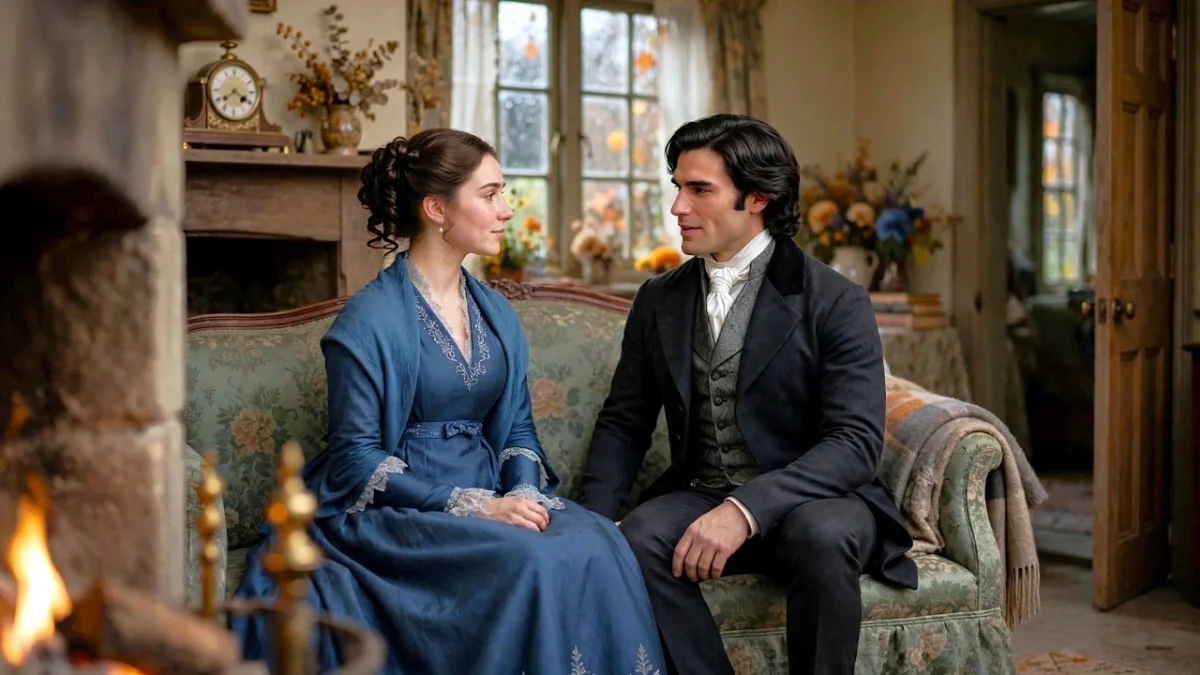
The Duke Dismissed His Sister’s Friend as a Passing Guest — Until She Became His Reason to Stay
He calculated the exact date her usefulness would end, assuming she would simply vanish from his family’s table.
But as the weeks of her visit drew to a close, his grace found himself staring at the empty chair beside him, realizing with a quiet jolt of dread that he was the one who had arranged for her departure.
Now the man who managed everything perfectly had to learn how to ask a passing guest for the one thing he couldn’t control, a reason to stay.
The faint clink of porcelain settling against a saucer punctuated the quiet of the Bellamy drawing room.
Early autumn sunlight angled through the tall windows, catching the steam rising from the tea service.
You will join us for lunchon next Sunday, Edmund. Will you not? Lady Maranne Bellamy asked, her voice carrying the bright hopeful cadence of a woman newly accustomed to managing her own home.
Edmund Ashkam, Duke of Witchmir, accepted his cup with a slight nod. He was a man composed of sharp lines and quiet authority, entirely used to bearing the weight of his family’s well-being.
He looked across the low table, his gaze brushing past his sister to the woman seated quietly near the window.
Miss Clara Witkim had been Marannne’s steadfast companion through the frenetic weeks of the wedding preparations, a gentle woman of modest means and unending patience.
“I should be glad to, Maryanne,” Edmund replied, his tone perfectly even. “He turned slightly, addressing Clara with the polite detachment of an employer checking a schedule.”
“And when, precisely, does your visit with us conclude? Miss Whitam, you have been of immense help to my sister during this transition, but we must not monopolize your time indefinitely.
A profound silence fell over the tea table. The silver spoon in Clara’s hand hovered for a fraction of a second before she lowered it silently to her saucer.
She did not flush, nor did she look away. She possessed a quiet dignity that required no defense.
I am engaged to remain for the 6 weeks we originally agreed upon your grace, Clara said, her voice even and calm.
Afterward, I shall return to my aunt, Mrs. Vale. It is but a short distance.
And we shall continue to expect her on Sundays, Maryanne added smoothly, though a line of protective tension had appeared between her brows.
Clara is not a governness, Edmund. She is my dearest friend. Edmund inclined his head, conceding the point without truly absorbing it.
Of course, it is a kind arrangement for the present. He took a sip of his tea.
In his mind, Clara was a temporary necessity, a fixture of Marannne’s adjustment to married life.
Clara, watching the impassive lines of his profile, understood perfectly. To the Duke of Wishmir, she was not a friend to the family.
She was merely a function that would soon expire. The matter of Claraara’s supposed departure lingered beneath the surface of the afternoon, surfacing again when the conversation turned to the Bellamy’s first small evening gathering.
Edmund drew a folded sheet of paper from his coat pocket, his expression shifting into the familiar, efficient mask of the man who organized the world.
I have taken the liberty of drafting a preliminary list of guests, the Vicor, of course, and the Ashcrofts.
It is best to begin with a manageable number so as not to overwhelm your staff.
The crisp rustle of the paper sounded loud in the quiet room. He extended the list toward his sister, entirely expecting her to accept his guidance.
He had, after all, managed her life since their father’s death. Claraara watched Maryanne’s hands tightened slightly in her lap.
It was a small movement, one Edmund entirely missed in his pursuit of order. Before Maryanne could take the paper, Claraara spoke, her voice laced with mild, unassuming curiosity.
Who is it that you most wish to invite, Marannne? The Ashcrofts are lovely, certainly, but you mentioned last week how much you enjoy the company of the Daltons.
Edmund’s handstilled. He looked at Clara, his dark brows drawing together. She did not wither under his gaze.
She simply looked back, calmly, returning the choice to the woman who actually owned the house.
For a fleeting second, Clara felt the familiar urge to simply take the list, organize the evening herself, and spare everyone the friction.
She firmly clamped down on the impulse. “Clara is right,” Thomas Bellamy murmured from his armchair by the fireplace.
He offered his wife a warm, encouraging smile. “It is your drawing room, my dear, though I must beg you not to invite anyone who expects me to select the music.
My judgment in that arena is famously disastrous.” Maryanne let out a breath of a laugh, the tension breaking.
“The Daltons, then Thank you, Edmund, but I believe Thomas and I shall draft our own list this evening.”
Edmund slowly withdrew the paper. He looked from his sister to Claraara. There was a flash of irritation in his eyes, swift and sharp, but it was immediately chased by something else.
Respect. He folded the list and put it away, leaning back in his chair. He had expected resistance, perhaps even tears.
He had not expected to be outmaneuvered with such quiet surgical grace. An hour later, the visit concluded.
Edmund stood in the grand foyer. His great coat draped over his arm, waiting for his carriage to be brought round.
The heavy oak front door stood open to the crisp autumn air. The crunch of carriage wheels on gravel signaled its approach.
Claraara crossed the foyer to retrieve a shawl left on a side table. Finding themselves briefly alone, Edmund turned to her.
Gone was the dictatorial edge of the man with the guest list. Tell me the truth, Miss Witam, he said quietly, his gaze steady on her face.
How does she fair truly? He asked for no reports, issued no instructions. It was a sincere question from a brother who carried too much weight.
Clara paused, her fingers resting lightly on the fringe of her shawl. She is perfectly happy, your grace.
She wishes only to build a life that is entirely her own alongside Mr. Bellamy.
She offered him a small knowing smile. She does not need to be protected from a quiet evening gathering.
Edmund’s jaw tightened then relaxed. It is a difficult habit to break. “I know,” Claraara admitted, her voice dropping to a softer, more intimate register.
It is entirely unnatural to stand aside and let her stumble through a task I could easily complete for her in half the time, but I am learning to let her do it.”
Edmund looked at her, truly looked at her, the sharp intelligence in his dark eyes focusing entirely on her face.
In her quiet admission, he recognized the exact echo of his own deepest flaw. They were both people who equated their worth with their usefulness.
They both struggled to exist in a room without a task to perform. The heavy tread of the footman announced the carriage’s readiness.
Edmund stepped toward the door, then paused, looking back over his shoulder. I shall see you next Sunday, Miss Witkim.
Until Sunday, your grace, Clara replied. As his carriage rolled away down the long treelined drive, Edmund realized he was no longer merely attending a familial obligation.
For the first time in recent memory. He was looking forward to a conversation that had absolutely nothing to do with managing his sister’s life.
The following Sunday arrived with a soft gray drizzle that confined the Bellamies and their guests to the drawing room before lunchon.
“Do sit with Edmund Clara,” Maryanne requested, pausing at the threshold of the parlor. “I must consult with Mrs.
Higgins about the dining room arrangements. Thomas, come and save me if I am gone longer than 10 minutes.”
Thomas chuckled, remaining in his armchair near the hearth, close enough to satisfy propriety, but sufficiently absorbed in his newspaper to afford Claraara and the Duke a measure of privacy.
Claraara took her seat on the velvet seti. On the low table between them lay a heavy leatherbound volume of Italian travellogs.
Edmund was already turning the thick gilded pages, his expression intent. You are researching your upcoming journey, your grace, Clara asked, smoothing the skirt of her dark blue day dress.
Edmund did not look up immediately. I am mapping the itinerary. If one does not secure arrangements in Florence by the middle of October, the accommodations are notoriously inadequate.
You have the entire continent before you, and you are treating it as a logistical problem to be solved, Claraara observed, a faint, teasing lilt in her voice.
Do you plan every hour of your rest? Edmund finally lifted his gaze. I find that rest is rarely achieved if one leaves the details to chance, Miss Witkim.
Perhaps, she allowed, leaning forward slightly, to look at the illustration of a sundrenched piaza.
But if you know precisely what will happen every day, you leave no room to discover something you were not looking for.
I should think the greatest luxury of travel is the permission to be entirely unbothered by a schedule.
Edmund stared at her for a long moment. Then a low unexpected sound escaped him.
A genuine unguarded laugh that transformed the austere lines of his face. Clara blinked in brief surprise.
It was a warm, rich sound that made the vast drawing room feel suddenly smaller.
“And what would you do, Miss Whitam, if you were unbothered by a schedule in Florence?”
He asked, his dark eyes bright with amusement. “I should find a quiet bakery, purchase something terribly sweet, and sit by the Ano until I had read an entire book,” she answered without hesitation.
“And I should not check a time piece once.” Edmund closed the traalog, the heavy pages settling with a soft thud.
He did not return to his itinerary. Instead, he leaned back, resting his arm along the back of the sofa, and spent the remainder of the hour asking her exactly what sort of book she would choose.
Two weeks later, the gray skies cleared into a brilliant, crisp autumn afternoon. The gravel of the Bellamy Estates walking paths crunched rhythmically beneath their boots.
Claraara walked at Edmund’s side, maintaining a leisurely pace, while Marannne and Thomas strolled a dozen yards ahead, their arms linked.
“I leave for London in a fortnight to finalize my letters of credit,” Edmund remarked quietly, his gaze fixed on his sister’s retreating figure.
“By the time I depart for the continent, Maranne will have the estate running with the precision of a naval flagship.”
He paused, his tone losing its usual certainty. I confess, I do not entirely know what she will do with my presence when there is absolutely nothing left for me to organize.
Perhaps, Clara said gently, she will simply enjoy your presence. Ahead of them, Maryanne and Thomas stopped abruptly where the path branched.
Maryanne gestured toward the rose garden while Thomas pointed toward the lake, their voices carrying back in a good-natured disagreement over which route to take.
Instinctively, Clara’s weight shifted forward. Her first impulse, honed by years of practice, was to close the distance, intervene, and smooth the minor friction into a comfortable compromise.
She took a half step, then stopped. She forced her shoulders to relax and remained exactly where she was, beside Edmund.
Edmund watched the subtle, deliberate restraint in her posture. He looked from his sister, who was now laughing as Thomas yielded to the Rose Garden route, back to the woman beside him.
He understood precisely what that small hesitation had cost her. “What would you do with an afternoon?”
Edmund asked, his voice dropping to a register meant only for her. Claraara turned to him momentarily confused.
Your grace, if you were not smoothing a disagreement or managing a household or ensuring someone else’s comfort, he clarified, his dark eyes holding hers with a steady, penetrating weight.
What would you choose to do simply for yourself? No one had asked her such a question in years.
Clara looked away, watching a dry leaf drift to the gravel. I paint, she admitted, her voice uncharacteristically quiet.
Watercolors. I am not a master by any means, but I enjoy the quiet of it.
Capturing the light on a building or a stretch of water. It is the one thing I do that serves absolutely no practical purpose.
Edmund did not offer a polite platitude. He did not suggest she paint a portrait of Maryanne.
He simply walked beside her, his pace matching hers perfectly, and listened with complete, unbroken attention as she described the way the morning light struck the stone bridge near her aunt’s cottage.
Clara realized with a strange soaring lightness in her chest that she had not done a single useful thing for him all afternoon, yet he was still walking beside her.
By the penultimate week of Claraara’s stay, the small evening gathering Maryanne had planned finally came to fruition.
The Bellamy drawing room hummed with the polite murmur of 20 guests, the soft clatter of silver spoons against porcelain carrying over the low strains of a string quartet in the corner.
Clara stood near the hearth, holding a glass of ratafia. For once she was not monitoring the servants or ensuring the older guests had comfortable seats.
She was simply enjoying the warmth of the fire. Across the room, Edmund stood in conversation with the vicar, but his attention was tethered elsewhere.
He watched as Maryanne crossed the floor, bypassing two empty chairs to reach Clara. His sister did not ask Clara to adjust a centerpiece or fetch a forgotten shawl.
Maryanne simply leaned in to whisper something amusing, her face bright with joy, wanting to share the moment with her friend.
You shall have to tell me if the Daltons are always this entertaining, Maryanne was saying as Edmund quietly approached them.
You must promise to come to dinner the week after next, Clara. Just the three of us.
I should be delighted, Clara replied warmly. My aunt will not mind sparing me for an evening.
Edmund stopped. The date Maranne had just proposed fell a full week after Claraara’s scheduled return to Mrs.
Vale. The realization struck him with the force of a physical blow. The end of Claraara’s visit was not the end of her presence.
The date that had seemed so absolute only ended her lodging here. She belonged to this circle not because she was useful, but because she was loved.
Maryanne drifted away to greet a late arrival, leaving Clara and Edmund alone in the ambient noise of the party.
You are still contemplating watercolors, Miss Wickham. Edmund asked softly, resuming their conversation from the garden as naturally as breathing.
I was actually contemplating the light in Florence, Clara replied, a warm, genuine smile touching her lips.
I suspected is superior for painting. Edmund’s chest tightened. Florence, the itinerary he had built to escape a sister who no longer needed him.
The reminder of his impending departure fell between them, sudden and heavy. Clara’s smile slowly faded as she read the shift in his expression.
The lively hum of the drawing room seemed to recede. For the first time, Edmund looked at the life he had so carefully organized for himself, and realized with absolute certainty that he did not want to leave.
And Claraara, looking up at the guarded, shadowed depths of his eyes, realized just how deeply she would mourn his going, even as she knew she would never ask him to stay.
The quiet intimacy of the evening gathering vanished with the dawn. 3 days into the final week of Clara’s stay, Edmund found his sister in the small morning room, a stack of heavily sealed letters in his hand.
Claraara sat by the window, a piece of embroidery resting forgotten in her lap as Edmund presented his newest plan with the practiced efficiency of a man conducting state business.
It is entirely settled, Marannne, Edmund announced, placing the letters on the desk. I have written to the steward at Witchmir.
He is preparing the east wing for your arrival. Thomas’s estate will manage itself for a few months, and you will both spend the winter with me.
Maryanne stared at the letters, her brow furrowed. The winter, Edmund, whatever are you talking about?
It is a sensible arrangement, he pressed, his voice brisk, masking the desperate, scrambling need beneath it.
He turned slightly, bringing Clara into his line of sight without quite looking at her.
The first year of a household is taxing. You require stability. Miss Witcom will of course accompany you.
Her presence has been highly beneficial, and the change of air will be agreeable for you both.
I have already arranged for a carriage to collect her from Mrs. Veale’s cottage whenever she wishes to visit.”
Claraara’s hands tightened on the linen in her lap. The warmth that had been steadily building between them over the past weeks fractured, replaced by a cold, sharp clarity.
“Edmund,” Maranne said, her tone firming into the authority she was still learning to use.
Thomas and I do not wish to spend the winter in Whitmere. This is our home.
We intend to live in it. It is merely a convenience, Edmund argued, his jaw rigid.
The plan was flawless in its logic. It kept them all together without requiring him to explain why he suddenly dreaded Florence.
He looked directly at Clara. Now, Miss Witkim is already accustomed to assisting you. It is the most practical solution.
Claraara stood up. The soft rustle of her skirts sounded unnaturally loud in the quiet room.
“Are you inviting me your grace?” Claraara asked, her voice dangerously quiet. “Because you value my company, or are you simply attempting to extend my employment as your sister’s companion?”
Edmund flinched, the accusation landing with precise accuracy. The truth was raw in his throat.
He was terrified of leaving, terrified she would disappear into the countryside, and terrified of asking her to stay simply for him.
He fell back on the only defense he knew, “Authority. I am thinking of my family’s comfort, Miss Witcom,” he said stiffly.
“Your presence is useful. I saw no reason not to formalize the arrangement.” Clara stared at him.
The man who had laughed with her over a traalog. The man who had asked about her watercolors.
He had vanished, replaced by a duke who believed he could secure her presence by turning her back into a function.
“I see,” Claraara said, her voice completely devoid of the warmth he had come to crave.
“She did not raise her voice. She did not need to.” “Then you must excuse me.
I have packing to attend to.” She walked past him, her posture perfectly straight, leaving the room and the shattered remains of his plan behind.
The following afternoon, the Bellamy estate felt heavy with unspoken tension. Clara found Edmund in the library.
He was standing by the large windows, staring out at the rain soaked gardens, his hands clasped tightly behind his back.
“I am returning to Mrs. Veils tomorrow as originally planned,” Clara said quietly from the doorway.
Edmund turned. He looked exhausted, the austere lines of his face drawn tight. “Miss Witcom, I will remain Marannne’s friend, your grace,” Clara continued, stepping into the room, but maintaining a careful distance.
Her tone was measured, stripped of anger, but firm with resolve. I am not abandoning her, nor am I asking you to abandon your journey to the continent.
I will gladly attend the dinner tomorrow evening to bid you a safe voyage. Edmund took a step forward, the rigid control he usually maintained beginning to fray.
Claraara, but I will not be managed, she said, cutting him off, her chin lifting.
I have spent my life being convenient, accommodating my schedule to the needs of others.
I will not accept a place in your household simply because you find me a useful tool to organize your sister’s life.
That is not why I asked,” he said, the words torn from him, low and harsh.
“Then you should have asked me,” Clara replied, her voice trembling just slightly, betraying the deep hurt beneath her composure.
“You should have asked me if I wish to go to Witchmir. You should have asked if I desired your company rather than presenting my life to me as a completed itinerary.
She met his gaze, refusing to let him hide behind his title or his fear.
Our conversations in the garden, the time we have spent together. They mattered to me.
I will not pretend your proposal yesterday was an impersonal act of charity. It was a refusal to treat me as an equal who has a choice.
Edmund stood in the center of the vast library, stripped of his authority, his logic, and his defenses.
He could not blame her modesty, nor could he pretend she had misunderstood the nature of his interest.
She had seen exactly what he was trying to do, and she had refused him.
“I expect I shall see you at dinner tomorrow, your grace,” Clara said. She turned and left the library.
The quiet click of the heavy door closing behind her sounded in the silence like a lock turning on an empty room.
Edmund was left alone with the crushing realization that he could no longer arrange for her presence.
If he wanted Clara Witcom in his life, he would have to risk everything to ask her to choose him.
In the quiet solitude of the Bellamy Library, the scratching of a quill against heavy parchment marked the dismantling of the Duke of Witchmir’s defenses.
Edmund signed his name, folded the letter, and pressed his seal into the hot red wax.
He drafted three such letters in rapid succession, one to his steward, countermanding the preparations at Witchmre, and two to his agents in London, entirely cancelling his letters of credit and his passage to the continent.
There would be no itinerary. There would be no escape to Florence. He was stripping away every carefully constructed excuse he had used to justify his movements.
When he found Maryanne later that morning in the breakfast room, he offered no elaborate defenses.
“I apologize, Maryanne,” he said simply, standing before her without his usual posture of command.
“I attempted to organize your marriage to serve my own conveniences, and I was wrong to do so.
You require no supervision from me.” Maryanne studied him, a quiet knowing softening her eyes.
She accepted the apology with a gentle nod, but she offered no absolution on Clara’s behalf.
Edmund had not expected her to. As he left the room, he felt the terrifying weight of a man who had finally surrendered his control.
He had undone the damage of his false proposal, but he had no guarantee that Clara would ever look at him with warmth again.
He had to face her with nothing but his own unshielded choices. The evening meal, long anticipated as a formal farewell, carried a fragile tension as the soup was served.
Clara sat across from Edmund, her demeanor polite and impeccably guarded. She anticipated a discussion of his impending journey, stealing herself for the finality of his departure.
Instead, Edmund waited until the footman had retreated before speaking. I have written to my agents in London, he announced, addressing the table at large, but keeping his tone conversational.
I shall not be traveling to the continent this autumn. I find my presence is required in England.
The soft clatter of silverware paused briefly, then resumed. Maryanne exchanged a swift, luminous glance with Thomas, but neither pressed for details.
Clara kept her gaze on her plate, her heart giving a strange, entirely unexpected thud.
Caution immediately followed. Was this another maneuver, another way to orchestrate the board? Edmund did not demand gratitude.
He made no grand declarations, nor did he attempt to dictate where anyone would spend the coming months.
He simply ate his dinner, his voice devoid of the commanding edge that usually accompanied his decisions.
It was only later, as the tea tray was being cleared from the drawing room, that he approached Claraara’s chair.
He did not hover over her. He stood at a respectful distance, the fire light casting long shadows across his face.
“Miss Witum,” he said, his voice pitched low enough that it belonged only to them.
“When you are settled once again at Mrs. Vale’s cottage, would you be amendable to receiving me for a visit?”
Claraara looked up. His request contained no assumptions, no veiled instructions. He was asking for permission.
I would, she answered softly. You may call on us your grace. 2 days after Clara returned to the familiar comforts of her aunt’s cottage, a heavy carriage bearing the witchmre crest rolled to a halt beyond the garden gate.
Mrs. Veil, a woman of profound practical sense and very few illusions, received the Duke in her modest parlor with composed hospitality.
“Your grace,” she said, gesturing toward the armchairs near the hearth. “I shall have the tea brought in.
Though I must observe, in my experience, the tea always goes entirely cold when a gentleman arrives, insisting he will not impose upon our time.”
Her dry, understated humor carried no sting, nor did it attempt to pry into the nature of his visit.
Edmund offered a faint, acknowledging smile, recognizing the boundary she had gracefully drawn. Mrs. Vale excused herself to a nearby sitting room, leaving the door a jar, a chaperone present in convention, but absent in conversation.
Claraara sat opposite him, the quiet ticking of the mantle clock marking the silence between them.
The delicate porcelain teacups remained untouched on their saucers. “I used my sister’s need to disguise my own,” Edmund began, his voice steady, but stripped of all its former armor.
I convinced myself that if I could arrange an environment where you were useful, I would not have to ask you to stay, and I would not have to risk hearing you decline.”
Claraara watched him, her hands folded quietly in her lap. “And your journey canceled entirely by my own choice,” he replied, meeting her gaze without flinching.
“Not as a condition of your favor, nor as a burden placed upon your conscience.
I remain in England because I wish to remain. You owe me no response for it.
He leaned forward slightly, resting his forearms on his knees, a posture of absolute vulnerability from a man accustomed to standing above others.
I wish to court you, Miss Witam, not as a companion to my sister, and not as a convenience to my household, but because my days are entirely hollow when you are not in them.
Claraara drew a slow, deliberate breath. The words she had longed to hear were suspended between them, but the fear of losing herself to his authority had not entirely vanished.
“I wish to know you under these new conditions, Edmund,” she said, using his Christian name with quiet, steady intent.
“But you must understand something. If I accept your courtship, I will not become the next person whose life you organize simply to avoid the discomfort of uncertainty.
I do not ask you to submit to my management, Clara, he said softly. And what will happen, she pressed, her gaze unwavering, when my choices contradict yours.
When I wish to do something that you have not planned for, or when I refuse an arrangement you deem sensible.
Edmund held her eyes, absorbing the weight of the question. He did not offer a sweeping promise of instant perfection.
I will likely be immensely frustrated, he admitted, a trace of his dry humor surfacing before softening into profound sincerity, but I will listen.
I will remember that I have no right to decide for us both. And I will choose the woman who argues with me over the empty quiet of a life perfectly arranged.
The lingering tension in Claraara’s shoulders finally completely gave way. She saw the truth of it in the unshielded depths of his dark eyes.
He was no longer trying to secure her presence. He was asking to share it.
She reached across the small space between them, offering her hand. Edmund took it, his long fingers closing over hers with a gentle grounding warmth.
“Then you may court me,” Clara said, a genuine smile finally breaking across her face.
“And we shall see how well you tolerate a life you cannot entirely predict.” “Over the next four weeks, the crest of the Duke of Witchmir became a familiar, unthreatening sight outside Mrs.
Vale’s modest cottage. Their courtship settled into a steady, reliable rhythm built not on grand declarations, but on the quiet accumulation of chosen hours.
One brisk Tuesday afternoon, as they sat in the cottage parlor, Edmund set his teacup on the small table between them.
“Thomas and Maryanne intend to drive out to the ruins at Waverly tomorrow morning,” he remarked, his tone casual.
“I thought we might join them. I can send my carriage for you shortly after breakfast.
Clara smiled, the warmth of the hearth fire reflecting in her eyes, but she gently shook her head.
It sounds lovely, Edmund, but I cannot tomorrow. My aunt and I have promised the morning to reviewing the parish charity accounts, and we are expecting the vicer’s wife before noon.”
Edmund paused. For a fraction of a second, Claraara saw the old familiar instinct flare in his dark eyes, the reflexive urge to rearrange the vicar’s wife’s schedule, to offer his carriage to speed the accounts along, to smooth the obstacle away so his own plans might proceed.
But the impulse died almost immediately. He looked at her, recognized the boundary she had drawn, and simply inclined his head.
I see, he said, his voice perfectly even. Then I shall wish Thomas and Maryanne a pleasant journey on their own.
He did not offer a solution. He did not take her refusal as a lack of affection or a problem to be solved.
Claraara’s heart gave a soft, profound pull. She leaned forward slightly. However, the weather is meant to hold until Thursday.
Would you care to walk into the village with me then? There is a new volume of poetry I wish to find.
Edmund’s eyes warmed with quiet, unmistakable pleasure. I should like nothing better. A few days later, the autumn wind rattling the window panes of the cottage went entirely unnoticed inside the parlor.
Mrs. Vale had discreetly retired to the upper floor, leaving them to the quiet privacy of the afternoon.
Edmund stood near the fire, looking down at Clara, where she sat on the seti.
The guarded, authoritative Duke, who had once meticulously planned his own escape from England, was entirely gone.
“I have spent the entirety of my adult life managing an estate, my sister’s future, and my own obligations,” Edmund said softly, closing the short distance between them.
He sat beside her, turning his body to give her his complete, undivided attention. “I am exceedingly good at it, but I find I have absolutely no desire to manage you, Claraara.”
He reached out, his long fingers gently taking her hand, his touch was warm, deliberate, and grounding.
“I am not asking you to come to Witchmir because it is sensible,” he continued, his voice dropping to a register that sent a shiver down her spine.
I am not asking you because you would be an excellent duchess, though you certainly would be.
I am asking because I want the life that happens when there is no work to be done.
I want your laughter when I am too serious. I want your arguments when I am too stubborn.
I want you entirely for yourself. Will you marry me? Clara looked into his dark, steady eyes.
There was no fear left in her, no lingering anxiety that she was simply filling a convenient role.
He was offering her a true partnership built on choice rather than utility. “I have no desire to be indispensable to you, Edmund,” Clara answered, her voice thick with emotion, her fingers curling securely around his.
“But I have every desire to be yours. I will gladly argue with you, and I will gladly share your quiet hours.
I love you and I will marry you. Edmund exhaled a breath that sounded suspiciously like a prayer of relief.
He lifted her hand, pressing a slow, reverent kiss to her knuckles, sealing a promise that required no itinerary, no schedule, and no justification.
The Bellamy dining room glowed with candlelight. The following Sunday, the news of the Wikmir engagement had settled over the family with profound uncomplicated joy.
The heavy silver and fine crystal felt less like the setting of a formal gathering and more like the comfortable backdrop of a family that had finally found its center.
As the meal concluded and the servants began to clear the plates, Maryanne leaned across the table toward Claraara.
You will come early next Sunday, will you not, Claraara? The new pianoforte is arriving, and Thomas will undoubtedly need us to protect it from his attempts to tune it himself.”
Thomas laughed from the head of the table, offering no defense. Edmund sat beside Claraara.
In the past, this was the exact moment he would have calculated the duration of her visit, measuring the absolute limits of her stay.
Now he simply turned his head, his dark eyes meeting hers. He did not presume to organize the invitation.
He did not assume his title gave him the right to dictate the day. “May I also claim a place at your table next Sunday?”
Edmund asked quietly, a faint, teasing smile touching the corners of his mouth. “Clara smiled back, the warmth in her chest blooming into absolute certainty.
There is always a chair for you, Edmund,” she replied, her voice soft with affection, though I must warn you, there is absolutely nothing here that requires your management.
“I am learning to tolerate the idleness,” he murmured. As the family rose from the table, Edmund offered her his arm.
Claraara rested her hand on his sleeve, and they walked toward the drawing room together.
She was no longer a passing guest, and he was no longer a man preparing to leave.
They simply belonged, not because they were needed, but because they had chosen to stay.
The journey from a passing arrangement to a lasting choice is a beautiful one. If Clara and Edmund’s quiet, hard-earned romance warmed your heart, please leave a like and share your favorite moment in the comments below.
Subscribe to the Regency Affair for more comforting slowb burn historical love stories. We would love to have you join our circle for the next audio book.
Until then, may your own choices always lead you to a place where you truly belong.








