The Duke Chose His Mistress at the Ball — His Bride Married His Rival Before Midnight
The Duke Chose His Mistress at the Ball — His Bride Married His Rival Before Midnight
Barely dry. The ink on the marriage settlements couldn’t save Lady Linda from being abandoned when her fianceé chose his mistress over his bride as the clock struck 11.
In front of 300 of London’s elite, he handed her humiliation on a silver platter, expecting her to weep and hide.
Instead, she found his worst enemy. And before midnight struck, she became someone else’s wife.
The Rothmia diamonds felt like a chain of ice against Linda’s collarbone. They were heavy, ostentatious, and entirely too cold for the stifling heat of the ballroom.
300 bodies packed into the grand hall of the Duke of Rothmare’s London estate. The air was thick with the smell of melting beeswax from the chandeliers, souring beneath the heavy masking scent of rose water and expensive French perfumes.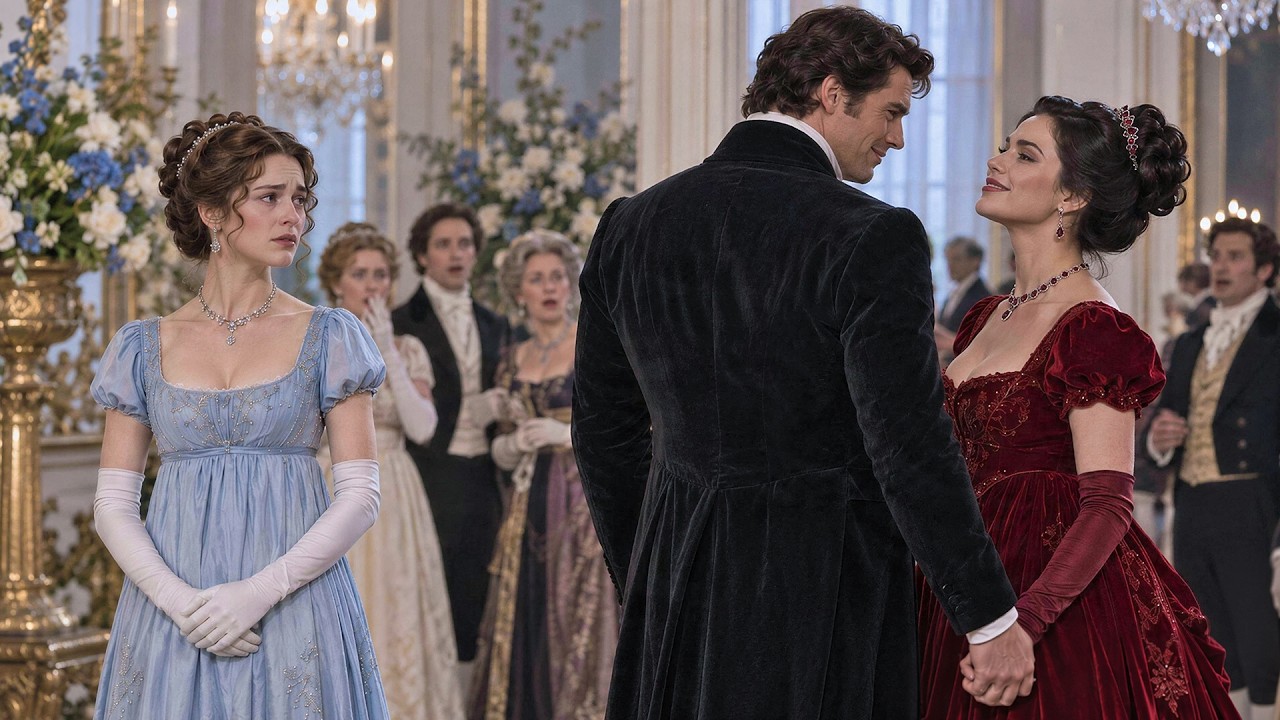
Linda stood near the pillars at the edge of the dance floor. She kept her spine perfectly straight.
Her father, Lord Hensley, hovered two steps behind her, practically vibrating with nervous greed. “Smile, Linda,” her father muttered, his breath warm and smelling faintly of brandy.
“Half the room is looking at you.” “They are looking at the necklace, father,” Linda replied.
Her voice was flat. She did not bother to turn her head. She was 22, which in London society meant she was on the verge of becoming a fixture rather than a prospect.
But her father’s gambling debts had mounted to a sum that threatened them with debtor’s prison.
Enter Walter Huntington, the Duke of Rothmir. Walter didn’t need a wealthy bride. He possessed coal mines in the north, vast estates in the south, and a banking fortune that made the crown look destitute.
What Walter needed was a respectable, quiet, well-b bred woman who would provide an heir, smile at his dinners, and look the other way when he lived his actual life.
Linda fit the bill perfectly. She was observant, pragmatic, and entirely unromantic. When Walter had proposed two weeks ago in her father’s shabby drawing room, he hadn’t spoken of love.
He had spoken of allowances, country houses, and duty. She had accepted with a nod.
Survival rarely came with poetry attached. Across the room, Walter held court. He was a striking man, tall, broadshouldered, with sharp aristocratic features and eyes the color of a winter sky.
He wore his arrogance like a perfectly tailored coat. He was currently nodding along to something a minor lord was saying, looking supremely bored.
Linda watched him. There was no affection in her chest, only a dull, hollow acceptance.
This was her life now. She would manage his estates. She would wear his heavy freezing diamonds.
She would ignore the whispers. And there were whispers. They rippled through the crowd like wind over a wheat field.
The ton knew about Walter’s long-standing arrangement with Madame Genevieve Croft, a French widow of impeccable style and entirely ruined reputation.
She had been Walter’s mistress for 3 years. Everyone assumed the affair would end quietly before the wedding.
That was the rule. You married for duty, and you kept your indiscretions discreet. He’s coming over, her father hissed, gripping her elbow tight enough to bruise.
Look accommodating. Walter detached himself from the sycopants and charted a path toward Linda. The crowd parted for him instinctively.
He moved with the predatory grace of a man who had never been told no in his life.
He stopped in front of her. He did not bow. He simply looked at her, his gaze sweeping over her pale blue silk gown and settling on the diamonds at her throat.
“You look well, Linda,” he said. His voice was a rich baritone, completely devoid of warmth.
“Thank you. Your grace,” she murmured. “The supper is to be announced at 11:00,” he said, checking a gold pocket watch.
“I will come for you then. We will lead the guests into the dining hall.
It is expected, of course. He lingered for a second longer, as if trying to think of something else to say to the woman he was marrying in less than 12 hours.
Finding nothing, he gave a curt nod and turned back to the crowd. Linda let out a slow, measured breath.
It was a business arrangement. She reminded herself of that fact every time panic threatened to claw up her throat.
It was just a transaction. She traded her freedom. He paid her father’s debts. But as she watched Walter walk away, she caught the eye of a man standing alone by the terrace doors.
Lord Thomas Waverly, the Earl of Ashbborne. If Walter was the son of London society, brilliant and blinding, Waverly was the stormfront rolling in to ruin the afternoon.
He was entirely too tall, his creat tied with an intentional carelessness, his dark hair falling slightly into his eyes.
He wasn’t classically handsome like Walter. Waverly had a face built of sharp angles and hard experience.
He had inherited a bankrupt title and spent 10 years in the West Indies, rebuilding his fortune through sheer ruthless grit.
He was also Walter’s bitterest rival. The feud went back a decade, a land dispute in Cornwall that ended in a gruelling three-year court battle.
Walter had won the land. Waverly had publicly punched the Duke in the jaw on the steps of the Royal Exchange.
They hadn’t spoken a civil word since. Waverly was staring directly at Linda. He raised his crystal glass of champagne in a slow, mocking toast.
Linda did not look away. She didn’t blush or avert her eyes like a proper debutant.
She simply stared back, her expression blank, until Waverly’s mocking smirk faded into a look of quiet, intense curiosity.
The heavy grandfather clock in the corner of the ballroom began to chime. 11:00. The supper was starting.
The chimes echoed through the cavernous room, cutting through the string quartet’s final notes. The doors to the grand dining hall were thrown open by powdered footmen.
The smell of roasted meats, truffles, and rich sauces drifted into the ballroom. Linda stood by the pillar waiting.
The protocol was absolute. The host and his future bride must lead the procession. The guests began to form a loose pathway, an avenue of silk, lace, and expectant faces, waiting for the Duke to claim his fiance’s arm.
Walter emerged from the crowd. He was walking toward her. Linda adjusted her gloves, stepping forward to meet him halfway.
Then the murmurss began. It started near the entrance. A sharp intake of breath from a daagger.
A muffled curse from a gentleman. The crowd rippled, heads turning away from the Duke and toward the grand double doors of the ballroom.
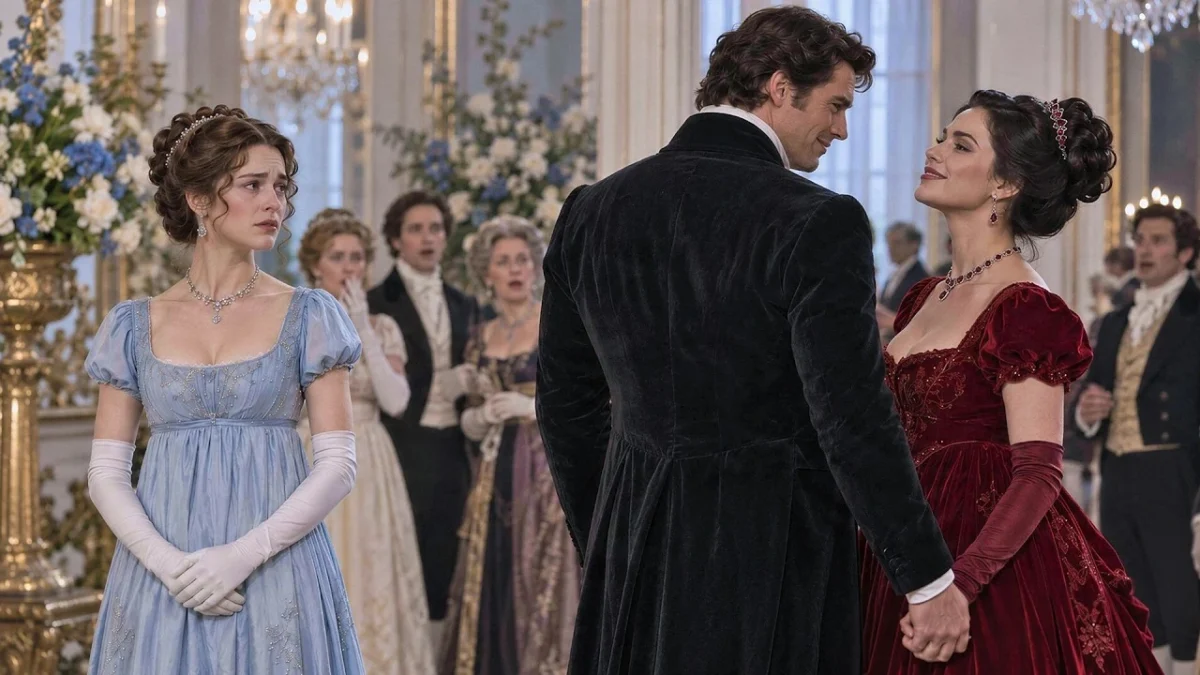
Linda paused. She looked past Walter’s shoulder. Standing in the doorway, draped in crimson velvet that clung to her curves like a second skin, was Madame Genevieve Croft.
She was breathtaking. Dark hair piled high, rubies glittering at her ears, her lips painted a scandalous shade of red.
She didn’t look like a woman crashing a high society ball. She looked like a queen surveying her conquered territory.
The ballroom went de@d silent. The only sound was the crackle of the hearthfires and the soft rustle of Genevie’s skirts as she stepped onto the polished oak floor.
Walter stopped walking. He was 10 ft away from Linda. Linda watched his face. She saw the exact moment the mask of aristocratic boredom slipped.
His posture stiffened. His eyes locked onto the French woman. Don’t, Linda thought. The word echoed in her mind, a frantic, desperate plea.
Walter, please do not do this. It wasn’t about love. It was about respect. If he acknowledged his mistress now in front of the entire town on the eve of their wedding, he was telling the world that Linda was nothing, a broodmare, a joke.
She would spend the rest of her life in London as an object of pity.
Genevieve smiled. It was a small secret smile meant entirely for the Duke. She took two steps forward and extended her gloved hand.
Walter looked at Linda. For a fraction of a second, there was a flicker of hesitation in his eyes.
He knew what this meant. He knew the absolute destruction of her pride it would require.
But Walter Huntington had never denied himself anything he wanted, and he wanted Genevieve. He turned his back on Linda.
The collective gasp from the crowd was a physical blow. Linda felt the blood drain from her face, leaving her entirely cold.
Walter crossed the floor. He took Genevieve’s extended hand, bowed over it, and offered her his arm.
She took it, her smile widening into something triumphant and cruel. Together, the Duke of Rothmare and his mistress walked toward the dining hall.
Passing through the parted crowd, they did not look back. Linda stood alone. 300 pairs of eyes slowly turned to her.
The silence was suffocating. She could feel the pity practically dripping off the walls. She saw the older women hiding their whispers behind feathered fans.
She saw the men exchanging knowing cynical smirks. Her father materialized beside her. His face was purple with rage and panic.
Laugh. He hissed violently in her ear. Pretend it is a joke. Say you feel faint.
Do something, Linda, or we are ruined. Linda didn’t move. Her heart was beating a slow, heavy rhythm against her ribs.
She looked down at the Rothmere diamonds resting on her chest. They suddenly didn’t feel like ice anymore.
They felt like a collar, a heavy iron leash tying her to a man who would gladly let her drown if it meant he didn’t have to get his boots wet.
If she fainted, she was weak. If she wept, she was broken. Tomorrow, she would be dragged to St.
George’s, strapped into white lace, and forced to say vows to a man who had just publicly executed her dignity.
Linda reached up, her fingers, steady and cool, found the heavy gold clasp at the back of her neck.
Linda, what are you doing? Her father panicked. Grabbing her wrist, she wrenched her arm out of his grasp with a violence that made him stumble back.
She undid the clasp. The heavy diamond necklace slipped from her collarbone, pulling into her hands.
It caught the chandelier light, throwing fractured, ugly rainbows across her pale skin. She walked over to a silver tray held by a stunned footman who was frozen by the pillars.
She dropped the necklace onto the tray. The heavy thud of the jewels hitting the silver echoed sharply in the quiet room.
Return these to his grace, Linda told the footman. Her voice was remarkably steady. Tell him they are too heavy.
Without looking at her father, without looking at the staring crowd, Linda turned and walked out the terrace doors, disappearing into the dark, cool night.
The night air was a shock of cold against her bare shoulders. Linda didn’t stop on the stone terrace.
She kept walking, moving quickly down the stone steps and into the Duke’s sprawling, manicured gardens.
She walked until the music and the light from the ballroom were nothing but a distant muffled hum.
She found herself in the rose garden, surrounded by towering hedges that blocked out the wind.
There was a stone bench near a marble fountain. She sat down. For a long time, she just breathed in and out.
The scent of damp earth and crushed roses filled her lungs. She wasn’t going to cry.
She refused to give Walter the satisfaction of her tears, but her hands were shaking.
The adrenaline was fading, leaving behind a cold, hard knot of reality in her stomach.
She had just thrown away a duked. Her father would likely lock her in a cellar.
The creditors would take the house by Friday. She had no money, no title of her own, and as of 10 minutes ago, no reputation.
You left the diamonds. The voice came from the shadows to her left. Deep, rough, and entirely unapologetic.
Linda didn’t jump. She turned her head slowly. Lord Thomas Waverly stepped out from the darkness of the hedge archway.
He was holding a lit chirut, the tip glowing red in the dark. He wasn’t wearing his evening coat.
It was slung over one shoulder, his white linen shirt stark against the night. “Were you following me, Lord Ashborn?”
Linda asked. Her voice was perfectly level. “I stepped out for a smoke,” Waverly said, walking closer.
Watching Rothmare humiliate you was entertaining, but the smell of that many aristocrats in one room always gives me a headache.
He stopped a few feet away, leaning against the edge of the stone fountain. He took a drag from his cherut, the red ember illuminating the sharp lines of his jaw and the cynical amusement in his dark eyes.
You should have kept the necklace, he noted. You could have porned it, funded an escape to the continent.
They belong to the Rothmere estate, Linda said. I am not a thief. No, just a martyr.
Waverly tapped the ash from his chirut onto the gravel. What is your plan now, Lady Linda?
Your father looked ready to sell you to a passing whaler if it would cover his bets.
Linda looked away, staring at the dark water of the fountain. That is none of your concern, my lord.
It isn’t, he agreed easily. But I have a fondness for lost causes, and I have an intense, abiding hatred for Walter Huntington.
Linda looked back at him. The moonlight caught his face. There was no pity there.
None of the sickening sweet sympathy she had seen in the ballroom. Waverly was looking at her the way a man looks at a locked door, trying to figure out the mechanism.
Why do you hate him so much? She asked quietly. Over a piece of land, Waverly scoffed, a harsh grating sound.
The land was nothing. I hate Walter because he is a coward who was born on third base and thinks he hit a triple.
I hate him because he destroys things just to prove he can. He paused, his eyes narrowing slightly.
He broke you tonight to prove to his mistress that he answers to no one.
Not the ton, not the church, and certainly not his quiet little bride. Linda flinched.
The words were but they were true. He did not break me. I know, Waverly said softly.
That is why I am standing here. He pushed off the fountain and walked toward her.
He stopped just in front of the bench, towering over her. He smelled of tobacco, clean linen, and cold night air.
You need a husband, Waverly said. It wasn’t a question. Linda stared at him. Excuse me.
Your father owes £40,000. Rothmia was going to clear it tomorrow. Now you are ruined and your father is facing fleet prison.
You need a husband with a very deep pocket. Are you offering Lord Ashborn? She asked a bitter sarcastic edge to her voice.
Because if this is a joke, it is an exceedingly poor taste. I never joke about money, Lady Linda, Waverly said.
He tossed the chirut onto the gravel and crushed it under the heel of his boot.
I am entirely serious. Linda’s breath hitched. She looked at him, searching his face for the punchline.
There wasn’t one. His jaw was set, his dark eyes intense and de@d serious. Why?
She whispered. Two reasons, Waverly said, holding up a finger. First, my uncle left me a rather substantial inheritance that I cannot touch until I am married.
I have been putting it off because I find polite society women utterly intolerable. You, however, just publicly castrated the Duke of Rothmare by dropping his diamonds on a serving tray.
I respect that. He held up a second finger. Second, Walter Huntington just threw you away.
He thinks you are going to crawl home and wither into a spinster. Imagine his face when he wakes up tomorrow to find that his discarded, ruined bride married his worst enemy before the sun even came up.
A slow, treacherous warmth began to spread in Linda’s chest. It was vindication. It was spite.
It takes 3 weeks to call the bands, Linda said, her practical mind immediately engaging, even as her heart hammered against her ribs.
We cannot marry tonight. Waverly reached into the inside pocket of his discarded evening coat.
He pulled out a folded piece of heavy parchment. Special license, he said, tapping it against his palm.
Signed by the Archbishop yesterday morning. I was supposed to marry the Vic Countess of Masten next week.
A business arrangement. She eloped with her riding master yesterday afternoon. The license just says Thomas Waverly and bride.
He held out his hand to her. His palm was calloused, the hand of a man who had worked the riggings of ships.
Not just shuffled playing cards. I have a carriage waiting in the alley behind the muse.
My solicitor and a very sleepy bishop are at my townhouse in Mayfair right now.
Waverly leaned down slightly, his voice dropping an octave, becoming a low, grally temptation. Marry me, Linda.
I will pay your father’s debts by breakfast. I will put a ring on your finger that makes Rothmir’s diamonds look like glass.
And tomorrow morning, we will walk into Hyde Park together. And watch Walter choke on his own arrogance.
Linda looked at his extended hand. It was madness. He was a rogue, a cynic, a man who admitted he was marrying her partly for spite.
But as she looked up into Waverly’s eyes, she saw something Walter had never offered her.
Partnership, a mutual, unvarnished honesty. Waverly wasn’t pretending this was a fairy tale. He was offering her a sword.
Linda didn’t hesitate. She reached out and placed her gloved hand firmly into his. “Take me to the bishop, Lord Ashbornne,” she said, Waverly’s mouth curved into a sharp, genuine smile, his fingers closed over hers, strong and warm.
“With pleasure, my lady.” The carriage ride through London was a study in profound rattling silence.
The leather seats of Lord Ashborne’s carriage were cold, the air smelling faintly of rain and old wool.
Outside the gas lamps of Mayfair flickered past the frosted windows, casting long, warped shadows across Linda’s silk gown.
She stared straight ahead. She had not brought a cloak. Thomas had draped his heavy evening coat over her shoulders before helping her into the carriage.
It dwarfed her. The wool held the heat of his body and the sharp clean scent of tobacco and cedar.
Thomas sat opposite her, his long legs stretched out, taking up most of the space.
He did not try to fill the silence with platitudes. He did not ask if she was all right.
Linda was grateful for it. If he had shown her an ounce of pity in that carriage, her fragile composure would have shattered.
My townhouse is on Berkeley Square. Thomas said finally, his voice cutting through the steady clatter of hooves on cobblestone.
My solicitor, Mr. Harding, lives two streets over. He is already there with the bishop.
You arranged this very quickly, Linda noted. I bought the license 3 days ago, anticipating a different bride.
The bishop is well compensated for his midnight inconveniences. Thomas leaned forward, resting his elbows on his knees.
The faint light from the passing street lamps caught the sharp angles of his face.
Are you afraid, Linda? It was the first time he had used her Christian name.
It sounded different in his mouth. Harsher. Real. I am terrified, she answered honestly, her voice barely above a whisper.
But I am more terri of what my life would become if I stayed. Thomas nodded slowly.
Good. Fear is useful. It keeps you sharp. Despair is what kills you. The carriage jolted to a halt before a massive dark bricked townhouse.
There were no grand statues, no ostentatious sweeping staircases like Rothmere House. It was solid, imposing, and aggressively private.
Within minutes, Linda found herself standing in a gas-lit library. The walls were lined with floor to-seeiling mahogany bookshelves, smelling intensely of old paper, leather bindings, and wood smoke.
A fire roared in the hearth, throwing heat against her chilled skin. A stout man in a rumpled woolen robe, the bishop of Suffuk, stood near the fireplace, blinking sleep from his eyes, and looking distinctly displeased.
Beside him stood a thin, nervous man clutching a leather satchel. “Mr. Harding, the solicitor.”
“Ashborn,” the bishop grumbled, pulling his spectacles down his nose. “This is highly irregular. It is past midnight, and God never sleeps your grace,” Thomas replied dryly, walking over to a massive oak desk and pouring two glasses of amber liquid from a crystal decanter.
He handed one to Linda. Drink it. You look like a ghost. It was whiskey.
It burned a fiery path down her throat, but it stopped the trembling in her hands.
“The lady is not the Vic Countess of Men,” Mr. Harding pointed out, his eyes darting to Linda’s pale blue ball gown.
“The lady is Lady Linda Hensley,” Thomas said, setting his empty glass down with a sharp clink.
And she is the woman I am marrying tonight. The license specifies no name. Rid the vows, Bishop.
There was no organ playing. There were no flowers. Linda’s father was not there to give her away.
There was only the crackle of the fire and the nervous throat clearing of the solicitor.
Linda stood next to Thomas. He was a head taller than her, his presence a solid, immovable wall in the dimly lit room.
The bishop began to read the ancient heavy words. They echoed in the quiet library, stark and transactional.
To have and to hold, for richer, for poorer. When it came time for the ring, Thomas reached into his waste coat pocket.
He did not pull out a family heirloom or a diamond. He produced a plain, heavy band of solid gold.
It was thick, unadorned, and clearly bought in a hurry. He took her left hand.
His skin was warm. He slid the heavy gold band onto her fourth finger. It was slightly too loose, but the weight of it was grounding.
“I, Thomas, take thee, Linda,” he said. His voice did not waver. He looked directly into her eyes, his gaze piercing, stripping away the ballroom, the whispers, and the humiliation.
“I, Linda, take thee, Thomas,” she repeated. Her voice was quiet, but it did not break.
“By the power vested in me,” the bishop muttered, making a hurried sign of the cross, “I pronounce you man and wife.”
It was done. In less than 15 minutes, she had severed her future from the Duke of Roth and chained it to his greatest enemy.
The silence stretched. The bishop and the solicitor gathered their papers, looking everywhere but at the newlyweds.
Thomas signed the registry with a sharp, aggressive slash of ink. Linda signed beneath him, her hand perfectly steady.
Linda Waverly, Countess of Ashbborne. Once the men were shown out by a sleepy butler, Thomas turned to her.
He ran a hand through his dark hair, suddenly looking every bit of his 34 years.
My housekeeper, Mrs. Gable, has prepared a room for you on the second floor. Thomas said quietly.
It connects to mine, but the door locks from your side. You have had a hellish evening, Linda.
Go to sleep. Linda looked at him, startled by the sudden boundary. You You do not expect.
I expect you to rest,” Thomas interrupted, his tone gentle but firm. “I bought a wife tonight, Linda.
I did not buy a captive. We have a war to wage tomorrow, and I need my partner well-rested.”
The breath she hadn’t realized she was holding left her lungs in a long, shaky sigh.
Thank you, Thomas. Good night, Lady Ashbornne. Linda woke to the sound of rain lashing against the window panes.
She opened her eyes, instantly disoriented by the heavy emerald velvet canopy above her. The mattress was incredibly soft, the linen smelling of lavender and fresh air.
It took precisely 3 seconds for the memories of the previous night to crash into her mind.
The ballroom, the diamonds hitting the silver tray, the cold terrace, the midnight vows. She sat up, throwing back the heavy duvete.
She was wearing a voluminous cotton night gown provided by Mrs. Gable. She touched her left hand.
The heavy gold ring slipped slightly on her finger, cool against her skin. It was real.
She was married. A soft knock at the door preceded the entrance of a young maid carrying a copper tub and steaming pitches of water.
“Good morning, my lady,” the maid chirped, completely unfazed by the sudden appearance of a new mistress in the house.
His lordship requested you join him in the morning room for breakfast whenever you are ready.
I’ve brought one of your day dresses from your father’s house. Linda froze. My father’s house.
Who went there? Mr. Harding? The solicitor? My lady. He went at first light to settle some business and brought back a trunk for you.
Linda bathed quickly, her mind racing. She dressed in a dark navy wool morning gown, simple and unadorned.
She twisted her hair into a severe knot at the nape of her neck. When she looked in the mirror, she did not look like a blushing bride.
She looked like a woman preparing for a siege. She found the morning room on the ground floor.
It was a bright, masculine room with heavy oak furniture and large windows overlooking a rainswept garden.
Thomas was already seated at the table. He was dressed flawlessly in a dark gray morning coat, a crisp white crevat, and a silver waist coat.
He was drinking black coffee and reading the times. He looked up as she entered.
He didn’t smile, but a glint of approval flashed in his dark eyes. “Good morning,” he said, folding the newspaper and setting it aside.
He gestured to the chair opposite him. “Coffee or tea?” “Coffee, please.” “Black,” Linda said, taking her seat.
A footman immediately poured the dark, bitter liquid into a porcelain cup. Linda wrapped her hands around it, letting the heat seep into her chilled skin.
Thomas reached across the table and pushed a thick manila envelope toward her. “What is this?”
She asked. “Receipts,” Thomas replied simply, buttering a piece of toast. “Your father’s debts to the gaming hells in St.
James, his tailor, his butcher, and the note held by the Bank of England, paid in full as of 7:00 this morning.
Linda stared at the envelope. £4,000, a staggering, liferuining sum of money, dismissed before she had even eaten her breakfast.
“My father is currently nursing a massive hangover and counting himself the luckiest bastard in London,” Thomas said dryly.
I sent Harding with a message. Your father is clear of debt on the condition that he retires to his estate in Somerset by the end of the week.
He is not to show his face in London for a year. Linda looked up sharply.
“You exiled him?” I removed a liability. Thomas corrected, meeting her gaze evenly. “He would have come crawling to you for more money within a month.
He would have used your new title to open new lines of credit. I cut the rot out at the root.
Do you object? Linda looked back down at the envelope. Her father had been ready to sell her to Rothmir to save his own skin.
He had stood by while she was humiliated. No, Linda said quietly. I do not object.
Good. Thomas picked up his coffee cup because we have larger problems today. The ton, Linda said, the dread settling heavy in her stomach.
By now, the rumors have spread from Mayfair to Covent Garden, Thomas said. Rothmir will have woken up expecting a frantic, grolling letter from your father, begging him to overlook last night.
Instead, he will find out that his prized, obedient bride bolted into the night and married the man who broke his jaw in 18.
Linda took a sip of the bitter coffee. “He will be furious. He will be apocalyptic,” Thomas corrected, a grim smile playing on his lips.
“Roth’s entire existence is built on the illusion of his absolute control. You broke the illusion.
Now he has to retaliate or he looks weak. How will he retaliate? He will try to ostracize us.
He will demand his syphants cut us de@d. He will parade Madame Croft around to prove he doesn’t care.
And he will try to corner you when I am not around to intimidate you into showing regret.
Thomas leaned forward, his elbows resting on the oak table. The casual distance was gone, replaced by a fierce, commanding intensity.
Listen to me, Linda. London Society is a pack of starving wolves. If you bleed, they will tear you apart.
Today, we are going to drive the open carriage through Hyde Park at 5:00. Every titled busy body in England will be there.
Linda’s knuckles turned white around her coffee cup. You want to parade us. I want to plant our flag.
Thomas said, “You will not lower your eyes. You will not blush. You will look at them with the exact same cold, de@d indifference you gave Rothmir when you dropped his diamonds.
You are the countest of Ashbborne. Act like you own the ground you walk on, and they will believe you do.”
Linda looked at the hard, unyielding man sitting across from her. He wasn’t offering comfort.
He was offering armor, she set her coffee cup down. She sat up straighter, pulling her shoulders back.
I will need a new hat, she said evenly. If I am to conquer London, this navy wool will not suffice.
Thomas stared at her for a moment. Then he threw his head back and let out a genuine booming laugh that startled the footman by the door.
Get your cloak, Countest. Thomas grinned, standing up. We are going to Bond Street. The rain broke by 3:00, leaving the London air crisp, and the gravel paths of Hyde Park gleaming in the late afternoon sun.
At 5:00, the carriage paths were choked with the elite. Open bares, sporty fatans, and gentlemen on horseback paraded in a slow continuous loop.
It was the daily ritual of seeing and being seen. But today, the usual languid gossip was replaced by a feverish, vibrating tension.
Everyone was waiting. When Lord Ashborn’s blackened gold feton entered the Stanh Hope gate, a ripple went through the crowd.
It was physical. Carriages slowed. Conversations died mid-sentence. Heads snapped around so quickly feathers practically flew from velvet hats.
Thomas drove the fyoton himself. He handled the matched pair of massive black gelings with effortless aggressive control.
He wore a dark green driving coat and a tall beaver hat, looking every inch the ruthless self-made titan of industry.
The ton whispered about. Beside him sat Linda. She did not look like the quiet, accommodating girl who had stood in Rothmier’s ballroom the night before.
Thomas’s money and a small army of Bond Street modistes had worked a miracle in 4 hours.
She wore a walking dress of deep rich burgundy silk that caught the afternoon sun paired with a fitted black velvet Spencer jacket.
On her head sat a sharp, stylish velvet hat adorned with a single black heron feather.
She looked expensive. She looked untouchable, shoulders back, Thomas murmured, his eyes fixed straight ahead on the horses.
Breathe. Linda kept her spine rigid. She could feel the stairs burning into her skin.
She saw Lady Jersey peering through a gold lornette. She saw Lord Fe whispering furiously to his companion.
The silence was deafening. They completed half a circuit. Nobody approached them. Nobody bowed. The invisible wall of social ostracization was being built right before their eyes.
Rothmir’s influence was heavy, pressing down on the park like a physical weight. “They are waiting for him,” Linda said quietly, not moving her lips.
They won’t wait long, Thomas replied. He pulled the heavy leather res, bringing the feton to a smooth halt near the serpentine, forcing the line of carriages behind them to stop as well.
It was a brazen move, a challenge. A moment later, the crowd parted. Walter Huntington, the Duke of Roth, was riding toward them on a massive gray stallion.
He was flanked by three of his closest cronies. Walter looked immaculate, but his face was tight, his jaw clenched so hard a muscle twitched near his ear.
He brought his horse to a halt directly beside the fetton, forcing Thomas to look up at him.
The entire park seemed to hold its breath. Even the horses stood perfectly still. Walter did not look at Thomas.
He looked directly at Linda. His winter sky eyes were blazing with a cold absolute fury.
“Lady Linda,” Walter said, his voice carried across the quiet park, dripping with aristocratic condescension.
“I see you have recovered from your hysterical fit of last night. Linda’s heart hammered against her ribs like a trapped bird.
Every instinct told her to look down, to apologize, to submit. She felt Thomas shift slightly beside her, his grip tightening on the res, ready to intervene.
But Linda didn’t need him to. The panic suddenly vanished, replaced by a cold, crystalline clarity.
Walter was just a man on a horse, a cruel, arrogant man who had tried to turn her into a joke.
Linda tilted her head slightly, her face a mask of absolute bored indifference. I am quite well, your grace, Linda said, her voice clear and carrying just as far as his.
Though I must correct you. It is Lady Ashborn now. Walter’s face darkened, a flush of ugly red creeping up his neck.
You are making a public spectacle of yourself. This stunt is pathetic. Did you think marrying this tavern brawler would save your dignity?
He sneered, finally glancing at Thomas. “Your father will be ruined by sunset.” “My father’s debts were paid in full before you finished your morning tea,” Rothmere Thomas interjected smoothly, leaning back in his seat.
“You should check with your bankers. You lost the note.” Walter’s horse danced nervously as the Duke yanked on the res.
You think this changes anything, Waverly? She is a discarded scrap. I threw her away.
You did, Linda said. The soft, clear agreement stopped Walter de@d. He stared at her completely derailed.
Linda looked at him, her dark eyes entirely devoid of the fear he so desperately wanted to see.
She raised her left hand, adjusting the collar of her velvet jacket. The heavy gold band on her finger caught the sunlight.
Gleaming brightly. “You freed me, your grace,” Linda said, her voice echoing in the absolute silence of the park.
“I simply took the liberty of finding a better offer.” “To give my regards to Madame Croft,” a collective audible gasp rippled through the surrounding carriages.
Someone in the back actually choked. Linda had not just insulted him, she had pied him.
She had publicly acknowledged his mistress and dismissed them both in a single breath. Walter’s face went entirely pale.
He opened his mouth to speak, but no words came. He looked at the surrounding carriages.
He saw the shock, but worse, he saw the faint, suppressed smiles of his rivals.
He had lost the high ground. Without another word, Walter spurred his horse violently, cutting through the grass and galloping away from the path, his cronies scrambling to follow.
Thomas watched him go. Slowly, a wicked, triumphant smile spread across his face. He turned to Linda, his dark eyes burning with dangerous approval.
“Checkmate, count,” Thomas murmured. He snapped the res. The black geling surged forward. As they drove down the path, a strange thing happened.
Lord Fe tipped his hat. Lady Jersey offered a slow, calculating nod. The invisible wall had shattered.
London society respected power, and Linda had just proven she held a blade of her own.
She sat beside her new husband, the wind biting at her cheeks, feeling something she hadn’t felt in years.
She was free, and the war had only just begun. London did not easily forgive a shattered convention.
For the first two weeks, the tongue tried desperately to maintain the invisible wall Walter Huntington had demanded.
Invitations to the Ashborne Townhouse were mysteriously lost in the post. Carriages conveniently broke down when Linda was scheduled to call.
But Thomas Waverly was not a man who fought on society’s terms. He fought on his own.
He did not care about ballrooms. He cared about the royal exchange. Within 10 days of the wedding, Thomas systematically began to choke the Duke of Rothmir’s investments.
Walter’s wealth was old. Tied up in vast, slowmoving estates and massive unwieldy coal operations, Thomas’s wealth was liquid, sharp, and brutally modern.
He bought out the shipping contracts Walter relied on to move his coal. He undercut Rothmere’s timber prices in the north by 20%, bleeding his own profit margins simply to watch Walter hemorrhage cash.
The social war fell to Linda, and she fought it with a ruthlessness she had not known she possessed.
She did not wait for invitations. She hosted her own events. She targeted the younger sons, the impoverished daaggers with sharp tongues, and the new money families desperate for aristocratic validation.
She threw dinner parties where the food was spectacular, the wine was French, and the conversation was dangerously witty.
She wore Thomas’s money like a weapon. She dressed in deep, rich colors, sapphire, emerald, ox blood, leaving behind the pale virginal pastels her father had forced upon her.
It was a Tuesday evening in late October. The house was finally quiet after a gruelling 4-hour dinner party.
Linda sat in Thomas’s library, the fire burning low in the great. She had a heavy leather ledger open on her lap.
The door clicked open. Thomas walked in. He had loosened his crevat, his waist coat unbuttoned, his dark hair ruffled from the wind.
He looked exhausted. He smelled of rain, horses, and the faint bitter tang of cheap coffee from the docks.
“The East India men are holding out,” Thomas said, crossing the room to the heavy crystal decanter.
He poured two fingers of scotch. Rothmir bribed the harbor master to delay my shipments.
“I know,” Linda said, turning a page in the ledger. “I saw the expense report from your cler.”
Thomas stopped, his glass halfway to his mouth. He looked at her. She was sitting in his wing back chair, wearing a dark green velvet dressing gown, her feet tucked under her.
Her hair was down, falling over her shoulders in dark, heavy waves. “You are reading my ledgers,” he noted.
“Your clark, Mr. Finch possesses the mathematical ability of a concussed sheep, Linda replied without looking up.
He miscalculated the tariff on the Jamaican sugar by 300. I corrected it. Thomas slowly lowered his glass.
He walked over to her chair and leaned over, bracing one hand on the armrest.
He looked at the ledger. Neat, precise columns of ink filled the margins, correcting months of sloppy bookkeeping.
You understand maritime tariffs? He asked, his voice low, tinged with genuine surprise. I managed my father’s estate since I was 15, Thomas.
When one is constantly avoiding creditors, one learns to understand exactly where every penny is hiding.
She finally looked up. His face was only inches from hers. Up close, the harsh lines of his face were even more pronounced.
The small faded scar that cut through his left eyebrow, the permanent exhaustion shadowed under his dark eyes.
He wasn’t a gentleman of leisure. He was a man who had clawed his way out of hell with his bare hands.
“I married a highly competent woman,” Thomas murmured. His gaze dropped to her mouth for a fraction of a second before returning to her eyes.
“You married a desperate woman,” Linda corrected softly. “Are you still desperate, Linda?” The question hung in the quiet room.
Linda looked at him. The intense, simmering energy between them had been building for weeks.
They slept in adjoining rooms. They fought a war side by side during the day.
But at night the heavy oak door between their chambers remained locked. Neither had dared to breach the arrangement.
“No,” Linda admitted. “I am not,” Thomas stared at her. His jaw tightened. He reached out, his rough, calloused fingers brushing a stray lock of hair away from her cheek.
His touch was incredibly gentle, completely at odds with the violence of his reputation. Rothmare will make a final move soon, Thomas said, his voice dropping to a grally whisper.
He is bleeding money. The banks are getting nervous. He is a proud man. And a proud man cornered is dangerous.
Let him come, Linda said. She didn’t flinch away from his hand. We will break him.
A slow, dark smile curved Thomas’s lips. God, you are magnificent. He stepped back, breaking the spell.
He took his scotch and walked toward his adjoining door. Good night, Linda. Good night, Thomas.
She watched the door click shut. Her skin still burned where his fingers had touched her cheek.
The war with the Duke was one thing. The war against her own growing, terrifying affection for her husband was entirely another.
That the Covent Garden Opera House was a sea of velvet, diamonds, and suffocating heat.
It was the premier event of the autumn season. Don Javanni, Linda sat in the front row of the ashborne box, her posture perfectly rigid.
She wore a gown of midnight blue silk, her neck completely bare of jewelry. It was a calculated statement.
She did not need diamonds to prove her worth. Thomas was supposed to be beside her, but a crisis at the docks had delayed him.
He had promised to arrive before the second act. The curtain fell for the intermission.
The gas lights flared, illuminating the massive theater. Instantly, a 100 pairs of opera glasses turned toward Linda’s box.
She ignored them, keeping her eyes fixed calmly on the heavy red curtain of the stage.
A sharp knock sounded at the door of her private box. Linda did not turn.
Enter. The door opened and the heavy scent of expensive French cologne and brandy filled the small enclosed space.
Lady Ashbornne sitting alone. How terribly tragic. Linda slowly turned her head. Walter Huntington stood in the doorway.
He was dressed in immaculate evening wear, but the perfection was fraying. There were dark circles under his pale blue eyes.
His face was thinner, the arrogance sharp and brittle. Behind him, lingering in the corridor was Madame Genevieve Croft.
She wore a necklace of heavy rubies that Linda recognized immediately. They had belonged to the previous Duchess of Rothmir, Walter’s mother.
I am entirely comfortable your grace, Linda said. Her voice was flat, devoid of any inflection.
Though I am surprised to see you, I was under the impression you had sold your box to cover your losses in the northern timber markets.
Walter’s face twisted in an ugly spasm of rage. He stepped into the box and shut the door behind him, leaving his mistress in the hall.
You think you have won? Walter hissed, stepping close to her chair. You think you and that unwashed dock worker have beaten me?
I do not think of you at all, Walter. Linda said it was the absolute truth, and she knew it would cut him deeper than any insult.
Walter slammed his hand flat against the velvet covered railing beside her chair. “Your father did not flee to Somerset,” he snarled.
He went to Paris and he immediately incurred £20,000 in gambling debts. The French creditors contacted my bankers yesterday, assuming the connection still held.
Linda’s blood ran cold. The absolute suffocating terror of her father’s incompetence crashed over her.
Walter saw the flicker of panic in her eyes and smiled. It was a cruel, desperate expression.
Waverly cannot save you from this. He has tied up every piece of liquid capital he owns, trying to strangle my shipping routes.
He is overextended. If this debt hits the papers tomorrow, your husband’s credit will shatter.
The banks will call in his loans, and you will both be entirely, permanently ruined.”
He leaned in closer. His breath was warm on her cheek. “Beg me, Linda. Come to my townhouse tomorrow morning alone and ask for my forgiveness.
Tell the ton you made a mistake. Do that and I will pay the French creditors quietly.
Linda stared at him. He wanted her broken. He wanted to parade her as a conquered enemy.
She opened her mouth to tell him to go to hell, but the door to the box swung open with a violent crash.
Thomas stood in the doorway. He was out of breath. He was not wearing evening clothes.
He wore a dark wool overcoat, his boots stained with temp’s mud, his crevat missing entirely.
He looked like a wolf that had just kicked down the door to a sheepfold.
Walter straightened up, his aristocratic sneer firmly in place. Waverly, did they run out of jin at the docks?
Thomas ignored him. He walked directly to Linda. He looked at her pale face, then turned his dark, lethal gaze to the Duke.
“Get out of my box,” Rothmir, Thomas said. His voice wasn’t raised. It was a low, terrifying rumble.
“Or what?” Walter mocked. “You will punch me again.” “Go ahead, show London exactly what kind of brute you are.
It won’t save you from bankruptcy tomorrow when the French creditors call. Thomas stopped. A slow, chilling smile spread across his rough face.
It was the smile of a man who had just watched his enemy step perfectly into a steel trap.
“The French creditors,” Thomas repeated softly. He reached into his heavywool coat and pulled out a thick stack of folded parchment sealed with heavy red wax.
He tossed it onto the velvet railing in front of Walter. I did not go to the docks tonight, Walter.
Thomas said, “I went to the Bank of England. The governor is a very good friend of mine.
I just bought your loans.” Walter froze. He looked down at the parchment. “You leveraged your estates to survive the shipping blockade.”
Thomas continued, his voice echoing brutally in the small box. You borrowed against your coal mines to keep Madame Croft draped in your mother’s rubies.
You thought I was overextended. I wasn’t. I was liquidating assets to buy your debt.
Walter’s hand trembled as he reached for the parchment. He broke the seal. He read the top line, and all the color drained from his face, leaving him a sickening shade of gray.
You owe me £60,000,” Thomas whispered, leaning in so only Walter could hear. “Payable by Friday, or I take the coal mines, I take the Southern Estates, and I take Rothmere House.”
“You, you cannot do this,” Walter stammered, the arrogance shattering completely, leaving behind a terrified, hollow man.
Your father’s debt in Paris, Thomas said, turning his head slightly to look at Linda, was settled by my solicitor 3 hours ago.
Your father is currently on a boat to America, courtesy of a one-way ticket I purchased for him.
He will never set foot in Europe again. Thomas looked back at the Duke. You have nothing to hold over her.
You have nothing to hold over me. You are finished, Walter. Walter stood perfectly still.
He looked at Thomas, then he looked at Linda. She did not show him an ounce of pity.
She sat straight backed in her chair, a queen watching an execution. The door opened slightly.
Genevie Croft peered in, sensing the shift in the atmosphere. She looked at Walter’s ruined face, then at the parchment in his shaking hand.
She was a survivor. She understood the mathematics of ruin faster than anyone. Genevieve did not say a word.
She simply turned around and walked down the corridor, her silk skirts rustling quietly. She was already gone.
Walter dropped the parchment. He looked completely, utterly hollowed out. Without it a single word, the Duke of Rothmare turned and walked out of the box, leaving the door hanging open behind him.
The intermission bell rang. The gas lights began to dim. Thomas let out a long, ragged breath.
He leaned back against the wall of the box, rubbing his hand over his tired face.
Linda stood up. Her legs were shaking, but she walked over to him. She looked up into his face.
He had yet bought her father’s debt again. He had exiled the man to save her.
He had systematically dismantled an empire to protect her. “You look terrible, Lord Ashborn,” Linda whispered.
Thomas dropped his hand. He looked at her, his dark eyes soft and exhausted. “I ruined a duke in muddy boots.
Lady Jersey will never forgive me.” Linda reached out. She took his dirty, calloused hand in both of hers.
She pressed it against her cheek. “Take me home, Thomas,” she said. The carriage ride back to Berkeley Square was entirely different from their first journey on the night of their wedding.
There was no cold silence. There was no distance. Thomas sat beside her on the leather seat.
He did not let go of her hand. The rain had started again, drumming a steady, hypnotic rhythm against the roof of the feton.
When they arrived at the townhouse, the staff was asleep. The house was dark, save for the low embers in the library hearth.
Thomas shrugged off his muddy overcoat and tossed it over a chair. Linda untied her velvet cloak and let it fall to the floor.
Thomas walked to the fire and grabbed an iron poker, stirring the embers until a low flame caught the fresh wood.
He watched the fire for a long moment, his back to her. “The war is over,” Thomas said quietly.
Linda stood in the center of the room. “It is,” Thomas turned around. He looked at her, standing in the shadows of the library in her midnight blue gown.
The adrenaline of the opera had faded, leaving behind a stark, heavy reality. “I bought the license to spite him,” Thomas said, his voice rough.
“I married you because you were brave, and because it was the most efficient way to humiliate a man I despised,” Linda’s heart tightened.
She gripped the fabric of her skirt. I know, but I did not know you,” Thomas continued, taking a slow step toward her.
“I did not know you would fix my ledgers. I did not know you would face down the entire ton without blinking.
I did not know you would look at me like I was a man. Instead of a weapon you could use to save yourself,” he stopped 3 ft away from her.
The vulnerability in his dark eyes was jarring. This ruthless, violent man who had just destroyed a dukedom was looking at her with absolute terrified uncertainty.
Walter is gone, Thomas said softly. Your father is gone. You are completely secure, Linda.
You have half my fortune in your name. If if you want to retreat to the country estate, if you want a separate life, I will not stop you.
I will not force you to play the wife of a tavern brawler now that the spite has worn off.
He was offering her an out. He had built a fortress around her, and now he was handing her the keys to the gate, fully expecting her to walk away from him.
Linda looked at him. She looked at his messy hair, his exhausted posture, the heavy gold ring on his left hand that matched her own.
She didn’t want a country estate. She didn’t want a quiet, respectable life. She wanted the storm.
She wanted him. Linda took a step forward, then another. She stopped directly in front of him, entirely erasing the distance between them.
“You are an idiot, Thomas,” she whispered. “Thomas blinked, startled.” “Linda,” she didn’t let him finish.
She reached up, weaving her fingers into his dark hair, and pulled his face down to hers.
She kissed him. It wasn’t a tentative, blushing kiss of a debutant. It was desperate, fierce, and entirely possessing.
For a split second, Thomas froze, shocked by the sudden heat of it. Then, with a low groan that sounded like a surrender, his arms wrapped around her waist, pulling her flush against his chest.
He kissed her back with a starving intensity. His mouth was rough, demanding, tasting of rain and whiskey.
One of his large hands slid up her back, tangling in her hair, the other gripping her waist so tightly it bruised.
Linda had felt the solid immense strength of him, the rapid, hammering beat of his heart against her ribs.
She opened her mouth to him, pulling him closer, kissing him until the room spun and the oxygen burned out of her lungs.
All the restraint, all the careful, measured distance they had maintained for weeks, shattered perfectly, violently into dust.
Thomas broke the kiss, resting his forehead against hers. Both of them were breathing heavily, the silence of the library broken only by the crackle of the fire and the ragged sound of their breathing.
“I am not going to the country,” Linda said, her voice shaking, her hands gripping the lapels of his ruined coat.
“I am staying exactly where I am.” “You are my husband, and I am entirely, irrevocably yours.”
Thomas closed his eyes. A profound shuddering relief swept over his face. He buried his face in the crook of her neck, his lips pressing against her pulse point.
“Thank God,” he breathed against her skin. He lifted his head and looked down at her.
The cynical amusement was gone. The anger was gone. There was only absolute unvarnished devotion.
Without breaking her gaze, Thomas bent slightly, wrapped one arm behind her knees, and swept her off her feet.
Linda gasped, wrapping her arms around his neck as he carried her out of the library and up the dark, sweeping staircase.
They bypassed her bedroom entirely. Thomas kicked open the door to his own chamber, the heavy oak slamming shut behind them, locking out the world, the whispers and the past.
He did not set her down gently. He laid her on the heavy mattress following her down.
There were no ghosts in the room. There were no diamonds. There was only the heat of his hands, the rough slide of wool against silk, and the absolute certainty that she was finally perfectly exactly where she belonged.
Walter Huntington had made his choice at the ball. He had chosen his pride. Linda had made her choice at midnight.
She had chosen a monster who fought in the mud. And as Thomas’s hands traced the curve of her spine, pulling her desperately against him, Linda knew she had won the war.
The Duke played a dangerous game. But Linder and Thomas changed the rules completely. From a ruined bride to a ruthless countess, Linda proved that sometimes the best revenge is living a life your enemies could never handle.
Did Walter get exactly what he deserved at the opera? How much did you love Thomas’s brutal loyalty?
Hit that like button if you were cheering for their victory. Share this story with your friends who love a dark, intense historical romance, and subscribe for more epic tales of revenge and love.
Tell me in the comments what was your favorite moment of their revenge.








