The Cowboy’s Hunt Took a Turn—Instead of Meat, He Brought Home a Wounded Apache Woman
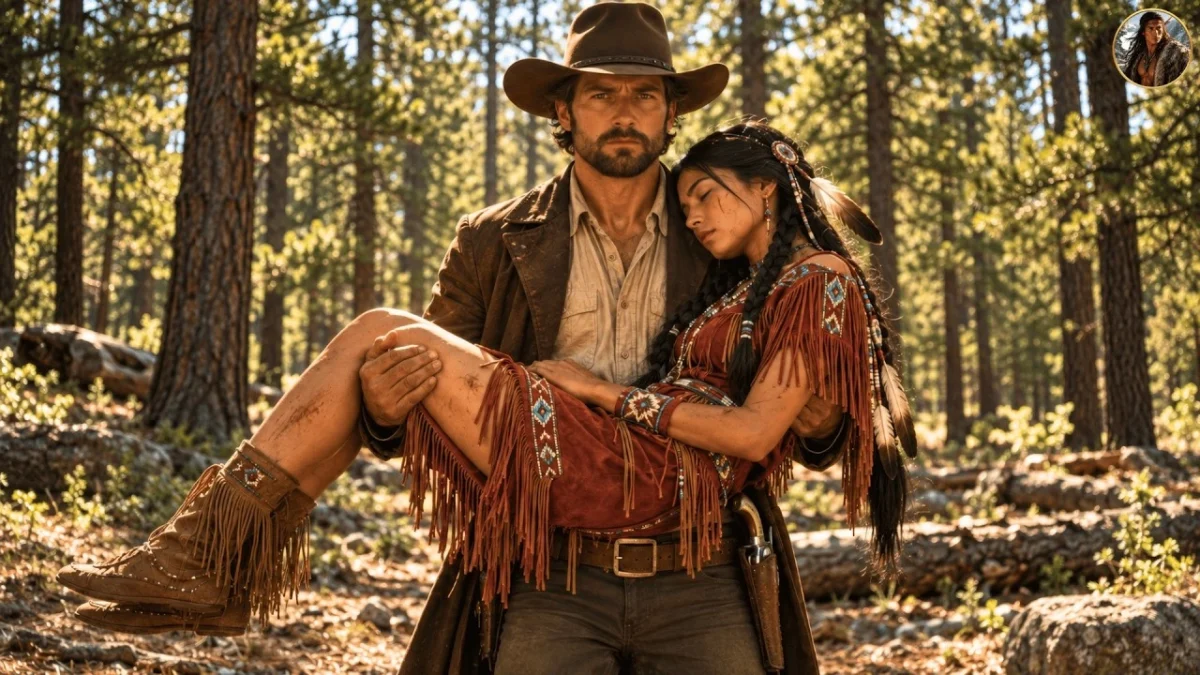
The Cowboy’s Hunt Took a Turn—Instead of Meat, He Brought Home a Wounded Apache Woman
Folks said Cal Ransom was a man shaped by silence and hard ground scarred by too many seasons.
He was the kind of rancher who rose before first light, worked until the skin split across his hands, then returned each evening to an empty cabin where even the wind seemed unwilling to linger.
But on that bitter morning, with frost still clinging to the grass, and the whole country feeling hollow and still, Cal followed a trail of blood through the pines, and found something that would change the course of his life forever.
The cold had teeth that morning, sharp enough to cut through wool and leather. Frost glazed the grass like shattered glass, while thin skins of ice covered the puddles along the lower trail.
Cal’s boots crushed through the frozen ground with every step, his breath turning white in the pale dawn.
He was 37, broad through the shoulders from years of ranch work, with a beard already touched by gray long before its time.
People in town called him a loner, a man who kept his distance from everyone.
They were not entirely wrong. Since Rose Ransom died, the only company Cal truly trusted had been his cattle, his rifle, and the steady rasp of a saw biting through timber.
He had gone hunting that morning, not for sport, and not to prove himself with a gun, but because winter left little room for pride.
A rabbit, a turkey, even a lean deer could mean another week with something hot on the table.
The rifle resting across his shoulder was no decoration. Out there, it could mean the difference between making it through winter and going hungry.
Halfway up the ridge, Cal noticed something that did not belong. A dark red smear against the pale needles beneath a pine.
He slowed at once and crouched, gray eyes narrowing beneath his brow. His fingers touched the damp earth.
Blood fresh enough that it could not have been there much longer than a day.
“Maybe a deer,” he muttered. He followed the sign deeper into the timber, a streak across a stone, heavy drops darkening the frost.
His body settled into the familiar rhythm of tracking. Careful steps, quiet breathing, ears tuned to every snap of a twig and every whisper of brush moving in the cold.
Then he pushed through a thick patch of scrub and stepped into a narrow clearing.
Cal stopped de@d. There was no wounded buck lying in the grass. There was a woman.
She had been partly covered with pine branches, as though she or someone else had tried to hide her from anyone passing nearby.
Long black hair was tangled with dirt and dry needles, though small beads woven into her braids still caught the weak morning light.
Her buckskin dress hung torn and loose around her body, ripped badly across one shoulder, and split near the hip.
Dark bruises covered her skin, some fresh, others already fading toward yellow and purple. Raw marks circled both wrists where rope had burned deep into the flesh.
Her chest rose in short, uneven breaths. Every muscle in Cal’s body tightened. Old memories struck him without warning.
Raids, ambushes, nights when Apache war cries had rolled across the darkness like thunder. He had fought Apache warriors before.
He had lost men in those fights. He had buried friends because of them, his grip closed around the rifle until his knuckles turned white.
Then the woman opened her eyes. They were dark and steady, carrying fear and defiance in equal measure.
She did not beg. She did not plead. There was no softness in that stare, only a fierce challenge, as if she were waiting to see whether Cal would become another man who hurt her.
He stood caught beneath that gaze, breathing hard through his nose. A man could have turned around.
He could have walked away and told himself it was none of his concern. But the longer Cal looked at her, the harder it became to see an enemy.
He saw no trap, no threat, only a human being barely holding on to life.
His jaw tightened. Slowly, deliberately, he lowered the rifle. “Damn it,” he whispered. Then he dropped to one knee beside her and carefully pulled the branches away.
Her skin was cold beneath his hand. She flinched when his shadow fell across her, but [bell] she did not try to crawl away.
Cal slung the rifle over his back, slid one arm beneath her shoulders and the other beneath her knees, then lifted her from the frozen ground.
She weighed less than he expected, far less than a healthy woman should have. Her breath touched his neck in weak, broken bursts, but she was breathing.
That was enough. Cal rose with her held firmly against his chest. He started back toward the trail, his boots grinding through the frost, while the weight of the decision settled deeper inside him with every step.
The cabin he had built for one man would not feel the same after he carried her across the threshold.
He already knew that. But one truth mattered more. He could not leave her there to die.
By the time the cabin finally appeared between the trees, Cal’s arms were burning. He had carried calves heavier than that woman.
None of them had ever felt so heavy against his chest. Every step back seemed to carry him farther into a life he had never asked for.
The cabin stood plain and solid among the pines, built from logs Cal had cut and stacked himself.
Smoke still curled from the chimney, carrying the faint smell of the previous night’s fire.
He pushed the door open with his boot and stepped inside. The single room held a little warmth, lit by the red glow of coals buried beneath the ashes.
A narrow bed stood against one wall. A wool blanket folded neatly across the foot.
Cal crossed the floor and lowered the woman onto the mattress as gently as he could.
She moved weakly, eyes sweeping across the room like a cornered animal, studying every possible way out.
Her breathing came too fast, shallow and uneven. Cal pulled the blanket over the torn places in her dress, covering her with care and giving her back whatever dignity he could.
Tala watched every movement. There was no trust in her eyes yet, not even close.
Cal stirred the fire back to life, hung a kettle from the iron hook, then poured warm water into a tin cup.
When he leaned over to hand it to her, their fingertips barely touched. Her hands were scraped and rough.
Both wrists were swollen beneath the rope burns. She drank slowly. A thin stream of water slipped down her chin, but she wasted none of it.
Cal studied her face in silence. Dirt covered her cheeks, yet beneath it he could see high cheekbones and a stubborn strength that had not been beaten out of her.
“Not yet.” He cleared his throat before speaking. “What’s your name?” He asked more out of habit than any real expectation that she would answer.
For a long moment, she said nothing. Then in broken English shaped by uncertainty, she finally whispered, “Tala.”
Cal gave a small nod. “Cal?” Nothing more. Silence settled over the cabin again. Only the soft crackle of the fire and the faint whistle of the kettle disturbed the heavy stillness.
Cal stood, reached for an iron skillet, and warmed the beans left over from the night before.
For a moment he thought about how little food remained in the cabin. Winter had already been lean, but the thought of leaving that woman to die in the timber weighed far heavier than sharing what little he had.
He placed the plate in front of her. Tala hesitated. Her gaze shifted from the food to the rancher’s face, then back again.
At last, hunger won. She began eating slowly, chewing each bite with care, as though even that small effort cost her more strength than she wanted to show.
Across the room, Cal sat beside the table. He picked up his knife, pressed the blade against a damp sharpening stone, and began drawing the steel across it in slow, steady strokes.
Once, twice, again. And though he kept his hands busy, his eyes continued drifting back toward the Apache woman now sitting beneath his roof.
Cal’s gray eyes kept drifting back to her. Questions circled through his mind like buzzards over dry country.
Who had put those ropes on her? Were they still close? Would they come looking for what they had lost?
Tala’s voice finally broke the silence. Chains. The word came out low and heavy with pain.
She touched one wrist, then lifted her fingers toward the bruises along her shoulder. That single word told Cal more than a full confession ever could.
She had been bound. She had been hurt. And whoever had done it had likely left her in the timber once they decided she would not live long enough to matter.
Cal’s jaw locked tight. During the war, he had known men capable of ugly things, deeds so rotten they could stain a man’s soul long after the smoke cleared.
He had sworn long ago he would never become one of them. He reached for a small tin of salve, tore a strip from a clean bandage, and sat carefully on the edge of the bed.
Tala stiffened the moment his hand moved toward her arm. I’m only cleaning the wounds,” Cal said, his voice quiet and steady.
Her dark eyes searched his face. For several seconds, she watched him as though weighing every breath, every movement.
Then, little by little, the tension eased from her arm. Cal cleaned the torn skin as gently as he could, spread salve over the raw marks, then wrapped the wrist with fresh cloth.
She flinched once, only once, but she did not pull away. He treated the other wrist the same way.
When he finished, Tala whispered several words in her own Apache tongue. Cal understood none of them.
Then she looked directly at him again. “No, kill me.” Her voice was barely more than a broken whisper, but there was no mistaking what she meant.
Cal leaned slightly closer, meeting her eyes with the same calm he carried into bad weather and worse trouble.
I’m not here to hurt you. Her breathing slowly began to settle. At last, she let herself sink back beneath the blanket, and for the first time since Rose Ransom died, Cal felt something inside him shift.
He had not ridden into the timber that morning looking for a reason to change his life.
Yet somehow he had carried one home in his arms. And whatever it cost him now, there was no taking that choice back.
The cabin fell quiet in a way Cal had not known for years, it was no longer the same emptiness that used to claw at his chest after sundown.
This silence felt different. Fragile, watchful, filled with things neither of them knew how to say.
Tala lay beneath the blanket with her eyes half closed, though she remained alert. Even while resting, she watched him the way a hawk watches open ground from high above.
Cal returned to the table and slowly worked his knife along the damp wet stone.
The rough scrape of steel filled the room in a steady rhythm, almost like the beat of a heart.
After a while, his gaze drifted into the fire. He saw Texas again. Wide grass lands bending under the wind.
The old oak where Rose ransom rested beneath the earth. The little house he had abandoned after grief hollowed him out from the inside.
For one brief moment, Rose’s smile came back to him, bright as sunlight, flashing across water.
Then it vanished. Cal forced the memory aside. Out on the frontier, a man who held too tightly to yesterday could let it drag him straight into the grave.
But Tala was not yesterday. She was flesh and blood, scarred, bruised, breathing, and that meant trouble.
Beyond those log walls, the world had not stopped moving. Men who could put chains on a woman would not simply shrug and forget she was gone.
They would come back. They would ride hard, and they would come with cold eyes and cruer hands.
That was why Cal’s rifle stayed propped against the wall within easy reach. He had lived long enough in wild country to understand that peace was never solid.
It was thin ice stretched over deep water. One crack was all it took. Tala shifted beneath the blanket and slowly pushed herself higher against the pillow.
She pulled the wool tighter around her shoulders even though the fire had warmed the cabin.
Then she looked straight at Cal. Alone. Her English was still rough. The word clipped and uncertain, but the meaning was plain.
Cal stopped moving the knife across the stone. Yes. The answer came out dry, too simple for how much weight it carried.
Tala pointed to herself, then to him. Now two. For the first time in years, a handful of words cut deeper into Cal than he expected.
He gave the smallest nod and swallowed against the tightness rising in his throat. Later, he went outside to split wood.
The cold air scraped his lungs as he lifted the axe overhead. He brought it down hard.
The log split cleanly with a sharp crack, sending chips across the frozen ground. The sound echoed through the trees.
Then Cal heard something else. Hoof beatats. Far off, muted, but unmistakable. He froze with the axe still in his hands.
His gray eyes narrowed toward the ridge. A few seconds later, the sound faded into the timber, but the warning remained.
Riders were moving through those hills. Cal carried the split wood back inside without saying a word.
Tala watched him closely, her dark eyes following the tension drawn across his shoulders. She knew.
He did not have to explain. That night, Cal kept the fire low. He left his boots on and placed the rifle close enough to reach in a single motion.
Then, he sat in the chair facing the door. Tala curled beneath the blanket and whispered something softly in her Apache language before sleep finally pulled her under.
Cal could not understand the words, but he knew what a prayer sounded like. He leaned back in the chair, jaw tight, while old memories gnawed at him from the dark.
He had seen writers like that before, men like Boon Kerzy. Men with cold smiles and a hunger to own whatever they could control.
Gus Talbot and Cade Varner were usually right behind him. Shadows at Boon’s side, always willing to do the bloody work he did not want on his own hands.
They were the kind of men who treated lives like loose change, spent without thought, lost without regret.
And now they were hunting. Cal shut his eyes. Sleep never came. He was no longer just one man hiding from the world in a cabin among the pines.
There were two people breathing beneath that roof now. Two lives tied together by a decision he could no longer undo.
Outside, the wind carried the distant cry of a crow through the darkness, harsh and lonely beneath the night sky.
Cal’s hand slid toward the stock of his rifle. If those riders came to his door, he already knew what he would do.
He would stand his ground. And this time he would not be standing for himself alone.
Dawn came slowly over the ridge, gray and heavy, dragging the night behind it. Cal Ransom was already awake.
He sat beside the stove with the rifle resting across his knees. Sleep had been scarce inside that cabin, not with the memory of distant hoof beatats still pounding through his thoughts.
Tala stirred beneath the blanket. Her black hair had come loose across the pillow. The small beads tangled between the strands.
She stared up at the roof beams for a moment, almost as though she were measuring the walls of another prison.
Then her gaze shifted to Cal. Her eyes did not soften. They rarely did. When she finally pushed herself upright, the blanket slipped from one shoulder.
Dark bruises stretched across her skin. Cal’s jaw tightened. Marks like those did not come from falling.
They came from hands, hard hands, cruel ones. Tala noticed where he was looking and quickly pulled the blanket higher, protecting what dignity she still possessed, even while her body remained weak.
Then she slowly raised one wrist. Her fingertips rested against the angry red scars circling it.
Chains. The word came rough and broken, but sharp enough to cut through the room.
The air between them seemed to stop. Cal leaned forward, elbows resting on his knees while firelight carved hard shadows across his face.
He did not answer right away. He did not need to. The way he looked at her told Tala that he understood.
She touched her throat next, then her shoulder, showing him the marks left by rough rope and struggle.
She did not have to tell the whole story. One word, one scar. That was enough.
Someone had tied her. Someone had dragged her. And somewhere beyond those walls, there were men who still believed they owned her.
Cal rubbed a calloused hand across his beard. He had seen chained men before, prisoners taken during the war, outlaws marched into town wearing iron.
But this was different. This was cruelty wearing the mask of ownership. The thought stirred a kind of anger in him he had not felt since the war.
“You’re safe here,” he said at last. His voice was low, steady, certain. Tala studied his face as though trying to decide whether his promise carried weight or was nothing more than another empty sound.
After a long moment, she gave one small nod. It was not much, but it was real.
The rest of the day passed beneath a restless kind of quiet. Cal kept to his chores.
He split firewood, carried water, checked the roof for leaks before the weather turned worse.
But with every swing of the axe and every trip toward the creek, his eyes kept drifting toward the timber.
He was waiting for movement, waiting for riders. Inside the cabin, Tala moved carefully, but with stubborn purpose.
She tried grinding corn with unsteady hands. She dipped water from the basin. She stayed near the warmth of the fire.
Each task was small, but Cal could see the pride behind every effort. She refused to become helpless, refused to sit there and become someone else’s burden.
At one point, her legs began to shake. She lost her balance. Cal crossed the space between them quickly and caught her by the arm before she hit the floor.
Tala sucked in a sharp breath. Her whole body went rigid beneath his hand, but she did not pull away.
For one long heartbeat, they stood close enough to hear each other breathe. “Too close.”
Their eyes met. “Easy,” Cal said softly. Tala steadied herself, her lips pressed into a tight line before she finally lowered her gaze.
By evening, the sky beyond the ridge had turned the color of hammered copper. Cal sat near the fire, running his knife slowly across the sharpening stone.
Tala remained wrapped in the blanket nearby. For the first time since Cal had carried her into that cabin, she spoke without waiting for him to ask a question.
They’ll come. Her English remained rough, but there was nothing uncertain about the words. She kept staring at the door.
The certainty in her voice made the room feel colder. Cal stopped drawing the blade across the stone.
He did not ask how she knew. Some truths did not require explaining. He slid the knife into its sheath, reached for the rifle, and laid it across his knees.
Then let them try. The fire cracked sharply. A handful of sparks climbed toward the chimney and disappeared into the darkness above.
Tala watched him without speaking, her fingers tightening around the edge of the blanket. Neither of them looked away.
The scars from the ropes still marked her body, but something inside that cabin had changed.
For the first time since whatever had happened to her, Tala was no longer standing alone.
And Cal Ransom knew one thing for certain. If Boon Kurzy or any of his men rode up to that cabin, they would not find a helpless Apache woman waiting to be taken.
They would find Cal Ransom standing between them and her. The next morning came cold and clear, the kind of sharp frontier air that filled a man’s lungs and carried the scent of pine stronger than good whiskey.
Cal stepped onto the porch and swept his eyes across the ridge. Nothing moved. The country was silent.
Too silent. He stood there listening for several moments before going back inside. Tala was already awake, sitting on the edge of the bed with the blanket around her shoulders.
Her eyes followed Cal as he moved across the room. The old distrust was still there.
But now something else lived beside it. Curiosity. She pointed toward a sack of dried corn resting on a shelf.
Work? Cal raised one eyebrow. You want to try? Tala gave a slow nod. He brought down the handmill, set it on the table, and poured in a handful of corn.
Tala sat in front of it and wrapped her still weakened fingers around the handle.
The mill groaned as metal turned against metal. Her arms began trembling almost immediately. Still, she kept turning.
Cal leaned back against the wall and crossed his arms. Not bad. Tala stopped long enough to catch her breath and looked up at him.
She pressed her lips together, trying to hide it, but Cal caught the faint spark of pride behind the exhaustion.
By midday, Tala decided she was ready to cross the cabin without help. She took several careful steps.
Her legs gave beneath her. She caught the bed post before falling, but Cal was already moving.
He reached her in time and caught her around the waist. Tala stiffened instantly beneath his hands.
Her breathing sharpened, but this time she did not fight him. Their faces were only inches apart.
For once, there was no wall of suspicion between them. “Take it slow,” Cal whispered.
Neither moved for several seconds. Then Tala lowered her eyes. She allowed him to guide her back towards the chair.
Her pride was still there, strong as ever, but the resistance was beginning to fade.
That evening, Cal set a plate of beans and a piece of bread on the table.
Tala rose again. She moved slowly, but there was more strength in her steps than the day before.
Crossing the small cabin with care, she lowered herself into the chair across from him.
They ate without speaking. Only the pop and crackle of burning wood filled the room, but the silence between them had changed.
It no longer felt cold. There was warmth in it now, something almost familiar. Cal chewed slowly while watching her from across the table.
He noticed the hollows beneath her cheeks, the sharp line of her collarbone, and the faint trembling in her fingers whenever she lifted the bread.
She was exhausted, but she was not broken. Halfway through the meal, Tala finally spoke.
“Why did you help me?” Her voice was quiet and uncertain, but the question carried weight.
Cal lowered his spoon to the table and leaned back in his chair. He met her eyes before answering.
No grand speech, no excuse, only the truth. Because I couldn’t leave you out there to die.
Tala parted her lips as though she wanted to say more. Instead, she gave a small nod.
Firelight caught the beads woven through her black hair, making them gleam like tiny stars.
Later, when the cabin settled into silence once again, Cal returned to sharpening his knife while Tala rested beneath the blanket.
Her eyes were nearly closed with sleep. Still, he could feel her watching him. Not since the day he buried Rose Ransom beneath that old oak in Texas at Cal felt anything quite like this.
It was not peace. Not yet. It was only a crack in the wall he had built around himself.
A narrow opening in years of grief and silence. Something inside him, long shut away, had begun to move again.
He had no idea where any of it would lead. But as he looked at Tala, her face warmed by the glow of the fire, Cal understood one thing clearly.
She was no longer simply a wounded stranger he had carried out of the woods.
She had become the reason that old cabin no longer felt empty. The following morning began like any other.
Cal stood outside splitting wood, each swing of the axe landing with a hard, steady rhythm.
Crack, lift, strike again. The sound carried through the cold air like the beat of a heart.
Tala sat near the cabin door, grinding corn with the same stubborn determination she had shown from the moment she found the strength to stand again.
Morning sunlight spilled over the ridge, turning the frost gold. For a few minutes, the whole world seemed still.
Then came the hoof beatats. These were not the distant sounds Cal had heard the night before.
These were close, heavy, hard. The pounding rolled across the frozen ground. Cal stopped in the middle of a swing.
His gray eyes snapped toward Tala. “She had frozen, too.” Both hands still wrapped around the mill handle.
“They’re coming,” she whispered. There was no fear in the words, only certainty. Cal set the axe against the wall, grabbed his rifle, and stepped onto the porch.
Tala followed several paces behind him, holding the blanket tightly around her shoulders. Her face had gone pale, but her eyes were burning, fixed on the tree line.
Three riders emerged from the pines. Boon Kurszy came first. His smile never reached his eyes.
A long dustcoated coat hung from his shoulders, and he rode with the easy arrogance of a man who believed anything he saw could eventually belong to him.
To his right rode Gus Talbot, broad across the shoulders, heavybilt. A long scar twisted one side of his face into a permanent sneer.
On Boon’s left came Cade Varnner. Tall, lean, restless. His eyes moved constantly across the cabin, the porch, the trees, searching for weakness the way a wolf searched for a wounded animal.
The three men stopped their horses in front of the cabin. Their attention never left Cal.
“Morning, rancher,” Boon called. His voice was smooth. Too smooth. Fine day for company. Cal kept the rifle pointed toward the ground, but only barely.
I don’t remember inviting any. Boon gave a short laugh. He shifted in the saddle, resting one leg comfortably before leaning forward.
We’re looking for something. He paused. Or maybe I should say someone. His eyes slid towards the cabin.
Sharp, cold. Word is you came back from the woods carrying a mighty interesting prize.
His smile thinned. A patchy woman hurt pretty bad. He tilted his head. That sound familiar?
Tala flinched behind Cal, only slightly. Cal did not move. His jaw tightened. Can’t say it does.
Gus Talbot spat into the dirt. Funny. His scar pulled tighter as he spoke. Town says different.
Cal narrowed his eyes. He knew how quickly talk traveled through frontier settlements. Faster than rainwater through a dry wash.
Faster than a snake through tall grass. Town talks too much. Boon’s smile grew smaller, meaner.
Enough games. His voice lost some of its softness. That woman belongs to us. The words hung in the cold air.
She’s ours. Boon shifted his reigns in one hand. Hand her over and we ride away without trouble.
He let the silence stretch, then added. Otherwise, his smile returned. That would be a real shame.
Behind Cal, Tala tightened her grip on the blanket. Her breathing had quickened, but she stayed where she was.
Cal lifted the rifle just enough for the morning light to catch along the barrel.
I don’t figure you’ve got any business here. The clearing went still. Cade Varner’s hand drifted toward the butt of his revolver.
Gus leaned forward in the saddle, almost eager for someone to make the first move.
Boon, however, remained calm. His eyes stayed on Cal. Studying him, measuring him like a man looking over a fence and deciding where it might be easiest to break through.
At last, Boon let out a low laugh. All right, he straightened in the saddle.
Not today. Then his expression hardened. But you’re going to regret this, rancher. He pulled gently on the res and turned his horse.
Gust Telbot followed. Cade Varnner did the same, though his eyes stayed fixed on the cabin until the last possible moment.
They rode back toward the pines, like vultures circling off, only because the carcass had not fallen yet.
Cal kept the rifle raised until the sound of hoof beatats finally disappeared into the trees.
Only then did he let out the breath he had been holding. He turned toward Tala.
She was still standing in the doorway, still watching him. “They know,” she whispered. Cal looked back toward the ridge.
“Yes.” Cal’s voice came out rough. He rested the rifle against the wall, his jaw still set hard.
“But they haven’t won yet.” The fire continued to snap inside the cabin, though the room somehow felt colder than before.
Cal understood one thing with absolute certainty. This was only the beginning. The night after Boon Kerszy’s visit passed without real rest.
Cal stayed in the chair beside the door, boots still on, his rifle close enough to grab without standing.
Tala lay on the bed with her eyes open in the darkness, whispering softly in her Apache tongue.
Cal could not understand the words. The fire burned low, and neither of them slept for long.
By first light, Cal had made up his mind. If those men came back, it could not be enough for only one person in that cabin to know how to fight.
He stepped outside with the rifle slung across his shoulder. Tala followed him. She still wore Cal’s old shirt, the sleeves rolled above her elbows, with the blanket wrapped around her shoulders almost like armor.
Frost cracked beneath their boots as they crossed towards the corral. Cal took the rifle from his shoulder and held it out to her.
If they come back, you need to know how to use this. Tala’s hands trembled when she accepted it.
The weathered wood felt heavier than it looked. She studied the rifle for a moment, drew in a deep breath, then gave him a determined nod.
Cal positioned her feet in the dirt and adjusted her stance. Then he carefully guided the stock against her shoulder.
Her body tightened at his touch, but she did not step away. Hold it tight.
Tight, she repeated carefully. Cal pointed toward an old tree stump across the clearing. Aim there.
The barrel shook as Tala raised the rifle. Her breathing quickened. Cal moved behind her.
One hand steadied her elbow while the other pressed the stock firmly against her shoulder.
Breathe slow. Don’t fight the rifle. Let the air out. Tala exhaled. Then she pulled the trigger.
The gunshot tore through the quiet morning. Her bullet struck the dirt well short of the stump.
Tala jerked from the recoil, one shoulder thrown backward, but she refused to drop the rifle.
Cal only nodded once. Again, she raised the weapon. Three more shots followed. None struck the stump, but after every round, her feet planted more firmly, her shoulders steadied.
Sweat gathered along her forehead despite the cold. After the fourth shot, she lowered the rifle and fought to catch her breath.
Better. Cal glanced at the marks scattered across the dirt. Then he looked back at her.
Much better. A faint spark appeared in Tala’s eyes. It was not happiness. Not yet.
It was pride. They practiced through the rest of the morning. Her arms shook beneath the weight of the rifle, and every recoil sent fresh pain through her shoulder.
Still, she never asked to quit. And somewhere between those shots, Cal saw something beneath the bruises and scars that had not been there when he found her beneath the pines.
Strength. Not the desperate strength of someone simply refusing to die. Something more. Tala was no longer only surviving.
She was taking her life back. At noon, they sat together on the porch with bread and beans between them.
Tala ate slowly, her eyes never staying away from the treeine for long. They’ll come back.
It was not a question. It was a certainty. Cal finished chewing before he answered.
Yes. He looked toward the pines. They will. Tala met his eyes. We fight together.
The words carried more weight than any promise spoken over a Bible. Cal held her gaze.
After several quiet seconds, he gave one slow nod. Together. That afternoon, Taylor worked the cornmill at the table while Cal repaired an old saddle strap.
The fire crackled nearby, throwing restless shadows across the log walls. For the first time since she had arrived, the silence between them no longer felt awkward.
It stretched between them like a good rope pulled tight, strong, dependable. When Tala noticed Cal watching her, she pointed toward the rifle beside the door.
“Tomorrow.” Cal breathed out. The faintest trace of a smile touched his face. Tomorrow outside, the wind whispered through the pines.
The ridge remained quiet. But Cal had spent too many years on the frontier to trust quiet for long.
Sooner or later, Boon Kerzy and his men would return, and when they did, they would not find the same broken Apache woman they had abandoned in the woods, expecting the cold to finish what they had started.
They would find Tala holding a rifle and Cal Ransom standing beside her. The next few days brought a new rhythm to the ranch.
Cal heard it in every stroke of the axe, every shovel biting into the earth, every squeak of the corral gate.
Tala had changed the place. She no longer remained beneath the blankets like a wounded bird waiting for strength to return.
She moved around the cabin now slowly, carefully, but every step carried the stubbornness of someone who had decided she would not be defeated.
One morning, Cal found her working the cornmill again. Her sleeves were rolled above her elbows, her mouth set in determination.
Her arms trembled from the effort, yet she kept turning the handle without complaint. Later, she reached for the iron pot and burned her hand.
Cal caught her wrist gently and guided it into cool water until the pain began to ease.
Tala did not thank him. She simply looked up. That look said more than words could have.
That evening, they sat beside the fire. Cal repaired another worn strip of tac, the leather creaking beneath his fingers.
Across from him, Tala wore his old shirt. The blanket still draped around her shoulders.
Fire light painted warm copper across her face and flashed against the beads hidden in her dark braids.
She was the one who finally broke the silence. I belong here. Her English remained simple, but there was nothing uncertain in the way she said it.
Cal’s hands stopped moving over the leather. He watched her for a long moment. Then he answered, “Then this is your home.”
The words were plain, but they carried the weight of an oath. Tala gave one small nod.
Something softened in her dark eyes before she looked back into the flames. The silence they shared was no longer the silence of strangers.
It was the quiet of two people listening to the same wind beneath the same roof.
But the world beyond that cabin had not changed. Cal knew it. Every time he stepped onto the porch, his eyes went toward the ridge.
Those riders had not gone far. Men like Boon Kerzy did not abandon something they believed belonged to them.
They would return, and when they did, there would be violence in their eyes. One evening, while the sky burned red over the mountains, Tala stood in the doorway, watching Cal stack the last of the firewood.
Her voice carried across the yard. When they come back, we fight.” Cal rested the axe against the wall and wiped the sweat from his brow.
He looked at her for several seconds. You’re damn right we do. The smallest curve touched Tala’s lips.
Not quite a smile, but enough to stir something deep inside Cal. After supper, she surprised him again.
Without being asked, Tala gathered the plates and washed them in the basin. Cal leaned back in his chair and watched her move through the cabin.
For years, that place had been nothing more than logs, smoke, and silence. Now, with her there, it was beginning to feel like a home, not merely a place where a man survived the winter.
When she finished, Tala sat across from him. The fire reflected in her eyes. For a long while, neither of them spoke.
Then, Tala placed one hand lightly against her chest. Tala. Cal gave her a quiet look.
I know. She slowly shook her head. Tala means wolf. Cal blinked, letting the word settle somewhere deep inside him.
A wolf wounded, hunted, scarred by everything life had thrown at her and still standing.
Cal gave a slow nod. Fits you. Tala held his gaze a heartbeat longer than necessary.
Neither of them looked away. Then the fire snapped sharply, sending a spark up the chimney and breaking the moment, but whatever had begun between them remained.
That night, Cal did not take his usual chair beside the door. The rifle stayed within easy reach, but he spread his bed roll across the floor near the fire, only a short distance from where Tala slept.
Before long, her breathing settled into a slow, even rhythm. For the first time in years, Cal noticed that the silence inside the cabin had changed.
It was no longer emptiness. It felt like waiting. And he knew exactly what they were waiting for.
The storm. Morning came heavy with warning. Low clouds pressed against the ridge and long shadows crawled between the pines as though something unseen were moving through them.
Cal sensed trouble before he heard it. Years on the frontier had taught him that danger usually announced itself long before a bullet was fired.
Near midday, the hoof beatats began. Cal grabbed his rifle and stepped onto the porch.
Tala was already beside him. She held the revolver he had taught her to use, both hands wrapped tightly around the grip.
The weapon looked large against her slender frame, but her stance was steady. Her dark eyes held the hard shine of flint.
Three riders emerged from the trees. Boon Kurzy led them. That same thin smile sat across his face like an old scar.
Gus Talbot rode on one side, his broad shoulders filling out a dust stained coat.
On the other came Cade Varner, restless as ever, one hand hovering close to his revolver.
The three men stopped in front of the porch. Dust rolled around the horse’s legs before slowly settling.
“Well, rancher,” Boon called, tipping his hat just enough to mock courtesy. “Figured we’d give you one last chance to do the sensible thing.”
He pointed toward Tala. Hand over the woman and nobody gets hurt. Cal lifted the rifle slightly.
The weak sunlight flashed along the barrel. His voice came hard and level. She never belonged to you.
For an instant, Boon’s smile vanished. Then it returned colder than before. “You still don’t understand how things work out here, do you?”
He leaned forward in the saddle. What we take becomes ours. His eyes narrowed. And right now you’re standing in the way.
Gus spat into the dirt. Move aside, Ransom. We’d rather not bury you beside her.
Tala’s fingers tightened around the revolver. Then she spoke. Her English still carried the rough edges of a language learned through necessity, but there was no weakness in her voice.
We fight together. Boon turned toward her. For one brief second, surprise crossed his face.
Then his smile deepened into something cruel. Well, look at that. He gave a quiet laugh.
She learned how to talk back. His eyes hardened. Shame it won’t save you. Cal’s jaw tightened.
If you want her, you’ll have to come through me. The yard went still. Even the wind seemed to stop.
Gus’s hand began creeping toward his revolver. Cad’s horse stamped nervously at the frozen ground.
Boon remained motionless in the saddle, studying the two people in front of him. One lone rancher holding a rifle, one Apache woman standing beside him with a gun of her own.
He saw no fear, no weakness, only defiance, the kind that did not break easily.
At last, Boon leaned back in the saddle and let that poisonous smile return. Not today.
He pulled the reinss and turned his horse. Gus muttered something under his breath, but followed.
Before leaving, Cade gave Cal one final look. The kind of look that carried a promise without needing words.
Then all three disappeared among the pines. Their hoof beatats faded through the hills like distant thunder.
Cal kept the rifle raised until the last sound vanished. Only then did he breathe deeply, but his eyes stayed fixed on the ridge.
He knew men like Boon Kerzie too well. They were not leaving for good. Beside him, Tala still held the revolver high.
Her breathing came fast. After a moment, she slowly lowered the weapon and looked at Cal.
They’ll come back. Cal nodded. A hard decision burned in his eyes like banked coals.
Then next time we finish it. The storm had already reached the ranch. The real fight had yet to begin.
The following morning brought no peace. The sky hung low and gray, the color of old iron.
The air felt thick, almost charged, as if the land itself knew something violent was coming.
Cal stood on the porch with the rifle in his hands, watching the ridge. Inside the cabin, Tala checked the revolver he had given her.
Her jaw was set. Her eyes were steady. They did not have to wait long.
At noon, hoof beatats thundered between the pines again. This time they came faster, harder, more urgent.
Three riders burst into the clearing, kicking dust behind them like smoke. Boonzy rode in front.
His smile was gone. In its place was something colder, something far more dangerous. Gus Talbot gripped a shotgun.
Cade Varner kept one restless hand above his revolver as though he had been waiting since their last visit for an excuse to draw it.
Boon hauled hard on the reinss. His horse stopped sharply. His eyes burned with anger.
This ends here, Ransom. He pointed toward Tala. Give her to us or we take her after stepping over your body.
Cal raised the rifle. His stance never moved. Try it. The cabin door opened. Tala stepped out beside him.
She held the revolver with both hands, her voice carried across the yard, strong and clear.
We fight. The clearing went still. Then everything exploded. Gus fired first. The shotgun blast tore into the porch post, sending splinters flying through the air.
Cal dropped to one knee and fired back. His rifle cracked across the clearing like thunder.
Cade drew his revolver and fired almost immediately. The shot struck the dirt near the porch steps.
Tala held her ground. Her hands trembled. Her eyes did not. She pulled the trigger.
The revolver roared. Cad’s hat flew from his head as he jerked backward in the saddle with a curse.
Boon kicked his horse forward. The animal charged across the yard toward the cabin. Cal rolled from the porch and fired again.
The bullet tore across Boon’s arm. The outlaw twisted sideways in the saddle with a shout, grabbing at the wound as rage flooded his face.
Gus brought the shotgun up again. Tala was faster. Her revolver cracked. Gus jerked backward and fell from the horse.
The shotgun slipped from his hands before his body struck the dirt hard. Cade wheeled his mount around.
Blood darkened one’s sleeve. I’ll burn this damn place to the ground. He raised his revolver.
Cal fired. One clean shot. Cad’s gun flew from his hand and struck the dirt.
Then there was only Boon. Bleeding and furious, he climbed unsteadily from the saddle. The revolver shook in his fist.
He lifted it toward Tala. Hatred twisted his face. You should have stayed in chains.
Cal started to move, but Tala’s voice cut across the yard first, strong, unshaken. Never again.
Her revolver fired. Smoke curled from the barrel. Boon staggered backward. Shock crossed his face.
Then his knees gave way. He collapsed into the dust. Silence returned. The echoes of gunfire rolled away between the trees.
Until there was nothing left but nervous horses shifting their weight and the heavy smell of powder hanging over the yard.
Cal lowered his rifle. His chest rose and fell hard as he searched the clearing for another threat.
Gus Talbot lay motionless. Cade Varnner did not move. Boonzy was stretched across the dirt, de@d.
It was over. Tala remained beside Cal. Her revolver hung loosely from one hand. Her breathing was fast and uneven.
Then her dark eyes found his. And for the first time since Cal had discovered her bleeding beneath the pines, there was no fear in them, only fire.
Cal lowered the rifle completely and stepped toward her. You’re free now. Tala slowly shook her head.
When she answered, her voice was quiet. But certain we’re free. Behind them, the cabin no longer looked like a place built for a man waiting to die alone.
It looked like a home reborn through blood and fire. A home built not only from one man’s grief, but from the strength of two people who had refused to surrender.
Cal looked toward the ridge one final time. Then he turned back to Tala. For the first time in many years, the silence surrounding him carried no weight.
It did not feel empty. It felt alive. And so did he. Thank you for staying with Cal and Tala through this journey of survival, courage, and a second chance at life.
If their story moved you, please take a moment to like the video, share your thoughts in the comments, and subscribe for more emotional western stories filled with danger, loyalty, and hard-earned love.
Your support helps us keep bringing these frontier tales to life. Until the next story, may you always find the strength to stand your ground and the courage to choose freedom.
Disclaimer: This is a fictional western romance story inspired by life on the 19th century American frontier.
Characters, events, dialogue, and dramatic situations are created for storytelling purposes. Historical settings and cultural details are researched for authenticity.








