The Cowboy Hired the Apache Widow to Clean His Home — That Night, She Called the Cowboy to Her Bed
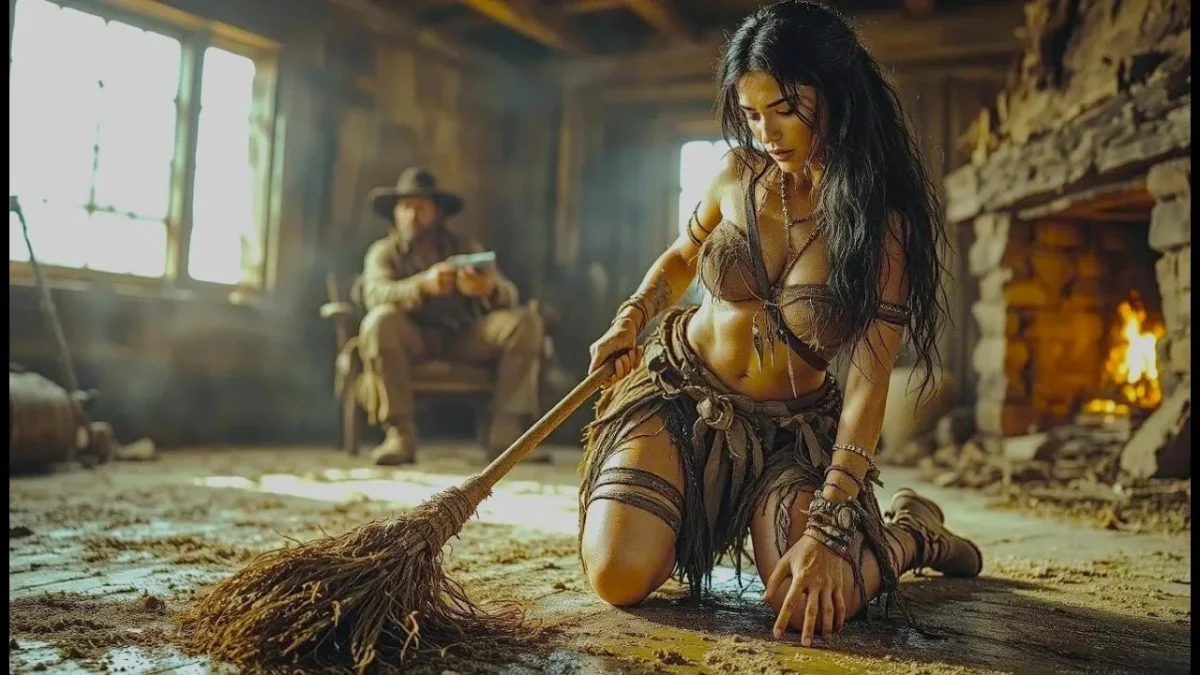
Before we begin the story, don’t forget to like the video and tell us where you watched in the comments.
The cabin stood at the far edge of town where the last hitching posts ended and the road turned into open desert.
Its roof sag from years of sun and rain, and the porch rail leaned in the middle where no one had bothered to mend it.
Inside, the floor carried a film of dust. Dishes sat unwashed in a crooked stack, and shirts hung where they had been dropped weeks before.
The air smelled faintly of gun oil and stale tobacco. It wasn’t a home so much as a stopover, a place a man entered only to rest his bones before the trail called again.
The cowboy stepped inside and stopped near the door. His eyes taking in the room the way a tracker studies ground for signs.
His shoulders were stiff from the saddle, his mouth dry, and there was a low pressure behind his eyes that came from too many nights of broken sleep.
He dropped his saddle bag by the wall and stood for a moment, uneasy with the silence of his own dwelling.
It wasn’t the dirt or the clutter that bothered him. He had lived rough most of his life, but the sense that the cabin reflected the truth he carried, that he had built nothing permanent, left nothing steady.
He had been on the move for years, working as a bounty hunter, riding far and wide across the territory after men who’d left trouble behind them.
The work paid enough to keep him fed, booted, and armed. But it also left him coming home with fresh bruises, blood on his shirt that wasn’t always his, and a heart that stayed sharp even when the fighting was over.
He knew every outlaw by the look of their tracks, but he barely knew what it felt like to sit at a table and eat without watching the door.
That afternoon, weary and sore, he made a decision. He needed help with the cabin.
He told himself it was practical. If the place stayed clean, he could focus on the job without worrying about spoiled food or broken furniture.
But part of him admitted it was more than that. The loneliness had begun to press in.
The silence, once a comfort, now reminded him of all the years spent alone. His thoughts settled on the neighbor he had seen almost daily, but never truly approached.
She was an Apache widow, a woman who had carried her years with a quiet kind of strength.
Her small yard was orderly, a water barrel shaded by cloth, herbs growing in neat rows, and smoke rising each morning from her chimney.
She rarely spoke to anyone in town unless spoken to, and most folks kept their distance out of old prejudice.
He had never given her more than a respectful nod, but he had noticed her steadiness.
That steadiness was what his place lacked. He washed the road, dust from his hands, straightened his shirt, and walked across the dry ground to her cabin.
His boots crunched against gravel, each step slower than the last, and he felt the old familiar tightness of hesitation in his chest.
Asking for help was not something he did easily. He carried the fear that she might turn him away, not with anger, but with the kind of polite refusal that cut deeper than an insult.
When she opened the door, he saw a woman of about his own age, maybe a little younger, with long black hair tied back and dark eyes that studied him carefully before softening.
Her skin bore the lines of hardship, but also the calm of someone who had survived it.
She did not smile right away, but she greeted him with warmth that was cautious and measured, as if weighing his intentions.
He explained himself in plain words. His cabin needed tending, cleaning, cooking, the sort of upkeep he had never managed.
He offered fair pay, not charity. His voice was steady, though inside he was bracing himself for the answer.
For a few seconds, she said nothing, and he felt the strain of the silence.
Then she gave a short nod. “I’ll come at first light,” she said. Relief spread through him, though he hid it behind a simple thank you.
He tipped his hat, turned back toward his cabin, and on the walk across the dry earth, he felt the pressure behind his eyes ease.
He didn’t fully understand why, but something had shifted. For the first time in a long while, he felt that the cabin might not stay empty.
The widow arrived at first light, carrying a small bundle wrapped in cloth. Inside were rags, a brush, and a tin of soap.
She stepped onto the cowboy’s porch without hesitation, though her eyes moved slowly over the warped boards.
The door frames still marked from years of rough use. When he opened the door to greet her, he noticed the way she held herself, steady, practical, with no trace of embarrassment of being asked into a man’s house.
He felt a brief moment of unease. He had invited her, but now the reality of her presence in his private space made him aware of every untended corner, every piece of his life left in disorder.
She walked inside, set her bundle on the table, and opened the shutters. Light poured into the cabin, cutting through the stale dimness.
For the first time, he saw the place as someone else might see it. Dust caked along the baseboards, cobwebs in the corners, dishes piled so long that grease had hardened on the edges.
A man living alone, he thought, leaves a trail that speaks louder than words. For a moment, a trace of shame touched him.
He had faced gunfire without blinking. But now, standing in his own cabin, he felt exposed.
The widow said nothing judgmental. Instead, she began to work. She filled a pot with water, set on the stove, and moved with an order that showed she had done this countless times in her own home.
Her sleeves rolled back. She scrubbed dishes until the tin shone. She swept the floor with even strokes, her movements quiet, but determined.
She did not waste words, but her silence did not feel heavy. It carried a steadiness that the cowboy realized he had been missing.
He tried at first to busy himself, pretending to sort through his saddle bag, but before long he left the cabin, saying he had errands to see to.
On the trail outside, his thoughts turned restless. He asked himself if it was right, asking a woman who had lived through her own struggles to step into his life in this way.
He remembered the rumors he’d heard whispered about her, that her husband had died of fever years ago, that she had no children, that some town’s folks still treated her as an outsider.
He wondered if people might talk now that she was in his cabin cleaning, cooking.
A flicker of worry crossed him, where she paid the price for helping him. He weighed the thought against the truth of what he saw in her.
A woman who had accepted the work with dignity, not charity. His decision settled like a stone.
She had chosen freely. The least he could do was respect that choice. By late afternoon, he returned with a small sack of flour and a fresh bundle of coffee, both bought from the merkantile.
His lip was split and swollen from a scuffle in town with a man who had resisted arrest.
The widow looked at him with sharp eyes, but did not ask for details. Instead, she finished setting a meal of beans and cornbread on the table and placed a cup in front of him.
He sat, remove his hat, and for the first time in years ate food in his own home that was hot, clean, and served without haste.
The silence between them might have seemed strange to others, but not here. It was not the silence of distrust, nor the silence of two people with nothing to say.
It was the quiet of people who understood that words were not always needed. When the dishes were done, she wrapped them in a cloth and set them neatly away.
The cabin looked different. Floors swept, air fresher, table cleared. As evening shadows stretched across the desert, the cowboy walked her back to her door.
Along the way, he asked a question he had not planned. You’ve been alone here a long while.
His voice was careful, not prying, but curious. She glanced at him, then looked ahead.
Since my husband passed, no children. My kin left for the north when a railroad came.
Her tone was simple, unadorned. She wasn’t seeking sympathy, only stating fact. He nodded slowly, taking in the truth of her words.
Alone, same as him, though in different ways. A flicker of empathy stirred, sharper than he expected.
He realized then that he hadn’t just hired her to keep his cabin in order.
He had given himself a reason to come home. When they reached her yard, she paused, her hand resting lightly on the gate.
Tomorrow I’ll come again. There’s more to be done. He tipped his hat. I’ll be here.
As he walked back to his cabin under the fading sky, he noticed his step was lighter.
For years, his mission had been one thing only. Track men, bring them in, survive the next job.
But now, without planning it, something else was settling into place. His cabin was no longer just a stopover.
It was beginning to feel like a place worth returning to. The next morning, the widow returned as promised.
The cowboy had woken early, his instincts sharpened from years of sleeping light. But instead of preparing for another long ride, he found himself straightening the cabin before she arrived.
He rolled his blanket tighter, set his rifle back in its rack, and splashed water on his face.
It was not vanity. It was a matter of respect. He had asked her into his life, and he would not have her walk into the same neglect she had faced the day before.
She stepped inside, carrying a small basket with a loaf of bread she had baked.
He caught the faint smell of cornmeal, and it struck him with a pang. When was the last time his cabin had smelled of anything other than dust, smoke, or gun oil?
She set the bread on the table, nodded at him once, and began her work without delay.
While she swept and scrubbed, the cowboy sat near the door, pulling on his boots.
He told her he would be leaving to follow a lead. A drifter wanted for horse theft had been spotted outside town.
She looked up from the floor and asked quietly, “Is it dangerous?” He gave a short, truthful answer.
“Always is.” For the first time, he realized she was not only keeping his home in order, but worrying about whether he would return to it all.
That thought lingered with him as he left. Stirring something deeper than he cared to admit.
Out on the trail, chasing the faint sign of tracks, he found his mind unsettled.
Normally, his thoughts were clean and sharp, focused only on the hunt, how the earth bent under a hoof, where a man would ride if he was desperate for water, how to catch him before nightfall.
But this time, his mind wandered back to the cabin. He wondered if she was eating while she worked, if the bread would still be warm when he returned, if the town gossips were already turning her name over in their mouths.
He knew how people talked, especially about an Apache woman. It troubled him more than he expected, because her dignity deserved better.
When he returned that evening, dust on his clothes, and the drifter still at large, he found the cabin transformed again.
The table was scrubbed clean, the floor bore neat, sweeping lines, and his spare shirt had been washed and hung.
Supper was waiting, beans, onions, and the bread she had brought that morning. The room felt different.
Not simply tidier, but alive in a way that caught him off guard. He looked at her across the table, seeing not just the woman who worked, but the woman who chose to step into a place that most would have left to rot.
As they ate, she asked a question that had hung unspoken until then. Why do you hunt, man?
Her tone was steady, not accusing, but curious, because people talk, but rumors never tell the truth.
The cowboy paused, his fork halfway to his mouth. For years, he had avoided answering that question.
Many rode with never asked. Saloon folk didn’t care. But now, sitting across from her, he felt the weight of her expectation.
He spoke carefully. Words chosen like bullets. I started when I was younger. After a hard winter left me with nothing.
No herd, no money. Bounty work was what I could do. I was good at tracking and it paid enough to keep me alive.
So, I stayed at it. He looked down at his plate. Then added, “But sometimes it feels like the work never lets me stop.”
She listened without interrupting. There was no judgment in her face, only quiet understanding. When he finished, she set her fork down and said simply, “You do what you must to survive.”
Same as me. The silence that followed was not empty. It was filled with something new.
The recognition that both of them carry burdens, that survival had cost them more than they ever spoke about to others.
The cowboy realized that the more time he spent with her, the less the cabin felt like a hiding place and more like a ground he could stand on.
When she rose to leave, he offered to walk her home. This time, she did not refuse.
On the way, he noticed how the town looked at them. Two figures walking side by side in the fading light.
One marked by law and dust, the other by the prejudice of being an Apache woman.
Whispers carried on the evening air, but he did not quicken his step or hang back.
Let them talk, he thought. He had seen enough of the world to know that respect between two people mattered more than the noise outside.
At her gate, she paused and asked a question that surprised him. Do you mean to keep this life forever?
Riding after men, always gone, always at risk. Her voice held no demand, only curiosity.
But he heard the concern beneath it. He answered honestly, “I don’t know. Been in it so long I forgot what else there is.
She studied him a moment, then gave a short nod. You’ll remember. One day he watched her step inside her yard, her figure framed against the dim light of her window, and then he walked back to his cabin.
Her words followed him into the night, stirring thoughts he hadn’t allowed himself in years.
For the first time, he wondered if the life he had chosen was the only one left for him, or if something steadier was waiting just beyond his reach.
The next evening, the cowboy returned later than usual. His horse was lthered with sweat, and his own shirt was torn at the shoulder.
He had caught up with the drifter he’d been following for 2 days, but the man hadn’t come quietly.
A scuffle of the aoyo left him with a cut on his knuckles and a dark bruise rising under his cheekbone.
When he stepped into the cabin, the widow was already there, having finished sweeping and setting a pot of stew on the stove.
She turned and saw the mark on his face, her eyes narrowing with quiet concern.
Without asking permission, she fetched a bowl of warm water and a cloth. “Sit,” she said firmly.
He hesitated. He wasn’t used to being tended to, but something in her tone left no room for argument.
He lowered himself onto the chair by the table, and she knelt beside him. She cleaned the blood from his knuckles with careful movements, drying his hand with the corner of her cloth so it wouldn’t sting.
He watched her closely, trying to read what lay beneath her silence. Was it pity, obligation?
But her face showed neither. What he saw was calm, deliberate care, something he hadn’t been on the receiving end of in years.
It unsettled him. He was a man accustomed to patching himself up, to ignoring pain and moving forward, having another person notice his wounds, let alone touch them, stirred something he didn’t want to name.
Still, he let her finish. When she rose, she set the cloth aside and ladled out two bowls of stew, placing one in front of him.
He muttered a low, “Thank you.” And they ate in silence, the only sound, the wind rattling softly against the shutters.
After supper, he glanced at the window. The sky outside was black and heavy, the kind of dark that pressed in on a man.
The wind was picking up, carrying grit against the glass. He thought of her walking home alone, the mile between his cabin and her swallowed in that thick darkness.
Something in him tightened. He cleared his throat and spoke carefully. No need to walk back tonight.
The storm will be worse before it gets better. Stay here. She looked at him long, her expression unreadable at first.
He felt the old hesitation rise in him. Had he overstepped? Made her feel cornered.
But then she gave a small nod. If you’re sure, she said. I’m sure, he answered.
He pulled a spare blanket from the trunk at the foot of the bed and shook the dust from it.
Take the bed, he added. I’ll keep the chair by the door. He meant it.
He wanted her to feel safe, not obliged. She studied him again, perhaps weighing whether he spoke truth or merely courtesy, then accepted the blanket.
The cowboys settled into the rocker, his rifle within reach as always, and she laid down without fuss.
The storm broke soon after, rain hammering the roof in sudden bursts, wind moaning against the eaves.
Inside, the cabin felt smaller, the walls closer. In the dim glow of the lamp.
He saw her profile against the quilt, her eyes open, not yet given to sleep.
He wondered what she was thinking, if she felt safe here, if the weight of the town’s judgment followed her even into these walls.
If she regretted saying yes. For his part, he felt a mix of tension and relief.
Tension because he was not used to sharing his space, not used to the fragile trust that came with it.
Relief because for once the silence inside the cabin was not empty. There was someone else breathing in rhythm with the storm.
Someone whose presence steadied the restless churn in his chest. Neither spoke again that night.
The storm carried on and the minute stretched. When he finally drifted in a light sleep, his last thought was a simple one.
He had not misjudged her. She belonged here, at least for tonight. And the cabin, for the first time in years, did not feel like a lonely man’s shelter, but like a place meant to be lived in.
The storm raged through most of the night. The sound of rain hammering against the roof, making the cabin feel like the only safe place left in the territory.
The cowboy sat in the rocker by the door, his rifle leaning against the wall within reach.
His body was tired, but his mind refused to let go of its watchfulness. He had spent years sleeping light, ears trained to catch the faintest stir outside.
Yet tonight his thoughts wandered not to threats in the dark, but to the woman lying in his bed.
The widow lay on her side, her eyes half open, the blanket pulled to her shoulders.
She listened to the storm, but more than that, she listened to the sound of him shifting in the chair every few minutes, his boots tapping lightly against the floor.
She knew he was staying awake, not just out of habit, but because of her presence.
It struck her that a man who hunted outlaws by day was now guarding her rest at night.
And the thought brought both comfort and unease. She turned, her voice quiet, but carrying through the stillness.
You wear yourself out sitting like that. You don’t need to guard me. He glanced over, his expression hard to read in the lamplight.
It’s not you I’m guarding from. It’s the world outside. He paused, then added, “Old habits don’t break easy.”
Her eyes lingered on him. She had lived long enough to recognize the weariness in a man’s bones.
The way violence leaves its mark even when the scars fade. She had known loneliness herself.
Her husband taken by fever, her kin scattered when the railroad carved through the land.
Nights had been long and empty since then. And though she carried her grief quietly, it weighed on her still.
Now in this cabin, she felt something she hadn’t in years. The presence of another soul near enough to ease the silence.
Minute stretched, the storm eased slightly, the rhythm of rain softening on the roof. The widow shifted under the blanket and spoke again, more hesitant this time.
“It’s been many years since I shared a roof with anyone. Too many.” She let the words hang, testing if he would hear the meaning behind them.
The cowboy straightened, uncertain. His instinct was to stay guarded, to keep boundaries clear. But her tone carried no demand, no manipulation, only loneliness laid bare.
He felt the pull of her words in his chest, a tug against the armor he had built around himself.
She turned on her back and met his eyes, her voice lower now, trembling, but deliberate.
Come closer. Not for duty, not for pity, just because it has been too long.
He froze in the chair, caught between hesitation and the need to answer her honesty with his own.
Years of solitary living, years of mistrust, years of telling himself he was safer alone.
They all pressed on him at once. His heart pounded with the old fear of letting someone see him as more than the bounty hunter, more than the man who never stayed.
But there was something undeniable in her gaze, something steady and human that cut through the noise in his head.
Slowly, he rose from the chair. Each step toward the bed felt heavier than a mile on the trail, but he did not stop.
He sat at the edge of the mattress, boots still planted on the floor, and for a moment, neither of them spoke.
Their shoulders touched, a small point of warmth that carried more weight than words. The widow reached out, her hand brushing his as if to ask permission.
He did not pull away. Instead, he turned his hand over, letting hers rest there.
The silence between them shifted. No longer the quiet of strangers, but the quiet of two people deciding without ceremony that the years of loneliness had lasted long enough.
When he finally lay down beside her, it was not rushed. There was care in every movement, a mutual understanding that neither was seeking escape or distraction.
They sought only the warmth of another person, the reassurance that after years of loss, it was still possible to feel connected.
The night unfolded with that simple closeness, unspoken but real. For the first time in years, the cowboy let himself sleep deeply, the steady rhythm of another’s breath beside him.
For the widow, the weight of solitude lifted just enough for her to close her eyes without dread of the long dark hours ahead.
By morning, when the storm had passed, and sunlight cut across the floorboards, the cabin no longer felt like two separate lives crossing paths.
It felt, for that moment, like a place where both belonged. The morning came with a clear sky.
The storm washed clean from the land. Sunlight spilled in sharp lines through the shutters, falling across the wooden floor and the blanket tangled at the edge of the bed.
The cowboy stirred first, his instincts always keeping him half awake at dawn. He shifted carefully, not used to another presence beside him, and for a moment he felt the familiar urge to rise, put on his boots, and ride.
But when he looked down, he saw the widow’s hand resting lightly on his arm, her breathing calm, her face softened by sleep.
The urge to leave passed. When she woke, there was no alarm in her eyes.
No regret, only a quiet steadiness as she adjusted the blanket around her shoulders. The cowboy cleared his throat, uneasy with the silence, but needing to say something.
“What happened last night?” He paused, searching for the right words. “It wasn’t something I planned.
But I don’t regret it.” She studied him for a moment, then sat up slowly.
“Nor do I,” she answered. Her tone carried no shame, no excuses, only truth. But we should speak clear.
If this is to mean something, it cannot be hidden or treated like a mistake.
He nodded, grateful for her honesty, but weighed down by his own doubts. He had lived too long on the trail, too long in a life where leaving was easier than staying.
“I don’t have much to offer,” he said plainly. “No land worth counting, no steady work besides chasing men.”
That life doesn’t leave much room for for this. The widow pulled her hair back and tied it behind her neck.
Her movements slow, deliberate. I didn’t come here looking for riches, she replied. I came because you asked and because I wanted to.
What I need is respect. If I choose to stay at your side, it must be by my will, not as charity.
Her words struck him deeper than he expected. He realized then that his biggest fear wasn’t her leaving.
It was the thought that she might believe he saw her as less than equal.
He shook his head. Respect is already yours. You’ve shown more strength than most men I’ve known.
I wouldn’t take that from you. As the morning stretched, their conversation moved toward the past, the parts neither had spoken before.
She told him about her husband, how the fever had taken him in the span of a week, how she had buried him with her own hands when no one else would help.
She spoke of the loneliness afterward, of neighbors who looked through her rather than at her, of whispers that followed her in town.
The cowboy listened without interruption, his jaw tight, anger rising at the thought of her bearing that weight alone.
In turn, he shared what little he ever admitted about himself, how he had once been a ranch hand with hopes of owning cattle, how debt and drought had ruined him, how bounty work had been the only road left.
He confessed that he had ridden so long chasing lawless men that he no longer knew who he was without the hunt.
It’s a hard thing, he admitted quietly, to wonder if you’ve built a life or just wasted it.
She placed her hand on his arm again, steady. You haven’t wasted it. You’re still here.
You’re still choosing. That counts for more than you think. Her words settled into him like a truth he hadn’t dared consider.
For the first time in years, he thought of what it might mean to stop running from place to place, to plant himself in one spot and not leave.
The thought scared him, but also ease something deep inside. By midday, the widow rose to leave, wrapping her shawl around her shoulders.
He offered to walk her back, but she shook her head, saying she needed the time to think on her own.
At the door, she paused and looked back at him. If you want me here truly, then it can’t be halfway.
I will not live in shadows. Decide what place I have in your life, and I will answer in kind.
He stood in the doorway long after she left, her words echoing in his mind.
He knew she was right. Whatever had begun between them could not remain unspoken, nor could it survive if treated as a passing comfort.
It demanded a choice. For the rest of the day, he sat on the porch, hat pulled low, staring out at the open land.
The weight of years on the trail pressed on him, but so did the new thought, one he couldn’t push aside now, that maybe his mission wasn’t just about hunting men anymore.
Maybe it was about finding something worth protecting, something that gave meaning to the cabin, the land, and his days.
As the sun lowered in the west, he understood what unsettled him most. For the first time in his life, the decision wasn’t about survival.
It was about staying. And staying had always been the hardest thing for him to do.
The widow’s words weighed on the cowboy for days. He still rode out to follow trails, still carried irons and cartridges, but every time he looked back toward the cabin, he felt the pull of a choice he hadn’t yet made.
He had spent years telling himself he belonged to the road. But now the road felt less like freedom and more like a chain.
That realization unsettled him in ways he hadn’t expected. It was during one of those uneasy evenings while he leaned against the porch rail sharpening his knife that the sheriff rode up with news.
Wickcom slipped a posi two counties over. The sheriff said, wiping dust from his brow.
Word is he’s headed this way. Man’s got a grudge and your name’s on it.
The cowboy’s jaw tightened. He had brought in Kumza’s brother the year before, and he knew revenge rode harder than hunger.
For the first time in years, the thought of danger wasn’t just about him. His eyes flicked toward the cabin door, where the widow was inside, kneading dough for bread.
If Kums came, she would be in crossfire. That night, he sat with her at the table and told her the truth.
There’s a man coming. Dangerous. He’ll want me de@d. It might spill to this place.
He expected her to flinch, maybe even leave, but she didn’t. She wiped flower from her hands, looked him straight in the eye, and said, “Then we prepare.
I’m not running.” He tested her resolve, reminding her of the risks, but she held firm.
She had lived through loss, through loneliness, through the cruelty of neighbors whispers. She would not live in fear now, not after choosing to stay.
So they made ready. He checked the rifle, counted cartridges, and placed a shotgun near the window.
She gathered blankets and water, moved the table against the door to brace it, and even tied her hair back so it wouldn’t fall on her face if she needed to work fast.
He showed her how to reload, and though her hands trembled at first, she steadied them until each movement was sure.
The cowboy watched her closely, a mix of admiration and fear tightening in his chest.
He knew many men who would have walked away from fight like this. But she stood firm and he realized something else.
Her presence forced him to fight differently. Before he would have risked himself without thought.
Now every choice had weight because her life was bound to his. As darkness fell, they doused the lamp and sat in the quiet, the air thick with waiting.
His mind circled with old questions. Could he protect her? Could he build a life here if enemies kept trailing his past into the present?
But beneath all of that ran a steady truth. He no longer faced these nights alone.
Boots crunched in the distance just before midnight. The widow heard them too. She looked at him, her eyes steady, and whispered, “I’m ready.”
He gripped the rifle, his heartbeat calm and sure. Whatever came through that dark, they would face it together.
The night was heavy with silence after the sound of boots in the dirt. The cowboy’s hand gripped the rifle stock, his breathing slow but sharp in his chest.
Years of hunting men had trained him to know the difference between chance wanderers and those who came with purpose.
The steps outside carried weight, the careful kind that meant Kums wasn’t alone. The widow crouched low by the table, the shotgun resting against her leg.
She wasn’t shaking now. Her breaths were measured, her eyes fixed on the door. She had never stood in the middle of a gunfight before, but she had lived through nights just as dangerous in different ways.
Nights of sickness, of hunger, of neighbors trying to drive her off her land. She knew what it meant to survive when the odds were poor.
Now she refused to be treated as a bystander. A voice called from the dark, “You in there, cowboy?
I figure you know who this is.” The cowboy didn’t answer right away. He moved to the window and peered through the narrow gap in the shutter.
Three figures, one leaning against a post, one holding a lantern low, and the taller shape in the middle had to be His rifle stayed trained on the window frame as he spoke low to the widow.
Three men, at the front. Stay low. Don’t fire unless you have to. Then raising his voice, he called back, “You should have kept riding, You won’t find what you’re after here.”
The reply came with a laugh, bitter and hard. You brought my brother in last year.
He died in a cell before the rope even found him. I’ve been waiting for the chance to pay you back.
Tonight’s the night. The widow’s hand tightened on a shotgun. She leaned closer and whispered, “If he comes through that door, you’re not alone in this.”
Her voice was steady, not pleading, not fearful. It grounded him in a way no gun ever had.
A shot cracked suddenly, splintering the door frame just above the latch. The cowboy answered instantly, one round through the shutter.
The lantern outside swung wildly, light bouncing across the yard. A curse rang out as the men scattered for cover.
The widow slid a box of cartridges across the floor to him, her hands firm despite the gunfire outside.
He glanced at her, seeing not panic, but resolve. Another shadow moved toward the side window.
The widow saw it before he did. She snatched the pan from the stove, still warm, and slammed a heart against the wooden sill.
The noise startled the man outside, giving the cowboy the split second he needed to fire.
The outlaw dropped back into the brush with a wounded arm, his rifle clattering on the ground.
For a moment, silence fell again, except for the wind. Then Kum shouted, his voice raw.
You can’t keep her safe forever. You think one night in your bed makes her yours.
You’ll die and she’ll be left with nothing. The word struck deeper than the bullet hat.
The cowboy’s jaw tightened. Wasn’t just aiming to kill. He was aiming to break his resolve.
He lowered his rifle slightly, speaking in a calm, even tone that carried through the walls.
You don’t get to decide her place. She chose to be here. That’s more than you’ll ever have.
The widow’s eyes flicked to him, a faint glimmer of something unspoken in her gaze.
Pride, maybe even relief. She had waited years to be defended with truth rather than pity.
Minutes dragged. The outlaws shifted in the brush, but none pressed closer. The cowboy held his position, rifle ready, ears tuned to every sound.
The widow reloaded the shotgun with careful hands, each shell clicking into place. Together they waited, the air thick with the knowledge that one wrong move would end it all.
Finally, Boots retreated, Coons cursed under his breath, the sound fading as the three men pulled back into the dark, leaving only the swing of the broken lantern smoldering in the dirt.
The cowboy didn’t move at once. He waited, listening until the night grew still again.
Only then did he ease the rifle down, his body releasing the tension that had locked it tight.
The widow rose slowly, her legs stiff from crouching. She placed the shotgun back on the table and exhaled.
You think they’ll come back? He wiped his brow, sweat mixing with dust, and shook his head.
Not tonight. They’ve lost their courage for now. But Kums isn’t done. Men like him don’t quit easy.
She met his eyes, her expression firm. Then neither will we. For the first time in years, the cowboy felt the truth of partnership, not in words or contracts, but in the way she had stood her ground beside him, unflinching.
He had always fought alone. Tonight proved he didn’t have to anymore. Dawn broke calm, the storm long gone, and the gunpowder smoke cleared from the air.
The cowboy stepped onto the porch with his rifle slung across his shoulder, scanning the ridge where the outlaws had fled.
The ground was marked by fresh boot tracks, easy to follow in the soft earth.
He knew Kums wouldn’t vanish quietly, not with a grudge that deep. If left free, would circle back.
Maybe not tonight, maybe not tomorrow, but eventually, and the widow would always be at risk.
He saddled his horse and loaded a small pack. The widow watched from the doorway, arms folded, her face calm, but eyes heavy with unspoken questions.
You’re going after him, she said. I have to, he answered. As long as he’s out there, you’ll never be safe.
Her jaw tightened. And what about you? You ride out alone. You might not come back.
Then what’s left for me? The cowboy paused, the weight of her words hitting harder than he expected.
For years, his choices had only concerned his own survival. Now someone else’s life was tied to them.
He saw the truth in her worry. If he kept chasing death, he might succeed in finding it, and she would be left with nothing but the memory of one night and a half-lived promise.
He stepped closer, lowering his voice. I won’t make this a habit. But this one, I can’t leave him free.
She held his gaze, searching for any sign of doubt. Finding none, she nodded once.
“Then go, but come back. Don’t make me a widow twice.” With that, he mounted and rode out, following the tracks through the dry scrub and up toward the ridge.
Hours passed. The sun climbed, heat rising off the rocks. He moved with the patience of a man who had hunted too many times to rush.
By midafternoon, he found them. Kums and his two men camped near a dry creek bed.
The fight was brief and brutal. One outlaw surrendered when the cowboy leveled his rifle.
The second tried to run and was taken down with a warning shot that knocked him to the ground.
Kumzo came out with his pistol raised, eyes wild. You think you can take everything from me?
My brother and my freedom. You’ll pay the same. The cowboy’s answer was steady. You brought this on yourself.
I only ever took men the law wanted. Your brother made his choices. And now you’ve made yours.
The exchange ended with a single shot. Fell hard, his pistols skittering into the dirt.
Silence followed, broken only by the wind. The cowboy bound the surviving men, loaded them onto their horses, and rode them back into town.
By evening, the sheriff had the outlaws locked behind iron bars. He clapped the cowboy on the shoulder, praising him for ending it clean.
But the cowboy wasn’t listening. His eyes kept drifting to the road that led back to the cabin.
For the first time, he didn’t feel satisfaction at finishing a job. He felt only the need to return home.
When he arrived, the widow was waiting on the porch. She didn’t rush to him, didn’t weep with relief, but her eyes softened when she saw him alive.
He dismounted slowly, almost hesitant, and said, “It’s done. Couns won’t trouble us again.” She studied him for a long moment.
“And you? Will you keep chasing men until another takes your life?” The cowboy stood silent, the question cutting deeper than any bullet.
He thought of the years wasted on trails, of cold camps and faces he couldn’t remember.
He thought of her hands steady on a shotgun, of the bread she left on his table, of the way she had told him she would not live in shadows.
For the first time, he said it aloud. “No, I’m done with it. The law has enough men willing to hunt.
I’ve had enough of death.” Her shoulders eased, and something unspoken passed between them. A promise, fragile but real.
She turned, opening the door to the cabin, and for the first time, it didn’t feel like a shelter for a lonely man.
It felt like a home waiting to be lived in. That night, as they sat side by side at the table, the silence between them was no longer the silence of strangers or even allies in survival.
It was the silence of two people who had decided to face the days ahead together.
For the cowboy, it was the hardest choice he had ever made. Not riding out, not fighting men, but staying.
The days after Kum’s capture passed with a rare stillness. For the first time in years, the cowboy didn’t ride out before dawn.
Didn’t sharpen his knife with tomorrow’s fight in mind. Didn’t check his saddle every evening in case he had to leave at moment’s notice.
He sat on the porch instead, mending a bridal, watching the sun climb over the horizon and settle down again.
The widow came and went between her cabin and his, and soon there was no longer a line between them, her bread cooling on his table, his tools stacked by her wall after a day’s fixing.
The sheriff stopped by one afternoon, leaning on his horse and spitting into the dirt.
“You’re certain you’re done?” He asked. “Men like you don’t usually quit.” The cowboys answer was plain.
“I’ve chased long enough. Tomi stayed put. The sheriff gave him a long look, then nodded.
Town could use a man who knows how to hold ground instead of always leaving it.
With that, he tipped his hat and rode off, leaving the cowboy with the certainty that his decision was no longer just a thought, but the shape of his future.
That night, he spoke with the widow under the lamplight. I’ve given word to the sheriff.
I won’t be hunting men anymore. I’ll take work guarding freight runs, maybe fixing fences, whatever keeps me here.
He hesitated, then continued. But I don’t want it to be just me. Not anymore.
I want this to be our place, not just mine. She listened quietly, her hands folded in her lap, her expression steady.
For weeks, she had tested his resolve, waiting to see if he would keep one foot in the trail.
Now she heard in his voice the finality she needed. If you mean it, she said softly.
Then I’ll stand beside you. But it must be a life built together. Nami tucked away.
Nami hidden from town’s eyes. He nodded. No hiding. You’re not a secret. You’re my partner.
The decision was sealed days later when they stood behind the mission house under a hard clear sky.
The priest read a short passage. The sheriff bore witness and a handful of towns folk gathered quietly.
Some still whispered about the Apache widow marrying a man like him, but neither cared.
She wore a simple dress she had sewn herself. He wore a clean shirt and boots he had polished with care.
When their hands joined, there was no trembling. Both knew exactly what they were agreeing to.
Not romance dressed in illusion, but the steady labor of building a life side by side.
Afterward, they walked back to the cabin. Now there’s in full. The cowboy replaced the sagging porch rail with new wood.
The widow laid a quilt across the bed that she had kept folded for years.
They planted a small patch of herbs near the door, watered with a shared bucket, and set a shelf by the window for her jars and his tools.
Every act was practical, yet each carried weight. Proof that the place was no longer temporary, no longer only his.
That evening they ate supper together, meat, beans, and fresh bread with butter soft in the heat.
The sun dropped low, but the air was calm. No storm on the horizon. They sat on the porch steps afterward, shoulders close, listening to the wind move gently across the grass.
For the cowboy, the silence was different than it had ever been. It was no longer the silence of empty rooms or watchful nights.
It was the silence of belonging, of knowing that he did not have to leave in the morning, that the person beside him would still be there when the day broke again.
For the widow, it was the silence of being seen, no longer overlooked, no longer surviving alone, but sharing the weight of her days with someone who had chosen to stay.
There were no debts hanging over them, no enemies waiting beyond the ridge, only the work of the land, the rhythm of days, and a promise that they would carry it together.
And so, the story ended not with departure, not with violence, but with a simple, hard-earned truth.
The cabin was a home now, and they had chosen it and each other for








