The Apache Cowboy Showed the “Simple” Woman a Letter From His de@d Love—She Whispered, “I Wrote It.”
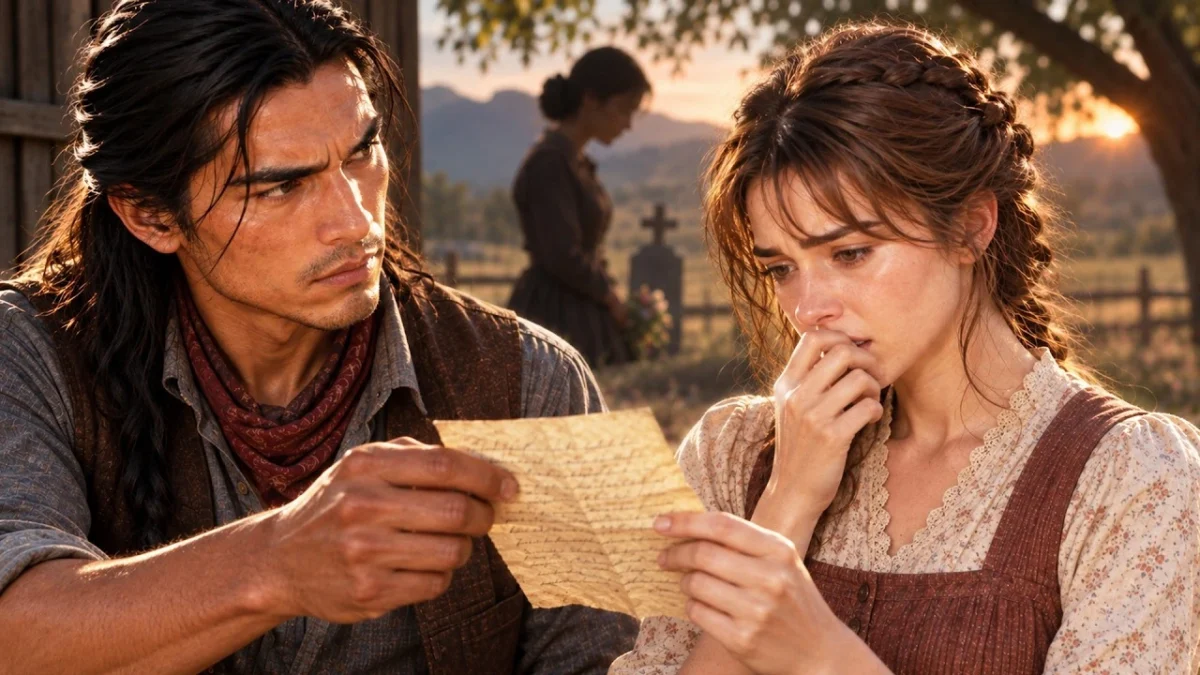
The Apache Cowboy Showed the “Simple” Woman a Letter From His de@d Love—She Whispered, “I Wrote It.”
For 2 years, Daniel Red Horse had mourned a woman he had never seen. All he had left of her were 46 letters and the certainty that she was de@d.
Then, in a dusty Arizona town, a woman everyone called Simple Rose looked at one of those letters and went pale.
Daniel expected her to hand it back. Instead, she looked up at him and whispered, “I wrote this, but to understand how a de@d woman could be standing in front of him.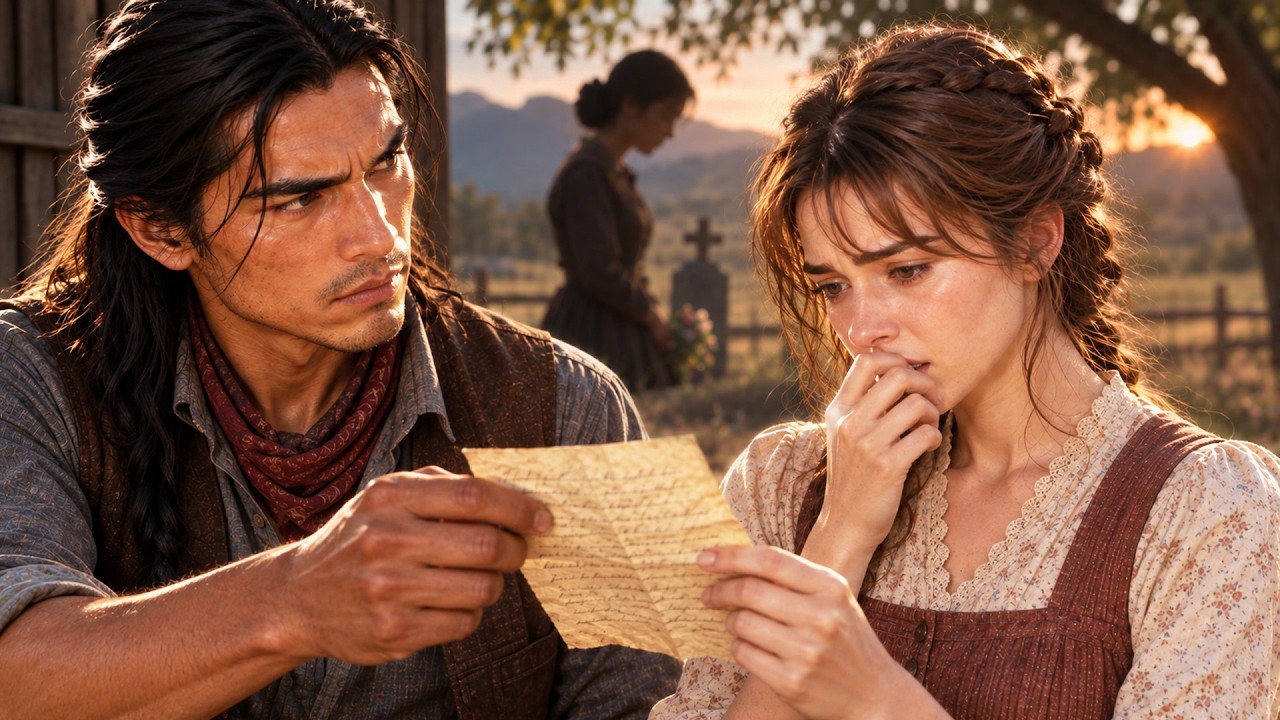
You have to go back to the day Daniel first rode into Red Mesa. By the time Daniel Redor rode into Red Mesa, the morning wind had already pushed half the road into the air.
Dust moved in pale sheets between the buildings, settling on hitching posts, wagon wheels, and the shoulders of men who had stopped pretending to notice it years ago.
Red Mesa was not much of a town, just one crooked street, a church set back from the road, a blacksmith, a saloon, and a general store with the post office tucked inside like an afterthought.
Daniel had come for cattle work, nothing more. Harland needed experienced hands for the spring roundup, and Daniel needed wages.
The arrangement was simple enough, which was one reason he trusted it. He tied his bay geling, copper outside the general store, and stepped inside.
The room smelled of coffee beans, flower sacks, lamp oil, and old wood. A young woman stood at the counter.
Daniel noticed her because everyone else seemed determined not to. She wore a plain brown dress and an apron faded nearly white at the edges.
Her dark hair was pinned without much care, and she held a folded list between both hands while the storekeeper raised two sacks for her to sue Cece.
Which one did Miriam want? Rose, the Kansas flower, or the cheaper one. Rose looked from one sack to the other but did not answer immediately.
A man near the stove chuckled. Give simple Rose another minute. Pike settle down before she makes up her mind.
A few others laughed. Rose lowered her eyes. Beside her stood a broad shouldered man in a dark vest.
Perhaps 50 with iron gray beginning at his temples. The cheaper one, he said. Rose doesn’t know the difference.
Daniel looked at her again. Something in her expression bothered him because what he saw there was not confused fusion.
It was restraint. The storekeeper reached for the cheaper sack. She didn’t answer yet. Daniel had spoken before, deciding whether it was any of his business.
The room went quiet, and the older man turned toward him. Daniel knew that particular silence.
Sometimes it came because he was Apache. Sometimes because strangers were trying to decide whether an Apache cowboy standing among white men was trouble.
He had learned not to help them with the decision. Rose lifted her eyes and looked directly at him for the first time.
They were gray, sharp, and far more alert than anyone in the room seemed willing to notice.
Daniel thought, “There you are.” The man beside her started. “Rose, the Kansas flower,” she said.
Her voice was quiet, but there was nothing uncertain about it. The storekeeper blinked. “Kansas.”
Then Daniel looked away as though nothing had happened. But when he glanced back, Rose was still watching him outside.
He was tightening Copper’s cinch when he heard wood scrape behind him. Rose was trying to maneuver a heavy crate down from the store porch toward a wagon.
Daniel walked over. She saw him coming. I can carry it. I know that stopped her.
He took hold of the other end, but Rose remained where she was for a moment.
You planning to argue you? He asked. Or Carrie? Her mouth tightened. Daniel was not entirely certain whether he had offended her until he caught the smallest movement at one corner of it.
They lifted the crate together halfway to the wagon. Rose’s hand slid along the wooden grip grip and brushed his.
She pulled away so quickly that the crate nearly tipped, forcing Daniel to catch his side.
Rose looked embarrassed. Daniel said nothing, which seemed to surprise her more than if he had teased her.
When they reached the wagon, he waited for her to decide where the crate belonged.
She pointed and he set it down. Thank you. Daniel nodded toward the store. You always take that long choosing flower.
Her eyes narrowed. No. Good. Good. Why? I was afraid supper might be delayed. She stared at him, then against her will.
She laughed. It was a small, quick sound that disappeared almost immediately, but Daniel heard it.
He rode away, thinking about that laugh longer than he had any reason to. Two days later, Harlon sent him to the bell place to return a mayor that had slipped a fence during the night.
Daniel was leading the animal toward the barn when he heard a woman’s voice inside, clear and measured, reading.
He stopped. Rose sat on an overturned feed box in a strip of afternoon sunlight, a thick book open across her knees.
She read without hesitation, moving easily through the words, not slowly, not poorly, beautifully. Daniel leaned against the door frame.
Rose looked up and all the color left her face. She snapped the book shut.
You weren’t supposed to hear that. I gathered. She stared at him. What are you reading?
Nothing. Daniel glanced at the thickness of the book. Nothing’s gotten longer since I was a boy.
That almost earned him another smile. Alms. Then he saw the fear replace it. Are you going to tell anyone about the book?
About me? Daniel studied her, and the pieces from the general store began to settle into place.
The long pauses, the lowered eyes, the way everyone answered before she had the chance.
Rose could keep up with Red Mesa just fine. She had simply learned there was some advantage in letting Red Mesa believe she could not.
No, he said. Rose searched his face. You don’t even want to know why. I expect you’ll tell me if you want me to know.
She looked down at the closed book. Her thumb moving slowly along the edge of the pages of cheese outside.
The mayor shifted and leather tack creaked softly in the quiet. After a moment, Daniel asked, “Why let them call you simple?”
Rose was silent for a few seconds. When she answered, there was none of the hesitation he had seen in the store.
Simple women aren’t asked dangerous questions. Daniel did not smile this time. Whatever Rose Whitmore was doing, he understood now that it had never been a game.
That evening, 5 miles away, Silas Bell stood at the kitchen window while Miriam cleared the supper plates.
He watched the road Daniel had taken back toward Harlland’s ranch. Miriam followed his gaze.
He’s just one of Harlland’s new hands. Silas said nothing. Silas. His fingers tightened around the curtain.
Then he asked quietly, “What’s Red Horse doing here? Before we continue, if stories of the Old West, hidden truths and second chances are your kind of story.
Subscribe and stay with us.” Because Silas Bell didn’t turn pale by accident. He knew the name Red Horse.
And while Daniel was beginning to wonder what Rose was hiding from the town, he had no idea that Rose was about to discover something about him, something that should have been impossible.
In the days that followed, Daniel Redhorse did not court Rose Whitmore. He brought no flowers and invented no reasons to linger at the bellgate.
Neither of them would have known what to do with such things anyway. They simply began appearing in each other’s days.
Sometimes Harland sent Daniel across Bell Land after strays. Sometimes Rose into town for flower or lamp oil and found him in tying copper outside Pike’s store.
Another afternoon he found her reading in the barn again. This time she did not close the book.
She shifted aside on the feed box, and Daniel sat beside her while she read.
Somewhere during those quieter April days, Rose learned the sound of Copper’s hoofbeats without meaning to, she could pick out his steady rhythm on the road beyond the cottonwoods before Daniel ever came into view, and she hated the small lift it put inside her.
Daniel was learning things, too. He knew the difference between Rose’s real silences and the careful blankness of simple Rose.
He learned that she disliked being handed anything she could reach herself, that she read sad passages twice, and that she laughed more easily when she forgot someone might hear.
It was Thomas Harper, who made Daniel realize how much he had already noticed. Thomas arrived at the bell place one afternoon with fencing wire over one shoulder, and walked into the yard like a man who had been doing so for years.
The west gate again. He asked. Rose nodded. Lower hinge? Of course. Thomas went straight to the tool shed, found the right hammer without asking, then tossed Rose a pair of gloves hanging beside the door.
She caught them without looking. Daniel watched from the corral. Thomas knew the troublesome gate where the tools were kept, even which gloves belonged to Rose.
None of it should have mattered. Irritatingly. It did. Later, Rose brought Daniel a length of rope.
You don’t like him. Daniel glanced toward Thomas. I barely know him. That wasn’t an answer.
No. Rose waited while he began coiling the rope. You do that on purpose. What?
Say as little as possible saves way. Rose laughed. Daniel liked the sound too much, which bothered him considerably more than Thomas Harper did several evenings later.
They found themselves talking about love. The sun was low behind the hills as Daniel repaired a bridal strap beside the barn.
Rose sat on the fence rail nearby. A closed book resting in her lap. “You really mean to leave when Roundup ends?”
She asked. That was the arrangement. And after work somewhere else. Forever. Daniel glanced at her.
That’s a long contract. Rose looked toward the darkening pasture. Never wanted a place of your own.
His hands slowed. Once a ranch, a few cattle, a house, a wife. He gave her a look.
You ask dangerous questions for a simple woman. You’re the one who found out. Daniel returned his attention to the leather.
There was someone. Rose grew quiet. What happened? She died. The plainness of it caught her off guard.
There was no dramatic confession in his voice. Only two words he had apparently carried for years.
I’m sorry. Daniel nodded. After a while, Rose asked. Was she beautiful? I don’t know.
You don’t know. Never saw her. Rose turned fully toward him. She wrote to me, Daniel said.
For how long? 6 years. Something stirred faintly inside her. 6 years. What began as friendship on paper had become something neither of them knew how to name until years later.
And you loved her. Daniel was silent long enough that Rose wished she had not asked.
Then he said, “Yes. How? He looked up. I mean, if you never saw her.
Daniel’s thumb moved over the worn leather as he looked toward the last light on the mesa.
For once, the dry amusement was gone from his face, and Rose saw the loneliness beneath it.
“What did you love?” She asked. His answer came quietly. The way she made the world feel less empty.
Rose looked down at the in her lap. She did not recognize the words, yet something beneath them hurt like a memory.
A week later, she found the tin box. Daniel had ridden to the bell place after one of Harland’s horses caught itself on loose wire.
Rose was helping him in the barn when she noticed the box sitting open beside his saddle bag, plain and dented at one corner.
Inside were dozens of letters, those hers. Daniel followed her gaze. Yes, you kept all of them.
All I got. How many? 46. Rose’s hands went still. Daniel reached into the box just as a gust swept through the open barn door.
One of the letters slipped loose and fell. Rose bent to pick it up. The moment the paper touched her fingers, something changed.
It was creamcoled, faintly ruled in blue gray, folded once and then again. Near the lower edge was a tiny dark blemish where ink had once soaked through from another sheet.
Rose knew that mark. More than that, she knew the paper. Rose. She looked up too quickly and caught her palm against a jagged edge of the stall.
Daniel crossed to her. Let me see. It’s only a scratch. I’ve heard about your relationship with nothing.
Before she could object, he took her hand and wrapped the small cut with a clean strip of cloth from his saddle bag.
His fingers were careful around hers. When he finished, neither of them moved. Rose lifted her eyes and realized how close he was.
Daniel seemed to realize it at the same moment. Then his fingers loosened. Only after he let her go did Rose notice the cold air against her palm.
Daniel closed the tin box and left before the rain came. Rose remained in the barn, listening to Copper’s hoofbeats fade down the road.
46 letters. She looked at the hand Daniel had bandaged. Then at the place where the tin box had been, a memory surfaced, a desk lit by lamplight, a bottle of ink, stacks of cream colored paper hidden beneath an old Bible where Silas would never find them.
Rose went still. She had folded those pages once, then again, long before Daniel Redhorse ever held them in his hands, Rose had.
Rose slept badly for three nights. Whenever she closed her eyes, she saw cream paper beneath her fingers.
Not Daniel’s letters, hers. She remembered buying it a few sheets at a time from Pike’s store, so no one would wonder why she needed so much.
She remembered writing after Miriam and Silas had gone to bed. A blanket pushed against the bottom of her door to hide the lamplight.
She remembered waiting for ink to dry before folding each page once. Then again, 46 times she had done it.
No, Rose sat upright in the darkness. 47. By morning, she could no longer tell herself.
Memory was playing tricks on her. She found Daniel near the creek, beyond Harland’s lower pasture.
Cottonwood leaves turned silver in the wind above him. He was kneeling beside the water, washing dust from his hands.
When he saw her coming, he stood. Rose did not bother with greeting. I need to see the letters.
Something in her voice took the question from his face. Why? I think they’re mine.
Daniel went very still. Rose heard how impossible the words sounded. I wrote to someone once.
She said, “For 6 years.” His expression changed. Rose. He was 19 when I first wrote him.
He worked cattle. His mother taught him to be careful with contracts because she said a man who couldn’t read what he signed was letting someone else decide what he owned.
Daniel stared at her. Rose’s heart began to pound. She had never told him that.
Not Daniel standing before her, but she had told someone, a boy she had known only through ink.
Daniel spoke quietly. What did you sign? R. The creek moved between stones. Nothing else seemed to move at all.
Daniel turned toward his horse. When he came back, the tin box was in his hands.
He opened it slowly. Rose saw the letters again. 46 pieces of a life she had believed lost.
Daniel touched them as though counting was no longer enough to make them familiar. Then he reached beneath them.
There was one more. He took out a different sheet, older now, folded thin at the creases his face had pulled in away Rose had never seen.
This came after the others. He held it toward her. For a moment, she could not take it.
Daniel’s eyes stayed on hers. Can you read this? Rose almost laughed. Of all the questions he could have asked her.
Instead, she took the letter. The first line stopped her breath. She read further. A sentence about winter rain.
Another about the west-facing window she once dreamed of having. Then words about being ill, growing weaker, about death coming soon, about not wanting Daniel to come looking.
Rose’s hands began to shake. I wrote it. Daniel’s face emptied. What? I wrote those words.
She looked down again. No. Her finger found one sentence. This. I wrote this in a letter about Miriam being sick one winter.
She moved lower. And this was from another one. I was talking about wanting a room with a west window someday.
Daniel said nothing. Rose read the final lines again. They were gentle, loving, final, and completely foreign.
She looked at him. I wrote those words. Her voice broke. But I didn’t write this letter.
Daniel seemed to forget how to breathe. Who are you? Rose had hidden behind one letter of the alphabet for six years.
Now there was nowhere left to hide. R. Daniel took one step backward. Rose had expected disbelief.
Anger. Perhaps. Instead, she watched grief leave a man’s face without knowing where to go.
You’re alive. The question hurt more than anything else could have. I thought you knew.
Daniel looked at the letter in her hands. I buried you without a grave. Rose’s eyes burned.
I thought you left me. His head came up. What? My last letter. I told you my name.
Rose Whitmore. I told you where I lived. I never got it. I asked you to come.
I never got it. Rose swallowed. You answered, “No, you said it had gone too far, that whatever we’d imagined was better left on paper.”
Daniel’s face hardened. “I never wrote that.” The wind moved through the cottonwoods. For 6 years they had trusted words more than faces.
Now words themselves had betrayed them. “How many?” Daniel asked. “47.” “I have 46. My last one told you everything.
I never saw it. Rose looked at the false death letter, and I never wrote this.
Neither spoke for a long while. The truth between them was still incomplete. But one part of it had become terribly clear.
Daniel had not abandoned her. Rose had not died. Someone had needed each of them to believe the other was gone.
Rose sat beneath the cottonwood because her legs no longer felt trustworthy. Daniel sat several feet away, not beside her.
That small distance nearly undid her. For 2 years she had carried anger, because anger was easier to live with than longing.
She had imagined Daniel reading her name, seeing where she lived, and deciding that the woman behind R was not worth the ride.
Now she looked at him and understood that somewhere during those same years he had been grieving a de@d woman who still woke every morning beneath Silas Bell’s roof.
Daniel rubbed a hand over his face. I spent 2 years trying to stop talking to you in my head.
A tear slipped down Rose’s cheek. She did not wipe it away. I spent two years trying to hate you.
He looked at her. Did it work? No. Something almost like a smile touched his face and vanished.
Me neither. Rose laughed once through her tears. It was a broken little sound. Daniel moved closer then.
Not all the way. Just close enough that she could see how tired his eyes were.
I don’t know what to do with this, he said. For once. Rose knew exactly what he meant.
Neither do I. His hand lifted, then stopped before touching her face. The hesitation mattered.
Daniel had waited for her answer the first day they met. He waited now. Can I?
Rose looked at the man before her, and for one strange instant she saw both of them.
The quiet cowboy who held gates open without taking the work from her hands. And the young man who had once waited months for letters signed with a single initial.
She nodded. Daniel kissed her. There was no hunger in it at first, only disbelief.
His hand rested lightly against her cheek. As though some part of him still expected her to disappear if he held too tightly, Rose caught the front of his shirt, not to pull him closer, to make certain he was there.
When they parted, Daniel rested his forehead against hers. Neither said anything. There was too much to say, and Rose understood, even through the ache of finding him again, that the letters had not solved everything.
Daniel had loved R. Rose had loved a young man made of ink and distance.
The people beneath the cottonwood were older now, changed, real. They would still have to learn each other without paper between them.
Rose lowered her eyes. The false letter remained crushed loosely in her hand. Something on the envelope caught her attention.
The postmark. She smoothed it against her knee, then frowned. What? Rose read the town name again.
I’ve never been there. Daniel took the envelope. His eyes moved from the postmark to rose.
Whatever tenderness had been in his face disappeared. Then whoever sent this didn’t want me finding you.
For the next few days, Rose and Daniel discovered the awkwardness of knowing too much and not enough.
Daniel knew she had once lain awake, wondering whether loneliness could become a habit. Rose knew he had witch wept after his mother died and had been ashamed of it afterward.
Yet Rose did not know how Daniel took his coffee. Daniel did not know she hated having anyone stand behind her had been bolder on paper.
She had teased him, argued with him, once written threats explaining why his opinion of a novel was wrong.
Rose sitting beside Edi him beneath the cottonwoods. Sometimes searched half a minute for a sentence she would once have written without hesitation.
Daniel was different too. The young man in the letters had filled pages. The man besides her could make three words do the work of 30.
You used to talk more. Rose told him once I had paper that helped. Couldn’t interrupt me.
She laughed. And for a little while the past felt less like a grave they had opened and more like a road that had somehow brought them home.
But the false letter remained. Someone had known Rose well enough to borrow her words.
Someone had known Daniel well enough to keep him away. And whoever had done it had been afraid of one thing above all.
Daniel finding Rose. The question was no longer whether someone had lied. It was why.
And Rose had begun to suspect the answer started much earlier than the letters. It started with her name.
That Sunday evening, Rose found Silas at the kitchen table going over cattle accounts. Miriam stood at the wash basin with her back to them.
Rose remained standing. Was Whitmore really my father’s name? Silas’s pencil stopped. Only for a moment, but Rose saw it.
Of course, it was. What was his first name? Silas looked up. You know, I never knew much about your people.
You told me you knew them. I knew of them. That isn’t the same thing.
Behind him, Miriam dropped a spoon. It struck the wash basin with a sharp metallic sound.
Rose turned. Miriam did not. Silas set down his pencil. Your mother was badly hurt when we found you.
There was a confession. Whitmore was the family name we were given. By whom? Rose.
By whom? Silus’s expression changed, not anger. Something older. It was the look he had used throughout her childhood.
Whenever a memory surfaced that did not fit the story he had given her. You’ve always had a way of fastening on to things and making them larger than they were once.
That voice could make Rose doubt herself. Not tonight. Then answer me behind her. Miriam made a sound.
Rose turned. Her aunt was gripping the edge of the wash basin. Miriam. Silas warned.
I can’t. He stood. Miriam, I can’t keep doing this. The words changed the room.
Silas went still. Miriam disappeared down the hall. When she returned, she carried a small wooden box.
Rose had never seen it before. Silas had the color left his face. Put that away.
Miriam held it tighter. You said she was too young to remember. Miriam, you said there was no one left to ask.
Aunt Miriam. Miriam looked at Rose for the first time in Rose’s life. The woman who had raised her could not meet her eyes.
I should have asked, she whispered. Years ago. I knew I should have. She placed the box in Rose’s hands.
It smelled faintly of cedar and old cloth. Inside lay a woman’s comb, a dried sprig that had long ago lost its color, several papers, and a small Bible worn smooth at the corners.
Rose opened it. A name was written on the first page. Abigail Mercer. Something cold moved through her.
Beneath the Bible lay a folded record. Rose opened it. May 1868. Father Jonathan Mercer, mother Abigail Mercer, child Rose Abigail Mercer for 23 years.
She had been Rose with five lines of faded ink saw otherwise. Who is Abigail Mercer?
Miriam covered her mouth. Silas answered, “Your mother?” Rose looked at him. And Jonathan, your father, her fingers tightened around the paper.
And Whitmore. Silas hesitated. That hesitation told her the answer would hurt. Miriam’s maiden name.
Rose looked at the woman who had raised her. Miriam was crying now. Rose wasn’t.
Not yet. The room seemed to tilt beneath her. Simple had been a lie she had chosen because it kept her safe.
R had been a secret she had chosen because it let her speak. But Rose Whitmore, she had not chosen that at all.
Someone else had put that name into her hands before she was old enough to question it.
And now another name lay trembling there. Rose Abigail Mercer. It belonged to a three-year-old girl whose parents were de@d and whose life Rose could not remember.
She looked at Silas. How did they die? His face closed. Rose, that’s enough for tonight.
There it was again. The decision made for her. What she should know, when she should know it, how much truth she was allowed at one time.
Rose folded the record. No. Silas frowned. No, you don’t get to decide when I’ve had enough.
For once, Silas had no answer. Rose left before either of them could tell her what any of it was supposed to mean.
Daniel found her after dark sitting against the outside wall of the barn. He did not ask why she was crying.
He simply sat beside her for they listened to the horses moving softly inside. Then Rose handed him the birth record.
Daniel read it by lantern light. “Rose Abigail Mercer,” she said. A humorous little breath escaped her apparently.
Daniel folded the paper carefully. What do you want me to call you? Rose turned to him.
That was all. No. So Mercer is your real name. No. Now we know who you are.
No attempt to take the pieces and assemble her for her. He had left the answer where it belonged, with her.
Rose looked across the dark pasture. She thought of Whitmore Mercer. R simple Rose. Then she thought of the one thing all of them shared.
Rose. Daniel nodded at Rose. Then for some reason that nearly made her cry again.
The name Mercer meant nothing to Daniel. But it meant something to his father. Matthew Red Horse went quiet when Daniel spoke it.
They sat outside the small house where Matthew and Daniel’s aunt Nita were staying miles from Red Mesa while evening settled purple against the distant mountains.
Jonathan Mercer. Matthew finally said Daniel leaned forward. You knew him. Knew of him. Small cattle place.
Long time ago. How long? Matthew looked toward Nidita. She had stopped shelling beans. 71.
She said. Something moved at the edge of Daniel’s memory. Heat. Dust. Horses frightened by shouting.
Then nothing. Matthew looked toward the darkening hills. Mercer died. Wife too. I heard. Bad business is around a wagon.
Daniel’s skin prickled. What kind of business? Neither answered. Nita slowly set the bowl aside.
There was confusion that day. Men writing somebody hurt. Your mother was frightened half to death.
Why? Nita looked at him. Because she couldn’t find you. Daniel went still. Where was I?
Nita’s expression changed. She was no longer looking at the man sitting before her. She was looking 20 years behind him.
When we found you, she said slowly. You weren’t a lie. The evening seemed to stop around them.
Daniel waited. Nah’s voice softened. There was a little girl. Something flickered inside him. A sound, crying, small hands.
Then it vanished. Daniel stared at his aunt. What little girl? Daniel remembered almost nothing about the little girl.
That troubled him. He remembered the day in pieces. The way childhood sometimes preserved what mattered least and buried what mattered most.
A wagon wheel crooked against the skull, a dust in his mouth, his mother’s voice calling somewhere far off and crying.
A little girl’s crying. But whenever he tried to see her face, there was only sunlight.
He told Rose what Nita had said. They stood beside the bell barn in the morning chill.
Rose listened without interrupting. A little girl, she repeated. That’s all she remembers clearly. In 1871, “Yes, the year my parents died.”
Daniel nodded. Rose looked toward the hills. Only days ago. She had been Rose Whitmore.
Now she had parents named Jonathan and Abigail Mercer, a birth record she had never seen, and a childhood someone else had explained to her before she was old enough to remember it herself.
And somewhere inside Daniel’s childhood was a little girl. There were too many pieces now, too many things that almost touched.
Neither of them tried to force them together. Not yet. Perhaps that was why Jacob’s question caught Daniel unprepared.
His cousin found him that afternoon repairing a broken stirrup strap outside Harland’s bunk house.
Jacob had known about R for years. He had never read her letters. But he had watched Daniel wait for them, watched him grieve when they stopped.
Now are had returned from the de@d wearing the face of the woman Daniel had already begun noticing before he knew who she was.
“You’ve got the look again,” Jacob said. Daniel kept working. “What look?” “The one you had when the male rider came.”
Daniel glanced up. Jacob smiled faintly, then lost it. “You sure you’re seeing her?” Daniel’s hands stopped.
“Rose. Rose, I know who we’re talking about. Do you? Daniel’s eyes narrowed. Jacob sat on the hitching rail.
You loved a woman made of letters for 6 years. Then you thought she died.
Now you find her alive. And she’s the same woman you’ve been looking at like a thirsty man.
Looks at rain. Careful. I am. Jacob leaned forward. That’s why I’m asking. Daniel waited.
Jacob’s voice softened. If she weren’t R, would you still want her? Daniel opened his mouth.
Nothing came. Not because the answer was no. Because until that moment, he had never understood the question.
R was Rose. Rose was R. One had told him things no one else knew.
The other had laughed beside a wagon, argued over books, carried crates she did not need carried, and looked toward doors before saying anything she feared someone might hear.
How was he supposed to cut one from the other, and decide which half he loved.
Then he heard a small sound behind him. Rose stood near the corner of the bunk house.
She carried a book Daniel had left at the bell place. Her face told him she had heard the silence.
Not the question, the silence. Rose, I came to return this. She set the book on a barrel.
Then she walked away. Daniel did not follow immediately. Jacob exhaled. That went well. Daniel gave him a look.
I’ll start digging. For what? My grave. Rose made it nearly to the creek before Daniel caught up.
She did not stop. Rose, I heard you. I know. That was a long silence.
Yes. At least he did not insult her by denying it. She stopped. If I hadn’t written those letters, “Would you have wanted me?”
Daniel looked at her. Rose hated how difficult it was a few days ago. She might have swallowed the question.
Now she was tired of letting silence answer for her. If R had really died, she said, and I were only Rose Whitmore, the simple woman from Bell Ranch, would you have looked twice?
Daniel’s face tightened. That isn’t what Jacob asked. It’s what I’m asking. He said nothing.
Rose looked away. Every time you learn something about me, I become someone else. Rose R, the woman you thought was de@d.
Rose Mercer now maybe some little girl from 20 years ago. Her voice softened. What happens when there’s nothing left to discover?
Daniel understood then this was not about Jacob. Not really. It was about a woman who had spent 23 years wondering whether there was anything about her worth seeing once all the names and secrets were stripped away.
No. The word struck her. Then Daniel stepped closer. No, he repeated. That’s what you’re afraid of.
Rose looked at him. Daniel did not touch her. You want to know what R never told me?
She said nothing. She never told me you look at the door before you say something.
You’re afraid people will hear. Rose’s eyes returned to him. She never told me you try to carry everything yourself, even after somebody’s already offered a hand.
A faint crease appeared beside his mouth. She never told me you laugh then look guilty about it.
I do not. You do. Despite herself, Rose nearly smiled. Daniel saw it there. She stopped smiling.
Exactly. Something inside her loosened. R never told me you read a sad sentence twice.
Rose went still. You noticed that. You tapped the page. She stared at him. Twice.
Daniel said. The creek moved softly behind them. Daniel’s voice lowered. I love the woman who wrote those letters.
Rose waited. But I love you now for everything the letters never knew. For once.
There was nothing in Rose that wanted to hide. She stepped toward him. Daniel lifted a hand to her cheek.
As Rose raised her face. The cord beneath her collar caught against the top button of her dress.
Something slipped free. A small blue button swung against her throat. Daniel’s hand stopped. All the warmth left his face.
Where did you get that? Rose instinctively covered it. What the button? She looked down.
I’ve always had it. Daniel stared. Always. As long as I can remember. He stepped backward.
Rose had seen shock on his face before at the creek. When she told him she was R.
This was different. This looked older. Daniel stared at the faded blue shell. And suddenly he remembered a coat.
Not the whole day, just the coat. Brown wool too large around a little girl’s shoulders.
One blue button missing near the bottom. His hand moved beneath his shirt. Rose watched him draw out a small leather pouch on a worn cord.
What is that? Daniel did not answer. He opened it. A blue button fell into his palm.
Rose forgot to breathe. Same size, same faded blue, the same four holes, the same pale ring around the edge where years had worn the color thin.
“No,” she whispered. Daniel was no longer looking at her. He was somewhere else. A broken wagon, cold water in a tin cup, a coat wrapped around shaking shoulders, small fingers clutching the front of it, a child’s voice, “Mama!
He remembered crying, not his. He remembered standing once, meaning to find the adults. The little girl had screamed, so he sat down again.
He pulled his coat tighter around her. I’ll stay. Daniel’s head snapped up. Rose had gone white.
Her fingers closed around the button at her throat. She did not suddenly remember a face.
She did not remember his name. What came back was smaller than that. Wool against her cheek, dust, water touching her mouth, a boy’s knees beside hers, and the terror she had felt when those knees moved away.
Then a voice. I’ll stay. Rose’s lips parted. You said you’d stay. Daniel stared at her.
The wagon. Rose covered her mouth. Neither of them said it at first, perhaps because saying it would make the impossible solid.
Then Rose whispered. “It was you.” They rode to Nidita before sunsets, he said. Rose kept one hand closed around the button most of the way.
Neither called it fate. Neither tried to make it mean more than they knew. They only wanted to know if two pieces of faded blue shell could possibly have come from the same coat.
Nidita needed only one look. That was Sarah’s coat. Daniel stood beside Rose in the fading light.
Nidita turned one button between her fingers. Your mother replaced the buttons herself. Blue ones, said Brown made a boy look too serious.
A faint smile touched her face then vanished. You lost one that day. Daniel opened his hand.
Two. Nita looked from his button to Rosio’s. No one spoke. 20 years earlier, a frightened boy had wrapped his coat around a frightened little girl.
Two buttons had come loose. One remained with him. One remained with her. Nothing more miraculous than that.
There was no prophecy in those little pieces of blue shell. No promise made by heaven.
Only a coat, a frightened child, a boy who had stayed with her until help came, and two small things that 20 years of lies had failed to destroy.
Rose looked at Daniel, the man she had written to without knowing his face, the man she had met again, without knowing he had once been part of a childhood she could barely remember.
For years, other people had told Rose what her past meant. She would not do that to herself now.
She would not call this destiny. She would not call it proof. It was simply something that had happened long before either of them knew enough to choose anything.
“You found me twice,” she whispered. Daniel looked at the two buttons resting side by side in Nidita’s palm.
Then it rose. “Looks like I was slow.” The second time Silas knew about the buttons before Rose told him.
Perhaps it was the way she came home that evening. Perhaps it was Daniel riding beside her.
Or perhaps a man who had spent 20 years protecting a lie had learned to recognize the sound of truth coming up the road.
I was waiting in the kitchen. Miriam sat near the stove, hands folded tightly in her lap.
Silas looked at Rose. Then Daniel. So he said, “You’ve found another story.” Rose stopped.
Daniel did not. He crossed the room and stood near the wall, leaving the space between Rose and Silas empty.
Rose noticed. Even now, he would not stand in front of her. Silas noticed, too.
His mouth tightened. “You’ve always been good at stories, Rosie. Don’t call me that. I raised you.
You named me. I feed you. You lied to me. Silas rose. And what has he told you?
That you’re some lost child he was meant to find. That those letters prove the two of you were destined from the beginning.
Daniel’s expression did not change. Roses roses did. Silas saw it. He had always been good at finding the place where she was weakest.
He loves the story. Silas said, “Stop. R the Mercer girl, the little child under the wagon.”
Every time he turns around, he gets another reason to believe you are something extraordinary.
Rose felt Daniel behind her, not touching, waiting. The fella stepped closer. Take all that away.
His voice softened. That frightened her more than shouting would have. No letters, no de@d parents, no buttons, no miracle of finding each other again.
He looked at her almost tenderly. Who’s left? Rose could not answer. Silas did it for her.
Just Rose. The old fear entered quietly. Simple Rose. The woman Daniel might have ridden past if she had never been.
R. The woman without mystery, without destiny, without a story worth remembering. Then Daniel spoke.
Rose, only her name, nothing more. She turned. He did not tell her Silus was wrong.
He did not remind her what he had said beside the creek. He simply looked at her as if the answer was hers to give.
Something inside rose steadied. She faced Silas again. Where is my 47th letter for the first time?
Silas looked afraid. I don’t know what you’re talking about. Yes, you do. You’ve worked yourself into.
Where is it? Rose. Miriam’s voice. Everyone turned. She was standing now. And in her hands was an envelope.
Silas went pale. Miriam, I found it years ago. You don’t understand. I understand enough.
She walked toward Rose. Silas caught her wrist. Daniel moved. Rose lifted one hand. He stopped.
Miriam looked down at her husband’s fingers around her arm. Something changed in her face.
20 years of obedience did not vanish dramatically. They simply ended. Let go of me.
Silus. He did. Miriam placed the envelope in Rose’s hands. Rose knew her own handwriting before she even looked at the address.
Daniel Red Horse. Her fingers trembled. The seal had been broken. Inside was the letter she had written in 1889.
The letter she had believed had traveled west without her. Daniel read only after Rose handed it to him near the end.
Her younger self had written, “My name is Rose Whitmore. I live outside Red Mesa.
I have been afraid of being known for so long that I almost forgot being known might also mean being found.
And beneath it, if you still want to meet me, come.” Daniel lowered the page.
Silas looked away. You took it, Rose said. Silence. You took my letter. I was protecting you from what?
Silus’s anger returned because anger was easier than shame. From him, from questions. From people digging into things that should have stayed buried.
Jonathan Mercer. Silas froze. Rose knew. Miriam began to cry. Tell her, she said. Silas said nothing.
Tell her. Rose did not take her eyes from him. What happened to my father?
Silas’s jaw tightened. For a moment, she thought he would refuse. Then 20 years of lies began to come apart, not as a confession.
As pieces dragged out of him, Jonathan and I did business. What kind? Cattle. Silas looked toward the table.
A few went missing from account. Rose waited. Then more. And the money. His silence answered.
My father found out. Yes. What happened? We argued. Beside the wagon. Silas looked at her sharply.
Rose saw the answer before he gave it. He came at me. Miriam closed her eyes.
Silas heard himself and changed it. We fought. What happened? I pushed him. His voice had gone.
He fell wrong. Rose stood perfectly still. How wrong? Silus looked at the floor. She did not need the answer.
Then my mother. No response. Silus. Abigail saw it. The name sounded strange in his mouth.
She took you. Tried to get away. Rose’s fingers tightened around letter 47. The wagon, horses spooked.
There was shouting. One of them bolted. And my mother. Silas looked away. She was hurt.
Rose felt the room narrow around her. She was alive. It was not a question.
Silas said nothing. Rose stepped closer. She was alive when you left her. Miriam covered her mouth.
Silas whispered, “Yes.” The word was almost nothing. Yet, it contained the last moments of Abigail Mercer’s life.
“You could have helped her. I would have hanged. You could have helped her. I was afraid.
So was she.” Silus flinched. Rose’s voice became quieter. And she had a three-year-old child.
Miriam was openly weeping now. I didn’t know, she said. Rose turned. Not then. Pis brought you home and told me your parents were de@d.
We’d lost our baby and I. Her voice failed. Rose waited. Later. Miriam whispered. Things stopped fitting.
I knew there were questions I should ask, but you didn’t. No. Why? Miriam looked at her “Because I loved you for one terrible second.”
Rose’s face crumpled. Miriam continued before fear could stop her again. “And because I was afraid that if I learned the truth, someone would take you away.”
There it was. Not innocence. Love made selfish by fear. Rose looked down at letter 47, then back at Silas and Daniel.
His face closed again. You recognized his name? Silence. Red Horse. Silas looked toward Daniel 20 years earlier.
Members of the Red Horse family had been near the Mercer wagon, not close enough to know what Silas had done.
Close enough to be dangerous if anyone ever started asking questions. Then years later, letters addressed to Daniel Red Horse began passing through the house.
At first, they were only letters. Rose signed them with one initial. She never gave Daniel enough to find her.
Silas could let that continue, but letter 47 was different. Rose looked down at it.
My name? Silas said nothing. My home. Still nothing. I asked him to come here.
Yes. Daniel face hardened. Rose understood. The first 46 letters had kept Daniel far away.
The 47th could have brought him directly to Red Mesa, directly to Rose, directly back to the place where Jonathan and Abigail Mercer had died.
So you stopped it. Silas looked at her. I had to. No. Rose’s voice was almost gentle.
You two chose to. Silas looked away. Daniel spoke for the first time and the letter telling me she was dying.
Silas’s mouth tightened. You had plenty of her words. Rose went still. Silas had kept more than he should have.
Old pages Rose had thrown away. Drafts. Bits of letters she had rewritten. Enough phrases to know how she spoke on paper.
Enough to imitate the shape of her thoughts. He had taken sentences Rose had once written about Miriam’s illness.
Winter rain, loneliness, and death. Then he had made them say something Rose never had.
Daniel stared at him. You killed her on paper. Silas snapped. She was alive. Daniel’s face changed.
That isn’t an answer that helps you. Silas looked away. Rose thought of the false letter Daniel had carried for 2 years.
Her own words turned against her. Then another memory surfaced, a different letter, shorter, cruer, the one she had received after sending letter 47.
She looked at Silas and mine. He did not answer. Rose stepped closer. The letter I received from Daniel.
Daniel looked at her. Silas said nothing. Rose’s stomach turned. She remembered that letter. The handwriting had looked like Daniel’s almost at the time.
She had stared at it for hours. There had been something wrong with it. The letters too deliberate, the slant too even.
She had told herself grief was making her imagine things. Now she understood. You copied his hand.
Miriam looked at Silas in horror. Rose continued. You had his old letters. Silas’s silence was enough.
He had taken one of Daniel’s earlier letters from Rose’s hiding place. Not to destroy, to practice from, stroke by stroke, word by word.
Then he had written the answer Rose feared most, that things between them had gone too far, that whatever they had imagined was better left on paper, that knowing her name changed nothing.
Rose remembered reading those words until she could no longer see them through tears. I knew something was wrong with the handwriting, she whispered.
Daniel looked at her. Rose swallowed. But I wanted an answer more than I trusted myself.
That was the crulest part. Silas had not needed his imitation to be perfect. He only needed Rose to doubt herself.
And Silas had spent most of her life teaching her how. For a long moment, no one spoke.
Then Rose looked at him. You didn’t just lie to me. Her voice shook once.
You taught me not to believe myself. Then you depended on it. Silas had no answer.
One lie had protected another. Jonathan, Abigail, Rose’s name, letter 47, Daniel’s grief, Rose’s abandonment.
Year after year, until Silas had stopped knowing the difference between protecting Rose and possessing the life she was allowed to have, Rose felt something inside her become very calm.
I remembered the wagon. Silas shook his head automatically. You were three. I remembered crying.
Rose. I remembered someone giving me water. You’ve heard people talking. Children build memories out of Enough.
Nidita’s voice came from the doorway. Matthew stood beside. Nidita had heard enough. She looked directly at Rose.
Your memory wasn’t the lie. Girl. Silas had no answer for that. Rose looked around the kitchen where she had grown up, the table where Miriam had taught her letters, the doorway where Silas had measured her height, the stove beside which she had set through winter evenings, the room where she had learned that silence kept peace.
There had been kindness here, laughter, too. There had even been love. That was what made the betrayal hurt.
Silas looked suddenly old. I kept you alive. Rose met his eyes. No. She thought of Abigailer trying to take her child away from danger.
Of a 7-year-old boy wrapping his coat around a frightened little girl and refusing to leave when she cried.
You found me alive. Silas’s face broke. I gave you 20 years. Rose shook her head.
Those 20 years weren’t yours to give. And just like that, he had nothing left with which to name her.
No simple Rose, no confused girl, no orphan whose memories belonged to him. Only Rose.
Daniel was waiting outside when she finally stepped into the night. He had not followed her out.
He had not asked whether she was all right. For one singy moment, Rose wanted him to.
She wanted to cross the space between them and let him hold her until Silas, Abigail, Jonathan, Whitmore, Mercer, and 20 years of borrowed history stopped hurting.
Daniel would have let her. That was the problem. She could make his arms the answer.
It would be so easy. Rose stopped. All her life, someone had been telling her who she was.
Simple rose. Rose Whitmore. R. Rose Abigail Mercer. A lost little girl. A de@d woman.
The woman Daniel had found twice. And now, perhaps the woman he loved. Even beautiful names could become cages if she let someone else decide what they meant.
Daniel saw something in her face. What is it? Rose looked toward the road. She had spent her whole life afraid of places she could not name.
Questions she could not answer and truths no one else would confirm for her. For the first time, not knowing what came next did not feel like danger.
It felt like something else. Choice. She looked back at Daniel. I have to leave.
Daniel’s first thought was that Rose should not go alone. He almost said it before he remembered what she had just told him.
The road to the county seat was long. Rose had never been comfortable traveling far by herself.
There were stretches without shade, washes that could turn ugly after rain, and places where a broken wheel could leave a traveler waiting half a day for help.
Every practical thought in Daniel’s head became the same argument. Stay close. Make sure she’s safe.
Do not lose her again. I’ll go with you. Rose shook her head. No. Daniel looked at her.
Not angry. Hurt. That was worse. Rose stepped closer. This isn’t me leaving you. Daniel’s eyes met hers.
Feels close. I know. She swallowed. But if you come with me, I’ll spend the whole road wondering what you think I should do, what name I should use, what all of this means.
I wouldn’t tell you. I know. That was exactly why this hurt. Rose looked down for a moment, then back at him.
I need to know who I am when no one is telling me.
His jaw tightened, including me. She wished he had not understood so quickly, especially you.
The words hurt him. She saw it. For most of Daniel’s life, love had taught him the same lesson.
Whatever mattered could disappear. His mother, R, even the little girl beneath the wagon. Though he had been too young then to understand loss by name, every part of him wanted to turn love into something he could hold tightly enough that it could not be taken.
Rose stood in front of him, asking for the opposite. Trust me enough to let go.
Daniel looked toward the dark road, then back at her, then go. Her eyes filled.
He could have asked when she would return. He could have asked whether she would return.
He asked neither. Rose understood what that cost him. That was the gift and the wound.
Two mornings later, she left Red Mesa alone at the county office. A clerk barely looked up when Rose stepped to the counter.
Name: For 23 years, other people had answered questions for her. Rose felt the old instinct rise.
Wait, hesitate. Let someone fill the silence. No one did. My name is Rose. The clerk dipped his pen.
Last name. Rose looked at the Mercer record in her hand. She thought of Abigail, Jonathan, Whitmore, R.
None of them disappeared because she chose one name. None of them could finish the answer for her either.
Mercer. The clerk wrote it down later when when Rose signed for copies of the records.
She wrote slowly, “Rose a Mercer.” She stared at the name. It did not suddenly tell her who she was.
That was not what she had come for. For the first time, the name beneath her hand exist existed because she had chosen to write it.
And for now, that was enough. Spring Roundup ended without Rose returning. Harlon paid Daniel what he was owed and offered him work farther north.
Good wages is the kind of offer Daniel would once have taken without thinking. He declined.
Jacob studied him. You waiting? Daniel looked toward the western road. No. Jacob raised an eyebrow.
Daniel lifted his saddle. I’m staying. There was a difference. Waiting meant putting his life somewhere Rose Rose could return to staying me and living it whether she did or not with his roundup wages and what he had saved.
Daniel bought six head of cattle. Not 20, not 30. Six enough to begin. Matthew helped him arrange grazing.
Jacob helped him repair an abandoned two- room place outside Red Mesa whose roof leaked in three places he ceases and whose chimney leaned as if considering escape.
Daniel repaired both. He fixed the corral, reset the door, replaced two warped floorboards. Then he began cutting an opening in the west wall.
Jacob watched him measure it. That for her. Daniel kept working. No. Jacob waited. Then while I west, Daniel looked through the unfinished frame toward the evening sky years ago.
A girl made of ink had told him she wanted to write beside a west-facing window.
He remembered. Of course, he remembered. But Rose had asked for a life she could choose.
Daniel would not build a house that demanded she choose him. Because I like the light.
Jacob stared at him. Daniel returned to the saw. He built nothing that required Rose to come back.
No room called hers. No promise made on her behalf. No future waiting unfinished until she stepped into it.
He simply built a life large enough that if she returned, there might be room for her.
And if she did not, it would still be a life. That was new for Daniel for years.
Losing something had taught him not to want too much. Now he began to understand that grief was not proof.
The wanting had been a mistake. Weeks passed. The cattle settled. The roof stopped leaking.
The west window finally held glass. Rose did not return. Daniel did not go looking for her.
Then one afternoon, he was fitting a board beneath the window when Jacob stopped working.
Daniel. The tone made him look up. Dust was rising beyond the ridge. A wagon had appeared on the western road.
Daniel could not see the passenger clearly. His hammer went still. Jacob looked at him.
Daniel said nothing. He did not walk toward the road. He did not call her name.
He stood beside the west-facing window he had built without a promise and waited. The wagon came slowly.
Daniel knew it was Rose before he could see her face. Not because of fate, not because some hidden part of him recognized her across the distance.
He knew because the wagon stopped at the fork leading toward Red Mesa. And after a moment, it turned away from town toward him.
Daniel set the hammer down. Jacob looked from the wagon to his cousin. You planning to stand there all afternoon?
Yes, Jacob considered that. Fair enough. Then he picked up his tools and walked toward the barn.
Daniel remained beside the unfinished house. The wagon drew nearer. Dust rolled behind its wheels.
The horses were tired. One wheel squeaked every third turn. And then Daniel saw her.
Rosa sat beside the driver in a plain traveling dress. One hand holding her hat against the wind.
She looked thinner, a little browner from the sun. Otherwise, she looked exactly like the woman who had left him.
That surprised him. Some part of Daniel had expected truth to change her face. The wagon stopped.
The driver climbed down. Daniel did not move. Rose looked at him for several seconds.
Neither spoke. Then she climbed down by herself. She thanked the driver, took her small case, and stood beside the road while the wagon turned back toward town.
Only after it disappeared did Rose begin walking. Daniel wanted to cross the distance. Every step she took made, wanting it harder.
But once, long ago, a frightened little girl had needed him to stay. Later, a young woman had needed him to listen.
This time Rose had asked for something more difficult. She had asked him to let her come back only if coming back was hers to choose.
So Daniel waited. Rose stopped a few feet from him. Hello. Hello. Her mouth trembled.
Daniel looked at the case in her hand. You travel light. I discovered I own very little.
That helped. More than I expected. Silence settled between them. It was not the old silence.
That one had been full of things they were afraid to say. This one simply gave Rose.
Daniel finally asked, “Why did you come back?” Rose looked toward Red Mesa. For weeks, she had imagined this moment.
On the road, she had composed speeches. At night, she had written answers in her head.
Now, none of them seemed necessary. The first time I was three, Daniel’s expression changed.
I didn’t know where I was. I didn’t know your name. I only knew I was frightened and you stayed.
She took another step. The second time I didn’t know your face. The letters. Six years of ink traveling across country.
Neither of them could see from end to end. The third time. I didn’t know my own.
Rose touched the papers inside her case. Records bearing Mercer. Old pieces of a life taken from her.
And this time, Rose looked directly at him. This time I do. Daniel waited. Anie had become very good at that.
And Rose smiled through the tears gathering in her eyes. I choose you. Something in Daniel’s face finally gave way.
Good. Rose laughed softly. Good. He stepped closer. Because I choose you, too. She shook her head.
Six years of letters, and that’s the best you can do. I told you. Paper helped.
Rose laughed then. Really laughed. Daniel had missed that sound more than he had allowed himself to know.
This time, when he reached for her, there was no question in it. Rose came willingly.
He held her beneath the Arizona sky with dust on the road and cattle calling somewhere beyond the rise.
Nothing extraordinary happened. No thunder, no sudden wind, no sign from heaven. Rose simply put her arms around the man she loved and stayed.
Later, Daniel showed her the house. Calling it a house was generous. One room was nearly fit.
The other had more sky than roof. The chimney still leaned slightly despite Daniel’s efforts.
Rose walked through it with stomach attention. You built this parts of it. Which parts?
The one still standing. She gave him a look. Then she saw the west wall.
A square opening had been cut there, framing the evening sky. Rose stopped. Beyond it, the sun was lowering over the mesa, turning the land the color of old copper.
For an instant, she was 15 again. A girl writing by lamplight beneath Silus Bell’s roof.
She had once told a boy she had never seen that if she could choose any room in the world, it would have a window facing west, a place to sit and write while the daylight went away.
You remembered. Daniel stood behind her. I remember most things you tell me. Rose touched the rough wooden frame.
And if I don’t want it, tack room. She turned. Don’t you dare. Daniel smiled.
Not the small guarded smile. She had learned to watch for a real one. Rose looked back through the empty window.
For years she had imagined freedom as leaving. Now she understood it could also mean choosing where to remain.
She reached for Daniel’s hand. Window stay. All right. And I want a desk here.
That sounds expensive. I know a man with six cattle. Five. Rose frowned. What happened to the sixth window?
She laughed again. And that was how their life began. Not with the first time they met.
Not with the first letter. Not even with the first kiss. It began when two people who had been separated by fear, lies, distance, and 20 years of other people’s choices were finally free to make one of their own.
Years passed. Then decades. The little house grew. So did the herd. The west window remained.
Children learned to read beside it. Later, grandchildren did, too. And through all those years, an old tin box stayed in the house long after Daniel’s hair had gone silver.
And Rose needed spectacles to read the handwriting of her younger self. They still kept it.
Inside were 46 letters, the real ones. There was also the false letter that had once killed Rose Abigail Mercer without taking her life across its envelope.
Someone had eventually written one word, false. Beside it lay two faded blue buttons, small enough to disappear in a man’s palm, old enough that no one looking at them would have guessed what they had survived.
And at the very bottom rested one final letter, number 47. The letter Rose had written in 1889.
The letter that had spent years hidden instead of traveling to the man whose name was written across its face.
At some point in his old age, Daniel had added four words beneath Rose’s faded signature.
No explanation. None was needed. Received at least. The first time fate found them. The second time words found them.
The third time they found each other. And after that they chose to stay. The end.
When I wrote Rose and Daniel’s story, I kept returning to one simple thought. Love is not the person who tells us who we ought to be.
It is the person who gives us enough room to become who we choose to be.
Rose spent much of her life being named, judged, and spoken for by others. Daniel’s greatest gift was not that he rescued her, but that he listened, waited, and let her choose.
Perhaps that is why some letters take the long way home. And perhaps being truly loved is simply this.
To be seen as we are and still be given the freedom to say, “I choose








