SOMETHING SHIFTED INSIDE HIM WHEN HE SAW HER PAINFUL MARKS
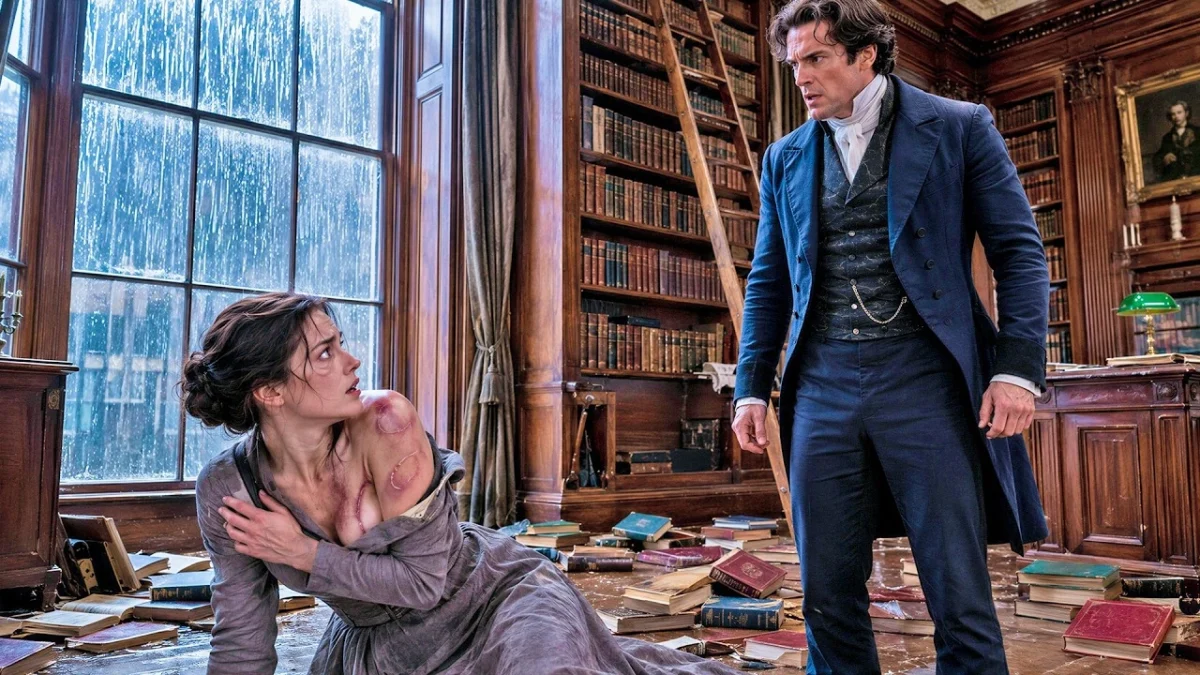
SOMETHING SHIFTED INSIDE HIM WHEN HE SAW HER PAINFUL MARKS
He thought he knew every type of ruin London had to offer. He had seen gambling debts destroy ancient families and whispered scandals burn pristine reputations to ash.
But when the drab silent woman in his library reached for a slipping ledger, her high collar tore.
The pale skin of her shoulder was a brutal tapestry of faded silver lines and angry fresh bruising.
In that fraction of a second, a man who had sworn off caring felt something violent and unyielding snap awake in his chest.
The library of the Ashdown estate smelled of damp wool, decaying leather, and the sour tang of old secrets.
Rain lashed against the tall windows, blurring the London streets into a gray, weeping smear.
Benedict Ashdown sat in a wing back chair by the unlit hearth. A glass of lukewarm scotch rested on his knee.
He was 32, wealthy enough to be left alone, and cynical enough to prefer it that way.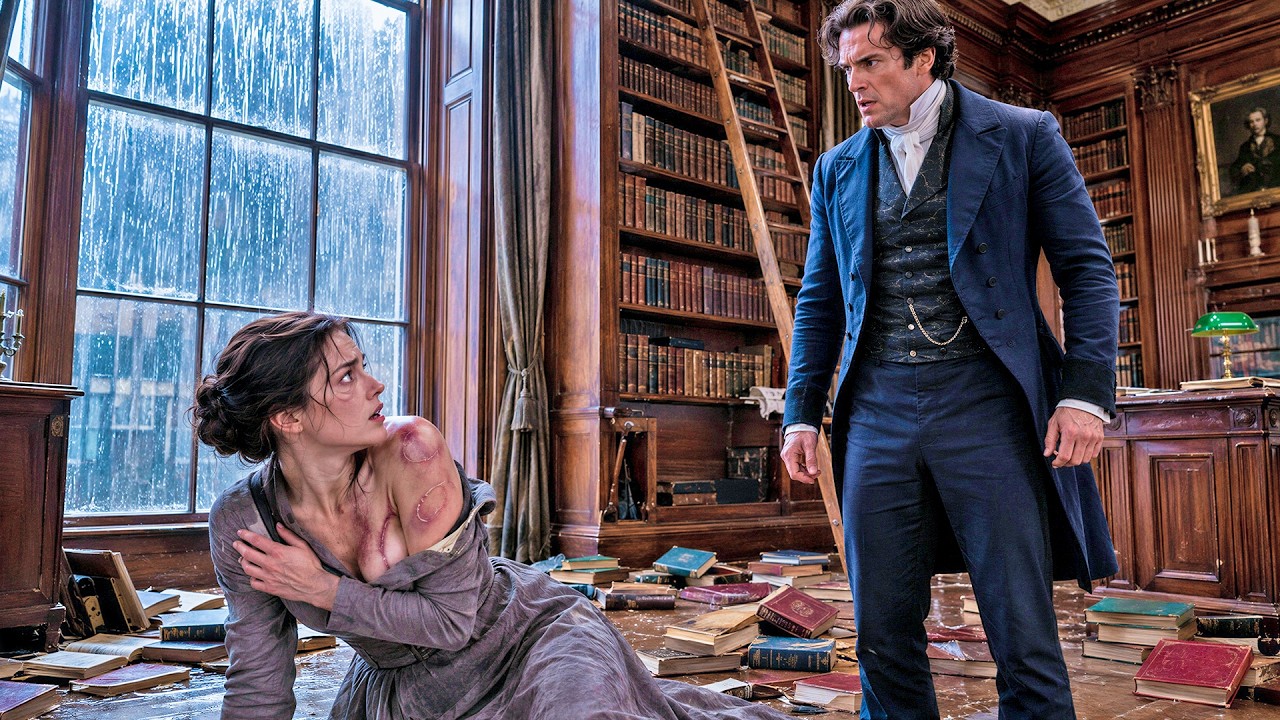
He watched her. Her name was Josephine Witmore. She had been in his house for 3 weeks, hired by his solicitor to catalog the disastrous mountain of ledgers, maps, and journals his late father had hoarded.
She was a woman seemingly constructed of shadows and starch. She stood by the mahogany tables, head bowed over a stack of yellowed correspondence.
She wore a dress of heavy gray bombazine that looked suffocating in the humid August heat.
Its collar was buttoned tightly to the very base of her chin. Her cuffs were pinned firmly at her wrists.
She moved with a strange economical grace. No wasted gestures, no sudden turns. Benedict took a sip of his scotch.
It burned the back of his throat. You have been on that same stack of letters for 2 hours, Miss Witmore.
My father was a fool, but he was rarely a compelling writer. What could possibly hold your attention?
Josephine didn’t jump. She simply paused. She laid her pen down parallel to the inkwell.
The precision of the movement grated on him. Everything about her was too controlled. “I am cross-referencing his debts from the year 1810, my lord,” she said.
Her voice was flat, carrying the grally texture of someone who rarely spoke. “There are discrepancies between his personal notes and the bank drafts.
Leave it.” Benedict set his glass on the side table. The crystal clicked sharply against the wood.
The man is de@d. The debts are paid. I hired you to organize the library, not to conduct an autopsy on his financial failures.
As you wish. She picked up the letters, perfectly aligning their edges, and moved them to a designated pile on her left.
She did not look at him. She never looked at him. It annoyed him. Women in Benedict’s world usually fell into two categories.
Those who wanted his title and those who wanted his money. They flirted, they schemed, they demanded.
Josephine Witmore treated him like a piece of furniture. A somewhat irritating armchair that occasionally spoke.
He stood. He was a tall man, broadshouldered and restless. He paced toward the long windows, hands shoved deep into his pockets.
Do you ever remove that jacket, Miss Whitmore? The air in here is thick as soup.
You must be boiling. I am perfectly comfortable, my lord. You are persspiring. I assure you I am well.
Her tone was a locked door. Benedict turned to look at her. She had her back to the wall.
He had noticed this quirk early on. She never worked with her back to an open room.
If she had to move to a center table, she constantly shifted her weight. Her eyes darting toward the heavy oak doors, calculating distances.
She walked softly, toeto-heel, making no sound on the floorboards. She was hiding. That much was obvious.
The solicitor had found her in a boarding house in Cheapside, desperate for work, claiming a background in archiving for a deceased uncle.
Benedict hadn’t cared at the time. He just wanted the mess in the library cleared.
Now her presence was a puzzle that chipped away at his carefully cultivated boredom. “There is tea on the tray,” Benedict said, pointing to the silver cart near the door.
“Pour yourself a cup. That is an order, not a suggestion. You have been standing there since dawn.”
Josephine stiffened. A microscopic flinch, but he caught it. “Thank you, my lord. I am not thirsty.
Drink the tea, Miss Witmore.” She closed her eyes for a fraction of a second.
Defeat. She stepped away from the safety of the wall and crossed the room. Her posture was rigidly straight, her chin tucked down.
As she reached for the silver teapot, a sharp crack of thunder shook the window panes.
Josephine gasped, her hand jerked. The teapot clattered against the saucer, spilling scalding amber liquid across the tray and over the cuff of her gray sleeve.
“Damn it,” Benedict muttered, crossing the room in three long strides. He grabbed a linen napkin from the cart.
“Here, let me,” he reached for her arm to dab the boiling water from her sleeve.
The moment his fingers brushed the damp wool, Josephine recoiled violently. She threw herself backward.
Her hip struck the edge of the mahogany table. A stack of ledgers hit the floor with a heavy, dusty thud.
She didn’t seem to notice. She was breathing fast, her chest heaving, her eyes blown wide and dark with a terror, so absolute it stopped Benedict de@d in his tracks.
She stood pinned against the table, her hands clutching the edges of the wood behind her.
She looked at him as if he had drawn a knife. Benedict stood frozen, the linen napkin in his hand.
The silence in the library was sudden and heavy, broken only by the rain hitting the glass.
I I apologize, my lord, she whispered. Her voice shook. She swallowed hard, forcing the panic down, shoving it behind the flat, emotionless mask she usually wore.
It took a monumental effort. He watched the muscles in her throat work. I was startled by the thunder.
I will clean up the spill. She didn’t move. She was trembling. Benedict looked at his own hand, then at her.
He dropped the napkin onto the tray. He stepped back deliberately. One step, then another, giving her space.
Leave it, he said, his voice softer than it had been a moment ago. Grounded.
Low. The maids will see to it. Take the rest of the afternoon off, Miss Witmore.
I have not finished the I said, “Take the afternoon.” She didn’t argue. She skirted around the edge of the room, keeping a wide birth between them, and slipped out the door like a ghost.
Benedict watched the empty doorway for a long time. The smell of spilled salon tea mingled with the dust.
He didn’t know what kind of hell Josephine Witmore had crawled out of. But as he looked at the spot where she had stood, gripping the table for dear life, he realized he was going to find out.
A week passed. The sweltering August heat broke, leaving behind a sticky, oppressive humidity that hung over London like a damp rag.
In the library, the tension between them had settled into a fragile, unspoken truce. Benedict stopped pacing.
He stopped making sudden movements. He sat in his leather chair and read, or pretended to, while Josephine continued her methodical dissection of his father’s ruined estate.
She was currently perched halfway up the rolling oak ladder, reaching for a high shelf.
The top rows contained oversized folios, massive leatherbound architectural plans that weighed a stone each.
Benedict watched her over the top of his newspaper. She was reaching too high. “Those are too heavy for you to pull down from that angle,” Benedict said, his voice calm, pitched to carry without startling.
“I have it, my lord,” Josephine replied. She stretched higher, the hem of her gray dress lifted, revealing scuffed, practical boots.
Her fingers gripped the spine of a dark blue folio. She pulled. The book was wedged tight between two others.
She yanked harder. The folio gave way. Suddenly, the sheer weight of it pulled her forward.
The oak ladder groaned and shifted on its brass wheels. Josephine twisted, trying to regain her center of gravity.
But the heavy book slipped from her hands, crashing to the floor. She pitched backward into empty space.
Benedict was moving before she even screamed. He crossed the carpet in a blur of motion, throwing his arms out.
He caught her hard against his chest. The impact knocked the breath out of him, driving him backward a step.
They hit the floor together in a tangle of limbs, heavy wool, and crushed breath.
For a second, there was only the sharp pain in Benedict’s shoulder and the ringing in his ears.
Josephine scrambled off him instantly, fighting the fabric of her skirt, gasping for air. I’m sorry.
I’m so sorry. I Are you hurt? Benedict pushed himself up on one elbow. Miss Whitmore, stop her moving.
Are you injured? No, I am fine. I apologize. I lost my footing. I She was frantic, pulling at her clothes, trying to stand.
In her panic, her boot caught in the heavy hem of her dress. She stumbled as she threw her arm out to catch herself on a chair.
The tight shoulder seam of her gray bodice, already strained by the fall, gave way with a sickening, tearing sound.
The heavy bombazine ripped from the collarbone down to the bicep. The fabric fell away.
Benedict froze. Josephine gasped instantly, clapping a hand over her exposed shoulder. But she was a second too late.
He had already seen it. The skin of her left shoulder and upper arm was a ruin.
It was a chaotic map of cruelty. Pale raised welts years old, silvered and thick, crisscrossed her pale skin.
But worse, so much worse, were the newer marks. Dark, ugly blossoms of purple and yellow green bruising spread across her collarbone.
Near the joint of her shoulder, an angry circular burn stood out in stark relief.
The skin puckered and red. It was the shape of a signate ring, heated and pressed into flesh.
The air in the room vanished. Benedict felt a physical jolt in his chest. A sickening drop in his stomach, followed instantly by a surge of white, hot, blinding rage.
It tasted like copper on his tongue. Josephine was paralyzed, her hand covered what it could, her knuckles stark white.
She stared at him, her eyes wide, glassy with absolute terror. She wasn’t just frightened.
She was waiting for a blow. He saw it in the tight brace of her neck, the way she tucked her chin.
She expected him to hurt her. Benedict forced his hands to remain flat on the floor.
He did not reach for her. He knew if he moved quickly, she would shatter.
He stood up slowly, deliberately. He brushed the dust from his trousers. He kept his eyes fixed on her face, refusing to look at her shoulder again, affording her that small scrap of dignity.
“Who did this?” He asked. His voice didn’t sound like his own. “It was dangerously soft.
A razor blade wrapped in velvet.” Josephine backed away. Her back hit the bookshelves. She flinched at the impact.
I I tore my dress. I need to return to my room. Josephine. He had never used her Christian name.
It hung in the air between them, heavy and intimate. Who did this to you?
No one. It was an accident years ago. A fire. She was lying, stammering, her eyes darting towards the heavy oak doors.
“A fire does not leave the imprint of a signate ring,” Benedict said, taking one slow step toward her.
He stopped when her breath hitched. A fire does not leave fresh bruises on a collarbone.
Someone beat you recently. Please. It was a ragged whisper. A plea. Please, my lord, let me go to my room.
I will pack my things. I will leave tonight. You will not have to look at me.
The words struck him like physical blows. You will not have to look at me.
She thought she disgusted him. She thought this meant she was ruined. Offensive to his sensibilities.
The rage in Benedict shifted, deepening, hardening into something cold and permanent. He looked at this woman, this quiet, methodical woman who had spent 3 weeks carefully avoiding shadows, hiding her pain beneath suffocating wool.
He didn’t feel pity. Pity was useless. He felt an overwhelming violent urge to dismantle whoever had put that fear in her eyes.
Benedict took off his coat. Josephine flinched again, throwing her good arm up to block her face.
He stopped. He held the dark blue wool coat out, tossing it gently so it landed on the arm of the chair beside her.
“Put that on,” he said, his voice entirely devoid of anger. Now just a steady, unyielding calm.
The draft in the hallway is cold. She lowered her arm, staring at the coat.
Then she stared at him. Confusion wared with the panic in her eyes. “You are not leaving this house,” Benedict said.
He turned his back to her, looking out the window, giving her the privacy to cover herself.
“You are employed here. Your work is not finished. Go to your room, Miss Witmore.
Mrs. Oier Liri will bring you hot water and a needle for your dress. He heard the rustle of fabric.
He knew she was slipping his coat over her shoulders. It would swallow her hole.
“Why,” she whispered. Benedict kept his eyes on the rain sllicked glass. Because this house is entirely too quiet and you are the only one who can decipher my father’s terrible handwriting.
He paused. No one will enter your room. You have my word. Lock door if it brings you peace.
He heard her hesitant footsteps. Soft toe to heel. She paused at the door. He didn’t turn around until he heard the heavy latch click shut.
When she was gone, Benedict walked over to the mahogany table. He picked up his crystal scotch glass, closed his fist around it, and squeezed until the thick glass shattered, driving sharp shards into his palm.
He didn’t feel it. The blood on his hand was an inconvenience. Benedict wrapped a handkerchief around his palm, ignoring the sting as he walked through the quiet corridors of his estate.
Within the hour, a messenger boy was sprinting through the rain toward Mayfair, carrying a brief, urgent note to Felix Kavanaaugh.
Felix was a man who traded in whispers. While Benedict despised the ton and its minations, Felix swam through ballrooms and gentleman’s clubs like a shark, absorbing every piece of gossip, debt, and scandal London had to offer.
Felix arrived as the grandfather clock in the hall struck six. He was dripping wet, peeling off a ruined beaver hat and a soaked cape.
“Your note suggested murder, treason, or an empty wine cellar,” Felix said, striding into Benedict’s study.
He stopped, taking in his friend’s grim face, and the bloody rag wrapped around his right hand.
The humor vanished from Felix’s eyes. “Benedict, what happened?” “Sit down,” Benedict said.
He was standing by the fire. He had not changed his clothes. I need you to find someone.
A man. Felix sat in the leather chair, leaning forward, resting his elbows on his knees.
Name? I don’t have it. Benedict paced in front of the hearth, the fire light catchings to the sharp angles of his jaw.
I have a woman in this house, Josephine Witmore. She was hired to archive the library.
Today there was an accident. I saw her shoulder. Benedict stopped pacing. He looked at Felix.
The memory of the puckered burn and the livid bruising flared in his mind. She has been beaten, Felix, repeatedly, systematically.
There is a burn mark from a heavy signate ring on her arm, and she is terrified of her own shadow.
Felix’s brow furrowed. Witmore. The name doesn’t ring immediate alarm bells. A husband perhaps, but she claimed to the solicitor that she archived for an uncle who recently passed.
I need you to dig. Start in Cheapside where she was lodging. Find out who she ran from.
Find out who owns a signate ring that he uses as a branding iron. If she’s a runaway wife, Benedict, legally she belongs to him.
Legally, he can rot in a ditch, Benedict said, his voice dropping to a grally low.
“She is under my roof. I want to know who is hunting her. I will find him,” Felix promised quietly.
He stood, “And when I do, just bring me the name. I will handle the rest.”
After Felix left, Benedict walked upstairs. The house was silent. He paused at the end of the third floor corridor.
Josephine’s door was shut. He stood there for a long moment, listening. No crying, just silence.
He reached out and lightly pressed his good hand against the wood of the door, a silent sentry before turning away.
The next morning, Josephine didn’t come down to the library. Benedict did not summon her.
Instead, he called for Mrs. Oly, his formidable housekeeper. Miss Witmore is unwell, Benedict told the older woman.
Move her from the attic room to the blue guest chamber on the second floor.
It has better light and a stronger lock on the door. Mrs. Olirri’s eyes widened slightly, but she knew better than to question the Vikunt’s tone.
Yes, my lord. Shall I have her meals brought up? Yes, meat, eggs, rich broth.
She is too thin. And Mrs. So Larry, my lord, she is not to be startled.
Tell the maids to knock loudly before entering and wait for her permission. If a man comes to this house asking for her, the footmen are to bar the door and fetch me immediately.
Understood? Perfectly, my lord. It took two days for Josephine to emerge. Benedict was in the library attempting to read a report on his textile mills in Manchester, though his eyes hadn’t moved past the first paragraph in an hour.
The heavy oak doors creaked open. He didn’t look up immediately. He didn’t want to spook her.
“Good morning, Miss Whitmore,” he said to the page. “Good morning, my lord.” He finally looked at her.
She was wearing a different dress, a dark navy blue, similarly severe, buttoned to the chin.
She looked paler than usual, her eyes bruised with lack of sleep, but her jaw was set.
She held his heavy wool coat folded over her good arm. She walked toward his desk and laid the coat down gently.
I had it brushed and pressed. My lord, thank you for the loan. Keep it.
I have no need of it now. My dress is repaired. I said, “Keep it,” Benedict repeated, closing his report.
He looked her in the eye. It was the first time she hadn’t immediately looked away.
There was defiance in her, buried deep under the layers of fear. It sparked something fierce and bright in his chest.
“You may use it as a blanket. The blue room gets cold in the autumn,” Josephine stiffened.
Mrs. Liri moved my things. I do not understand, my lord. I damaged your property.
I dropped your books. I caused a scene. You should have dismissed me without a character.
Do you want to be dismissed? No. The word was quick, desperate. She clamped her mouth shut immediately after.
Benedict leaned back in his chair. Then you will stay. The cataloging is far from finished.
However, we are making some changes. He stood up and walked over to the mahogany tables where she usually worked.
He dragged one of the heavy velvetbacked chairs from the corner and placed it right at the edge of the table facing the door.
You will sit here, Benedict said. Your back will be to the wall. You will have a clear line of sight to the hallway.
No one can approach you without you seeing them first. Josephine stared at the chair.
Her throat bobbed as she swallowed. She understood exactly what he was doing. He was building her a fortress inside his house.
“I I prefer to stand,” she lied, her voice cracking. “Sit, Josephine.” She walked slowly to the chair.
She sat down. The solid wall was immediately against her back. The open doors were in front of her.
For the first time since she had arrived at the Ashdown estate, her shoulders dropped a fraction of an inch.
Benedict returned to his desk, putting a wide, safe expanse of carpet between them. He opened his report again.
If the books are too high, use a hook to pull them down, or ask me, “If you spill tea, leave it on the floor.
I employ a dozen people to clean floors. I do not employ them to watch you panic over a stained rug.”
Silence stretched across the room. It wasn’t the cold, guarded silence of the past 3 weeks.
It was thick, fragile, and heavy with unspoken things. “Why are you doing this?” She asked softly.
“Benedict didn’t look up from his paper.” “Because, Miss Witmore, I have spent my life dealing with cowards and thieves.
It is a rare privilege to sit in a room with a survivor. Now tell me about the discrepancies in the 1810 ledgers.
Across the room, Josephine let out a long shaky breath. It sounded like a dam breaking.
She reached for her pen, perfectly aligning it with the inkwell, but this time her hands weren’t trembling.
September swept into London, dragging a bitter chill that stripped the leaves from the oaks in the courtyard.
Inside the library, a massive fire roared in the hearth. Benedict had ordered it lit before dawn.
Josephine sat at her designated table. Her back remained to the wall. The heavy blue wool coat hung over the back of her chair, a permanent fixture.
She had not worn it again, but she liked it there, a barrier, a silent guard dog woven from worsted yarn.
Their days had fallen into a rhythm. It was a quiet, meticulous dance of two people who preferred the company of dusty paper to the clamor of high society.
Benedict handled his estate correspondence. Josephine dismantled the financial ruin his father had left behind in the ledgers.
She was brilliant. That was the thing that caught Benedict offguard. Underneath the paralyzing fear and the severe bombazine dresses lay a mind that worked like a steel trap.
My lord, she said one afternoon. The fire snapped, sending a shower of orange sparks up the chimney.
Benedict did not look up from his letter. Miss Witmore, your father did not lose £3,000 to the farro tables in the winter of 1812.
Benedict paused. He set his pen in its brass stand. I assure you he did.
I remember the shouting matches with the bank manager. He lost 1,000, Josephine corrected, her voice steady, carrying the quiet authority of someone looking at incontrovertible proof.
The other 2,000 were funneled into a shipping venture out of Bristol. A venture managed by a Mr.
Edwin Cross. The ship sank in a storm off the coast of Spain. Your father falsified the gambling debts to cover the bad investment so his creditors would not seize his properties.
Benedict stared at her. He lied about being a degenerate gambler to hide the fact that he was an incompetent investor.
It appears so. Yes. She tapped a pale finger against the edge of a faded manifest.
Society expects a V account to lose money at cards. It does not forgive him for sinking his fortune into a rotting hull.
A short, harsh laugh punched its way out of Benedict’s chest. It was a cynical, ugly sound, but it was genuine.
God. The absolute vanity of the man. Josephine looked at him. For a moment, the mask slipped.
The tight defensive lines around her mouth softened. The corners of her lips twitched, fighting an upward pull.
It wasn’t a full smile, but it was a crack in the ice. It transformed her face, bringing a sudden, arresting warmth to her sharp cheekbones and dark eyes.
Benedict felt his pulse stutter. He leaned back in his chair, keeping his movements slow.
“You find my family’s financial ruin amusing, Miss Witmore. I find your father’s pride illogical.”
She replied softly. She looked back down at the ledger, the moment of levity passing.
But the room felt different, lighter. She was eating now. Mrs. Olirri’s heavy broths and roasted meats had begun to fill out the hollows of her cheeks.
She still jumped if a door slammed somewhere in the house, but she no longer hugged the walls when she walked.
When she reached for high shelves, she used the brass hook he had left. Conspicuously on the table.
She trusted the room. She was beginning to trust him. Late that evening, after Josephine had retired to the blue guest chamber, the heavy brass knocker on the front door echoed through the quiet house.
Benedict was in his study, pouring a glass of scotch. He didn’t shatter the glass this time.
He drank it neat, letting the burn anchor him. The study door opened and Felix Kavanaaugh slipped inside.
He looked tired. The sharp predatory edge he usually carried through London’s ballrooms was blunted by exhaustion.
You took your time, Benedict said, pulling out a second glass. Felix tossed his leather gloves onto the desk.
You asked me to find a ghost, Benedict. Ghosts do not leave forwarding addresses. He took the glass offered to him and drained it in one swallow.
But monsters leave trails. Benedict’s grip tightened on the crystal decanter. “Tell me, her name is not Josephine Witmore,” Felix said quietly.
He pulled a folded piece of parchment from his inner coat pocket and laid it flat on the desk.
“It is Josephine Graves. She is the wife of Baron Victor Graves.” Benedict stared at the parchment.
It was a marriage certificate, a copy pulled from a parish registry in Surrey. Graves, the name tasted like ash.
He is a minor baron with a major fortune in iron works, Felix explained, leaning over the desk.
He rarely comes to London. He prefers his estate in the north. The man has a reputation, Benedict.
Ugly whispers. Servants who leave in the middle of the night. Dogs that disappear. His first wife died falling down a flight of stairs.
Josephine is his second. Benedict closed his eyes. The puckered circular burn. The livid bruising.
She disappeared from his estate two months ago. Felix continued. Graves has been quietly turning the underworld inside out, looking for her.
He hasn’t gone to the magistrates. He doesn’t want the law involved. He wants her back.
Quietly. He has hired men. He isn’t getting her back. Benedict’s voice was a low, flat rasp.
Felix sighed, running a hand through his damp hair. Benedict, listen to me. Graves is not a debt collector you can buy off.
He is a violent, possessive man who views his wife as property. Legally, she is.
If he finds out she is here, he can walk through your front door with the constabularary and drag her out by her hair.
And there is not a damn thing the law will do to stop him. Let him try, Benedict said.
He opened his eyes. They were entirely devoid of warmth. I will bury him in my courtyard before I let him touch her.
You are a Vic count. You cannot start murdering baronss in Mayfair. Watch me. Felix looked at his friend.
He saw the immovable, terrifying stillness in Benedict’s posture. Felix picked up his gloves. I will keep my ears to the ground.
If Graves’s men get close to London, I will send word. Do that, Benedict said.
When Felix left, Benedict did not go to sleep. He sat in the dark for a long time, listening to the wind rattle the glass.
The following morning, Benedict did not sit at his desk. When Josephine entered the library, carrying a fresh stack of correspondence.
He was standing by the fire, watching the flame. She stopped in the doorway. She was incredibly attuned to his moods.
It was a survival instinct forged in a very different, very violent house. She sensed the shift in the air immediately.
The careful, easy silence of the past few weeks was gone. My lord, she asked, her voice cautious.
“Close the doors, Josephine,” she did. The heavy oak shut with a solid click. She remained by the door, her hands clutching the letters to her chest like a shield.
Benedict turned around. He looked at her. He saw the way she braced her shoulders, preparing for a blow.
He hated that he was the one putting that look back on her face. “Sit down,” he said softly.
She walked to her chair by the wall. “She did not take her eyes off him.
Benedict stayed by the fire. He needed to keep his distance. My solicitor hired a woman named Josephine Witmore to organize this library.
He told me she was a spinster from Cheapside, grieving an uncle. Josephine stopped breathing.
The letters in her hands crumpled slightly under her grip. Yesterday, Benedict continued, keeping his voice strictly level, bleeding every ounce of anger out of it.
I received information that there is no Joseph in Witmore, but there is a Joseph in graves, and she is currently being hunted by a man who uses his signate ring to burn his property.
The color drained out of her face so fast, Benedict thought she might faint. Her eyes widened, the dark pupils swallowing the irises.
Panic, raw and absolute, seized her throat. She sprang up from the chair, the letters scattered across the mahogany table.
She didn’t speak, she just moved. She scrambled toward the heavy oak doors, her boots sliding on the Persian rug.
Josephine, stop. Benedict didn’t move toward her. He didn’t raise his voice. She grabbed the brass handle of the door, yanking it open.
If you run out that door, you have nowhere to go, Benedict said. The word struck her back hard and true.
She froze in the open doorway. Her shoulders shook violently. She was a bird caught in a snare, looking out into the cold, gray hallway.
She had a few shillings saved from her wages. She had no carriage, no protection.
Benedict took one slow step forward. Close the door. She let out a dry, ragged sob.
She pushed the heavy door shut, leaning her forehead against the wood. Her knuckles were white on the brass handle.
“He found me,” she whispered to the door. “Oh, God, he found me. He has not found you.”
“Benedict kept his distance.” “I found out who you are because I had someone look.”
“Graves does not know you are here.” “No one knows.” She turned slowly, keeping her back pressed against the wood.
Tears tracked silently down her pale cheeks. You don’t understand what he is. He is not a man.
He is a sickness. If he knows you are hiding me, he will destroy you.
He will burn this house to the foundation. Let him try to strike a match.
He will kill you. Her voice cracked, rising in desperation. Josephine. Benedict took another step.
Look at me. She squeezed her eyes shut, shaking her head. “Look at me.” She opened her eyes.
They were red- rimmed and hollow with a terror he could barely comprehend. “I am 32 years old,” Benedict said, his voice dropping into a register of cold, absolute certainty.
“I hold a title that is older than the dirt on Graves’s estate. I have more money than God, and I have absolutely nothing to lose.
I have been bored, angry, and useless for the better part of a decade. He took another step, stopping just 10 ft away.
Victor Graves is a coward who tortures women behind closed doors. If he comes to this house, I will break him into pieces so small they will fit in a snuff box.
Do you understand me? Josephine stared at him. The sheer quiet violence in his tone was staggering.
It wasn’t the volatile explosive rage she was used to. It was calculated. It was cold iron.
“You are dismissing me,” she stammered, trying to find the trap. “You know who I am.
I am married woman. I am a runaway. I am a scandal. You must throw me out.
I am not throwing you out,” Benedict said. He finally walked over to his desk.
He picked up the heavy iron poker from the fireplace stand and calmly set it on the mahogany table right next to her neat stack of ledgers.
I am telling you to lock your door at night. I am telling you to eat your dinner.
And I am telling you that if a shadow crosses that threshold, it will have to go through me first.
He looked at her. Now sit down and fix my father’s catastrophic accounts. Josephine stood against the door for a full minute.
The silence in the library was deafening. She looked at the iron poker on the table.
She looked at Benedict, who had already sat down at his desk and opened a book, pretending to read.
Slowly, her breathing steadied. She pushed herself off the door. She walked back to her chair by the wall.
She pulled the blue wool coat a little closer around the back of the seat.
She sat down. She picked up a crumbled letter, smoothed it out flat, and dipped her pen in the ink.
He lost another 500 on a terrible bet concerning a horse race in York, she said.
Her voice was raspy, trembling, but it held. Benedict didn’t look up from his book.
Of course he did. The man was an idiot. October brought frost that coated the windows in jagged crystalline patterns.
The library was a fortress of warmth and fire light. Outside its heavy oak doors, however, the real world was beginning to press in.
It happened on a Tuesday. Josephine was on the top rung of the oak ladder.
She was reaching for a box of architectural drafts, using the brass hook with practiced ease.
Benedict was at his desk drafting a letter to his mill manager in Manchester. The heavy doors opened without a knock.
Josephine froze on the ladder. Benedict dropped his pen. It was Mrs. Olirri. The housekeeper’s face was drawn tight, her lips pressed into a thin, bloodless line.
She did not look at Josephine. She looked straight at Benedict. “My lord,” she said, her voice strained.
There is a gentleman in the foyer. He is demanding an audience. Benedict stood up slowly.
Demanding? Yes, my lord. He pushed past the footman. He claims he has legal business regarding a fugitive.
Josephine made a sound. It wasn’t a word. It was a small, high-pitched gasp of pure agony.
The box of drafts slipped from her fingers, clattering onto the top shelf. She scrambled down the ladder, her boots slipping on the rungs.
She hit the floor and immediately backed into the corner, wedging herself between a towering bookshelf and the heavy velvet drapes.
She pulled her knees up, pressing her hands over her mouth to muffle her breathing.
The ghost was back. In a matter of seconds, three months of healing vanished. Benedict felt the rage hit him like a physical blow to the sternum.
He didn’t look at Josephin. If he looked at her huddled in the corner, he would kill the man in the foyer with his bare hands, and that would serve no one.
“Mrs. Olirri,” Benedict said, his voice deathly calm. “Take Miss Whitmore into my private study.
Lock the inner door. Do not come out until I tell you.” “Yes, my lord.”
Mrs. Olirri moved quickly. She went to the corner, shielding Josephine with her body, murmuring low, soothing words.
She coaxed the terrified woman out of the corner and hurried her through the disguised side door that led to Benedict’s private rooms.
The lock clicked shut. Benedict straightened his waist coat. He walked out of the library and down the grand staircase.
Standing in the marble foyer was a man who looked entirely out of place among the gilded mirrors and silk wallpaper.
He was heavily built, wearing a highcoared coat that had seen better days. His nose had been broken more than once.
He looked like a tavern brawler squeezed into a solicitor’s suit. Two of Benedict’s footmen were flanking him, looking nervous.
Lord Ashdown, the man said, offering a mocking bow. Apologies for the intrusion. My name is Lorson.
Lawson. I represent baron graves. You represent a baron, yet you lack the manners of a stable boy, Benedict said, descending the final steps.
He did not offer his hand. He stopped 10 ft away. “You forced your way into my home, Mr.
Lawson. Give me one reason why I shouldn’t have my men throw you through the glass of the front door.”
Lorson smirked. Because I am here on a lawful errand. My client’s wife, Lady Josephine Graves, has absconded.
We have reason to believe she is hiding in Mayfair, earning wages under false pretenses.
Some say a woman matching her drab description, was seen purchasing stationery near this very square.
Benedict’s face remained a mask of bored aristocratic disdain. And you believe I am harboring runaway wives in my spare bedrooms?
I believe a man with a library as massive as yours might recently have hired a mousy little archavist.
Lawson took a step forward. I have a magistrate’s rit, my lord. It grants me the right to reclaim Lord Graves’s property.
Hand her over. Over and I’ll be on my way. Benedict looked at the man.
He looked at the heavy boots tracking mud onto the marble. He looked at the greasy collar of his coat.
“You are mistaken, Mr. Lawson,” Benedict said smoothly. “I employ an elderly man named Higgins to manage my library.
He is currently suffering from gout. Would you like to carry him back to Baron Graves?”
Lawson’s smile vanished. “Don’t play games with me, Ashdown. I know she’s here.” “You know nothing,” Benedict said.
His voice dropping the board veneer. It turned sharp, lethal. But let me tell you what I know.
You are John Lawson. You run a gambling den in Suffukk. You currently owe £2,000 to a man named Silus.
No, excuse me. A man named Corkeran. Corkeran is an aggressive creditor. He breaks kneecaps.
Lorson swallowed hard. The swagger faltered. I bought your debt from Corkran yesterday morning. Benedict lied flawlessly.
He hadn’t, but he had the funds to do it before lunch. Which means you owe me £2,000.
Payable immediately. Lawson went pale. You’re bluffing. Test me. Benedict took one step forward. The sheer predatory dominance in his posture made Lawson take a step back.
If you ever cross my threshold again, if you ever speak my name or the name of anyone in my employ, I will call the debt in.
I will ruin you. And then I will have Corkran break both of your legs.
Benedict looked at his footmen. Throw this piece of filth onto the street. If he resists, break his nose again.
Lorson didn’t resist. He practically tripped over his own boots as the footman grabbed him by the arms and shoved him out the front door into the freezing morning air.
The heavy door slammed shut. Benedict stood in the quiet foyer for a moment. He drew a deep breath, smoothing the anger from his features.
He turned and walked back upstairs. He bypassed the library and went straight to his private study.
He unlocked the door. Mrs. Olirri was standing by the window. Josephine was sitting in a heavy leather chair, her knees still pulled to her chest, rocking slightly.
Her eyes were fixed on the door, wide and unblinking. “He is gone,” Benedict said quietly.
“Mrs. Olirri gave a curt nod and slipped out of the room, leaving them alone.”
Josephine didn’t stop rocking. “He will come back. He knows. He doesn’t know. He was guessing.”
Benedict walked slowly across the room. He didn’t tower over her. He crouched down in front of the chair, putting himself at her eye level.
He is a hired thug. I sent him packing. He will not return. Graves will send someone else, she whispered, a tear spilling over her lashes.
He won’t stop. You don’t know him. You don’t know what he does in the dark.
Then we won’t let him in the dark. She looked at him. Really looked at him.
She saw the iron resolve in his jaw. She saw a man who had just lied to a dangerous thug without blinking.
She saw a shield. Slowly, her rocking stopped. She unclasped her arms from around her knees.
Her hands were shaking violently. Benedict did something he had sworn not to do. He reached out.
He didn’t grab her. He placed his large, warm hand, palm up on the armrest of the chair, inches from her trembling fingers.
An invitation, an offer. Josephine stared at his hand. It was strong, capable of violence, but it was entirely still.
She took a shaky breath. Slowly, agonizingly slowly, she reached out. Her cold, trembling fingers brushed against his palm.
He didn’t close his hand. He let her dictate the contact. She rested her fingers against his, grounding herself in his warmth.
“You are safe here, Josephine,” Benedict whispered. For the first time in her life, she almost believed it.
November descended on Mayfair with a biting wet cold that seeped through the window panes.
Inside the library, the fire burned constantly. The atmosphere had shifted. The fragile, terrified silence was gone, replaced by a low, simmering, focused energy.
Josephine no longer sat against the wall. She had moved her chair to the side of Benedict’s massive mahogany desk.
It was a pragmatic choice. It allowed them to share the scattered maps and financial reports without constantly crossing the room.
But it was also a statement. She was no longer hiding. Benedict was reviewing a property deed when a piece of parchment slid across the polished wood, stopping inches from his inkwell.
He looked at it. It was a list of names, dates, and shipping tonnages written in Josephine’s precise angular hand.
“What is this?” Benedict asked. Josephine set her pen down. “It is a list of Victor’s illegal tariffs.
The iron foundaries in the north are heavily taxed. Victor bypassed the crown’s levies by misreporting the weight of his shipments leaving Liverpool.
He has been defrauding the customs office for 5 years. Benedict stared at the parchment.
How do you know this? Because he is arrogant, she said. The tremor that usually accompanied any mention of her husband was entirely absent.
Her voice was flat and cold. He believed a woman’s mind was entirely incapable of comprehending mathematics.
He would leave his private ledgers open on the desk in his study while he drank himself to sleep.
I read them. Benedict leaned back in his chair. He looked at the woman sitting beside him.
The severe buttoned to the chin dresses had given way to slightly softer wools in deep greens and plums.
The heavy blue coat still hung on her chair, but she rarely needed it. She was eating.
She was sleeping. She was quietly and methodically building a guillotine for the man who had tortured her.
Defrauding the crown is a serious offense, Benedict murmured, his eyes tracing the neat columns of figures.
If the ex-jecker gets a hold of this, they will freeze his assets. They will seize his foundaries.
He will be utterly bankrupted before the courts even convene. I know. Josephine met his gaze.
Her dark eyes were perfectly steady. Your friend, Felix Kavanaaugh. He knows the right people in the excheer.
Give him the list. Benedict felt a slow, dark smile pull at the corner of his mouth.
It wasn’t a nice smile. It was the expression of a man watching a trap snap shut.
“You want to ruin him? I want him to have nothing.” Josephine corrected softly. “Men like Victor draw their power from their wealth.
They buy the silence of their servants. They buy the complicity of the local magistrates.
Strip the money away.” And he is just a loud, violent man in an empty house.
Benedict picked up the parchment. He folded it carefully and slid it into his breast pocket.
I will send for Felix immediately. The retaliation was swift and invisible. Felix took the information to a contact deep within the customs office.
A quiet audit was triggered. Warrants were issued in Liverpool. Within 3 weeks, the financial arteries sustaining Baron Victor Graves were severed.
News trickled back to Ashdown House through Felix’s network. Graves’s creditors, smelling blood in the water, began calling in his debts.
His foreman walked off the job. His northern estate was placed under lean by the local bank.
They were bleeding him dry, and Graves had absolutely no idea where the knife had come from.
As December approached, the work in the library neared completion. Benedict’s father’s disastrous estate had been meticulously untangled, categorized, and filed away.
The debts were settled. The profitable ventures were isolated. Josephine had done the impossible. But as the piles of ledgers shrank, a new unspoken tension grew between them.
It happened late one evening. The library was lit only by the dying fire and a single oil lamp on the desk.
They were sorting the final box of personal correspondence. Benedict reached for a stack of letters just as Josephine did.
Their hands collided. It wasn’t a brush of fingertips. It was a solid, undeniable point of contact.
Benedict immediately throws, instinctively, preparing for her to flinch, to pull away, to apologize. She didn’t move.
Her hand rested against his. Her skin was warm. He looked at her. The lamplight caught the sharp angle of her jaw and the deep, fathomless dark of her eyes.
She was looking back at him. Her breathing had hitched, but not in fear. The silence in the room suddenly felt incredibly heavy, charged with a current that had nothing to do with ledgers or survival.
Benedict slowly turned his hand over, resting his palm flat on the desk, offering the same silent invitation he had given her in his private study months ago.
Josephine looked at his hand. Then, with agonizing slowness, she unccurled her fingers and slipped her hand into his.
Her grip was strong. Benedict closed his fingers around hers, feeling the steady beat of her pulse against his thumb.
He didn’t say a word. He didn’t want to break the spell. He just held her hand in the quiet, fire lit dark, letting the absolute certainty of the gesture settle into his bones.
He was never letting her go. The hammerfell 2 days before Christmas. London was buried under a thick blanket of gray snow.
The streets were treacherous, slick with ice and mud. Benedict was in the foyer, shrugging into a heavy wool overcoat, preparing to meet Felix at a nearby club to finalize the last of the customs reports.
A loud, violent pounding struck the front door. It wasn’t the measured knock of a caller.
It was the desperate hammering of a man who intended to break the wood. Before the footman could unlatch the lock, the door was shoved inward.
Victor Graves stumbled into the marble foyer. He was a massive man, broadshouldered and thick-necked, but he looked completely unraveled.
His expensive overcoat was stained with snow and carriage grease. His eyes were bloodshot, entirely wild.
The arrogance that usually carried him had been stripped away, replaced by the cornered, frantic panic of a ruined man.
He held a heavy brasshandled walking stick in his right hand. Benedict didn’t flinch. He signaled sharply with his left hand, and his footman stepped back, moving to secure the hallway doors.
“Where is she?” Graves roared, his voice bouncing off the high ceilings. He pointed the walking stick at Benedict.
“I know she is here,” Lorson told me before he fled the city. “You have my wife,” Benedict finished buttoning his overcoat.
His movements were slow, entirely relaxed. “You are trespassing, Baron Graves. It is a terrible habit for a man who is already in such dire legal peril.
Don’t play your games with me. Graves lunged forward, the walking stick raised. Benedict didn’t retreat.
He simply shifted his weight. As Graves swung the heavy stick downward, Benedict stepped inside the ark of the swing.
He brought his left forearm up, brutally blocking Graves’s wrist. The crack of bone on bone echoed in the foyer.
Graves gasped, dropping the stick. It clattered against the marble floor. Before the baron could recover, Benedict grabbed the lapels of Graves’s ruined coat, twisted his grip, and slammed the heavier man backward.
Graves hit the carved oak door frame with a sickening thud. Benedict pinned him there.
The cynical, bored Vic count was gone. The man holding graves by the throat was cold, violent, and entirely ruthless.
“Keep your voice down,” Benedict said. His tone was a razor sliding against skin. This is a quiet house.
Graves grabbed desperately at Benedict’s wrists, his face turning an ugly shade of purple. “You, you bankrupted me,” he choked out.
“The customs office, the leans. It was you. It was me, Benedict confirmed, leaning in closer.
You owe the crown £40,000 in back tariffs. You owe the Bank of London another 20.
Your foundaries are locked. Your estate is seized. You are entirely completely ruined. I will kill you, Grave spat, though his eyes were rolling with panic.
You are going to prison, Victor, Benedict said smoothly, ignoring the threat. Or you are fleeing to the continent on a cargo ship tonight.
Those are your only options. If you stay in London, the crown prosecutors will arrest you by morning.
If you ever come near this house again, I will not bother with the magistrates.
I will simply drown you in the tempames. Graves stopped struggling. The sheer immovable certainty in Benedict’s eyes broke him.
He saw the truth. He was outmatched, outfunded, and out of time. “She is my wife,” Graves wheezed, a pathetic, grasping attempt at reclaiming power.
“She is a ghost,” Benedict said, his grip tightening just enough to cut off Graves’s air for three agonizing seconds.
“She died the moment you burned her. The woman sitting in my library owes you nothing.
Benedict let go. Graves collapsed against the doorframe, coughing violently, clutching his throat. He looked at Benedict, then at the two massive footmen who had quietly retrieved heavy iron fire pokers from the nearest hearth.
The baron scrambled backward, his boots slipping on the melted snow on the marble. He didn’t say another word.
He turned and stumbled out the open door, disappearing into the blinding white flurry of the London streets.
Benedict stood in the doorway, watching the snow bury Graves’s footprints. He took a slow, deep breath, letting the freezing air clear the copper taste of violence from his mouth.
He closed the door. He turned the heavy brass lock. He walked up the grand staircase.
He didn’t go to the club. He walked straight to the library. The heavy oak doors were open.
Josephine was standing by the desk. She was clutching a heavy brass paper weight in her right hand.
Her knuckles were stark white. She had heard the shouting. Benedict stopped in the doorway.
He looked at her. He saw the terror lingering in the edges of her eyes, fighting a desperate battle with the fierce, unyielding courage she had built over the last 5 months.
He’s gone,” Benedict said quietly. Josephine stared at him. She lowered the paper weight, setting it gently on the desk.
“He knows. He knows I am here. It doesn’t matter what he knows,” Benedict said, crossing the room.
“He stopped a few feet away from her. He is leaving the country. The crown issued the warrants this morning.
If he stays, he will rot in New Gate. If he runs, he will he will never have the money to return.
He is erased, Josephine. She took a shaky breath. The magnitude of the word seemed to crash over her all at once.
The invisible chain that had dragged behind her for years finally, irrevocably snapped. She wasn’t being hunted anymore.
She was just here. She looked at the perfectly organized library, the neat stacks of ledgers, the dusted shelves.
“The work is finished,” she whispered. Her voice was incredibly small. “Your father’s estate is settled.
The archiving is done.” Benedict felt a sudden sharp panic flare in his chest. It was a far more terrifying feeling than facing Victor Graves.
“Yes, the contract is complete,” Josephine looked down at her hands. Then my employment here is over.
Yes, she nodded slowly. She didn’t cry, but the profound crushing sadness in her posture was a physical weight in the room.
She turned toward the chair to pick up the heavy blue wool coat. Leave the coat, Benedict said.
She stopped. She turned back to look at him. Benedict closed the remaining distance between them.
He didn’t touch her. He just stood in front of her, forcing her to look up, to meet his eyes.
Your employment is over, Benedict repeated, his voice dropping into a low, entirely grounded register.
You do not work for me anymore, Josephine. Which means I no longer have to keep my distance to protect your reputation.
Her breath hitched. Her dark eyes searched his face, looking for the catch. She had spent her entire life waiting for the trap to spring.
I am a married woman, she whispered, the words tasting like ash. Legally, I belong to a ghost.
Legally, you are a complication, Benedict agreed smoothly. Socially, you are a complete disaster. The ton would never accept you, and the scandal sheets would have a field day, Josephine flinched.
The words hurt, even if they were true. Which is why, Benedict continued, finally reaching out, letting his fingers lightly trace the edge of her jaw.
I’m selling this house, Josephine froze. What? I despise London. I despise the society. I have an estate in Cornwall.
It is built on a cliff. It is loud. It is isolated. And it has a library twice this size that is in desperate need of an archavist who doesn’t drop my books.
He stepped closer. The cynical board Vic count was entirely gone, replaced by a man who had finally found something worth giving a damn about.
Come with me, Benedict said. It wasn’t a command. It was a request. The first truly vulnerable thing he had ever asked of anyone.
We will live quietly. We will read terrible ledgers. And I will spend the rest of my life ensuring you never have to put your back to a wall again.
Josephine stared at him. The tears she had held back for 5 months finally broke, spilling silently down her cheeks.
She didn’t need to speak. She closed the final inch between them, pressing her forehead against his chest.
Benedict wrapped his arms around her. He held her firmly but carefully, mindful of the scars beneath the fabric.
But as she leaned into him, her hands sliding around his waist, holding him just as tightly, he realized she wasn’t fragile at all.
She was the strongest thing he had ever known. Two years later, the air smelled of sea salt and approaching rain.
The library of the Cornwall estate was a massive circular room with floor to-seeiling windows that looked out over the churning gray Atlantic.
There were no heavy velvet drapes to block the light. There were no dark corners to hide in.
Benedict sat in a worn leather armchair by the fire, a sleeping hound resting heavily across his boots.
He held a book in his lap, but he wasn’t reading. He was watching her.
Josephine stood by the tall windows looking out at the storm rolling in over the cliffs.
She was wearing a dress of soft, pale blue muslin. The severe suffocating collars were gone.
The neckline dipped, leaving her collarbone bare. The scars were still there. The silver lines and the faded puckered circle near her shoulder joint would never completely vanish.
They were a permanent map of a past life, but she didn’t cover them. When they first arrived in Cornwall, she had kept her high collars.
She had kept the heavy blue wool coat draped over her chair. But slowly, as the months turned into years, as the silence of the house proved it was safe.
The armor began to shed, she turned away from the window, catching him staring. A slow, brilliant smile broke across her face.
It reached all the way to her eyes, warming the sharp angles of her cheekbones.
She walked across the room, moving with an easy, uncalculated grace. She didn’t walk toe-to-toe anymore.
She made noise. She took up space. She stopped in front of his chair. “The roof in the West Wing is leaking again,” she announced, crossing her arms.
Benedict sighed, closing his book. I pay a man to fix the roof. You pay a man who is currently drunk at the village tavern.
Josephine corrected smoothly. Which means you will be climbing a ladder this afternoon. I am a vicount, Benedict grumbled, though he made no move to get up.
I do not climb ladders in the rain. Josephine leaned down, pressing a soft, lingering kiss to the corner of his mouth.
Her fingers brushed against the nape of his neck. “You will if you want your first additions to survive the night.”
Benedict caught her hand, pulling her down onto the arm of his chair. He wrapped his arm around her waist, anchoring her to him.
He looked at the pale, scarred skin of her shoulder. He didn’t feel rage anymore when he saw the marks.
He only felt a profound, overwhelming gratitude that she had survived long enough to find him.
“Fine,” Benedict murmured, pressing a kiss to the silvered skin of her collarbone. She didn’t flinch.
She leaned into the touch, her hand resting heavily in his hair. “I will fix the roof.”
“But you are auditing the estate accounts tonight.” “Deal,” she whispered, resting her head against his.
Outside the storm broke, rain lashing fiercely against the glass. But inside the library, the fire held steady, burning bright and warm against the dark.
Thank you for listening to this original historical romance drama. If you felt the emotional journey of Benedict and Josephine, please take a moment to click the like button below.
It truly helps support the channel and allows us to bring you more immersive, grounded stories.
Share this video with friends who appreciate a deeply human tale of survival, healing, and hard one love.
Don’t forget to subscribe and ring the notification bell so you never miss a new chapter.
Leave a comment letting us know your favorite moment from their story. Until next time, stay safe and keep listening.








