Single Dad Drove His CEO Home On Christmas—Her Mother Opened The Door And Froze
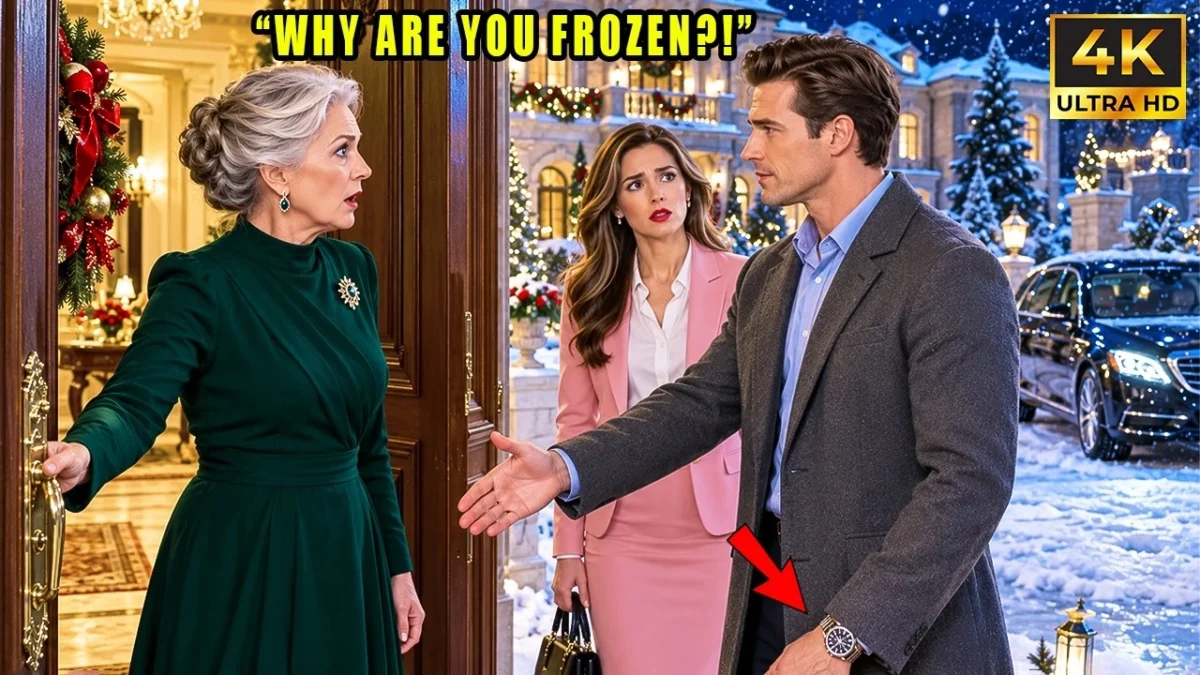
Single Dad Drove His CEO Home On Christmas—Her Mother Opened The Door And Froze
On Christmas Eve, I assumed the worst thing waiting for me was being turned into a driver by my own chief executive in front of the entire leadership team.
I was wrong. Almost an hour later, the sedan stopped in front of the Sterling estate, buried under fresh snow.
Celeste climbed the steps without a word of thanks. I only meant to turn the car around and go home to my daughter.
Then the tall front door swung open. An older woman stood under the amber light and looked straight past Celeste straight at me.
The glass in her hand tilted. Her face went white and she said my name.
The ballroom on the 40th floor smelled like pine and cold champagne. And I remember thinking that the company had spent more on the tree than it had spent that year on the ventilation retrofit I had requested twice.
I was standing at the back with a radio clipped to my belt because facilities always worked the holiday party rather than attended it.
Men in tailored charcoal suits drifted past me without registering that I existed, which suited me fine.
My name is Elias Vance. I was 42 years old and my job title was operations facility supervisor at Sterling Aeronautics.
I wore a gray jacket that had been good eight years earlier and a wristwatch older than that.
And I had made peace, or something close to peace, with being the least interesting man in a room full of people who believed they were the most interesting men alive.
Celeste Sterling took the small stage at a quarter 8. She was 37, the chief executive and the last living heir to a name that had been stamped into aircraft components for 60 years.
She spoke without notes, which impressed people, and she spoke about sacrifice, which impressed them more.
She said that Sterling had never been built by the comfortable. She said that every generation of the company had been carried on the backs of people who gave more than they were asked to give.
200 faces tilted upward and agreed with her. And the strange thing is that I agreed with her too, just not about who those people were.
Lenora Ashccraftoft found me during the applause. She was the chief legal officer, 45, and she had a talent for making a smile look like a filing.
She stopped beside me with a glass she had no intention of drinking, and said loud enough for the three directors nearest us that she had been curious about something.
She said she had seen my name on a weekend coverage request the previous month, declined.
She said she had always wondered what a facility supervisor did with his weekend that a contract renewal could not interrupt.
The director’s laugh, the particular laugh of men who are not sure what is funny but are certain who it is aimed at.
Celeste had come down from the stage by then, and she heard the tale of it.
She looked at me for perhaps two seconds. The way you look at a chair, you are deciding whether to move.
And then she said lightly that Sterling was not built by people who watched the clock at 5.
It landed the way she wanted. A few more laughs, warm and easy, and then the conversation moved on to the year-end numbers and whether the restructuring would close before the holidays.
I did not answer her. I had learned a long time ago that the only thing you truly control in a room like that is whether you hand somebody the reaction they came looking for.
What none of them knew is that I had stopped leaving at 5 for a reason with a name and a birthday.
My wife Diane had died 3 years and 4 months earlier in a hospital where I had also learned everything I needed to know about which hours of a life are actually scarce.
My daughter was 15. She was at that moment at home wrapping a present for me in paper she had bought with her own money and she was expecting me by 9.
I had made her exactly one promise after the funeral and the promise was not about ambition.
So I let Celeste have her line and I checked the temperature readout on my handheld and I went back to work.
20 minutes later the ballroom started to get warm. Not uncomfortable yet, but warm in the way that tells you something upstream has already failed.
The contracted crew opened the service panel in the corridor and began working through the sequence they had been trained on, checking the thermostat calls, then the zone dampers, then the controller logs.
I watched them for a while because it was not my system and not my night.
After 25 minutes, the room was genuinely hot. People were fanning themselves with cocktail napkins, and the young facilities manager, a kid named Witcomb, came looking for anyone with more gray hair than he had.
I looked at the panel for maybe 8 seconds. The supply fan was calling correctly, and the chilled water valve was showing open, which was exactly the problem because the readout was reporting a commanded position rather than an actual one.
I told him to stop trusting the screen and go put his hand on the valve stem in the mechanical room on 39 and if it had not moved to look for the linkage set screw because that particular actuator model had a habit of spinning free after a decade of thermal cycling.
He came back 11 minutes later with a look on his face that I have seen many times and have never enjoyed.
He asked me whether I had worked on this system before. I told him it was a long time ago and I went to find my coat.
The snow had changed while we were inside. It had gone from the pretty kind to the kind that closes bridges and the valet were standing under the awning with their hands in their sleeves.
Celeste’s private driver had called to say that the highway out of the western suburbs was down to one lane and he could not reach the building for at least 90 minutes.
I heard this secondhand the way I heard most things from a radio conversation I was not part of.
Then Lenora Ashccraftoft came through the lobby with her coat already on, saw me, and stopped.
She said that facilities had company vehicles. She asked whether Mr. Vance could drive. She asked it with the same pleasant precision she used when she asked whether a contract had been countersigned.
And I understood immediately that this was not a logistics problem she was solving. It was a demonstration.
It was the second half of the joke she had started upstairs and she was setting it up for an audience that had already proven willing to laugh.
Celeste did not ask whether it was convenient. That is the detail I kept turning over later because it was not cruelty exactly.
It was something flatter and more ordinary. She held out the key fob to the company sedan and she said two words, “Take me home.”
In her mind, I am certain she had solved a transportation problem using an available resource.
In the eyes of everyone standing in that lobby, a facility’s employee had just been converted into the chief executive’s driver on Christmas Eve, and they would all be telling it that way by Monday.
I took the key. I did not argue and I did not make the face that would have let them know they had landed a hit.
But before I walked out into the snow, I turned my wrist over and looked at my watch because I needed to know how far behind I was going to be.
And because looking at that watch was by then a reflex that had outlived its original meaning.
It was a steel field watch unfashionable. The crystal scratched near the six. Celeste glanced at it and saw nothing at all.
It would be another two hours before anyone in that family looked at it and understood exactly what it was.
The sedan was cold and the wipers could barely keep ahead of the snow. Celeste got into the back seat, which told me everything about how she had framed the arrangement in her own head.
And for the first nine miles, neither of us said a word. She worked her phone, typing with the fast, flat sound of someone answering people who are afraid of her.
I drove. The city gave way to the parkway, and the parkway gave way to a two-lane road where the plows had not been through since 8.
And eventually, the phone went dark, and there was nothing left for her to do except notice that she was in a small, warm box with a man she had publicly diminished an hour earlier.
She started the way people like her always start with a question dressed as a compliment.
She said she had pulled my file that afternoon before the party because Ashcraftoft had mentioned the weekend refusal.
She said the file was strange. 12 internal recommendations, four separate promotion tracks offered over 3 years and a declination on every single one.
She said she had assumed I was coasting. But coasting men do not get recommended 12 times.
So she asked me in a tone that was almost curious what exactly I thought I was doing with my career.
I told her there were things that mattered more than a title. I heard how it sounded even as I said it.
It is the sentence that unambitious people use as a shield and ambitious people use as a punchline.
And she took it as the second. She said with real conviction that people who say that are usually describing a decision they were afraid to make.
She said her father had slept at the plant in Hartsfield for 11 straight nights in the winter of the recall on a cot beside the line because he understood that a company does not survive on the people who go home.
The road was very quiet. I watched the snow come through the headlights and I said before I decided to say it that he had not been there every night.
I regretted it at once, not because it was untrue, but because it opened a door I had kept shut for 13 years, and I had opened it out of something as small as tiredness.
She turned her head in the mirror. I saw her stop being a passenger. She asked me how I could possibly know that, and there was an edge in it now, the edge of someone who has heard strangers claim intimacy with her father before and has learned to punish it.
I told her the plows would have us at her gate in 20 minutes and asked if she wanted the heat higher.
She let me change the subject, but she did not stop looking at me for a long time after that, and I could feel her rearranging something.
4 miles later, we came up over the rise on Old Meridian, and the road runs directly past the original campus, and there it was through the snow, low and dark and honest looking, with the original sign still lit.
Sterling building number four, 1961 construction, brick, singlestory test bays, the kind of building that no longer photographs well.
In an annual report, Celeste said almost conversationally that the building was in the restructuring package and would be sold in the first quarter and that the buyer intended to take the site down to the slab for a distribution facility.
I did not answer for longer than was comfortable. That is the only reason she noticed.
She asked me in a voice that had gone cold and precise whether there was a problem.
I said no. Then I said the only honest thing I had left, which was that I did not think her father would have liked it.
She said very quietly that I should not confuse having a badge with understanding her family.
She said the building was an asset with a carrying cost and a depreciation schedule and no operational value.
And that sentiment was the most expensive thing a company could keep on its books.
She said it the way you would discipline someone and she waited for me to apologize or argue because those were the only two responses her position had ever produced.
I did neither. I put the wipers on high and took the turn onto the estate road and the silence that followed was not a comfortable one.
If you had been in that car, you would have wanted me to say something to open my mouth and hand her the truth and watch her face change.
I understand that impulse, but I had signed my name to a piece of paper 13 years earlier, and I had built a quiet life on the far side of it, and I had a 15-year-old at home who did not need her father starting a war on Christmas Eve.
The Sterling estate sits behind a stone wall on 11 acres, and on that night every window was lit, and there were white lights strung along the whole length of the eaves, the kind of decorating that takes a crew 3 days.
I stopped under the portico. Celeste was already getting out before the car had fully settled, which I had expected, and then she remembered the gifts in the trunk, which she had not carried herself in some years.
I got out and opened the trunk and lifted the boxes, four of them wrapped by a store in identical silver paper.
She took two. She said, “Thank you.” In the way you say it to a door someone is holding.
And she started up the steps and I thought with genuine relief that in 90 seconds I would be back on the road and home by 11.
The front door opened before she reached it. Warm light came out across the snow on the steps, and with it a wave of sound from inside, a piano recording and voices somewhere deeper in the house.
A woman stood in the doorway in a dark green dress, 66 years old, silver hair pinned up, a glass of something amber in her right hand.
Maryanne Sterling, the founder’s widow. I had not seen her in 13 years and two months.
She looked at her daughter first and she smiled and she said something about the roads.
Then her eyes went past Celeste’s shoulder down the steps to the man standing at the open trunk of a company sedan with snow collecting on his shoulders.
She stopped, not a flinch, a full stop, the way a machine stops when the power is cut, and the glass in her hand tilted until the liquid touched the rim, and a little of it went over onto the stone.
She did not notice. She came down one step in house shoes into the snow and she said my first name as a question.
Celeste turned around so fast that one of the boxes slipped under her arm. I saw her look at her mother, then at me, then back, and I watched her try and fail to build any version of the world in which those two facts fit together.
I had no plan, so I said the only thing available, which was, “Good evening, Maryanne.”
Maryanne came down another step. She was looking at my left wrist. My sleeve had ridden up when I lifted the boxes, and the watch was showing steel and scratched and 30 years out of style.
Her face changed again, and this time it was not shock. It was something closer to grief.
She asked me whether August had given it to me. I said yes. Celeste said loudly that someone needed to tell her what was happening.
Nobody answered her and I think that was the first time in her adult life that a question from her had gone unanswered in her own family’s house.
Maryanne simply said, “Bring Elias inside.” I refused. I said I had a daughter waiting and the roads were closing and there was nothing to discuss.
It was true and it was also a retreat and Maryanne knew the difference. She stood there in the snow in her house shoes and she looked at me for a long moment and she said that after 13 years I could at least give her 10 minutes.
The entry hall of that house is two stories high and every hard surface in it reflects sound.
I heard the door close behind me and I heard my own boots on the marble and I remember the specific discomfort of tracking snow across a floor I had been raised to respect.
Maryanne handed her glass to a woman in a black apron and asked her to bring coffee to the library and to keep everyone else in the east room, and the staff moved with the speed of people who understood that something had just been reorganized.
Celeste had gone very quiet. She was walking half a step behind her mother, which I do not think she had done since she was a girl, and she kept glancing at me the way you glance at a piece of evidence.
She had spent the evening constructing a version of me. A man who had refused 12 recommendations and watched the clock at 5.
And every second in that hallway was pulling threads out of it. Nobody likes that feeling.
What I will say for her, and I did not expect to be saying anything for her that night, is that she did not reach for the easy exit.
She did not decide her mother was confused. She followed us. The library was August Sterling’s room, and it had not been changed.
Green shaded lamps, a wall of engineering references nobody had opened in a decade. The smell of paper and cold ash.
And along the north wall in identical black frames, the photographic history of the company.
Groundbreaking, 1961. First flight certification, 1974. The Hartsfield line, 1988. Maryanne did not have to search.
She walked directly to the fourth frame from the end and she stood aside. I had not seen that photograph in a long time.
11 men and three women on a test stand floor, a prototype engine assembly on a cradle behind them.
Everybody in the bad khaki of that era. August Sterling in the center with his sleeves rolled.
And beside him, shouldertosh shoulder, close enough that their arms overlap in the frame, a man of 29 with dark hair and an expression of complete exhaustion.
Celeste leaned in. I watched her find it. She had grown up with these pictures, and I am sure she had walked past this one a thousand times without looking the way you do.
She looked at the face and then at me, and then back, and her mouth opened slightly, and nothing came out.
She said finally that I was not in the back row. That is exactly what she said.
Not who are you? Not what is this? She said I was not standing in the back and she meant it as an accusation though she did not yet know of what.
Maryanne told her the truth in nine words. She said that Elias was the lead systems engineer on that program.
I should explain what that program was because the name means nothing now. In 2011, Sterling Aeronautics was 8 months from losing the Trimble contract, which at that time represented 61% of forward revenue.
The company had bet everything on a new environmental control and bleed air management architecture, and I had been running the systems team on it since I was 26.
We got it certified. It held. Sterling kept the contract, doubled in 5 years, and every executive bonus paid between 2012 and 2019 was in a direct and traceable sense paid out of that architecture.
She asked me why. She asked it not as an executive, but as a woman who had just discovered that a wall in her own house was lying to her.
I told her it was a long story. I meant it as a door closing.
Her mother did not let it close. Maryanne said in the flat voice of someone who has been rehearsing a sentence for over a decade that it was not a long story.
She said it was a story they had deliberately made short. The coffee came and nobody touched it.
Maryanne sat down in the chair that had been her husband’s, which I noticed and which I do not think her daughter did, and she started at the part she could bear to start at.
In the fall of 2011, 11 weeks before the certification review, my team found a fault in the bleed air over pressure logic.
Not a theoretical fault. Under a specific and uncommon combination of altitude, ambient temperature, and a single failed sensor, the controller would hold a valve open when it should have commanded it closed.
The consequence, in the worst modeled case, was a thermal event in a duct run that passed within 14 in of a wiring harness.
The probability was small. The probability is always small. Everything that has ever gone wrong in this industry had a small probability attached to it and a schedule pressing on it.
I brought it up through the proper channels in writing on a Tuesday. By Friday, it had reached the executive floor and by the following Wednesday, the conversation had stopped being about the Valve logic and started being about the calendar.
Disclosure meant a re-qualification cycle. A re-qualification cycle meant missing the trimble milestone. Missing the milestone meant a cure period, penalties, and a very real chance the customer would walk.
The number that got used in the room was $38 million and the end of Sterling as an independent company.
There was a faction on the executive committee and I will not name them here because two of them are de@d and one of them was I believe simply frightened that wanted a cleaner answer.
Their preferred answer was that the fault had been introduced downstream by the junior controls group, three engineers with less than four years of experience between them, one of whom had a wife who was pregnant that autumn.
It was a good answer for the company. It kept the failure below the waterline.
It made the problem a competence issue in a subordinate team rather than an architecture issue signed off by senior leadership.
I refused to go along with it. I said so in a meeting and then I said so in writing which was the actual mistake because a spoken objection can be forgotten and a written one has to be dealt with.
An internal investigation opened 8 days later, Celeste said, and I could hear her reaching for solid ground that then I had actually done something wrong.
She said it almost with relief because if I had made an error, then the world made sense again.
Then her company had behaved normally. Then her father had been a good man in a hard situation.
Her mother got up and went to the desk. She opened the second drawer on the left and took out a folder that had clearly been moved many times and opened often, and she handed her daughter three pages in her father’s handwriting.
The first page was a chronology in August Sterling’s own hand, dated the 11th of March, 2012.
It recorded the date I raised the fault, the date it reached the executive floor, the date the investigation was opened, and a line underscored twice, noting that the design revision in question had been approved for release by the executive change board on a date 9 days before I had ever seen it.
I had not approved anything. I had received it, tested it, found the fault in it, and reported it.
The record had been written backward from a conclusion. The second page was a draft of a statement.
He intended to publish it internally, correct the record, name the committee members who had directed the investigation’s framing, and reinstate me.
The third page was a note to himself about how to protect the junior controls engineers during the fallout.
He never published it. In April of 2012, August Sterling had the first of the two strokes that took him off the executive floor permanently.
He came back for 8 weeks in the following year, and he was not the same man.
And the people who had reason to prefer the existing version of events had 13 months to make it permanent.
What happened to me happened in a conference room in June with the Chicago firm on one side and Sterling’s outside council on the other.
The offer was simple and it was not technically a threat. The company would not pursue any claim against me.
The findings would remain internal and unpublished. I would resign with a settlement and I would not discuss the matter and the certification package would go forward with a quiet corrective action folded into a scheduled service bulletin which is to say that the fault would actually be fixed which was the only thing I had ever wanted.
I asked them one question in that room. I asked whether the corrective action was going in either way or whether it was contingent.
They told me it was in the package. I signed. Celeste put the pages down on the arm of the sofa and asked me why.
She asked it with real heat. She wanted to know why a man with a written record in the founders’s own hand had not fought, had not sued, had not walked into a newspaper office with a box of documents and burned the whole thing to the ground.
She said, and this is the part that told me who she really was underneath all of it, that she would have fought.
I told her that I believed her and then I told her the arithmetic which is the only honest answer I have ever had.
If I had fought publicly in the summer of 2012, the Trimble certification would have been suspended during discovery.
Suspension passed the milestone triggered the cure period. Sterling did not have the balance sheet to survive a cure period, and the restructuring plan that had already been drafted on the 12th floor called for closing the Hartsfield line and the Riverside machining operation.
That was 1940 people, most of whom had never heard my name. I said that if I had won, thousands of other people would still have lost.
Then Celeste asked the question I had been dreading since the doorstep and she asked it well, which I had not expected.
She said that if all of that was true, then I had been paid, leased, and erased in 2012.
So what in the world was I doing on the 40th floor of her building 13 years later, wearing a facilities jacket?
I could see her working the possibilities. There are only a few. A man comes back to the place that destroyed him for evidence or for leverage or for revenge.
Her mother was watching her arrive at that conclusion and her mother was letting her get there because Maryanne had known me at 29 and knew it was wrong.
After I signed, I did not stay in the industry. I went east. I did building systems work for a hospital network for 6 years.
I met Diane in the second of those years and we had a daughter and none of them knew or cared what a bleed air over pressure schedule was.
I was not bitter. I want to be precise about that because bitterness is a more interesting story and it is not the one I lived.
I was relieved. I had gotten out of a world where being right could cost thousand people their jobs.
And I had traded it for a world where being right meant a hospital operating room stayed at 65°.
Then Diane got sick and then she died and I moved us back west to be near her sister and I took the first job I could find that did not require me to travel or to be reachable at midnight.
It was genuinely a coincidence. Sterling was hiring a facility supervisor for the North Campus.
I almost did not apply. What made me apply was a public filing I read one night.
A routine notice about a supplier change for safety instrumented systems across three sites. I recognized the part numbers.
Sterling had begun replacing the original over pressure monitoring hardware, the very equipment that existed because of what we did in 2011 with a cheaper commercial line that had a different diagnostic architecture and a shorter test interval.
So, I took the facilities job. It gave me a badge, a set of keys, access to every mechanical space on four campuses, and most importantly, no political existence whatsoever.
Nobody asks a facility supervisor why he is in the old test annex at 6:00 in the morning.
In 3 years, I corrected 41 things. A cross-connected sensor line at the north campus.
Two fire dampers wired to the wrong zone. A calibration drift on its test stand that had gone unchecked for 19 months.
I wrote none of it up as an achievement. I declined 12 recommendations because every one of them would have moved me to a floor where I could no longer put my hands on anything.
And building number four, I said, is not an empty brick building with a carrying cost.
It holds the original environmental test chamber, which is the only chamber on the western seabboard, still configured for the altitude and thermal profile the original architecture was qualified against.
And in the basement in 11 filing cabinets and on a server that has been powered continuously since 2009.
It holds the original design data, the asbuilt parameter sets, the failure mode analyses, the raw qualification data from 2011.
None of it was migrated in either records project because both projects scoped to active programs and by then that program was not active.
It was just flying. I told her that in September I had begun seeing an anomaly in the new line.
Three over pressure warnings across two aircraft in 9 weeks. All cleared as sensor faults, all on the new hardware.
Three is not a pattern. Three is a question. And the only way to answer the question is to take the new hardware into the old chamber and run it against the original qualification profile using the original parameter sets.
If building number four is sold and cleared to the slab in the first quarter, both the chamber and the data go into a dumpster and Sterling permanently loses the ability to tell the difference between a sensor problem and an architecture problem.
There was a long silence in that library. Then Maryanne said that there was something else and she asked her daughter to help her with the cabinet behind the desk.
The safe was August’s, a floor model from the 60s with a dial, and Maryanne knew the combination without thinking about it.
Inside were the things you would expect: deeds, a ring, a folder of letters in rubber bands.
She took one envelope out and held it for a moment before she gave it to me.
It was sealed. It had my name on the front in his handwriting and under my name a date in October of 2013, which was 14 months after I signed and roughly a year before he died.
He had written it during the eight weeks he came back. He wrote that he had failed me in those words and that he was aware he was writing it too late to be worth much.
He wrote that he had spent 40 years believing that a company’s character is tested when it is losing money and that he had been wrong.
That character is actually tested in the specific hour when telling the truth is expensive and nobody outside the building would ever know the difference.
And he wrote that if Sterling ever became the kind of place that treats people as a costline and loy loyalty as obedience, then somebody would need to remind it that the company had been saved twice by men who were willing to say no.
He did not leave me anything. There was no stock, no instruction, no mechanism. He was past the point of being able to command anything, and I think he knew it.
The letter was never sent because he had a second stroke in December of that year and Maryanne found the envelope in the safe 6 months after the funeral.
She told us then that she had tried. She had hired a firm in 2015 to find me and they had found an address in a state I had left by then and a letter came back undeliverable.
She had asked the board once in 2016 to reopen the internal record and had been told politely by people who worked for her family that reopening a closed personnel matter carried legal exposure and no benefit and she had stopped.
She said that out loud in front of her daughter with no defense attached. She said, “I stopped and I have known for 9 years exactly what I did not do.”
Celeste was crying by then, which I am fairly sure had not happened in that house in some time, and she was furious about crying.
She said something I did not fully hear, and then she said the thing it actually meant, which was a repetition of her own sentence from 4 hours earlier.
Sterling was not built by people who watched the clock at 5. She said it as a question.
Then she said that she had used her father’s voice to say the exact opposite of what her father believed in front of 200 people and that she had aimed it at the one man in the room who had already paid for the difference.
I did not say anything. I want to be clear that this was not generosity or strategy.
There was simply nothing to add. She had gotten there on her own and anything I said would only have given her something to argue with instead of something to sit in.
She looked at me waiting for the lecture and when it did not come I watched her understand that there was not going to be one and that was worse and that was the moment it went all the way in.
She asked for her phone at half midnight on Christmas morning and she did not ask me to leave which I noted.
The restructuring package was on a company system she could reach from anywhere and she opened building number four and she read it in front of us like a woman reading a medical result.
I watched her face while she worked through it and I did not need her to tell me what she was finding because I had found it in October and had been told I was speculating.
The sale had moved fast, unusually fast. Initial listing in August, buyer identified in September, exclusivity in October, and a target close set 14 days before the fiscal year ended.
Property dispositions at Sterling had historically taken 11 to 16 months. This one was on a 5-month clock, and somebody had been driving it hard.
Worse, the purchase agreement swept in fixtures, equipment, and retained records rather than requiring the seller to clear the site first, which meant 11 filing cabinets nobody had valued were going with the walls.
And driving all of it was Lenora Ashccraftoft. Her name was on the disposition memo, the exclusivity approval, and the accelerated timeline request.
The motive was not sinister, which is what made it so hard to fight. Close to before the fiscal year ended moved a non-performing asset off the books delivered the divevestature target in the annual plan triggered the executive incentive threshold for the year and cleaned up a line item she had described in writing as de@d weight on the north campus.
Then Celeste found my reports. I had written two. The first in October of the previous year when the supplier change went in recommending that the original chamber be retained through at least one full qualification cycle on the new hardware.
The second in September after the third over pressure warning recommending an independent technical review before any disposition of the building for sight contents.
Both had been routed up and both had stopped at the same desk. The second one had a note on it.
Four words typed into the review field. Initialed facilities speculation. No executive relevance. Celeste read it twice.
She turned the phone around and showed it to her mother, which was not something a chief executive does, and she said in a very small voice that she had seen this.
She had seen the summary line in a legal packet in October and had not opened the attachment because the attachment was from facilities.
She called the meeting for 8:00 on Christmas morning. Four people video, no agenda circulated.
I told her I was not going to be on it and she did not argue, which I appreciated more than I can say.
I heard afterward what happened on that call, some from her and some from Witcom, who heard it from someone else.
The way these things travel. Ashcraftoft answered the way she had answered everything for 20 years.
She said the reports had been triaged appropriately and that the author was a facility supervisor without engineering authority and that treating unsolicited facilities remarks as a technical finding would make the disposition process unworkable.
She said, and everyone heard it, that he was just a facility supervisor. Celeste said no.
She said that was precisely the mistake they had made. And then she said it was the second time the company had made it with the same man.
And she let them sit with not knowing what she meant. What came out of that call was not a bloodletting.
I want to say that plainly because I know how these stories are supposed to end.
Nobody was marched out of a building. The disposition of building number four was suspended pending an independent technical review with the review scope written by an outside engineering firm rather than by anyone with a bonus attached to the outcome.
The two over pressure events were reclassified from sensor faults to open technical findings and a third was found in the data the following week that had been closed without review.
Legal was instructed to notify the buyer that the closing date would not be met.
Lenora Ashccraftoft was removed from oversight of the disposition for the duration of the review and asked to preserve her records.
She retained her title. I understand there is an ongoing process about what she wrote and about the timeline pressure and I have not asked about it.
I have no appetite for watching anyone disassembled by an internal investigation. I know what that room looks like from the other chair, and the personnel record from 2012 was reopened.
Not quietly. Celeste put her name on the request and attached her father’s chronology, and she made the general counsel’s office do it in front of the audit committee, which was the only way it could be done in a manner that would survive her.
The offer came 4 days later in her office with the city white outside the window.
She offered me the engineering organization, executive vice president, technical integrity, a seat on the executive committee, a number that was roughly five times what I was making and included equity and a public correction of the 2012 record time to the annual meeting.
She had clearly worked on the presentation of it, and she delivered it well. And when she finished, she sat back with the expression of someone who has balanced an account.
I told her no. Here is the thing I do not think she had understood yet and the thing I had not fully understood myself until she put the offer on the desk.
She believed that I had been waiting 13 years for Sterling to give me my name back.
That the whole arc of it, the return, the facilities jacket, the reports nobody read was a long patient campaign for recognition and that the moment she handed me the title, the story would resolve.
But I had stopped needing that somewhere around 2017 in a hospital corridor holding a cup of coffee I did not drink while a doctor explained something to me in a very kind voice.
I had gone into that period as a man carrying an old injustice and come out the other side without it.
Not because I forgave anyone, but because there was no longer any room in me to carry both.
Diane took that with her when she went. It is the only debt anyone has ever canled on my behalf.
So I told Celeste what I wanted and there were four things. I wanted the technical record to say what actually happened in 2011, including the names of the three junior controls engineers who were nearly made to carry it.
Two of whom still work in this industry and one of whom is now a chief engineer in Witchah and has no idea how close it came.
I wanted building number four held until the chamber had run the new hardware against the original profile, whatever the review found and whatever it cost, and the original data physically inventoried and archived before any site was sold.
I wanted a reporting path for engineers that did not pass through anyone whose compensation depended on a schedule and a written rule that no technical finding could be closed by a person without the qualification to evaluate it.
And I wanted her to stop using her father as a reason to measure people by the hours they sit in a building because he had never once measured me that way.
And because there are people in that company right now with a sick parent or a newborn or a 15year-old at home and they are listening to her and they believe her.
She was quiet for a while. Then she asked what job title would let me actually do the first three since I had just declined the one that came with the authority.
We settled on director of operational integrity. It is a small office and a small budget and the org chart puts it three boxes below where she wanted to put me.
But it has two things the executive vice president role did not have. It has a standing direct line to the chief executive for any technical finding.
Bypassing legal and operations entirely and it keeps me on the floor in the buildings with a key ring which is the only place I have ever been any use to anyone.
I had one condition and I put it on the table last. I told her I would still be going home at 5 when the work allowed it.
She looked at me across her father’s desk, which was her desk now for a long moment.
Snow was coming down past the window in the flat gray light of a week that was not quite the new year.
I honestly did not know which way it would go, and I had decided that if it went the other way, I would finish the review as a contractor and then go do hospitals again.
She said she thought her father would have agreed. The old photograph was copied and reframed in early January and hung in the historical corridor on the ground floor between the 1988 line photo and the certification plaque.
They did it without a ceremony which I had asked for and which I think embarrassed the communications department considerably.
Under the frame is a plate with the names of everyone in the picture in order left to right.
Mine is 11th. It does not say that I saved the company. It does not say anything about 2012 or about the investigation or about 13 years.
Those things are in the record now in the correct file available to anyone who has reason to look which is exactly where they belong and not one inch further.
It says Elias Vance, lead systems engineer, prototype safety team. Maryanne came in to see it on a Tuesday.
I was not there, which was deliberate. She stood in front of it for a long time, long enough that two people from accounts payable, asked her if she needed help, and she was still standing there when her daughter came down from the 40th floor to find her.
Celeste asked whether I was coming to the small thing they were doing at 4 and whether I had seen it yet.
Her mother said that I had already gone. Celeste asked where and Maryanne smiled at the wall and said, “Home.”
It was a little after 5 and the traffic on the Parkway was moving badly in the snow.
My own car is 14 years old and the heater takes 6 miles to commit.
The lights were still up on the houses along Meridian, the honest kind, put up by people on ladders.
My daughter had texted me a picture of a cake she had decided to make for no particular occasion, and it was structurally ambitious.
August Sterling’s watch was on my wrist where it has been since he handed it to me in a hallway in 2011 and told me that the only thing a man builds that lasts is the thing he refused to sign.
It keeps poor time. I have never had it serviced and I do not intend to.
At the light before the turn, my phone lit up on the seat. Four words from Celeste.
Building for review starts Monday. I read it twice. I did not answer right away.
There would be time on Monday and there would be a great deal of it and some of it would be difficult in ways neither of us could see yet.
I turned the screen off and put the phone face down and drove the rest of the way home through the Christmas lights.
For 13 years, Sterling believed that Elias Vance was the man who walked away from the company.
It took one Christmas for them to understand that the company was the thing that had walked away from everything he stayed to protect.








