She Was Hired to Care for a Dying Duke — He Hired Her to Keep a Secret, Not Nurse Him
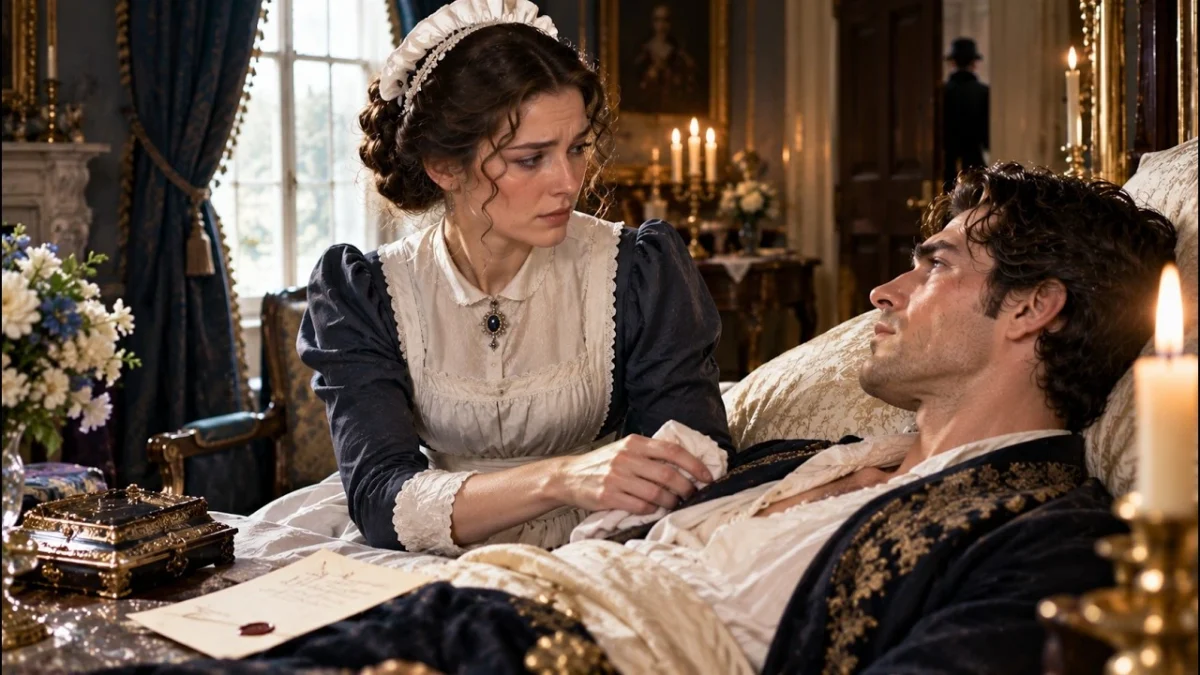
She Was Hired to Care for a Dying Duke — He Hired Her to Keep a Secret, Not Nurse Him
On the night Lady Beatatrice Holay waged 50 guineies that no woman of sense could endure an hour in the presence of the dying Duke of Wikliffe, Ellen Vale stood at the edge of the ballroom and calculated that 50 guineies would keep her father’s creditors from taking the silver teaspoons.
It was not a romantic calculation. Romance, in Eleanor’s experience, was an indulgence belonging to women whose brothers had not gambled away the roof, whose mothers did not require expensive tonics, and whose fathers did not sit in dark parlors pretending in unpaid bill was a temporary inconvenience rather than a wolf at the door.
Speeswax warmed the air. Silk whispered against parket floors. Men in black coats laughed into crystal glasses, while ladies arranged their expressions into the delicate boredom of people who had never wondered whether their butcher would extend credit another week.
At the center of the room, beneath a painted ceiling crowded with rosy cherubs, Lady Beatatrice tilted her fan toward a small gathering of admirers.
“The Duke has not appeared in public for nearly 2 years,” she said, loud enough for those nearby to hear.
“They say his wounds have turned his mind. He keeps the west wing locked. He dismisses servants for breathing too loudly.
Last month, a physician fled Wikliffe Hall before breakfast. Lady Beatatrice tilted her fan toward a small gathering of admirers.
Lady Beatatrice tilted her fan toward a small gathering of admirers. Lord Harrow asked, delighted.
Surely that is an exaggeration. Ask Dr. Calthorp. He claims his grace threw a decanter at his head.
Did he? Lady Beatatric’s smile sharpened. No one knows, which makes it all the more likely.
The laughter that followed was polished and vicious. Eleanor stood beside a marble column, holding the tray of champagne she had been hired to carry for the evening.
She had not been born a servant, though aristocratic guests found it easier to believe she had.
Her faded black gown was plain enough. Her gloves carefully mended, and poverty made a woman invisible in rooms designed for the rich.
Lady Beatatric’s eyes found her. Pretending was for people with choices. She crossed the ballroom with the tray balanced in one hand.
My lady, you are looking for employment, are you not? I am always looking for employment.
How admirably honest. Lady Beatatrice lifted a glass from the tray. I have heard Wikliffe Hall seeks a nurse.
A hush moved through the little circle. Eleanor’s fingers tightened around the silver tray. A nurse for the Duke, Lady Beatatrice said.
His household has advertised discreetly. They require a woman of steady nerves, some practical experience, and no expectation of pleasant company.
Lord Harrow leaned closer. Then you will refuse. Eleanor looked at Lady Beatatric’s fan painted with little blue flowers.
The woman had once sent Eleanor’s younger sister a broken ribbon after promising her a place as companion to a distant aunt.
It had been an accident. Lady Beatatrice said. Everything was an accident when committed by someone rich enough.
What is the wager? Eleanor asked. Lady Beatatrice blinked. You have one? Eleanor continued. The paper had been folded so often the creases had nearly torn through it.
Final notice. Amount overdue. Failure to settle will result in legal action. Make it 50, she said.
Only 50. I have no desire to profit from your confidence in misery. Lady Beatatrice laughed, but there was a faint irritation beneath it.
“Done, on one condition, my dear Miss Vale, you are hardly in a position. You will pay whether I stay or not,” Elellanena said calmly.
“Of course, how very noble,” Ellanena replied. The next morning, a black carriage rolled through the iron gates of Wikliffe Hall.
The estate lay under a low November sky, vast and gray against the moors. Cold rain combed the bare branches.
The house itself seemed less built than summoned from the earth. Dark stone, narrow windows, towers blackened by age and weather.
No smoke rose from the chimneys on the west side. The coachman glanced at Eleanor as he unloaded her single case.
“If I were you, miss,” he said quietly. “I’d ask for payment in advance.” “I did.”
His eyes widened. “Did they pay?” “No.” He made the sign of the cross, though Eleanor was fairly certain.
He was tall, silver-haired, and so rigid he appeared to have swallowed the household rules whole.
Miss Vale, yes, I am Mr. Finch, steward to his grace. You have been expected.
That is more encouraging than being dreaded. Mr. Finch did not smile. I would advise you not to attempt humor with the Duke.
Then I shall attempt honesty. His expression altered by the smallest degree. That may be even more dangerous.
The entrance hall smelled of beeswax, damp wool, and old stone. Portraits of Finch led her up a broad staircase, through a corridor where the carpet muffled every step, and finally to a door at the end of the west wing.
The Duke’s physician will arrive twice a week, he said. The housekeeper will provide meals.
You are to assist his grace as required, ensure he takes any medicines prescribed, and remain available at all hours.
Does his grace suffer from a specific condition, Mr. The finch’s gaze flicked toward the closed door.
His grace suffers, he said, from many things. Heavy curtains were half drawn over the windows, turning the afternoon light into a gray smear across the carpet.
Books lay open on a long table beside maps, sealed letters, and a pistol resting on top of a ledger.
Near the fire stood a man with one hand braced against the mantle. He was taller than Elellanar had expected, though his posture was rigid with effort.
Dark hair fell over his brow. He wore no crevat, only a white shirt open at the throat, and a black waist coat that emphasized the hard line of his shoulders.
The dying Duke of Wikliffe looked neither dying nor mad. He looked furious that the world had sent him another witness.
“Leave us, Finch,” he said. The steward bowed and disappeared. Elellanor placed her case beside the door.
“Your grace!” His glance moved over her worn cloak, her sensible boots, her plain gloves.
“You are younger than the last one, the last nurse, the last woman paid to pity me.
I do not pity you.” His gaze returned to her face. “No,” he asked. “No.”
It showed only in the faint tightening near his eyes, but Eleanor had learned to notice small changes in powerful people.
Their faces were often the only part of them that could be caught unguarded. He reached for the cane.
His hand trembled once before it closed around the handle. Not weakness, Eleanor thought. Pain, the thought came unwillingly.
She had expected a tyrant wrapped in blankets, a spoiled aristocrat performing suffering because he had no one left to command.
Instead, she saw the tight muscle in his jaw before he shifted his weight. She saw how carefully he controlled his breathing.
She saw the thin sheen of sweat at his temple. Despite the fire. That is a bold observation for a nurse.
I am not a nurse. No, he said softly. You are not. He crossed the room with deliberate difficulty.
The cane striking the floor once, twice, three times. Every movement seemed measured against an invisible cost.
Elellaner did not rush to help him. He noticed. Most people would have most people would have fluttered, reached, apologized for reaching, and made his injury the center of the room until he could scarcely breathe around it.
The second page contained only one sentence. You will repeat nothing you see, hear, infer, or discover within Wikliffe Hall upon pain of legal prosecution and personal ruin.
Elellanar read it twice. Then she looked up. This is not a nursing position. No.
What is it? A secret keeping position. Whose secret? Mine. That is not an answer.
It is the only one you will receive today. Eleanor’s face warned, though not from shame.
I came because your household advertise sent you. She does nothing unless there is humiliation to be purchased.
Eleanor’s face warned, though not from shame. I came because your household advertise. You came because she wagered you would run.
I came because 50 guineies matters more to me than her opinion. Yet you will refuse the position.
I will refuse to promise my ruin to a man who will not tell me what he expects.
For a long moment, the fire cracked between them. Then the Duke did something strange.
He smiled. It was not a pleasant smile. It looked unused, almost painful, but it was real.
Sit down, Miss Veil. I would rather stand. I am about to tell you something that may make you regret entering this house.
That has already happened. His gaze held hers. Sit. Eleanor sat, not dying perhaps, but hurt enough that his body was a battlefield he could not leave.
“My name,” he said, “is Adrien Ashkcom. I was injured at Salamanca 3 years ago.
A musk ball shattered my hip. Infection followed. I was fortunate to survive. Lady Beatatrice believes you did not.
Lady Beatatrice believes whatever makes her feel important. Then why let the world believe you are dying?”
His fingers tapped once against the desk. Because a dying man is ignored. People speak freely around him because they do not expect him to remain long enough to use the knowledge.
And you have been listening. Yes. To whom? To men who have forgotten I was once in command.
There was something in his voice that changed the room. It was not loudness. It was not threat.
It was the flat cold certainty of a man who had given orders while other men bled and obeyed him because they believed he would not waste their lives.
She stared at him partly and the locked west wing. I want you to tell me when the household lives.
She stared at him partly. Why me? Because you do not belong to the sort of society that assumes I cannot see them.
You are accustomed to noticing what people hide in plain sight. I am accustomed to counting coins before buying bread.
Exactly. She wanted to dislike the way he said it. Not mockingly, not even pityingly, as if poverty were a useful skill, an education she had never asked for, but had passed with distinction.
“You do not need a nurse,” she said. “I need someone everyone will underestimate. And if I accept, you will be paid that you are here to care for a dying man.
And if I discover something dangerous, you bring it to me. And if I decide I no longer wish to keep your secrets, then you leave with your wages, provided you have kept them until that point.”
Eleanor looked down at the contract. My father’s debts are not a secret, she said.
No, Adrienne replied. They are simply not my affair. The honesty of it struck harder than kindness would have.
No false promises, no grand declarations, no suggestion that he would rescue her. The east wing creaked with servants before dawn.
The kitchens clattered beneath her rooms. The library fire hissed when rain came down the chimney.
The Duke’s cane struck hardwood at odd hours, always with the same deliberate rhythm, as though Adrien refused to allow pain, even the privilege of surprise.
In public, she played the nurse. She carried trays of broth he barely touched. She measured bitter drops into small glasses.
She arranged blankets over his knees. Whenever visitors came, Adrien perfected the performance. Not because it was cruel, though it was.
When the doors were closed, he did not lounge dramatically in bed. He worked until his hands shook.
He read coded correspondence. He met with men who entered through the garden after midnight.
He stood over maps with his weight held unevenly, sweat darkening his collar, refusing to sit until his injured leg buckled beneath him.
The first time it happened, Eleanor caught his arm. His body went rigid. So he said through clenched teeth, “You do touch patience.
You were falling. I had a strategic reason to inspect the carpet to determine whether it was conspiring against me.
Eleanor kept her grip on his sleeve until he regained his balance. Eleanor His coat was warm beneath her fingers.
The muscles in his arm were hard, held tense with humiliation. “You ought to sit,” she said.
“You ought to stop giving orders. I am not giving orders. I am preserving the illusion that I am competent.”
His eyes met hers. Then slowly he released a breath. Chair,” he said. She helped him to it.
He did not thank her. But the next morning, when she entered the library before sunrise, a second cup had been placed beside the fire.
Tea, strong, no sugar. She looked at Adrien, who sat near the window with a blanket over his knees and a letter in his hand.
“I did not know how you took it,” he said. Eleanor picked up the cup.
“Your grace! Hypocrisy is the chief occupation of the aristocracy.” A sound escaped him, then low and brief, a laugh.
After that, their mornings became an unspoken arrangement. Before the household fully woke, Eleanor would meet him in the glass house behind the south terrace.
The place had once been filled with exotic flowers. Now most of its pots held only dark soil and stubborn herbs.
Frost feathered the panes. The air smelled of damp earth and cold iron. Adrienne walked slowly between the empty beds, leaning on his cane, while Eleanor matched her pace to his without ever making it obvious.
He told her little about the war at first and cold iron. Adrienne walked slowly between the empty beds, leaning on his cane, while Eleanor matched her pace to his without ever making it obvious.
He told her little about the war at first. Hey told him nothing about her family.
They discussed safer things, the weather, the absurdity of titled men, the estate accounts, the cost of coal.
Then one pale morning he found her staring at a de@d orange tree in the corner.
My father planted those, Adrienne said. They do not like English winters. Neither do I.
No one asked you to thrive here. I was born here. That has never prevented a place from being unsuitable.
He looked at her sideways. Is that how you feel about your family? Eleanor’s hand tightened around the handle of the basket she carried.
You are paying me to find your secrets, not mine. Not cruel. Worse, perhaps they were true.
She turned toward him. My father was a barristister. He had a good practice until his health failed.
My brother had charm without judgment. He borrowed money against expectations that did not exist.
My mother still speaks of our circumstances as if they have merely taken a temporary holiday.
Adrienne said nothing. Eleanor continued because once a door opened, words rushed through it like cold air.
My sister is 17. Clever, too clever to be protected by innocence. Not wealthy enough to be protected by society.
You should not have to carry that. That is a beautiful sentence, she said. It changes nothing.
No, Adrienne said. It does not. His cane sank slightly into the damp soil as he stood there looking at her with an expression she could not name.
You resent kindness, he said. I resent kindness that arrives with a ledger. Most things do, and yours, my kindness is rarely kind enough to be mistaken for charity.
I gave orders that seemed correct from where I stood. Men obeyed them. Some died because I was wrong.
Others died because there was no right order left to give. The glass house was very still.
“You were injured saving them?” Elellanar asked. “I was injured failing them. That is not the same thing.
Every officer believes it is. She looked at him then, not as the Duke everyone feared, not as the secretive employer who held his house like a fortress, but as a man who had survived when survival itself had become an accusation.
You are not dying, she said softly. No, might you have been punishing yourself as if you are?
For a moment, the cold between them felt sharp enough to cut. Then Adrienne’s gaze dropped to the frost on the path.
You are intolerably direct. You hired me for honesty. I did not understand the full cost.
You are a duke. You can afford it. His mouth moved. A reluctant smile almost hidden.
Noted. The danger at Wikliffe Hall wore good boots and carried engraved calling cards. Sir Malcolm Vain arrived on a Thursday afternoon with three companions, two hunting dogs, and the bright confidence of a man who had never been denied anything he wanted badly enough.
He was Adrienne’s cousin and presumptive heir. Eleanor knew this because Mr. Finch’s mouth tightened when he announced him two hunting dogs and the bright confidence of a man who had never been denied anything he wanted badly enough.
She was Adrienne’s Malcolm came into the library smelling of rain, leather, and expensive cologne.
He was handsome in the careless way that made women forgive him before he had done anything deserving forgiveness.
His hair was golden. His smile was easy. His eyes were not. Cousin, he said, bending over Adrienne’s hand without waiting for invitation, still haunting the land of the living, I see.
Adrienne sat in his chair by the fire, blanket over his legs, a book lying open in his lap.
“Your disappointment is touching,” he murmured. “Sir Malcolm laughed, but his eyes flicked toward the cane.
You look worse.” Eleanor stood beside the sideboard, arranging a tray she had already arranged twice.
She felt Sir Malcolm notice her. Men like him noticed women the way hunters noticed movement in the brush.
“And who is this?” He asked. “My nurse,” Adrienne said. Sir Malcolm’s smile widened. A nurse, how progressive.
I had assumed Wikliffe had exhausted every physician in England. Miss Vale has not yet fled.
Then she is braver than she looks. I look and stepped closer. Miss Veil, I hope my cousin is not too difficult.
Then you have my sympathy. I have not requested it. His grin sharpened. No, I suppose you are paid for the inconvenience.
Eleanor met his eyes. As are you, I imagine. The room went silent. Sir Malcolms expression cooled.
Adrien slowly closed his book. “Malcolm,” he said. “It was only a name,” quietly spoken, but Sir Malcolm stepped back.
The visit lasted less than an hour. Eleanor served tea. Adrienne coughed at appropriate intervals.
Sir Malcolm slowed. “You should not provoke him.” Eleanor said, “You should not provoke him.
I am not the one expecting to inherit a dukedom.” “No,” Adrienne said. You are the one who is more likely to recognize a viper before it bites.
She turned to face him. You suspect him. I suspect everyone. That is an exhausting way to live.
It is also why I am still alive. 3 days later, Eleanor found the first proof.
She had gone into the old linen room searching for a clean cloth after Adrienne’s physician left muddy footprints on the library floor.
That alone would have meant little, except the latch was high, and the floor beneath it bore a fresh smear of mud.
Eleanor crouched. A strip of paper had caught beneath the baseboard. She drew it free.
It was part of a letter, torn raggedly across the middle. The handwriting was elegant.
We cannot afford another delay. The Duke’s papers must be obtained before Parliament sits. If his condition worsens naturally, all is resolved, if not to arrange a circumstance that will not invite suspicion.
Her stomach tightened. She did not take the paper to Mr. Finch. She took it to Adrien.
He was at his desk, his coat discarded, his sleeves rolled up. He looked tired enough to be transittal, his cannot to Mr.
When she set the fragment before him, he read it without changing expression. Where the linen room?
Who else has access? Everyone with keys, which is almost everyone. Adrienne held the paper over the flame.
You are burning it, Ellaner asked. I am making certain its writer believes it lost.
That is not proof enough to act upon. No. Then why have me find it?
His eyes lifted. I did not have you find it. You hired me to observe deceit.
I hired you because I knew someone would search for the papers. And now, now I know the search has become desperate.
Eleanor stared at him. You used yourself as bait. I have been bait for nearly 2 years.
I allowed them to become careless. And if they had decided to kill you, Adrienne’s expression did not move.
But something changed in his eyes. Then I would have known how far they were willing to go.
You might have died, perhaps. The word landed heavily. Eleanor stepped closer to the desk.
Do not say that as if it means nothing. It means exactly what it means.
No, it means you have grown so accustomed to being wounded that you think more of it would not matter.
His hand closed around the edge of the desk. You do not say that as if it means nothing.
His hand gripped the desk. The other clenched around the cane. Eleanor should have stepped back.
Instead, she put her hand over his. His skin was cold. For once, he did not pull away.
“You are right,” he said so quietly she nearly missed it. I have been careless with my own life.
Why? His fingers turned beneath hers. Not quite taking her hand, but touching the edge of it.
Because it was easier than admitting I wanted one. The confession was not romantic. It was more dangerous than romance.
It was truth. Before Eleanor could answer, a knock struck the door. Mr. Finch entered with a face pale beneath its careful dignity.
Your grace, he said, there is trouble in the village. The trouble had arrived from London in a hired carriage and was now standing in the Vale family parlor.
Eleanor knew it before Mr. Finch finished speaking. A letter awaited her in her room, delivered by a groom who had written hard from the station.
Her sister’s handwriting shook across the page. Eleanor, please come if you can. Mr. Bane says father’s note has been called in.
There are men here. They have made an inventory. Mama is unwell. Thomas has gone to find help, but I do not know where.
Please come. Eleanor read the letter once. Then again, the words blurred. My father’s debts have been called.
By whom does it matter? Yes, it matters to me. Then it is Mr. Baines, a lender who smiles while he counts the bones in your body.
He has sent baiffs. They are taking our belongings. Adrienne’s voice became very calm. How much?
Eleanor laughed once without humor. Do not. How much? That is none of your concern, Miss Vale.
I said, “Do not.” The words cracked out of her before she could stop them.
You have never had to understand that charity is merely ownership. Wearing a gentler coat.
The words hung between them. Adrienne’s face went white. Not offended. Wounded. She hated herself for seeing it.
Then he reached for the stack of papers on the desk. “You are wrong,” he said.
“How comforting.” “I do understand.” No, you understand obligation. That is different. He picked up one document and held it out.
This is your father’s debt. Eleanor did not take it. How did you get that?
Yes. He thought your family had nothing left worth taking. You bought our debt. Yes.
How her anger rose so fast it made her dizzy. You had no right. I had every legal right.
I do not care about legal rights. Neither do I. Adrienne snapped and the force in his voice silenced the room.
He lowered it again with visible effort. I care that Baines intended to sell your sister’s future as security for a debt your father could not pay.
He has made inquiries, he continued. He has spoken of an arrangement with a man named Lord Keen.
Keen is 53, widowed twice, and has a fondness for purchasing vulnerable women through their father’s obligations.
Eleanor’s fingers went numb. No, she whispered widowed twice. He whom I know men like Keen, and I know that your family has been exposed because no one with power chose to see them, she looked at the document again.
What do you want? She asked. Adrienne flinched as if she had struck him. Nothing.
No one buys a debt for nothing. I did not buy it for nothing. Then named the price.
He was silent for a moment. Then he said, “Help me end this.” She frowned.
Sir Malcolm is involved with Baines. Adrienne continued, “The letters, the threats, the pressure on your family.
It is not coincidence. Malcolm needs me isolated. He needs the papers I possess. You want to use my family’s danger as part of your scheme.”
“No.” His voice roughened. “I want to use every resource I have to make certain no one threatens them again.
That still sounds like ownership. Then call it a partnership.” Eleanor stared at him. Your father’s debt is now held by my solicitor, Adrienne said.
It will not be collected. Not from you, not from your sister, not from anyone.
In exchange, you will tell me the truth when you believe I am becoming insufferable.
She should have gone home alone and fought the baiffs with every scrap of pride she possessed.
But pride did not keep a roof over Lydia’s head. Pride did not stop Lord Keen from turning her sister into an item on a ledger.
Pride did not erase the shaking handwriting in the letter tucked against Eleanor’s heart. So she lifted her chin.
Very well, she said. A partnership. Adrienne looked at her for a long moment. Then he held out his hand in his fingers closed around hers with grave careful pressure.
The trap was set at a Christmas masquerade. Sir Malcolm hosted it at his London townhouse, pretending affection for his invalid cousin.
Off the fashionable world attended. The rooms glittered with guilt mirrors and candle light. Music drifted through the corridors.
Masks turned everyone into a more elegant version of their worst self. Eleanor wore a plain silver mask and a gown of deep green borrowed from Adrienne’s sister, who had died years before, and whose memory lived quietly in the wardrobes of Wikliffe Hall.
Adrien wore black. He arrived leaning heavily on his cane, looking pale enough to satisfy every rumor.
Miss Vale, you did not flee after all. Miss Vale, I have disappointed many people in my life.
Eleanor said. You appear to be among them. Lady Beatatric’s eyes traveled over the green silk.
How fortunate that the Duke’s household has been generous. Generosity is not the same as theft.
You may wish to remember that distinction. Before Lady Beatatrice could respond, Sir Malcolm approached.
Cousin, he said smoothly. You look remarkably alive. Tragic. I The words were soft, nearly pleasant.
That made them uglier. Lady Beatatrice watched with avid interest. Sir Malcolm leaned closer. A woman in your position ought to be careful.
Men may mistake ambition for invitation. Elellanena met his gaze. Only men too stupid to understand the difference.
His smile disappeared. Careful, he murmured. Your family cannot afford your pride. Adrienne’s cane struck the floor.
Once the music seemed to falter and every person near them felt it. Sir Malcolm, Adrienne said.
His cousin looked at him. You will apologize to Miss Vale. Sir Malcolm gave a short incredulous laugh.
For what? For speaking to her as though she were beneath your notice. You cannot be serious.
I am very serious. The surrounding guests had fallen quiet. Fans paused, glasses lowered. Sir Malcolm’s face reddened.
She is a nurse. No. Adrien saw it. I have left for family. For the first time, fear entered Sir Malcolm’s expression.
It was only a flicker. How little patience I have left for family. Sir Malcolm turned toward her, his jaw tight.
Miss Veil, forgive my poor choice of words. I do not, Eleanor said. A breathless murmur traveled through the room.
Adrienne’s mouth almost curved. Sir Malcolm stared at her. Then Adrienne said, you may go.
His cousin did. The moment he disappeared into the crowd, the music resumed in a stumbling rush.
Eleanor looked at Adrien. That was unwise. Probably. You have made him desperate. He’s wise.
No one speaks to you that way again, he said. Not while I can stand.
Her gaze dropped to his cane to the hand gripping it hard enough that his knuckles had turned white.
“Then sit,” she whispered. “Before your noble protection causes you to collapse. I am not collapsing.
You are listening. I am a duke. Dukes do not list. Ships list. Dukes behave worse.
This time he laughed. A real laugh. And his hand found hers beneath the shadow of his black coat.
The proof against Sir Malcolm came before dawn. One of Adrienne’s men intercepted a courier leaving the townhouse with documents hidden inside a hollowed prayer book.
The proof against Sir Malcolm came before dawn. One of Adrienne’s men intercepted a courier leaving the townhouse with documents hidden inside a hollowed prayer book.
The papers contained correspondence between Sir Malcolm Baines and Lord Keen. He said there were references to the parliamentary letters Adrienne had concealed to threats against the Vale family to a plan to arrange a fatal carriage accident for the Duke if illness failed to complete its work.
So Malcolm was arrested at breakfast. Lady Beatatrice sent flowers to Wikliffe Hall and a note claiming she had never trusted him.
Elellanar used the flowers to brighten the servants’s hall and burned the note. Winter passed slowly after that.
Adrienne no longer needed to pretend he was dying, though he still withdrew from society more often than his title permitted.
He walked farther each morning. He worked less at night under Elellanena’s relentless supervision. The debt was erased.
Her father wept when he learned it, though he tried to hide it behind a handkerchief and complaints about the weather.
Lydia began studying with a governness paid from the restored Veil household accounts. Thomas was sent to work under one of Adrienne’s estate managers, where charm was less useful than punctuality.
Elellanor remained at Wikliffe Hall. At first, because there was work unfinished, then because leaving became harder than staying.
One March morning, the frost had finally melted from the glass house windows. The orange tree remained stubbornly bare, but tiny green shoots had appeared on one branch.
Adrien stood beside it, his cane resting against a table. Adrienne stood. He used it when pain demanded, which Eleanor considered progress, though he called it surrender.
“You are staring at that tree again,” he said. “I am waiting to see whether it has any sense.
It survived winter.” “So did we. That proves endurance, not sense.” He smiled faintly. The morning light touched the scar at his temple.
He looked stronger now, though not untouched. Perhaps no one was ever untouched. Perhaps strength had less to do with escaping damage than with choosing what one built around it.
It is a revised management proposal for Wikliffe Hall. She stared at him. The estate accounts are a disgrace.
Finch is excellent, but he has been forced to manage three generations of aristocratic incompetence.
The tenants need better leases. The village school needs funding. Half the West Wing is collapsing because my grandfather believed repairs were a sign of moral weakness.
Your family had unusual principles. They had wealth. It permitted them to call selfishness principle.
He handed her the document. That’s my steward as my equal in every decision that matters.
I am not qualified to be a duchess. I have met duchesses. Qualification is not a requirement.
Adrien, his gaze held hers. I am not asking you to save me. He said, “I have been saved often enough by people who wanted gratitude in return.
I am asking you to stay because this house is quieter when you are not in it.
Because I trust your judgment more than my own, because you do not let me mistake suffering for virtue.”
The glass house seemed filled with sunlight and silence. He took a breath, then carefully he lowered himself to one knee, the tightness around his mouth, but he did not look away.
I have no beautiful speech, he said. I have an estate in need of repair, a reputation people enjoy fearing, a leg that aches when it rains, and a habit of building walls before anyone can leave me behind them.
Eleanor’s eyes burned. I have debts in my history, she whispered. A family that will always need me.
A temper, no dowy, no patience for polite dishonesty. Excellent, he said. We shall be intolerable together.
She laughed through the tears she refused to let fall. Adrienne reached for her hand.
“Marry me, Eleanor,” he said. “Not because I need a nurse. Not because I require someone to guard my secrets.
Marry me because I would rather face every locked door in this country with you beside me than live another day behind one alone.”
She looked at the man everyone had called monstrous, the wounded duke, the feared recluse, the dying ghost in the West Wing.
He was none of those things now. Or perhaps he had always been more than the story society found convenient.
Eleanor placed her hand against his cheek, his eyes closed briefly beneath her palm, as if tenderness still surprised him.
You must understand that one may require negotiation, and I will not be grateful for what you have done for my family.
I do not want gratitude. What do you want? He opened his eyes. You? The answer was so simple that it broke something open inside her.
Eleanor bent toward him, not with the obedience of a servant, not with the desperation of a woman rescued from ruin, but with the certainty of someone choosing her own life.
Yes, she said, his breath caught. Yes, she repeated. But we are not building another locked house, your grace.
No, Adrienne said, rising slowly as she helped him to his feet. We are building a fortress against whom?
He looked out through the glass at the wide estate, the waking fields, the road that led toward every danger the world could still invent.
Then he turned back to her and took her hand. Against anyone who believes they can make us less than we








