She Prepared for a Cold, Loveless Marriage on the Farm — Until the Farmer Changed Her Life Forever
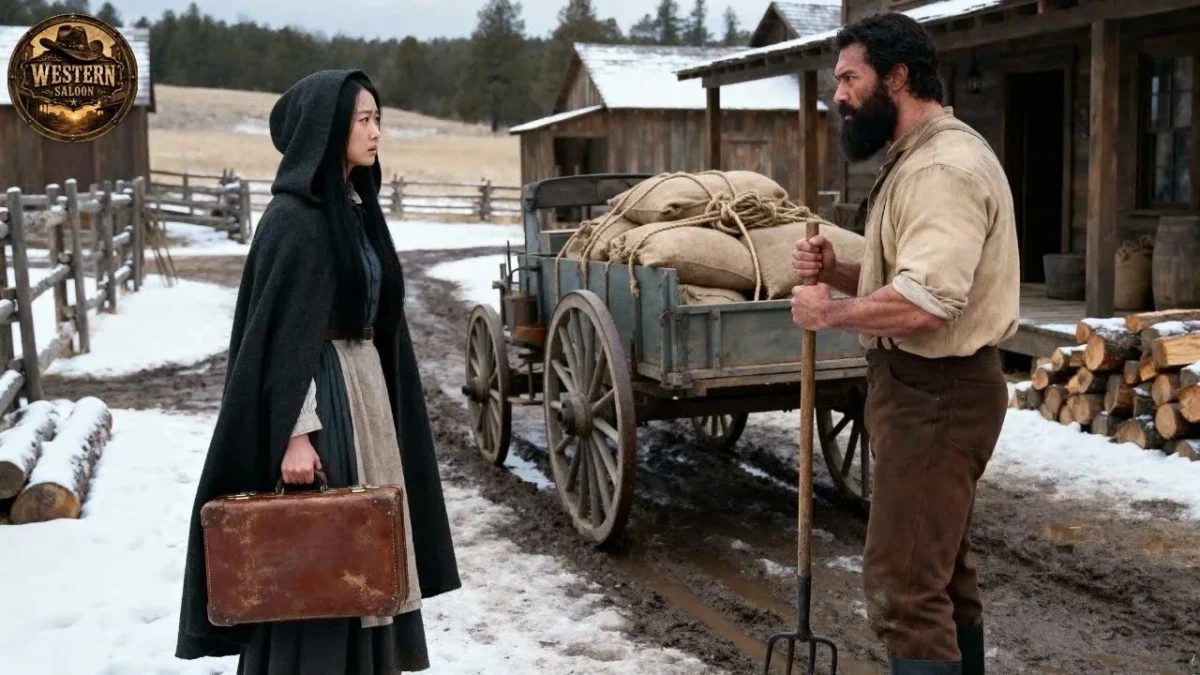
She prepared for a cold, loveless marriage on the farm until the farmer changed her life forever.
The wind cut across the open plains of the Nebraska territory with the sharpness of a freshly wetted blade, whistling through the gaps in the canvas wagon cover.
May sat huddled in the back, her knees drawn up to her chest, wrapped in layers of wool that smelled of damp earth and strangers.
The journey had been weeks of rattling silence, broken only by the driver’s curses at the mules and the grinding of iron wheels against frozen ruts.
She did not know the name of the place where the wagon was taking her, only that the contract had been signed in a smoke-filled room in San Francisco, trading her future for the settlement of a debt she had not incurred.
The landscape outside was a monochromatic blur of white snow and gray sky. A vast indifferent emptiness that seemed to swallow sound and hope alike.
May tightened her grip on the small battered trunk that held everything she owned. Two tunics, a comb made of bone, and a heavy iron skillet her mother had packed years ago.
She had prepared herself for cruelty. In the stories whispered among the women at the boarding house, the men of the frontier were beasts forged by the harsh land into creatures of violence and demand.
She expected a cold house, a hard floor, and a loveless existence where she would be little more than a beast of burden.
When the wagon finally lurched to a halt, the sudden sessation of movement felt more jarring than the bumps.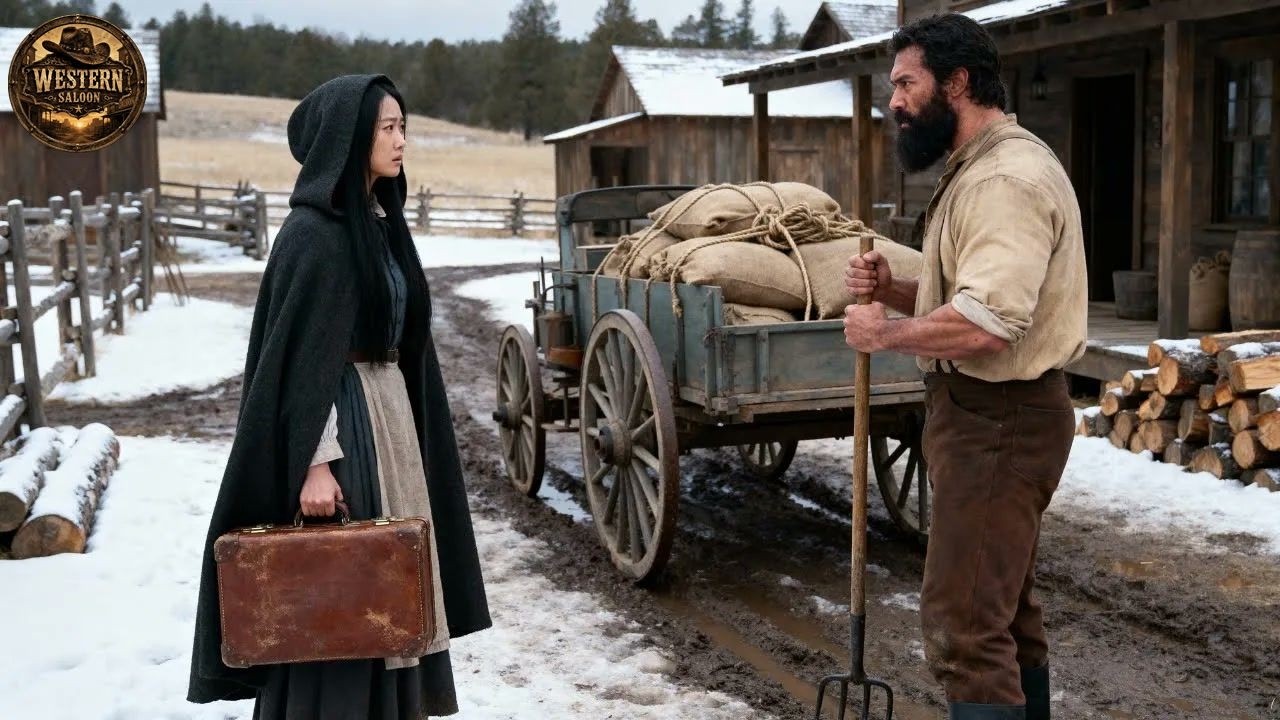
The driver shouted something unintelligible, and the canvas flap was thrown back, revealing a world biting with frost.
May stepped down, her boots sinking into the crust of the snow. Before her stood a cabin of hune logs, dark against the blinding white, smoke drifting lazily from a stone chimney.
Standing on the porch was a man. He was tall, his shoulders broad enough to block the doorway, bearded and weathered like an old oak.
This was Silas. He did not smile. He simply watched her, his eyes shadowed under the brim of a battered hat, his hands hanging loosely at his sides.
He looked exactly like the hard, unyielding men she had been warned about, a man made of the same stone and ice as the land itself.
Silas stepped off the porch, the wood groaning under his weight, and approached the wagon without a word to the driver.
He reached for her trunk, lifting it as if it contained nothing but feathers, and nodded once to May, a gesture that was less a greeting and more an acknowledgement of her presence.
She followed him toward the house, keeping her head lowered, her breath misting in the frigid air.
The wind bit at her exposed cheeks, stinging like needles, urging her toward the only source of heat in this desolation.
As she crossed the threshold, the wind died instantly, replaced by the heavy reinous scent of pine and wood smoke.
The cabin was a single large room, dimly lit by the fire roaring in the hearth and the gray light filtering through two small windows.
It was sparse, utilitarian, and clean in a way she had not expected. There was a table with two chairs, a cast iron stove, and a bed in the corner covered in a thick patchwork quilt.
May stood near the door, clutching her hands together to stop them from trembling, waiting for him to tell her what to do, to list her chores or demand his due.
Silas placed her trunk at the foot of the bed, and turned to look at her.
The silence stretched, heavy and thick. He took off his hat, revealing hair the color of wheat mixed with gray, and gestured vaguely toward the fire.
“Warm yourself,” he said, his voice a low rumble that sounded unused to speech. He did not bark the order.
He offered it. He moved to the stove, lifting the lid of a pot that released the smell of beans and salt pork.
May moved tentatively toward the hearth, the heat prickling her frozen skin. She watched him from the corner of her eye, terrified of making a mistake.
He poured coffee into a tin cup and set it on the table, then pulled out a chair.
“Sit,” he said. It was not a request, but it lacked the malice she had braced for.
She sat. He placed a bowl of stew before her, and then, to her confusion, took his own bowl and walked to the rocking chair by the fire, leaving her the table.
He ate in silence, staring into the flames, leaving her alone in the center of the room, bewildered by a distance that felt like respect rather than rejection.
The first night passed in a haze of confusion and rigid tension. May had expected to be told to sleep on the floor, or worse, forced into the bed while he claimed his rights.
Instead, after he finished his meal and washed the bowls in a basin of warm water, Silas took a heavy buffalo robe from a hook on the wall.
He pointed to the bed. “You sleep there,” he said, his voice flat. “It holds the heat better.”
Before she could protest or ask, he arranged the buffalo robe in a woolen blanket on the floor near the hearth, creating a makeshift pallet for himself.
He blew out the oil lamp, plunging the room into darkness, save for the dying orange glow of the embers.
May lay stiff beneath the quilt, listening to the wind howl outside, sounding like a pack of wolves trying to claw through the chinking.
She listened to the rhythm of his breathing, waiting for the sound of movement, for footsteps approaching the bed.
They never came. The man slept the sleep of the exhausted, heavy and deep. By morning, the routine had begun to set like concrete.
Silas was up before the sun, the fire already restoed before May opened her eyes.
When she emerged from the warmth of the covers, he was already gone, the door latch cold to the touch.
She found a pot of porridge kept warm on the back of the stove. She ate quickly, guilt gnawing at her.
She was a wife purchased for labor and bearing, yet she had done nothing. She looked around the cabin, desperate to prove her worth, to secure her place before he decided she was useless.
She found a broom made of straw and swept the floor until the rough planks were spotless.
She found flour and lard, and guessing at the proportions, managed to knead dough for biscuits.
She ventured outside to the well, the cold air hitting her like a physical blow, and hauled water until the indoor reservoir was full.
The landscape was terrifyingly open, the horizon a flat line that offered no shelter, making the cabin feel like a tiny boat on a frozen ocean.
By midday, the sky had darkened to the color of a bruised plum, signaling a storm.
Silas returned from the barn, stomping snow from his boots, bringing with him a gust of arctic air.
He stopped when he saw the water barrel full and the bread resting on the table.
He looked at May, who stood by the stove, wiping her hands on her apron, her eyes downcast.
He said nothing about the work. He merely walked to the table, broke a piece of the bread, and ate it.
Good, he murmured, the word falling into the quiet room like a stone into a deep well.
It was the most he had said to her since her arrival. He went back out to the barn, and she watched him through the frosted pain.
He was chopping wood, his ax rising and falling with a rhythmic hypnotic cadence. The pile of split logs grew, a fortress against the coming freeze.
May realized then that his silence was not anger. It was a form of endurance.
He was a man fighting a war against the elements, and words were a waste of the energy needed to survive.
Later that afternoon, as the wind picked up speed, rattling the window frames. She noticed he had left his heavy coat on the peg near the door.
He was out there in just his flannel shirt and vest. Fear spiked in her chest, not for him, but for what would happen to her if the cold took him.
Without the farmer, she was a de@d woman in this wilderness. She grabbed the coat, heavy wool lined with sheepkin, and opened the door.
The wind nearly ripped the handle from her grasp. She pushed out into the gale, shouting his name, though the sound was snatched away instantly.
“Silus!” She cried, the name feeling strange on her tongue. He turned, axe mid swing, and saw her struggling against the drift.
He dropped the axe and stroed toward her, his long legs eating up the distance.
He took the coat from her hands, his fingers brushing hers, his skin was ice cold, hers burning with adrenaline.
He didn’t put it on immediately. Instead, he ushered her back toward the house, shielding her body with his own bulk against the wind.
Inside the temperature had dropped despite the fire. The storm had arrived in full fury, a blizzard that erased the world outside the windows.
The cabin shuddered under the assault. Silas finally put on the coat, but he did not sit.
He paced the small floor, checking the windows, checking the latch. “It will be a bad one,” he said, looking at May.
“Three days, maybe four.” He went to a chest at the foot of the bed and pulled out another blanket, draping it over her shoulders.
The gesture was awkward, stiff, but the intent was undeniable. He was ensuring she would not freeze.
May looked up at him, really looked at him for the first time. She saw lines of fatigue etched deep around his eyes, a weariness that went down to the bone.
She saw that his hands, large and scarred, were trembling slightly from the cold he had endured outside.
Without thinking, she reached out and took his hands and hers. They were rough, calloused like leather, and freezing.
She led him to the fire, pushing him gently toward the chair. He resisted for a moment, surprised, then sank into the seat.
May knelt before the hearth, feeding more wood into the flames until they roared. She took a cloth, dipped it in the warm water from the reservoir, and began to wipe the grime and frost from his knuckles.
He watched her, his body tense, as if waiting for a trap to spring. But she only dried his hands and held them near the heat.
“Warm,” she whispered, one of the few English words she felt confident in. Silas exhaled, a long, ragged breath that seemed to carry years of solitude out with it.
He looked at her hands holding his, the contrast of her small, pale fingers against his weathered skin.
For a moment the howling wind outside ceased to matter. The terror of the empty plains receded.
There was only the fire, the smell of drying wool, and the strange, terrifying realization that they were two strangers bound together in the dark, and that perhaps, just perhaps, there was no monster in the room, only a man who was just as afraid of the cold as she was.
The blizzard did not relent for three days, sealing the cabin in a twilight world of howling wind and drifting snow.
Time lost its rigid structure, dissolving into a cycle of waking, tending the fire, and waiting.
The cabin, once a place of terrifying strangeness to May, began to shrink, forcing an intimacy that was neither requested nor rejected.
They moved around each other like two planets in a small orbit, learning the rhythm of the others body without speaking.
May learned that Silas hummed a low, tuneless vibration when he was mending his harness leather by the fire light, a sound that seemed to rumble from his chest rather than his throat.
Silas learned that May moved with the silence of a cat, her presence announced only by the rustle of fabric, or the scent of the tea she brewed from dried herbs she had found in a jar.
The isolation stripped away the social pretense of their arrangement. There was no room for the awkward politeness of strangers when the water in the bucket froze solid a few feet from the hearth.
They shared the labor of survival in the dim light. When the wood box grew low, May would bundle herself in the buffalo robe and stand by the door, ready to unlatch it the moment Silas returned with an armful of logs from the porch stack, minimizing the heat loss.
It was a silent dance of efficiency. On the second evening, as the wind battered the roof with the force of a hammer, Silas looked up from the beans he was stirring.
“The drift is over the windows,” he said, his voice rusty. “We are buried.” It was a statement of fact, not fear.
May looked at the darkened glass, now just a wall of white pressed against the pain.
She did not feel the panic she expected. Instead, she felt a strange anchored safety.
The world outside, the world that had judged her, discarded her, and sold her, had ceased to exist.
There was only this room, the crackling fire, and the man who ensured her bowl was full before he filled his own.
She picked up the iron skillet, heavy and black with age, and began to wipe it clean with a rag.
“Then we wait,” she answered softly. Silas watched her hands, his eyes lingering on the strength in her small wrists.
He nodded once, a slow dip of his chin, and for the first time the silence between them felt companionable rather than empty.
When the wind finally died, the silence that followed was so absolute it woke them both.
The sun rose on a world erased. When Silas forced the door open, shoving against the weight of the drift, a blinding brilliance flooded the dark cabin.
The snow was piled high as the eaves, a glistening ocean of white under a sky of piercing cloudless blue.
The reality of their position set in immediately. They were dug in, but the livestock in the barn were unreachable.
Silas stood on the porch, squinninging against the glare, his breath pluming in the shatteringly cold air.
He looked at the shovel leaning against the wall, then at the expanse between the house and the barn.
50 yards of deep, heavy snow. He didn’t say a word, just grabbed the shovel and stepped off the porch, sinking to his waist.
May did not wait for an instruction. She found a flat board in the corner, a piece of scrap lumber, and followed him.
He broke the trail, heaving heavy loads of wet, packed snow aside, his back straining with the effort.
She followed in his wake, using the board to widen the path, clearing the debris he missed.
It was grueling, backbreaking work. The cold burned their lungs, but the exertion made sweat run down their spines.
For hours, the only sounds were the scrape of iron on ice and their ragged breathing.
They were a team, united by a singular, desperate purpose. When they finally reached the barn door, Silas slumped against the wood, exhausted, his chest heaving.
He looked at May, her face flushed red from the cold and the work, her hair escaping its pins.
She was leaning on her board, trembling with fatigue, but her eyes were bright, fierce with triumph.
He reached out, his gloved hand brushing the snow from her shoulder. Strong, he rasped, the word heavy with a respect he had not given easily.
It was not a compliment of beauty, but of survival, and to May it meant more than any poetry.
They entered the barn together, the warm animal smell of hay and manure wrapping around them like a blanket, the sounds of the restless mules and the loing cow confirming that life had endured the white siege.
The thaw did not come quickly, but the days settled into a hard, brittle routine.
The danger, however, had shifted from the elements to the hunger that stalked the plains.
A week after the storm, the moon was full, casting long, skeletal shadows across the snow.
May was awakened by a sound that prickled the hair on her arms. A high-pitched yipping that dissolved into a chaotic chorus of snarls.
Silas was already out of his pallet, pulling on his boots in the dark. The shotgun he kept above the door already in his hand.
“Cyot,” he whispered, the word a curse. They smell the calf. He didn’t tell her to stay.
He simply vanished into the night. May sat up, her heart hammering against her ribs.
She heard the barn door slam, then the boom of the shotgun, a flash of thunder that shook the cabin walls.
Then a shout. Silas’s voice sharp with pain. Fear, cold and immediate, flooded her veins.
She didn’t think. She grabbed the heavy iron lantern from the table, lit it with trembling hands, and ran out into the snow, clad only in her night shift and boots.
The cold was a physical shock, but she ignored it, sprinting down the path they had dug.
The barn was a scene of chaos. The shadows were alive with movement. Three gaunt shapes were circling in the straw.
Silas was on his knees, using the stock of the shotgun to club at a coyote that had latched onto his forearm.
The weapon useless at such close range. Another beast was snapping at his legs. May screamed, a raw, guttural sound that tore from her throat and charged.
She swung the heavy lantern like a flail, the glass shattering, the oil igniting a flare of orange light that sent shadows leaping wildly.
She struck the coyote biting Silus, the heavy metal base connecting with a sickening crunch.
The beast yelped and scrambled back. The sudden fire, the scream, and the fury of this small woman startled the pack.
With snarls of frustration, they turned and bolted into the night, leaving only the smell of blood and burnt oil.
Silas remained on his knees, clutching his bleeding arm, staring up at May. She stood over him, breathing hard, the broken lantern smoking in the snow, a warrior in a night gown, her eyes blazing with a terrifying protectiveness.
Back inside, the adrenaline faded, leaving them both shaking. The cabin was warm, but the smell of blood was metallic and sharp in the air.
May pushed Silas into the chair by the fire and rolled up his torn sleeve.
The bite was deep, jagged tears in the flesh that oozed sluggishly. She worked with efficient, steady hands, boiling water, tearing strips from a clean sheet, and retrieving a bottle of whiskey from the shelf.
Silas watched her, his face pale, sweat beating on his forehead despite the cold. “He did not flinch when she poured alcohol over the wound, though his jaw muscles bunched tight enough to snap.
“You came out,” he said, his voice low, sounding almost confused. You could have stayed inside.
May paused, her hands hovering over the bandage she was applying. She looked him in the eye, the first time she had held his gaze for so long.
“You are my husband,” she said. The words were simple, spoken with the flat affect of a fact, but they carried a weight that filled the room.
It was not a declaration of romantic love, but an acknowledgment of the bond forged in blood and snow.
“They were two broken halves trying to make a hole.” Silas looked away, staring into the fire.
“I bought a contract,” he muttered, the shame evident in his tone. “I didn’t buy a savior.”
He looked back at her, his expression unguarded for the first time. This land, it kills the soft things.
I thought you were soft. May finished tying the bandage, pulling the knot tight. I am not soft, she whispered, touching the rough skin of his hand.
And I am not alone. Not anymore. Silas turned his hand over, interlacing his fingers with hers.
The grip was firm, desperate, an anchor in a shifting world. Weeks later, the relentless white began to recede.
It happened slowly at first, the icicles dripping a rhythmic cadence from the eaves, the snow turning to heavy slush, revealing patches of brown wet earth that smelled of rot and rebirth.
The cret broke its frozen silence, rushing with the meltwater of the mountains. Spring had arrived, not with flowers, but with mud and the promise of work.
One morning, a wagon appeared on the horizon, splashing through the mire. It was a traitor heading west toward Oregon, stopping to water his horses.
Silas walked out to meet him. They spoke for a long time, the murmur of their voices drifting back to the porch where May sat shelling dried beans.
When Silas returned, he walked heavily, carrying a small leather pouch. He climbed the steps and stood before her, blocking the sun.
He held out the pouch. “He is going to the city,” Silas said, his voice void of emotion.
“There is money in there, enough for a passage. Enough to start over somewhere. Easier.”
He looked at the fields, still scarred by winter, then at his own scarred hands.
“You paid your debt, May, in the storm. You don’t have to stay here. You don’t have to be a farm wife to a ghost.
It was the escape she had dreamed of when she first climbed into his wagon in San Francisco.
Freedom, warmth, a life without the crushing weight of the sky. May looked at the pouch, then at the man holding it.
She saw the fear in his eyes, not the fear of the wolves or the cold, but the terrifying fear of returning to the silence.
She saw the man who had given her his bed, who had shielded her from the wind, who had let her see his weakness.
She stood up, brushing the bean husks from her apron. She took the pouch from his hand.
Silas flinched, his eyes darkening with resignation. May walked to the edge of the porch and tossed the pouch onto the bench near the door.
“The garden needs turning,” she said, her voice steady and clear. And the roof needs patching before the rains.
She turned back to him, a faint, rare smile touching her lips. I am not going anywhere, Silas.
The coffee is on. Silas stood frozen for a moment, the breath leaving him in a shuddering sigh.
He nodded, the lines in his face softening. The ghost finally laid to rest. He stepped past her into the house, leaving the door open, letting the light and the fresh spring air fill the room where they would together endure.








