She Gave Her Last Coin to a Ragged Beggar — Never Knowing He Was the Duke She Was to Marry
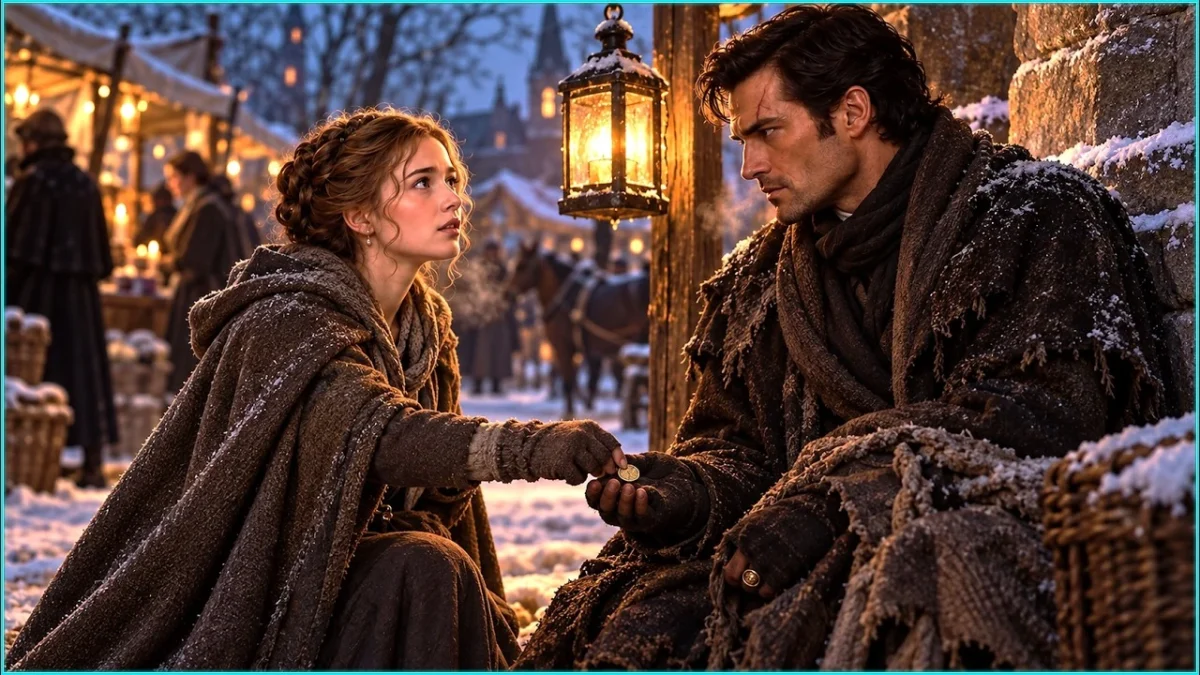
She Gave Her Last Coin to a Ragged Beggar — Never Knowing He Was the Duke She Was to Marry
Take it, she said, pressing the coin into his ragged glove before he could refuse her.
You need it more than I do tonight. The Duke of Ukote said nothing because to speak in his own voice in that cold, would have undone the whole foolish scheme he had set for himself.
And because the girl kneeling in the frost before him, offering the very last farthing she owned to a stranger, she believed a beggar had struck something in his chest that no ballroom, no council of solicitors, no letter of introduction had managed to strike in 11 long years.
He was Rabad, seventh Duke of Yukot, master of 11,000 acres and more coin than most men could count in a lifetime, and he was crouched against a crumbling wall at a frozen crossroads market, with his hands blew beneath a beggar’s mittens, watching a woman he had never met give him everything she had.
He had come to Milbrook Cross that morning for a single purpose, to look unseen upon the woman his solicitors and his aunt had chosen for him before he bound himself to her for the rest of his life.
He had expected to watch from a distance, perhaps exchange a word with a stranger about the family passing through, and returned to Yukatote no wiser and no worse.
He had not expected the wind off the fend to cut through his borrowed coat like a blade, nor had he expected.
After 2 hours of standing sentinel near the tall house, to find his knees buckling with cold beneath him until he sank humiliatingly against the wall like the very vagrant he had dressed himself to resemble, he certainly had not expected her.
She had come with an older woman, her mother, he would later learn, though in that moment she was only a slight figure in a gray wool cloak gone thin at the elbows, her bonnet a faded blue that had once perhaps been fine, her gloves mended at two fingers.
She had stopped in the middle of the frozen lane, in the bustle of carts and stamping horses and hawkers crying their wares, and she had looked at him the way no one had looked at him in years, not with deference, not with calculation, not with the particular woriness people reserved for a duke’s notice, but with plain unguarded concern, as one creature looks at another creature in pain.
“Sir,” she had said, crouching without a thought for the mud soaking into the hem of her cloak.
Sir, you are half frozen. Have you eaten today? He had meant to wave her off.
He had meant to grow some rough word in the flattened vowels of a farm laborer and send her on her way before she looked too closely at his face, which for all its grime was not a laborer’s face.
And before anyone in that market recognized the Duke of Yuko crouched in the frost like a common wretch, but when he opened his mouth, nothing rough came out at all.
What came out in a voice he barely recognized as his own, roughened by cold rather than disguise, was the truth.
Not since yesterday, madam. She had not flinched at madam, though it was an odd word for a beggar to use to a girl in a mended cloak, and he cursed himself even as he said it.
But she seemed not to notice or not to care, already unwinding the muffler from her own throat.
Then you’ll take this,” she said, and wrapped it twice around his neck before he could protest her fingers, cold as they were, brushing his jaw with a briskness that held no revulsion in it at all.
“And this,” she had reached into the small drawstring purse at her waist, and he had heard, even before she opened it, that there was almost nothing inside, a thin, papery rustle of near emptiness, one dull clink of copper against copper.
She drew out a single coin, not a shilling, not even a full penny from the look of it.
A worn farthing, its king’s head rubbed nearly smooth. “I haven’t much,” she said, “and there was no apology in it, only a kind of rofal honesty.
But you have less. Take it, please. There’s a baker two stalls down who will sell you a heel of bread for it if you tell him Vivien sent you, and look pitiful enough.”
He’s soft-hearted under all that flour. Robert, Duke of Yukot, who had turned away petitioners with harder eyes than a market baker’s, who had watched men of considerable fortune calculate to the guinea what a smile from might be worth to their daughters, sat in the frozen mud and stared at the coin in his palm as though it might bite him.
“You cannot spare this,” he said, and this time his voice did not sound rough at all.
It sounded to his own ear almost like begging. I can spare it better than you can go without, she said simply and rose brushing uselessly at her ruined hem.
We none of us know what a day may bring, sir. Better to be the sort of person who gives when she has little than the sort who waits until she has much and never does.
He should have let her go then. Every instinct that 11 years of guarding a dukedom and a broken heart had trained into him told him to let her go, to watch her disappear into the crowd of the market, to return to Yukot with his answer and never speak of it again.
Instead, he heard himself say, “Your mother will be looking for you.” Something crossed her face then, not fear exactly, but a shadow quickly suppressed of a burden she was carrying that had nothing to do with him.
“She will,” Vivienne said. We have a long way yet to go today, and I confess I am not eager to arrive.
She said it lightly, the way one admits to dreading a tooth drawing, and then seemed to catch herself, as though she had said too much to a stranger, and offered a small apologetic smile.
Forgive me. That is no business of a man half frozen in a ditch. Are you traveling far, sir?
Not so far as you, I think, he said, which was true in every sense that mattered, since his own bed lay only four miles distant across the frozen fields, behind a park wall and a lodge gate and 40 rooms he had never learned to feel at home in.
“Where are you bound?” He almost told her. The lie sat ready on his tongue, some village name plucked from memory, and instead what came out was another truth dressed thin enough to pass to a house I do not much want to enter.
She laughed. A short startled sound quickly smothered as though she had not expected to laugh at all that morning.
Then we are alike in that sir, you and I. I am promised. She stopped herself again, glanced toward the crowd, where presumably her mother waited and shook her head slightly, more to herself than to him.
It does not signify. I ought not to burden a stranger with my complaints when he has none of his comforts, and I have most of mine, even so worn as they are.
Tell me,” he said, and he did not entirely know why he asked it, except that some part of him, some old and buried part that had once believed in the honesty of strangers, wanted very badly to hear what she would say to a man she believed could never repeat it to anyone who mattered.
“I have nowhere to be for the next quarter hour, and a beggar makes a safe confessor.
I can carry no tales where I am bound.” She studied him a moment, and here, for the first time he felt a flicker of danger, for her eyes were clear and steady, and missed very little, he thought, when she chose to look.
But whatever she saw in his frost reddened, dirt smudged face satisfied her. Or perhaps she was simply too weary of carrying the thought alone, for she sat down on the frozen mounting block beside him, careless of her skirts, and said, “I am promised in marriage to a man I have never once laid eyes upon.
A duke no less. Can you credit it?” A poor squire’s daughter promised to a duke, and everyone tells me ought to be transported with joy.
And I only feel as though I am being walked toward a cliff with a blindfold on.
Told all the while how fortunate I am not to see the drop. Robert went very still.
They say he is hard. She went on looking not at him now but out at the gray sky pressing down over the market stalls.
The smoke of the brazers, the huddled shapes of hawkers stamping their feet against the cold.
Hard and cold and quick to anger that he turned off his last betrod with scarcely a word of explanation and has not smiled in a decade and rules his tenants the way a general rules a garrison.
My aunt says I ought to be grateful he wants a wife at all given his temper and grateful further that he has agreed to take me though I bring nothing to the match but my name and my mother’s debts.
She says beggars cannot be choosers. She smiled thinly at her own choice of word, glancing sideways at him as though only now recalling to whom she spoke.
“No offense intended, sir.” “None taken, he managed.” “I do not know him,” she said, quieter now, and something in her voice had gone thin and honest in a way that pierced clean through the layers of grime and disguise and 11 years of careful armor that Roart had built around himself.
I do not know if he is truly as unkind as they say, or only unhappy, or only tired of being watched and measured and weighed by everyone who wants something from him.
I think, she stopped, seemed to consider whether to say the rest, and said it anyway, perhaps, because a beggar at a crossroads could keep no secrets that mattered.
I think I am more afraid of being nothing to him than I am afraid of his temper.
A wife bought to settle debts is not a wife at all. She is a transaction with a ring on her finger.
I had rather be poor and loved by someone, even a poor someone, than rich and invisible in a great house full of strangers who resent that I exist at all.
The wind cut across the crossroads somewhere a peddler was crying the price of ribbons.
And the Duke of Ukote, who had spent 11 years believing with good and bitter cause, that no woman living would ever want him for anything but his title and his rent roll, sat in the frozen mud beside the very woman he was to marry, and felt the whole architecture of his cynicism begin.
Quietly and without his permission to crack. Perhaps, he said carefully, he does not know how fortunate he is.
She looked at him properly, then for the first time, not the muffler she had given him, or the coin still closed in his fist, but at his face, and for one long moment he thought, with something between terror and an emotion he could not name, that she would see straight through the grime to the man beneath it.
But her eyes only softened, taking his words for the kindness of a stranger returning kindness, and she rose, brushing the frost from her skirts.
“You are a gallant beggar, sir, whoever you are. I hope the bread is good.
She hesitated, glancing once more toward the crowd, where a woman’s voice, sharper, old, was calling a name that was not quite Vivien’s, close enough to serve.
I must go. My mother will fret herself into a fever if I linger. God speed to you.
Wherever that house is that you do not wish to enter, and to you, he said, wherever that house is that you fear to enter.
She laughed again, surprised into it a second time, and turned to go. And then, as though some final scruple would not let her leave a debt unpaid, she turned back, unworn the second planer scarf from beneath her cloak, the one she wore against her own skin, and held it out.
Take this as well. You’ll want it more than I will walking. I have my mother’s carriage waiting.
You have only your own two feet, I think, wherever you’re bound. He took it.
He could not have refused her a third time any more than he could have stopped the cold sun from sinking that afternoon behind the bare elms along the fen road.
Her fingers brushed his again as she pressed the wool into his hands, and this time she did not pull away quickly, and for one unguarded second their eyes held hers clear and gray green, and entirely without artifice.
His he was certain, betraying far more than any duke ought to betray to a stranger at a crossroads.
Then the sharp voice called again closer this time and Vivien startled murmured a last farewell and was gone into the crowd a slight gray shape swallowed by carts and stalls and the general gray business of a market morning leaving Robert alone against the war with a farthing worth less than a shillings fraction pressed hot into his palm a stranger’s scarf warm around his throat and the sudden sickening exhilarating certainty that in 4 hours time when the coach from Alderare turned up the long drive of Yukot and his aunt presented him in his own drawing room in his own unimpacheable ducal dress to Miss Vivien Etchingham of Marlo Fen.
The girl who had just given a beggar her last coin her muffler and the truce confession she had likely made to any living soul in a year would be looking for the first time upon the face of the man she believed had never once considered her worth loving for herself.
He sat a long while after she had gone, the market noise rising and falling around him, the cold forgotten.
He turned the coin over once in his fingers, worn smooth, nearly weightless, the poorest currency in England, and found that his hand, when he closed it again, would not let the thing go.
He ran the last mile across the frozen park, which was not a thing the Duke of Yukot had done since he was a boy of 12 racing his brother to the lake, and he did not care who saw him do it, because there was no one to see, only the bare elms and the gray sky, and the rooks wheeling up from the home wood as he crossed the haha at a de@d sprint with a beggar’s coat flapping about his knees.
Hodgej. His valet had gone white as a tablecloth when his master came through the garden door, still half frozen, stre with mud, a stranger’s scarf wound round his throat, and demanded a bath drawn and his blue coat laid out inside of 40 minutes.
Your grace, Hodgej had managed. The family from Marlo Fen is not expected until 4:00.
I am aware of the hour, Hodgej. I set it myself. Robert was already stripping off the ruined coat, already calculating with the cold precision that had rebuilt a bankrupted Duke in 11 years exactly how much time remained to become once more a man Vivien Etchingham would not recognize.
I require a bath, a shave, and complete silence on the matter of where I have spent my morning.
Complete silence, Hodgej. Do you understand me? Yes, your grace. Hodg’s face suggested he understood nothing whatsoever and would spend a sleepless week failing to understand it further.
But he was a man who had served the Duke of Ukote for 9 years and had learned in that time that his master’s rare eccentricities were never without some private and iron logic beneath them.
Robert scrubbed the markets grime from his hands in water gone gray within a minute and did not look at his own face in the glass above the basin for as long as he could avoid it because he was afraid of what he would see there not the Duke’s face he had worn for 11 years controlled and unreadable and he had told told more than once more than a little frightening but something roarer beneath it something that a girl with a mended glove and a rofful smile had cracked open at a frozen crossroads in under half an hour.
He had gone to Milbrook Cross that morning, half convinced he already knew the answer to the question his aunt’s matchmaking had posed him.
He had been engaged once before to Lady Saraphina Eldus. 7 years passed, a beauty of impeccable birth and no fortune of her own, who had smiled at him with every appearance of tenderness for the better part of a year.
And then the very week his father’s death revealed the Duke hadums debts to be far graver than anyone outside the family had guessed, discovered a sudden and passionate attachment to a viscount with coal mines in Durham and no burdens whatsoever.
She had not even troubled to invent a kinder excuse. She had simply stopped answering his letters and then sent word through her mother that circumstances had altered and he had learned at 4 and 20 precisely what his title was worth to the world and precisely how little he himself weighed against it.
He had built the last seven years on that lesson like a mason builds on rock.
He did not smile easily because a smile could be read as an invitation and an invitation could be exploited.
He was called cold by the men who dined at his table and hard by the women who danced at his balls.
And he permitted both descriptions to stand uncorrected because a reputation for coldness discouraged exactly the sort of calculating tenderness that had ruined him once and would not ruin him twice.
When his aunt, the daaja lady Yukot, had begun her campaign 3 months to see him married and settled for the succession.
She said, though he suspected loneliness of a different variety than his own drove half her urgency, he had agreed only because a man of 8 and 30 without an hair was a standing invitation to every ambitious cousin in the county, and because Margaret had produced from among the impoverished gentry of three counties, a name he did not know attached to a family so far beneath notice that no one surely could accuse the match of being anything but what it plainly was a transaction.
Poor girl’s family relieved of debt, a duke relieved of the necessity of courting anyone who might break his heart a second time, because a woman that desperate for rescue would never dare to withhold her gratitude, let alone her affection, from the man who provided it.
He had gone to the crossroads that morning to confirm this. He had wanted before he signed the settlements to look once, unseen, unsuspected, upon the face of the woman who was about to become his wife for reasons that had nothing to do with him and everything to do with his bank.
He had not expected to find a woman who dreaded the marriage more than he did.
He had not expected to hear his own reputation recited back to him by the very mouth that was to kiss him at the altar, framed not as a boast of good fortune, but as a private terror.
He had not expected, God help him, to hear her say that she would rather be poor and loved than rich and invisible, and to understand, with the sick lurch of a man discovering he has misjudged everything, that whatever else Vivien Etchingham was, she was not a fortune hunter, and had never once, in that quarter hour at the crossroads, behaved, though she believed herself in the presence of anyone worth cultivating.
She had given a ragged stranger her last coin because she believed he needed it more than she did.
That was all. That was the whole of her calculation, and it had cost her everything she carried.
He was shaved, dressed, and standing in the long gallery above the entrance hall, outwardly composed in dark blue super fine, and a crevat tied with more care than he generally troubled to give it.
When the carriage from Marlo Fen came up the drive at 4, its wheels crunching over gravel gone hard with frost, and his heart, an organ he had believed thoroughly disciplined out of any capacity for undignified behavior, began to beat in a manner he associated uneasily with the crossroads and the cold and a farthing he had not been able to make himself set down.
He watched from the gallery window as the party descended. An older woman first, sharp featured under an elaborate turban, whom he took correctly for Mrs.
Etchingham’s sister-in-law, Mrs. Honoria Vain, self-appointed chaperowned by his aunt’s account, the true architect of the match, then a second, softer woman, clearly the mother, moving with the careful economy of someone whose gowns had been turned and re-trimmed more than once.
And then Vivien, she had changed her cloak. Of course, she had changed her cloak.
No one arrived to be presented to a duke in the same garment they had worn to a market, and her hair had been repinned, and there was a faint, determined color in her cheeks that had not been there at the crossroads.
The particular brightness of a person stealing herself for an ordeal. But it was unmistakably her, the same clear gray green eyes, now guarded and watchful in a way they had not been with a beggar, the same mouth, held now in careful composure rather than the easy rofal frankness she had offered a stranger who could carry no tales.
She did not look up at the gallery window. She looked instead at the great gray face of Yukatote itself, its long windows, its worn stone lions flanking the steps, its evident and oppressive grandeur, and Robert watched her expression, for one unguarded instant before she mastered it, become something very close to grief.
He went down to receive them with his aunt at his side and performed for the length of the introductions.
The only role he had ever truly perfected, the Duke of Yukote, correct and controlled, his bow precisely calibrated, his voice pitched low and even, betraying nothing of the man who had sat in the frozen mud that same morning, and confessed to a stranger that he did not wish to enter his own house, Miss Etchingham.
He took her gloved hand, new gloves he noted, purchased or borrowed for the occasion.
Nothing like the mended pair she had worn at the market, and bowed over it, and felt her fingers, cold still despite the fires blazing every hearth of the entrance hall, tremble very slightly within his own.
“You are welcome to you coat,” she curtsied, and murmured something correct and colorless about the honor of the invitation, and did not once meet his eyes.
Out of proper modesty he supposed or out of particular dread she had described to a man she believed a beggar and the thought of it of standing before her now in the very persona she feared twisted something in his chest that felt uncomfortably like guilt it was Mrs.
Vain who filled every silence, praising the house, the drive, the weather, and tones that suggested she found all three barely adequate, and steering her niece by the elbow as though Viven were a parcel requiring careful delivery.
“Such a fortunate connection,” she said, not quite under her breath, to Mrs. Etchingham, as they were led toward the drawing room, though I confess I hardly expected the girl to look so pale before dinner.
“Do stand up straighter, Vivienne. A duchess does not slouch. Robert, walking a pace behind with his aunt, saw Viven’s shoulders draw back at once, obedient and swift, and saw also the flicker there and gone of something that was not quite shame and not quite anger, but close cousin to both cross her face before she smoothed it away.
He filed the sight of Mrs. Vain’s careless cruelty in the same part of his mind where he kept the memory of Lady Saraphina’s mother’s letter and thought with a coldness that surprised even him that he would not forget it.
Dinner was a performance of correctness on every side. He ordered without explanation that the fire nearest Viven’s chair be built up twice over the footman’s usual measure and that the soup be served hotter than his cooks custom and told himself these were only the ordinary courtesies due a guest who had traveled far in poor weather.
Though some more honest corner of his mind knew perfectly well he was thinking of blue tinged fingers and a threadbear cloak.
He watched her decline twice, a second helping she plainly wanted, with the automatic economy of a woman long practiced in wanting less than she was given, and he found he could not look away from the small, private discipline of it.
It was only afterward, when the ladies withdrew, and returned to the drawing room, and his aunt contrived, with the particular genius of a matchmaking daajger, to draw Mrs.
Etchingham and Mrs. Vain into an inspection of the portrait gallery, leaving Robart and Vivien alone by the drawing room fire under the flimsiest pretense of propriety that he had his first unguarded conversation with his betrod as himself.
“You are very quiet, Miss Etchingham,” he said, when the silence had stretched a full minute.
“I am told a young lady ought to gentlemen to lead the conversation your grace.
There was the faintest edge beneath the correctness, not quite defiance, but something adjacent to it, the same rofal honesty he had heard at the crossroads, straining now against the collar of good behavior.
And if I told you I had rather hear what you actually think than what you believe I wish to hear.
She looked at him then properly for the first time since her arrival, and he made himself hold still under the scrutiny, though every instinct screamed at him to look away before she saw too much.
Then I should say, your grace that I passed a most curious morning, and cannot yet decide whether it has made today easier or harder to bear, his pulse stumbled.
How so? I met a beggar at the crossroads market, she said, turning her gaze to the fire, and something in her face softened, unguarded now in a way it had not been since she’d stepped from the carriage.
Half frozen, poor man, and proud in the strangest way. He would not take charity as charity, only as a kind of fair exchange, as though he could not bear to be only pied.
I gave him what little I had. I have thought of him most of the day, wondering whether he found shelter before nightfall.
It is foolish, I dare say, to think more of a stranger’s comfort than my own circumstances on today of all days.
It is not foolish, Robert said. Lo, before he could stop himself, I should think he is warmer tonight than he has been in some while.
Thanks to you, she smiled, the first true smile he had seen from her since the crossroads, small and startled, as though she had not expected a duke to say anything half so kind.
And for one long moment in the fire light, with his aunt’s laughter, drifting faintly from the gallery beyond, Robert, Duke of U coat, sat very still, and let himself want, with a fierceness that frightened him to tell her everything.
The coat, the coin, the scarf still folded now inside his desk drawer, the whole ridiculous, revealing truth of where a duke had spent his morning.
He did not tell her. The words rose in his throat, and he swallowed them back down, telling himself it was too soon, that she had only just arrived, that a confession delivered now before either of them knew the other, would read as mockery rather than honesty, as though he had tested her, and found her conveniently worthy.
But he watched her face in the fire light a moment longer than was strictly proper, and thought, with the particular clarity of a man recognizing his own downfall, arriving gently and by daylight, that whatever else came of this arranged and mercenary match his aunt had constructed with such careful calculation.
He did not think he would be able to keep this secret from her for very much longer.
The settlements were signed within the fortnight in the dry business-like language of solicitors, and the wedding fixed for the first week of March.
Time enough, Lady Yukote declared, for the bride’s truss to be assembled, and the requisite calls paid, and not one day more.
For the daagger had waited 11 years to see her nephew settled and had no intention of permitting some further delay to intervene between her and the christristening of an air.
Viven and her mother removed to the Daer house at the edge of the park a smaller, kinder building of mellow brick that Roart had offered with more warmth than his aunt’s arrangement strictly required on the grounds unspoken but understood by everyone including himself.
That 6 weeks under his own roof before the wedding would scandalize even a countryside inclined to overlook a great deal for a duke.
Mrs. Vain to Robert’s private and considerable relief, returned to her own establishment in Bath, declaring the Daer House too damp for her constitution, though not before informing her niece within his hearing that she hoped Viven meant to make herself agreeable and not squander through excessive shyness, an opportunity that would not come twice to her family in their situation.
It was in the six weeks that followed that Roard learned to love her. Though he would not have named the feeling so plainly, even to himself, until considerably later, and though every day of those 6 weeks was also a day, he did not tell her the truth.
A debt acrewing interest he had no notion how he would ever repay. He called at the Der House most mornings, ostensibly to walk the grounds with his betrothed, as propriety, and his aunt’s schedule dictated, and found that Viven, freed of Mrs.
Vain’s sharp supervision was an entirely different creature from the pale careful girl who had curtsied to him in the entrance hall.
Quick to observe, quicker to laugh when something struck her as absurd, possessed of an eye for the ridiculous that she deployed.
He began to notice almost exclusively against herself and never against anyone weaker than she was.
She noticed everything. She noticed the stooped shoulders of old Tom Ferris, who kept the home farm’s diary, and asked after his knees before Robert had thought to.
She noticed that the second housemaid at the Daer house, a girl of perhaps 15, flinched whenever a door slammed and drew the story out of her gently over the course of a week until she learned the girl’s father drank and struck her and came to Robard not with tears, not with helpless appeal, with a plan already halfformed, to ask whether a place might be found for the girl at Yukot itself, further from home, with wages sent quietly to the mother instead.
You need not trouble yourself with the arrangements of my servants, he told her the first time this happened, more from habit than conviction, testing perhaps whether she would retreat.
They are not yet your servants your grace nor mine, Vivien said entirely unbothered by his tone, but they will be, and I had rather begin, as I mean to go on.
You may tell me it is not my place if you like, and I shall apologize very prettily and continue exactly as before, only more quietly.
He had laughed, an actual laugh startled out of him, the sort of unguarded sound he could not recall making in the company of another adult person in longer than he cared to calculate, and told his steward the very next morning to find a place for the girl in the still room at double the usual wage.
He began without entirely deciding to to test himself against her the way one tests a wound to see whether it has healed.
Walking beside her through the frozen gardens and finding himself more often than not watching not the bare rose beds but the play of her expression as she spoke.
Sitting across from her in the Daer house’s small parlor, ostensibly discussing the order of the wedding breakfast, and losing the thread of the conversation entirely, because she had tucked a stray curl behind her ear in a gesture so unconsciously graceful that he had forgotten for a moment what either of them had been saying.
He carried the coin with him always. It sat in the same waste coat pocket, wrapped now in a scrap of soft leather, to keep the last of its worn detail from rubbing away entirely.
And there were mornings he caught his own fingers straying to it beneath the desk in his study, turning it over and over as he read through a state correspondence, as though its smooth, worn face were a talisman against the day he would have to tell her where it had come from.
The muffler he had kept as well, folded now inside the same drawer as the coin, though he told himself this was mere thrift, and did not examine too closely why he had not simply returned it to the housekeeper for laundering and redistribution among the tenants.
As any sensible man would have done with a stranger’s castoff scarf, the trouble, and he knew it was trouble, even as he permitted it to continue, was that the longer he waited, the more impossible confession became.
In the first week, he might have told her over dinner lightly as an amusing coincidence.
You will never guess, Miss Etchingham, who it was you rescued at Milbrook Cross. She might have laughed.
She might, he thought with a chill each time he considered it, have felt instead the particular cold humiliation of having been observed and tested without her knowledge or consent, of having poured out her private terror of him to the very man she feared, disguised, watching to see what she would say when she believed herself safe from consequence.
The longer the silence stretched, the more it began to resemble in his own private accounting precisely the sort of calculated deception his own broken engagement had taught him to despise in others.
He told himself some mornings that he would confess it that very day. He told himself this on the morning he took her to visit the armchouses at the edge of the estate where six elderly widows lived out their years on his charity and watched her sit for the better part of an hour with old Mrs.
Pwit, who was nearly blind and lonelier than her pension could cure, listening to the same rambling story of a son lost at sea that the old woman had likely told a hundred visitors before, with an attention so complete and unfeigned that Mrs.
Puit wept at the end of it, and pressed Viven’s hand, and called her an angel sent to a forgotten old woman.
You did not have to stay so long,” Robert said afterward, as they walked back toward the carriage across ground still hard with the last of the winter frost, though the hedgeros had begun to show here and there the first green defiance of spring.
“No,” Vivien agreed. “I did not have to.” But I remember she stopped and he saw a hesitate weighing whether to continue and thought with a lurch of the same hesitation at the crossroads, the same private calculation of how much truth a listener deserved.
I remember what it is to feel invisible your grace to have people look through you because you have nothing they want and nothing they fear.
I had rather be the sort of person who looks even when it costs me an hour I might have spent elsewhere.
You are not invisible, he said more roughly than he intended, and stopped walking so that she stopped too, turning to face him with a question in her eyes.
I should think it quite impossible for anyone to look through you, Miss Etchingham, once they have troubled to look at all.
Color rose in her cheeks, not the practiced decorative blush he had seen a 100 debut hunters deploy across a 100 bowl rooms, but something involuntary and real.
And she looked away first toward the armchouse roofs behind them before she answered low.
You are kinder than they say. Your grace, I confess, I did not expect it.
What did you expect? A stranger, she said. A cold one. I had prepared myself for a stranger and instead I find.
She stopped again and this time did not finish the sentence at all, only shook her head, and he did not press her because he understood with a clarity that frightened him precisely what she had stopped herself from saying, because he felt the same unfinished sentence lodged in his own throat, and neither of them, it seemed, was yet brave enough to speak the whole of it aloud.
It was into this fragile, unfinished tenderness that Mr. Edmund Thorne arrived 3 weeks before the wedding, ostensibly to pay his respects to his cousin, the Duke, and to wish him joy of the match.
And in fact, as Robart understood within the first quarter hour of his cousin’s visit, to satisfy himself firsthand as to whether the rumored bride was quite as unsuitable a connection as a society whispered, Edmund Thorne was the son of Robert’s late father’s younger sister, a pleasant-faced, well-ted young man of 30, who stood by the strict letter of entail to inherit Yukot itself should Robard die without issue, and who had therefore taken a very particular end in Robard’s private estimation rather unbecoming interest in his cousin’s marital prospects for the better part of a decade.
Charming girl, I’m sure,” Edmund said, over brandy in the library, after an evening at which Vivienne had been invited to dine and had born.
With more grace than Robot thought he himself could have managed, a quarter hour of Edmund’s determinedly probing questions about her family’s circumstances, her father’s unfortunate investments, and the precise sum of the debts her marriage was understood to be settling.
One admires your generosity, Robert, truly. Not every man would look past so very modest a fortune, shall we say, for the sake of a pretty face.
I did not marry her fortune, Edmund, having found none to marry, Robert said in the flat, even tone he reserved for men he was one sentence from having removed from his house.
I imagine that is precisely your point, and I would thank you not to make it twice.
No offense meant, cousin, only I should hate to see you taken in by a family more clever than they appear.
Desperate people can be remarkably resourceful. You know, when a duke’s fortune hangs in the balance, Edmund swirled his brandy, entirely unbothered by the temperature of his cousin’s silence.
Though I dare say you know your own mind, you always have rather a change from poor Saraphina, though, isn’t it?
Marrying beneath you this time rather than above your touch. One wonders which mistake proves costlier.
Robot set down his glass with a control that cost him a great deal more than Edmund’s careless smile suggested he understood.
“You will not speak of Miss Etchingham in that manner again in my house or out of it, Edmund, or I promise you the entail will be the very least of the inheritances I contrived to keep from you.”
Edmund laughed, waved a placating hand, and changed the subject to hunting. But the words had lodged, and Roard, lying awake that night with the coin turning over and over between his fingers in the dark, found he could not entirely dislodge them.
Not because he believed Edmund’s insinuation for one moment. He had seen Vivienne give away her last coin to a man she believed had nothing to offer her in return, had watched her spend an hour of a busy morning holding a lonely old woman’s hand for no reward.
But the woman’s own comfort, but because Edmund’s careless cruelty was only a crude echo of the same fear Robert himself had carried into that crossroads market in the first place.
The fear that had made him disguise himself and spy on his own betrod, rather than simply asking her honestly who she was.
He was no better than Edmund, he thought, turning the coin once more in the dark.
He had simply been quieter about his suspicion and dressed it in rags instead of brandy.
And he had been given in return for his distrust more honesty and more kindness than he had any right to expect and had answered it so far with nothing but silence.
Tomorrow he told himself for perhaps the 20th time in as many days. Tomorrow he would tell her everything.
He did not tell her the next day nor the day after that. And the reason when he was honest with himself in the small hours was not merely cowardice, but a creeping superstitious fear that the truth once spoken would end the very thing it described.
He had watched Viven over the six weeks of their courtship come to trust the Duke of Yukot a little more each day.
Not the reputation, not the title, but the man himself, the one who remembered that old Tom Ferris’s knees troubled him worse in wet weather, and sent linament to the home farm without being asked.
The one who had laughed unguarded at her small rebellion over the housemaid’s wages. If he told her now that this same man had first come to her disguised as a beggar to test the honesty of her heart before he risked his own, he feared she would hear only the testing, and none of the tenderness that had grown up around it since.
And so he said nothing, and the silence, instead of settling, began to develop a life of its own, the way a small crack in a dam does not remain small merely, because one wishes it would not spread.
The first threat to his secret came from the least likely quarter, his own stables.
It was old Perin, the head groom at Ukote, a man who had served three generations of the family, and possessed the long, uncomplaining memory of someone who had spent his life around horses, and therefore trusted very little that walked on two legs instead of four, who nearly undid him on an ordinary Tuesday in February.
Robert had ridden out with Viven that morning. She rode passibly well, though without the polish of a woman bred to the side saddle from the cradle, and he had found himself more than once more absorbed in watching the concentration on her face as she managed a skittish mare than in minding his own mount, and they had returned to the stable yard, laughing over some small misadventure with a fallen glove, in the easy companionable warmth that had become, without either of them quite naming it, the ordinary temperature of their days together.
Perne had come to take the hor’s heads, touched his cap to Vivien, and said entirely without guile.
Fine to see your grace out and about of a morning again. Proper like different from the other business a few weeks back, eh?
He had chuckled, tugging at the mayor’s bridal. Old Ned at the crossroads swore up and down he’d seen a beggar.
The very image of your grace loitering round Milbrook Market the week before the young lady arrived.
Had us all laughing in the tack room. The very idea. I told him he’d been at the cider too early in the day.
The stable yard seemed to Robard to go very quiet, though nothing had actually changed.
The horses still stamped. A stable boy still whistled somewhere behind the loose boxes, and Perne had already moved on, entirely unaware of the small catastrophe he had nearly caused to comment on the mayor’s off forleg.
But Robert’s eyes had gone involuntarily to Viven’s face and found her looking at him with an expression he could not immediately read.
Not suspicion not yet, but a kind of arrested curiosity. The look of a person turning over a stray puzzle piece without quite recognizing yet which puzzle it belonged to.
“How very absurd,” she said after a moment in a voice that was almost but not entirely light.
“A beggar who looks like a duke. I wonder what Ned had been drinking. Cider evidently, and a good deal of it, Robert said, and was appalled to hear how smoothly the deflection came, how practiced his voice had grown at concealment, even as every other part of him longed to seize the opening Perin had unwittingly handed him, and simply tell her the truth.
Country tales grow taller with every telling Miss Etchingham. By harvest time, I dare say Ned will have seen me sprout wings.
She laughed and let it go, and he told himself the danger had passed, but he noticed over the following days that she grew quieter on the subject of the beggar she had met at the crossroads, no longer mentioning him in in the easy wandering way she once had, as though some private thought had begun turning over in the back of her mind, that she was not yet ready to examine in daylight, and he could not decide whether her silence frightened him more than her curiosity would have.
The second threat came from Viven herself, though not by design. She had taken, in the weeks since her arrival, to a quiet habit of asking after the poor of the district, whenever she went among them, not merely her own tenants to be, but travelers and dvers and the shifting population of the crossroads markets that dotted the county, inquiring her gentle, persistent way, whether anyone had seen a certain half-rozen stranger in a workman’s coat, who had once helped her when she was troubled, and whom she hoped had found better fortune since.
It was Robert understood, entirely characteristic of her. The same impulse that had sent her to sit an hour with blind Mrs.
Puit, extended now to a man she believed a nameless beggar she would likely never see again, simply because she could not bear to wonder, unanswered, whether a kindness she had given had done any good.
He learned of this habit from his own housekeeper, Mrs. Doyle, who mentioned it in passing, with the particular fondness servants reserved for a mistress they had already unofficially decided to love.
Miss Etchingham was asking again after that poor traveling man your grace, the one from the market at Milbrook, sweetest thing, worrying so over a stranger.
I told her I’d ask about thou, though I don’t know has anyone seen hide nor hair of such a fellow since.
Rabard had thanked Mrs. Doyle and retreated to his study and sat for a long while with his head in his hands because the sheer uncomplicated goodness of it that Viven was still weeks later quietly worrying over the comfort of a stranger who had never given her his name was somehow worse than any accusation could have been.
She was not calculating what the beggar’s fate might mean for her. She simply could not stop caring what had become of him.
And every day that Robert failed to tell her the beggar had wanted for nothing, had in fact gone home that very night to fortify fires, and a full ladder, and a fortune beyond counting, felt to him now less like discretion, and more like an act of cruelty dressed up as tacted.
It was the flood at Hollowde that finally cracked the dam beyond mending. The thor came hard and sudden in the last week of February, swelling the small river that ran along the eastern edge of the estate until it broke its banks in the night and sent brown water surging through the row of tenant cottages at Hollow Med before dawn.
Robard was woken by his stward pounding on his door before 6, and was dressed and on horseback within a quarter hour, riding through gray halflight toward a scene of considerable chaos.
Cottages wading through kneedeep water to salvage what furniture could be saved. Livestock lowing in distress and the widow cutter’s youngest child, a boy of perhaps four, missing from the general muster of frightened, shivering families gathered on the higher ground of the lane.
Robert did not think. He had never in 11 years of careful controlled ducal composure moved faster than he moved in the 90 seconds it took him to understand that a child was somewhere in that rising water and he was off his horse and into the flood before his steward had finished the sentence describing the crisis.
Wading through water that came near his waist toward the cutter cottage from which a thin frightened cry could just be heard over the rush of the current.
He found the boy on the stairs, trapped by water rising faster than a four-year-old’s legs could climb ahead of it, and carried him out against his shoulder through water that had risen in the few minutes since he’d entered, high enough to threaten his own footing, and delivered the child, soaked in wailing, but entirely whole, into his mother’s arms on the lane above, before turning back without pause to help whole furniture and livestock and elderly cottages to safety for the better part of 3 hours working alongside his own tenants with his coat discarded and his shirt soaked through and his hands by the end of it as raw and cold as they had been at Milbrook Cross.
He did not know until he straightened at last from hauling a soden trunk clear of the water that Viven had come.
She stood at the edge of the lane, her own cloak abandoned somewhere in favor of an apron borrowed from a cottage’s wife, her sleeves pushed up past her elbows.
Having spent the last hour, he learned afterward, laddling hot soup from a cauldron someone had thought to set, boiling and pressing dry blankets into the arms of shivering children with the same unhesitating, unglamorous competence she brought to every act of kindness he had watched her perform since the day they met.
She was looking at him now across the muddy lane with an expression he had never seen on her face before, not the guarded pelotness of their first meeting.
Not even the easy warmth of their weeks of courtship, but something rawer and more open than either, as though the sight of him waist deep in flood water with a rescued child against his shoulder had stripped away some final layer of the Duke of Yukot and left only the man beneath plainly visible.
For the first time in full daylight, “You went in after him yourself,” she said when he had crossed off the lane to her dripping and exhausted, and it was not quite a question.
There was no one else near enough, he said, which was true, though it was also true that he could not in that moment have stood by and watched while another man went into that water for a child who was his own tenants son.
They told me she stopped, glanced past him toward Perne, who’d come with the other grooms to help with the horses and livestock, and something crossed her face quick and troubled before she mastered it and did not finish the sentence.
It does not signify you are frozen through. Come and have some of this soup before you catch your death, your grace, and do not argue with me, for I have spent the morning too frightened for that child to have patience left over for a duke’s pride.”
He let her press a cup of soup into his shaking hands, standing there in the mud and the thin, watery sunlight breaking at last through the clouds, and thought with a clarity that felt almost like relief after weeks of dread, that he could not carry the secret one day further.
Whatever it cost him, her anger, her hurt, the particular specific pain of learning, she had been observed and tested in her most private moment of honesty, he owed her, after this the whole truth, delivered by his own mouth and not stumbled upon by chance through a groom’s careless gossip or a housekeeper’s innocent remark.
Viven, he said, and the use of her given name, unadorned by any title, made her look up at him sharply, for he had not called her so before.
There is something I must tell you, and I find I can delay it no longer, whatever the cost of the telling.
Something in his voice must have carried the full weight of what was coming, for her face changed, not to fear precisely, but to a stillness, embracing as though she had sensed for weeks that some reckoning was approaching, and had simply been waiting, with the same patient courage, she brought to everything else, for it to arrive.
Then tell me,” she said, “whatever it is, your grace. I think I would rather know it than continue wondering.”
But before he could speak another word, Perin’s voice rose from across the lane, urgent and cracking with alarm.
The water was rising again at the milace. Another cottage in danger, and the moment broke apart around them as swiftly as it had formed, scattering both them back into the desperate business of the flood.
The confession still unspoken, hanging now between them like a debt whose interest had grown, in that single interrupted moment, more dangerous than either of them yet understood, the mill race held in the end, though it took until well past noon before the water began grudgingly to recede, and by the time the last cottage was secured, and the last shivering family settled with dry blankets and hot food in the barn Robard had ordered thrown open for their shelter, the confession that had trembled pulled on his tongue that morning had been buried beneath so many hours of exhausted urgent labor that neither he nor Viven found the moment, nor perhaps entirely the courage to return to it that day.
He told himself he would speak that evening instead. Once she had rested, once the household had settled from the crisis, but a fever took hold of two of the rescued children by nightfall, and Viven, who had not left the makeshift infirmary in the estate’s old daer barn since morning, would not be persuaded to leave their bedsides.
And Robard found himself, rather than delivering confessions, sitting up half the night beside her, fetching cool water, and holding a lamp steady while she bathed small, hot foreheads with a competence that suggested she had done such nursing before.
In circumstances he had never thought to ask her about. It was near 3:00 in the morning, with both children finally sleeping easier, and the worst of the danger passed, that Viven herself, holloweyed with exhaustion, said the thing that very nearly forced the truth from him before he was ready to give it.
You are very good to your people, your grace, she said low, watching the smaller child’s chest rise and fall in the lamplight, better than the stories ever told of you.
I begin to think half of what is said of the Duke of Yukot in drawing rooms is invented by people who have never troubled to see him weighed into a flood for a tenant’s son or sit up half the night for children who are nothing to him by blood.
“They are not nothing to me,” he said. No, she agreed and looked up at him then, and something in her face, worn thin by exhaustion until every god she habbitually kept in place had simply worn away, made her next words come without the careful hesitation she usually gave them.
I think I have been unfair to you in my own mind before I ever met you.
I built a monster out of rumor and my own fear, and I have spent these last weeks slowly discovering that the monster does not exist, and that I do not entirely know how to feel about the man who has replaced him, except that I think, she stopped, flushed, looked back down at the sleeping child.
I think I have come to feel a great deal more than gratitude your grace, and I did not expect that, and I do not quite know what to do with it.
He should have told her then. He knew it even as the silence stretched. Knew that this was the moment, offered to him a second time by fate or by her own honesty, to lay down the whole truth beside her confession, and let them stand together, whatever the consequence.
But exhaustion and cowardice conspired against him one final time, and what he said instead.
Coward that he was was only I feel it too, Vivien, more than I have any right to feel, for a match my aunt arranged over a solicitor’s table before either of us had spoken a single word to the other.
It was enough that night to carry them both to sleep in their separate exhausted corners of the barn, and to postpone one final time the reckoning that fate had clearly decided would not be delayed indefinitely.
It came instead 3 days later, in a manner neither of them could have arranged, at the small stone chapel on the Yukakota estate, where the wedding itself was to be held within the fortnight.
Viven had gone to the chapel that afternoon with the vicar’s wife to discuss flowers and ribbons and the small ordinary business of a wedding, and had asked in passing whether she might see the old vestri where the parish kept its poor box and its records of charity dispensed to the district’s needy over the generations.
An idle curiosity, she told the vicar’s wife, born of nothing more than her own long habit of wandering after the fates of those less fortunate than herself.
It was there in a battered oak chest beneath the vestri’s single narrow window among ledgers recording arms given out over 40 years of Yuko Dukes that she found the smaller box Robard kept for his own private charity the coins and tokens he set aside each year unofficially and unrecorded in the parish books for the specific and particular relief of travelers and strangers passing through the district in hard weather a practice he had begun 11 years ago in the first bitter winter after his father’s death and told almost no one about because he had never wanted his own kindness weighed and measured the way his title and his fortune were weighed and measured by everyone else who knew him.
Inside that box, folded with a care that betrayed exactly how much it had mattered to the man who placed it.
There was a woman’s scoff of plain gray wool, worn soft with age and washing, and beside it wrapped in a scrap of leather, a single farthing its king’s head wore nearly smooth.
Viven had gone very still, the Vikar’s wife told Robert afterward, with the particular hushed alarm of a woman reporting a catastrophe she did not fully understand, but knew instinctively to be grave.
She had lifted the scarf from the box and held it a long moment, turning it over in her hands.
And something in her face had changed entirely. The Vikar’s wife said gone wine then strangely very calm as though she were assembling piece by piece a puzzle whose picture she had somehow already half suspected without ever quite permitting herself to look at it directly.
Robot found her an hour later in the chapel itself, sitting alone in the front pew where she was to stand as his bride within a fortnight, the scarf still in her hands, the coin resting in her open palm.
And he knew from the stillness of her shoulders and the way she did not turn at the sound of the door that the moment he had delayed for 6 weeks had finally without his permission and by no design of his own arrived.
“Vivenen,” he said, and his voice to his own ears sounded like a strangers. I told a beggar at a crossroads market that I feared marrying a man I had never met.
She said still without turning, her voice very quiet and very even in a way that frightened him far more than tears would have.
I told him things I have told no one else living. Not my mother, not my aunt, not the vicar’s wife who has been kinder to me these six weeks than my own family ever troubled to be.
I told a stranger that I would rather be poor and loved than rich and invisible, because I believed he could carry no tales where he was going, and could never repeat a word of it to anyone who mattered.
She turned at last and held up the coin, her hand trembling now despite the steadiness of her voice.
This is the coin I gave him. Your grace, I would know it anywhere. I chose it because, as it was the poorest thing I owned, and I remember the very shape of the wear across the kings face.
Tell me how a stranger’s farthing came to be kept folded in leather like a keepsake in your private box of charity.
There was no possible answer but the truth and Roard who had rehearsed a h 100red versions of this confession in a hundred sleepless hours found that every one of them deserted him now and what remained was only the plain fact of it delivered as simply and as nakedly as she deserved to hear it.
Because I was the beggar,” he said. “There was no one else at that crossroads that morning, Viven.
I came in disguise on foot in a borrowed coat to look once at the woman my aunt had chosen for me before I bound myself to her for life, believing, God forgive me for it, that I would find in you exactly the kind of calculated gratitude I had been promised, a woman desperate enough for rescue to overlook whatever coldness I brought to the bargain.
I found instead a woman who gave away her last coin to a stranger she believed had nothing to offer her in return, and who told that stranger with no thought of consequence that she would rather starve honest than live rich and unloved.
I have carried that coin and that scarf for 6 weeks because I could not make myself set them down.
And I have failed every single day of those six weeks to find the courage to tell you the truth of where they came from.
Because I feared rightly it seems from your face just now that the moment you learned it, you would see nothing in me but the deception and forget the whole of what has grown between us since.
The silence that followed felt to Robard longer than the whole of the six weeks that had preceded it.
Vivienne sat very still in the front pew of the chapel, where she was to have become his wife, the coin closed now in her fist, her face working through something he could not read, not quite anger, not quite grief, but some complicated, wounded cousin of both, and when she finally spoke, her voice had lost its terrible event and cracked at last into something roarer and more human.
“You watched me,” she said. You let me believe you a stranger with nothing. And you let me pour out every private fear I carried about you, about our marriage, about my own worth in the world.
And you said nothing, and you have gone on saying nothing for 6 weeks while I have.
She stopped, pressed her free hand to her mouth for a moment, and when she took it away, her eyes were bright with tears she was plainly fighting not to shed in front of him.
While I have fallen in love with you, robot, thinking I was falling in love with an honest man, and now I do not know which parts of these six weeks were real, and which were only you continuing to test me, to watch and weigh and measure whether I was worth the risk of your own heart.
All of it was real, he said, and crossed the chapel to kneel before her, careless of his own dignity, careless of anything but the desperate need to make her believe him before she closed herself against him entirely.
The disguise lasted a single morning, Vivien. Everything since, every word, every hour, every small unguarded thing I have said to you in 6 weeks of courtship has been nothing but the truth of a man who did not expect to fall in love with his own arranged bride, and did not know how to tell her so without confessing a deception he was ashamed of from nearly the first day it was done.
Then why did you not tell me the first day? Her voice broke fully now, the tears spilling over at last.
Why let it grow into six weeks of silence when a single honest sentence at the beginning would have spared us both this?
He had no answer that did not sound even to his own ears like the same cowardice dressed in new and more sympathetic clothes.
And so he gave her the only truth he had left. The rowest one, the one he had not even fully admitted to himself until this moment, kneeling before her in the chapel with the coin she had given a stranger closed now between her fingers like a wound.
Because I have been made a fool of once before, for loving too openly and too soon, he said, “And I was afraid, Vivien, afraid that if I told you the truth before I was certain of my own heart, I would lose the chance to ever be certain of it at all.
I was a coward. I have been a coward for 6 weeks. While you have been nothing but brave, and I do not ask you to forgive it tonight or even this week, I ask only that you believe this much.
Whatever else I concealed, I never once lied to you about what I felt. That much at least was never a disguise.
She looked at him a long moment, kneeling before her in the candlelight of the small chapel, tears still bright on her face, the coin and the scarf both clutched now against her heart as though she could not decide whether they were treasures or wounds.
And then, without another word, she rose from the pew and walked past him out of the chapel and into the cold evening beyond, leaving him kneeling alone before the altar, where, in a fortnight’s time they had been meant to become husband and wife.
She did not receive him the next morning, nor the morning after that. Mrs. Doyle, sent with a note, returned to say only that Miss Etchingham was indisposed, and begged to be excused from calls, and Roard, who had faced down bankruptcy, a broken engagement, and a flooding river without once losing the cold composure that had carried him through 11 years of guarding a duke.
Found himself pacing the length of his study for the better part of two days like a man who had misplaced something he could not name and could not stop searching for.
He did not go to her a third time uninvited, though every instinct in him screamed to do exactly that, to ride to the Daer house and stand beneath her window until she insented to hear him to fall on whatever mercy she had left for him and beg it without dignity or reserve.
He held himself back only because he understood in the small clear part of his mind that still functioned beneath the misery that Viven had spent six weeks discovering she could trust a man she had feared.
And that trust once broken could not be mended by the same forceful persistence that had broken it.
She had asked in effect for the one thing he had failed to give her from the beginning.
The plain truth delivered without calculation in his own time and not extracted from him by circumstance.
If he wished to earn back what he had lost, he thought he would have to learn finally to wait for her to choose it rather than arranging matters disguised or otherwise to produce the answer he wanted.
It was on the third day that Mrs. Vain arrived back from Bath summoned Robert suspected by an anxious letter from Mrs.
Etchingham, and installed herself once more at the Dower House, with an energy that boded ill for everyone within reach of her opinions.
He learned of her return, and of its consequence the same afternoon, when his aunt appeared in his study, with a face like a gathering storm, and a piece of gossip she had plainly ridden the better part of two miles to deliver in person, rather than trust to a servant.
Mrs. Vain is telling anyone who will listen in the village that the engagement is off.
Lady Yukot announced without preamble, settling herself into the chair opposite his desk with the particular ferocity of a woman spoiling for a fight on someone else’s behalf.
That the girl has come to her senses or been made to see reason and that a more suitable match will be found for you before the month is out.
She has apparently already written to Lady Cresa Fenwick’s mother suggesting the acquaintance be renewed.
Which I need not tell you is a piece of impertinence I have not forgiven in 11 years and do not intend to forgive now.
The engagement is not off, Robert said, though the words cost him more certainty than he felt.
Then I suggest you make that plane to someone besides your study walls. Roard, because at present the only person acting as though it still stands is you sulking in here like a boy sent from the table.
While that woman turns the whole district against a girl who has done nothing wrong except fall in love with a man too proud or too frightened to tell her the truth when it would have cost him least.
His aunt’s voice softened fractionally, though her eyes remained sharp. I have known you since you were in short coats, and I have watched you build a wall around yourself brick, brick by brick, since Saraphina Aldus proved herself unworthy of the trouble.
And I understood it, God knows, better than anyone. But I did not arrange this match to watch you retreat behind that same wall the very first time.
It cost you something real to stay outside it. She will not see me. Then find another way to be seen.
Lady Yukote said with the flat unanswerable logic of a woman who had by his own admission engineered half the important events of his adult life through sheer refusal to accept the obstacles others found insurmountable.
You did not court that girl as a duke these six weeks. From everything I have observed and everything the servants report to me.
Whatever they may think I do not hear, you courted her as a man. I suggest, nephew, that if the Duke’s apologies will not be received, you send the man instead, and stop standing on the dignity that has done you so little good in matters of the heart thus far.”
He turned her words over for the whole of that night, and by morning he understood exactly what he must do, though the doing of it required him to surrender the very armor he had spent 11 years constructing, in front of the one district in England most inclined to gossip about it.
He went the following dawn not to the dower house’s front door in his own carriage with his own name announced by his own footman but on foot alone dressed in the same worn coat and muffler retrieved at his own private and rather sheepish instruction from the trunk where Hodgej had stored it after that first frozen morning and walked the four miles from Yukot to Milbrook cross in the gray light before sunrise to stand once more at the same crossroads where the whole of this had begun.
He did not know when he set out whether Vivien would come. He had sent no message announcing his intention, calculating correctly, as it turned out, for Mrs.
Doyle had not been able to resist confiding the plan to the Daer house’s own housekeeper, who had not been able to resist confiding it to Viven’s maid.
That word would travel through the servants’s quiet channels faster and more honestly than any formal note could carry it, and that if Viven chose to come, she would come because she wished to, and not because a duke had commanded her presence, she came an hour after sunrise, on foot herself, without her mother or Mrs.
Vein, wrapped in the same gray cloak she had worn the first morning they met, and stopped a dozen paces from where he stood against the same crumbling wall, in the same cold, and looked at him for a long moment without speaking.
“You look absurd,” she said finally, and her voice, though still guarded, held none of the flat wounded a Venice of the chapel 3 days past.
“A duke standing at a crossroads in a beggar’s coat at dawn. If anyone from the village sees you, you will have given them gossip enough to last a decade.
Let them talk, Robert said. I find I have grown considerably less afraid of gossip than I am of losing you, Vivien, which is a change I did not expect to undergo in 6 weeks, and which I have you entirely to thank for.
She did not answer at once, but came a few steps closer, studying him with the same clear, unflinching attention she had turned on him that first frozen morning, when she had known him only as a stranger in need.
Why did you come here dressed like this? What do you imagine it proves? Nothing, perhaps, he admitted, or everything.
I confess I am no longer certain which I came because this is where I first learned who you were.
Before I had any title or fortune to color your answer. And I thought foolishly perhaps that if I could not win back your trust as the Duke of Ukote, I might have some smaller chance of it as the man you met here first, the one who had nothing to offer you but his own gratitude, and received from you more honesty and more kindness than he had been given by anyone in 11 years.
He drew the coin from his pocket, the same worn farthing, still wrapped in its scrap of leather, and held it out to her on his open palm.
I do not ask you to take this back, Vivien. I ask only that you understand what it has meant to me these six weeks.
Not merely a keepsake of a pleasant mourning, but a daily reminder that somewhere in this world was a woman capable of giving away everything she owned to a stranger, expecting nothing in return, and that I very nearly let my own cowardice cost me the chance to spend my life earning the right to stand beside someone like that.
Her eyes had filled again. But she did not look away this time, and when she spoke, her voice, though still unsteady, had lost the raw wound of the chapel and gained something else in its place.
Not quite forgiveness yet, but the first ground it might grow from. I have spent 3 days telling myself I was a fool, she said.
That I gave my heart to a disguise, and that whatever grew from it since could not be trusted, because it began in a lie.
But I have also spent three days remembering every single hour of these six weeks.
The flood, the shouse, the housemaid’s wages, the laugh you gave me the day I told you I meant to arrange your servants without your leave.
And I cannot make myself believe that any of that was false, however the whole of it began.
I think perhaps I have been angrier at myself these three days for wanting to forgive you so quickly than I have been at you for deceiving me at all.
Then let me make it easier, he said, and knelt there in the frozen mud of the crossroads, exactly as he had knelt before her in the chapel three nights past, though this time it was not a confession he offered, but a request.
Viven Etchingham, I am asking you now, as the man you met at this very crossroads, and not as the Duke who arranged to meet you here in secret, will you still have me?
Not out of duty to a settlement my aunt arranged, not out of gratitude for a fortune that clears your family’s debts, but because you find when you weigh the whole of these six weeks honestly that you would rather be poor and loved by me than rich and married to anyone else in England.
I cannot promise you I will never again be a coward in some smaller matter.
I am only a man and a badly frightened one where my own heart is concerned.
But I can promise you that I will never again let six weeks of silence stand between us where a single honest sentence would serve.
However much that sentence costs me to speak, she looked down at him a long moment, kneeling in the mud at the same crossroads where she had once given a ragged stranger her last coin without a single thought of what it might cost her, and something in her face, the last of the guarded wound.
The last of the careful self-protective distance she had held since the chapel finally gave way entirely.
“You are going to ruin that coat kneeling in the mud. Your grace,” she said, and her voice, thick with tears, had nonetheless found its way back to something warm enough to hold a tremor of laughter within the grief.
“I hope you know a good tailor.” “I know several,” he said, not moving, not daring yet to hope.
“Is that a yes, Vivien?” She crossed the last few paces between them and drew him up from the mud with both her hands, cold as they had been that first morning, wrapped now around his own, and looked at him with an expression that held nothing guarded in it any longer at all.
“It was always going to be yes,” she said. “I think it has been yes since the moment you told me the bread was good, though I did not yet know the man who had eaten it was the very duke I had been dreading to meet.
I was only angry that you made me discover it in a vestry chest instead of hearing it from your own mouth.
When your own mouth is the thing I have come these six weeks to trust above every other voice in England, she paused and something ruthful crossed her face.
An echo of the same ry honesty she had offered a stranger at this crossroads two months passed.
Though I will tell you plainly, Robert, that if you ever again keep so large a secret from me for so long a time, I shall give away considerably more than my last coin in protest.
I have not decided precisely what, but I promise you it will be inconvenient.” He laughed, the same unguarded, startled laugh she had first drawn from him weeks ago over a housemaid’s wages, and drew her hands cold and steady and entirely his own, up to his lips, right there at the frozen crossroads where the whole of it had begun.
Then I shall simply have to give you no cause, he said, for the rest of both our lives.
They walked back from Milbrook Cross together in the full light of morning. Viven’s hand tucked through his arm in a manner that drew more than one curious glance from farm carts passing on the road.
And Robot found he did not care in the slightest who saw him, muddy coat and all, walking home with his betrothed, as though the whole of the county’s opinion weighed less to him than a single one of her smiles.
We must tell your aunt,” Vivienne said as Yukot’s chimneys came into view above the bare trees.
And my mother, who I expect has been beside herself these three days, listening to Aunt Vain’s predictions of ruin, she will want to know precisely how thoroughly her predictions have failed.
Your aunt, Robert said with feeling, will not be pleased to learn her predictions have failed, whatever comfort it brings your mother.
I begin to understand why you bore her company so patiently for so many years, Viven.
I do not think I could manage a fortnight of it without losing every shred of the composure 11 years have cost me to build.
I did not always bear it patiently, Viven admitted with a small, rofal laugh. I bore it because my mother could not after my father died, and someone needed to stand between her and Aunt Van’s opinions about how a grieving widow ought to comport herself.
It is a very particular skill, your grace, standing between two people who cannot agree.
And I confess I am rather tired of practicing it. I had hoped marriage might relieve me of the office, though I begin to suspect a duchess has her own version of the same duty, only conducted in larger rooms.
He glanced at her, something in her light tone, not quite masking the weight beneath it, and found himself asking a question he had wanted to ask for weeks and never quite found the opening for.
Tell me about your father. You have never spoken of him beyond the debts he left behind.
And I find I know almost nothing of the man who raised the woman I am about to marry.
Something crossed her face. Old grief worn smooth at the edges the way old griefs become, rather than the raw kind, and she was quite a moment before she answered.
He was a foolish man in the ways that matter to a solicitor, and a good one in every way that mattered to me.
He invested badly twice in schemes that promised more than they delivered because he could never quite believe that the world would not reward a man for trying his best.
He gave away money we could not spare to neighbors who needed it more, the same as I have done.
And my mother despared of him for it constantly, and loved him for it just as constantly, which I have come to think may be the truest description of any good marriage I have ever witnessed.
He died four years ago of a fever that took half the parish that winter and left us debts I did not fully understand until Aunt Vain began explaining them to me at rather greater length and rather less kindness than the situation required.
She glanced up at him. A shadow of her old woriness returning briefly. I tell you this so you understand, Robert, that whatever Edmund Thorne implied at that dinner some weeks passed.
My family’s poverty was never a scheme. It was only bad luck, and a good man’s generosity outrunning his income, and I would not have traded my father for a richer, more careful one if it had cost us twice the debt we actually carried.
I would not have wished you, too, Robert said, and meant it entirely. I think from everything you have told me, and everything I have watched you do these six weeks, that you inherited a great deal more from him than his debts, Vivien, and I count myself fortunate for every part of it.
They found Lady Yukot and Mrs. Etchingham together in the drawing room when they arrived.
The former mid lecture on the impropriety of allowing gossip to dictate a family’s happiness, the latter dabbing at her eyes with a handkerchief already considerably the worse for use.
And the scene that followed. Tears, embraces, Lady Yukot’s triumphant declaration that she had known all along matters would resolve themselves.
Delivered with a straight face that fooled absolutely no one, occupied the better part of an hour before either Robard or Viven could extract themselves for the quieter conversation they both still wanted.
It was Lady Yukot, in the days that followed, who insisted the engagement be publicly reaffirmed before the wedding could proceed.
On the grounds that Mrs. Vain’s gossip had traveled too far and too fast to be allowed to die a quiet death, and that nothing would kill a rumor so thoroughly as a duke, and his intended appearing together, radiantly and undeniably devoted, before the very drawing rooms where the rumor had first taken root, the occasion she selected was the county assembly at Hartwell, held the second week of March in the long room above the coaching inn that had hosted every notable dance in the district for the better part of a century.
And attended that particular evening by nearly every family of consequence for 20 m in every direction, including Robert learned with a resigned sort of amusement, Lady Cresa Fenwick, and her mother, whom Mrs.
Vain had so helpfully alerted to the supposed collapse of his engagement. Viven had been nervous beforehand in a way she rarely permitted herself to show, and Robard had found her.
An hour before they were to depart, standing before the small looking glass in the daer house’s modest parlor, turning a simple string of pearls, gift from Lady Ukote, pressed on her with more insistence than Viven had wished to accept over in her fingers with an expression he recognized at once, having worn something close to it himself often enough over the years.
“You are afraid they will look at me and see only Aunt Vain’s rumors,” he said from the doorway.
And I promise you, Vivien, that whatever they see, it will not matter half so much to either of us by morning as it seems to matter tonight.
They will look at me and see a Porsquiaire’s daughter who nearly lost a duke through some scandal no one troubled to explain properly, she said, and they will wonder what I did to deserve losing him, or what I did to win him back.
And either answer will make me sound rather more interesting than I actually am. Then let them wonder,” Robert said, crossing the room to take the pearls gently from her hands and fasten them himself, his fingers steadier now at such tasks than they had been weeks before.
When he had first fastened a different chain around her throat, with a heart hammering fit to wake the house, I intend to spend this evening making it entirely clear to every person in that room precisely how I feel about the woman on my arm.
And I find I care remarkably little what conclusions they draw from it, so long as the conclusion includes the plain fact that I chose you, Viven, with my eyes open and my heart entirely engaged, and would choose you again tomorrow if given a hundred chances to reconsider.
She had turned to look at him then, something easing visibly in her shoulders, and had not argued further, though the particular brightness in her eyes when they set off for Heart, while an hour later suggested his words had done rather more good than either of them troubled to remark upon aloud.
The assembly itself might have been designed, in retrospect, as a small theater for exactly the demonstration Lady Yukote had intended.
Robert danced the first two dances with Viven himself, a departure from strict propriety that raised eyebrows throughout the room, since custom generally dictated a betrothed couple share only a single dance before supper, and spent the whole of the evening at her side rather than retreating, as he had done at every county assembly for the better part of a decade, to the card room with the older gentlemen, who found dancing beneath their dignity and conversation with young ladies accord or best avoided.
Lady Cresa Fenwick, approached by her mother with what was plainly intended as a casual inquiry after the state of the Yukote engagement, received in reply from Robot himself, delivered with a pleasant, unhurried cotesy that somehow conveyed rather more finality than a sharp word would have managed, the information that his wedding to Miss Etchingham remained fixed for the following week, that he counted himself the most fortunate man in the room by a considerable margin, and that he hoped Lady Cresa would do them the honor of attending.
An invitation extended with such evident sincerity and such complete absence of any awkwardness that the rumor Mrs.
Vain had so carefully cultivated withered by all accounts before the evening’s supper was even served.
It was during that same supper, seated beside Viven at a long table crowded with acquaintances who had over the course of two dances and one very public conversation entirely revised their opinion of the match that Robot found himself telling her unprompted and more fully than he ever had.
The whole story of Lady Saraphina Aldus, not as an excuse for his six weeks of silence, which he had already offered, and she had already, with more grace than he deserved, begun to forgive, but simply because he found, for the first time in 11 years, that he wanted someone to know the whole of it, rather than the guarded, bitter fragment he had permitted the world to see.
“She was not cruel,” precisely, he said, low beneath the general noise of the supper room.
I have called her calculating in my own mind for 11 years. And perhaps she was, but I think now with some distance that she was also very young and very frightened of poverty in a way I did not understand until I watched your own family navigate real want these six weeks.
She chose security over sentiment when the moment came. And I have spent a decade believing that meant no woman could ever choose otherwise, which I think rather more my failure of imagination than any particular fault in the whole of womankind.
He glanced at her some old guarded thing in his chest, finally fully unclenching. You have taught me otherwise, Viven, at considerable cost to your own composure, and I do not think I have properly thanked you for the lesson.
You need not thank me for loving you, she said simply. Any more than I need thank you for loving me back.
I think perhaps that is the whole of what either of us was afraid of in our different ways.
That love given honestly might not be returned in kind, and that we would each be left.
As you were with Lady Saraphina, and as I feared I would be with a duke I had never met, holding out our hearts to someone who only wanted what we could provide them, I am glad we were both wrong.
The wedding preparations that filled the final week moved with a speed that left Robart faintly astonished at how quickly a household could be turned toward joy once it had spent so many weeks braced for disappointment.
Lady Yukote took Viven in hand for the ordering of a trussorra to a duchess, an undertaking Vivien submitted to with rather less resistance than Robart had expected, though she insisted over his aunts mild protests.
On having half her existing gowns turned and retrimmed rather than replaced outright, on the grounds that a woman ought not forget, the moment fortune improved, the frugal habits that had served her well enough through harder years.
You may spend freely on the household charities instead, she told Lady Ukote with the same firm, unhesitating logic she had once used to argue for a frightened housemaid’s wages.
And I shall consider the bargain more than fair. Lady Yukote, who had spent 11 years failing to interest her nephew in a single suitable match, found herself, in the week before the wedding, confiding to Mrs.
Doyle over Sherry that she had quite fallen in love with the girl herself and did not know when she had last enjoyed the prospect of a wedding huff so much.
Robert, for his part, spent the final days before his marriage in a state he did not immediately recognize, having gone so long without cause to feel it, and identified only gradually.
Watching Viven cross the long gallery at Yukote one gray afternoon with sunlight breaking briefly through the clouds to catch the loose curl at her temple as something dangerously close to simple uncomplicated happiness the kind he had believed for 11 careful years no longer available to a man in his position and had discovered at a frozen crossroads with a stranger’s coin in his palm waiting for him after all.
Two days before the wedding, Robert rode alone to the small family plot behind the chapel, where his father and mother lay beneath matching stones of gray Yuko granite, a visit he made perhaps twice a year, and always alone, and always in a silence he had never before felt the need to break with words.
He broke it that morning, standing bare-headed in the cold with his hat in his hands, feeling rather more foolish than he had felt kneeling in the mud at a crossroads days before, and yet unable to stop himself from speaking.
Anyway, “I do not know if you can hear a man talking to Stone,” he said, “but I find I want you to know regardless, whatever good it does either of us.
I am to be married Saturday to a woman neither of you ever met and would have liked considerably more than any of the connections you once hoped I would make.
She has no fortune, father, and I think you would have approved of that more than you ever let on.
Given how little you cared for the fortunes some of your own friends married, and how much you cared always for whether a wife could laugh at herself and mean it.
He paused, turning his hat over once in his hands. I built a very high wall after Saraphina mother.
I do not think you would have liked watching me do it, though I understand now why you might have forgiven me the effort.
I have found someone worth tearing it back down for. I thought you should know before Saturday that whatever mistakes I have made getting here, and there have been several, some of them considerable, I do not believe I am making one now.
He stood a while longer in the cold and rode back to Yukot with something loosened in his chest that had been knotted there.
He suspected since he was one and 20 and had first understood that his parents would not love to see whatever family he eventually made and found Viven waiting for him in the stable yard.
Having ridden over herself that morning on some pretext of consulting Lady Yukot about the wedding flowers and looking when she saw his face as though she understood immediately where he had been and did not need to be told.
You went to see them, she said, simply taking his arm as he dismounted. I wanted them to know, he said.
It seemed foolish even as I did it, and I find I do not regret a word of it.
It is not foolish, Vivien said. I visit my father’s grave more often than I have told you, and I have had entire conversations with him about you that would likely embarrass us both if he could actually answer back.
I think the de@d deserve to be told the good news along with the bad, Robard, even if we cannot be certain they are listening.
It would seem unkind to include them only in our grief and never in our joy.
That evening, the household staff having been given leave for a rare hour of quiet before the final push of wedding preparations began in earnest, Robert found Viven in the long gallery, standing before the portrait of his grandmother, the third duchess, a formidable woman by all family accounts, who had reputedly ruled Yukote’s tenants and its dinner table with equal and terrifying efficiency for the better part of 40 years, and studying the painted face with an expression of Frank, assessing curiosity.
“I hope I am not meant to model myself upon her,” Viven said without turning.
“She looks as though she once made a bishop cry.” “She made several bishops cry, according to my father,” Robert said, coming to stand beside her, and reduced at least one prime minister to stammering apology at her own dinner table.
Though the family account of that particular triumph has grown, I suspect somewhat in the telling over three generations, you need not model yourself on her, Viven.
I find I have had quite enough of duchesses who rule by terror. I should like very much to be married to one who rules by the same means she used on a beggar at a crossroads, by simply refusing to let anyone she meets go hungry or cold or unheard, whatever it costs her to prevent it.
That is a considerably harder standard to live up to than terrifying bishops, Viven said, turning to look at him, though I find I would rather attempt it.
It was there in the quiet gallery, with his grandmother’s painted, formidable gaze looking down on them both, that he told her the last piece of the story he had not yet found occasion to share.
The fate of the young housemmaid at the Daer House, the one Viven had rescued from a drunken father’s temper in the very first weeks of their courtship, and whose situation Robert had continued to quietly manage in the months since, without troubling Viven with the details, believing wrongly, as it turned out, that she would prefer not to be burdened with a problem she had already, in her own mind resolved.
“Her mother came to see me last week,” he said, “while you were occupied with the trusso.
She wished to thank you directly, but feared it presumptuous to call at the Daer House uninvited.
So she brought the thanks to me instead, along with the news that her husband has left the district entirely, gone to find work in the mills at Manchester by her account, and unlikely to return, which she counts, God forgive the harshness of it, the best outcome the family has had in a decade.
The girl is thriving in the still room. Mrs. Doyle tells me she has a genuine talent for preserves and speaks of training as a housekeeper herself one day in some great house, though she cannot yet quite believe such a future is meant for someone like her.
Viven’s eyes had filled, listening, and she said nothing for a long moment. Only reached for his hand and held it there in the quiet gallery, with a grip that told him more than any words could of how much the small, unglamorous kindness had mattered to her, even secondhand, even delivered weeks after the fact by a man who had managed it quietly rather than making of it any grand announcement.
“You did not have to see to all that yourself,” she said finally. You could have left it to a steward or a solicitor and told me only the barest outcome.
I know, Robert said. I found I wanted to see to it myself. I think I have spent this whole courtship discovering that the fish matter most rarely announced themselves as important at the time.
A girl’s fear of her own father, a stranger’s cold hands at a crossroads, a farthing thing that seemed to everyone but you like nothing at all.
I do not wish to be the kind of duke who only notices what is placed formally before him in a ledger.
Viven, I would rather be the kind who goes looking the way you have always gone looking for the small unormerous needs that everyone else has learned to walk past.
Then we shall go looking together, she said, for the rest of our lives, and I shall try very hard not to give away so much of our household budget that Lady Yukot is driven to an early grave by the accounting.
He laughed and drew her hand up to his lips exactly as he had done at the crossroads, and thought, standing there in the gathering dusk of the long gallery, with his grandmother’s stern portrait, looking down, and his bride two days from becoming his wife, that he had spent 11 years believing himself a man incapable of being loved for anything beyond his title, and had discovered, through nothing more than a market morning’s foolish disguise, that the whole of that belief had been not merely mistaken, but a kind of slow private grief he had carried so long he had forgotten it was possible to set it down.
The morning of the wedding itself dawned clear and mild for March, the first truly warm sun of the year breaking over the park in a manner the older tenants declared.
With the particular authority of people who had watched 50 years of English weather, a certain sign of good fortune for whatever marriage it blessed, Robert stood at his dressing room window a long while before Hodgej came to help him into his wedding clothes, watching the light spread slowly across the same frozen fields he had once crossed at a de@drun in a borrowed coat, and found himself, for once in 11 careful years, entirely without any guard, raised against whatever the day might bring.
He thought of the coin safely wrapped now in its rosewood case, awaiting the ceremony, and of the woman who had given it away without a single thought of return, and understood, watching the sun climb higher over Yukote’s bear waiting park, that he had never in his life been so certain of anything as he was certain, standing at that window, that he was about to marry the one person in England who had never once wanted anything from him but the truth.
They were married on the second Saturday of March in the small stone chapel at Yukote where the truth had first broken between them and in breaking had somehow mended itself into something stronger than either of them had believed possible 6 weeks before.
It was not a grand wedding. By the standards of the tonard had wanted, and Vivienne had wanted more than he could have guessed, a quiet ceremony among the people who had actually witnessed the whole of their courtship.
Mrs. Etchingham weeping openly from the first pew. Lady Ukote respplendant and smug in a manner she had more than earned.
Old Tom Ferris and his wife invited at Viven’s particular insistence seated near the front with an awkward pride that suited them better than the back pew they had modestly chosen for themselves.
Mrs. Doyle and half the Yukote household staff crowded near the dawn and to Robod’s considerable private satisfaction no invitation whatsoever extended to Mrs.
Hanoria Vain who had returned to Bath in High Dudge in the week following the crossroads reconciliation and whose absence from the proceedings was mourned by precisely no one in attendance.
Edmund Thorne had come, to everyone’s mild surprise, and had approached Viven after the ceremony with an expression that suggested he had, at some point in the intervening weeks, been made to understand likely by his own mother, who had heard the full story of the flood and the crossroads, and had apparently informed her son, in terms Rabad, was not permitted to overhear that his behavior at dinner some weeks past had been beneath even his own low standard, the full measure of his earlier unkindness.
Kindness. I find I owe you an apology, your grace, he had said with a stiffness that was for Edmund nearly humility.
I spoke of your family’s circumstances in a manner that did neither of us credit, and I have since had occasion to learn a great deal more about the sort of woman my cousin has actually married than I troubled to discover at the time.
I hope you will permit me to wish you joy and mean it more sincerely than I likely deserve credit for.
I accept your apology, Mr. Thorne, Vivienne had said with the same easy grace she extended to almost everyone, though Robard had noted with private amusement the very slight edge she allowed to remain in her voice.
And I hope in future you will find it easier to judge a family’s worth by something other than the sum of its debts.
You may find the accounting comes out rather differently than you expect. The wedding breakfast that followed was held in the long gallery at Yukot, hung for the occasion with early spring greenery that Viven herself had helped arrange, refusing over Lady Yukot’s mild protests to leave the whole business entirely to hire decorators when she had two perfectly good hands and considerable practice from a lifetime of managing on little in making a small budget look like more than it was.
It was there, amid the toasts and the laughter and the particular wars of a household celebrating its master’s long delayed happiness that Robard drew his new wife aside for a few private minutes on the terrace overlooking the same park he had raced across weeks before.
In a beggar’s coat, with his heart pounding at the thought of what waited for him at the house behind, “I have a gift for you,” he said.
Though I confess it is not the sort a bride generally receives on her wedding day.
He drew from his coat a small case of polished rosewood and opened it to reveal nestled in blue velvet a slender gold locket and inside it set behind a circle of crystal so that it might be seen but never spent the worn farthing she had once pressed into a stranger’s hand at a frozen crossroads.
Its kings face rubbed nearly smooth by two generations of poverty before it had ever reached her own purse.
“I had the jeweler set it so that it could never again be given away, however generous a impulse might seize you,” he said, fastening the chain around her throat with hands that were,” he noted with some private amusement, considerably less steady than they had been commanding a flood rescue weeks before.
“I find I cannot bear the thought of it ever leaving your possession again, Viven.
Not because I begrudge your generosity. I have watched you give away nearly everything you own to people who needed it more, and I hope you never stop.
But because that particular coin is, I think, the truest history either of us possesses of how we came to love each other.
I should like you to carry it always, however many other coins pass through your hands in the years to come.”
She touched the locket where it reested against her collarbone and looked up at him with an expression that held nothing guarded in it at all.
No woriness, no bracing for disappointment, none of the careful self-p protection she had carried into their first meeting like armor against a world that had taught her early and often to expect very little.
I have been thinking, she said, that I should like to continue Ned’s tradition, if you will permit it, your private charity box in the vestry.
I should like to add to it each year on this day, so that whatever we have been given, some part of it continues to pass to those who have less.
It seems a fitting way to remember a coin that meant everything to a beggar who turned out to have everything already and gave it away regardless.
I can think of no better use for a duke’s fortune, Robert said, than to be spent making certain no one else at that crossroads goes hungry while we sit warm in this house.
I love you, Vivien. I do not think I said it plainly enough in all the tangled weeks of confession and forgiveness that brought us here, and I find I do not want to leave a single day of the rest of our lives together without you knowing it beyond any possible doubt.
You need not have doubted it,” she said, smiling, though her eyes were bright with tears again.
The good kind this time, the kind that came with any weight of grief behind them.
“I have known it, I think, since the flood, since I watched you go into that water for a child who was nothing to you but a tenant’s son, and understood that whatever else you had concealed from me, the goodness beneath it had never once been a disguise.
I love you, too, Robod.” Not the Duke of Ukote, though I have grown fond enough of him in his own gruff way, but the man who gave a beggar’s coat and a stranger’s kindness the honor of teaching him what he was worth before he ever let himself believe a duke could be loved for anything but his fortune.
They stood a long while on the terrace after that, saying very little more, watching the last of the wedding guests spill out onto the lawn below in the pale, hopeful light of a March afternoon that held for the first time in longer than either of them could easily remember the actual promise of spring rather than merely its rumor in the years that followed, and they were many years long and full, and by the account of everyone who knew them, remarkably contented for a match that had begun in a lie.
And nearly ended in a vest chest. The Duke and Duchess of Yukot became known throughout the county, not for the cold reputation that had once preceded Roard into every drawing room in England, but for a particular and much remarked upon warmth, Duke, who personally oversaw the Armshauses, and knew every tenants’s family by name, and a duchess who could still on a given market day be found pressing coins or bread or a warm word into the hands of strangers who needed it.
With no thought whatsoever of what such kindness might cost her because she had long ago learned at a frozen crossroads with nothing left to give but her last farthing that it never truly cost her anything at all.
The coin stayed in its locket, worn now smoother still by the years of a hand that touched it, now and again, without quite meaning to, in moments of worry, in moments of joy, in the particular quiet moments of a long marriage when a woman reaches for the small proof, always close at hand, of exactly how she came to be so thoroughly and so lastingly cherished, and Robert watching her from across whatever room they happened to occupy, a nursery eventually full of children who grew up hearing the story of the beggar and the coin told and retold until it passed into something very like legend in the district.
A fireside in the long winters that followed, her hand resting easy in his. The old fear of being loved only for his title, long since burned away by six weeks of honesty hard one, and never again withheld, thought every single time that he had very nearly let his own cowardice cost him the one thing in all, his considerable fortune that had ever actually been worth having.
He had gone to a frozen crossroads, a duke, convinced that no one would ever love him for anything but his name.
He had come home in every way that mattered, a man who had been given freely and without calculation, the truce gift of his life by a woman who believed she had nothing left to spare.
And he spent the whole of his remaining years making certain she never again doubted, not for one single frozen morning, that she had been from that very first moment the most treasured thing he owned.








