She Entered the Duke’s Library as a Guest — and Left Having Defeated Him at His Own Game
She Entered the Duke’s Library as a Guest — and Left Having Defeated Him at His Own Game
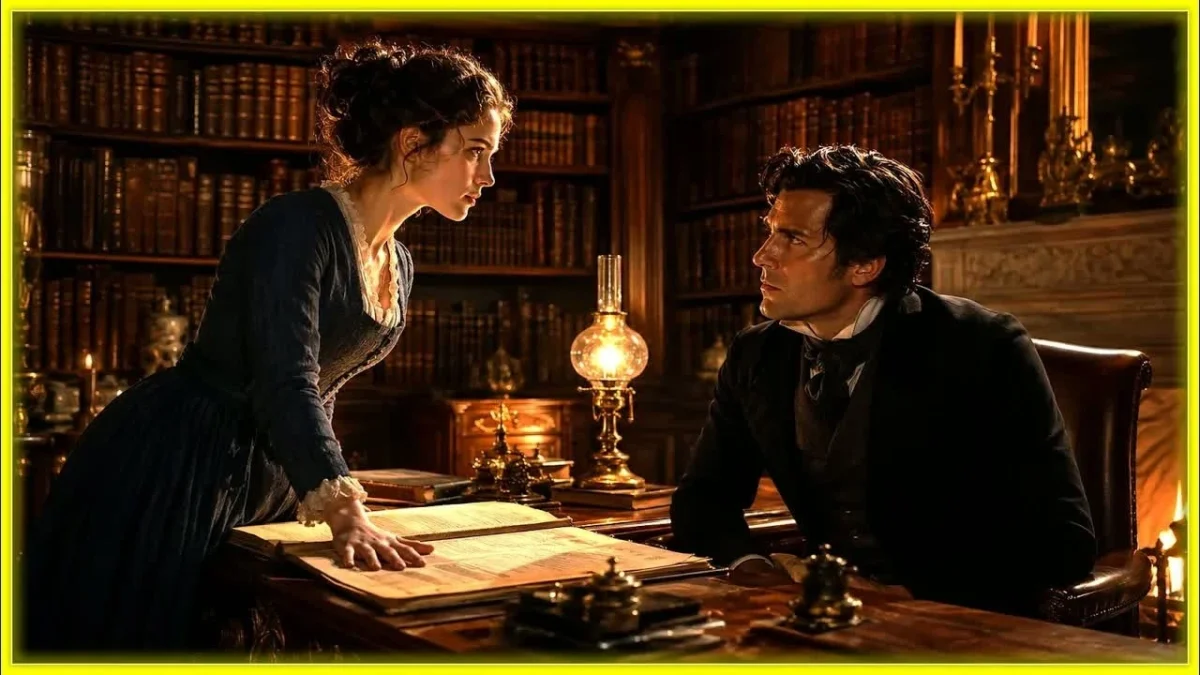
You are mistaken, Miss Hartley, said the Duke of Fenwick, not bothering to rise from his chair, and I have neither the time nor the inclination to debate the law of property with a woman who reads it as a hobby.
Then it is fortunate, your grace,” Susanna Hartley replied, setting her heavy folio of documents down upon his polished desk, with a deliberate thump, that I read it not as a hobby, but as a necessity, since you are attempting to steal 11 acres of land that have belonged to my family for a 100red years.”
The Duke’s eyebrows rose. He was a handsome man. She would grant him that much, and not a syllable more, dark and lean, and insufferably certain of himself, lounging in his great library among 10,000 books he had probably never read, accustomed to a world that arranged itself for his convenience.
He had not expected her. Gentlemen of his sort never expected her. They expected a tearful spinster, or a meek apology, or no resistance at all.
They did not expect a woman who had spent three winters reading her late father’s law books by candle light, and who could quote the precise statute they were violating.
“Steel,” the Duke repeated, as though tasting the word and finding it impertinent. “I am redrawing a survey, Miss Hartley.
The old boundary stones have rotted. My surveyor has placed the line where the original deeds indicate it should fall, which is, I am sorry to inform you, some distance to what your family has assumed was theirs.
Your surveyor, Susanna said sweetly, is being paid by you, which I find tends to influence a man’s reading of a rotted stone.
She opened the folio, but we need not rely on his eyesight or his loyalty.
We have the deeds, the actual deeds, your grace, not your convenient recollection of them.
And the deeds describe the boundary as running from the great oak to the bend in the Fenbrook.
Then along the brook to the mill, she tapped the document. The oak still stands.
The brook still bends. The mill, regrettably, for your survey, has not moved in a century.
I can walk the line in an hour, and there is not a magistrate in England who would read it otherwise.
The Duke of Fenwick was no longer lounging. He had sat forward, and he was looking at her now with an expression she could not quite place, something between annoyance and a reluctant, dawning interest.
“You have read the deeds,” he said. “I have read everything,” Susanna said. “It is a great failing in a woman, I am told.
It quite ruins one for polite conversation.” For a moment she thought he might smile.
He did not. But the annoyance had gone out of his face, and something sharper had come into it, the look of a man who has been playing chess against an empty chair for years, and has just discovered across the board.
An opponent. Leave the deeds, he said. I shall examine them. I shall leave copies, said Susanna, which I made myself in my own hand, and which I will swear to.
The originals remain with my attorney who has instructions should anything happen to delay their return.
She gathered her shawl. I am not your grace a woman who hands a powerful man the only proof of her claim and trusts to his honor.
I have read a great deal of history as well as law and history is not encouraging on the subject of dukes and their honor where land is concerned.
This time he did smile very slightly, a brief flash that she caught and disliked herself for noticing.
You think me a villain, he said. I think you a man accustomed to winning, Susanna said, who has not yet realized he is about to lose.
The two are easily confused. She left him with that and swept out of the great library with her chin high and did not allow herself to feel the way her heart was hammering until she was safely in the lane alone with the wind cooling her hot face.
He was insufferable. He was arrogant beyond bearing and she had God help her. Enjoyed herself more thoroughly in that half hour than in any drawing room she had endured in years.
He called upon her 3 days later. She was astonished. Dukes did not call upon the daughters of impoverished gentlemen, particularly not daughters who had just accused them of theft.
But there he was on the doorstep of the small house she shared with her ailing aunt, hat in hand, looking faintly as though he could not quite believe it himself.
I have examined the deeds, he said. And and you are correct, he said, with the air of a man swallowing something unpleasant.
The boundary runs as you say. My servier was mistaken, apped, dishonest. I have dismissed him either way.
He turned the hat in his hands. I have come to tell you that the 11 acres are yours free and clear, and that I withdraw the survey entirely, and that I owe your family an apology, which I am now, with some difficulty attempting to make.”
Susanna stared at him. Of all the outcomes she had imagined, an arrogant duke standing on her step admitting he was wrong had not been among them.
“You might have sent a letter,” she said. “I might have,” he agreed. “I found I wish to deliver it myself,” he hesitated.
“And I confess I had a second purpose, Miss Hartley, which I shall now make, since I have already been thoroughly humbled, and can hardly sink lower in your estimation,” he drew a breath.
I have a great library as you saw which my grandfather assembled and which I have neither the learning nor the patience to make use of.
There are documents in it, old land records and charters going back 400 years that no one has read in a generation because no one in this house can read the old hands or the Latin.
I am told you read both. He met her eyes. I should like to engage you to catalog and translate them.
Properly paid, properly chaper and entirely respectable. Your aunt is welcome at Fenwick whenever she is well enough to travel.
A pause. I find I have wasted a remarkable library for years and I have only just met the one person in the county clever enough to unlock it.
It was Susanna thought most extraordinary offer she had ever received. It was also, she knew perfectly well, a great deal more than an offer of employment, though he addressed it carefully enough that she could refuse it without embarrassment to either of them.
She looked at the proud Duke of Fenwick standing humbled on her doorstep, having ridden out himself to admit he was wrong, and then to ask her clever mind back into his house, and she made a decision that surprised even her.
I shall require my own opinions to be heard, she said, even when they contradict yours, which I expect will be often.
I shall require that you not call my reading a failing. And I shall require your grace that you understand I am coming for the library and the wages, and not because a duke has dained to notice me.
For I assure you, I have spent my whole life unnoticed by dukes, and have found it no great hardship.
Understood, said the Duke of Fenwick gravely on all three points, particularly the first. I should be disappointed if you did not contradict me.
I have not been contradicted in years, and I find I have rather missed it.
So Susanna Hartley came to Fenwick, and the war became something else. She worked in the great library through the long autumn, surrounded by the old charters, her aunt dozing contentedly by the fire on her good days, and the Duke, who had claimed he had no patience for learning, found a great many reasons to be in his own library.
He came to ask her how the cataloging progressed. He stayed to argue. They argued about everything about law and history and the management of his estate, and whether his grandfather had been a wise man or merely a lucky one.
And Susanna discovered to a considerable alarm that the arrogant Duke of Fenwick was not stupid at all.
He was merely lazy and bored and lonely, and beneath the insufferable certainty was a quick mind that had never been given anything worth doing.
She gave it something worth doing. She set him reading the old records alongside her, his Latin halting and improving his interest, despite himself catching fire.
They sat at the long table with the lamps against the early dark, two heads bent over the same crumbling page, arguing in low voices, and more than once Susanna looked up to find him watching her instead of the document, and looked quickly down again, with her heart misbehaving in her chest.
There was an afternoon she would remember afterward as the day the war truly ended.
They had been walking the disputed boundary together, the very 11 acres that had brought her storming into his life, for she had insisted on showing him precisely where the line ran, and precisely how badly his surveyor had aired.
The autumn wind was sharp, and the great oak stood bare against a put sky.
And Susanna strode along the brook with the deeds in her hand, naming the marks one by one, and the Duke of Fenwick walked beside her, and did not once interrupt.
“You were right,” he said at last, when they reached the mill. “Entirely right. I have looked at this land my whole life, and never once seen it as you see it,” he glanced at her.
“How is it that you know my own estate better than I do after a single autumn?”
Because you looked at it as a possession, Susanna said, “And I looked at it as a puzzle.
Possessions are dull. One owns them and forgets them. Puzzles are alive. They want solving.”
She tucked a windb blown curl behind her ear. “You have spent your whole life surrounded by interesting things, your grace, and found all of them dull, because nothing has ever asked anything of you.
I should think it the loneliest way in the world to live. He stopped walking.
The wind moved in the bare branches. “Yes,” he said quietly. “I believe it is.”
She had meant it as an argument, and he had answered it as a confession, and something shifted between them on that windy boundary that neither of them named, and they walked back to the house in a silence that was for the first time not a battlefield, but a kind of peace.
His aunt, the formidable Lady Ashford, descended upon Fenwick a week later, summoned by the alarming reports that her nephew was spending his autumn translating Latin charters in the company of a clergyman’s daughter.
She found the Duke in his library, and she found Susanna at the long table, and she looked between them with the practiced eye of a woman who had married off three daughters.
“You are the blue stocking,” she said to Susanna, not unkindly. The whole county is talking.
They say you accused my nephew of theft and proved it. I did, Susanna said, declining to apologize.
And now you catalog his library. I do. Lady Ashford turned to her nephew. She is not at all what is expected of a duchess, she observed.
No, the Duke agreed. She is a great deal better. She is the only person in this house who tells me the truth.
He said it lightly, but he did not look away from his aunt when he said it, and Susanna felt her own face grow warm and bent quickly over the charter in her hands.
Lady Ashford studied her nephew for a long moment, and then to Susanna’s astonishment, she smiled.
Well, she said, “It is about time someone did. I despaed of you, you know, a handsome man with 10,000 books and not one idea in his head worth defending.”
She drew on her gloves. Mind you keep contradicting him, Miss Hartley. He is insufferable when agreed with.
He always has been. And she swept out again, leaving a silence behind her in which neither the Duke nor Susanna could quite meet the others eyes.
You will forgive my aunt, he said at last. There is nothing to forgive, Susanna said.
She is the most sensible woman I have met in years. And the Duke laughed and the work went on and the autumn deepened toward winter and the war that had begun over 11 acres became day by lamp day something else entirely.
“You have changed your mind about me,” he said one evening when the cataloging was nearly done.
“I have revised my hypothesis,” Susanna corrected in light of new evidence. “It is what one does.
I had supposed a villain. The evidence suggests you are merely a man who was given too much too young and never required to be anything in particular.
It is a different failing and a more forgivable one. High praise, he said dryly.
It is rather, she said, from me, and she let herself smile at him properly for the first time and watched the effect of it move across his face like sun across water.
He set down his pen. Susanna, he said, and the use of her name, which he had never dared before, hung in the lamp air between them.
I am going to say something, and I beg you will let me finish it before you marshall an argument against it, for I have been composing it for some weeks, and I should hate to lose my place.”
She said nothing, which from her was a remarkable concession. And he went on, “When you walked into this library and accused me of theft, I had not been genuinely surprised by anything in 10 years.
People agree with me. They have always agreed with me because I am a duke and it is easier.”
And then a clergyman’s daughter with 11 acres and a folio of deeds walked in and told me I was wrong and proved it and refused to flatter me and would not even leave me the original documents because she did not trust my honor.
His mouth twitched. I have thought of nothing since. I gave you the 11 acres because the law required it.
But I asked you back in into this house because I could not bear the thought of the rest of my life without someone in it who would tell me when I am being a fool.
Susanna’s careful composure was deserting her. That is a great deal of responsibility. She managed to lay upon one woman’s honesty.
It is the only thing I have ever valued and never been given. He said simply, “Agreement is cheap, Susanna.
Anyone will agree with a duke. But you argued with me as though I were merely a man, and you were right, and you made me better for it, and I find that I am wholly and ridiculously in love with the one person in England who refuses to be impressed by me.”
He rose and came around the table, and stood before her, and for once the arrogance was entirely gone, and what was left was just a man, uncertain, hopeful, holding his heart out in his hands.
“I am not asking you to be impressed. I should not believe you if you claim to be.
I am asking whether a clever woman who reads everything and fears nothing and humbled me in my own library might consider spending her life arguing with me across this table as my wife and my duchess and my equal in all things.
I warn you I shall lose most of the arguments. I find I do not mind.
Susanna Hartley, who had a ready answer for everything, found for once that she had none.
She had come to Fenwick armed with deeds and statutes and a heart. She had locked away years ago against a world that had no use for a clever woman.
And here was a duke of all impossible things, asking not for her silence or her admiration, but for a contradiction, for her mind, for the very qualities that made every other man in the county call her unmmeritable.
You understand, she said when she could trust her voice, that I will not stop reading, that I will not stop arguing.
That I will run your estate better than you do and tell you so at every opportunity.
I am counting upon it, he said. That I came here for the library, she said, and that I am only somewhat amending that position now.
By how much? He asked. Entirely,” Susanna admitted, and the word came out softer than she intended, and she watched it land in his eyes like a key turning in a lock.
“I came for the library, your grace, and I am staying for the man, who is far less of a villain, and far more of a fool than I first supposed, and whom I appear, against my every better judgment, and the entire weight of my experience, to have fallen quite hopelessly in love with,” she stood, so that they were nearly of a height.
Her chin lifted in the way he had first seen across his desk. “Yes, I will marry you on the condition that you never ever again tell me that reading the law is a hobby.”
The Duke of Fenwick laughed the free, surprised laugh of a man who has not laughed in years, and he took both her inkstained hands in his and pressed them to his lips, and the great library, which had stood silent and unread for a generation, seemed to wake around them.
There remained the matter of her aunt and of the small house and of the 11 acres that had begun it all.
The Duke insisted the acres be settled upon Susanna outright, her own land, her own to do with as she chose.
No part of the marriage settlement and no part of his estate. I will not have it said that I married you for 11 acres, he told her, nor that you married me to keep them.
They were yours when you walked into my library and proved them so. They remain yours.
I am marrying the woman who won them, not the land she won. And Susanna, who had braced her whole life against being valued for what she could be made to surrender, found she had no argument at all, and was obliged for once simply to accept a kindness.
As for her aunt, the Duke had a wing of Fenwick made comfortable and warm with a southern aspect and a fire kept always lit, and the old woman who had dozed by a borrowed hearth, lived out her last years in gentle ease, telling anyone who called that she had always known her clever niece would come to something, and that she had merely not expected it to be a duchess.
They were married in the spring, and it was the talk of the county, the proud Duke of Fenwick and the Blue Stocking, who had bested him over 11 acres.
The drawing rooms could not understand it. A man who might have had any beauty in England, they said, and he had chosen a sharp tonged spinster who read law.
They shook their heads. They did not see what he saw. But the tenants of Fenwick saw.
They saw an estate transformed, the accounts set right, the disputes settled fairly, the new duchess walking the bounds herself with the deeds in her own hand, missing nothing.
And they saw their duke, who had been bored and idle and impossible all his life, become a man of purpose under the steady, contradicting, brilliant gaze of the wife, who would never simply agree with him.
In the evenings they sat together in the great library, the lamp slit two heads bent over the same page, arguing in low and happy voices.
And sometimes in the middle of an argument he was plainly losing, the Duke of Fenwick would simply look at her across the table at the clever woman who had walked into his life and refused to be impressed.
And he would think that of all the things 400 years of Fenwick had ever brought into that library, she was beyond all measure the finest and the only one worth keeping.
And that he would spend the whole of his life grateful she had thought him a villain first so that he might earn at last the rarer thing of being thought worth loving.








