My Sister Stole My Fiancé—So I Married His Duke Uncle and Made Him Call Me Aunt
My Sister Stole My Fiancé—So I Married His Duke Uncle and Made Him Call Me Aunt
Within the space of two hours, Miss Eleanor Fairmont lost her future husband and acquired a bridegroom old enough to be her father.
The first betrayal occurred in the blue drawing room at Fairmont House. Mr. Adrienne Harkort stood beside Eleanor’s younger sister, one hand covering Lydia’s, as though the gesture were tender rather than obscene.
He had grown up on the neighboring estate. At 15, he promised Eleanor the first dance at every assembly.
At 22, he knelt beneath the cedar tree and swore no title or fortune could tempt him from her.
At 27, apparently her father’s commercial interests could. Forgive me, Adrienne said. But the Harkcourt mills require Fairmont Capital.
Your father has decided Lydia is the more suitable bride. Lydia lowered her lashes. She wore Eleanor’s pearl earrings.
We never intended to hurt you, sister. Affection simply cannot be commanded. Three nights earlier, Adrienne had kissed Eleanor in the conservatory and discussed names for their future children.
How long? Eleanor asked. Adrienne looked away. 6 months. Lydia supplied with a softness designed to resemble shame.
Eleanor’s mother entered before grief could become speech. Lady Fairmont did not embrace her eldest daughter.
She adjusted a vase. It is unfortunate, but hardly disastrous. Lord Pomemeroy has renewed his offer.
Lord Pomeroy was 52, twice widowed and famous for explaining that both wives possessed fragile constitutions.
He needed an heir and wanted access to Fairmont stone quaries. Eleanor had refused him once.
Her father entered carrying proposed marriage articles. The ceremony will occur next week. Pomeoy will advance the funds we expected from Harkort.
I will not marry him. Sir Thomas Fairmont’s palm struck the table. You have consumed this family’s money for 24 years.
It is time you returned value. Her mother sighed. Do not be theatrical. Lord Pomemeroy is mature, established, and experienced in managing wives.
Elellanar almost laughed. She looked at the four people who had composed her idea of home.
The man who sold her, the woman who justified it, the sister who stole from her, and the lover who calculated which daughter brought greater advantage.
Something inside her broke cleanly enough to become useful. “No,” she said again. She went upstairs, locked her door, and opened the carved box beneath her drafting table.
It contained designs she had made in secret. Cottages with better ventilation, schools positioned for natural light, drawing rooms arranged for conversation rather than display.
Women decorated, gentlemen designed buildings. Eleanor had never accepted the distinction. Her godmother, Lady Beatatrice Hol, knew everyone in London and disapproved of most of them.
Eleanor wrote her one sentence. I require a husband before next Thursday. Preferably one who needs a wife as little as I need a master.
Lady Beatatric’s reply arrived within an hour. Come at 3. Wear blue. Desperation is not improved by an unfortunate complexion.
At half 3, Eleanor sat in a private salon behind Lady Beatatric’s library. Across from her was the Duke of Blackthornne.
Nathaniel Ashford was 34, unmarried and considered dangerous in the quiet manner of men who rarely repeated themselves.
His mother had been a hardcourt, making him Adrienne’s maternal uncle, despite only seven years separating them.
He controlled six estates, a parliamentary interest, and the banking house upon which half Adriennes ambitions depended.
He was also the last man Eleanor expected to seek a practical marriage through her godmother.
Nathaniel wore black as if color had applied for admission and been refused. His gaze moved over Eleanor without insult or admiration.
Lady Beatatrice says, “You require immediate protection from an engagement. I require independence. Marriage appears to be the only door society has neglected to lock.
And if the husband locks it afterward, then I have chosen poorly twice in one day.”
His mouth almost smiled. Nathaniel needed marriage because his grandfather’s trust would transfer control of several contested estates to his grasping cousin unless he established a household before the end of the season.
He had rejected every alliance proposed by the ton. I offer a one-year arrangement, he said.
Publicly we behave as husband and wife. Privately we maintain separate rooms and independent lives.
At the end we may seek separation or continue by mutual agreement. Fidelity absolute. A private arrangement does not excuse public humiliation.
My architectural work continues. His brows lifted. Architectural. I design interiors and buildings. My family calls it an unsuitable hobby.
I own unsuitable buildings. She looked at him carefully. You would allow me to work?
I would have no right to prevent it. I can offer access to estate plans and competent builders if you wish.
No man had ever treated her ambition as fact rather than defect. I need the marriage before next Thursday.
Nathaniel checked the clock. A special license may be obtained tomorrow. Tomorrow. Efficiency is our first shared virtue.
Elellanor extended her hand. Then we have an agreement. Your grace. Chapter 2. The special license.
Nathaniel’s solicitor drafted articles that evening. Eleanor retained her inheritance from her grandmother. Every future earning and any property acquired through her designs.
Blackthornne granted her an annual income, a London residence upon separation and unrestricted correspondence. Neither spouse could enter the others bed chamber without invitation.
Most fathers would object, the solicitor observed. Mine will not see them until after the ceremony, Elellanor said.
Nathaniel glanced at her. You are certain? My father prepared to marry me to Pomeroy without allowing me to read those articles.
He surrendered the privilege of consultation. The following morning, they married in Lady Beatatric’s private chapel.
Elellanor wore the blue dress recommended by her godmother. Nathaniel wore a dark coat and an expression of solemn attention.
There were no flowers, bridesmaids, or tearful relatives. Yet, when the clergymen asked whether Eleanor came freely, Nathaniel did not look toward him.
He looked at her. Freely, she said. Only then did he take her hand. The gold ring felt heavier than its size.
Are you frightened? He asked afterward. Extremely. So am I. She stared. Dukes are permitted fear, he said.
We merely employ better tailoring. He drove her to Fairmont House in his own carriage.
At the gate, he descended first and offered his hand. Eleanor placed hers in it, aware that servants watched from every window.
Adrienne and Lydia emerged together. Lydias triumphant smile vanished when she recognized Nathaniel. Adrienne went white.
Uncle Elanor turned toward her new husband. You neglected one relevant detail. Lady Beatatric’s dossier included Mr.
Harkwart’s name, Nathaniel replied. I considered the connection incidental. It was not incidental to Adrien.
Why are you holding Eleanor’s hand? Nathaniel drew her closer with calm possession. Allow me to introduce her.
Grace, the Duchess of Blackthornne, my wife. Silence fell across the steps. Eleanor smiled. Adrien, by family custom, I believe you should now call me Aunt Eleanor.
His face passed through disbelief, rage, and something remarkably like panic. You married him to punish me.
You overestimate your importance in my decisions. Sir Thomas and Lady Fairmont rushed outside. Her father began with fury, but the sight of a duke transformed it into obsequious delight.
Your grace. Had we known, Elellanor, why did you not tell us? Because yesterday you said the choice was not mine.
Nathaniels hand settled at the small of her back. We have come for the Duchess’s possessions, he said.
Nothing more. Lady Fairmont attempted to claim Lord Pomeroyy’s proposal. Had been a misunderstanding. Nathaniel regarded her with chilling courtesy.
Then your daughter has spared everyone the embarrassment of clarifying it. Elellanor packed one trunk.
Years of obedient daughterhood occupied surprisingly little space. Clothes, drawing instruments, certificates from anonymous competitions, and a childhood sketchbook.
She paused over a portrait of herself and Adrienne beneath the cedar tree. Then she tore it once and left the pieces in the great as Nathaniel carried her portfolio downstairs.
Adrienne blocked the passage. “She is using you. We discussed our uses before marriage,” Nathaniel said.
“That distinguishes us from your engagement. You do not know her.” Nathaniel looked toward Elanor.
I know. She asked for fidelity, work, and an exit. She asked for no jewels, title, or revenge.
I know enough to begin. For the first time that day, Eleanor’s composure nearly broke.
Chapter 3. Terms of a ducal marriage. Blackthornne House contained enough marble to intimidate a cathedral.
Nathaniel showed Eleanor two adjoining suites, each with a lock controlled from within. The library, galleries, and garden were hers to use.
His steward would provide estate accounts and architectural surveys. The blue suite receives morning light, he said.
Lady Beatatrice mentioned you work early. You asked her. A marriage arranged in 24 hours benefits from research.
He gave her a household account and a key to a private carriage. He did not give her permission.
He gave her access. At breakfast the next day, they reviewed the written agreement. One year public cooperation, private independence, fidelity.
No attempt by either family to use the marriage for unauthorized contracts. If separation occurred, Eleanor retained property and income sufficient to maintain a professional studio.
She reduced the proposed settlement. This is excessive. Most women argue the opposite. I require capital to establish myself, not a reward for tolerating you.
Nathaniel considered her revision and signed. You truly intend to practice design. You truly imagined I did not.
I imagine society made practice difficult. Society also made this marriage difficult. We accomplished it before lunchon.
He laughed. The sound transformed his face. Eleanor understood why London women invented reasons to stand near him and she disliked understanding it.
Their first challenge arrived in the form of invitations. The Duchess of Blackthornne was expected everywhere.
Nathaniel proposed she attend only essential family events until gossip cooled. Will that appear cowardly?
It may appear sensible. Then society will never believe it of me after yesterday. They agreed to attend the Asheford family gathering on Saturday.
Before then, Nathaniel took Eleanor to inspect Hawthorne Court, an abandoned dower house on his Suriri estate.
Its roof leaked, rooms were dark, and servants called it beyond repair. Eleanor walked through the ruin with growing excitement.
Remove this wall. Open the southern windows. Move the service stair and create a central hall.
The estate architect smiled indulgently. Your grace, that wall carries the upper floor. Eleanor opened her portfolio and showed calculations for a concealed iron support.
His smile disappeared. Nathaniel examined the drawing. Will it stand? Yes. Then build it. The architect protested the impropriety of receiving instructions from a lady.
You are receiving instructions from the owner, Nathaniel said. I have transferred Hawthorne Court into the Duchess’s independent management.
Eleanor stared at him. Why? Because you required a place to prove whether your designs work.
No love declaration could have reached her more dangerously. Eleanor’s interest in buildings had begun at 13 when fever swept through cottages near the Fairmont Quarry.
She accompanied the housekeeper with baskets and noticed every sick family lived in rooms whose windows had been sealed against winter drafts.
Smoke blackened the ceilings. Six people sometimes slept within 12 ft of one another. She drew a cottage with opposite windows, a raised floor, and a covered drain.
Her father praised the neat hand, then told her such matters belonged to surveyors. The following year, an elderly mason named Mr.
Pike began leaving discarded plans where she could find them. He taught her scale, load, and proportion in secret, pretending she visited the yard to sketch flowers.
When he died, his widow returned a packet of Eleanor’s early drawings tied with the words.
“Houses remember whether the person who planned them cared how others lived at Hawthorne Court.”
She opened that packet for Nathaniel. Adrienne said the work made me severe, she told him.
He preferred me at dances. “Dances are improved by women who understand whether the floor will collapse.”
She smiled, then showed him a darker drawing. The Fairmont Quarry cottages as they actually stood.
If Hawthorne succeeds, I want commissions that are not grand houses, schools, infirmaries, workers homes, then Hawthorne should prove more than taste.
Nathaniel invited two engineers to review her plans anonymously. One approved the ventilation, but criticized the stair load.
The other found her drainage system superior to the estate architects. Nathaniel delivered both reports without revealing which judgment he preferred.
You expected me to defend you, he said when she bristled at the criticism. I expected you to believe me.
Belief is why your structure deserves the same testing as any man’s. Elellanor reread the reports.
Adrienne had praised everything until praise ceased to benefit him. Her parents dismissed everything. Nathaniel offered the more difficult respect of serious examination.
She corrected the staircase. Chapter 4. Dinner with the family. Ashford Hall received Elellanor like an invading army.
Nathaniel’s grandfather, the Duke of Asheford, sat at the head of a room crowded with descendants and dependent.
Old, sharp, and unimpressed by surprise, he examined the marriage certificate through a silver lens.
Fairmont’s daughter, he said. The one Adrienne discarded. The one Adrienne betrayed, Nathaniel corrected. Adriennes mother, Lady Augusta Harkort, rose indignantly.
Must private heartbreak be rehearsed before servants? Only when private advantage depends upon silence, Eleanor said.
Several cousins concealed smiles. Lydia wore pale pink and Adriennes family sapphires. She clung to his arm as though ownership required display.
“Sister,” she said sweetly, “what extraordinary fortune. One might almost think you planned everything. “If I had planned it, I should have chosen a less distressing first act.”
At dinner, Lady Augusta questioned Eleanor’s lineage, education, and sudden marriage. Nathaniel answered twice before Eleanor touched his sleeve.
Your grace, if I am to remain your wife for more than a week, I must practice defending myself.
He leaned back. Proceed. Lady Augusta asked whether a merchant baronet’s daughter possessed the refinement to become a duchess.
My grandfather quarried the stone beneath half London’s grand houses. Eleanor replied, “If commerce is too vulgar for this family, I suggest returning the walls.”
The old Duke barked with laughter. Lydias attack was more personal. Eleanor has always been serious.
She preferred rulers and floor plans to balls. Adrienne required warmth. How fortunate he found it in my sister, Eleanor said.
Some men cannot distinguish warmth from a fire consuming their house. Adrienne set down his wine.
Enough. The command was aimed at Eleanor as though betrayal had not ended his authority.
Nathaniels gaze chilled. You will not address my wife in that tone. She was mine for 10 years.
I was never yours,” Eleanor said. “I was loyal to you. Your inability to recognize the difference explains much.”
After dinner, the old Duke summoned Elellanor to his study. He expected her to seek money or influence.
Instead, she showed him designs for Hawthorne Court. Nathaniel says, “You intend to establish a design studio.”
“Yes, women arranged cushions. Poorly arranged ventilation killed 30 tenants during last winter’s fever. Cushions were innocent.
The Duke studied her plans. If the house stands after one year, I shall call it talent.
If not, I shall call it expensive enthusiasm. Agreed. Outside the study, Adrienne waited. You look pleased with yourself.
I survived dinner. You married my uncle within a day of losing me. Do you expect me to believe you never wanted him?
I expect nothing from you now. He seized her wrist. Nathaniel appeared at the end of the corridor.
Adrienne released her. Good evening, Aunt Elellanor,” he said bitterly. She smiled. “Your manners improve, nephew.
Chapter 5, the stolen drawings. Work on Hawthorne Court began in spring.” Elellanor spent mornings at the site and evenings revising plans.
Nathaniel visited without interfering. When she disagreed with the architect, he demanded calculations from both and selected the stronger argument rather than automatically supporting rank or sex.
Their companionship grew in practical increments. He learned she forgot meals while drawing. She learned parliamentary debates caused him headaches he concealed behind silence.
They shared black coffee at dawn and brandy after difficult dinners. The arrangement remained intact, but the line between performance and marriage blurred.
At a theater, Nathaniel placed her cloak around her shoulders before remembering an audience watched.
At home, Elellanor reached for his hand during a thunderstorm before remembering no audience existed.
Lydia noticed she had spent childhood taking whatever Elellanor valued. Ribbons praised the brighter bed chamber and eventually Adrien.
Eleanor always surrendered rather than provoked their parents. Now Lydia could not take Nathaniel, so she turned toward Eleanor’s work.
The Royal Society of Arts announced a competition for improved workers housing. Eleanor prepared a design using light wells, shared pumps, and separate sleeping rooms to reduce disease.
She submitted under the initials YFB. Eleanor Fairmont Blackthornne. One week before judging, the drawings vanished from her locked studio.
Two days later, newspapers praised Miss Lydia Fairmont for an innovative housing plan sponsored by Adrienne Harkort.
It was Eleanor’s design. Every measurement, elevation, and water system had been copied. Lydia changed the decorative facade and signed her name.
Elellanor read the announcement without speaking. Nathaniel wanted to summon Bow Street. Not yet. She stole months of work and believes my silence remains predictable.
Eleanor kept dated sketchbooks, suppliers estimates, and correspondence with builders. More importantly, her original design contained one deliberate structural uncertainty marked for later correction.
Lydia’s stolen copy preserved it without understanding the calculation. If built as submitted, Eleanor said, the eastern roof will sag within a year.
Then expose it before judging. No, let her explain it. The society’s exhibition would be attended by patrons, architects, and half the ton.
Eleanor requested permission to question finalists publicly. Nathaniel looked almost proud enough to be alarming.
You are enjoying this. I have spent 24 years being called difficult whenever I defended what was mine.
I intend to discover the pleasures of accuracy. Chapter 6. The exhibition. The Royal Society Gallery filled before noon.
Lydia stood beside Eleanor’s stolen plans in white muslin, receiving compliments with modest smiles. Adrienne had secured favorable notices and persuaded Sir Thomas to invest in the proposed building company.
Eleanor entered on Nathaniel’s arm, wearing dark blue. Lydia’s composure flickered. The judges invited each finalist to explain the design.
Lydia spoke of compassion, healthy families, and beauty available to the poor. Her language came from Eleanor’s submission notes.
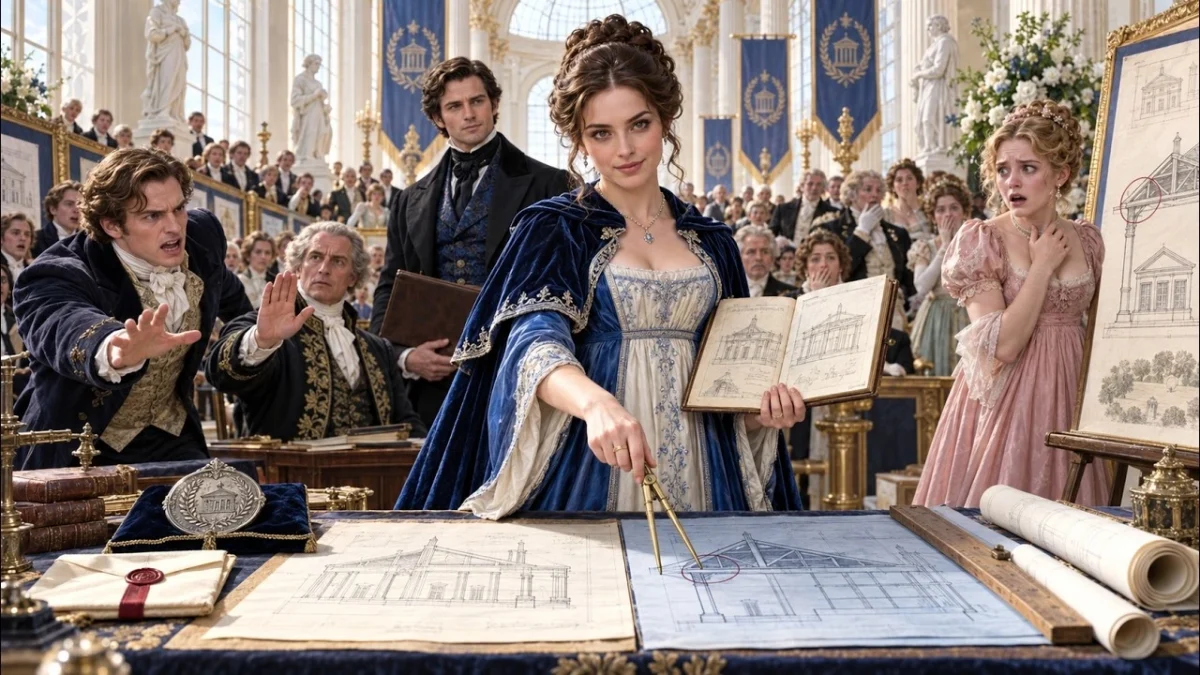
Then questions began. Eleanor raised one hand. Miss Fairmont, what supports the eastern roof after removal of the central masonry wall?
Lydia blinked. An iron beam. Of what depth? The ordinary depth? There is no ordinary depth.
The span is 32 ft. Adrienne stepped forward. This is harassment disguised as scholarship. One judge silenced him.
The question is relevant. Lydia guessed. Eleanor produced the builder’s calculation, proving the proposed beam insufficient.
Then she presented her dated sketchbooks, wax sealed drafts, and a letter from the iron founder discussing the corrected support.
The final question, Eleanor said. Why does the water pump face north? Lydia stared at the page.
In the original plan, north facing placement was a coded note reminding Eleanor to reverse the courtyard orientation after a survey.
Anyone who understood the site would know the pump must face south to avoid winter ice.
Lydia’s silence answered. The judges compared handwriting, paper, and dates. Her entry was disqualified. Whispers moved through the gallery.
Sir Thomas approached Elellanor, furious, not at theft, but exposure. You have humiliated your sister.
She signed her name to my work in public. I merely ensured the public could read it.
Lady Fairmont accused her of jealousy. Nathaniels voice cut through the room. The Duchess of Blackthornne does not require Miss Fairmont’s reputation, fiance, or stolen plans.
Jealousy generally looks upward. Lydia fled in tears. Adrienne remained. You could have settled this privately.
Private settlements are where my family buries what Lydia does. Eleanor’s corrected design won the competition.
For the first time, her full name appeared beneath her own work. The victory nearly failed during the final review.
Lydia produced a statement from Eleanor’s former made claiming she had seen Miss Fairmont drafting the plans before Eleanor’s marriage.
The judges hesitated. A sisterly dispute was distasteful. Public institutions often preferred uncertain injustice to uncomfortable investigation.
Eleanor asked the maid one question. What instrument did Miss Fairmont use to draw the curves of the pump housing?
The woman looked toward Lydia. A ruler. A ruler draws straight lines. I used a proportional compass inherited from Mr.
Pike. She opened its worn wooden case. The distinctive arc it produced matched every curved measurement in the submitted plan.
Lydia’s copy even reproduced a tiny irregularity caused by a bent hinge. Nathaniel’s solicitor then produced the maid’s recent bank deposit paid through an account controlled by Adrien.
Adrienne protested that the money was a charitable gift. The judge asked why charity required a false name.
The maid began to cry and confessed that Lydia promised her a position after marriage.
Her testimony had been rehearsed in the Fairmont morning room. Eleanor felt no pleasure in the servant’s terror.
She requested that the society decline prosecution if the woman returned the money and gave a truthful statement.
“Your sister attempted to erase you,” Nathaniel said afterward. “Why protect her accomplice?” “Because Lydia offered a poor woman security in exchange for dishonesty.
I want the truth, not a sacrifice small enough to make the powerful comfortable. The society adopted new submission rules, sealed preliminary sketches, witness dates, and individual credit for assistance.
Eleanor insisted upon the last provision. Her victory would mean little if it reproduced the same system beneath a more fashionable name.
At the award dinner, the chairman praised the Duke of Blackthornne for encouraging his wife’s talent.
Nathaniel Rose. Her grace possessed talent before I possessed the sense to recognize it. Please direct the honor accurately.
He sat before applause began. Eleanor looked at the medal in her hand and understood why the correction mattered more than the compliment.
Chapter 7. The contract changes. Victory did not immediately become happiness. The newspapers celebrated a designing duchess, but anonymous letters called Elellanor unnatural, vindictive, and incapable of sisterly affection.
Contractors questioned whether Nathaniel secretly produced the plans. One magazine suggested Hawthorne Court existed only to entertain a board aristocratic wife.
Elellanor worked harder, slept less, and stopped eating. Nathaniel found her unconscious across the drafting table.
She woke in her bed with a physician nearby and fury in her husband’s face.
You cannot prove worth by destroying the person who possesses it. I was working. You were vanishing.
The words touched an old wound. Her family noticed her only when she produced value.
Without realizing it, she had carried their bargain into freedom. Nathaniel canceled no project. He reorganized de@dlines with her consent, hired two female assistants, and established regular meals in the studio.
You do not need to earn your place here each morning. He said, “Our marriage is a contract.
The contract does not require starvation. What does it require now?” Silence changed the room.
Their separate bed chambers had become increasingly artificial. They spent evenings in the same library, mornings at the same table, and nights pausing too long at adjoining doors.
Nathaniel opened the drawer containing their articles. In 8 months, you may leave with Hawthorne Court, your earnings, and the promised settlement.
I will not obstruct you. Do you want me to leave? No. It was the first personal demand he had made.
Then asked me to stay. He crossed the room slowly. Eleanor, stay. Not because you need my title, not because your family threatens you, and not because separation would cause gossip.
Stay because the life we are making belongs to both of us. She touched his face.
Our contract requires fidelity. I have been faithful since before it existed. That sounds suspiciously romantic.
Do not tell Parliament. She kissed him. The connecting door remained open that night. Chapter 8.
Adrienne’s regret. Adrienne’s engagement began to fail after the exhibition. Lydia blamed him for not protecting her.
He blamed her for stealing incompetently. Sir Thomas demanded the hardcourt investment promised before the scandal.
While Adriennes mill creditors refused further delay. He began appearing wherever Eleanor might be found.
At the opera, he stood behind her box. At church, he waited near her carriage.
Finally, he came to Hawthorne Court and found her supervising the installation of a staircase.
We need to speak. You need many things. Conversation with me is not among your entitlements.
Lydia is not what I believed. Eleanor set down her measuring rule. Six months of deception suggested considerable familiarity.
She admired me. You always corrected me. I corrected contracts that would have bankrupted you.
Exactly. With you, I felt inadequate. There it was. The translation of her competence into his injury.
So, you selected a woman willing to pretend theft was talent. I made a mistake.
A mistake is misplacing a decimal. You maintained two courtships, accepted my help, and chose my sister.
When my father attached greater capital to her marriage, he reached for her. She stepped back.
Leave him. Adrienne said, “My uncle is cold. He cannot know you as I do.
He knows I prefer south-facing workrooms, black coffee, and silence while calculating. You knew I would forgive betrayal because I disliked conflict.”
Nathaniel approached from the garden but stopped far enough away to let Eleanor decide. Adrienne saw him and raised his voice.
Did you marry her to humiliate me? Nathaniel answered, “I married her because she asked.
I remain married because she stays.” The simplicity defeated every dramatic accusation. Adrienne left with one final appeal.
“You loved me once.” “Yes,” Eleanor said. “That is why I know exactly what you wasted.”
Chapter 9. The family’s last bargain. Sir Thomas’s finances collapsed in autumn. He had borrowed against the stone quaries to fund Adrienne’s mills, expecting Lydia’s marriage to unite the ventures.
After the plagiarism scandal, investors withdrew. Lord Pomemeroy offered rescue on one condition. Eleanor must transfer part of her grandmother’s inheritance back to Fairmont control.
Her parents came to Blackthorn House with tears and accusations. “Your sister will be ruined,” Lady Fairmont said.
Lydia ruined her own competition entry. The estate may be sold, Sir Thomas added. Your childhood home.
Eleanor felt the old reflex. Save them. Surrender. Prove usefulness. Nathaniel said nothing. This decision belonged to her.
She requested the books. For 3 days, she and Blackthornne’s accountants reviewed every debt. Fairmont could be saved without Lord Pomemeroy or her inheritance, but only if Sir Thomas surrendered management, sold the London house, and allowed Corey workers to purchase cooperative shares.
Her father rejected the plan. I will not hand family property to laborers. Then you prefer losing it to creditors.
You are my daughter. You owe me obedience. You attempted to exchange that obedience for Pomeroyy’s money.
Eleanor offered one final arrangement. She would purchase the debt at fair value and place the estate in trust.
Her parents could remain for life, but neither could mortgage it. Lydia would receive an allowance conditional upon abandoning false claims to Eleanor’s work.
Sir Thomas called it humiliation. No, Eleanor said. Humiliation is what you called my safety when it interfered with profit.
This is accounting. Lady Fairmont accepted. Her father signed only when the creditors carriage appeared at the gate.
Lord Pomemeroy then sued for breach of the informal marriage agreement. Eleanor’s solicitors produced letters showing he expected control of her inheritance and intended to confine her to his country estate after producing an heir.
The hearing drew half London. Pomemeroyy’s council argued that Sir Thomas had promised his daughter and that substantial business arrangements had been undertaken in expectation of the match.
“My client purchased quarry notes,” the barristister declared. “He prepared a daer suite. He dismissed a companion whom Miss Fairmont disliked.”
Eleanor’s barristister asked whether she had signed any promise. She had not whether she had accepted correspondence, jewels, or visits from Lord Pomemeroy.
She had refused all three. Pomememoroy took the stand and made his own position worse.
He described Elellanor as a healthy young woman of proven obedience and admitted he expected architectural work to cease because professional ambition caused barrenness.
From the gallery, Lady Beatatrice whispered loudly. His previous wives must have died of conversation.
Even the judge concealed a smile. Then Eleanor produced Pomeroyy’s letter to Sir Thomas. Once she is installed at Brackenhal, distance and pregnancy will cure these notions of independence.
Her grandmother’s trust can then be challenged as unnecessary to a properly maintained wife. The court found no enforcable agreement.
More damagingly, the letter circulated through every drawing room by supper. Families of Pomeroyy’s late wives contacted Eleanor’s solicitor.
One discovered that her daughter’s inheritance had been absorbed into an estate account. Another found a separation settlement never paid.
Pomememoroy had relied upon women being too isolated to compare injuries. Eleanor introduced them. Within a season, three claims froze his unintent property.
He withdrew to the continent, complaining that English women had become latigious. The suit collapsed.
His two former wives families began asking new questions about their settlements. For once, the old man’s appetite cost him more than a bride.
Chapter 10. Lydia without an audience. Lydia came to Hawthorne Court in winter. She wore no pearls and arrived without Adrien.
Their engagement had ended after he learned Sir Thomas could no longer finance the mills.
“He left me because there was no money,” she said. Eleanor continued marking a floor plan.
“He left me because father offered him money through you. Consistency may be his only virtue.”
Lydia flinched. “Do you hate me?” Sometimes the honesty startled them both. Lydia confessed that their mother had compared them since childhood.
Eleanor was the clever one, the reliable one. The daughter trusted with real tasks. Lydia learned that beauty and fragility drew attention faster than competence.
Taking Adrienne had been less about love than proving she could take the one thing Eleanor believed secure.
That does not excuse you, Elellanor said. I know. Do you? Lydia placed the stolen pearl earrings upon the table.
I do not know how to become anyone if I am not winning against you.
Eleanor looked at her younger sister. Not innocent, not monstrous, merely shaped by a family that turned daughters into competing assets.
Then begin somewhere no one knows my name. She arranged a place for Lydia with a charitable school in Bath.
Not as a teacher of design, but as an assistant in the nursery. There would be wages, supervision, and no audience for tears.
Why help me? Lydia asked. Because consequence should teach. Destruction teaches nothing. Will you forgive me?
Not today? Lydia nodded. It was the first answer she accepted without attempting to change it.
Chapter 11. Hawthorne Court. Hawthorne Court reopened one year after Eleanor first entered its ruined hall.
The central wall had been replaced by an iron support concealed within carved oak. Southern windows filled the rooms with winter light.
Service passages reduced unnecessary labor. Water pumps remained unfrozen, and every nursery chimney drew cleanly.
The old Duke of Asheford inspected the building with three architects. It stands, he admitted, an unexpectedly useful quality in a house, Eleanor replied.
He offered her a commission to redesign tenant cottages across two estates. Her studio employed four women and three men.
Every drawing bore the contributors name. Apprentices received wages rather than gratitude. At the opening ball, guests gathered beneath the ceiling Eleanor designed.
Some had mocked her after the marriage. Now they competed to praise the Duchess who made practicality fashionable.
Nathaniel found her alone on the terrace. Our year expires at midnight. She had known the date without admitting it.
He handed her two documents. One was a separation agreement already signed. The other was a new marriage settlement, removing the term entirely while preserving every independent right.
Choose, he said. Eleanor read both. If I select the second, what do you receive?
Breakfast arguments, unauthorized alterations to ancestral houses, and the continued possibility that you will improve my character.
A severe bargain. I am prepared to suffer. She tore the separation agreement in half, then suffer permanently.
Nathaniel kissed her while music drifted through the open doors. Inside, Adrienne watched from the edge of the ballroom.
He had come with his mother and stood alone. When Eleanor laughed against Nathaniels mouth, he finally understood something simple and irreversible.
She had not married the Duke to punish him. She had married the Duke to escape.
She stayed because she was loved without being diminished. Chapter 12. Her own Own Name.
In later years, Scandal Sheets reduced Eleanor’s story to a delicious sentence. Jilted by her childhood love, she married his Duke uncle before supper.
The truth was larger. She had been betrayed by Adrien, but also by a household that measured daughters according to exchange value.
Nathaniel had offered protection, but protection alone would merely have replaced one dependency with another.
Their marriage survived because he respected the work, property, and choices that made her more than his wife.
Fairmont recovered under professional management. Cory workers owned shares and elected a representative to the trust.
Sir Thomas complained until dividends arrived. Lady Fairmont discovered charity committees where her talent for social pressure became unexpectedly useful.
Lydia remained in Bath for two years. She eventually married a widowed schoolm who knew her history and required neither helplessness nor rivalry.
Forgiveness between the sisters came slowly through letters that contained no demands. Adrienne lost the mills.
He rebuilt a smaller life managing another man’s estate. Work that forced him to distinguish charm from competence.
He wrote Eleanor once, apologizing without asking for return. She believed the apology. She did not answer.
Lord Pomemeroy retired abroad after investigations into his former wife’s settlements. Women who might once have been offered to him as solutions heard the story and refused.
Eleanor’s designs spread across Britain. Hospitals requested her ventilation plans. Schools copied her windows and courtyards.
A book appeared under her full professional name. Practical Rooms in Humane Houses by Eleanor Fairmont Ashford, Duchess of Blackthornne.
At the book’s first public lecture, a young woman asked whether marriage had made her career possible.
Eleanor looked toward Nathaniel, seated in the back row rather than upon the platform. Money, access, and legal protection made many opportunities possible, she said.
But no husband can bestow a mind upon his wife. At best, he may decline to stand in its way.
Nathaniel applauded first. That evening they returned to Hawthorne Court. Their daughter had covered a nursery wall with crooked houses.
Their son was asleep beneath the drafting table. A hereditary disorder, Nathaniel observed. Talent, disrespect for furniture.
Eleanor leaned into him. Once she believed safety meant belonging to the most powerful person available.
Her parents had offered Pomeroy on that principle. Adrienne had offered childhood familiarity. Nathaniel offered something more difficult and valuable, a door she could open from either side.
Do you regret the speed? She asked. I regret that Lady Beatatrice made us wait until 3.
You did not know me. I knew you negotiated your exit settlement before accepting a duchess’s coronet.
It suggested excellent priorities. She smiled. Beyond the windows, light-filled rooms that had once been considered beyond repair.
Eleanor understood the resemblance without needing to say it. Her family had called her difficult, serious, and unlovable when she refused to become useful on their terms.
Nathaniel had never rescued her from being those things. He had given her room to discover they were not defects.
The house stood because she had redrawn its support. So did she.








