My Fiancée Ranked My Sexual Failures for Her Bridesmaids… So I Returned the Wedding Folder
My Fiancée Ranked My Sexual Failures for Her Bridesmaids… So I Returned the Wedding Folder
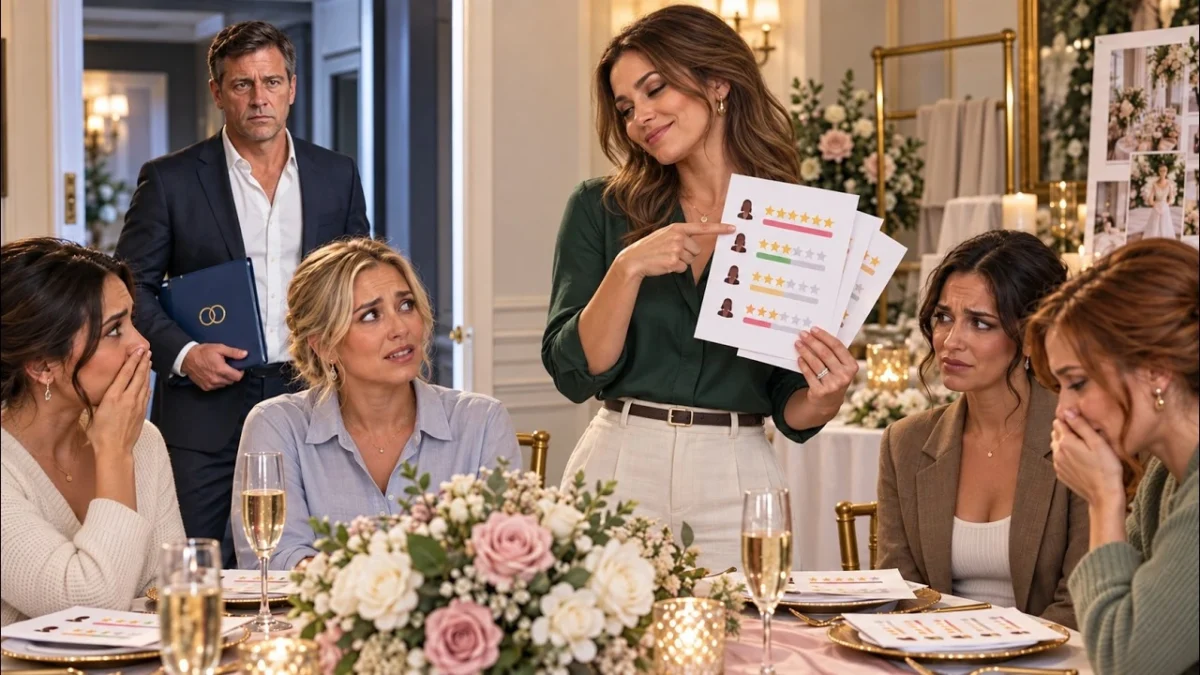
My fiancée read a scorecard of my sexual failures to her bridesmaids while I stood in the doorway holding our blue wedding folder.
“Staying hard: four out of ten,” Dana said. “Satisfying me: three. Confidence: two. Size: five, and I’m being generous.”
One woman gasped. Two laughed. Tessa asked, “Where did the answers come from?” Dana smiled.
“Me. I supplied every one. Who else would know?” I stepped into the side room.
The smiles vanished. Dana folded the card against her palm. “Nathan, it’s a private bridal joke,” she said.
“A roast. You weren’t supposed to hear it.” She reached for the folder. “Give me that.
Elena needs the signatures.” I held it at my side. “You made our bedroom a scorecard?”
A bridesmaid pushed the remaining cards beneath a napkin. Tessa said, “Dana, stop. He heard you.”
Dana answered, “Then he shouldn’t have listened outside a closed door.” I turned and walked straight to Elena, the venue coordinator.
Dana followed, calling my name. I put the blue folder on Elena’s table, still unsigned.
“We won’t need this,” I said. “The wedding will not happen.” Elena looked from me to Dana.
“Are you certain?” “Yes.” Dana grabbed the folder’s edge. “You cannot cancel our wedding over a stupid card.”
I let go. “I’m not ending this because of cardstock. I’m ending it because you made me group entertainment for the women who were supposed to stand beside us.”
Dana’s face went white. Then she said, “You’re humiliating me in front of the coordinator.”
Elena closed the folder without looking inside it. She told us she would give us privacy and stepped into her office.
Dana pulled the folder toward herself as if possession could restart the walkthrough. She said we could finish the signatures after I calmed down.
I told her there was nothing left for us to sign together. Three bridesmaids had followed us into the hall.
Dana looked at them and asked why nobody was explaining that the scorecard was only a game.
None of them answered. I asked Dana one question. “Did you write those categories and provide those scores?”
She crossed her arms. “Yes, because it would have been weird for them to guess.”
“That is the whole problem.” “No, the problem is that you heard something meant for the bridal party.”
She still believed the audience was an accident. It wasn’t. The audience was the purpose.
I walked toward the elevator. Dana followed me past the sample tables and caught the doors before they closed.
She said I owed her five minutes after four years together. I told her I would speak with her when she could describe what she had done without blaming the door, the bridesmaids, or me for hearing it.
She said women talked about sex with their friends all the time. I said talking was not the same as creating categories, assigning numbers, printing cards, and performing the results.
The elevator opened at the lobby. Dana stepped out with me and said, “You just made me look insane in there.”
“I didn’t read the card.” “You didn’t have to cancel everything in front of Elena.”
“I returned a folder to the person who gave it to us. You chose the crowd.”
Outside, Dana asked if I was really throwing away four years because her friends had laughed.
I told her the laughter hurt, but it was not why I was leaving. She had taken information I trusted her with and shaped it for applause.
She had done it voluntarily, before our wedding, with the people she had chosen to stand closest to us during our vows.
I got into my car. Dana had arrived with Tessa, so she had a ride.
Before I drove away, I told her clearly that the engagement was over, not paused, and that I would not be returning to finish the walkthrough.
Our wedding had been five weeks away. The blue folder contained the ceremony schedule, the final seating plan, and pages where we were supposed to confirm the last choices.
I had carried it because I was usually the one who remembered practical things. Dana used to tease me about being the operations department of our relationship.
Until that afternoon, I had considered the joke affectionate. We had been together four years and engaged for fourteen months.
Our sex life had never been effortless, but I had not considered it broken. There were warm, easy stretches and tense ones.
Over the previous six months, Dana had become quieter in bed. If I asked what she wanted, she would say I was turning intimacy into an interview.
If I tried something different, she sometimes went still and then insisted she was only tired.
Twice, I lost my erection after sensing her pull away. Neither time became a fight.
I asked whether she was attracted to me and whether something needed to change. She kissed my shoulder and said I was overthinking it.
On another night, I asked if she was actually satisfied. Dana said yes, then accused me of fishing for reassurance when I asked a second time.
I believed her first answer because believing your partner is one of the ordinary risks of loving them.
If she had told me privately that I was not satisfying her, I would have been hurt.
I also would have listened. We could have slowed down, talked more directly, tried different things, or admitted that we were incompatible.
None of those possibilities required either of us to be ashamed. A difficult bedroom conversation could have changed our relationship, but it would still have treated us as partners.
The scorecard was different. It turned every vulnerable moment into material. My body, the two times I had lost my erection, and questions I had asked because I cared about her experience had become categories in a competitive game.
Dana had not been too frightened to discuss sex. She had discussed it in detail.
She had simply chosen five other women instead of me. When I reached our apartment, Dana was not there.
The paper calendar on our refrigerator still showed the remaining wedding appointments in blue ink.
Friday said venue walkthrough. Saturday said final suit fitting. The wedding date had a thick circle around it.
I took the calendar down and placed it facedown on the kitchen counter. Then I sat at the table and listened to the refrigerator cycle on and off because every other sound in the apartment belonged to a future that had just stopped.
Dana sent one message that evening. She said she would stay with Tessa and come home after I had slept.
Then she proposed telling our families that wedding stress had forced us to postpone. I answered once.
“The engagement has ended, and the wedding is canceled. I will not describe a permanent decision as a postponement.”
The next morning, I sent a brief message to our parents, siblings, and wedding party.
I said Dana and I were no longer engaged, the wedding would not take place, and nobody needed to choose sides or ask for private details.
I did not repeat the scorecard lines. I did not send pictures of the cards or tell people which bridesmaids had laughed.
Publicly humiliating Dana would not have restored anything she had taken from me. My mother called first.
She asked whether Dana had cheated. I said no. She asked whether I was certain about ending a four year relationship over a bad joke.
I told her the joke contained details from our sex life and that Dana had created it for her bridesmaids.
My mother went quiet. Then she asked whether Dana had apologized. I said she had defended the privacy of the room, not the privacy of our relationship.
Dana’s mother called that afternoon. She said Dana was devastated and described the scorecard as a tasteless bridal game that had gotten out of hand.
I asked her one question: “Who supplied the answers?” She said Dana had. I told her that was all she needed to understand.
I would not discuss the ratings with her or turn our parents into referees. She did not agree with my decision, but she stopped asking me to reverse it.
The ordinary routines changed before the apartment did. Sunday morning came without Dana reading wedding emails across from me.
I bought groceries for one person and kept reaching for things she liked out of habit.
Her mug stayed in the cabinet. The dry cleaner returned only my shirts. At night, I no longer heard her practicing the ceremony music while she brushed her teeth.
None of those changes felt dramatic. Together, they made the ending real. During that first week, Dana kept returning to the wrong injury.
She said Becca should never have printed the cards. She said Tessa should have warned her when I approached the room.
She said the bridesmaids had encouraged her to make the scores harsher because mild answers would not be funny.
Each explanation moved responsibility around the room while leaving Dana in the center holding the card.
I replied that I would meet her once when she was ready to speak plainly.
We agreed on one hour at a quiet café the following Saturday. No parents, no bridesmaids, no discussion about reviving the wedding schedule.
I wanted to understand whether the woman I had planned to marry could finally name the choice she had made.
Understanding was not a promise to reconsider. Dana arrived early and sat at a table near the back.
She had no wedding binder, no rehearsed pages, and no one waiting nearby. When I sat down, she started with, “I know the joke went too far.”
I said, “That still makes the joke sound like something that escaped from you. Tell me what you did.”
She stared at her coffee for several seconds. Then she said, “I wrote a scorecard about your erections, whether you could make me come, your confidence in bed, and the size of your dick.
I gave copies to my bridesmaids and read my answers out loud because I wanted them to judge whether I was settling.”
It was brutal. It was also the first honest sentence she had given me since I entered that side room.
I asked how the game started. Dana said that months earlier, the bridesmaids had spent a brunch boasting about their partners.
The conversation became competitive. One woman talked about stamina. Another talked about size. Dana had felt embarrassed because our sex life had been tense, but she did not want to admit that she sometimes became so worried about performing pleasure that she could not experience it.
Instead, she complained about me. The complaints got bigger because bigger complaints got stronger reactions.
Someone joked that every bride should complete a final scorecard before the wedding. Dana volunteered to make hers first.
Becca printed the cards, but Dana chose the categories and wrote every answer. The side room reading was supposed to be the final vote on whether Dana was marrying a man who could satisfy her.
I asked whether the scores were true. Dana said some were based on real frustration and some were exaggerated.
The rating for staying hard came from those two nights when I had lost my erection.
She admitted she had never told her friends that she had gone silent and turned away before it happened.
The satisfaction score came from orgasms she had faked because she feared taking too long.
The confidence score was mostly invented because she thought it made the list funnier. The size rating came from comparing me to a former boyfriend, something she had never once raised with me.
“Why didn’t you tell me any of that?” I asked. “Because then I would have had to admit I was part of it,” she said.
“Sometimes I get so focused on whether I look sexy or whether I’m taking too long that I disappear into my own head.
If I told the girls you were bad in bed, they told me I deserved better.
That felt easier than wondering if something was wrong with me.” I told her nothing was wrong with needing time, reassurance, or a different kind of intimacy.
The problem was that she had protected herself from one vulnerable conversation by making me carry all the shame.
She did not merely seek advice from a trusted friend. She turned dissatisfaction into a contest and offered my private failures as the entertainment.
Dana nodded. She said she had wanted her friends to validate her. If they agreed I was sexually inadequate, then she would not have to ask for what she wanted or admit that some of the distance came from her own anxiety.
The more they reacted, the more certain she felt. She knew the numbers were cruel.
Their cruelty was what made the game work. I asked whether she had intended to tell me about the scorecard after the wedding.
“No,” she said. “Would you have apologized if I had not heard it?” “No.” “Were you still planning to marry me?”
“Yes.” That answer settled something in me. Dana had not created the cards because she was trying to end our relationship.
She had intended to marry me while preserving a private audience where contempt for me was acceptable.
She wanted the security of a husband and the approval that came from presenting him as sexually deficient.
I told her that private incompatibility was painful but fixable. We could have learned more about each other.
We could have discovered that our needs did not match and separated without degrading one another.
What I could not fix was becoming a product she delivered to a group. Every intimate question after that would carry another question behind it: Was she answering me, or collecting material for them?
Dana apologized without adding a defense. She said she had been cruel, cowardly, and competitive.
She said the worst choice was not letting the bridesmaids hear it; it was inviting them to judge something that belonged between us.
She admitted that when I entered the room, she cared first about being caught. That was why she blamed the closed door and accused me of humiliating her in front of Elena.
I believed that apology was sincere. Believing it did not restore my desire to marry her.
Dana offered to gather the bridesmaids and tell them every score had been distorted. She offered to tell both families exactly why I had canceled the wedding.
She said we could discard the current plans, spend a year rebuilding, and become engaged again later.
I told her not to stage another group event on my behalf. She could correct the claim that I had panicked over wedding stress, but my sexual history did not need a second presentation, even one designed to defend me.
Then I told her there would not be another engagement. Returning the folder had not been a threat meant to force better behavior.
It was my decision. I could accept that she regretted what she had done and still refuse to place my most vulnerable self back in her care.
Dana cried quietly. She did not accuse me of overreacting again. Near the end of the hour, she said, “I finally told the truth, and it’s too late.”
I answered, “It is not too late for you to stop doing this to someone.
It is too late for us to get married.” We left separately. There was no final embrace and no promise to check in after emotions settled.
We agreed that future communication would be limited to finishing the practical separation of our lives.
Two weeks later, Dana told both families that she had shared intimate information, made it into a degrading game, and broken my trust.
She did not repeat the ratings. Her mother sent me one apology and did not ask me to reconsider again.
Dana moved her remaining things out while I was at work. I later moved to another apartment when it made sense for my routine, not as a dramatic escape.
At my mother’s next Sunday lunch, she set one fewer plate. My sister stopped including Dana in family messages.
Friends who had expected to see us married learned to invite us separately. The consequences spread through ordinary habits instead of one explosive scene.
For a while, I questioned whether a sincere apology should have changed my answer. I did not want anger to make the decision for me.
But the calmer I became, the clearer the difference looked. Forgiving Dana’s apology meant I no longer wanted to hurt her back.
It did not mean I trusted her with access to my body, my uncertainty, or my future.
Marriage would have required that trust every day. The unused wedding date arrived five weeks after the walkthrough.
My phone displayed the old ceremony reminder before I deleted it. I spent that Saturday helping my brother assemble shelves in his garage, then ate dinner with his family.
Nobody made a replacement celebration out of it. The date passed like an ordinary day, which was painful in the morning and relieving by night.
There was no ceremony to reschedule because there was no engagement left to protect. Five months have passed since the walkthrough, and the date printed on our invitations passed almost four months ago.
Dana and I are not engaged, not taking space, and not working toward another try.
We are no longer in contact. Our last conversation ended with a mutual agreement that the wedding was canceled for good and the relationship was over.
The irreversible part is not the money or the embarrassment of notifying people. It is that the ceremony never happened, the date is gone, and five women who were supposed to witness my vows were instead invited to grade the most private parts of me.
No apology can make them unhear her answers, and I no longer want to build a marriage around pretending they did.
I kept the charcoal suit I had bought for the ceremony. I had the trousers shortened without the extra break Dana liked and removed the pale pocket square from the breast pocket.
I have worn the suit twice since then, once to a presentation and once to my nephew’s winter concert.
Tonight, the jacket is draped over the back of my dining chair while I replace a loose button before work tomorrow.
The thread keeps slipping through my fingers, so I turn on the brighter kitchen light and try again.
When the button finally holds, I set the needle in its little paper case, smooth the lapel, and leave the jacket there for morning.








