Mountain Man Turned from the Town Beauty and Chose the Sister Nobody Wanted
Mountain Man Turned from the Town Beauty and Chose the Sister Nobody Wanted
The calluses on a woman’s hands will tell you more about her than the silk at her throat ever will.
Everyone in Garnet Falls knew Clary Edwardson was the prettiest girl the Okanagan country had ever produced.
Pale gold hair, a laugh like windchimes. Hands so soft she lined her gloves with rabbit fur just to keep them that way.
Her older sister, Cigrid, was the one they called on when the smokehouse great collapsed.
When a pack mule threw a shoe in the mud, when the trading post ledger needed balancing before the creditors came calling, Cigrid kept that family solvent, kept the shelves stocked, kept the whole rickety operation breathing, and received in return a bed above the back storeroom, and the right to eat her meals in the kitchen.
When Tovvelcain came down from the high country, with a season’s worth of of prime links and martinfur and gold dust, enough to pay a man’s wages for 3 years, every unmarried woman in Garnet Falls put on her best dress.
Every father started calculating. Nobody put money on cigarid. They were wrong. A man who has survived six winters above the snow line learns eventually the difference between a fire that looks beautiful and a fire that actually keeps you alive.
 Toville had ridden down from the upper Fraser Plateau in 5 days, which meant he had pushed his horses hard and himself harder.
The high country exacted its toll. His face was windcoured, the skin tight and dark over the bones.
His dark hair grown past his collar and shot through at the temples with gray he hadn’t earned in any town.
He was a big man in the way that wilderness makes men big, not from vanity, but because surviving at altitude requires a body that doesn’t waste a single thing.
He wore a canvas duster patched at the elbows twice and smelling of pine pitch and muskrat.
His hands wrapped around the lead rope of his packor were cracked across the knuckles and stained a permanent dark ochre from tanning hides.
He hadn’t spoken to another human being in 4 months. It showed he tied his horses at Edvson’s trading post without a word to the two men lounging on the porch and pushed through the door.
The post smelled of dried tobacco, coal oil, and the sweet rot of bulk molasses.
Clary was behind the counter, arranging a display of ribbon in the window. She heard him come in and turned with practice, letting the light from the glass fall across her hair in a way that was not entirely accidental.
She had been doing this her whole life without ever needing to be taught. Hello, she said her voice was warm as a parlor stove.
Are you passing through? To looked at the ribbon and the careful posture and the milk white hands.
His expression didn’t change. Need to trade? He said his voice had gone rusty from disused pelts and I’ll want flour, salt, coffee, and dried beans.
Clary brightened. We can certainly help you with that. Papa is just in the back.
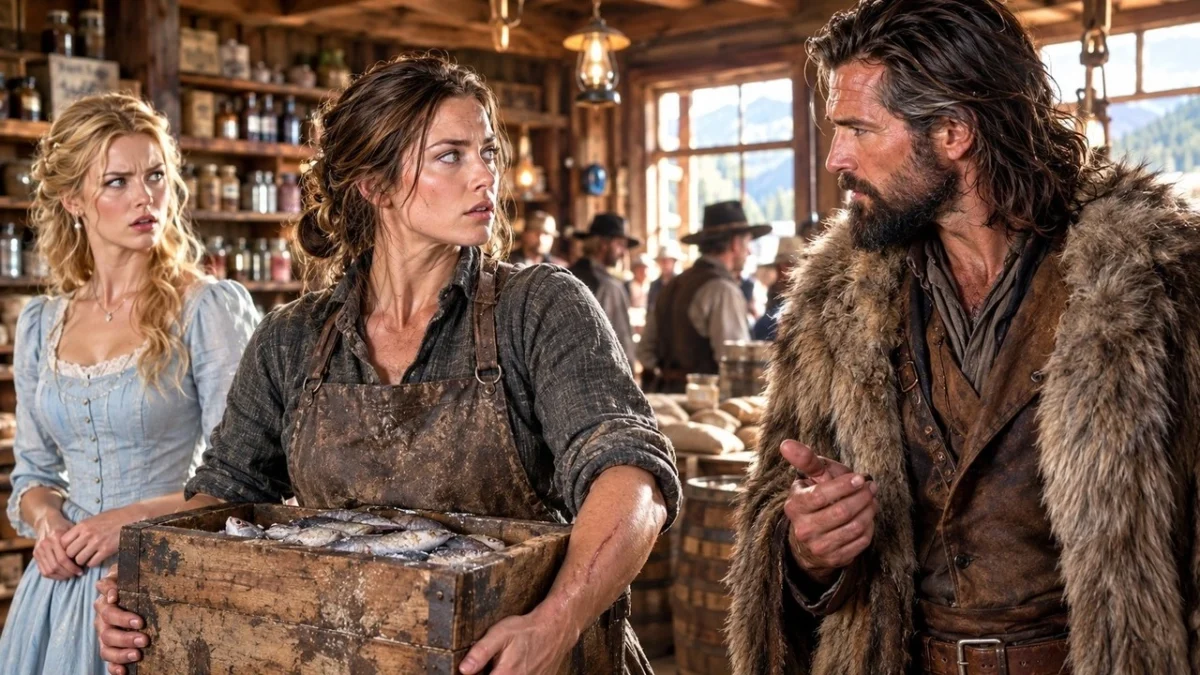
The rear door banged open. A woman backed in through it, hauling the near end of a heavy crate packed with brinecured fish.
She was moving fast, her weight low, boots braced against the rough floor planks. She was broad shouldered, her arms thick with working muscle, her dark hair tied back with a strip of rawhide.
A long thin scar ran from her right forearm up past her wrist, the kind left by a blade, or a saw moving fast through careless timber.
She wore an oil skin apron stiff with brine, and the particular smell of hard work done in the coal.
She cleared the doorframe, set the crate down with a controlled thud, and straightened. She finally looked at the stranger.
Her eyes were a peculiar shade. Not quite gray, not quite green, the kind of eyes that see without performing.
“Cigrid,” Clary said tightly, “we have a customer.” Cigrid wiped her hands on her apron.
She looked at the man standing in the middle of the shop. She looked at his cracked knuckles and the packorse visible through the window, and the particular kind of stillness that comes from living alone a long time.
She didn’t smile and she didn’t fluster. She said, “You’ll want to stable your horses.
Grounds going to Frost tonight. Boyd’s livery is down the block on the left. He’s fair.
Tell him Scrid sent you, and he won’t charge you for the extra hay.” To looked at her.
It was the first useful thing anyone had said to him since he rode into town.
“Much obliged,” he said. He stayed 4 days. The town’s autumn social was on the second evening, a fiddle supper in the Graange Hall, the kind of event where half the people come to eat and the other half come to see who is standing next to whom.
To went because his horses needed another day’s rest, and he had nothing else to do.
He stood against the back wall with a cup of something that was supposed to be punch and watched.
Clary was in the center of the room wearing a dress of deep amber cotton that made her hair look like spun harvest wheat.
She was surrounded. She had a gift for making every man in her orbit feel as though he were the one she’d specifically come to see.
She found Toval within 20 minutes. “You should dance,” she told him, touching his sleeve with two fingers.
The touch was light, just enough pressure to suggest a claim without making one. I haven’t danced with anyone half as interesting as you all evening.
To looked at those two fingers resting on his wool sleeve. He felt the touch through the fabric, and what he felt was nothing except a vague irritation, like a fly landing on his arm.
“I don’t dance,” he said. Clary’s smile held. Every man dances with the right partner.
He set his cup down on the nearest table. “Excuse me,” he said, and he walked out the side door into the cool, dark.
The graange hall sat on the edge of the river flat. Behind it, a narrow path led down through the wood lot to the town’s communal smokehouse.
Toval walked until the fiddle music softened to a murmur, and the cold came up from the river and cleared his head.
Then he heard the sound, rhythmic, heavy, a splitting mall hitting Greenwood over and over, steady as a clock.
He followed it. Cigrid was working in the wood lot behind the smokehouse, splitting older rounds in the lantern light.
She had changed out of her oil skin, but she was still in her work clothes.
Heavy canvas trousers, a wool shirt with the sleeves rolled to the elbow despite the cold.
She swung the mall with the complete economy of someone for whom the motion has become thoughtless automatic.
The blade fell, the round split clean. She kicked the halves aside and set the next piece.
She hadn’t bothered attending the social. She hadn’t even considered it. To stood at the edge of the lantern light.
He should have announced himself. He didn’t. He watched her work. There was something in it.
The competence, the total absence of performance. That was like cold water after a long thirst.
When she paused to wipe her forehead, she saw him. She didn’t jump. She just lowered the mall and waited.
“You didn’t stay for the supper,” he said. “She tilted her head toward the smokehouse.”
Venison rack needed turning, and someone had to split the morning wood. “You do all of this?
Most of it, she said it without bitterness, just straight. He walked to the splitting block, picked up an unsplit round, set it, and swung.
Then he picked up another. She watched him for a moment, then went back to work beside him.
They split wood together in the lantern light for nearly an hour, neither of them talking.
It was the most comfortable Toolville had felt since he left the mountain. Finally, he said, “I live at 4,000 ft north of Revel Stoke.
The valleys may be a mile wide, and the nearest neighbor is a trapper who doesn’t speak, and a black bear that thinks he owns the creek.
Winter starts in October and runs through April, some years longer.” She stopped swinging. She turned to look at him.
“I know what you’re saying,” she said. “Do you? You’re telling me what you have to offer and what it costs.
He looked at the lantern light on the scar on her forearm. He said your sister would last until the first hard frost.
Sigrid’s jaw tightened. Don’t talk about Clary. I’m not talking about Clary. I’m talking about you.
She was quiet for a long moment. She set the mall against the block. She said, “What makes you think I want to go anywhere?”
He didn’t have a poetic answer. He wasn’t built for poetry. He said, “The way you walked out of that store the first day.”
“Like you’d forgotten something outside and couldn’t wait to get back to it.” She stared at him.
Something shifted in her face. Not softness exactly. Recognition, maybe. The slightly stunned look of a person who has been seen accurately for the first time in a long while.
I leave at first light day after tomorrow, he said. I’m buying two more pack horses in the morning.
If you want to come, be at Boyds at dawn. He picked up the lantern, handed it to her, and walked back toward the graange hall without looking back.
She was at Boyds at dawn. She had one canvas bag, a heavy coat that had been her mother’s, and a skinning knife in a worn leather sheath on her hip.
Tolv had the hottes loaded and ready. He looked at her boots, good ones, oiled and laced to the knee, and nodded once.
That was the entire exchange. The trail climbed fast. Within an hour the poppplers gave way to lodgepole pine, and within 3 hours the pines thinned, and the air went thin with them.
Sigrid walked. The horses had enough weight. To walked, too, leading the string, and that told her something about him that she filed away quietly.
On the second afternoon, the trail crossed a frozen creek on a shelf of ice that hadn’t seen direct sun in weeks.
To went first, testing with a long pole. He led the first two horses over.
He was halfway back for the third when it went. The lead pack horse broke through, both front legs punching into the black water, the current immediately dragging at the loaded paniers.
The horse screamed and began to lunge. Each lunge pushing it further through the ice.
Toville dropped the pole and lunged for the lead rope, wrapping it around his forearm.
The weight hit him like a wall. He skidded toward the creek bank, boots carving furrows in the snow.
Sigrid was already moving. She didn’t go for the rope. She grabbed the nearest pania strap, a thick leather billet attached to the pack frame, and unbuckled it in three fast, sure movements.
She stripped the heaviest pack off the horse’s back and threw it onto the ice.
200 lb of de@d weight, gone, the horse surged upward, suddenly lighter, and Toville heaved the rope, and together they dragged the animal up onto solid footing, and from there to the bank.
The horse stood blowing and trembling, its legs streaming water already beginning to freeze in the cold air.
Toal looked at her. She was on her knees in the snow, checking the horse’s legs, running her hands down each cannon bone with practiced focus.
Nothing bowed, she said. She looked up. You’ll want to blanket him fast. He already had the blanket out of the second horse’s pack.
They made camp on the high side of the creek. In the last of the daylight, a fire built up hot against the cold, dropping fast.
“The paniers held half the flower and most of the coffee. It was a real loss, and both of them knew it.
You could have lost the horse entirely,” Cigrid said. “She was pulling wet leather through her hands, ringing the water out.
We’d have had a harder time explaining that to the mountain.” He looked at her over the fire.
“Where did you learn to strip a pack frame that fast?” “My father bought horses he couldn’t afford and couldn’t keep,” she said.
“Someone had to learn.” She went back to the leather work. To watched her for a while, the fire light moving across her face and the scar on her arm, and he felt something in his chest that was unfamiliar and not entirely comfortable.
It was the feeling of being glad for someone’s presence. He had stopped expecting to feel that.
He pulled a small tin from his coat pocket and held it out. She took it, opened it, made a face at the smell.
Bare fat and pine resin, he said. Keeps the leather from cracking. She handed it back.
Same for hands, I imagine. He handed it back to her. She used it on both the leather and her own skin, and didn’t thank him again.
And that was exactly right. The cabin was a day and a half further up.
It sat on a bench above the treeine, surrounded on three sides by gray limestone, and fronted by a narrow meadow that would run with snow melt come spring.
It was a serious building. Thick logs, a sod roof already buried in the season’s first snow, a door made of 2-in planks banded in iron.
No ornamentation of any kind, a building that had decided what it was, and kept its word about it.
Sigrid walked the perimeter once before she went inside. She checked the chinking, the roof overhang, the height of the wood pile.
Then she went in and stood in the middle of the single room and the great stone hearth, the bed built into the wall piled with skins, the rough table and two mismatched chairs, the traps hanging from the rafters, the smell of old smoke, pine pitch, and the animal musk of a place that had been lived in hard.
“It’s a good cabin,” she said. To was at the hearth building the fire. He paused and looked at her.
Most people said it was rough. It is rough. That’s not the same as bad.
That night he slept on the floor beside the hearth on a rolled elkhide and told her the bed was hers.
She looked at the floor, then at the bed, then at him. I won’t argue tonight, she said.
I’m tired, but this arrangement isn’t permanent. In the morning, the fire was low, and she had already rebuilt it before he woke.
And there was water heating on the grate. He lay still for a moment and listened to her moving around the cabin and felt the unfamiliar thing in his chest again.
November came down hard. The cold that settled over the high country above Revel Stoke was a different creature from town cold.
It had weight and intent. Pressing on the cabin walls at 40 below, cracking the pine trees in the nightlike rifle shots.
They fell into the rhythms of survival the way that compatible people sometimes do without needing to discuss it.
Sigrid took the fine skinning work. She was faster than him at it, the precise knife work of keeping a hide intact.
He took the heavy hauling and splitting. They learned each other’s pacing and stayed out of each other’s way and ate together in the evenings beside the fire.
She proved herself in the small ways first, repairing the smokehouse rack with split cedar, and wire when the weight of curing venison brought the old frame down, recolking the north wall when wind started whistling through a gap in the chinking, sharpening every blade in the cabin, including ones he hadn’t touched in 2 years.
He noticed all of it and said very little, which was his way of indicating approval.
She proved herself in the large way in January. Toville had gone out to run the high trap line, a long loop that swung north toward the ridge and back.
A day’s work in good weather. The weather turn. A chinook had softened the snow pack the day before.
And then overnight the temperature dropped 50° and everything froze again in a new configuration.
Hard crust over soft snow, treacherous and exhausting to travel through. He made it to the far end of the line and turned back, but the return took twice as long, and by the time the light went bad, he was still 2 mi out.
He misjudged a slope in the dark. He went through the crust and into the soft snow beneath up to his chest, and the weight of his pack drove him down before he could throw it off, and the snow compacted around him, and held.
He got free eventually, but it cost him 20 minutes of agonizing effort in the dark.
By the time he reached flat ground again, his hands had lost feeling, and the shivering had started in his core, which was bad.
He knew the math. Extreme cold, still a mile from the cabin. He moved because moving was the only option.
Sigrid had hung a lantern on the corner post when the weather turned. A bearing point in the dark, a habit from her father’s farmstead days.
She had been watching the treeine for an hour, when the distant light she’d been willing into existence finally materialized, moving wrong, too slow, too wavering, she didn’t hesitate.
She tied a rope to the door latch and took the other end with her.
She found him 40 yard from the cabin, moving on pure stubbornness, his legs barely bending at the knee.
She got under his arm without a word. He was too far gone to protest and too experienced to waste breath on pride.
She walked him in. The rope led them back to the door when the dark closed everything down.
Inside she stripped his outer layers fast, the way she had stripped the pa from the horse, efficiently, no wasted motion.
She had the fire built high. She piled furs on him and pressed herself after them, her warmth against his ice cold back.
He shook so hard the skins shook with him, and she wrapped her arms around his chest and held on and told him flatly that she had not walked 4,000 ft up a mountain to watch him die of bad judgment on the last mile home.
He tried to say something. She told him to be quiet and breathe. He was quiet and he breathed.
By morning the shivering had stopped and the fever had started. She fought it the way she fought everything.
Stubbornly, methodically, without drama. Willow bark tea, cold cloths on his neck, broth forced past his clenched teeth with patient determination.
On the second night of the fever, he grabbed her wrist in the dark and held it without saying anything, his grip strong even through the delirium, and she sat beside him on the edge of the bed and let him hold on.
She stayed there until the grip loosened, until the fever flush left his face, and his breathing went deep and even.
She did not sleep. He recovered slowly, and it infuriated him. He sat wrapped in furs by the hearth, carving trap stakes from cedar, watching her run the high line and do the heavy work.
He said very little. He wasn’t good at saying things. On the day she came back from the trap line and set a prime martin pelt on the table, the best catch of the season taken clean at the neck.
He got up from his chair without speaking, took the pelt, and turned it over in his hands for a long time.
Then he set it down and put his hand over hers, just briefly, the rough, dry palm covering her knuckles for the span of a breath.
Then he let go and went back to his chair. It was the most romantic gesture she had ever received in her life.
She recognized it as such. Spring came in mud and bird song. The creek flooded its banks, and the meadow turned a violent green.
They patched the sod roof together, working from opposite ends and meeting in the middle.
And at some point during the work, she looked up and found him looking at her.
And neither of them looked away for a moment that lasted exactly as long as it needed to.
The rider came up from Garnet Falls in late May, a young man on a rangy bay geling, who looked profoundly uncomfortable with the altitude.
He pulled up in the yard and said he had a message for Sigrid Edvson from her father.
Sigrid was splitting kindling. She set down the hatchet. The message was that Clary had married well, a Victoria businessman, a house on the better side of town, an easy life, and that the trading post needed a manager now that Clary was gone, her own room, her own wages, a proper situation.
The rider shifted in his saddle and recited carefully that people in town talked sometimes about the situation up here and that it wasn’t too late to come down and live decently.
Sigrid looked at the cabin. She looked at the cabin. She looked at the meadow and the ridge above it and the improbable blue of the sky at this altitude.
She looked at Toval, who had come to the doorway and was leaning against the frame with his arms crossed, watching the rider with an expression that was neither welcoming nor threatening.
Just present, just there. She picked up the hatchet. Tell him thank you, she said.
Tell him Clary sounds happy and I’m glad of it. The rider waited. She split another piece of kindling.
The blade hid clean. And tell him I’m happy, too. That’ll probably surprise him, but it’s the truth, so he should have it.”
The rider looked between her and the man in the doorway, and seemed to conclude the conversation was finished.
He turned his horse and picked his way back down the trail. The yard went quiet again.
Just the creek and the wind through the new pine needles and the particular silence of the high country that Sigrid had decided somewhere between November and now was not emptiness at all.
It was space. It was room to breathe. It was the sound of a life built to her actual measurements, not the ones the town had assigned her.
She gathered the split kindling into her apron and carried it to the porch. To moved aside to let her pass, and as she went by him, he reached out and tucked a loose strand of her hair back from her face.
The collused pad of his thumb careful against her cheek, the way a man handles something he finally knows the value of.
She didn’t stop walking, but she smiled, facing away from him into the cool, dark of the cabin.
The mountain saw none of it. The mountain didn’t need to. It just stood there, immovable and patient, keeping the wind off them while they figured out the








