“I Can’t Read Your Letter,” She Admitted — “Then I’ll Read It Aloud Before the Whole Church”
“I Can’t Read Your Letter,” She Admitted — “Then I’ll Read It Aloud Before the Whole Church”
Tessa Brangan had come west on an orphan train at the age of six, one of 40 children shipped out of a crowded New York asylum with a number pinned to her coat and no memory of the parents who had given her up.
And she had learned in the 19 years since that a person could survive almost anything so long as she was clever enough never to let anyone see her weaknesses.
The family that took her off the train in Missouri had put her to work rather than to school.
And by the time she was old enough to understand what she’d missed, the missing had already hardened into something permanent.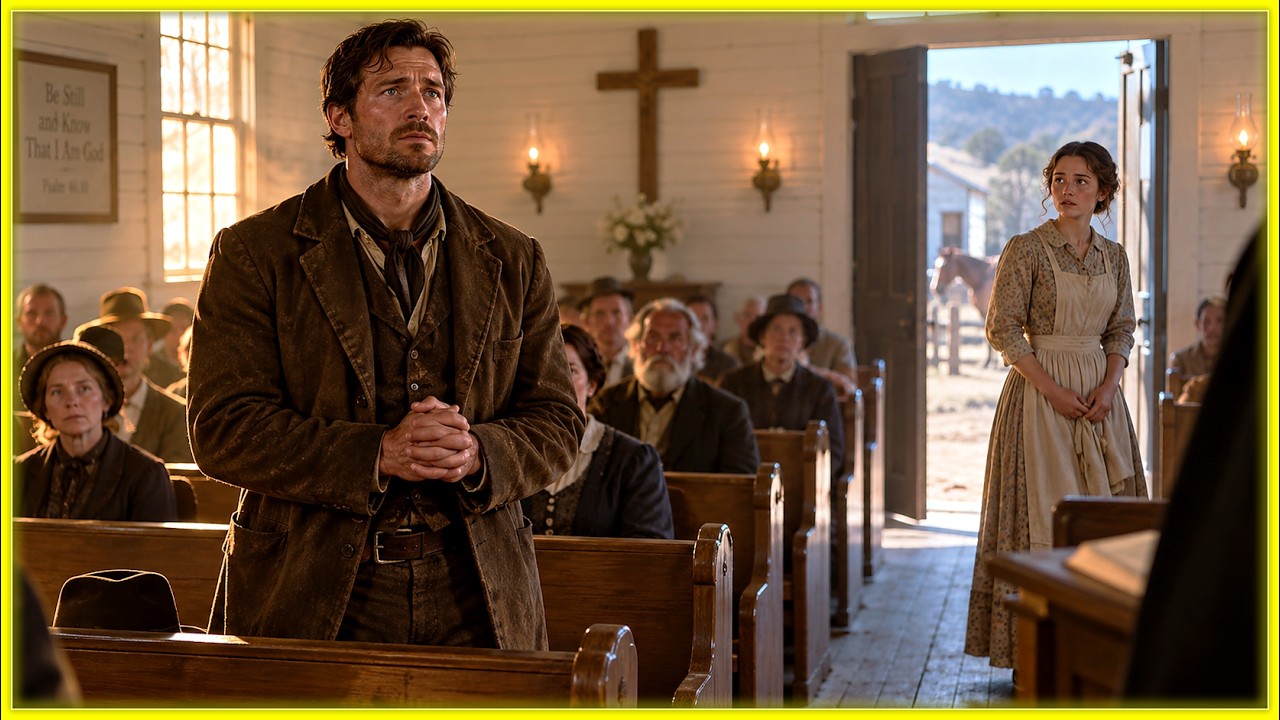
She could scrub a shirt collar clean of every stain a Texas cattle town could produce.
She could iron a crease sharp enough to cut paper, and she could not, no matter how she squinted at them, make sense of the letters printed on any page.
She had come to Salt Fork four years back, following work the way laresses always followed it, from one dusty cattle town to the next, and had set herself up in a small building behind the hotel with a copper boiler, a mangle, and a line of rope strung between two mosquite posts, where the wash of half the town’s bachelors and half its cattle outfits dried in the relentless Texas sun.
She was 25 now, capable and quietly proud of what her two hands could accomplish, and she had built around the single fact of her illiteracy, a fortress of careful habits, memorizing which basket belonged to which customer by the pattern of the mending, rather than any name written on it, asking Miss Ogden’s school children to read aloud from any notice posted at the merkantiel, under the pretense that her eyes were tired, and never under any circumstances, allowing herself elf to be handed a letter she could not read in front of anyone who might notice her hesitation.
Salt Fork itself was a cattle town in the truest Texas fashion. Its single dusty street lined with a merkantiel, a hotel, a saloon that did brisk business every payday, and the small whitewashed church that served as the moral center of a community otherwise built on beef and dust, and the occasional gunshot argument over grazing rights.
Tessa’s laundry sat behind the hotel in a low-frame building she rented from Holly’s Prut at a rate she privately considered robbery, though she had never once said so aloud, understanding well enough that a woman alone with no family and no schooling had little leverage to argue rents with anyone, let alone a man who held the deed to the only decent building in town suited to her trade.
Ward Keller ran a modest but respectable spread six miles outside Salt Fork. 34 years old, careful in his habits, and shy in his speech in a way that had kept him unmarried a good deal longer than most men of his standing in that part of Texas.
He brought his laundry to Tessa every second week, had done so for the better part of a year, and had watched her over that year with the particular attention of a man who has decided something important, but has not yet found the courage to say it plainly.
He was not, by his own private reckoning, a man skilled with words spoken aloud.
He tended to stammer and lose his thread the moment any conversation ventured toward feeling rather than fact.
And so after months of working up his nerve and losing it again every single time she looked at him with her steady gray eyes, he had finally sat down one evening with a pencil and a clean sheet of paper and written slowly and with more care than he had given anything in years.
A letter asking Tessa Brangan to marry him. He had rewritten that letter four times before he judged it fit to send, tearing up the first attempt for being too plain, the second for sounding to his own critical ear too much like a business proposition.
The third for veering in one paragraph into sentiment so awkwardly phrased he’d blushed alone in his own kitchen reading it back.
The fourth version struck the balance he’d been reaching for honest, unadorned, but with enough of his true feeling folded into the careful language that any person reading it closely would understand exactly what it cost him to write.
He sealed it, addressed it, and delivered it himself to her laundry door on a Tuesday afternoon, touching his hat and leaving before she could say anything at all, which was, Tessa would later understand, exactly the kind of retreat a shy man makes when he has finally done the bravest thing he knows how to do and cannot bear to watch the reaction.
She turned that sealed letter over in her hands for three full days. She set it on the shelf above her washdub the first evening, telling herself she would open it in the morning when the light was better.
She carried it in her apron pocket the second day, taking it out every hour or so to study the careful, unfamiliar shapes of Ward Keller’s handwriting on the outside, searching for some clue in the slant of the letters themselves as to what they might contain.
By the third day, the not knowing had become a heavier weight than any confession could possibly be, and Tessa set down her iron, wiped her hands on her apron, and walked the six dusty miles out to the Keller ranch with the letter still sealed and unread in her pocket.
She found him in the yard mending a section of fence. And when he straightened at the sight of her, hopeful and uncertain all at once, Tessa held the letter out to him and made herself say the words she had been dreading for 3 days.
I can’t read your letter, she said barely above a whisper, and braced herself for whatever expression she expected to see cross his face pity most likely, or the particular embarrassed discomfort people reserved for a grown woman’s admitted ignorance.
What she saw instead was something else entirely. Ward’s face did not soften with pity, nor did it flicker with the awkward retreat she’d stealed herself for.
Something in his expression simply settled, as though a puzzle he’d been quietly turning over had at last clicked into place, and he looked at her with a steadiness that made her chest ache in a way she couldn’t immediately name.
“Then I’ll read it aloud before the whole church,” he said. Tessa’s first thought, standing there in the dusty ranchyard with her heart pounding, was that he intended it as punishment, that a woman who’d hidden her shame for 19 years, was now to have it exposed before every soul in Salt Fork as some manner of cruel justice for having walked the letter back unopened.
She left the ranch that day more frightened than she’d been in years, certain that Sunday would bring her public ruin.
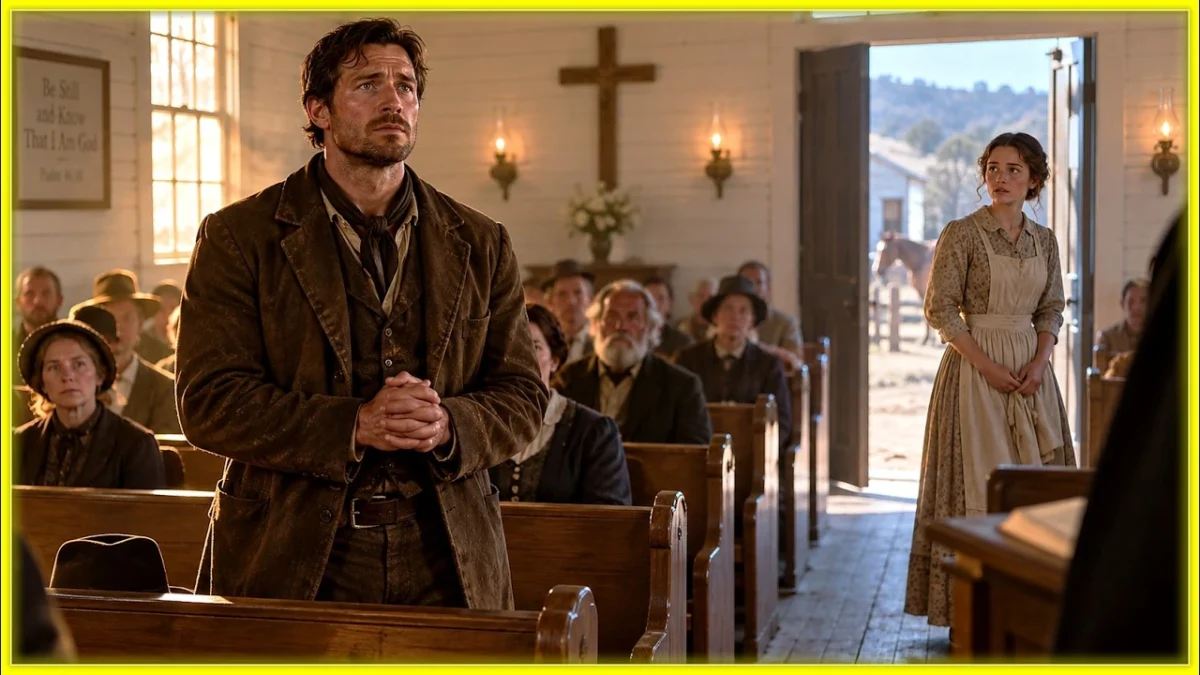
Sunday came, as Sundays do, whether a person is ready for them or not. Tessa sat in her usual pew near the back of the small clapboard church, half convinced she should not have come at all, and watched with rising dread as Ward Keller stood at the conclusion of Pastor Willlet’s sermon, letter in hand, and asked the congregation’s indulgence for one small matter of personal business.
He read the letter aloud, in a voice that shook only slightly at the start, and steadied as he went, a plain, careful proposal of marriage, addressed to Tessa Branigan, laying out in unadorned language exactly what he could offer her.
A soundhouse, honest work, a partnership built on respect rather than romance alone, though there was plenty of that, too, folded quietly between the practical lines for anyone attentive enough to notice it.
The church went entirely silent. Every head turned toward the back pew where Tessa sat frozen, mortified, certain that every eye in Salt Fork now understood exactly why she had needed the letter read aloud in the first place, and she did the only thing her racing heart would allow her to do.
She ran. She was halfway across the churchyard, skirts gathered in both fists when ward caught up to her, having abandoned decorum entirely to follow her out mid-sentence.
An act that would give the sewing circle material for gossip for a full month afterward.
“How could you?” Tessa said, rounding on him with her eyes bright and furious. “Now they all know I can’t read.”
“No,” Ward said, quiet but certain. “Now they all know I asked. Tessa opened her mouth to argue and found for a long moment that she had no argument ready.
She had spent 19 years so thoroughly ashamed of what she could not do that she had never once considered the matter from the other direction.
That the thing exposed to the whole congregation that morning was not her failing at all, but his devotion plain and public and entirely undisguised.
She had not thought of it that way, and standing there in the dusty churchyard with the whole congregation still murmuring behind the closed doors, she found that she rather liked thinking of it that way now that he’d shown her how.
She did not answer him that day, nor the day after. Instead, quietly, without telling a soul beyond the one person whose help she needed, Tessa began walking to Miss Ogden’s small schoolhouse two evenings a week after the children had gone home, and asked the young school teacher, with more humility than pride had ever allowed her before, to teach her to read.
Miss Ogden agreed at once and without a single question that might have embarrassed her new pupil, understanding intuitively that Tessa’s dignity required the lessons be conducted quietly at odd hours, with no one in Salt Fork the wiser.
Tessa’s reasoning, when she finally explained it, was simple and stubborn in exactly the way Miss Ogden had come to expect from her.
She intended to read Ward Keller’s letter herself in her own voice before she gave him any answer at all because a decision that important deserved to be made with her own two eyes rather than borrowed ones.
The lessons were slow and humbling in ways Tessa had not anticipated. She was quick with her hands, and had always trusted her own competence, and it galled her some evenings to sit hunched over a primer meant for children a fifth her age, sounding out simple words, letter by stubborn letter, while Miss Ogden waited with endless patience beside her.
Some nights she left the schoolhouse more frustrated than when she’d arrived, certain the letters would never arrange themselves into anything but a stubborn tangle.
And she would walk home in the dark, furious at her own slowness, at the 19 years that had let this gap grow so wide, at a world that made a woman feel shame for a failing that had never once been her fault to begin with.
But she kept at it week after week because the alternative giving Ward Keller an answer she could not fully understand herself had become somewhere in the last month entirely unacceptable to her.
Miss Ogden, for her part, never once treated the lessons as remedial charity, praising each small victory.
A whole sentence sounded out without help, a word recognized on site the second time it appeared, with the same genuine warmth she gave her youngest pupils, and slowly across those six weeks the primer’s stubborn tangle of letters began one evening at a time to loosen into sense.
Word travels in a small cattle town regardless of how carefully a secret is kept.
And it was not long before Holly’s Prut, who owned the hotel and had underpaid Tessa for her laundry services for four years running on the theory that a woman with no other prospects would never dare complain, heard whispers of Ward’s public proposal, and saw in it an opportunity too convenient to pass up.
If Tessa Brangan had a rancher courting her, Prute reasoned, she had considerably less need of the pittance he paid her for scrubbing his hotel’s linens, and considerably more incentive to accept a husband’s support instead, which would save him the trouble of finding aress willing to work for what he was willing to pay.
He fired her without warning on a Thursday afternoon, citing some invented complaint about scorched collars, confident the loss of her income would push her straight into Ward Keller’s arms out of plain necessity.
Tessa did not tell Ward of her dismissal herself, too proud even now to run to him with her troubles.
But Salt Fork being what it was, the news reached his ranch before the day was out.
Carried by a ranch hand who’d heard it from a hotel border who’d heard it in turn from Pr’s own boasting at the saloon about how he’d finally found a way to be rid of an uppidity without having to pay her a severance.
Ward heard of it within the day and did not, as Prud had perhaps expected, ride into town to rescue Tessa from her sudden hardship with some grand romantic gesture that would leave her beholden to him.
Instead, he did something far more useful and far less showy. He rode straight to every ranch within a day’s travel of Salt Fork, and by the end of the week had arranged, through nothing but his own quiet persistence and considerable standing in the county, to have his own outfits laundry contract, and that of three neighboring ranches besides, rooted entirely through Tessa’s business at double the rate Prud had ever paid her.
She would never again need Holly’s Prof hotel linens to keep her boiler fed, and she would owe her continued independence to no one but her own two capable hands.
When Tessa learned what he had done, not from Ward himself, who mentioned nothing of it, but from one of the ranch hands who delivered the first of the new contracted wash, she sat down hard on her own backst step and cried for the first time in longer than she could remember, not from sorrow, but from the strange, overwhelming relief of being valued for exactly what she was rather than rescued from exactly what she wasn’t.
Six weeks after the lessons began, on a quiet evening with the schoolhouse dark and Miss Ogden gone home for the night, Tessa sat alone in her own small room behind the laundry, with a lamp burning low, and Ward’s letter finally spread open before her, and read it slowly, haltingly, sounding out the harder words the way Miss Ogden had taught her.
But read it, every line in her own voice, and by her own understanding for the first time.
It said more than Ward had read aloud that Sunday in church. He had stopped.
She realized one line short of the letter’s end, and there at the very bottom of the page in his careful, patient hand, was a sentence he had kept for himself alone.
If you say no, I’ll still bring my shirts, and I’ll still be glad to see you.”
Tessa read that line three times over, tears blurring the careful letters she had worked so hard to learn, understanding at last the full shape of what Ward Keller had offered her from the very beginning.
Not a bargain contingent on her answer, not a courtship that would sour into coldness if she refused him, but a devotion offered entirely without condition.
The kind of steady, patient love that asked nothing in return for its own continuence.
She wrote her answer that same night. Her very first letter composed with painstaking effort on a single scrap of paper by lamplight.
The words badly spelled and the hand unsteady, but every letter unmistakably her own. Three words.
She folded it carefully, and the following Sunday, before the service began, she pressed it into Ward’s hand at the church door without a word of explanation, watching his face as he unfolded it and read her three uncertain words, watching understanding dawn slowly and completely across his careful features.
The whole church seemed to hold its breath as Ward unfolded that small scrap of paper at the door, his hands not quite steady, and Tessa watched him read her three careful words once to himself before he even looked up, his throat working, his eyes bright with a feeling he had never once managed to put into speech in all the months she’d known him.
Ward stood again after the sermon that Sunday, the same as before, the congregation once more falling silent in anticipation of whatever this careful, quiet man intended to say.
He held up Tessa’s small scrap of paper for the church to see. “Yes,” he read aloud, his voice thick with feeling he no longer troubled to hide.
“Read this.” The church that had gone silent with shock the first time he’d stood before them now rose entirely to its feet.
Applause and laughter and more than a few tears mixing together in the small clapboard building.
And Tessa stood in the back pew where she had once tried to disappear and let herself for the first time in 19 years be fully and gladly seen.
They were married within the month in the same small clapboard church where the whole town had watched Ward read his heart aloud.
Not once but twice. And this time it was Miss Ogden who cried openly through the entire ceremony, having grown nearly as invested in Tessa’s two victories, the reading and the marrying both as Tessa herself.
Tessa’s laundry business continued to thrive under the contracts Ward had arranged. Run now from a proper little house on Keller land with its own well, and its own line strung between two cottonwoods rather than Mosquite.
And she insisted over Ward’s mild protest on keeping the business entirely her own even after the wedding.
Her own name still on the ledger, her own hands still doing the work she had built her independence upon, because some things a woman earns are worth keeping exactly as they are.
Marriage or no marriage. She kept up her lessons with Miss Ogden long after she’d mastered Ward’s letter, working her way through the church’s small library, one careful book at a time, until reading became not a shameful secret finally uncovered, but simply one more thing among many, that she had taught herself to do well.
Holly’s prruit, for his part, found himself short aundress and considerably shorter on the town’s good opinion once the full story of his scheme became known, and spent the better part of a year overpaying whatever poor soul he could convince to take on his hotel’s linens after that.
Years later, with a small daughter of their own tucked into bed in the house Ward had built, Tessa sat on the edge of the child’s bed with a story book open in her lap, reading aloud in a voice that had long since lost its early hesitation.
Though she still now and then stumbled over an unfamiliar word, a habit of 19 years not entirely erased by six weeks of evening lessons and years of practice since.
On those nights, Ward sat on the floor beside the bed rather than the chair across the room, close enough to reach if she wanted him.
And when she stumbled, he never once reached for the book to correct her. He simply waited, patient as he had always been, letting her find her own way to the word in her own good time, because he had learned that first Sunday in church, exactly how much more a person could give by trusting someone to find their own voice than by ever taking the reading from their hands.








