“I Can’t Read or Write, But I Can Work Your Ranch”—”I Asked God for a Husband to Lead Me to Him”
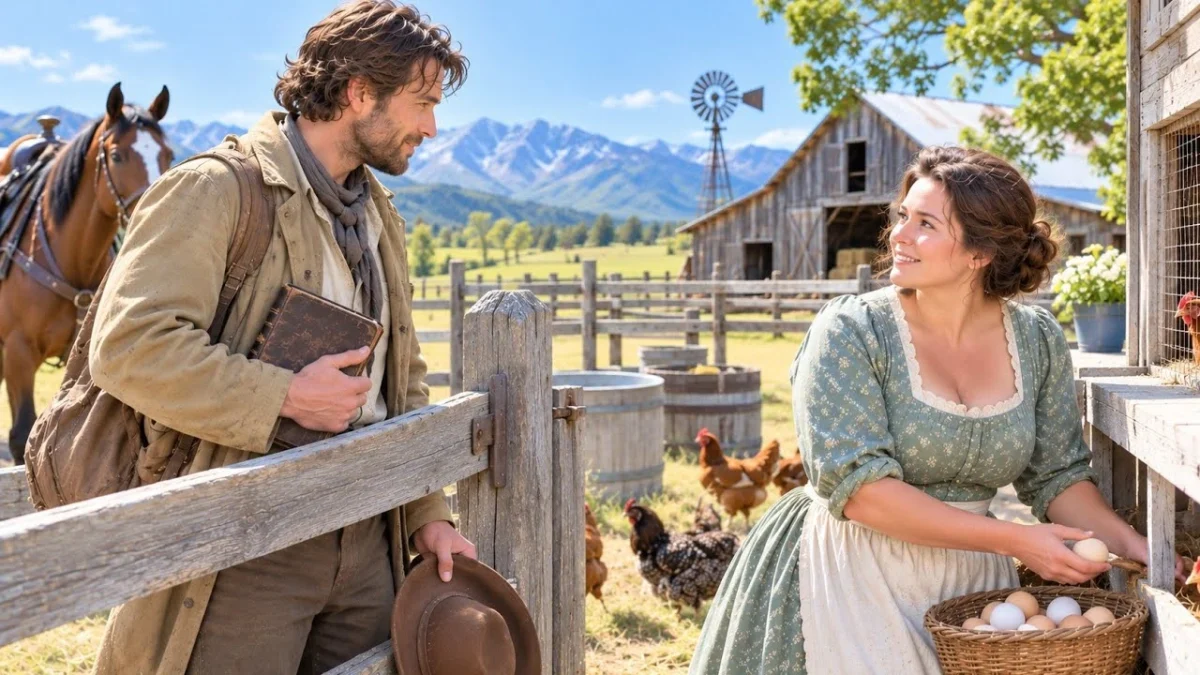
“I Can’t Read or Write, But I Can Work Your Ranch”—”I Asked God for a Husband to Lead Me to Him”
Good morning to you. Are you just passing through? I’m finding my way. In September 1891, the Missouri Hills had already begun turning the color of old brass when Clara Whitfield saw a stranger walking up the wagon road toward her ranch.
She stood at the pasture gate with a coil of fence wire in her hands.
The man was tall, dusty, and carrying a canvas bag in one hand and an old Bible under his arm.
“I’m looking for work,” he said. Clara had turned away several men that summer, but something about this stranger made her pause.
He looked tired, yet there was something steady in his eyes. “What kind of work can you do?”
Clara asked. “Whatever kind you’ve got,” he answered. She asked whether he could read or write.
He looked directly at her and admitted that he could do neither. Most men would have been ashamed, but Silas Bennett showed no embarrassment.
I know cattle, ma’am, and I can work. Clara was about to send him away when she noticed the Bible beneath his arm.
It was old and damaged, its leather faded, and its spine repaired with pieces of hide.
“If you can’t read,” she asked, “why do you carry a Bible? Silas looked down at the book.
His expression changed. He explained that his mother, Hannah, had read the Bible to him when he was a boy.
Some of the words had stayed with him even after she died. She had been the only person who had ever made him feel that those words belonged to him.
Clara listened quietly. She knew something about carrying memories inside an empty house. Her husband Daniel had been de@d for more than a year, and every evening she still found herself setting two plates before remembering that she was alone.
Clara allowed Silas to sleep in the bunk house for the night. The next morning, Eli Turner, an old ranch hand who had worked the land for more than 30 years, took Silas out to inspect the cattle.
Silas noticed something the others had overlooked. The cattle were growing thin, even though there appeared to be enough grass.
He watched their movements carefully and realized they were walking nearly three mi every day just to reach the creek for water.
The long journey was exhausting the animals, especially the cows carrying calves. Silas followed the worn trail to the creek and discovered an old spring on the northern hillside.
There was an abandoned stone water line that had once carried the spring water into a stock tank.
It had been neglected for years, and part of it had collapsed. Clara knew exactly why the work had been abandoned.
Her husband Daniel had started rebuilding the line before his death. She had not returned to that hillside since then because every unfinished stone reminded her of him.
Silas offered to finish the work if she would let him stay through winter. Clara agreed.
For weeks, Silas worked with Eli and the younger ranch hand Wesley to uncover the old stone line.
They removed broken stones, cleared roots, repaired damaged sections, and restored the tank. Finally, fresh spring water began flowing again.
Within days, the cattle stopped making the exhausting journey down to the creek. They stayed near the richer grass and rested beneath the northern trees.
Clara began recording their improvement in her ledger. For the first time in many months, she had something hopeful to write about.
One evening, Clara discovered Silas sitting on the porch with his mother’s Bible open across his knees.
He was not reading because he could not. He was simply looking at the pages.
Clara offered to read to him. After a long silence, he quietly accepted. She opened the Bible and read a psalm aloud.
That became the beginning of something neither of them expected. Almost every evening afterward, Silas returned to the porch and asked her to read a little more.
Soon he began asking questions about God, forgiveness, suffering, and whether a man who had wasted years could still return to God.
Silas eventually told Clara about his childhood. His mother, Hannah, had died of fever when he was 11.
His father had been a hard-working but exhausted man who believed work was more important than schooling.
Silas never learned his letters. He carried his mother’s Bible for decades, even refusing to sell it during a terrible winter when he desperately needed money.
He had been offered $2 for the leather, but he refused because the Bible was not his to sell.
His mother had given him something more valuable than money, words he remembered by heart.
One November evening, Clara read the story of the prodigal son. When she reached the part where the father saw his returning son while he was still far away and ran toward him, Silas suddenly stopped her.
He had always believed that a person had to become respectable before approaching God. Now he understood that the father ran toward the son before the son had proved that he had changed.
Tears filled Silas’s eyes. I always thought I had to walk the whole way to him first, he whispered.
Clara answered gently. Maybe grace is finding out he was already coming toward you. That night, Silas bowed his head and prayed for the first time in his life.
His prayer was simple. He admitted that he did not know how to speak to God properly, but he wanted to come home if God would still accept him.
Clara cried quietly beside him. She had thought she was teaching Silas how to find God again.
But something inside her had begun changing, too. She was reading the Bible every night after having avoided it for nearly 2 years.
Soon Clara offered to teach Silas to read. At first, he refused because he believed a grown man had no business learning letters like a child.
But Clara insisted that it was never too late to learn. They began with simple words.
Silas struggled because his hands were hardened by years of ranch work, and holding a pencil was painful.
Still he kept trying. Eventually he learned the word God. Later came love. Then one quiet evening he slowly sounded out a longer word on the page.
Jesus, he said. He looked at Clara with tears in his eyes. After 27 years of carrying the Bible, he could finally read the name his mother had taught him to love.
Winter came hard to the Witfield ranch. The cattle were healthier now because of the restored spring, but the work of keeping them safe had only begun.
In December, a heavy rainstorm struck the frozen ground. Water rushed down the hillside, overflowing the channel Silas had built.
The runoff crossed the wagon road, damaged the fence, and turned the cving lot into deep mud.
Silas stood in the rain looking at the damage. He could have blamed the unusual weather or defended his plan, but instead he admitted, “Then you saw something I didn’t.”
Eli showed him where to build a basin and a stronger spillway. Silas listened. They worked for weeks to repair the damage.
Silas learned that being a good man did not mean always being right. Sometimes wisdom meant admitting a mistake and listening to someone with more experience.
Clara respected him more for that than she ever could have respected a man who refused to admit an error.
Their evenings together continued with Clara reading from the Bible while Silas listened carefully. He began to understand that faith was not a promise that nothing painful would happen.
It was the confidence that he would not have to face those painful things alone.
Clara was learning the same lesson. Then came the storm that nearly destroyed everything. In February, freezing rain covered the ranch with ice.
Rain fell over frozen ground and the creek rose rapidly. The spring line filled with water and the basin threatened to overflow.
60 cattle were wintering on the northern pasture, many of them carrying calves. If the water broke through the wrong place, the fence and the entire herd could be lost.
Silas woke Clara in the middle of the night. For the first time, she saw fear clearly in his face.
“I can’t do this by myself,” he admitted. Clara took his freezing hand and reminded him of the words they had repeated together.
“God has power over my life,” Silas whispered. Clara nodded again, she said. “He repeated it.”
And then they prayed for wisdom and courage. They woke Eli and Wesley and went outside into the freezing darkness.
For hours they fought the rising water. They broke ice from the spillway, opened the channels, repaired weak sections of fence, and moved cattle away from dangerous ground.
Clara worked beside the men without asking for special treatment. At one point, she stood alone with a heavy bar in her hands and prayed aloud.
She did not ask for an easy life. She simply asked God to help them take the next right step.
By morning, the water had finally begun moving in the direction they had prepared for it.
The herd survived, although three cattle were lost during the storm. Clara was exhausted and grieving, but she refused to pretend that the loss did not matter.
She wrote in her ledger, “Storm lost three system held. Not alone.” Those final words meant more to her than she understood at the time.
For years, she had carried every problem by herself. Now she had people beside her, and more importantly, she had begun speaking to God again.
Spring arrived suddenly. Green grass covered the northern hillside. The cattle grew strong, and the calves were born.
Only one calf was lost. When a buyer came to inspect the herd, he was surprised by their condition.
Clara simply explained that they had stopped forcing the cattle to walk miles every day for water.
That evening, however, Silas stood outside the bunk house with his canvas bag. He believed his work was finished.
The water system worked, the cattle were healthy, and Clara had Eli and Wesley to help her.
Silas planned to leave and find work farther west. Clara watched him prepare to go, but she finally told him something she had never shared.
The night before he had first arrived, she had knelt beside her bed after many months without truly praying.
She still believed in God, but she no longer felt close to him. She had asked for someone who could help her find her way back.
Silas listened in silence. Clara explained that she had never expected the answer to look like a tired ranch hand carrying a Bible he could not read.
Yet that was exactly what had happened. Through reading to Silas every evening, she had started opening the Bible again herself.
Silas realized something important. Perhaps God had not brought him to the ranch simply to help Clara.
Perhaps God had brought them together because both of them needed to find their way home.
Clara told him that if he stayed, he should not stay merely because he believed God had sent him.
He needed to choose the ranch, the life, and her. Silas looked at the house, the barn, the hills, and finally Clara.
He admitted that he had spent his whole life leaving places before they could become home.
Maybe, he said quietly, he was finally tired of running. Silas picked up his canvas bag and carried it onto the porch instead of down the road.
That simple action gave Clara her answer. They continued their evening readings, but now there was a deeper understanding between them.
Silas kept learning to read and Clara kept discovering her own faith again. They did not pretend that life would become easy.
There would still be bills, storms, sickness, and difficult decisions, but they would face them together.
In August, they married at the church in Cad’s Mill. Eli stood beside Silas while Wesley tried unsuccessfully to hide his tears.
Their marriage was simple, but their home slowly became full of life. There were two coats hanging near the door, two mugs beside the stove, and an open Bible on the kitchen table.
Silas continued practicing his reading every night. One evening, he began reading from the Gospel of John.
He struggled with a few words, stopped, tried again, and continued. When he finally reached the words, “I am the way, the truth, and the life,” his voice broke.
He covered his face and wept. For nearly three decades, he had carried a Bible he could not read.
Now he was reading the words in his own voice. Years later, the Witfield home looked nothing like the lonely house Clara had lived in before Silas arrived.
The empty chairs were no longer symbols of grief. They were simply chairs around a table where people could sit.
The old canvas bag remained beneath the bed. Its straps still buckled because Silas no longer lived as though he needed to leave at any moment.
The Bible stayed open on the kitchen table. Sometimes Silas still stumbled over long words, and Clara never laughed or rushed him.
She simply waited until he found his way through them. Together, they had learned that faith did not remove every trouble.
It gave them someone with whom to carry it. And the greatest change was not in the ranch, the cattle, or the water system.
It was in two lonely hearts that had learned to trust again. Clara had prayed for someone to help her find her way back to God.
And she thought the answer would be a man who already knew exactly what to do.
Instead, God brought her a man who needed her to read to him. Silas had carried a Bible for 27 years without being able to read it.
Yet, that Bible became the beginning of a new life. They did not walk toward God alone anymore.
They walked together one step at a time, knowing that even when the road became difficult, they no longer had to carry it alone.








