He Was Supposed to Escort Her to Her Wedding—Instead, She Asked Him to Keep Riding.
He Was Supposed to Escort Her to Her Wedding—Instead, She Asked Him to Keep Riding.
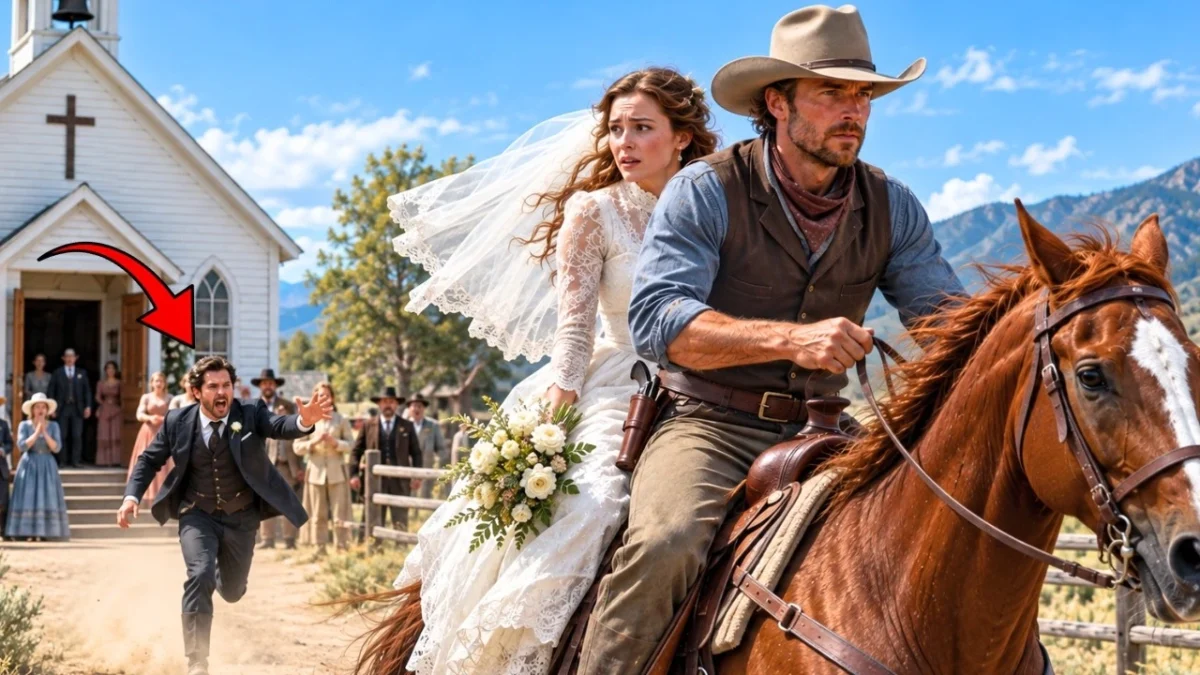
Kansas, 1886. On the morning of her wedding, the wagon meant to carry Eliza Danforth to church broke a wheel in the yard.
Her mother panicked. The groom was already waiting. So were the guests. Holt Pike offered the only solution fast enough to matter.
He’d carry her there himself, on horseback, still in her white dress. She climbed up behind him.
They started riding. Hol didn’t know it yet, but before the church bells finished ringing, the bride behind him would tighten her arms around his waist and ask him to carry her somewhere else entirely.
Eliza was 27 and had grown up on a modest ranch outside Willow Creek. After her father’s death two years before in the spring of 1884, she and her mother Ruth had been left with a mortgaged property, a dwindling herd, and a debt that seemed increasingly impossible to pay.
Her father had been a proud, careful man, the kind who’d rather work himself sick than ask a neighbor for help, and the debt he’d left behind had accumulated slowly, one bad season stacked at top another.
When the local bank finally sold off its bad notes to settle its own books, the Marrow Merkantile Company, owned by one of the wealthiest merchants in the county, had purchased the Danforth ranch’s outstanding debt outright, giving the Maro family full legal claim over what was owed.
Ruth had tried in those two years to manage the ranch’s finances herself, selling off portions of the herd each season simply to keep the interest paid, watching the principal itself barely shrink no matter how carefully she budgeted.
By the time Bennett Maro first called on the family, both women had grown considerably weary of a fight that seemed to have no honest end in sight.
When Bennett, the merchant’s own son, proposed marriage not long after, everyone saw it as a blessing.
Bennett was polished, well-dressed, and promised to settle every debt the ranch carried the moment the wedding was finished.
Eliza accepted, not because she loved him, because she believed it was her responsibility. There was only one person who never once celebrated the news.
Holt Pike. Everyone called him by his last name or simply Hol was 35 years old and had worked on that ranch for the better part of 18 years, arriving at 17, still more boy than man, and never finding a reason to leave.
He’d taught Eliza to ride when she was still a girl, patient through every fall, never once raising his voice when her nerve failed her partway up a difficult trail.
Whatever had quietly grown between them, though, hadn’t begun in those childhood years at all.
It began later, once Eliza was fully a woman grown, returning from two years spent nursing a sick aunt in the next county, and finding, to her own surprise, that the ranch hand she’d always trusted like an older brother, had somehow, in her absence, become someone she noticed entirely differently.
Hol noticed the change in himself, too, and said nothing about it, certain a hired hand had no business speaking on such matters to his late employer’s daughter.
When Eliza announced her engagement at the supper table, Hol had simply nodded once, excused himself early, and spent the rest of that evening alone in the barn, longer than any chore reasonably required.
Eliza had always known something existed between them. Hol knew it, too. Neither of them had ever said so.
Now, it seemed it was too late. The first few miles passed in near silence.
Hol kept his eyes fixed on the road ahead. Eliza held her bouquet in one hand and the saddle in the other.
The white fabric of her dress bunched awkwardly around her. You could talk to me, you know, she said finally, considering how long we’ve known each other.
Didn’t much see the point, Hol said, given where this ride is headed. That’s a poor excuse for silence.
Hol didn’t answer that, and Eliza let the matter drop a while, watching the fence lines pass, each one familiar from years spent riding this same land beside this same man.
Do you think I’m making a mistake? She finally asked, unable to leave the question buried.
Is it my place to decide who you marry? Hol said. Eliza felt the answer land wrong, though she couldn’t immediately say why.
Only later, replaying it, did she understand plainly that he hadn’t answered the question at all.
Further along, she tried another approach. If it were you waiting at that church, she said, would you want me riding toward you because I loved you or because I needed your money?
Holt’s hands tightened on the res. He said nothing. The church came into view, bells already ringing.
Eliza should have felt relief. Instead, she felt something closer to dread settling over her.
As they drew nearer, she caught sight of Bennett near the church steps, speaking low and urgent to one of his father’s clerks.
She caught only a single fragment as they passed. Once the papers signed, the notes transfer clean, whether her mother likes the terms or not.
It was one sentence, but paired with something in Bennett’s tone, sharp and business-like in a way she’d never once heard him use with her directly, it was enough to plant a seed of dread she couldn’t shake.
Hol noticed her go pale. Eliza, something’s wrong, she said. I don’t know what yet, but something is.
She looked at the church, at the guests, at Bennett waiting for her, still deep in conversation with the clerk, not yet aware she’d arrived.
Then she looked at the road stretching in the opposite direction. “Hol,” she said. He turned.
She took a breath. “Keep riding.” Hol was certain he’d misheard. “Eliza, the church is right there.”
“I know,” she said. She tightened her arms around him. Keep writing. Hol didn’t ask again.
He turned the horse and rode. Only a few minutes passed before Bennett noticed. He ran from the church steps, shouting her name.
Guests appeared on the doors, confused, several of them already whispering. But Hol and Eliza were already raising dust down the road.
The church and everything it had promised shrinking behind them. Running away, however, solved nothing.
Hol brought Eliza to a small property belonging to a widow he’d known for years, a woman named Mrs.
Aldridge, who took one look at Eliza’s wedding dress and asked no questions before showing her to a spare room and setting a kettle on the stove.
Ran from a wedding, did you? Mrs. Aldridge observed, entirely unbothered, handing Eliza a cup of tea.
Wouldn’t be the first woman to do it sensibly in my experience. Only difference is you had the good sense to bring an escort.
Hol made one thing plain before he left her at the door that first evening.
I didn’t ride you out here to make you mine automatically, he said, standing at the threshold with his hat in his hands.
You’ve just walked out of your own wedding. You’re shaken and raw, and I’ll not take advantage of a moment like that, whatever either of us might feel underneath it.
That’s a great deal of restraint, Eliza said. For a man who spent years apparently feeling something he never once mentioned.
“Restraints about the only thing I’ve had considerable practice at,” Hol admitted, and left before either of them could say anything further.
It was precisely that restraint that began changing how Eliza saw him. Bennett would have decided for her.
Hol insisted she decide for herself. Eliza rode home the following morning to face her mother, bracing herself for anger, or worse, disappointment.
She found Ruth sitting at the kitchen table instead, her father’s old account book already open in front of her, a lamp still burning, though morning light had long since made it unnecessary.
I’ve been going through this half the night, Ruth said, not looking up. Something’s never sat right with me about Bennett’s figures.
Your father was meticulous, Eliza. He wrote down every payment he ever made, down to the penny.
I should have looked sooner. Should have looked the moment Bennett first mentioned a sum that felt considerably larger than what your father always told me we owed.
You’re not angry? Ruth finally looked up, her eyes red- rimmed, but steady. I was frightened, she admitted, frightened enough to want you married quickly before I let myself think too hard about whether the man asking was honest.
That’s a poor reason to hand my own daughter into a marriage, and I’ve had a long night to sit with that failing.
She pushed the account book across the table. Take this. If there’s proof in here that we don’t owe what Bennett claims, I want it found properly, not simply hoped for.
What made you finally look? Watching you climb onto that horse in your wedding dress, Ruth said.
And understanding all at once that I’d rather lose this ranch honestly than keep it by selling you to a man neither of us has any real reason to trust.
It was, Eliza understood, her mother’s own way of apologizing and of joining the fight rather than simply waiting to see how it ended.
In the days that followed, word reached them that Bennett intended to press the Marrow Merkantile Company’s claim immediately, calling the full debt due within 30 days, legal standing to do so plainly on his side, now that the notes belonged to his father’s company outright.
Ruth risked losing the house entirely. Eliza considered going back, not to marry him, but to negotiate, armed with whatever proof her father’s careful records might hold.
Hol went with her. Before we go on, there’s something worth understanding about ranch debt in this period.
After a rancher died, debts secured against his land didn’t simply disappear. Creditors could still make claims against the estate or move to foreclose on mortgaged property, even when the surviving widow had never personally signed the original note herself.
Notes like these were also regularly bought and sold between banks and private companies, which meant the person holding the legal right to collect could change entirely without a family’s direct knowledge.
Exactly the position the Danfors found themselves in once the Marrow Merkantile Company acquired their debt outright.
On this channel, our stories not only entertain but also teach us something real about life in that period.
Now, let’s return to Eliza and Hol because what her father’s old ledger holds is about to change everything.
They spent the better part of two weeks working through it properly. First Ruth’s account book at the kitchen table, then the county recorder’s dusty archives.
Hol carrying stacks of ledgers while Eliza cross-referenced dates against her father’s own careful handwriting.
The work was slow and often discouraging. Entire afternoons spent finding nothing beyond the ordinary tedium of old receipts for feed and fencing wire.
No closer to proof than when they’d started. Here, Eliza finally said one afternoon, holding up a receipt gone yellow with age.
Paid in full. March of 83. Same note Bennett’s claiming is still owed, plus interest he’s added since.
Man’s either careless or counting on nobody looking close enough to catch it. Holt said, “I don’t believe Bennett’s ever once been careless in his life,” Eliza said.
They brought the receipt to the county recorder himself, a careful, unhurried man named Mr.
Findley, who confirmed after consulting his own copies that the 1883 payment had indeed been properly registered at the time.
Doesn’t mean the whole debt settled. Finley cautioned, adjusting his spectacles. Only proves this particular note was paid.
There may be others genuinely still owed, same as there may be others equally overstated.
I’d advise taking this to the county judge before assuming the whole matters resolved one way or the other.
It wasn’t the instant victory Eliza had hoped for, but it was enough for the judge to order the Marrow Company’s collection suspended while the full accounting was properly reviewed, buying them the time Ruth’s house desperately needed.
The investigation stretched into weeks, and somewhere in the tedious, patient work of it, Eliza and Hol found themselves simply living alongside each other again, the way they once had before the engagement changed everything.
One evening, exhausted from a long day at the recorder’s office. They sat on Mrs.
Aldridge’s porch steps, sharing a simple supper of bread and cold chicken, neither of them speaking of debts or documents at all.
Do you remember? Eliza said, “The summer you taught Charlie Dugens boy to rope and he caught you by the ankle instead of the fence post.”
Hol laughed. A real laugh. The first she’d heard from him in weeks. Spent two days walking with a limp and pretending it didn’t hurt.
“You were considerably less dignified than you’d like to remember.” “I remember it exactly as dignified as it needs to be,” Hol said.
And Eliza laughed properly, too. The sound easy and unguarded in a way neither of them had managed since the wedding morning.
Mrs. Aldridge, watching from her window, noted to herself that Hol had found no fewer than four separate practical reasons to ride into town that week, each one considerably thinner than the last.
One evening, not long after, sitting together on the porch once Mrs. Aldridge had gone to bed.
Eliza finally asked him plainly, “Why did you never say anything all those years?” Hol was quiet a long moment.
“Because you deserve to choose a bigger life than getting stuck with a cowboy who had nothing to offer.”
“Funny,” Eliza said. “I spent years waiting for you to give me a reason to stay.”
She was quiet a moment, then added, “I want to be plain about something, Hol.
I’m not choosing you because Bennett proved himself false. I’m choosing you because when I had no idea what came next, you gave the choice back to me instead of making it for yourself.”
Hol looked at her a long moment, something settling in his chest that had been unsettled for years.
Maybe he hadn’t lost her because he was poor. He’d lost her all those years because he’d stayed silent.
Even so, they didn’t begin a romance immediately. They finished the ranch’s business first. The full accounting once the judge’s appointed reviewer completed it, confirmed what Eliza had already suspected.
Bennett’s company had knowingly presented an incomplete record, omitting payments already made in order to inflate what remained owed.
The reviewer’s findings went to the county prosecutor, and though Bennett himself avoided formal charges, his father’s company was ordered to correct the accounting and forgive the padded portion entirely.
Bennett made one final attempt to salvage the situation, cornering Eliza outside the merkantile. “You’ll regret this,” he told her.
“Nobody else in this county will offer what I offered.” “You never offered anything,” Eliza said.
“You offered to buy a ranch and called it a wedding. I’d rather owe every honest dollar than owe you a single cent dressed up as love.”
Bennett left for Kansas City within the month, his father’s business considerably diminished by the scandal once word of the inflated accounts spread through town.
Ruth formally held the ranch’s title, as she always had, but by autumn, she’d signed over a working partnership to Eliza, splitting the responsibility and the eventual inheritance plainly between them.
You’ve earned a proper stake in this place, Ruth told her. More than earned it this past year.
With the debt resolved, Eliza expected Hol to simply stay on as he always had.
Instead, she found him one morning tightening the cinch on his horse, saddle bags already packed.
“Where are you headed?” Took on seasonal work up north months back, Hol admitted, not quite meeting her eyes.
Before any of this happened, back when I believed you’d be married and settled, and I’d have no particular reason left to stay close.
Man from the Kellerman outfits expecting me by month’s end. You could send word you’re not coming.
Could Hol agreed. Didn’t want to presume you’d want me cancelling arrangements on your account given how recently everything’s changed.
Didn’t want to make you feel pressed into deciding anything simply because I’d made myself inconvenient to refuse.
Eliza found him at the corral the following morning. Still deciding. It was almost the exact reverse of her wedding morning.
This time Hol was the one leaving. She looked at the road, then at the horse and smiled.
“Then perhaps I need another escort,” she said. “Provided the Kellerman outfit doesn’t mind sharing.”
Hol laughed. “To wear.” She stepped closer. “This time, I’m not asking you to take me anywhere.”
A pause. “I’m asking you to stay.” Holt set down the saddle bag slowly. You’re certain?
Not simply relieved Bennett’s gone and reaching for whatever’s familiar in the aftermath. I’ve had weeks to be certain, Eliza said.
This isn’t relief, Hol. This is choosing plainly with my eyes wide open. That was enough.
He sent word north, declining the position, and stayed through that autumn and into the following spring, courting her properly now, with none of the old silence standing between them.
They rebuilt the ranch together in more than name. New fencing, a second barn Holt had long argued they needed, Eliza taking over the accounts herself, with a thorowness that would have made her father proud.
Some evenings they simply sat on the porch after supper, planning nothing more urgent than which fields to rotate the following season.
The ordinary rhythm of shared work considerably more romantic to both of them than any grand gesture might have been.
Never thought I’d find bookkeeping this satisfying, Eliza admitted one evening, closing the ledger with visible pride.
Suits you, Hol said. Your father would have liked seeing you at that table. Mrs.
Aldridge remained a fixture in both their lives, informing anyone who’d listened that she’d known the two of them belonged together the very first evening Eliza arrived at her door in a torn wedding dress.
Told you so, more or less. That first night over tea, she reminded Eliza at least once a month, entirely pleased with her own foresight.
They married that following spring at the small church in Willow Creek, considerably smaller this time.
No wealthy men, no financial arrangement, no hidden debts. Ruth gave her daughter away herself, her hands steady in a way they hadn’t been in years.
Eliza arrived on the same horse as the first time. Hol waited outside the church.
Before dismounting, she teased him. There’s still time to keep riding. Hol smiled back at her.
Only if you’re coming with me. I intend to, Eliza said, though I’d prefer we make it as far as the altar first, if it’s all the same to you.
Reasonable request, Hol agreed, and helped her down himself. No uncertain silence stretching between them.
Only two people who’d finally said aloud what they’d spent years leaving unspoken. And Eliza smiled because this time nobody was choosing her life for her.
Not her family, not a debt, not a man. She’d arrived at the altar because it was exactly where she wanted to be.
Eliza Danforth once believed marrying for her family’s sake was simply her responsibility to carry, whatever it cost her own heart in the bargain.
Hol Pike spent years believing silence was the only gift he had left to give a woman who deserved more than an ordinary cowboy could offer.
It took a broken wagon wheel, a wedding that never finished, and a mother willing to fight alongside her daughter to teach them both the same lesson.
Love that’s worth keeping doesn’t ask you to be rescued. It simply rides beside you, however far the road runs, until you’re finally ready to choose it for yourself.
May God bless each and every one of you who listen today. Until next time, keep writing.
I carried you toward a wedding I never wanted you to make. White dress gathered around the saddle, church bells ringing down the way.
You asked me if I thought you were wrong. I said it wasn’t mine to choose.
But every mile I kept on riding, felt like one more mile I’d lose you.
Then you held a little tighter, but back once toward that church behind and whispered two words I still remember.
Keep riding. So ride beside me. Not because you need somewhere to go.
Not because I saved you. Not because I’m all you’ve ever known. Choose the road with both eyes open.
Choose the life your heart can see. If that road still leads you my way, darling, right beside me.
I don’t want a love that’s far. I don’t want a heart that isn’t free.
If you choose me, you could choose anywhere and right beside me. We spent weeks among old ledgers, dusty records, faded ink, finding truths beneath the numbers.
Someone hope we’d never think to read. And somewhere between cold suppers and long evenings on that porch, I heard your laughter like I used to before silence became something more.
You told me you’d been waiting for a reason I was scared to give.
And I finally understood that loving you and telling you how I wish to live.
So ride beside me. Not because you need somewhere to go. Not because I saved you.
Not because I’m all you’ve ever known. Choose the road with both eyes open.
Choose the life your heart can see. And if that road still leads you my way, darling, right beside me.
I don’t want a love that’s borrowed. I don’t want a heart that isn’t free.
If you choose me when you could choose anywhere and right beside me. And came the morning I was leaving.
Saddle bags tied horse turn north. And you stood there by the corral with the same choice as before.
Only this time you weren’t running. There was no church to leave behind.
You simply looked at me and told me what we’d both been scared to say all that time.
You said, “I’m not asking for an escort. I’m not asking where this road might end.
I’m asking you to stay beside me and let me choose you as my friend and maybe more than that.
So I’ll ride beside you through every season yet to come. Through fences needing mending through every setting cans of sun.
No debt will ever own you. No promise made from fear will bind.
And I will never call it loving if I have to choose your mind.
So take my hand both eyes open. I’ll take yours the same way, too.
You could have chosen any road before you. Somehow, darling, you chose the one with me and you.
The church bells rang behind us once and we rode the other way. Funny how the road we almost lost became the one that made us stay.








