He Stopped Just to Give a Ride… But Heard Her Weep: “Lord, Don’t Take My Father’s Horses!”
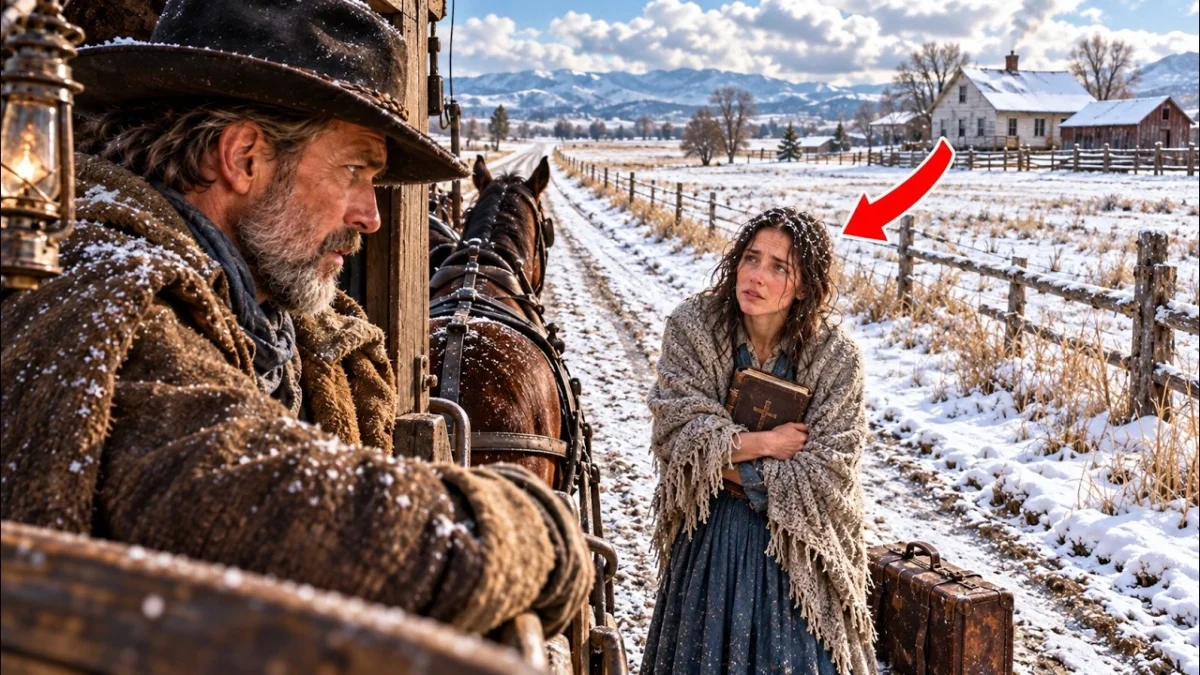
He Stopped Just to Give a Ride… But Heard Her Weep: “Lord, Don’t Take My Father’s Horses!”
In the late November of 1878, along the freezing timber trails of northern Arkansas, I passed a woman walking alone in the dark.
I did not stop. Not at first. And if I had kept driving the way I had driven past a hundred troubles before her, I would never have heard what I heard that night through a thin pine wall.
A woman on her knees whispering, “Lord, save my father’s horses. I don’t ask it for me, I ask it for him.
My name is Cole Vance. I was 52 years old that winter. And this is the story of the week God stopped my wagon.
She was walking down the middle of the wagon ruts, head bowed, hands tucked inside a worn wool shawl.
The sleet came at her sideways off the ridge. She was in my lantern light for maybe 3 seconds.
Then she was behind me. I kept driving. That was my habit and I was good at it.
About a/4 mile on, I pulled up the mules, harness jingling, wagon brake creaking. When she reached the wagon, I leaned down from the seat.
I’m not asking for a ride, she said. I want that on the record.
So noted. The record also says it’s 11 at night and you’re walking through slush in a cotton dress.
My buggy’s in the ditch on the old mill road 3 mi back. Broken wheel.
Then climb up before the lines freeze to my gloves. She looked at the mules, then at the long empty freight wagon, then at me.
She was in her early 30s, dark hair pasted to her face, and I could see her deciding whether I was a greater danger than the weather.
Pressed to her chest, she held an old leather Bible, the gold cross nearly worn off the cover.
“What do you haul?” she asked. “Whatever folks buy at farm sales. A horse trader sent me for a team up north of here.
I lead them home behind the wagon. Something moved across her face and was gone.
She climbed up. I owned that wagon. Four mules, a saddle horse, and a sign on my barn that said, “Vance freight.”
She was shaking so hard her teeth clicked. I pulled my buffalo coat off its peg and handed it over.
“Smells like mule,” I said. No extra charge. She put it on anyway. It covered her to the ankles.
“Does your outfit let you carry strangers?” I am the outfit. Nobody can fire me but me and I’ve tried.
That got half a smile. My name is Clara, she said. No last name. I didn’t ask.
In my line of work, you learn not to. Why didn’t you wait with the buggy?
I did. An hour. Then the lantern oil gave out. I decided to walk while it was still my choice.
Most people sit and wait. Most people aren’t wheelrights. Where am I taking you?
The boarding house in Cedar Bluff. The quickest way was the old mill road straight past a dozen farms.
Could we take the ridge road? She said, I know it’s longer. Please don’t take me past the farms on the old mill road.
Any farm in particular. Politely, she said. That’s all I’ve got for tonight. Every mile or so, we passed a hand bill nailed to a fence post.
Farm sale by order of the county court. Saturday, horses and implements. I had passed a thousand of those.
She watched everyone go by like it had called her by name. The boarding house had a card in the window.
No rooms. Welcome, sale buyers. The sleet had closed the ferry, and the teamsters had taken every bed.
The next inn was 25 mi west. Clara stood in the hallway in my coat doing the arithmetic.
She didn’t have 25 more miles in her. You know anybody in town? I asked.
I know everybody in town. That’s the problem. Outside. I heard myself say it. I have a spare room.
There’s a bolt on the inside of the door. She looked at me a long moment.
I’ll need terms. I cook breakfast. I don’t take charity. And you don’t ask me why I’m here.
Breakfast is the rent. Done. You didn’t even bargain. I haven’t had a decent breakfast in 2 years.
It’s not a position worth defending. She laughed quick and surprised like it got out without her permission.
I lived outside Cedar Bluff in a small white house with a big barn behind it, which tells you which one I cared about more.
I showed her the room in the bolt. She tried the bolt twice. I pretended not to notice and she pretended not to notice me pretending at the door.
She stopped. You passed me. A/4 mile later, you stopped. Why? I don’t know.
That’s not an answer. It’s the one I’ve got tonight. Fair, she said. It’s the one I gave you.
And the bolt slid home. Silence. Only wind. Then a faint trembling voice. The walls of that house are thin pine.
And sometime past midnight, I heard her. It was lower than crying. It was a woman on her knees.
Lord, you know I haven’t asked you for much in 13 years. I’m asking now.
Save my father’s horses. Don’t let him lose the last thing he has. And if you can’t spare them, then spare his heart.
Then she reads soft like someone who already knew the words. And we know that all things work together for good to them that love God, to them who are the called according to his purpose.
I lay in the dark and didn’t know what any of it meant, but I knew I had not stopped that wagon by accident.
At 5, the house already smelled of bacon and coffee. I went out to hitch the mules, and when I turned around, she was in the barn door in my coat, head tilted like somebody listening through a wall.
Hear that squeak? Your near hind wheel, the hubs running dry, and the iron tires working loose.
By the first thaw, it’ll come apart on you going downhill with a full load.
I looked at her. What exactly do you do, Clara? I fix wagons at a blacksmith and wagon works in Fort Smith.
Freight wagons, army wagons, stage coaches. They’re older than yours and have worse attitudes.
She turned for the house. Eggs are getting cold. That’s part of the rent. Over breakfast, I learned she took an unreasonable amount of sugar in her coffee.
I learned she bowed her head over a plate of eggs longer than most preachers do at Thanksgiving.
I did not learn why she was in Cedar Bluff. That was the deal. By 7, the sun came up hard and white over the stubble fields.
We took my light wagon out the old mill road to fetch her buggy. We passed a big white farmhouse with a red barn.
Wagons already lining the road. A banner on the fence. Rogers farm sale Saturday 9:00.
She did not turn her head. I noticed that she didn’t. I didn’t do anything with it.
At the ditch, she lashed a hickory splint into that broken wheel with rawhide quick as a surgeon and climbed up to steer without being asked.
It came out on the second pull. She started to take off my coat. I told her to keep it till the day warmed.
She gave me a look I couldn’t sort out, thanked me, and drove toward town.
Halfway home, I realized I never asked where she was going. The sail was loud by 8.
300 people in wool coats, the church ladies selling ham biscuits and hot cider, and Wally Boyed up on a hay wagon talking fast.
Covance, Grayson’s man, you’re here for the grays. The grays were a matched team of dapple grey perons standing alone in front of the barn in freshoiled harness.
Manes brushed, hooves blacked, so clean they looked carved. A brass plate on each bridal.
Moses Aaron. My order from Dwight Grayson was plain. Buy to $450. Lead them straight to my yard in Batesville.
That’s when I saw my coat. It was standing 40 ft from those horses with Clara inside it.
She wasn’t watching the crowd. She was watching Moses and Aaron. The way you watch somebody in a sick bed.
Wall-ally opened at 200. It climbed fast. I kept waiting for Clara to raise her hand.
She never moved. Sold $385 to Grayson of Batesville. Cole, they’re yours to lead. Clara turned and looked straight at me.
Not at the horses, at me. A big man in a brown work coat came up beside her.
Same dark hair, same jaw, only more tired. Clara, P wants you to come by.
The sister at the mission says he keeps asking who bought them. That’s how I found out.
I was the man hired to lead her father’s horses away, and she had slept in my spare room without one word about it.
The team came to my lead rope on the first touch. Somebody had trained them right a long time ago.
I had led a few hundred animals away in front of the families who owned them.
And I had a way of doing it. You look at the ropes, the knots, the hooves.
You don’t look at the people. That morning, it took everything I had to keep looking at the ropes.
The big man walked over. Bobby Rogers, that’s my father’s team you’re tying. I’m sorry about your father.
He fell in August, broke his hip. He’s in the mission home on Main Street and he’s not coming back out here.
I farmed this ground with him 22 years. Couldn’t make it pay after the drought.
Neither could the bank. He watched his sister. She stayed at your place. The boarding house was full.
Sure it was. 13 years. She never came home for one harvest, but she found time for the sale.
Land goes before the judge. Friday, she gets a third. That’s not my business.
No, he said. You just haul it. He wasn’t mean about it. He sounded like a man who’d been tired for 4 years.
It shouldn’t have landed. It did. When I was 16, I stood in our own yard, one county over, and watched a hauler lead my father’s team away.
He never once looked at us. I remember thinking that man had the right idea.
Clara came over. Her eyes were dry. Her voice wasn’t quite. You didn’t tell me, I said.
You didn’t ask. That was the deal. Which way are you going out? Main Street to the east road.
The mission home is on Maine. Paw’s window faces the street. He hasn’t seen them since August.
She stopped there. She didn’t ask me for anything. That was worse. Grayson had been clear.
Straight to Batesville. A wealthy breeder was coming down from Missouri on Sunday, paying for a team that went from one family’s barn to Grayson’s yard and nowhere else.
And the clouds in the west were already stacking up gray. I had one rule on sale days.
Load it. Tie it. Drive. Don’t stop in front of anybody’s window. Which window?
I asked. She blinked. The fourth one. At a/4 11, I eased the wagon up in front of the Cedar Bluff Mission home.
A minute later, the curtain went back in the fourth window. Then a sister in gray wheeled an old man out onto the porch in a wicker chair, a quilt on his knees, and a Bible on his lap, older than Clara’s.
Ernest Rogers was small and bald, with the biggest hands I ever saw on a man that size.
They brought him down the ramp, and he reached up and laid one hand flat on Moses’s neck, the way you’d settle a child.
Did they take the bit on the first try? He asked me. First try, she gentled them.
Winter. She was 18. Wouldn’t let me near the halter. You kept coming near it.
Clara said I was supervising. He looked my wagon over end to end. You lead many teams off many farms.
Most weekends, fall and spring. You ever look back at the house when you drive off?
No, sir. H, he said. He didn’t sound like he was judging me. He sounded like he was filing it.
Then Clara took hold of Moses’s mane and swung up onto his broad bare back.
Right there on Main Street in her blue cotton dress and sat her father’s horse like she was 18 again.
Folks on the boardwalk stopped to watch. The old man laughed till the sister made him put his hand back under the quilt.
Then he bowed his head and prayed out loud. Lord, I’ve sat at that window every morning since August, asking you to look after my children and whoever you send down this road.
Well, here’s who you sent. Bless these horses wherever they go. And bless the man leading them.
He doesn’t look back. Teach him to. Amen. Nobody on that street moved until he said, “Amen.”
Before I left, Clara walked me to the wagon. Bobby’s wife made up the seti for me.
Denise is kind, but I’d be sleeping in a house where everybody’s sorry I’m there.
Is that room still for rent? Breakfast rate. Breakfast rate, she said. By the time I pulled out, the sleet was back.
That thin gray glaze that turns a road to glass. 9 mi east, I found a freight wagon on its side at the bottom of Gileiam’s Hill.
I helped the man cut his mules loose. Then I turned around. You don’t lead another man’s $385 team down icy hills just to prove you’re on time.
I wired Grayson from the telegraph office. His answer came back in an hour. My Missouri man will stand Sunday in an empty corral Monday.
First thing Clara came home with groceries nobody asked her to buy and made beef stew and cornbread in a skillet I didn’t know I owned.
Thank you for the window. She said he’ll talk about it for a year. It was on the way.
It was not on the way. You turned a freight wagon around on Main Street.
She pointed her spoon at me. Did it cost you with your trader? Nothing.
Grayson’s fine. She looked at me a second, then nodded and went back to her stew.
I told myself it was a small lie, the kind that makes things simpler. That night, through the wall, I heard her pray again.
This time, I heard my own name in it. Sunday morning, she walked with me to the little white church at the crossroads and sang every hymn without the book.
That afternoon, she was under my freight wagon. “It’s the Lord’s day,” I said. The Lord made allowance for an ax in a ditch.
A wheel that’s going to kill you on a hill is close enough. Hand me the big wrench.
She held it up to the light. This has been used as a hammer.
It has not. There are hammer marks on your wrench, Cole. There were I don’t know how she saw them from under a wagon.
She worked the way good wheel rights work. No hurry, no wasted motion. And she talked to the bolts under her breath.
Not sweet talk. threats. By 3:00, I was holding the lantern. I’ve been demoted.
You’ve been promoted to lighting. It’s a very important position. When she pulled the hub, she held up the iron box that lined it.
A crack ran clean through right where the weight sat. She didn’t say, “I told you so.”
She just set it on my workbench where I’d see it every morning for a year.
That evening, she went to see her father and asked if I wanted to come.
I said I had ledgers. She came back an hour later and found me not doing any ledgers.
He asked why you didn’t come in. I’m the hauler. He said that’s a job, not a reason.
I didn’t have anything for that. Late that night, I found her sitting in the straw of Moses stall in the dark.
I leaned on the stall door. She told me about the winter she was 18 when she and her father brought those two colts in half wild.
And by Easter, she had them plowing a straight line with nothing but her voice.
She told me about the night she was 19 and asked whether any of the farm would ever be hers.
He said farms go to the one who stays. So I told him I’d go.
At 19, anything seems fair if it hurts enough. Why didn’t you bid on them?
She ran her thumb down Moses’s mane. You don’t get to leave for 13 years and come back and buy the parts you loved.
It was a good answer. It sounded practiced. Your turn, she said. Where did you learn not to look?
I watched you tie those horses. You looked at every knot in Arkansas. You never once looked at me.
It’s a safety thing. You watch your load. You do that when somebody asks you something real.
You answer a different question. I stood in my own barn and couldn’t think of one thing to say that wasn’t another different question.
She waited. Then she brushed the straw off her dress and said good night.
She didn’t push. Monday, she was on the wagon seat before I was. I want to see where they go.
It was a long day east to Batesville. The road dry, the stubble going by gold.
Moses and Aaron walking behind us. She had opinions about my driving. You’re babying the near mule.
I’ve driven these mules 11 years. Then you’ve been babying him 11 years. She asked about my father.
I said he passed 6 years ago. She asked if he farmed. I said a long time ago.
And I clucked to the mules and started whistling. She let the whistling run out and looked away across the fields.
I had done the thing again. At a road house at noon, she ate half my cornbread and told me it was rent.
Rent is breakfast. Times have been hard since 73, Mr. Vance. Rent goes up. Dwight Grayson was a big bald man who’ traded horses 30 years and never once been in a hurry to smile.
He told Clara it was the bestkept team he’d bought in 10 years. Then he spoke one word and watched both horses square up like soldiers.
Who trained these? I did. Clara said when I was 18. P was under orders not to touch them.
13 years and they still answer to the same hand. You ever need work, you come to me.
I fix wagons. Wagons are just horses that complain less. It was the closest thing to a joke I’d heard out of him in 11 years.
Then he walked me to his office door. “We’ll talk about spring,” he said. That was all.
“He’s fine,” I told Clara. She looked at me a second longer than she needed to.
Then she let it go. On the way home, she fell asleep against my shoulder with my coat for a pillow.
When I set the brake in my yard, the wheel didn’t squeak anymore. She woke and caught me listening for it.
“You’re welcome,” she said. “You were thinking thank you very loudly.” She sat up. “Cle, I’m going to kiss you.
Then I’m going inside and you’re going to let me go inside. Are those terms?
Those are terms.” She kissed me. It wasn’t long. Then she went into the house and I sat on that wagon seat 10 minutes in the dark listening to nothing squeak.
Tuesday, I hauled a broken mowing machine for Floyd Brewer. Two blacksmiths had looked at it.
Clara found a packrat nest in the gear case where the rat had chewed the drive strap through and had it running before I got the tailgate down.
Where did you come from? Floyd said. Cedar Bluff originally. Well, we sure could use you back.
Nearest wheel rights 40 miles and he charges like it’s 100. She laughed it off, but riding home, she looked at every empty storefront on Main Street like she was measuring it.
That evening, she said her father wanted to meet me properly. I said sometime this week.
Wednesday, she asked again. I said sometime. That was my rule, too. You lead the team.
You don’t sit with the family. Wednesday, I took her to the cafe on Maine.
Halfway through our eggs, Wally Boyd slid into the booth. Heard Grayson gave your spring hauling to that outfit from Cersei over the Rogers team.
That true? Just asking Wall-E. Just asking. He looked at Clara then at me and left.
Clara didn’t speak until we were in the wagon. You lost Grayson. Some of Grayson because you stopped on Main Street for my father.
That was my choice. You don’t get to pay for my family behind my back, Cole.
Why not? She opened her mouth and nothing came out. She was quiet all the way home.
Thursday, Bobby Rogers wrote into my yard. He didn’t want to come in. The land goes before the judge tomorrow at 10:00.
Her shares paid at the bank by noon. I expect she’ll be on the 1:00 stage to Fort Smith.
He looked at his boots. Somebody should have told me the first time she left.
I came in from the field and her room was empty and P was sitting at the table not talking.
13 years of Christmas letters. You seem like a decent man. She already cost you Grayson.
I stood in the barn door a long while. I had heard those words before in a different kitchen about a different woman and I was 16.
In the house, Clara’s door was open a crack. She was writing a letter, reading it to herself under her breath.
As soon as the papers are signed and the money is paid, I am finished here.
I will wire you from the road. She made pot roast that night. Halfway through, she set down her fork.
The land goes before the judge tomorrow. Bobby told me, “If you catch the 1:00 stage, you’ll make Fort Smith before the weather turns.”
That’s what you think this is. It’s what people do. Which people, Cole? I didn’t answer.
That was the answer. Ask me where I’m going. That’s not my business. I heard the words leave my mouth.
The exact words I’d said to her brother on sale day. She nodded slowly. All right.
She washed her plate, went down the hall, and I heard the bolt slide. First time all week.
And that night through the wall, I heard no prayer at all. Just quiet. At 5:00, I gave up on sleep and went out to the barn.
The cracked hub box was still on my workbench. When I came back at 8, her buggy was gone.
A plate of eggs and bacon sat on the stove with another plate turned over it to keep it warm.
My coat hung on the peg by the door. She had paid her rent. Past 4 that afternoon, a boy from the mission ran up my lane with a note in a big shaky hand.
Mr. Advance. You parked my horses under my window and never once came in to say hello.
Where I come from, that’s poor manners. Come now, E. Rogers. Room four smelled of coffee and linament.
Ernest sat by the window, his Bible open on his knees. Where’s my daughter?
Fort Smith. I expect. You expect. You know why she didn’t bid on those horses?
She said, “You don’t get to leave and then buy back the parts you loved.”
He made a sound like a tire coming off a wheel. That’s the version she tells so nobody feels sorry for her.
She didn’t bid because she was broke. I sat down on the edge of the bed.
Four years ago, we had the drought. Grasshoppers took what the sun left. The bank was going to call our note.
She found out I still don’t know how. She paid for the seed and the feed for spring planting.
Every dollar she had saved. And she made me swear on this book not to tell her brother.
He laid his big hand on the page. Bobby thought I paid it, I let him.
A man’s pride is an expensive animal. And today, the buyer took all the land but the house and the barn.
Bobby could keep those only if he found the money. At 10 this morning, in front of the judge, she signed her whole third over to him.
Walked out of that courthouse with nothing but the pen. She kept the pen. I thought of her in my wagon, telling me I didn’t get to pay for her family behind her back.
She’d been doing it for years. Does Bobby know? Bobby sat in his wagon outside the courthouse half the morning.
He’ll be all right. The old man turned from the window. Tuesday, she asked me something.
Whether a man who stops his wagon in the sle is the kind who keeps on stopping.
I told her I’d need to meet him first. He looked at me a long time.
Well, I’ve met him. Where did she go, Ernest? Did you ask her? No.
Then you don’t know, do you, son? He lifted his Bible, and we know that all things work together for good to them that love God.
I’ve prayed 13 years for my girl to come home. Never once told the Lord how to do it.
Turns out he sent a freight wagon. Don’t you make him send it twice. What I had to say wasn’t the kind of thing you put on a telegraph blank at 10 cents a word.
That Sunday under my wagon, she’d told me where she worked. Kellerman’s blacksmith and wagon works on Garrison Avenue in Fort Smith.
The one with the leaky roof over the third Forge Bay that nobody would fix but her.
The stage takes three days with all its stops. I saddled my horse and rode it in two.
I didn’t enjoy a mile. The forges were lit when I got there past 9 at night.
The night foreman pointed at bay 3 without a word. Clara was dragging a big red tool chest toward the door.
She saw me and stopped. You rode 2 days about that. On whose account?
Mine. She waited. She was good at waiting. You asked where I learned not to look.
I said I was 16. We had a farm one county over. P lost it the same way yours did.
Slow then all at once. I told her about the yard and the hauler who never looked at us.
Then I told her the part I’d never told anybody. My mother got her half of what was left that same week.
She moved to St. Louis, sent me a birthday letter a few years. Then she stopped.
So I decided that Holler had it figured out. Load it. Tie it. Don’t look at anybody.
Nobody can take a thing from you if you never get close enough to hand it over.
It took less time to say than I thought it would. When Bobby said the money would be paid Friday, I heard my mother.
I’m not proud of it. I’m not your mother. I know. Then say the rest.
I was wrong about you. About why you didn’t bid and I thought you were leaving for good.
You heard me Thursday. She wrapped her knuckles on the red chest. That letter was to Mr.
Kellerman. 12 years in this bay. You don’t quit a man like that by letter.
I told him I’d come in person once Bobby’s side was settled and I was finished with the farm.
I didn’t have anything smart to say. P’s got a few good years left. I want to be 20 minutes from them, not 3 days.
And Floyd Brewer’s right about that wheel, right? Floyd’s usually wrong. Not this time. Also, I wired Dwight Grayson Friday from the courthouse steps.
He sold Moses and Aaron back to me for exactly what he paid. 12 payments on a handshake over the telegraph.
Grayson doesn’t do that. Grayson does it when you tell him the whole story. I told him stopping on Main Street was my idea.
It wasn’t. It was my father’s window. You told me I don’t get to pay for your family behind your back.
I didn’t pay, she said. I traded different. I laughed louder than I meant.
The night foreman looked over. “So, here it is,” she said. “I need a place to keep a team and a place to fix wagons.
You have an empty stall?” “That’s the part I’m asking.” She looked straight at me.
“The rest, you ask.” So, I asked. I asked her to come home with me.
Not to the stall, to me. I told her I wanted her on the wagon seat when she wanted to ride and across the table when she didn’t.
I told her I’d heard her pray through my wall that first night, and I’d spent every day since wondering if I was part of the answer, and I’d like to spend whatever years God gives me finding out.
I was already coming back, she said. I know. I wanted to see if you’d come for me before anybody told you.
Nobody told me that part. I know. Her eyes were wet and she was annoyed about it.
Yes, with terms. When something costs you, you tell me. Before, not after. Done.
Same for you. She thought about it longer than I’d have liked. Done. Then, right there in bay 3, under that leaking roof, she took my hand and bowed her head.
And for the first time in 36 years, I prayed out loud with another human being.
It wasn’t a fine prayer. It was mostly thank you. I believe it was enough.
Then she shoved the red tool chest at me and said I could make myself useful.
The next week my ledger had a new work order in her handwriting. Pickup Clara Rogers at Grayson’s Batesville one team Percheron Moses and Aaron delivered to Vance Freight Cedar Bluff stall two.
Grayson helped me tie them. See you in the spring Cole. He said bring your wheel right.
She frightens me. On the way home I turned up Main Street. This time I didn’t have to think about it.
The curtain was already back in the fourth window. Ernest raised one big hand. Bobby stood beside his chair and after a second, Bobby raised his hand, too.
Clara was waiting at the barn in my coat. She led Moses and Aaron into their stalls like she’d been doing it her whole life, which I suppose she had.
Then she signed the bottom of the work order in the little box marked remarks that nobody ever fills in.
Five words. The driver stopped. Keep him. I’ve led a lot of teams off a lot of farms.
Those are the only two I ever brought home. I’ve thought a great deal about that quarter mile on the ridge road between passing her and pulling up the mules.
I used to say I didn’t know why I stopped. I know now. Honor isn’t what we say about ourselves.
It’s what we do in the cold with nobody watching when it would be easier to keep driving.
And some of the most important things God will ever do in your life begin in a moment you almost drove right past.
I didn’t know I was the answer to a prayer. And an old man at a window on Main Street had been asking God every morning to send somebody down that road.
None of us could see the whole of it. But God could. That’s what Romans 8:28 means to me now.
Not that every road is smooth. Not that every loss is undone. But that in all things, the sleet, the sail, even the lie I told over a bowl of stew, God was working for good for those who love him, no ride is an accident.
No stranger on the road is a stranger to him. Would you pray with me now, friend?
Heavenly Father, I lift up the dear soul listening tonight. Maybe they’re sitting alone in a quiet house.
Maybe they’ve buried a husband or a wife and the other side of the bed has been cold a long time.
Maybe the children are far away and they’ve begun to believe their story is already finished.
Lord, you are the God who stops on the road. You saw Hagar in the wilderness.
You saw the widow at 9. You see this one, too. Renew their hope.
Father, where they have closed the book, open a new chapter. And the chapters they cannot change.
The words left unsaid, the harvests missed, the doors they walked out of. Heal those pages with your mercy.
Bring home what can be brought home and what cannot carry for them so they don’t carry it alone.
Like an old farmer at his window, teach us to keep praying for the ones we love, even when we can’t see the road.
And send us, Lord, to be the ones who stop. Remind every heart hearing this that all things work together for good to them that love you.
Not some things, all things. In the precious name of Jesus, we pray. Amen.
If this story touched your heart, would you leave a simple amen in the comments and tell me where you’re listening from, which state or which country?
I read them and it blesses me to see how far these stories travel. And I’ll leave you with the question that stayed with me.
Would you have stopped on Main Street knowing what it would cost you? If this story warmed your heart, you can support our work by buying our humble storyteller a cup of warm coffee through the link below.
Every cup helps us keep telling stories of faith, honor, and the quiet ways God answers prayer.
Until next time, friend, may the Lord keep your road safe, your lamp lit, and your heart open to whoever he sends your way.
God bless you. The mountain sleep was falling fast. A lonely road wounded past.
I stopped my team into the cold. to find a grace I could not hold an old worn Bible in her hands.
A humble prayer across the land. The Lord was working through the night.
To make the heavy burden light. All things work together for the good, far more than my blind eyes ever could.
He heals the road where tears have ran. God guides the wagon, not the man.
Just an ordinary winter trail where heaven’s mercy did not fail.








