He Freed a Wounded Apache Woman Years Ago — When She Rode Back, What She Asked Changed Everything
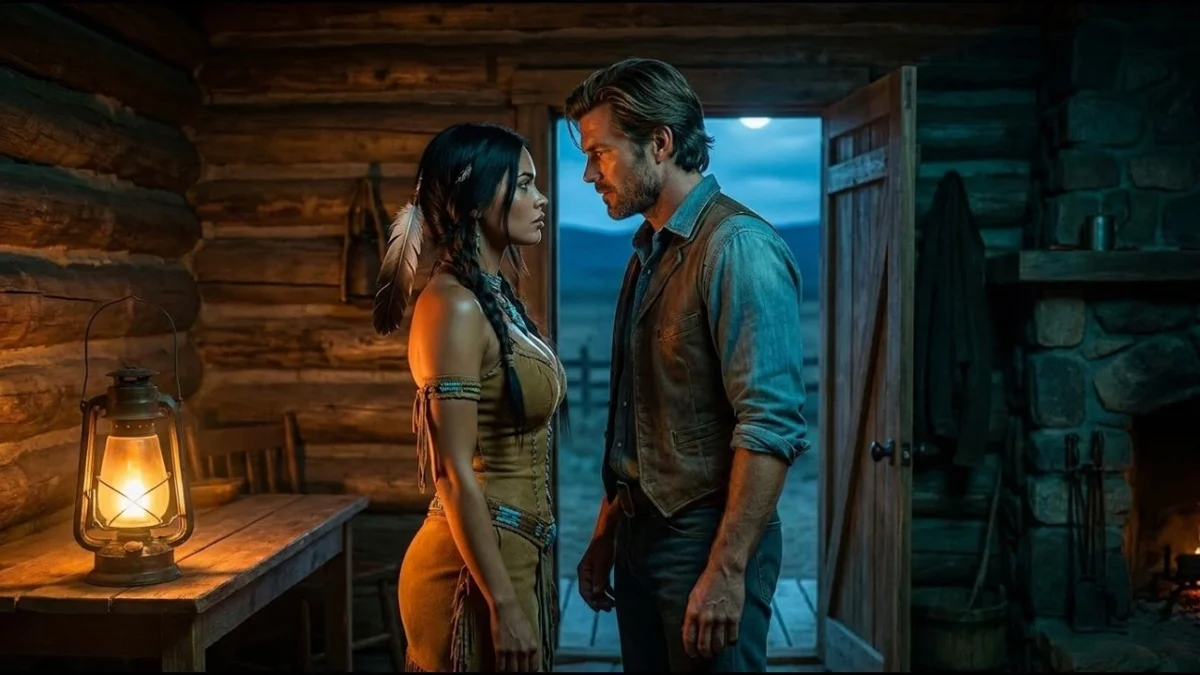
He Freed a Wounded Apache Woman Years Ago — When She Rode Back, What She Asked Changed Everything
The desert never forgot a debt. Caleb Reyes knew that much, even if he couldn’t have told you why he believed it.
In the high desert of the New Mexico Territory, on a stretch of scrub-flat land just south of Mesa Hollow, a lone rancher cut a woman’s ropes and let her go free.
He asked nothing. Said almost nothing. That was three years ago. He thought he’d never see her again.
He was wrong. The debt sat quiet on the desert’s ledger until the morning she rode back across his land, not broken, not afraid, to ask him something no man could answer lightly.
Stay until the end, and don’t forget to like and subscribe. In the New Mexico Territory, summers came on like a slow fever.
The kind that builds for weeks before it breaks. The land around Mesa Hollow was red-rock country, rust and shadow, where heat settled into the arroyos by midday and didn’t lift until long after dark.
Caleb Reyes had worked that land for eight years. He’d inherited forty acres from a man who owed his father a favor, and added twenty more by clearing mesquite, mending fence, coaxing water from a creek that ran dry half the year.
The work kept him moving. For a long time, moving was the point. His wife Clara had died of fever in the winter of ’77.
Twenty-nine years old. She left behind a quilt she’d never finished, a photograph on the mantel Caleb couldn’t bring himself to put away, and a silence inside those cabin walls unlike any he’d known before.
He had loved her without making enough of a fuss about it, the way men on the frontier sometimes loved things, quietly, with the assumption there’d be more time.
There wasn’t. There never was. In the two winters after, Caleb did what he knew.
Fed the cattle. Fixed the fence when the wind took it down. Rode into town for flour and coffee and came back the same day, nodding at people he knew without stopping.
The Hartfield family to the north had a daughter who left him plates of food on the porch sometimes, without knocking.
He ate them, washed the plates, returned them without a word. He wasn’t ungrateful. He’d just run out of things to say.
Language had started to feel like a tool he had no use for anymore. His horse, a brown quarter horse he called Beans, was his best company.
He talked to Beans in the evenings, standing at the fence while the sun went behind the mesa.
Nothing important. Complaints about the weather, notes on which stretch of fence needed work. Beans would flick an ear and keep eating, and Caleb found that more settling than most conversations he’d had with people.
He was thirty-two years old. He told himself he was fine. He mostly believed it.
It was the third spring after Clara died, spring of ’80, when everything shifted. He’d been out riding the south fence line when he saw the dust, then the horses, then the men.
Three of them, heavy-set, bounty papers folded in their vest pockets, with the look of men who thought more about money than about what came after.
They had a woman tied to a saddle horn. Wrists bound in front with rope, dress torn at the sleeve, long black hair loose and snarled from riding that way for God knows how long.
She held herself upright anyway. That was the first thing Caleb noticed. She wasn’t slumping.
She was watching everything around her with dark, careful eyes. The bounty men pulled up when they spotted him.
The one in front, reddish beard, broken front tooth, called out they were transporting a prisoner and to mind his business.
Caleb asked what she’d done. The man said it didn’t much matter what she’d done, that he had papers and that was enough.
He told Caleb to move his horse off the trail. Caleb looked at the papers.
Real enough. The territory had been issuing papers like those all season, part of a push to clear Chiricahua Apache off grazing land that ranchers to the east wanted for cattle.
The papers gave men like these legal cover to do whatever they pleased and call it law.
Caleb had never put much stock in papers. He looked at the woman. She met his eyes.
Didn’t beg. Didn’t look away. There was something in her face, not defiance exactly, more like she was reading him.
Taking his measure the same way he was taking hers. He told the bounty men they could water their horses at the creek and rest an hour.
Said he’d watch the prisoner while they did. The man with the red beard hesitated.
Caleb told him his hand was nowhere near his rifle, and that a man who’d turn down hospitality in the high desert in April was a fool.
That was the kind of logic these men respected. They took the water. While they were at the creek, Caleb cut the woman’s ropes with his skinning knife.
Fast, quiet work. He told her the Hartfields were twelve miles north, that she should avoid the main road, that a dry wash half a mile east would give her cover heading toward higher ground.
He told her the arroyo bent north before it bent east, and that if she rode the bend she’d come out above where the bounty men were likely to search.
She listened to all of it. Then she said something in her own language. Two words, short and deliberate, spoken low.
He didn’t know what they meant. But he understood the weight of them. He gave her his canteen.
She rode. He walked his horse back to the creek and told the bounty men she’d gotten loose and run, that he’d fired a warning shot but she was already over the ridge.
The man with the red beard called him a name Caleb didn’t dignify with a response.
There was a tense minute where he thought the man might go for his gun.
He didn’t. They rode east, cursing. That night Caleb sat on his porch thinking about what he’d done.
He didn’t regret it. He also didn’t expect to see her again. He picked up Clara’s unfinished quilt, set it back down, and went to bed.
Three years passed. He’d almost stopped thinking about her. Almost. On certain mornings, usually when the light came in at a particular angle and the land looked very old and very still, he’d think about those two words she’d spoken.
Wonder if she’d made it to the high country. He’d decide she had, and get back to work.
The morning she came back was ordinary. Early June. Caleb was at the well, winding up the bucket, when he heard a horse coming from the south at a walk.
No panic in it. Not the stride of something spooked or chased. Deliberate. He turned.
She was dressed differently than before. Long skirt of brown cloth, loose blouse, moccasins up past the ankle.
Her hair was braided now, neat and straight, and she wore a necklace of small shells that moved when she rode.
She sat the horse like the ground underneath it was hers. Maybe twenty-four or twenty-five.
Not the bound, disheveled woman from the trail three years ago. Not a bit of it.
She pulled up ten yards from the well. Caleb set down the bucket and said good morning.
It seemed the right thing. “You are the man who cut the rope,” she said.
He said he was. She nodded once, confirming something she’d already known. She told him her name was Nayeli.
Said she’d come from the Chiricahua camp in the Dragoon foothills, four days’ ride. She’d come because her people were being pushed.
Soldiers had ridden in twice that spring, burning food stores, baskets of dried mescal hearts, jars of preserved acorn mash, everything the band had put by for a hard summer.
A land speculator named Drayden, with money behind him, wanted the eastern slopes of the Dragoons cleared.
He’d hired men to do it. The same kind of men who had bound her three years ago.
She had come to ask if Caleb would stand with them. Not to fight. To speak.
He had clear title to his land and a clean name in the territory. His signature on their grievance at the Mesa Hollow land office would carry weight that a paper signed only by Apache names would not.
Not in those days. Then she waited. Caleb stood at his well a long moment.
He thought about the papers the bounty man had shown him three years back. Thought about the way the law bent for men with money.
Thought about the photograph on the mantel, the unfinished quilt, all the careful nothing he’d been doing since Clara died.
He said he’d make coffee and she could tell him more. She dismounted. The first few hours were careful.
They sat at the rough table outside, Caleb didn’t bring her into the cabin, not yet; it still had Clara all through it, and it didn’t feel right.
Nayeli told him about her band. The headman Dosela, an elder who’d kept peace with the territory for seven years by moving quietly and trading honestly.
The younger men who were tired of moving. The children who’d watched their parents give up ground until there was almost nothing left.
She watched him as she talked, still reading him. He had the sense she was deciding whether he was worth explaining any of this to.
That night he put her horse in the paddock and spread a bedroll on the porch.
She took it without comment. He lay awake a long time, listening to the desert.
The land outside felt less empty than it had in a while. He couldn’t have said when that started.
Morning came cool and gray, rare cloud cover for that time of year. Nayeli was at the fire pit when Caleb came out, feeding mesquite branches into the coals with the ease of someone who’d done it ten thousand times.
She’d found his iron pan. Frying salt pork and some dried herbs from a pouch at her belt, something with a faint green smell, almost like sage but sharper.
He didn’t ask what it was. It was good. They didn’t talk much over the meal.
After a while she asked how long he’d been on his own. He said two and a half years, more or less.
She said her mother had died when she was twelve, a bad winter, and that for two seasons she’d barely spoken to anyone.
He nodded at that. He didn’t try to meet it with something, didn’t reach for a response.
Some things are better just received. Over the days that followed, a rhythm settled in.
She helped him replace three broken fence posts on the south run, stronger than she looked, didn’t need to be shown how to set a post twice.
He helped her sort and dry the medicinal herbs from her saddlebags, spreading them on canvas in the sun while she named each one.
This for headache, this for a wound gone hot, this for fever. He thought of Clara at that last one.
Told her so. Said there’d been a fever he couldn’t do anything about. “You had no one to teach you,” she said.
Not unkindly. As a fact. He understood the difference. They taught each other small things.
She’d been learning English for years from a missionary’s wife in the Dragoon foothills and spoke it with a careful, unhurried cadence, choosing each word like she was picking through something she wanted to get right.
He taught her names for tools, some Spanish from his father. She taught him the Chiricahua word for water, tú, and for fire, and for the first light before sunrise.
Then she told him what those two words meant. The ones she’d said when he cut her ropes three years back.
Roughly: I see you as you are. Something her people said to someone who had looked past what was easy to see.
The evenings were the best part. They ate by the fire because the nights still had some cold in them, and afterward they’d sit without talking.
The sky in that country, away from any town, was extraordinary, more stars than seemed possible, and now and then one of them would point at something and the other would look.
One night she talked about a Chiricahua custom for honoring the de@d before the anniversary of their passing.
You gathered things the person had loved, held them in the smoke of a piñon fire, spoke their name four times.
Then you gave those things away or returned them to the earth. Holding on too long made the living heavy, she said.
She spoke her mother’s name to the fire that night, once, quiet, not for him, just for the night and for herself.
He sat with that awhile. Then he went inside and came back with Clara’s quilt.
Held it over the smoke, not burning it, just letting it sit in the air above the coals.
Said her name. Clara. It came out smaller than he expected. He hadn’t said it out loud in a long time.
Nayeli didn’t say anything. He folded the quilt and left it on the porch railing and went back to his chair.
The night felt different after that. He didn’t have a clean word for it. But lighter was close enough.
On the fifth day, Drayden’s men came. Four on horseback, from the east, before the heat had built.
Caleb saw the dust from the south pasture and walked back without hurrying. Nayeli was on the porch already, watching them come, one hand at her side, one on the strap of the saddlebag with her herbs.
He told her to go inside. She said she wasn’t going inside. He said it wasn’t an argument, it was a request, he’d have an easier time talking these men down if they weren’t fixed on her.
She looked at him a moment, then went. The men pulled up at the yard fence.
The one in front was younger than expected, mid-twenties, coat too heavy for the weather, covering inexperience with a hard face.
Said he had information a Chiricahua woman was on the property and that he had a warrant for her removal to Fort Bowie.
Caleb said he’d like to see it. It wasn’t a warrant. It was a letter on county stationery, signed by a justice of the peace named Aldrup, and Caleb knew Aldrup had been taking money from Drayden’s land office for six months.
He said so. Said the name, the amount he’d heard, the name of the man who’d told him.
The man in the coat went quiet. Caleb said the woman was on his property at his invitation.
Said his land had clear title on file at the Mesa Hollow office. Said any man who crossed his fence without cause would answer to the circuit judge, due in town in ten days, who was not in Drayden’s pocket as far as Caleb knew.
He said it all without raising his voice. Kept his hands open and away from the rifle.
Then the man in the coat pulled his pistol. Not quite aiming. Threatening, which was almost worse.
Caleb’s hands went up. The morning seemed to stop. Then something hit the dirt hard between him and the horses.
A rock. Loud crack as it landed. The horses shied. Two of the men were immediately busy with their own animals.
The pistol man looked up. Nayeli was on the cabin roof. She’d gone out the back window and climbed up.
Standing at the peak, balanced, three more rocks in her hands. Not smiling. Horses don’t deliberate.
Two of them spun and bolted a hundred yards before their riders got them stopped, and in that mess the pistol went away, because things had gone sideways enough that waving a gun at a man on his own land in front of potential witnesses was no longer the smart play.
The men rode off. Not hard. They left with the careful bearing of people who intend to tell it differently later.
But they left. Caleb watched them until they were small. Then he looked up at the roof.
Nayeli looked down at him. Still had the rocks. “I told you to go inside,” he said.
“I did go inside,” she said. “Then I went up.” He stood there a moment and then he laughed.
A real laugh, from somewhere he hadn’t been in two and a half years. Strange sound in his own ears.
Not unwelcome. Like a room he’d locked up and forgotten about. She climbed down. That evening the talk came easier.
Not the careful, tentative kind from the first days but something more like the conversation of people who had just come through something together and both knew it.
She told him about being nine years old and climbing the tallest pine at the edge of camp to prove to her older brother she could, getting stuck halfway down, and her mother standing at the base doing nothing.
Not calling up, not moving to help, just watching to see how Nayeli would work it out.
She worked it out. She always did. He told her about Clara properly this time, with the real details.
The way Clara laughed at her own jokes before she got to the punchline. The way she’d argue out loud with the photograph of her own mother on the wall.
The beef stew she made every Sunday that was never quite right, and that he told her was perfect every single time he ate it.
“That was kind,” Nayeli said. “It was selfish,” he said. “I didn’t want her to stop making it.”
She smiled at that. Small, but real. The next morning he came out with his coffee to find her saddling her horse.
He watched her a minute. Then he said he’d ride to Mesa Hollow with her.
He’d sign his name. She went still with the cinch strap in her hand. He said he’d been keeping out of things long enough.
Said the circuit judge was ten days out. Said the grievance was just and his name on it was worth something in that county, whether he liked the weight of carrying it or not.
“You understand what this will cost you,” she said. He said he understood well enough.
Said he’d spent a long time whittling himself down to nothing worth losing, and it turned out not to be as comfortable as it sounded.
She was quiet a moment. Then she said those two words, the ones from the trail, three years back.
I see you as you are. “Teach me to say it back,” he said. She did.
He said it badly. She corrected him. He tried again, less badly. She nodded. They rode for Mesa Hollow that morning, side by side, under a sky gone huge and clear.
The light in that country at that hour had a quality Caleb had never found a good word for.
It made the land look like it had been there a long time and would be there a long time after, and that you were welcome to it if you could bear the terms.
He’d spent two and a half years trying to want as little of it as possible.
Riding south with Nayeli beside him, he found the country looked wider than it had in a while.
Still hard. It was always hard. But wider, and he was in it again, moving forward with someone who had looked straight at him and told him she could see what he was.
Four months later he rode the four days to the Dragoon foothills to find her.
He had a question to ask. She knew what it was before he arrived, the riding itself told her.
She said yes before he finished asking. Her people marked it with a fire at night and the right words spoken over it, hands held in the smoke.
It meant more to both of them than any courthouse record. But that was still ahead.
For now, the morning held them. The desert going rust and gold in the early light, the horses steady, the silence of that country the way it always was, big enough to get lost in.
For once, Caleb Reyes had no interest in getting lost. He had somewhere to go and someone riding next to him, and the land between Mesa Hollow and wherever they ended up looked, for the first time in a long time, like something he was glad to be crossing.








