He Bought a Bruised Girl for $10—Her First Question Made the Mountain Man Freeze
He Bought a Bruised Girl for $10—Her First Question Made the Mountain Man Freeze
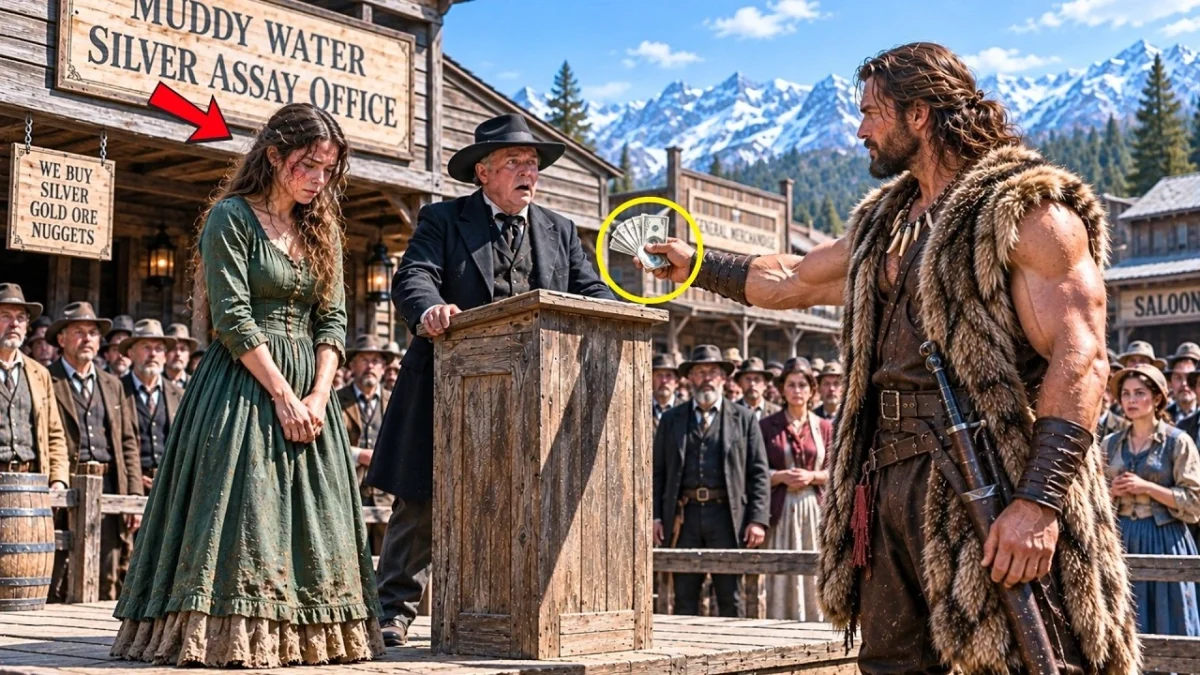
$10 bought a lot in 1881. A decent rifle, a winter’s supply of coffee and salt, two good mules if the trader felt generous.
Amos handed over a crumpled greenback for a woman who looked like she’d fought a cougar and lost.
Her first question stopped his breathing. Will I need to dig my own grave before the ground freezes?
Almost stared at her. Her left eye was swollen shut. The surrounding flesh, a mottled landscape of plum and bile yellow, her split lips scabbed over in a rough, uneven line.
She stood in the freezing mud of the supply camp, shivering violently inside a wool coat, three sizes too big.
Yet her one good eye, a hard flat slate gray, held his gaze without a tremor of submission.
He didn’t answer immediately. The wind sweeping down through the gorge carried the biting stench of the settlement woodsm smoke.
Raw sewage, spil whiskey, and unwashed men. Amos hated coming down the mountain. He hated the noise.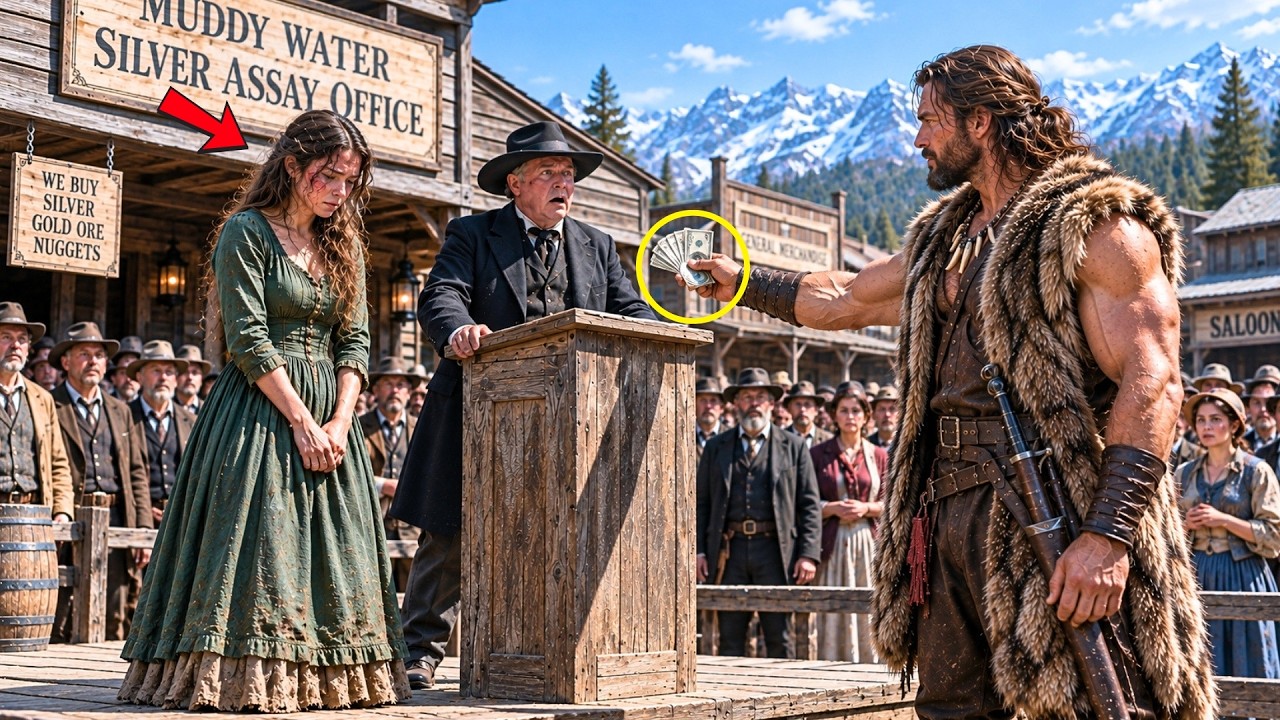
He hated the constant pressing desperation of a mining town that had run out of gold and was quickly running out of hope.
He had come for 50 lb of flour, a dozen tins of peaches, and enough black powder to see him through the spring thaw.
Buying a human being had not been on the list. The man who had held the tether, a thick-necked frighter named Sykes, was already pocketing the $10 bill.
Laughing a wet rattling laugh. She’s a mute half the time and a biter the rest.
Sykes had warned, spitting tobacco juice onto the frozen ruts of the road. You’re buying a chore.
Mountain man, don’t say I didn’t square with you. Amos ignored Sykes. He reached out slowly, making sure she could track the movement of his large, calloused hand, and took the frayed hemp rope from the frighter’s grip.
He didn’t pull it. He just held the end. I don’t have a shovel to spare.
Amos finally said, his voice grating like two stones rubbing together. It had been nearly 3 months since he had spoken to another person, and the ground is already frozen, so you’ll have to keep breathing.”
He turned and began walking toward where his two mules stood, tied to the hitching post outside the assay office.
He didn’t look back to see if she was following. He felt the tension in the rope.
A slight hesitation and then the slackening that meant she was moving. The settlement of Oberon was a scar on the lower valley.
Tents and hastily erected timber fronts huddled together against the encroaching frost. Amos packed his supplies with methodical efficiency, balancing the heavy canvas sacks across the paniers.
His hands worked over the buckles and straps by muscle memory. Hadtie stood beside the lead mule.
She didn’t crowd the animal, nor did she retreat into the street. She stood perfectly still, conserving whatever heat was left in her battered frame.
Amos stole a glance over the broad back of the mule. She couldn’t have been more than 25.
Though the exhaustion etched into the corners of her mouth added a decade. Dirt was ground deep into the pores of her skin.
He unstrapped a heavy buffalo hide blanket from the saddle horn of his riding horse and tossed it to her.
She caught it awkwardly against her chest. Wincing as the weight impacted her ribs. Wrap up.
Amos said, “We have a three-day ride up the ridge. The wind cuts worse the higher we go.”
Hattie looked at the blanket, then up at him. Why did you pay him? Because he was loud.
Amos said, tightening the cinch on the pack saddle. And I don’t like noise. It wasn’t a lie.
The sound of psych striking her behind the merkantile had irritated him. The wet smack of a heavy hand against a face, followed by the muffled grunt of someone refusing to cry out, had interrupted his mental inventory of supplies.
He had walked around the corner, seen the blood on her chin, seen Sykes raising his boot for a kick, and reached into his pocket.
Dendelar, it was an impulse. Amos didn’t do impulses. He lived by rigid routine. By the turning of the seasons and the migration of the elk, his survival depended on predictability.
Now he had 110 lb complication wrapped in a buffalo hide. Watching him with the weary intensity of a cornered fox.
Can you ride? He asked. I can walk. I didn’t ask if you could walk.
The trail is steep. The snow is already shin deep past the timberline. I have a spare saddle on the gray.
Can you ride? Yes. Amos nodded. He didn’t offer a hand to help her mount.
He knew a wounded animal didn’t want to be touched. He watched from the corner of his eye as she struggled, biting back a gasp of pain as she pulled herself up into the saddle.
She settled heavily, swaying for a second before gripping the horn with white knuckled intensity.
Amos mounted his own horse, took the lead ropes for the pack mules, and clicked his tongue.
The small caravan moved out of Obergan, leaving the mud and the shouting behind, heading toward the towering, jagged peaks of the divide.
The first four hours were spent in silence. The trail was a narrow ribbon of crushed rock winding through a dense stand of lodgepole pines.
The air grew perceptibly thinner cola, stripping the damp valley rot from their lungs and replacing it with the sharp medicinal scent of pine needles and ice.
Amos set a punishing pace. He needed to make the first shelf before nightfall. He checked his back trail periodically.
Not for followers, but to see if she had fallen out of the saddle. She hadn’t.
She rode with a stiff, unnatural posture, absorbing the jolts of the horse with her spine rather than her knees.
She was in agony. Amos could read it in the pale line of her jaw, and the way she held her left arm tight against her ribs.
But she didn’t ask him to stop. She didn’t complain as the sun dipped behind the western ridge, casting the forest into deep, bruised purple shadows.
Amos pulled up. They were in a small clearing backed against a sheer rock wall.
A shallow overhang offered a meager defense against the wind. “We camp here,” he said, swinging down from the saddle.
He didn’t wait for her. He began stripping the mules, hauling the heavy panters to the back of the overhang when he finally turned around.
Hattie was standing on the ground, leaning heavily against the gray horse’s shoulder. Her legs were trembling.
Amos walked past her, an axe in his hand. He felled a de@d standing pine, bucked it into manageable lengths, and carried the wood back to the overhang.
He worked with a fluid, economical grace that belied his massive frame. He built a small hot fire against the stone wall.
The heat reflected outward, pushing back the creeping chill of the evening. He pulled an iron skillet from a pack, sliced thick cuts of salt pork, and set them to fry.
He poured water from his canteen into a blackened tin pot and set it near the coals to boil for coffee.
Only then did he look directly at her. She was sitting on a flat rock near the fire.
The buffalo blanket pulled tight over her shoulders. She was staring at the skillet. What’s your name?
Amos asked. Heddy. I’m a moose. He reached into his pack and pulled out a small cked bottle of clear liquid.
He walked over and held it out. Hattie flinched, pulling her chin down against her chest.
Her eyes darting to his hands. Amos froze. He didn’t sigh. He didn’t offer reassurances.
He simply knelt down. Placing the bottle on the ground between them and backed away to his side of the fire.
It’s alcohol, he said quietly, “For the cuts. If you don’t clean the dirt out of that lip, it’ll rot before we reach the cabin.”
Hattie looked at the bottle. She slowly reached a hand out from beneath the blanket.
Her knuckles were split and caked with dried blood. She picked up the glass. She unccorked it with her teeth, poured a splash onto the hem of her oversized coat, and brought the rough fabric to her face.
She hissed sharply as the raw alcohol bit into the torn flesh. She didn’t stop until the cut was scrubbed clean.
Amos handed her a tin plate loaded with fried pork and hard tac. She took it without a word.
She ate like a starved hound. Barely chewing, desperate to get the calories down before they could be taken away.
Amos ate slowly, chewing his meat down to paste. Watching the fire, he said, “You were a biter.”
Amos noted. Breaking the long silence, Hattie stopped chewing. She swallowed hard, her throat clicking.
He tried to put his hand where it didn’t belong. So I took a piece of his thumb.
Amos nodded slowly. Good. Hadtie looked at him. Truly looked at him for the first time.
He was a hard man to read. His face was weathered into deep canyons. His beard thick and wiry, blending into the heavy collar of his sheepkin coat.
His eyes were pale blue, the color of winter ice. Holding no pity, no malit, and no discernable warmth.
He didn’t look like a savior. He looked like the mountain itself, indifferent, enduring, and dangerous.
The cold the next morning was a physical weight. It stiffened the joints of the mules and rhymed the horse’s coats in white frost.
Amos woke before the gray light cracked the horizon. Hattie was already awake. She was sitting in the exact position she had fallen asleep in, her back against the stone, the blanket pulled to her nose.
Amos built up the fire, boiled a handful of coffee grounds, and handed her a cup.
Drink it fast. He said, “We have a steep climb today. The second day was brutal.
The trail narrowed, switching back upon itself as they climbed above the timber line. The trees gave way to scrub oak and eventually to bear windswept rock.
The wind here didn’t just bite, it howled, carrying fine granules of ice that scoured exposed skin, had rode with her head bowed.
The gray horse picked its way carefully over the loose shale. Amos walked ahead, leading the mules, leaning into the steep grade.
His thighs burned, his lungs expanding in the thin air. He liked this pain. It was clean.
It made sense. By midday, the sky turned the color of bruised iron. A storm was brewing over the western peaks, rolling toward them like a dark heavy blanket.
We need to push. Amos yelled over the wind. Looking back at her, if that front hits while we’re on the screfield, we’ll freeze to the saddles.
Hadtie nodded. She dug her heels into the gray flanks, urging the tired horse forward.
They hit the screfield field an hour later. It was a treacherous stretch of loose flat rock spanning a mile across a steep incline.
A slip here meant a tumbling, bonebreaking slide down a thousand ft of jagged stone.
Amos dismounted and led his horse by the bridal. He signaled for Hattie to stay mounted.
She was too battered to navigate the unstable ground on foot halfway across. The wind shifted.
It hit them broadside. A massive invisible hand, shoving them toward the edge. One of the pack mules stumbled, its hooves scrabbling frantically on the sliding rock.
Amos dropped his horse’s reins and lunged back, grabbing the mule’s halter, throwing his entire weight uphill to counterbalance the animal for a terrifying 10 seconds.
They hung in the balance. The rock beneath Amos’ boots gave way, sliding down the mountain in a clattering rush.
He locked his knees, digging the edges of his soles into the dirt beneath the scree, his arms screaming in its socket as the panicked mule fought him, Hattie didn’t scream, she kicked her feet out of the stirrups.
Ready to bail if the gray lost its footing, but she kept her hands steady on the res, turning the horse’s head uphill to keep its weight distributed slowly.
Agonizingly, Amos pulled the mule forward onto solid footing. He stood there for a moment, chest heaving, his breath pluming in thick white clouds.
He looked back at Hadtie. She was pale, her knuckles white, but she was calm.
Panic killed on the mountain. She hadn’t panicked. Amos gave a curt nod and retrieved his horse’s res.
Keep moving. They reached the treeine on the far side of the ridge just as the first flakes of snow began to fall.
By the time they entered the heavy timber, it was a blinding white out. But Amos knew these woods blindfolded.
He navigated by the slope of the land and the sound of the wind through the different varieties of pine.
Two hours after dark, they broke into a small sheltered basin. Through the swirling snow, a dark shape emerged.
A cabin small lollum built of massive unpeeled logs. Hamus pushed open the heavy plank door.
The inside was freezing, smelling of old wood, ash, dried sage. And cured leather. He ushered Haddie inside.
Out of the wind and went back out to strip and stable the animals in the lean to attached to the back wall.
When he finally stepped back inside, carrying his rifle and the saddle bags. He struck a match and lit an oil lantern on the rough huneed table.
The cabin was purely functional. A cast iron stove dominated the center of the single room.
A heavy wooden table stood near the window. Along the far wall was a bed frame built into the logs, piled thick with furs.
Shelves lined the walls packed with tins, jars, tools, and ammunition. Hanging from the rafters were bundles of dried herbs and salted meat.
Hattie stood in the center of the room, exactly where he had left her. She hadn’t moved to explore.
She was shivering uncontrollably, her teeth clicking together. Amos went straight to the stove. He shoved in a handful of kindling and dry moss, struck a match, and coaxed a flame.
He added larger pieces of split oak until the fire roared, the iron quickly radiating a deep penetrating heat.
“Take the coat off,” Amos said, turning to her. “It’s wet. It’ll sap your heat,” Hattie hesitated.
Her hands gripped the lapels of the oversized coat. Amos stood perfectly still. He let out a slow breath.
I paid $10 for you to keep breathing, he said, his voice entirely devoid of inflection.
Pneumonia makes a bad return on investment. Take the coat off. She let go of the lapels.
Her numb fingers fumbled with the buttons. She shrugged the heavy wet wool off her shoulders and let it drop to the floor.
Beneath it, she wore a ragged cotton dress. Faded and torn at the hem. It offered no warmth.
Amos picked up the coat and hung it on a peg near the stove. He walked to the bed, gathered a thick mountain lion pelt, and brought it back.
He held it out. She took it, wrapping it tightly around herself, retreating to a stool in the corner of the room.
As far from him as she could get, while still feeling the stove’s heat, Amos ignored her.
He began the evening routine. He melted snow in a pot, boiled it, and made a heavy stew from dried venison, barley, and selt.
He set a bowl on the table. He didn’t tell her to eat. He simply took his own bowl and sat on a wooden crate near the door.
After 10 minutes, Hati Ros moved to the table and ate. She kept her back to the wall, her eyes locked on his hands.
The first week in the cabin established a rhythm of brutal necessity and profound silence.
The storm that chased them up the mountain stalled over the peaks, dumping 3 ft of snow and locking them inside.
Amos spent his days repairing harness gear. Oiling his rifle and carving new tool handles from cured hickory.
He was a man accustomed to the sound of his own breathing and the crackle of burning wood.
The presence of another human being in his small space was jarring. He found himself acutely aware of her every shift in weight.
The rustle of her dress, the jagged intake of her breath when a bruised rib caught her wrong.
Hattie remained hypervigilant. She slept in the bed. Amos had bluntly told her to take it.
While he rolled out a bed roll on the floor by the door, she slept lightly, waking with a start if the wind slammed against the shutters or if Amos rolled over.
She spent her days sitting in the corner, mending the tears in her cotton dress with a needle and thread Amos had left on the table.
She didn’t ask for it. He hadn’t offered it. He simply set it down where she would find it.
They communicated in actions, not words. The rules of their coexistence were negotiated without a single spoken sentence.
When Amos stood up to fetch wood, Hadtie immediately moved to the opposite side of the room.
Amos learned to telegraph his movements, clearing his throat before standing. Letting his heavy boots drag slightly on the floorboards.
So she always knew where he was. He didn’t resent her fear. He understood it.
In the wild, an animal that didn’t expect a trap usually ended up in one.
On the fifth day, the swelling in her face finally began to recede. Her left eye opened, revealing a matching slate gray iris.
The yellow and green bruising spread down her neck, tracing the lines of her collarbone.
Amos was at the table, working a wet stone over the blade of his hunting knife.
The metallic sh sound filled the room. Hattie was sitting on the bed watching him.
“Does the blade need to be that sharp to cut salt pork?” She asked. Her voice was raspy from disuse.
Amos paused his stroke. He wiped the blade on a rag. It needs to be sharp enough to skin a winter elk.
The meat runs out by February if I don’t. Hadtie watched him sheath the knife.
She stood up wrapping the lion pelt around her shoulders and walked to the small counter where Amos kept his cooking supplies.
She picked up a smaller dull pairing knife. She brought it back to the table, sitting opposite him.
“Show me,” she said. Amos looked at her, then at the dull knife in her hand.
He didn’t ask why. He reached into his kit and pulled out a smaller sharpening stone.
He slid it across the rough planks of the table, hold the blade at a 20° angle.
He instructed, demonstrating with his own knife. Push it across the stone like you’re trying to slice a thin layer off the top.
Don’t press down hard. Let the grit do the work. Hadtie placed her knife against the stone.
Her hands were still rough. The knuckles scarred, but they were steady. She pushed the blade forward.
It made a clumsy scraping sound. Too steep. Amos said, “Lower the spine.” She adjusted the angle.
She tried again. The sound changed a smoother. More resonant hiss. Amos nodded. Do that 50 times on each side.
They sat at the table for an hour. The dual rhythm of steel on stone replacing the silence.
It wasn’t comfortable, but it wasn’t hostile. It was a shared task. The next morning, the snow stopped.
The sky broke open into a blinding, painful blue. The cold was intense enough to crack the timber of the cabin walls.
Amos suited up, wrapping a wool scarf around his face. Pulling his heavy fur hat down over his ears, he needed to dig out the leanto and break the ice on the creek for the animals.
He walked to the door, resting his hand on the latch. He turned back. Hattie was sitting up in bed.
I’ll be gone an hour. Amos said, “Keep the stove stoked. There’s flour and baking powder in the blue tin on the top shelf.
If you make biscuits, don’t burn the bottoms. I hate burnt bottoms. He stepped out and pulled the door shut before she could respond.
When he returned an hour later, shivering, his beard crusted with ice. The cabin smelled of hot cast iron and baking flour.
Hattie was standing by the stove, turning a batch of biscuits in a skillet. She had discarded the oversized coat and the lion pelt.
She stood straight. Bearing her own weight, Amos stomped the snow off his boots. He took off his coat and hung it up.
He walked to the table and sat down. Hadtie brought the skillet over. She used a wooden spatula to slide three biscuits onto his tin plate.
They were perfectly browned. Amos picked one up. It was hot enough to burn his fingers.
He took a bite. He chewed slowly. “They aren’t burnt,” he said. “I know,” Hattie replied, returning to the stove to pull her own plate.
It was the closest thing to a compliment he had given her, and the closest thing to a victory she had claimed.
Over the next 3 weeks, the survival dynamic shifted into something resembling a partnership. Hattie took over the cooking and the mending.
She learned how to stretch the flour, how to render the fat from the salt pork, how to steep pine needles for a bitter vitamin rich tea that kept the scurvy away.
Amos hunted. He tracked through the deep powder on snowshoes. Returning every few days with snowshoe hairs or grouse and once dragging the hindquarter of a small mule deer, he noticed things about her.
He noticed that she favored her right leg when the cold dropped below zero. He noticed she never stood with her back to the door.
He noticed the long faded scars that mapped the back of her hands burns. He guessed.
From a stove or an iron, she noticed things. Two, she saw how meticulously he cleaned his rifle, never missing a speck of carbon.
She saw how he moved through the woods, not fighting the terrain, but blending into it.
She noticed he never raised his voice, not even when a log fell out of the stove and scorched the floorboards.
One evening, deep into December, the wind was tearing at the roof, threatening to rip the shingles off.
The cabin was a small, warm bubble in a violent, freezing world. Amos was reading a tattered copy of a farmer’s almanac by lantern light.
Hadtie was knitting a pair of thick wool socks. “Where did you come from before Obergun?”
Amos asked without looking up from the page. Hadtie stopped knitting. The needles rested quietly in her lap.
She looked at the dancing shadows on the wall. Saint Louie, she said softly. Long way from the mountains.
I was running out of west to travel. Amos turned a page. Who were you running from?
A man who thought he owned me because he married me. Hattie said, her voice flattening into that emotionless tone she used when expecting a blow.
He broke my jaw when I was 19. He broke my arm when I was 21.
When I was 24. He told me he was going to kill me. Amos slowly closed the almanac.
He looked at her. I waited until he fell asleep. Hadtie continued, staring straight ahead.
I took his money from the tin under the floorboards. I took his horse and I rode west.
The horse died in Kansas. The money ran out in Denver. I walked the rest of the way.
I ended up in Obergan washing clothes for the miners. Sykes. Sykes offered me a room.
[clears throat and snorts] Said I could work off the rent. She laughed. A short bitter sound.
Turns out rent was high. Amos absorbed the words. He didn’t offer pity. Pity was useless out here.
Sykes is a de@d man. Amos said simply, stating it as a fact of geology or weather.
Next time I go down the mountain, I’ll put a bullet in his knee, and when he falls, I’ll put one in his ear.
Hattie looked at him, her eyes wide, searching his face for the joke. For the bravado, there was none.
He was merely outlining a chore, like chopping wood or breaking ice. Why? She asked.
Amos picked up the almanac again. Because a man who beats a woman to pay her rent is a rabid dog.
You don’t negotiate with rabid dogs. You put them down so they don’t bite the next thing that walks by.
He opened the book and began reading again. Hattie looked down at her knitting. A strange unfamiliar pressure built behind her eyes.
It wasn’t sadness. It wasn’t fear. It was the terrifying, fragile sensation of feeling safe, she blinked rapidly.
Focusing on the rough wool in her hands, refusing to let the tear fall. Outside, the wind screamed against the heavy logs.
But inside, the fire burned steady and hot. There is a deep, quiet comfort in sitting by the fire and letting a story unfold.
Just like the old days before the noise of the world drowned everything out. If Amos and Hadtie’s journey through the high timber meant something to you today, consider leaving a like and subscribing to the channel.
Share this with someone who appreciates a grounded um tale. The trail continues. And we’ll be waiting right here to finish the climb with you next time.
Bakat January hit the high country like a falling anvil. The temperature plummeted to 30 below zero and stayed there for 10 days.
In the de@d of night, the surrounding forest sounded like a battlefield. The sap inside the ancient pines froze, expanded, and detonated with loud, echoing cracks that shook the snow from the high branches.
Cabin fever was a tangible presence. A third occupant in the small stifling room was spaced.
His large frame was not built for confinement. He checked the window, checked the stove, checked the window again.
Had he sat by the hearth, sorting dried beans, entirely unfazed by the isolation. To a woman who had spent years shrinking into corners to avoid a heavy hand, the quiet monotony of the snowbound cabin was a luxury.
On the 11th morning, the wind finally died. The silence that followed was absolute. Amos suited up before the sun cleared the eastern ridge.
I need to drop that leaning spruce behind the leanto, he said, pulling heavy leather mittens over his wool gloves.
The roots are heaving. One more heavy snowfall and it comes through the roof on top of the mules.
Do you need help? Hattie asked. No, stay inside. Keep the fire hot. He took his felling axe and a heavy crosscut saw.
Hattie watched him through the frosted glass of the small window. He waited through waistdeep drifts, his broad shoulders easily parting the powder.
He reached the spruce, a massive dying sentinel leaning precariously toward the shed. She turned away to knead a batch of sourdough.
5 minutes later, she heard the rhythmic biting thack of the axe. Then came the deeper groaning sound of the tree shifting on its frozen stump.
What happened next didn’t sound like a clean fall. It sounded like a localized explosion.
The spruce’s core was completely rotten, hollowed out by carpenter ants and frozen solid.
When Amos made his back cut, the hinge wood simply shattered. The massive trunk didn’t fall away.
It twisted violently on the stump, kicked backward, and slammed into the earth. Hattie dropped the dough.
She didn’t grab her coat. She shoved her feet into Amos’ spare, oversized boots, and bolted out the door.
The cold punched the breath from her lungs. She scrambled around the side of the leanto.
Amos was on his back in the snow. The trunk of the spruce 3 ft thick and covered in rough scaling bark lay across his right thigh.
He wasn’t screaming. He was completely silent. His jaw clamped shut. His eyes wide and fixed on the gray sky.
Blood was already blooming through the heavy canvas of his trousers. A stark brilliant red against the blinding white snow.
Patty dropped to her knees beside him. She grabbed his shoulders. Amus. He dragged his gaze from the sky to her face.
His skin was the color of old wax. Femurs intact. He gritted out, his breath hissing through his teeth, branch underneath, pinned, had he looked under the trunk.
A jagged, broken limb, thick as a man’s wrist, had driven straight through the meat of his thigh, pinning him to the frozen earth beneath the weight of the tree.
If she tried to pull him, it would tear the artery. Bik familiar and suffocating rose in her throat.
She swallowed it down. Panic killed on the mountain. He had taught her that the block and tackle.
Amos whispered, his eyes rolling back slightly. In the shed, Hatti ran. She didn’t feel the snow packing into the wide tops of the boots, freezing her ankles.
She threw open the lean-to door, spooking the mules. She found the heavy iron pulleys and the thick coil of manila rope hanging on a peg.
She hauled the gear back to the spruce. Amos was passing out, his head loling to the side.
Stay with me, Hattie yelled. The sheer volume of her own voice surprised her. It echoed off the rock walls of the basin.
Amos’ eyes snapped open. Hadtie scrambled up the slope above him. She looped the anchor rope around a sturdy, deeply rooted oak.
She ran the line down, hooking the heavy iron pulley to a secure branch on the fallen spruce.
She fed the whole line through the blocks. It was a mechanical advantage system. She had watched him rig one to hoist a deer carcass.
Four lines of rope meant four times the pulling power. She grabbed the end of the hall line, wrapped it around her waist, and leaned back.
The slack pulled taut. The rope groaned. The heavy iron blocks creaked. Nothing happened. The tree weighed two tons.
Huti said her yaw. She planted Amos’ oversized boots deep in the snowpack. She closed her eyes.
She thought of Sykes raising his boot. She thought of St. Louis, of the tin under the floorboards, of the bones in her face breaking.
She took all that accumulated terror, all that desperate, clawing need to survive. And she channeled it into her legs.
She leaned back and pulled. The rope stretched tight as a violin string. Her hands burned as the coarse hemp bit through her calluses.
The oak above her creaked slowly. Agonizingly, the pulley blocks began to close the distance.
The trunk of the spruce shifted. It rose an inch. 2 in. “Amos!” She screamed over her shoulder.
“Move!” Amos bit his lip until it bled. He dug his elbows into the snow and shoved himself backward.
The jagged branch tore out of his flesh with a sickening wet sound. He cleared the trunk by 6 in before Hattie’s footing gave way.
She slipped. The rope ripped through her hands, tearing the skin from her palms, and the spruce slammed back down into the snow, exactly where Amos’ leg had been a second before.
Hattie scrambled down the slope. Amos was unconscious. She couldn’t carry him. He outweighed her by a 100 lb.
She grabbed him by the collar of his heavy coat. Lean back and began to drag.
The snow acted as a sled, but the de@d weight was immense. It took her 20 minutes to drag him the 40 yard to the cabin door.
Her lungs burning, her muscles screaming in protest, she hauled him over the threshold, kicking the door shut against the cold.
She didn’t stop to rest. She grabbed her sewing shears and cut away the blood soaked canvas of his trousers.
The wound was ugly. The branch had entered the top of his thigh and exited the side, missing the femoral artery by a fraction of an inch.
But tearing a massive hole through the muscle, dark venus blood pulsed sluggishly from the deep puncture, Hetty ran to the stove.
She shoved in dry wood. Opening the draft wide, she grabbed the bottle of clear alcohol from the shelf, the same bottle Amos had offered her on their first night.
She found his sewing kit, a curved leather needle and thick waxed linen thread. She knelt beside him.
She poured the raw alcohol directly into the open wound. Amos Kumbul said he woke up with a roar, his back arching off the floorboards.
His hands blindly grasping for whatever was causing the agony. Hattie slammed her forearms against his chest, pinning him with all her weight.
“Hold still,” she commanded, her voice dropping into a harsh unyielding register. “I have to close it or you bleed to death on this floor.”
“Hold still.” Amos blinked, his eyes wild, unfocused. He saw the needle in her hand.
He saw the blood covering her arms. He forced himself to relax, his head falling back against the wood.
He grabbed the leg of the heavy iron stove to ground himself. Do it. Hi.
Rasput. Hadtie went to work. Her hands were torn and bleeding from the rope, but her fingers were steady.
She drove the thick leather needle through the torn meat of his thigh, pulling the waxed thread tight, forcing the ragged edges of the wound together.
She didn’t look at his face. She didn’t listen to the ragged, tearing sound of his breath.
She focused entirely on the mechanics of flesh and thread. Stitching a man back together the way she would mend a torn flower sack.
Eight stitches, thick, ugly, and tight. When she tied off the final knot, she sat back on her heels.
Her hands were shaking violently now. She wiped her forehead, leaving a smear of Amos’ blood across her brow.
Amos was looking at her. The pain was still radiating from him in waves, but his eyes were clear.
He looked at her bleeding rope burned hands. He looked at the heavy needle resting on the floorboards.
“You didn’t run,” he said quietly. Hattie looked down at her hands. “Nowhere to go.”
Amos shook his head slowly against the floor. “You didn’t run.” The fever set in 48 hours later.
The human body is a resilient machine. But a puncture wound from rotting wood carries deep, unavoidable poison.
Amos burned for 3 days. He thrashed in the bed. Lost in a delirium that stripped away the stoic, hardened mountain man, and left only raw instinct.
He muttered about snow drifts, about broken ice, about things Hadtie couldn’t understand. She became the warden of his survival.
She chopped the wood, her hands wrapped in rags to protect her rope burned palms.
She broke the ice in the creek to water the animals. She steeped bitter willow bark tea, forcing it down his throat drop by drop to fight the fever.
The dynamic had completely inverted. The man who had bought her life for $10 now owed her his own.
On the fourth night, the fever broke. Hadtie was asleep in the chair by the stove.
Wrapped in the lion pelt, her head resting on her knees. A sound woke her.
She bolted upright. Amos was looking at her. He was hollowed out. A ghost of the massive man.
He had been a week prior. His skin pale and stretched tight over his cheekbones, but his eyes were sharp.
They were his again. Water. He croked. She moved to the counter, filled a tin cup from the bucket, and brought it to the bed.
She slipped a hand behind his neck, supporting his head as he drank greedily. He fell back against the pillow, exhausted by the effort.
He didn’t thank her. Thank you was too small a phrase for what had transpired.
My hands, Amos whispered, looking at his own trembling fingers. They feel like cotton. “You’ve been burning for 3 days,” Hattie said, sitting on the edge of the bed.
The wound is hot, but the red streaks are fading. You kept your leg. Amos looked at her.
Really looked at her. He saw the exhaustion carving dark hollows under her eyes. He saw the confident, authoritative way.
She moved around the cabin. She wasn’t the bruised, terrified creature he had pulled from the mud in Oberon.
The mountain had hammered her. And instead of breaking, she had hardened into steel. Over the next six weeks, Amos healed.
It was a slow, frustrating process for a man accustomed to perpetual motion. Hadtie took over the hunting.
Amos sat up in bed, teaching her the intricate mechanics of the Winchester rifle. He taught her how to account for bullet drop, how to lead a moving target.
How to breathe out half her air and squeeze the trigger between heartbeats. Her first few trips yielded nothing but spent brass and echoes.
But on the second week, she returned carrying a brace of snowshoe hairs. A week later, a heavy tom turkey.
By late April, the ice on the creek finally fractured. The sound of running water echoed through the basin.
A rushing musical signal that the brutal siege of winter was lifting. The snow melt turned the lower trails into thick empasmude, but the air grew warm.
Green shoots pushed through the de@d pine needles. Amos was walking with a heavy limp using a carved hickory cane, but he was carrying his own weight again.
One morning he was sitting on the chopping block outside the cabin, watching the mules graze on the fresh spring grass.
Hadtie stepped out carrying two cups of black coffee. She handed him one and sat on a nearby stump.
Supplies are low, Amos said, staring down the valley. Flour is gone. Salt is running thin.
Hattie blew on her coffee. We need to go down to Obergon. Amos looked at her.
I made a promise about Sykes. Hadtie took a sip. She didn’t look away from the distant peaks.
Sykes is a ghost. Hermos. I left him in the mud. He doesn’t hold anything over me anymore.
Rabilto is Amos said stubbornly. Maybe Hattie replied quietly. But I’m not the thing he bit not anymore.
I don’t need you to kill him to prove I’m safe. I’m safe because I know how to use a Winchester.
And I know how to rig a block and tackle. She turned her head and looked him directly in the eyes.
I don’t want you going down there looking for blood. I just want the flower.
Amos studied her face. There was no fear in her slate gray eyes. There was only certainty.
She had reclaimed her own autonomy. Not through vengeance, but through competence. Vengeance was a tether to the past.
She had cut the rope. Amos slowly nodded. Just the flower. They rode down the mountain two days later.
The trail was slick, requiring slow, deliberate progress. By the time they reached Obergan, the settlement was a chaotic sea of spring mud, flooded tents, and shouting prospectors preparing for the summer rush.
Amos rode the grey horse. Hattie rode one of the mules, her posture straight, the Winchester resting easily across her lap in its leather scabbard.
They tied up at the merkantile. Amma stepped down, his limp pronounced, but his presence as imposing as ever.
They loaded the pack saddles with heavy canvas sacks, flour, sugar, salt, coffee, and a fresh tin of black powder.
As Amos was tightening the final cinch, the door of the saloon across the muddy street swung open.
Sykes stepped out. He was thicker, his face red from cheap whiskey, laughing at something, said inside.
He stepped off the boardwalk, his boots sinking deep into the mud. He looked across the street.
He stopped, his eyes locked on Amos, then shifted to Hattie. A slow, ugly grin spread across his face.
He didn’t see the hardened woman who had dragged a man through the snow. He only saw the $10 he had lost in the winter.
Well, now Sykes yelled across the street, his hand dropping casually toward the heavy revolver on his hip.
Looks like the mountain man brought my property back for a refund. Amos went entirely still.
His hand hovered an inch from his hunting knife. His muscles coiled, ready to close the distance despite the bad leg.
He remembered his promise. Knee, ear. Before Amos could move, Hattie reached down in one fluid practiced motion.
She slid the Winchester from its scabbard, levered around into the chamber with a sharp metallic clack, and brought the stock to her shoulder.
She didn’t aim at Sykes’s chest. She aimed at the mud. 6 in from his right boot.
She squeezed the trigger. The roar of the rifle echoed off the wooden storefronts, deafening in the narrow street.
A massive geyser of freezing. Black mud erupted squarely into Sykes’s face, blinding him and knocking him backward onto his hands and knees in the muck.
The street went de@d silent. Miners stopped in their tracks. Sykus sputed wiping the mud from his eyes, his hand frantically clawing for his revolver, Hattie levered another round, the empty brass casing spinning through the air and landing with a soft hiss in the mud.
She kept the sights leveled perfectly on the center of Sykes’s chest. “Keep the change,” Hattie said.
Her voice didn’t carry across the street in a shout. It didn’t need to. It cut through the silence like a straight razor.
Sykes froze. He looked down the barrel of the rifle. He looked at the cold slate gray eye behind the sights.
He slowly raised his hands, pulling them away from his holster and stayed in the mud.
Hattie lowered the rifle. She slid it back into the scabbard, turned her mule, and clicked her tongue.
Amos watched her ride past him. The ghost of a smile tugged at the corner of his scarred mouth.
He mounted the gray horse, took the lead ropes for the pack mules, and followed her out of town, leaving Oberun and its noise behind them for good.
They didn’t speak for the first few miles. The climb was steep. The horses working hard against the grade.
The air thinned, growing crisp and clean, smelling of pine, sap, and melting snow. When they reached the first shelf, the spot where they had camped on their first night, Amos called for a halt to let the animals blow.
He stepped down and walked over to where Hattie sat on her mule. He reached up, placing his large, calloused hand over hers on the saddle horn.
It was the first time he had initiated contact that wasn’t born of survival or medical necessity.
His hand was warm, rough, and incredibly solid. Hattie didn’t flinch. She turned her hand over, lacing her scarred fingers through his The trail gets steeper from here.
Amos said softly, looking up at her. Hadtie squeezed his hand. She looked past him, up toward the high timber, toward the cabin, toward the only piece of the world that belonged entirely to them.
“I know,” she said. “I can ride.








