“Follow Me Home.” A Rich Cowboy Saw Mother Of Twins Shivering By Campfire—What He Did the Next Day
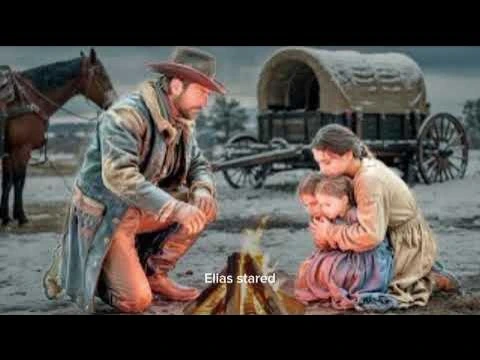
“Follow Me Home.” A Rich Cowboy Saw Mother Of Twins Shivering By Campfire—What He Did the Next Day
1880s. The snow had started before sundown, and by midnight, the Wyoming wind had turned the open country into a white wall.
Elias Whitmore, 38, a wealthy cattle rancher who owned nearly 6,000 acres outside Laramie, was riding home when he saw something that made him pull hard on the rains.
A small campfire, barely alive. Beside it, a young mother was crouched in the snow, wrapping both arms around two little girls who were trembling against her.
Behind them stood an old covered wagon, its canvas roof heavy with snow. Elias stared.
There was no cabin, no other wagon, no man, just a woman, two children, and a fire that looked moments away from dying.
He dismounted and approached slowly. The woman lifted her head. Her lips were blue from the cold.
“Please,” she whispered, tightening her arms around the twins. “We don’t want any trouble.” “Elias” stopped several feet away.
“My name is Elias Whitmore,” he said. “And unless you plan on arguing with this weather, you’re coming with me.”
The woman shook her head. “I can’t. You can barely keep your children warm.” Her eyes dropped toward the girls.
One of the twins coughed softly. Elias looked at the wagon, then back at the woman.
Where’s your husband? The woman didn’t answer. And somehow that silence told him more than words could have.
Elias removed his heavy coat and held it toward her. “Take this.” She hesitated, “Please.”
Finally, she accepted it, but she didn’t put it around herself. She wrapped it around the two children.
Elias noticed, and something inside the lonely rancher shifted. “What’s your name?” He asked. “Clara Bennett, and the girls, Rose and Ruth.”
“They’re six.” Elias glanced toward the dark mountains. “The nearest settlement is miles away. I know you won’t survive here tonight.
Clara swallowed. I’ve survived worse. That answer stayed with him. Because Elias knew exactly what it meant to say those words and not explain them.
For years, he had lived alone on his ranch. He had money, cattle, land, horses, and a house large enough for 10 people.
But he had stopped calling it a home long ago. His wife Margaret had died three winters earlier.
Since then, Elias had learned how to work until exhaustion became easier than remembering. He looked at Clara again.
Follow me home. She immediately shook her head. No, you can sleep in my barn.
No, I’ll keep my distance. She stared at him suspiciously. Elias understood. A woman alone with two children had every reason to be careful.
So he pointed toward his horse. I’ll ride ahead. You follow in the wagon. Nobody touches you.
Nobody asks questions tonight. Clara looked at her daughters. Then at the dying fire. She knew she had run out of choices.
Just until morning. She whispered. Elias nodded. Just until morning. But neither of them knew that morning would change all four of their lives.
By sunrise, the storm had covered the ranch in white. Clara woke in a small room above the stable with Rose and Ruth asleep beside her.
Someone had placed hot water near the bed. There was bread, milk, and a folded dress waiting on a chair.
She walked downstairs carefully. Elias was outside splitting wood. He looked toward her. The girls sleeping.
Good. Clara studied him. You said the barn. It is the barn. She looked around.
The room was cleaner and warmer than many houses she’d known. You own all this?
Most of it. Why help us? Elias paused. Because once someone helped my wife when she had nowhere else to go.
Clara noticed the way his expression changed. She didn’t ask another question. That afternoon, Elias did something nobody expected.
He rode into town. Not for supplies, not for cattle business. He went straight to the bank.
The rancher had discovered that Clara’s wagon wasn’t simply stranded. She had been trying to reach Laramie because the farm she’d inherited from her father was being taken from her.
Her father had died the previous spring. His land had been mortgaged and the bank had given Clara until the end of the month to pay the remaining debt.
If she couldn’t, the property would be seized. But there was another problem. A local land agent named Silas Crowe had already purchased the debt.
And Crow wanted the land badly. When Elias returned that evening, Clara was repairing a torn blanket.
“You went to town,” she said. “Yes.” “Why?” I asked about your father’s property. She immediately stiffened.
“You had no right.” “I know. Then why?” “Because I wanted to understand what you were running from.”
Clara stood. I wasn’t running. Elias waited. I was going home. Her voice broke slightly.
My father built that place with his hands. My girls were born there. Their mother is buried there.
She looked down. I left because Crow threatened to take everything. But I wasn’t going to let him take the girls home without fighting.
Elias finally understood. Clara wasn’t helpless. She was exhausted. There was a difference. The next morning, Elias surprised her again.
He placed a set of keys on the table. What’s this? The ranch office. She frowned.
I don’t understand. You said you know how to keep books. I do. Then help me with mine.
Clara stared at him. I need work. Elias continued. You need money. It’s honest work.
For the first time, she smiled. That’s your idea of charity. No. Good. It’s an offer.
She accepted. And over the next several weeks, something unexpected happened. Clara began working. She organized Elias’s accounts, discovered three unpaid cattle invoices, corrected a feed order, and saved him hundreds of dollars.
Rose and Ruth began following Elias everywhere. At first, he didn’t know what to do with children.
Then one afternoon, Rose handed him a broken wooden horse. Can you fix him? Elias looked at the toy.
I fix real horses. Then you can fix this one. He couldn’t help smiling. By Christmas, the twins had started calling him Mr.
Elias. He pretended not to notice how much he liked hearing it. But Clara noticed, and she noticed something else.
Elias had started leaving the kitchen door unlocked. His house had become warmer, louder, less empty.
Then one morning, a letter arrived. Clara opened it. Her face went pale. “What is it?”
Elias asked. “Crow?” He stepped closer. The bank had moved the foreclosure date forward. 3 days.
And Crow had discovered something else. Clara’s father’s land contained a small vein of silver.
Suddenly, the property was worth far more than the debt. Crow wasn’t trying to collect what he was owed.
He wanted the land. Clara looked at Elias. I have to go back. No, it belongs to my children.
I know. I can’t let him take it. Elias looked toward the window. Then he said quietly.
Then we don’t let him. They rode back to Clara’s homestead the next morning. The house stood beneath the mountains, half buried in snow.
Inside, Clara found something her father had hidden beneath a loose floorboard, a leather ledger.
It contained records proving that Crow had secretly added false interest charges to several loans.
But there was more. Her father had written the names of three other families Crow had cheated.
Clara stared at the pages. We can prove it. Elias nodded. But we’ll need witnesses.
They found them. One by one, frightened farmers came forward. And when Crow arrived with a sheriff to seize the property, he found half the valley waiting outside.
Clara stepped onto the porch. This is my father’s land. Crow sneered. You don’t have the money.
No, Clara said. But I have the truth. She handed the ledger to the sheriff.
The man read it. His expression changed. Crow began shouting. But this time, nobody moved aside for him.
The foreclosure was stopped. The false debt was investigated and Clara’s home was saved. Months later, spring finally came.
The snow melted from the mountains. Grass returned to the valley. Clara repaired the old farmhouse.
Elias helped rebuild the fence. Rose and Ruth planted flowers beside the porch. One evening, Elias stood beside Clara as the girls chased fireflies through the grass.
“You know,” Clara said softly, “You never did tell me why you stopped living in your house.”
Elias looked at the sunset. “I thought losing someone meant I had to keep living alone.”
Clara turned toward him. And now he looked at the two girls laughing in the field.
Now I think maybe home isn’t the place you lose. He paused. Maybe it’s the people who give you a reason to come back.
Clara smiled. Neither of them hurried. There was no promise made that night. Only trust.
Only the quiet understanding that some wounds don’t disappear. They simply stop hurting when someone stays.
And that was how a wealthy cowboy who thought he had nothing left to give found a mother, two little girls, and something he had forgotten how to feel.
Home. Because sometimes the person you rescue from the cold is the very person who brings warmth back into your life.
If this story touched your heart, please like the story, subscribe to Meaningful Trail, and share it with someone who could use a little hope today.
And tell us your city in the comments. Or if you have your own meaningful story, share it with us.
Perhaps one day we can share it with others.








