Duke Brought His Mistress To Meet His Former Duchess’s Crumbling Cottage—Until They Stepped Insi
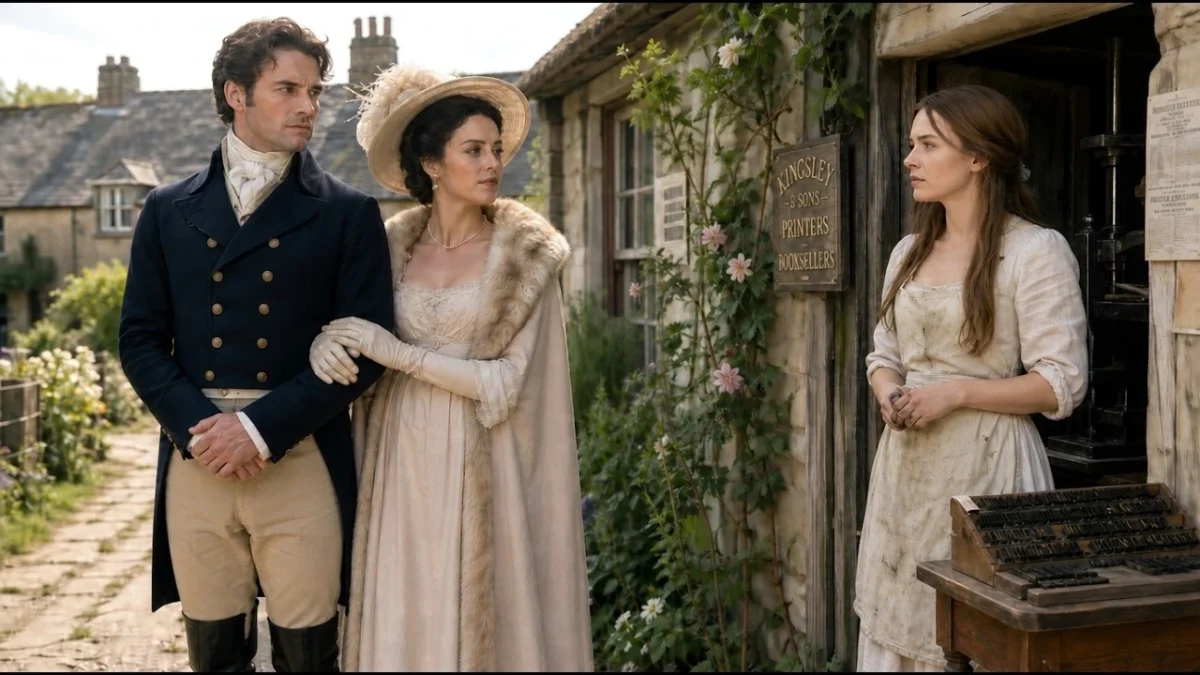
The road to the lodge was narrow and rutted, the kind of path a gentleman only traveled when he wished to remind himself how far someone had fallen.
Duke Peragan took it at a trot, his boots gleaming despite the mud, his mistress riding close beside him on a mare too fine for the setting they were headed toward.
“Are you certain this is wise?” Peragan? Lady Narcissa asked, adjusting the fur collar of her police.
The morning air still carried the bite of autumn, and she had dressed for spectacle rather than warmth.
A beaver hat set at a proud angle, gloves the color of fresh cream. Calling upon a woman you cast off hardly seems a fitting way to begin the day.
It is precisely the way to begin the day, Peragan said, and there was a satisfaction in his voice that had been building since he woke.
Oslo wrote to my solicitor last week demanding an increase to her allowance. An increase as though she has any claim left upon my generosity.
He smiled, the kind of smile that had once charmed half of London, and now simply looked practiced.
I intend to see for myself how low she has sunk. It will do me good.”
Narcissus said nothing more, though a flicker of unease crossed her face. Not for Osler’s sake, but for what such cruelty revealed about the man she had staked her future on.
She pushed the thought aside. It was not her place to soften him. They rounded a stand of birch trees, and the lodge came into view.
It was smaller than Peragan remembered, built of gray timber with a sagging roof line, tucked into a hollow, where the estate’s better gave way to scrub.
He had chosen it himself. Three years passed, precisely because it was the least of his properties, a fitting exile for a wife who had embarrassed him with her opinions and her refusal to be quiet about them.
He dismounted with a flourish meant for an audience that had not yet arrived, tossed his reigns to no one in particular, and stroed toward the door, already composing the words he meant to say.
Something about charity, something about how a woman ought to have learned her place by now.
But before his hand reached the latch, he stopped. A sound was coming from inside.
Not the quiet of a woman alone with her needle work, not the small domestic noises he had expected to find pathetic and satisfying in equal measure.
It was a rhythmic clatter, metal striking metal in steady mechanical repetition, loud enough to rattle the window glass in its frame.
Beneath it ran the low murmur of voices, several of them, more than a modest household, should hold.
Narcissa had come up behind him, her curiosity now plainly overtaking her caution. What in heaven’s name is that racket?
Peragrin did not answer. He shoved the door open himself hard enough that it struck the wall behind it and stepped inside, expecting damp walls and empty grates.
What he found instead stole the words from his mouth entirely. The main room of the lodge, once a modest sitting room, had been transformed.
A great iron press stood where the hearth furniture used to be, its arm rising and falling with a steady, deliberate rhythm, worked by a man with ink to his elbows.
Long tables ran along both walls, stacked with paper and stamped type, and three young men hurried between them, sorting freshly printed sheets into bundles.
A boy darted past the Duke’s boots with an armful of broad sheets, calling out something about the coaching office needing the bath bundle before 9.
The air smelled of ink and hot metal, sharp and unfamiliar in a place meant for quiet ruin.
And there, in the middle of it all, stood Lady Osla. She wore no silk, no jewels, nothing that spoke of the fortune she had once commanded as his duchess.
Instead, she wore a plain muslin gown covered by a canvas apron smudged with the same ink that stained the compositor’s hands, her sleeves pushed to the elbow, her hair pinned back with the brisk efficiency of a woman with no time for vanity.
She looked, Peragan thought with a jolt he could not name, more alive than he had ever seen her during their marriage.
She glanced up from the sheet she was reviewing, unsurprised, as though she had been expecting him for days rather than moments.
“Perigrin,” she said his name the way one might greet a delivery that had arrived slightly early.
“How good of you to call! You’ve saved me the trouble of sending this to you by post.”
She crossed the room without hurry, plucked a fresh sheet from the stack nearest the press, the ink still faintly damp, and held it out to him.
He took it without thinking, his eyes catching the bold heading at the top. The Mayfair Gazette.
Beneath it, in smaller but unmistakable print, ran a headline naming three of his private gambling establishments in London, their locations, and the names of the men who financed them.
His own name sat among the financiers, printed plainly for anyone with a penny to read.
The clatter of the press behind him did not pause. Somewhere in the room, Narcissa had gone very still.
You look pale, Osler observed, folding her inkstained hands before her. I do hope you’re not catching a chill.
You always did dress too thin for the country. Three days had passed since the lodge, and Peragrin had spent every one of them convincing himself the matter was smaller than it felt.
A gossip sheet, a woman with a grudge and a printing press. Nothing a man of his standing couldn’t outlast with a little composure and a great deal of pretending.
So he took Narcissa to Bath, to the assembly rooms, where the candle light fell kindly on everyone, and the orchestra played loud enough to drown out whispers.
It was the sort of evening designed to remind society who he was regardless of what any broad sheet claimed.
Narcissa wore ivory silk trimmed with seed pearls, her hair dressed high, and for the first hour it worked exactly as he’d hoped.
Gentlemen bowed, matrons nodded with the particular warmth reserved for a duke still very much in favor.
He danced two sets, laughed at the right moments, and allowed himself to believe the whole business at the lodge had been a private humiliation, contained to a hollow in the countryside, where no one of consequence would ever think to look.
Then the footmen began moving through the crowd. At first, Peragin barely noticed them. Two young men in plain livery, weaving between the dancers with folded papers tucked under their arms, pressing a sheet into this hand and that.
He assumed it some notice from the master of ceremonies, a change to the supper hour, perhaps.
It was only when he saw Lady Fenick unfold hers near the refreshment table, her eyebrows lifting sharply, that a cold thread of unease worked its way up his spine.
He caught the arm of a passing footman. What is this you’re handing about? The young man held one out without hesitation, as though he’d been given no instruction to withhold it from anyone, least of all the Duke himself.
Evening edition, your grace, compliments of the publisher. Peragan unfolded it, standing exactly where he was, in full view of half the room, and felt the floor tilt beneath him.
The Mayfair Gazette, Special Evening Printing. The piece detailed in cool and exacting language, a scheme involving East India stock, shell purchases made through three separate agents, and profits Peragan had never declared to a single soul outside his own study.
Names of the agents were printed in full, dates were printed in full. A copy of a ledger entry reproduced in miniature sat beneath the text like a signature no one could dispute.
He looked up. The room had not stopped dancing, not entirely, but the current beneath it had shifted.
Heads bent together near the pillars, fans lifted to hide murmured words, glances thrown his way, and quickly withdrawn when he caught them.
A man he’d known since university offered him the thinnest of nods and steered his wife firmly toward the far end of the room.
“Perigrin.” Narcissa was suddenly at his elbow, her own copy crushed slightly in her gloved hand.
Her voice had dropped to something urgent and private. “How does she know these things?
Agents, dates? This isn’t gossip. This is accounting.” “I don’t know,” he said. And for the first time that evening it was entirely true.
What he did know, watching the room reassemble itself around the wound the paper had opened, was that Osler’s reach did not end at the boundary of her hollow in the countryside.
It extended into ballrooms, into the hands of footmen, who took her coin as readily as anyone else’s, into the private ledgers he’d believed, locked away in a desk only he possessed the key to.
Someone had copied those figures. Someone close enough to touch them. Narcissa’s mind had gone somewhere else entirely, somewhere colder and more urgent than sympathy for her lover’s ruin.
If Osa could uncover a man’s most guarded financial secrets, and print them for an entire ballroom to read, what might she already know about the people standing beside him?
What might she know about her? She excused herself before the second dance began, claiming a headache, and found a quiet al cove behind a bank of hot house ferns where she could breathe without an audience.
Her hands, she noticed, would not quite stay still. 8 years was a long time.
Long enough, she’d told herself more than once, that the past belonged to someone else entirely, a younger, more foolish version of herself, who had married in haste, and buried the fact just as quickly, when the marriage dissolved into nothing more than a name in a parish register, and a husband who vanished at sea before anyone thought to ask questions.
She had rebuilt herself since then, carefully, piece by piece, until Narcissa, the Duke’s companion, bore no visible relation to the girl who’d once signed her name beside a Navy officers in a country church.
But a woman who could trace a man’s stock purchases through three hidden agents was not the sort of woman who would miss a parish register should she ever think to look for one.
Narcissa pressed her gloved fingers to her temple and told herself it was nothing. Osler had no reason to search for her past.
Their quarrel was with Peragrin, not with his companion. She almost believed it. Across the room, Peragan had abandoned any pretense of enjoying the evening.
He found the nearest exit, collected his hat and coat from a bewildered attendant, and stood on the steps outside the assembly rooms in the cool night air, the crumpled sheet still in his fist.
He needed counsel. Real counsel, not the polite murmurss of society friends already distancing themselves, but a man who understood the law and could tell him plainly whether a woman could be stopped from printing whatever she pleased about her former husband.
Surely there was a limit to what the law would permit her. Surely a duke still commanded that much.
He called for his carriage before Narcissa had even rejoined him, already rehearsing what he would say to his solicitor at first light, unaware that the woman he’d left behind among the ferns, was rehearsing something of her own, a silent, desperate hope that whatever Osler knew, it wasn’t everything.
The office of Sir Walter Crombi, High Sheriff and Magistrate for the county, smelled of pipe smoke and old leather, the kind of room built for settling boundary disputes and poaching complaints rather than the ruin of a duke.
Peragan had ridden through the morning to reach it, and he arrived with the particular impatience of a man who had already decided what outcome he was owed.
“I want the press seized,” he said before he’d even taken the seat offered him.
Today, if it can be arranged, the woman is printing sedicious material against a peer of the realm, and I expect the law to act accordingly.
So Walter, a heavy set man with a face weathered by decades of country business, folded his hands over his ledger, and regarded the Duke with the careful patience of someone about to deliver news he already knew would not be welcome.
Your grace, I sympathize with your position. Truly, I do. But I’ve had my cler look into the matter since your letter arrived yesterday, and I’m afraid the situation is not so simple as sedition.
Not simple. The woman named three of my private establishments in print. She reproduced my stock ledgers for the entertainment of every gossip in Bath.
She may print a great deal, your grace, and lawfully. So Walter reached for a folded document on the corner of his desk and slid it across.
Lady Osler holds a royal patent for her printing equipment, granted some months past. I confirmed it myself with the appropriate office in London before you arrived, so there’d be no mistake on my part.
The patent covers the press itself and permits its operation under the full protection of British press law, provided nothing printed is proven false.
Peragan stared at the paper without truly reading it, the words blurring together as the shape of the problem became clear.
Then let us prove it false. Every word of it. I’ll swear an oath. Can you?
Sir Walter asked not unkindly. Because from what my clerk gathered, the figures she’s printed align rather precisely with entries a bank clerk in London was willing to confirm off the record when a runner from the gazette called upon him.
If the content is true, your grace, there is no sedition to answer for. Truth is a complete defense under the law as it stands.
I cannot seize a press for printing facts, however unwelcome those facts may be to the subject of them.
The room felt smaller suddenly, the pipe smoke thicker in Peragan’s throat. He had ridden here with such certainty that the law would simply do as he asked, the way it always had before, the way every institution in his life had bent itself around his convenience since birth.
It had not occurred to him that Osa might have armored herself against exactly this response before he ever thought to make it.
“Very well,” he said, forcing his voice level. “If the press cannot be seized, then starve it.
She needs ink, rag paper, supply from the mills. Cut off what feeds the machine, and it stops running, whether the law permits her words or not.”
Here, Sir Walter’s expression shifted into something closer to genuine discomfort, and he took a moment before answering, as though hoping the Duke might withdraw the request before he had to explain why it wouldn’t succeed.
That, your grace, is where matters grow considerably worse for you.” He drew another paper from beneath the first.
There are two paper mills within reach of this county, capable of supplying ragstock in the quantity her press requires.
I looked into both on your behalf, thinking you might ask precisely this. Lady Osler has over these past several months quietly purchased the outstanding debt notes on both mills.
Not the mills themselves, the debt. Every shilling owed by either proprietor now sits in her possession.
What has that to do with my ink supply? Everything, I’m afraid. Should you attempt to pressure either mill owner into refusing her custom, she need only call in the debt she holds against them.
Both men would face immediate ruin, and both know it. They will supply her before they will risk your displeasure, because your displeasure costs them nothing so long as her patent protects her, whereas her debt notes could see them in debtor’s prison within the fortnight.
Sir Walter set the paper down and met the Duke’s eyes squarely. She has arranged matters, your grace, so that any attempt on your part to cut her supply lines results in lawsuits against yourself for interference with lawful trade rather than any harm to her.
I would advise against the attempt entirely. You would lose, and lose publicly.” Peragan sat very still, turning the shape of it over in his mind.
A woman he had exiled to a damp timber lodge with nothing but a modest allowance, had somehow acquired a royal patent, built a network of informants reaching into ballrooms and banking houses, and purchased her way into controlling the very supply chains he might have used against her.
None of it had happened by accident. None of it had happened quickly, either. These were the fruits of months of quiet, deliberate work, begun long before he’d ever ridden out to mock her.
How, he said finally. Does a woman with no fortune of her own manage such a thing?
So Walter shrugged, though there was something almost like admiration beneath his caution. I couldn’t say your grace, but I’d wager she had help.
No one builds a network like this alone, and certainly not in secret. The word help settled into Peragan like a stone dropped into still water, sending ripples toward a suspicion he did not yet want to examine too closely.
He thanked the magistrate with considerably less confidence than he’d arrived with, and rode back toward London, turning over every face he trusted, wondering which of them had been quietly feeding his secrets into Osler’s hands all along.
The letter arrived with the breakfast tray tucked beneath a folded napkin where the housekeeper always left the morning’s correspondence, and Narcissa nearly missed it entirely beneath the ordinary clutter of invitations and dressmakers bills.
It was the seal that caught her eye first. Plain wax, no crest pressed into it, the kind of anonymous fastening used by someone who did not wish to be traced.
She broke it alone, having sent her maid, Marin, out of the room on the pretense of fetching more chocolate, and unfolded a single sheet written in a hand she recognized at once as Marin’s own.
My lady, forgive me for what I must tell you, and forgive me more for how you will come to learn it.
I have served you three years now, and I hope you will believe I write this from loyalty, not treachery, though I fear you may not see the difference once I explain myself.
I have been carrying word to Lady Oller these past months. She approached me not long after you took up with the Duke, and I will not pretend the money she offered wasn’t a temptation I ought to have refused.
I did not think the harm would reach you directly. I believed I was only reporting small things, the Duke’s moods, his appointments, nothing that touched you.
But I write now because she has learned something I did not give her, and I owe you the warning before she uses it.
She has found the parish registry from Hollow, the entry from 8 years past. She knows of your marriage to Lieutenant Ashford Vain before he was lost at sea, and she knows you have never spoken of it to the Duke.
I do not know when she means to act upon it. I only know that she does not forgive easily, and she has never yet held a piece of knowledge without eventually putting it to use.
Burn this letter. I beg you not to think too harshly of me. M Narcissa read it twice before the words fully settled, and by the second reading her hands had gone cold, despite the fire crackling in the grate.
She set the paper down with exaggerated care, as though it might shatter, and stared at the pattern of the rug beneath her slippers, without truly seeing it.
8 years. She had been 2 and 20 then, foolish with a girl’s certainty that love excused every reckless choice.
And she had married Ashford Vain in a small stone church in Hollow, with none of her family present, none of society’s approval sought or given.
Only the two of them, and a curate who’d asked no questions he didn’t want answered.
Ashford had been handsome in his naval blues and desperately poor, his family’s fortune lost to bad investments before she’d ever met him, and she had told herself poverty meant nothing when set against a man who looked at her the way he did.
It had meant everything in the end. 6 months of marriage on a lieutenant’s meager pay.
6 months of counting candles and mending the same three gowns before his ship sailed for the Indies and never returned to port.
No body was ever recovered, no confirmation beyond a captain’s letter expressing regret and a Navy pension too small to live on.
She had waited a year, then two, clinging to some thin hope that he might yet appear before the truth settled over her with the finality of a door closing.
She was a widow in all but law, married to a man the sea had claimed and never returned, with nothing to show for it but a parish entry gathering dust in a country church, and a debt of grief she’d had no means to pay off.
So she had done what any sensible woman in her position might do. She had left Hollow, taken a smaller name, and rebuilt herself in London as a woman unencumbered by any prior attachment, a widow’s caution wrapped in a maiden’s freedom, available to whichever gentleman might offer her the security her first marriage never could.
Peragan had been the most promising of several prospects, a duke with wealth enough to overlook that she brought no dowy, charmed enough by her wit and her face that he had never once thought to ask what came before him.
Now 30 years old, with the particular clarity that only comes from watching one’s youth slip past without the security it was meant to secure, Narcissa understood precisely what discovery would cost her.
A duke did not keep company with a woman already married in the eyes of the church, whether her husband breathed still or not, and society would not distinguish between a scandal she’d caused and one she’d merely survived.
They would call her a fraud, regardless of the sea’s role in the matter. They would call Peragrin a fool for keeping her, and he would not forgive being made a fool of twice in one season.
Everything she had built, the townhouse, the jewels, the careful position she occupied at the edge of the Duke’s favor, rested on a foundation Osler could crumble with a single printed line.
She rose from her chair and crossed to the fire, letter in hand, meaning to do exactly as Marin had begged her to.
But she paused at the last moment, the paper hovering near the flames, and found she could not quite release it.
If Osler held this knowledge and had not yet used it, there was still time.
Time to reach her first, perhaps to bargain before the weapon was fired. Narcissa did not yet know what such a bargain might cost her.
Only that sitting still and waiting for ruin was no longer a choice she could afford to make.
She fed the letter to the fire at last, watched the wax seal blacken and curl, and began with the same cold calculation that had carried her this far, to consider what Osler might want badly enough to trade silence for it.
Peragrin had never before hired men for the kind of work he required that night, and the unfamiliarity of it sat poorly with him, even as he pressed the coin into the broker’s palm.
The man went by the name Gryom, a broadsh shouldered fellow with a scar through one eyebrow, who ran errands for gentlemen who preferred their names kept out of certain matters.
And he’d listened to the Duke’s instructions with the flat patience of someone who’d heard far worse requests than this.
Stop the carts, that’s all, Peragan had told him. Delay them. Turn them back. Scatter the bundles into the gutter if you must.
I don’t care how it’s done, only that tomorrow’s edition never reaches its readers. Gryom had named his price and asked no further questions, and now, past midnight, Peragan sat in a hired carriage two streets from Fleet Street, with the window cracked just enough to hear whatever came.
The fog had settled thick over the Printworks district, the kind that turned every lamp into a smudge of amber, and swallowed sound before it could carry far.
Osler’s premises occupied a narrow building wedged between a stationers and a coffee house long since shuttered for the night.
And behind it ran the alley where her delivery carts assembled before dawn, loaded with the morning’s bundles bound for the coaching officers and the London news stands.
Gryoms men moved into position without lanterns. Four of them pressed into the shadow of the stationer’s wall, waiting for the horses to be led out.
They did not have to wait long. A groom emerged first, leading two draft horses toward the waiting cart, and behind him came a boy with an armful of bundled papers, tied and ready for loading.
Gryom gave the signal, a low whistle, barely audible, and his men broke from the shadows toward the cart.
What followed was over faster than Perag, straining to hear from his carriage, could properly follow.
The alley, it turned out, was not so unguarded as Gryom had assumed. Men Osa had stationed at the mouth of the yard.
Former dock workers, by the look of their build, hired for exactly this possibility, closed in from both directions before Gryom’s crew had gone 10 paces.
There was shouting, the scrape of boots on cobblestone, the crash of an overturned barrel someone had knocked aside in the scramble.
One of Gryom’s men went down hard against the wall, and did not get up quickly.
Another turned and ran the moment he saw how badly the numbers had shifted against them.
Within a minute, the yard had gone quiet again, the fog closing back over the scene as though nothing had happened there at all.
Gryom himself came stumbling back toward the carriage a few minutes later, his coat torn at the shoulder, his earlier confidence entirely gone.
“They knew we were coming,” he said through the window, breathing hard. Had men waiting before we ever showed ourselves.
That’s no accident, your grace. Someone told them. Peragan said nothing. The same cold suspicion from the magistrate’s office curling tighter in his chest.
Someone close. Someone who knew his plans before he’d finished making them. He was still turning the thought over when a second carriage rolled into view at the alley’s mouth, its lamps unlit, moving at a pace too deliberate to be anything but intentional.
It stopped a short distance from his own, and a figure stepped down without hurry.
Asla, wrapped in a plain dark cloak, her hood thrown back despite the chill, looking for all the world like a woman who had simply come to inspect her own property rather than someone who had just repelled an ambush.
She walked to his window and rested one gloved hand against the frame, unbothered by the fog curling around her skirts.
“I did wonder how long it would take you,” she said. I confess I expected the attempt somewhat sooner.
You always were slow to act without Narcissa’s encouragement. I don’t know what you’re speaking of, Peragan said, though the lie sat badly even in his own ears.
No, I don’t imagine you’ll admit to it, and I have no patience tonight to argue the point.
Her voice remained even, almost conversational, which somehow made the words that followed land harder than shouting could have managed.
I watched the whole business from that carriage, Peragan. Every moment of it. I want you to understand something clearly so there’s no confusion between us going forward.
She leaned closer, just slightly, enough that the fog seem to close around the two of them alone.
This was the last time you send men into my streets. If you attempt anything of this nature again, if a single cart is delayed, a single bundle scattered, a single one of my people so much as jostled, I will not respond with guards in an alley.
I will respond by printing every private banking log your solicitor has been so carelessly leaving in his unlocked drawer.
Every transfer, every debt, every name you’ve paid to keep quiet. Peragan’s mouth went dry.
You wouldn’t dare risk. I dare a great deal these days, Osler said, straightening away from the window.
You built your whole life believing daring belonged only to men like you. That was always your mistake, and it will go on being your mistake until it ruins you entirely.
She stepped back into the fog, already turning toward her own carriage. Go home, Peragrin.
Nurse whatever wounded pride sent you here tonight, and leave my carts in peace. The next lesson won’t be nearly so gentle as this one.
She was gone before he could summon a reply, swallowed by the fog as completely as if she had never stood there at all, leaving him alone with Gryom’s ruined coat, his own racing pulse, and the growing unbearable certainty that every move he made against her had already been anticipated long before he thought to make it.
Narcissa had told her household she meant to visit a cousin in Wiltshire for a few days, and no one had thought to question it.
She traveled instead under a borrowed name in a hired gig rather than her own carriage, arriving at the edge of Blackwood estate as the last light drained from the sky and the lodge’s windows began to glow with candle light.
She had spent a full day watching the place from a discrete distance, noting the rhythm of it, when the print workers left for their supper, when the guards changed their posts along the perimeter, when a single lamp remained burning in what she’d guessed to be a study or library toward the rear of the building, long after the rest of the household had gone quiet.
That lamp, she reasoned, marked exactly the sort of room where a woman like Osa would keep her private papers.
A registry entry copied from a country parish would not sit among the printing stock.
It would sit somewhere locked, somewhere personal. Getting past the guards proved easier than she’d feared, mostly because she was smaller and quieter than the sort of intruder they’d been braced against since the incident on Fleet Street.
She kept to the treeine, slipped through a gap in the low garden wall where the hedge had grown thin, and reached a side door she’d marked earlier as leading toward the back of the house.
The library, when she found it, was modest but well ordered. Shelves of ledgers and bound papers, a writing desk beneath the window, and a locked cabinet in the corner that drew her attention immediately.
She worked the lock with a hairpin, a skill she’d learned in past, and never expected to need again, and the drawer inside yielded exactly what she’d hoped to find.
A slim folder of documents carefully labeled in Osler’s own hand, and near the top of it, a copied entry from the Hollowre Parish register, her own name inked beside Ashford veins in a clark’s careful script, her fingers closed around it, relief washing through her chest so completely that she nearly missed the sound of the door opening behind her.
I did wonder if you try something like this,” Osler said, standing in the doorway with a single candle in hand, entirely unsurprised.
“You have a talent for locks I wouldn’t have credited you with, given how little use you’ve had for honest work these past years.”
Narcissa froze, the folder still clutched in her hand, every excuse she might have offered dying in her throat before she could shape it into words.
There was no explanation for a woman crouched before another’s private cabinet caught mid theft that could be dressed up as anything but exactly what it was.
I can explain, she said anyway, because silence felt worse than a lie that wouldn’t hold.
I doubt that very much, but you’re welcome to try. Osa crossed the room without hurry and set her candle on the desk, then settled herself into the chair beside it with the unbothered calm of someone discussing the weather rather than confronting a burglar in her own house.
Though I confess I’d rather skip the pretense entirely. You came for the parish entry.
I put it precisely where you’d find it if you searched thoroughly enough, which tells me you’re cleverer than most people give you credit for.
The words landed strangely, and it took Narcissa a moment to understand their shape. You wanted me to find it.
I wanted you to come here. Yes. Whether you found it through cleverness or blind luck mattered rather less to me than the fact that you’d come at all.
Osa folded her hands in her lap, studying Narcissa with an expression that held no cruelty in it, only a kind of weary calculation.
I could have printed your marriage the same week I learned of it. You must know that a widow’s secret marriage concealed from the Duke who keeps her, it would have made for excellent copy, and I’d have enjoyed watching Peragan discover he’d been made a fool of by his own mistress quite as thoroughly as he made a fool of me.
Then why didn’t you? Because ruining you does very little to ruin him, and he is the one I intend to finish.”
Osler leaned forward slightly. You, on the other hand, might actually prove useful, provided you’re willing to be sensible about it.
You have access. I don’t. You’ve slept in his house, read his correspondence, likely seen ledgers and papers I could spend a year trying to obtain through other means.
I want the proof of his investment syndicate, the fraudulent one, the ledgers he keeps locked in his study desk.
Bring me those, and I’ll burn this parish entry myself in front of you, and you may walk out of my life with your secret and your reputation both intact.”
Narcissisa’s mind raced through the offer from every angle she could summon, searching for the trap she was certain must be hidden somewhere within it.
“And if I refuse, then I print what I have. You lose whatever future you imagined with Peragrin, and I find another way to reach his ledgers regardless, because I generally do.”
Osler’s voice carried no threat in it, only a flat and terrible certainty. “I’d rather not spend the effort.
You’d save us both considerable trouble by simply agreeing.” The folder felt suddenly heavy in Narcissa’s hand, the weight of the choice pressing down harder than the paper itself ever could.
Loyalty to Peragrin had never truly been the foundation beneath her. Security had been. And security, she understood now with a clarity that frightened her, was exactly what Osler was offering in exchange for a betrayal that cost her nothing she hadn’t already been prepared to abandon.
“Give me a fortnight,” she said finally. “I’ll need time to find them without raising suspicion.”
Osler smiled for the first time since she’d entered the room, and it was not an unkind smile, though it carried the particular satisfaction of a woman watching a plan unfold exactly as she designed it.
A fortnight then. Don’t disappoint me, Narcissa. I dislike being disappointed almost as much as I dislike being mocked.
13 days had passed since the library, and Narcissa had spent each one rehearsing this night in her mind until the plan felt worn smooth, like a coin carried too long in a pocket.
She had let Peragrin grow used to her presence again in the days since Bath, soft words, careful attention, nothing that might make him suspect the ground beneath their arrangement had shifted.
He had no reason to watch her closely. He never truly had. She waited until the house had settled into its deepest quiet, until even the last footman had banked the kitchen fire and retired, before she rose from the bed she rarely shared with him fully, and dressed again in the dark, choosing a plain gray traveling gown with no petticoats to rustle against the floorboards.
The key was the difficulty she’d worried over longest. Peragan kept his study locked always.
The key itself hung on a chain beneath his waist coat during the day, and left, she had learned, only through weeks of careful watching, in the pocket of whichever coat he’d last worn, hung in his dressing room rather than carried to bed.
She found it there now, cool and unremarkable in her palm, and felt her pulse climb as she slipped from the bed chamber and down the darkened passage toward the study.
The manor at night was full of small sounds that meant nothing and yet made her flinch regardless.
The settling of old timber, a draft working its way beneath a door, the distant call of some nightbird beyond the windows.
She kept close to the wall where the boards were least likely to complain, and reached the study door without incident, the key turning in the lock with a click that seemed in the silence loud enough to wake the entire household.
No one stirred. She let out a breath she hadn’t realized she’d been holding, and slipped inside, closing the door softly behind her before she risked lighting the small, dark lantern she’d carried folded in her cloak.
The mahogany desk sat exactly where it always had, broad and heavy, its surface bare of anything incriminating.
Perag was too careful a man to leave evidence lying in plain view. The drawers, however, were another matter, and the smallest of them, second from the bottom on the right, was locked with a mechanism far simpler than the one she’d faced in Osler’s cabinet a fortnight before.
Her hairpin found the mechanism within a minute. The drawer slid open with barely a sound, and there, beneath a false panel she nearly missed entirely in the lantern’s thin light, lay the ledgers.
There were three of them bound in plain leather filled with Peragan’s own hand recording transfers through agents whose names she now recognized from the bath broad sheet.
Sums moved and hidden, profits declared nowhere but here, a private accounting of exactly the fraud Osa had spent months circling without quite proving in full.
Narcissa lifted them carefully, her hands steadier now than she’d expected, and had nearly closed the drawer again when a floorboard creaked somewhere behind her.
She froze, lantern light guttering as her hand trembled around it, and turned to find not paragrin in the doorway, but nothing at all.
An empty passage, a draft working through some gap in the old window frame, the house merely settling as it always did.
She stood a long moment with her heart hammering before she trusted herself to move again.
It was not fear of discovery alone that held her still, she realized, but something closer to grief, strange, and unwelcome.
Whatever Peragrin had become, vain, cruel in his careless way, willing to ruin a mill owner’s livelihood without a second thought, there had been a version of him once, early in their acquaintance, who had made her laugh without trying, and never once asked what came before him.
She had used that lack of curiosity as safety. She had never once mistaken it for tenderness, and yet standing now with the proof of his ruin gathered in her arms, she found she could not entirely separate the two.
She closed the drawer, locked it again out of some instinct toward tidiness that made no practical sense, given what she’d just done, and slipped from the study with the ledgers wrapped inside her cloak.
The walk to the estate gates felt longer than it had by daylight. The gravel drive pale under a half moon, every shadow along the boundary hedge holding its breath as she passed.
Marin was waiting where they’d arranged, tucked into the gate house archway, with a hired trap standing ready a short distance beyond, her face drawn, with the particular attention of someone who had spent the last hour imagining every way the plan might collapse.
You have them,” Maron whispered. Narcissa drew the ledgers from beneath her cloak and pressed them into the maid’s waiting hands without a word.
The weight of them leaving her arms lighter and her conscience considerably less so. There was no ceremony to it.
No grand declaration of allegiance changed. Only a bundle of leather passed from one set of hands to another in the cold, thin dark, and the quiet understanding between them that whatever came next could not be undone.
Tell her it’s done, Narcissa said finally. Tell her I expect the parish entry burned by weeks end exactly as promised.
She’ll keep her word, Marin said. She always has with me. Narcissa watched the maid climb into the waiting trap and disappear down the lane toward wherever Oslo was keeping herself that night, and stood alone at the gates a moment longer than she needed to, feeling the full shape of what she’d just done settle over her.
She had chosen herself. She had known she would from the very moment Osa laid the bargain before her in that library.
And yet the knowing had done nothing to soften the strange hollow ache that followed the choosing.
She turned back toward the house before the cold could catch her out of doors any longer.
Already composing in her mind the ordinary face she would need to wear at breakfast.
Word of what Osa intended to print reached Peragrin’s solicitor four days before the special edition was set to run, delivered by a clerk who had, for a modest sum, agreed to warn certain gentlemen when the gazette’s presses were preparing something of unusual scale.
By the time Peragrin learned of it himself, his solicitor, a narrow, anxious man named Huxley, had already begun drafting the papers for an emergency injunction.
It is our only recourse, your grace, Huxley explained, spreading documents across the desk in his chambers, with the brisk energy of a man who sensed his fee depended on moving quickly.
We petition the Court of Chancery to restrain publication on grounds of liel pending a full hearing.
If we can delay her even a fortnight, we buy time to prepare a proper defense, perhaps negotiate a settlement she’d find preferable to a protracted legal battle.
Peragrin had agreed to all of it without truly listening, his mind still turning over the missing ledgers he’d discovered gone from his study 3 days prior, the lock undisturbed, no sign of forced entry, nothing but an absence where three bound volumes ought to have sat.
He had questioned the household staff individually and learned nothing, and the suspicion he could not quite silence, the one circling ever closer to Narcissa’s quiet, unreadable calm these past weeks, had begun to feel less like paranoia, and more like the only explanation that fit.
He pushed the thought aside as the hearing approached. There would be time enough to address it once this matter was settled.
The chancery court sat in a woodpanled chamber thick with the smell of old paper and candle wax, presided over by a judge named Lord Ashby, whose reputation for careful, unhurried deliberation, was matched only by his evident distaste for theatrics from either side.
Peragan arrived with Huxley and two junior council, dressed in his finest to remind the room, if reminding were needed, precisely what rank he still held.
Osler arrived with considerably less ceremony. A single barister at her side, a sharpeyed woman’s advocate named Mr.
Peton, whose quiet manner Peragan mistook in the opening minutes for weakness. Huxley opened with confidence, laying out the injunction request in careful legal language, describing the Gazette’s forthcoming publication as a calculated assault on the Duke’s reputation, designed to cause irreparable harm before any court could rule on the truth or falsehood of its contents.
He requested the publication be restrained entirely until a full liel hearing could determine the matter properly.
Lord Ashb listened without expression, then turned his attention to Pembbertton. And what does the respondent say to this?
Peeton rose unhurried and set a slim folder on the cler’s table before the bench.
My lord, an injunction against publication is a serious remedy reserved for cases where the truth of the printed matter remains genuinely in dispute.
It is not so reserved here. Every figure my client intends to publish has been independently verified.
He drew several papers from the folder and offered them to the cler for the judge’s review.
Sworn statements from two London bankers confirming the transfers in question. Certified copies of the ledger entries themselves cross-referenced against the agents own account books which my client’s investigators obtained through entirely lawful means.
And my lord, a formal deposition from the Duke’s own former cler taken under oath 3 weeks past, confirming he personally recorded these transactions at his grace’s instruction.
The room had gone very still. Peragan felt the blood drain from his face as Lord Ashb paged slowly through the documents, his expression unreadable, though the silence stretching through the chamber felt increasingly unfavorable with every passing second.
“Mr. Huxley,” the judge said finally, setting the papers down. “Do you dispute the authenticity of this evidence?”
Huxley glanced toward Peragan, clearly hoping for some instruction that did not come, then turned back to the bench with considerably less confidence than he’d begun with.
“My lord, we would need time to examine. You have had 4 days notice of this hearing, Mr.
Huxley, which I understand is rather more warning than the respondent generally affords the subjects of her printing.”
A faint dry note entered the judge’s voice, something almost like amusement he was making no particular effort to hide.
I am not in the habit of restraining publication of matters proven true merely because the truth proves inconvenient to a man of rank.
Were I to grant such injunctions on request, Mr. Huxley, half the newspapers in London would find themselves silenced by every lord whose ledgers didn’t bear close inspection.
And I do not believe that is a precedent this court exists to set. My lord, the reputational harm, the reputational harm, if any, flows from the conduct described, not from its description.
Lord Ashb closed the folder before him with an air of finality. The application for injunction is refused.
If his grace wishes to pursue a liel action once publication has occurred, he is welcome to file it, and I will hear the matter on its merits at that time, but I will not restrain the press from printing what appears on the evidence before me to be plainly and thoroughly true.
The gavl fell with a soft final sound that seemed to echo far longer than its actual weight should have allowed.
Peragan sat frozen in his chair as the chamber began to empty around him. Huxley, already gathering papers with the flustered haste of a man eager to distance himself from a losing case, murmured conversation rising among the handful of observers who’d come to watch a duke’s fortune’s turn.
Osler did not approach him on her way out, did not spare him so much as a glance of triumph.
She simply rose, gathered her cloak, and walked from the chamber beside her barristister with the composed satisfaction of a woman who had never truly doubted the outcome, leaving Peragan alone at the defendant’s table, with nothing left standing between himself and whatever she intended to print next.
The special edition reached the Royal Exchange precisely as the trading floor filled for the midday hour, carried in by news boys who had been paid, it seemed, to arrive at exactly this moment, rather than the usual scattered morning distribution.
Word of the injunction’s failure had already traveled through certain circles overnight, and there was an unusual hush of anticipation among the merchants and brokers gathered beneath the great arched colonade, as though everyone present had heard a storm was coming, and had simply gathered to watch it break.
The headline required no embellishment to do its work. The fraud of the East India Syndicate in the Duke’s own hand.
Beneath it ran reproductions of the ledger pages themselves. Peragan’s own careful script laid bare for any clark in the building to compare against the account books they kept for their own masters.
Alongside the sworn statements Peton had presented in court and a full accounting of every agent, every transfer, every shilling moved and hidden across 3 years of quiet manipulation.
A young broker named Hartley was the first to make the connection that mattered most.
Standing near the pillars with a copy already spread across his ledger desk. He had only that morning executed a substantial purchase on behalf of a client in shares tied indirectly to one of the very syndicate accounts named in the article.
He read the piece twice, his face going pale, and then turned to the nearest colleague, with the particular urgency of a man realizing his own reputation now sat rather closer to the fire than he’d like.
Sell, he said. Sell everything touching the Blackwood accounts and sell it now before the whole floor reads what I’ve just read.
He was not alone in reaching that conclusion. Within the hour, word had spread across every trading post beneath the colonade, whispered from desk to desk faster than any broad sheet could have managed alone.
Each merchant recalculating in real time what his own exposure to Peragrin syndicate might cost him should the fraud prove as thoroughly documented as it appeared.
Shares connected to the Duke’s name began sliding the moment enough sellers moved at once, slowly at first, then with the particular violence of a market that had lost all confidence in what it was holding.
By early afternoon the decline had become impossible to arrest. Men who had spent months quietly profiting alongside Peragan now scrambled to distance themselves from every transaction that bore his name.
Some genuinely alarmed at their own legal exposure, others simply unwilling to be seen standing anywhere near a scandal of this size.
Prices that had held steady for years crumbled within a single trading session, and by the time the exchanges bell rang to close the floor, the fortune Peragan had spent a lifetime accumulating, had shrunk to a fraction of what it had been that morning.
News of the collapse reached his London residence before he did. Carried by a breathless footman, who had run most of the way from the city, rather than wait for a handsome, Teragrin arrived home to find his front steps already crowded, not with well-wishes or curious neighbors, but with creditors, half a dozen of them at least, each clutching notes and demands they had apparently been holding in reserve, waiting for exactly the signal the exchange had just provided.
A man he recognized as an agent for one of his wine merchants stood beside another representing a bank he’d borrowed heavily against only the previous spring.
Both men wearing the particular expression of creditors who sensed a debtor’s collapse and meant to secure their claim before anyone else could.
“Your grace,” the bank’s agent said, stepping forward before Peragrin had even reached his own door.
Given the events reported this morning, my employers require immediate assurance regarding the outstanding balance on your account.
I’m instructed to say that without such assurance by weeks end, we shall have no choice but to pursue the matter through the courts.”
Perag pushed past them without answering, though the silence bought him nothing. By evening, three more notices had arrived by messenger, each demanding payment or explanation he had no means of providing.
His clubs, when he sent word requesting his usual table for supper, returned only the thinnest of regrets, citing a full house that had somehow never been full before.
Invitations that had arrived daily for years simply stopped arriving at all, and the few replies he did receive from men who had called themselves friends only weeks before, were couched in the careful, distancing language of acquaintances, who wished him well from a considerable distance, and no closer.
He sat alone in his study that night, the same room from which the ledgers had vanished, and understood with a clarity that arrived far too late to help him, that the ruin was not merely financial.
It was total. A duke’s fortune could survive a bad season, a poor investment, even a modest scandal weathered with enough charm and enough time.
It could not survive proof printed in his own hand, spread across every trading floor and drawing room in London within the span of a single day.
He thought of Osla as he sat there, of the woman he had written out to mock in her damp timber lodge only weeks before, certain he would find her broken, and grateful for whatever scraps of pity he cared to offer.
He thought of the iron press and the inkstained hands, and the calm, unhurried way she had handed him his own ruin, as though it were nothing more than the morning’s correspondence.
He thought too of the missing ledgers and of Narcissa’s strange quiet these past weeks, and felt the last piece of the puzzle settle into place with a bitterness that made the rest of the loss feel almost secondary.
Somewhere across the city, the presses that had done this to him were already being prepared for tomorrow’s ordinary edition, as though the world she had built would simply continue turning without him in it.
Which he understood now, watching the candle gutter low on his desk, was very likely exactly what it intended to do.
The ship and anchor sat close by the harbor, the kind of coaching in that catered to travelers who preferred not to be recognized, sailors, minor merchants, and now it seemed a duke reduced to traveling under a borrowed name.
Peragan had taken a room under the surname Ashworth, paid in coin rather than credit, and arranged passage on the evening packet to Calala through an agent who had asked no questions in exchange for a fee well above the ordinary rate.
He had left London 3 days after the creditors first gathered on his steps, once it became plain that no amount of composure or quiet negotiation would slow the collapse.
His remaining properties had been seized or signed over to settle the most pressing debts.
His London residence emptied of anything valuable enough to sell, and what remained of his fortune amounted to little more than the coins sewn into the lining of his traveling coat, and a single trunk of clothes no longer suited to the life he’d meant to live in them.
He sat now in the inn’s private parlor, a small fire doing little against the chill coming off the harbor, watching the light fail through a window stre with salt.
The packet sailed within the hour. He had told himself repeatedly over the past 3 days that this was merely a pause, a tactical retreat, until the worst of the scandal burned itself out, and he could return under some new arrangement, some fresh start built on whatever connection still remained loyal to him abroad.
He believed it less each time he repeated it. The parlor door opened without a knock, and he looked up, expecting the inkeeper with his supper, only to find Narcissa standing in the doorway instead, still dressed for travel in a plain dark cloak that suited neither the woman he remembered from Bath’s assembly rooms, nor the one who had shared his townhouse only weeks before.
“How did you find me?” He asked, though the question carried less surprise than it should have.
It wasn’t difficult. She closed the door behind her and remained near it, as though unwilling to commit to the room fully.
You’ve been careful about very little these past months, Peragrin. I doubt Osler found it difficult either, if she cared to look.
He studied her a long moment, and something in her bearing, steady, where he’d expected either guilt or grief, told him the last piece of the puzzle before she ever said a word to confirm it.
It was you. The ledgers. She did not deny it. Yes. Why? The word came out rougher than he intended, less accusation than genuine bewilderment.
I gave you everything. The townhouse, the jewels, a place in society you’d never have held otherwise.
You gave me the appearance of security, Narcissa said. Built on nothing sturdier than your favor, which I understood better than you ever credited me with understanding.
Osler offered something you couldn’t. Certainty and my own secret kept safe in the bargain.
I chose the offer that didn’t depend on your continued good opinion of me because I had watched enough of society’s favorites fall to know how quickly that opinion turns.
She paused. I’m not here to apologize for it. I’m here because I thought you deserved to hear the truth from me directly rather than piece it together alone on some foreign shore.
How generous of you. The bitterness in his voice surprised even himself, though it carried less heat than he expected.
Exhaustion had worn most of his anger down to something duller, closer to resignation. And what has she given you precisely for such loyal service?
A place at her side, a share of the empire she’s built from my ruin.
An annuity, Narcissa said plainly. Modest but secure, paid quarterly through a solicitor with no connection to either of us that anyone might trace enough to live quietly, comfortably, without depending on any man’s favor ever again.
I asked for nothing more than that, and she agreed to nothing more, which I confess I respected rather more than I expected to.
Peragrin let out a short, humorous laugh. So this is farewell, then. You’ve come all this way to tell me you’ll be perfectly comfortable while I board a ship with nothing but a trunk and a false name.
I’ve come, she said, and here her voice softened slightly, though not enough to suggest regret.
Because whatever else passed between us, it wasn’t entirely nothing. And I didn’t think you should sail without at least one honest conversation to carry with you.
You were not unkind to me, Peragrin. Not in the ways that would have made this easier.
I simply chose myself over you, the way you have always chosen yourself over everyone who stood near you.
I’d have thought you might understand that particular instinct better than most. He had no answer for that because she was not wrong, and the recognition of it settled over him with a weight heavier than the loss of his fortune had managed.
A bell sounded somewhere near the harbor, low and distant, marking the packet’s final call for boarding.
“That’s my signal,” he said, rising and gathering his coat with hands that were not quite steady.
Narcissa stepped aside from the door without offering an embrace or any final tenderness, only a small, measured nod, as though closing a ledger of her own.
“Safe passage, Peragan. I hope France treats you more kindly than London has.” He paused at the threshold, looking back at her once more.
The woman who had shared his bed and his secrets, and had in the end chosen precisely, as he might have predicted, had he ever thought to ask, what she truly wanted.
“And you? What becomes of you now?” “I intend to disappear rather thoroughly,” she said.
“It’s a skill I’ve had practice with before, as it happens.” He left without further words, crossing the cobbled yard toward the harbor where the packet waited, its sails already catching the last gray light of evening.
He did not look back to see whether she watched him go, and by the time the ship cleared the harbor mouth, the coaching in and the woman inside it had already receded into the kind of distance from which neither would ever fully return to him.
The new offices of the Mayfair Gazette occupied a handsome townhouse in the heart of Mayfair, three stories of pale stone with a brass plate beside the door announcing the publication’s name to anyone passing on the street below.
Osla had taken possession of it only a month past, purchased outright with funds that had, in the span of a single season, transformed her from a woman exiled to a damp timber lodge into one of the most discussed figures in London.
Admired by some, feared by considerably more, and courted now by both in equal measure.
She sat in the drawing room that had once belonged to some absent Lord’s town residence, the afternoon light falling soft through tall windows onto a table spread with manuscripts and correspondents.
Marin stood near the door, no longer dressed as a ladies maid, but as something closer to an assistant.
Her position in Osa’s household elevated considerably since the night she’d carried a bundle of stolen ledgers down a moonlit drive.
Beside her waited two men from Osa’s legal team, patient and well-dressed, reviewing a stack of contracts destined for signature before the day’s end.
“The Bristol Printing House has agreed to our terms,” one of the solicitors said, sliding a document across the table.
They’ll take on distribution for the western counties beginning next month under license from this office.
It doubles our reach beyond London within a season, should the arrangement hold, as promised.
Osa reviewed the terms with the same careful attention she gave every page that crossed her desk these days.
No detail too small to warrant a second reading. See that the contract specifies quarterly review of the terms.
I have no interest in being tied to an arrangement that grows unfavorable once they’ve grown comfortable with our custom.
Already included, my lady. She nodded and set the document aside, reaching next for a slim manuscript Marin had placed before her earlier that morning, a novel submitted by a young writer, hoping the gazette might expand into publishing longer works alongside its usual sheets.
Osler had found herself drawn these past weeks to precisely this sort of expansion, the press she’d built to expose one man’s fraud slowly becoming something considerably larger than the grievance that had birthed it.
There were trade manuscripts to consider now, correspondents from writers across the country hoping for a place in her growing enterprise, and even inquiries from book sellers wishing to stock whatever she chose to put her name behind.
This one has promise,” she said, turning a page. “Rough in places, but the voice is honest.
See that a reader gives it proper consideration before we decide.” “Yes, my lady.” Marin lingered after the solicitors had gathered their papers and taken their leave, waiting until the room had emptied, before she spoke what had clearly been sitting on her mind through the whole of the meeting.
“You’ve had no word from Narcissa, then since over.” None, Osler said, nor do I expect any.
She asked for a quiet life, and I gave her the means to have one.
I don’t imagine she’ll thank me for it publicly, and I have no need of her thanks in any case.
She set the manuscript aside and folded her hands, considering the question a moment longer than her tone suggested.
She served her purpose honestly, which is more than I can say for most people I’ve dealt with these past months.
I bear her no ill will for choosing herself. I did the very same once, and no one thought less of me for the trying, and his grace.
Somewhere in France, I imagine, discovering exactly how far a duke’s charm carries a man once his fortune no longer travels with it.
There was no particular satisfaction in her voice as she said it, only the flat certainty of someone stating a fact long since settled.
I don’t think of him often. I find I haven’t the time to spare for it, and considerably less desire than I once believed I would.
She rose from her chair and crossed to the window, looking out over the street, where a cart from her own print works had just pulled up, unloading fresh bundles bound for the afternoon’s second distribution.
3 years ago, she reflected, she had stood in a lodge in Wiltshire, with nothing but an allowance too small to live on comfortably, and a determination no one around her had thought to take seriously.
She had built the press with borrowed capital, and a single loyal printer willing to gamble his own modest savings on her judgment, had spent months learning the trade herself, hands stained with ink until the calluses grew familiar, until the work stopped feeling like exile, and started feeling like the truest thing she had ever done.
She had not set out in those early days to become what she was now.
She had wanted only to be heard, to have some means of answering a husband who had spent their marriage certain she possessed no voice worth listening to.
The rest, the patent, the mills, the network of information reaching into ballrooms and banking houses, had grown from that single wanting, piece by careful piece, until the woman who had once been quietly discarded, now sat at the center of an enterprise that answered to no one’s favor but her own.
Will there be anything else this afternoon, my lady? Marin asked from the doorway. Osler turned from the window, taking in the room around her, the manuscripts waiting for her judgment, the contracts securing her reach into counties she’d never set foot in, the quiet, steady hum of a household built entirely on work she had chosen for herself, rather than duty assigned to her by anyone else’s design.
No, she said, “Send word to the printer that tomorrow’s edition should lead with the Bristol arrangement.
I want it known the gazette intends to grow, not merely to survive whatever scandal made it famous.”
Marin nodded and withdrew, leaving Osa alone in the fading afternoon light, with the sound of the cart below rattling away toward the next distribution point, carrying her words further than she had ever imagined they might travel.
Back when all she’d wanted was for one man to read a single page and understand at last precisely what he had lost.








