CEO Banned a Single Dad at Christmas Dinner—Then Her Helicopter Crashed and He Returned to Save Her!
CEO Banned a Single Dad at Christmas Dinner—Then Her Helicopter Crashed and He Returned to Save Her!
Nobody in that ballroom believed I would come back after Helena Carrington told the staff I was no longer welcome at the executive table.
I walked out in my work coat while the snow thickened past the valet stand carrying the flight advisory she had pushed aside without reading the second page.
Less than an hour later, while the string quartet was still playing and the plates were still warm, her helicopter dropped off the tracking display somewhere above the ridge line.
The first man who understood where it might have gone down was the same one she had just ordered out of her Christmas dinner, and he was already turning his truck around.
If you like stories where an ordinary person is underestimated and lets his actions speak instead, subscribe and stay with me.
My name is Caleb Danner. I am 48 years old and for the last 11 years, I have been the regional operations safety supervisor for Carrington Meridian Group.
That title sounds larger than it is. Most days it means I read weather products nobody else reads.
I sign forms nobody else wants to sign and I get phone calls at 2 in the morning when a service truck slides off a grade road.
On Christmas Eve, it meant I was the duty officer at Carrington Mountain Lodge, a stone and timber place the company keeps at 7,000 ft because the board likes the view and the tax treatment.
Human resources had put my name on the dinner list that year. Third page near the bottom under the regional managers.
I had the invitation folded in my coat pocket when everything went wrong, and I never did take it out.
Here is what I had. A band of freezing precipitation was moving faster than the morning forecast had promised, sliding northeast along exactly the corridor the company helicopter would use to reach Denver.
Surface temperatures at the ridge stations had fallen 2° in 90 minutes, and the freezing level was collapsing toward the pass.
That alone would have been a conversation, not a crisis. But the maintenance file on the aircraft carried an open item on a component tied to the anti-system deferred under the allowable list with a scheduled inspection the following morning.
On paper, that deferral was legal. Every piece of it was legal. The problem was never one piece.
I have spent my whole adult life around the way accidents actually happen, and they almost never arrive as a single dramatic failure.
They arrive as four reasonable decisions stacked on top of each other who each looked at only their own piece.
A deferred item that is fine in clear air. A forecast that is fine at a lower altitude.
A schedule that is fine on a normal night. A pilot who is fine on every night.
Put them in the same hour on the same mountain route and the arithmetic changes in a way no individual signature reflects.
That stack was what I carried into the ballroom, printed and stapled with the relevant lines marked in blue pen because I am old enough to still mark things in pen.
Preston Whitlock reached me before I reached Helena, which I suspect was the point. He was the executive vice president, 52, silver, at the temples in the way that gets described as distinguished, and he had the particular gift of making you feel rude for speaking.
He put a hand on my shoulder like we were old friends, glanced at the pages, and asked me in a low, warm voice whether I understood what night it was.
He said, “The contractor had the aircraft under review already.” He said the word alarmist twice in under a minute.
Once as a joke and once as a diagnosis. Then he steered me toward the head table the way you steer a dog toward a door.
Helena Carrington was 40 and she had been running the company for 6 years after her father stepped back.
She wore dark green that night and she did not look up from her phone until I was standing close enough that ignoring me would have been theater.
When she did look up, she looked at the coat first. I have thought about that a great deal since.
Not at the pages, not at my face, not at the fact that a safety supervisor had walked into a black tie dinner holding a document.
The coat told her what category I belonged to, and the category told her how much time the pages deserved.
She asked me what she was looking at. I told her plainly that I was recommending the flight not depart that evening and that I could not sign the safety concurrence for it.
I said I was not claiming the aircraft would fail. I said I was claiming that three separate risk factors had lined up along one route on one night and that the cost of waiting until morning was a delay and the cost of being wrong in the air was not something anyone in that room could pay.
She let me finish. She was always good at letting people finish, and it rarely meant what people hoped it meant.
Then she asked, loud enough that the nearest three tables heard it, whether a regional supervisor believed he had the authority to cancel the schedule of a chief executive.
Somebody laughed, one short exhale near the wine. I remember the sound of a fork being set down very carefully on porcelain.
I said, “No, I was not canceling her schedule.” I said, “I had no ability to do that and no interest in it.”
I said the only thing I was refusing to do was put my name on a piece of paper stating that the flight was safe because I did not believe it was and my name was the only thing in the building that was actually mine.
The temperature of the room dropped in a way that had nothing to do with the storm.
Helena looked at me for a long moment and I watched her make a decision that I do not think was about aviation at all.
She turned slightly toward the event manager standing by the service door and said that Mr.
Danner would not be joining the Christmas dinner and that the executive level should be cleared of operational staff for the remainder of the evening.
She did not raise her voice. She did not have to. Two of the regional directors I had worked beside for 9 years found extremely interesting things to look at in the middle distance.
And one of them, Jean, actually turned his chair a few degrees away from me.
Preston smiled. That is the detail I could not shake later in the truck with the wipers losing the fight.
Not the humiliation which I have survived worse versions of, but the smile, small and satisfied, the expression of a man who had just watched a problem be solved at no cost to himself.
I did not argue. Arguing with a room like that is how you confirm every story they have already written about you.
I set the advisory down on the white cloth in front of Helena, squared it so the marked page faced her and said that it would be there if she wanted the second half.
Then I walked out through the service corridor past a cart of untouched desserts and rode the elevator down with a young man from catering who was holding a tray of empty glasses and pretending not to have heard anything.
The doors closed on the sound of the quartet starting something in 34 time. I took out my phone in the steel quiet and the mountain weather advisory had updated while I was standing at that table.
The advisory had gone from yellow to red. The operations yard sits at the base of the access road about 4 miles below the lodge.
A low pre-fabricated building with a gravel lot and a fleet shed and one string of colored lights somebody had stapled over the door in a hurry.
I got there a little after 8, hung my coat on the hook, and started closing out the duty log because the shift does not care how your evening went.
Dispatch had two plow crews out on the county spur and a lift mechanic on call, and the phones were quiet in the way they only are on Christmas Eve.
I made coffee that tasted like a filing cabinet. I watched the snow come sideways through the sodium light over the fuel island and pile against the north fence.
I called my daughter at 8:20. Marin is 19. A sophomore, and she had driven to a friend’s family place in Fort Collins for the break because I had told her honestly that I would be working through the holiday and she should not sit alone in the house for it.
She answered on the second ring with music behind her and gave me exactly the amount of grief I deserved, which was a lot.
She said I had worked the last four Christmas Eve. She said her mother would have made me come home.
That landed the way it always lands because her mother has been gone eight years now and Marin has gotten very good at using her as leverage and I have never once been able to argue with it.
I told her I loved her and that I would drive down on the 26th and she said fine and then she said be careful.
The passes are supposed to be terrible. I said I would. That was the entire conversation, maybe 4 minutes, and I have replayed it more times than I can count because it was the last ordinary thing that happened to me that year.
I hung up and set the phone face down on the desk beside the print out I had made of the same advisory I had left on the tablecloth.
Then I went out to check the diesel level in the shed. And while I was out there, I heard the turbine spool up somewhere above me, muffled and far off through the snow.
I learned the rest of it later from Ethan and from the investigation transcript, and I am telling it here the way it actually unfolded rather than the way it reached me.
Upstairs, dessert had been cleared. Preston had gone to Helena with his phone already open to a message from the maintenance contractor, two sentences long, with a subject line that said the aircraft was serviceable.
He held it out at the distance. A man holds something he once seen but not studied.
Serviceable is a real word with a narrow legal meaning, and it does not mean safe on a given night, on a given route, in given conditions.
It means the paperwork permits operation. Helena read it in perhaps 4 seconds and concluded that I had turned a maintenance footnote into a piece of theater at her dinner.
Ethan Row was 45 and had been flying her for 3 years, and he was the best pilot the company had, which I say without qualification.
He had been watching the same radar loop I had, sitting in the pilot lounge with a plate he never touched.
He had already told the flight coordinator twice that he did not love the look of the front.
But the loop showed a gap, a genuine one, a corridor along the lower route where the returns thinned for perhaps 40 minutes before the system closed.
And Ethan had flown that gap before. He asked whether the aircraft had any open items of consequence.
He was told the aircraft had been confirmed airworthy by the contractor. He was not told that the regional safety office had declined to concur.
That is the whole hinge of the night right there in a sentence. Somebody chose not to pass along.
Ethan is a professional. If a man had walked up to him on the pad and said the safety supervisor refuses to sign this, he would have walked back inside and told the chief executive that they were leaving in the morning and he would have taken whatever came after.
Instead, he got a green light and a weather window and a chief executive with a board meeting at 9 the next morning that she had spent 5 months arranging.
He pre-flighted in blowing snow with a flashlight in his teeth. He loaded two bags and one passenger and at 8:51 he lifted off the pad behind the lodge and turned southeast toward the pass.
I was pulling out of the yard at the time and I saw them. Anti-colision light first red and steady in the cloud, then the strobe, then both of them swallowed whole as the aircraft went into the upper layer above the ridge line.
It is a very common sight in that valley, and I had watched it a hundred times.
I remember thinking clearly and without drama that I hoped I had been wrong. That is what the job does to you eventually.
You spend your life hoping to be wrong, and the days you are wrong are the good days.
22 minutes later, my phone went off with a tone I had heard exactly twice in 11 years.
It was the operations alert, automated, blunt, four words on the screen. Aircraft telemetry interrupted.
I stopped the truck in the middle of the road with the headlights pointed into a wall of falling white and pulled up the tracking page with that were not quite steady.
The position symbol was there. It was a minute and a half stale. Then it was 3 minutes stale.
Then the transponder return flickered back for 4 seconds at an altitude 400 ft lower than the last one and vanished for good.
The operation center in Cheyenne began calling him on the assigned frequency and then on the company frequency.
Nothing. They tried the satellite handset in the cabin. Nothing. One minute went by and I sat there telling myself about terrain masking because terrain masking is real and it happens and it is almost always the answer.
2 minutes. At 3 minutes, I put the truck in gear and turned it around in the middle of the road.
And by the time I was pointed back uphill, I had the search and rescue dispatcher in the county on the line, and I was reading her the last known coordinates off my screen.
She was good, fast, unscentimental. She had the sheriff’s office and the state notified inside of 4 minutes.
And then she told me the thing I already knew and did not want confirmed.
The rescue aircraft were grounded. Same weather, same ceiling, same icing layer, and the nearest ground team was staging out of a town on the far side of the divide.
An hour and 50 minutes out in ideal conditions and considerably worse than that in what we had.
The last known position sat in the middle of a search box roughly 11 mi on a side in terrain where a mile takes an hour on foot.
I zoomed the map in anyway because sitting still was not available to me, and then I saw it.
If Ethan had gotten an icing indication and done what every good pilot in that valley does, he would not have continued along the last known track at all, he would have descended and turned to get out of the layer, and there is exactly one place to go when you need lower ground on that heading without flying into rock.
He would have broken left down the drainage toward Harrow Ridge. The last known position was not where the aircraft was.
It was where the aircraft stopped being visible. I looked up the service road and I could just make out the first switchback unplowed already ankle deep and filling.
13 years earlier I had gone up that same road on a February night with two other men and brought a crew of four off the north face of that ridge and two of them had lived.
I want to be clear about something because the story got told later in ways that flattered me and I do not need the flattery.
I did not go charging up a mountain alone in a blizzard on a hunch.
That is how you become the second search. What I did was call the dispatcher back and give her my reasoning in about 90 seconds.
Flat and specific. The way you give it to somebody who has to make a resource decision.
Pilot behavior under icing. Terrain on that heading. The drainage that leads to Harrow Ridge.
The old logging bench where a hard landing is survivable and the walls where it is not.
She put me through to the incident commander, a man named Doug Farall, who had been running mountain rescue in that county for 19 years and had no reason on earth to take the word of a corporate safety officer.
He listened. Then he asked me two questions that told me he was already ahead of me.
He asked whether the pilot had flown that drainage before and whether the company had anything with tracks.
I said yes to both. He said his team was 95 minutes out at best and that if I could get up the service road as a forward scout and mark a route for them that was worth more than anything else available to him at that moment.
He made me repeat my own coordinates back and promise to transmit every 15 minutes.
Then he said, “Do not go down anything you cannot come back up.” The company keeps a tracked utility vehicle in the fleet shed for the upper water intakes, an ugly orange thing with rubber tracks and a cab heater that has never worked.
I woke up the fleet lead, got the authorization logged so nobody could later pretend it was a rogue act, and pulled the winter kit off the wall, the trauma bag, two emergency blankets, chemical heat packs, a handsaw, 400 ft of line, a headlamp, and a spare, the handheld radio, and the beacon locator that lives in a case with a cracked latch.
I signed the equipment log. On the worst night of my life, I stood in a cold shed and filled out a form because forms are the only reason any of this held up afterward.
The road climbs 1100 ft in 2 and 1/2 m and then runs along a bench under the ridge.
The tracks handled it better than anything else would have, but the snow was coming so thick in the headlights that I was steering by the difference between the road cut and the trees, which is a stripe of slightly darker gray.
I called my position in at the first bend in the second. At the third, the world in front of me narrowed to the six feet the lights could reach, and I thought about the fact that I had been eating nothing at a table, where nobody wanted me 90 minutes earlier, and that the distance between those two things was almost nothing at all.
Nobody at that dinner knew what I had done before Carrington Meridian, because I had never found a graceful way to bring it up, and because after a while it stops feeling like yours.
I spent 11 years in the Air National Guard as a flight medic attached to a rescue unit.
I was not a legendary pilot. I was not some invincible operator out of a movie.
I was the man they lowered into the places where other people had already had the worst day of their lives.
And my whole job was to find them, stabilize them, and get them back. I did that in high country at night in weather more times than I can put a number on.
Then Rachel got sick and then Rachel was gone and Marin was 11 years old and I went looking for a job that came home every night.
Richard Carrington hired me himself in 2014, which is a thing I will come back to because at the time it seemed like nothing more than a decent old man being decent.
For 10 years afterward, almost no one in the executive suite knew any of it.
Preston Whitlock had reviewed my personnel file at least twice. Helena had signed my promotion to regional supervisor.
Neither of them had ever once asked me a single question about my life, and I understood why.
You do not ask questions of the furniture. 2.1 mi up, a lodge pole had come down across the road under the weight of the snow, trunk about 14 in, wedged against the uphill cut.
I worked at it for 6 or 7 minutes with the handsaw, and got nowhere that mattered.
So I called it in, gave Farall the exact position of the blockage so his team could bring a saw and a bigger machine, put on the pack, and went on from there on foot with snowshoes, which is a sentence that sounds far more heroic than the reality of a 48-year-old man wheezing up a grade in the dark.
The wind was worse above the bench. It came across the ridge and picked the loose snow up off the ground and threw it sideways, so the beam of the headlamp turned into a white wall about a yard in front of my face.
I kept the drainage on my right and the slope on my left, and I moved slowly, stopping every few minutes to listen because the ears are better than the eyes in that.
At 40 minutes out from the machine, I found the first thing, a shard of black composite the length of my forearm curved with a torn honeycomb edge, sitting on top of the fresh snow rather than under it.
After that, they came quickly. A dark smear across a drift that turned out to be fuel sharp enough in the cold air to make my eyes water.
A young fur snapped off at about 10 ft with the brakes still bright and raw.
Then a long trough in the snow on the downslope already softening at the edges.
The shape a large object makes whence when it stops flying and starts sliding. I got on the radio and told for all I had wreckages as my position and I heard him start moving people in the background before he had even finished acknowledging me.
400 yd further down the fall line. Through a gap in the trees, I saw a light in the bottom of the draw.
It was a weak pulsing red low to the ground. And for one full second, my brain tried to tell me it was a decoration, a string of lights, something from a house.
It was not. It was an emergency locator beacon, and beacons pulse like that when they are running out of what they have.
I started down toward it, and then, thin and torn apart by the wind, from somewhere below me on the slope, I heard a human voice calling out.
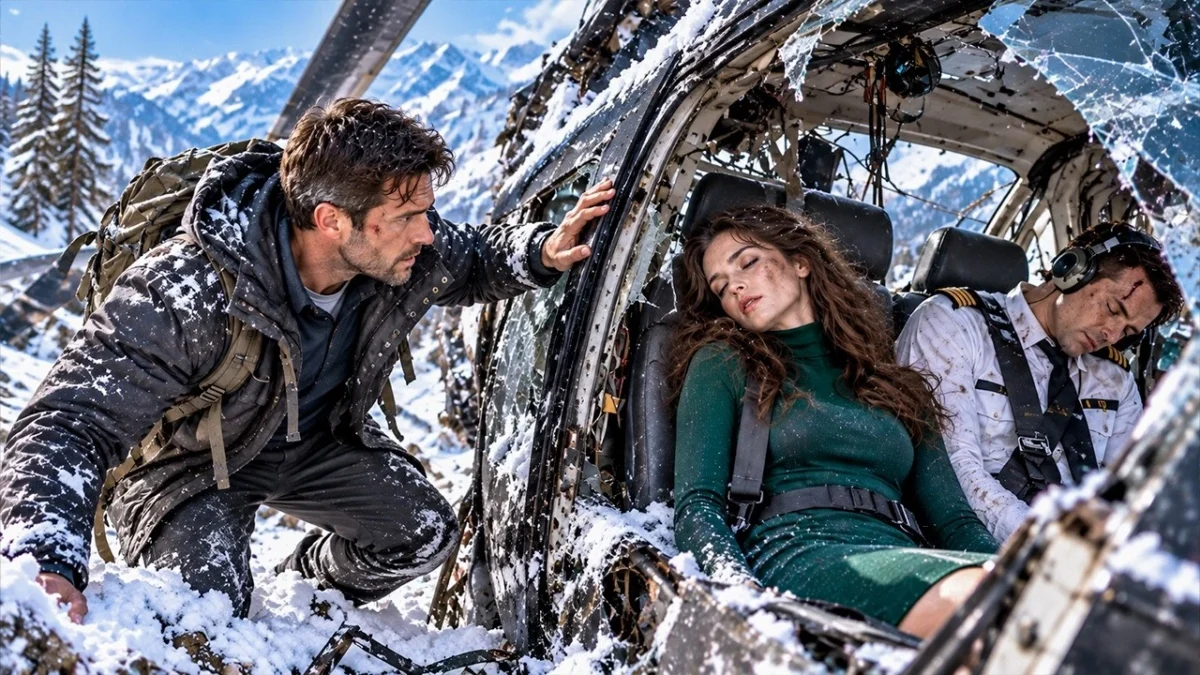
The aircraft was lying on its right side at the bottom of the draw about 60 ft below a stand of broken timber, nose downhill, tailrotor gone entirely.
It had not burned. Helicopters in the stories always burn, and the real ones mostly do not.
Because Ethan had done the hardest thing a pilot can do, which is to stop flying an aircraft on purpose before the aircraft stops flying on its own.
He had traded altitude for control, put it into the only open ground in that drainage, caught the timber with the right side, and slid.
The cabin was crushed inward along the top, and the windscreen was gone. But the cabin was still a shape, and shapes hold people.
I did not run. That is the single most important thing I know, and it is the hardest.
The wreck was sitting on a 40° snow slope with a fresh load on it and no anchor except the trees it had already broken.
And running down onto that would have put my weight exactly where it did not belong.
So I traversed above it sideways testing, keeping to the timber line and came in from the uphill side where the ground was firmer, calling out the whole way so whoever was awake in there would know something other than the wind was coming.
Ethan answered me first. He was still in the left seat with his harness on and his right leg pinned under the collapsed edge of the instrument console.
And when the light hit his face, he laughed once, which is a thing badly hurt people do more often than anyone expects.
He said my name like a question. He said, “Danner,” and then he said, “How.”
And I told him to stop talking and tell me who else was on board, too.
He said, “Just the two. No crew chief that night.” Helena was in the cabin behind him.
She had been thrown against the right side when it went over, and she was half sitting, half wedged, with the seat frame folded across her thighs and her left arm hanging in a way I did not like.
She was conscious. Her eyes were tracking. There was blood down the side of her face from her scalp, which looks appalling and usually means very little, and she was shivering hard, which looks like nothing and means a great deal.
She had lost one shoe. The green dress had frost in it. She looked at me standing in the broken window frame in the same coat she had ordered out of her ballroom 2 hours earlier.
And for a moment her face did something I had never seen it do, which was nothing at all.
She said, “I do not understand.” I said, “Do not try to.” I asked her whether she could feel both feet and she said yes.
I asked whether she could move her fingers and she did. I told her I was going to be moving fast and that she should answer me every time I said her name.
And if she stopped answering, I would be very annoyed with her. That got about half of a breath out of her.
That was nearly a laugh. And it was the first honest sound I had ever heard the woman make.
Then Ethan said, “Fuel.” He said it flatly. The way pilots say things, they have been trained to say without panic.
And he was right because I could smell it, too. Stronger inside the shell than it had been ups slope.
Jet fuel does not go up like gasoline. It also does not need to. There was a heater core and a battery bus in there and enough insulation smoldering somewhere to make the air taste wrong.
And I had a hard limit now that I had not had 30 seconds before.
I went to Helena first. And I want to say plainly that this was not chivalry.
She was closer to the opening. She was uninjured enough to help me help her.
And getting her clear opened the space I needed for Ethan. The seat frame had folded down across her lap and bound against the floor track.
I got the hydraulic ram from the kit under the leading edge, worked it in and gained about 4 in, and she pulled her right leg free herself.
The left was worse. I told her it would hurt, and she said, “Do it.”
And I moved the frame while she made a sound through her teeth that she never once apologized for afterward, and then she was out.
I got her up the uphill side and put her against the base of a spruce 40 ft above the wreck, wrapped an emergency blanket around her, cracked two heat packs into her hands and told her to hold them against her chest and not her palms.
She asked where I was going. I said, “Down.” She said, “Take me with you.”
Which was shocking. And I said, “No.” And I went. Ethan was the hard one.
The console had come down at an angle across the shin and it was carrying load from the airframe itself, which meant that anything I moved was going to move something else.
And while I was working on it, the slope told me exactly what it thought of the plan.
There was a low, soft crump from somewhere under the tail, and the whole wreck settled perhaps 8 in downhill with a groan of metal.
Snow came off the timber above us in a sheet. I remember Ethan saying very calmly that I should go and I remember telling him that I had come up a mountain in a dinner jacket mood and I was not walking back down with half a job.
I got the harness cut, got a loop of line around his chest and used the door frame as the fulcrum instead of my back.
Because my back is 48 years old and had opinions, the console lifted maybe 3 in.
That was all it needed. I got him out on the second pull with his leg coming free at an angle that told me the tibia was broken.
And I dragged him through the window frame and up the fall line on the blanket.
12 ft at a time, resting 12 ft again with my lungs burning and the snow driving straight into my open mouth.
We were about 60 ft above it when the slope finally let go. It was not dramatic.
There was no explosion, no fireball, nothing that would make a satisfying picture. There was just a long grinding sigh, and the aircraft that had cost $11 million slid away from us into the dark, slowly at first, and then not slowly, and the sound of it went on for a surprisingly long time, and then stopped.
The snow closed over the place where it had been within a minute. If I had arrived 20 minutes later, there would have been nothing there at all to find, and no reason for anyone to look in that drawer for a very long time.
Helena watched it go. I was watching her face when it happened because I was checking her pupils and I saw the exact moment the arithmetic arrived.
She had been rescued. That had been the whole story in her head for the last 10 minutes.
The terrible thing had happened and then it had ended. And now she was sitting in a wet evening dress in the bottom of a drainage at 9,000 ft in a storm.
And the man with her had a broken leg. And there was no aircraft, no road, no light, and nothing between the three of us and the weather except what I happened to have on my back.
I keyed the radio and got a wall of static. I moved 30 ft and tried again.
The draw we were in has walls on three sides, and it had been swallowing my transmission since I came down into it.
And the last position I had successfully passed was the wreckage sign 400 yd uphill on the wrong side of the timber.
Farall’s team knew roughly where to come. Roughly on that terrain in that visibility is a number measured in hours.
Ethan’s breathing had gone shallow. Helena had stopped shivering which is not the good news people assume it is.
I looked at the two of them and then I looked up at a sky that was not going to give us anything before dawn.
And I did the only honest math available. The crash was over. The crash had been survivable and they had survived it.
What was going to kill them now was much simpler and much more patient than any of that.
There is an old forest service cabin on the bench about a mile northwest, a single room with a stove that has not worked since the ‘9s.
And I knew it was there because I had used it 13 years earlier for the same reason.
A mile is nothing. A mile carrying one man and dragging another through thigh deep drift in the dark took us just under 2 hours.
I splinted Ethan’s leg with the handsaw in a length of line, and then I put Helena on the other side of him and told her she was going to carry weight, and she did.
She fell four times. She got up four times, and she never once said anything about it, and I revised my opinion of her somewhere around the third.
The cabin had a door that opened and a floor and three walls worth of roof, which on that night made it a cathedral.
I got them inside out of the wind, got the second blanket around Ethan, got the last heat packs going, and stripped the wet outer layer off Helena and put my coat on her, which she tried to refuse, and which I did not offer twice.
Then I sat them both against the interior wall, shoulderto-shoulder, because two bodies together hold heat better than two bodies apart, and the chief executive of Carrington Meridian Group spent the middle of that night pressed against her pilot on a dirt floor.
The long middle of that night went by on nothing but talking. Then she asked me the question she had been sitting on for an hour.
She asked how I had known to come to Harrow Ridge. When the tracking said they were 9 mi east of it, I told her the truth, which was that I had not known anything.
I had known Ethan. I said that when a competent pilot gets an icing indication in that valley, he does not hold heading and hope.
He gets lower and he gets out of the layer. And there is exactly one direction that gives him lower ground without putting rock in front of him.
I said that a last known position is not a location, it is a time stamp.
I said the search box was 11 mi on a side and the only thing I had brought to it was a guess about a man’s professional habits and that I had been about 400 yd wrong, which on a mountain is the same as right.
She was quiet for a while after that. Then Ethan surfaced the way people do and said something into the dark that changed the shape of the room.
He said he had asked on the pad whether there were any open items. He said he had been told the aircraft was confirmed airworthy.
And then he said the thing he had only just put together lying on a dirt floor with a broken leg, that nobody had told him the regional safety office had declined to sign.
He said that if anyone had told him Caleb Danner would not concur, he would have shut the door and walked back inside.
And he did not care whose dinner he interrupted. I heard Helena’s breathing change. I did not look at her.
There is a kind of silence that a person needs to be left alone inside and she was in it.
When she finally spoke, her voice was very small and very flat and she said, “You were in my ballroom.
You were standing in front of me holding it.” Everybody expects a certain sentence at that moment.
I have had a lot of time to think about why I did not say it.
It was not restraint and it was not grace. It was simply that the sentence would have cost me something I needed.
A man who is keeping two hypothermic people alive until dawn cannot also be a man who is winning an argument because those are two different jobs and only one of them works in the dark.
So I told her we could talk about all of that when everyone was off the mountain.
And here is the thing I did not say out out loud and will now.
I did not turn that truck around to prove her wrong. I would like to claim I did because it would make me interesting.
But if it had been Preston Whitlock in that draw, I would have gone. If it had been the man who laughed at the second table, I would have gone.
I went because a person in a wreck stops being a chief executive or an adversary or the reason your evening was ruined and becomes only a person who is going to die if nobody comes.
That is not nobility. It is just the only thing I know how to be.
And it is the one part of me that 11 years of being invisible never touched.
Dawn came gray at around 7 and with it came the sound of tracks on the bench road.
I got for all on the radio from a rock outcrop 200 f feet above the cabin with one bar of signal and gave him a bearing.
And 40 minutes later there were six people in that one room and a litter and warm fluids and somebody’s terrible instant coffee.
And Ethan was telling a paramedic a joke about Christmas bonuses. They took Helena out sitting upright, wrapped in foil, wearing my coat with my name stitched on the chest.
Preston Whitlock arrived at the regional hospital at 11 the next morning with two attorneys and a crisis communications firm out of Denver.
I heard him in the corridor before I saw him using a voice I recognized from the ballroom, warm and reasonable and absolutely airtight.
The phrase he had settled on was an unforcast and unpredictable weather phenomenon. He used it three times in 4 minutes.
It has the great advantage of being nobody’s fault and the small disadvantage of not being true.
I did not argue with him. I went to the nursing station, borrowed a pen, and sent one message to the operations director and copied the general counsel requesting that all maintenance records, deferral authorizations, contractor correspondence, dispatch recordings, and flight data for that airframe be placed under preservation hold immediately.
Then I sent a second one to the federal investigators on duty telling them I had done it.
Preston found out inside of 20 minutes and came down the hall to ask me with everyone watching on what authority a regional supervisor imagined.
He could insert himself into a corporate matter of that magnitude. He was good at it.
He made it sound like concern. He suggested gently that I had been through a traumatic night and might not be thinking clearly.
Helena was in the room behind him with the door open. She had 11 stitches in her scalp, a hairline fracture in her left wrist, and enough frostbite in two toes to keep her off her feet for a month.
She had heard all of it, and she was remembering, I think, a stapled document being squared on a white tablecloth in front of her by a man she had just humiliated.
She said from the bed that nothing was to be deleted, altered, or reorganized. She said it twice.
She told Preston that the preservation hold was hers now, not mine, and that he could take any objection to the board.
Preston stood in that doorway with his mouth slightly open. He was not smiling anymore.
The maintenance documentation came out of the system the following morning. The request to defer the replacement of the component tied to the anti- system had not originated with maintenance, and it had not originated with the safety office.
It had originated by email 6 weeks earlier from the office of the executive vice president.
The investigation ran through January and into the spring, and I will not pretend it produced a villain because it did not.
Preston Whitlock never touched an aircraft. What he had done was write to the maintenance contractor asking them to evaluate options for deferring the component change, noting that taking the airframe out of service in the fourth quarter would disrupt executive travel at the worst possible time.
The contractor came back with a deferral that was in the narrow technical sense permissible.
Every signature in that chain was legal. Every single one of them was also a small weight added to the same side of a scale by men who never once looked at the scale.
What I had seen standing in that ballroom with a stapled printout was not one broken thing.
It was a deferred anti- ice item plus a collapsing freezing level plus active freezing precipitation plus a mountain route at night plus a schedule that could not move.
Any one of those is a Tuesday. All five of them in the same hour is the reason my job exists.
That is the entire argument I was laughed at for making and it took a helicopter in a drainage to make it audible.
Then in February, Helena found the second thing and she brought it to me herself rather than sending.
She had been going through her father’s records for the board review and she found a governance document Richard Carrington had signed in 2015.
He had hired me the year before. He had watched me work a rescue on a county call while he happened to be standing on the other side of a line of tape and he had gone home and looked me up and offered me a job 3 weeks later.
And I had always assumed it was sentiment. It was not sentiment. It was design.
The document gave the company safety office one specific and unusual power written in plain language, the authority to ground any company aircraft when multiple risk factors compound regardless of the rank aenter aboard.
Richard had put it there because he had spent 40 years watching men with schedules override men with information and he wanted one person in his company who could say no to his own daughter.
Through three reorganizations, two general councils and one enterprise software migration, that authority had been quietly reclassified into an advisory function.
Nobody deleted it. Nobody had to. It simply became a line item in a policy appendix that no one read.
And by the time I inherited the role, I did not know I had it either.
I had been standing in that ballroom refusing to sign when what I had actually been handed a decade earlier was the power to stop the aircraft cold.
Helena read it in front of me at a conference table and then set it down and did not speak for a long moment.
Her father had hired one man specifically to keep the Carrington family from dying of its own momentum.
And on Christmas Eve she had looked at his coat and ordered him away from her table.
She did not become a different person overnight, and I would not have trusted it if she had.
What she did was stand up in front of the board in March and say without softening it that the aircraft had departed because she had wanted it to depart.
That she had been given a warning by the one department paid to give it and that she had treated the warning as a discourte because of who was holding it.
She did not use the word unpredictable. Preston was suspended during the investigation and resigned from the executive committee before it concluded.
The policy changes were unglamorous and they were the whole point. Safety concurrence became a hard gate rather than a form.
No officer of the company can now initiate contact with a maintenance contractor regarding a deferral and the grounding authority Richard Carrington’s generation would have called common sense got written back into the charter in the first paragraph where nobody can bury it again.
Helena offered me the leadership of a new independent aviation and operations safety office in April.
I did not accept in the room. I took a week and then I gave her one condition.
The office reports to the board, not to the chief executive, not to her, not to whoever comes after her.
She looked at me for a while and then she said that was the first sensible thing anybody had asked her for in 6 years and she agreed to it in writing before the end of the month.
They rescheduled the Christmas dinner for the second week of that month, which is a strange thing to attend in spring.
With the garlands back up and the snow gone from everywhere but the peaks, there was no executive table this time.
Somebody had made the decision to seat it as one long room, and I doubt it was an accident.
Ethan came on a cane and got a standing ovation. He tried very hard to walk away from.
I came in late, still in the field coat, because I had been at the maintenance facility in Cheyenne until 4:00, and there had not been time to change.
I have walked into that room feeling like a stain on a tablecloth. I have walked into that room knowing exactly what the silence meant.
This time the room simply made space the way a room does when a thing has been settled and I stood in the doorway for a second and understood that nothing about me had changed at all.
Helena saw me from the far side. She did not make a speech. She did not come across the floor with her hand out and nothing happened between us that night or since that belongs in a story like this one.
She just reached over and pulled the empty chair beside her out from the table.
And then she went back to her conversation, which was the most respectful thing she could possibly have done.
I looked at that chair for a few seconds. Then I sat down in it, not because she had finally decided I was allowed to, and not because a title or a new office had made me worth the seat.
I sat down because the whole room had finally arrived at the thing I had known on a mountain in the dark, which is that I had never needed their permission to be worth anything.
There are people who will only ever see the title, the suit, or the chair a person is permitted to occupy.
Life tends to tell us what someone is actually worth on the night everything else disappears.
Helena Carrington needed one night in a storm to learn that the man she did not want at her table was the one who came back for her.
If Caleb’s story made you think of someone who was underestimated and still chose to do the right thing, subscribe and stay with us for the next








