“You’re Not Leaving This Room,” She Purred—The Alien Obsession Begins
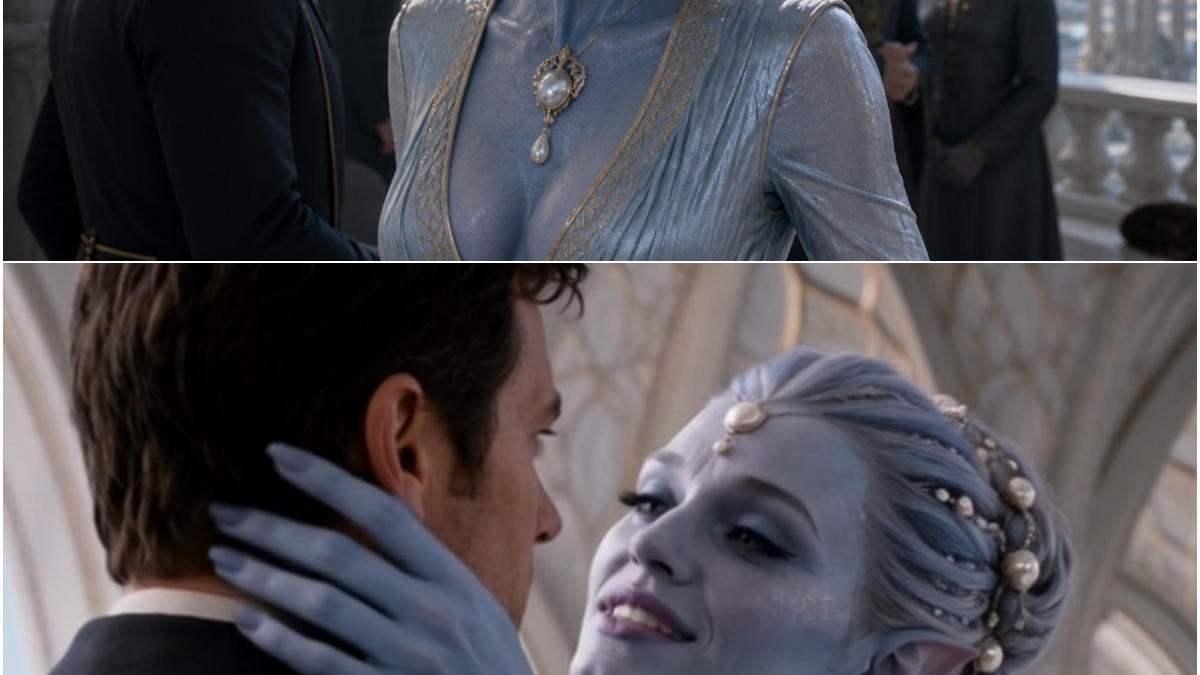
At 3:47 a.m. on a Tuesday, Ethan Park received a message that should never have been able to reach his phone.
It arrived without a sound, without a notification he recognized, and without any explanation of how it had crossed the distance between Earth and a civilization hundreds of light years away.
His screen filled with strange symbols, angular lines woven together like mathematical equations written by someone who had never learned to separate science from art.
They moved across the display, connecting and rearranging themselves until the photograph of his parents’ bakery disappeared beneath a living pattern of blue white light.
Then the symbols became English. Ethan Park, you have been identified. Your genetic markers confirm compatibility at the 99.7th percentile.
Under Article 12 of the Zhvi mate recognition protocols, I am required to inform you that I have claimed you.
This claim is irrevocable. I will arrive in 14 standard days. Sincerely, Thaver Jelcorin, senior genomic cgrapher, Zhlvhi, Imperial Sciences Division.
Ethan read the message once, then again, then a third time, searching for the hidden explanation that would turn the impossible into something ordinary.
He had spent his life learning that small differences could change an entire recipe, and he knew better than to overlook an unfamiliar instruction.
But there was no missing step here, no reasonable clarification waiting beneath the words. Somewhere beyond Earth, a scientist had examined his biology and decided that he belonged with her.
His first thought was that he was dreaming. His second was that he needed to call his mother.
His third was that the bakery would still need to open in a few hours.
And as the strange blue light pulsed against the dark walls of his apartment, Ethan began to wonder what it would mean when the woman who had claimed him finally walked through his door.
At 2:45 a.m., Ethan’s alarm went off. He had not slept properly after receiving the message.
He had spent most of the night sitting on the edge of his bed, staring at his phone, occasionally turning it off and on again in the hope that the strange communication would disappear.
It never did. The symbols remained, glowing with a faint blue white radiance that seemed to come from somewhere other than the screen itself.
By the time the alarm sounded, he had reached one practical conclusion. Whatever was happening in 14 days, the bread still needed to be made.
Ethan Park was 27 years old, and he was not the kind of baker who treated bread as a fashionable accessory.
He did not spend his mornings arranging expensive loaves beneath perfect lighting for photographs. He worked in a family bakery, six days a week, fifty weeks a year, beginning at three in the morning and finishing when the last order had been filled.
Park’s Bakery occupied the ground floor of a converted Victorian building on Southeast Hawthorne Boulevard in Portland, Oregon.
It had been there for twenty years, ever since his parents, Jinho and Sumin Park, had arrived from Busan with a sourdough starter, a treasured family recipe, and the conviction that Portland was a city where good bread could build a permanent home.
They had been right. The bakery had become a neighborhood institution. Its sourdough was famous among regular customers, its red bean buns were a familiar comfort to generations of families, and its croissants had once inspired a food critic to devote an entire column to the texture of butter.
But Ethan’s cinnamon rolls were the reason people lined up outside on Saturday mornings. He had spent fourteen months developing the recipe.
The dough was enriched with brown butter, the cinnamon was Korean, and the cream cheese glaze had to be applied at a precise temperature to achieve the glossy surface and delicate crystallization he wanted.
He had tested dozens of variations before finding the combination that made the rolls soft without becoming heavy and sweet without overwhelming the flavor of the dough.
He understood baking through instinct as much as measurement. He could tell how much kneading a dough needed by the way it pulled against his hands.
He could judge hydration by the sound it made when he folded it. He knew when a loaf had finished proofing by pressing one finger gently into its surface and watching how slowly the indentation recovered.
His hands were his most valuable instruments. They were strong from years of kneading, scarred from oven burns, and permanently marked by the work.
Even after washing them thoroughly, he often carried the faint smell of flour, yeast, and warm bread.
Once, he had turned down a date because the woman had complained that his hands smelled like fermentation.
He had realized afterward that he needed someone who would consider that a compliment. He had not found that person.
His mother sometimes said he was too patient with romance. She believed he treated love like sourdough, waiting for the right culture to develop rather than trying to force it into existence.
His father had a simpler theory. He believed that the right person would eventually find Ethan at the bakery, because the bakery was the center of his life and anything important would naturally find its way there.
Ethan usually pretended not to worry about being single. The pre-dawn hours occasionally made that pretense difficult.
When the dough was resting and the bakery was empty, the only company was the starter breathing quietly in its ceramic crock and the knowledge that he had built a life around making things for other people without having someone to share the ordinary moments with.
Now, apparently, an alien had decided to solve that problem. He arrived at the bakery shortly after three and began preparing the day’s dough.
The routine steadied him. He fed the sourdough starter, measured flour, weighed salt, and prepared the mixtures for the morning’s orders.
The familiar movements gave his thoughts somewhere to settle. But every few minutes, he found himself remembering the message.
A 99.7th percentile match. An irrevocable claim. Fourteen days. He had no idea whether the scientist was humanlike, whether she understood ordinary relationships, or whether the word claimed carried the same meaning in her culture as it did in English.
He only knew that she was coming. Eventually, he took out his phone and called his mother.
Sumin Park answered on the second ring. “Ethan, what’s wrong?” “Ma, an alien just sent me a message saying she’s claimed me as her mate and she’s arriving in fourteen days.”
There was a long pause. Then she asked, “What kind of alien?” “I don’t know.
The message says she’s from Zhlvhi. Or something close to that.” “Hold on.” He heard her moving around, followed by the familiar sound of a laptop opening.
His mother had a particular way of approaching a crisis. She researched first, worried second, and usually found a practical task for everyone before anyone had time to panic.
A few minutes later, she spoke again. “I found them. The Gelvashi.” “Gelvashi?” “That’s the species name.
They established formal diplomatic relations eight years ago. Their home world is Gelvash. It has very high gravity and mostly Arctic conditions.”
Ethan leaned against the kitchen counter. “What do they look like?” “Oh, they’re beautiful.” His mother said it with the same wonder she had once expressed when tasting his first successful cinnamon roll.
“Their skin is pale silver white, almost like fresh snow under moonlight. They have very large violet eyes with silver flecks, and their hair is white silver.
It has a crystalline structure that refracts light. They also have markings on their skin.
Geometric patterns that glow and change color with their emotions.” “Like the symbols on my phone?”
“Exactly. Their written language and their skin markings are related. They communicate through the same system, one expressed on a screen and the other through specialized cells in their skin.”
Ethan looked at his phone. The symbols had stopped scrolling. They now formed a precise, interlocking design across the screen.
“What’s a mate claim?” More typing followed. “The Gelvashi have a genomic compatibility system. Their genomic cgraphers study genetic profiles and determine how closely another individual’s biology matches theirs.
When a match exceeds the ninety-ninth percentile, the person becomes a mate candidate. Above the ninety-nine point five percentile, the match is classified as structurally destined.”
“Structurally destined?” “That’s the closest translation. Their culture believes compatibility at that level is not a coincidence.
They believe two people can be biologically designed to complement each other.” Ethan rubbed his forehead.
“And the claim is irrevocable?” “According to the cultural database, yes. A formal claim is filed through their Imperial Sciences Division.
The person making the claim must travel to the individual and complete something called the Kelshara.
It’s a reading. The scientist checks the compatibility in person.” “What happens if the reading confirms it?”
Sumin paused. “Apparently, if the reading exceeds the original analysis, the Gelvashi’s skin markings synchronize with the claimed individual’s biological rhythms.
Their patterns change permanently to include that person’s signature.” Ethan stared at the phone again.
“Permanently?” “For the rest of her life.” He was quiet. His mother continued in a softer voice.
“Ethan, the database says matches above ninety-nine point five are recorded approximately once per generation.
A 99.7 match is extraordinary.” Before he could answer, his father spoke from somewhere in the background.
“Is she bringing anything?” Ethan closed his eyes. “Appa, this is not about gifts.” “Of course it is about gifts.
If someone travels fourteen days to claim my son, she should bring something polite.” “I don’t even know if she eats bread.”
“Find out.” “Appa.” “If she eats bread, I will make her something special. A claiming gift.
We have a sourdough starter that is twenty years old. That is practically a family heirloom.”
Ethan pressed the phone against his forehead. His parents were impossible. They were also the reason he knew how to make bread, how to work through difficult days, and how to recognize love when it appeared in an unexpected form.
His mother returned to the conversation. “The cultural notes say the first meeting is very important.
She will read your biological signature in person. If the compatibility is confirmed, her markings may begin integrating your pattern.”
Ethan looked at the flour on his hands. He thought about the sourdough starter his father had carried across the Pacific.
He thought about the years of feeding it, dividing it, and protecting it through every season.
He thought about the way a living culture could survive because someone chose to care for it every day.
“Fourteen days,” he said. “Fourteen days,” his mother agreed. “I need to clean my apartment.”
“You need to prepare more than that.” “I know.” “But first, go to the bakery.
The bread still needs to be made.” So he baked. The next fourteen days passed in the familiar rhythm of early mornings, warm ovens, and the endless work of preparing food for people who depended on him.
His alarm rang at 2:45 a.m. He arrived at the bakery by three, lit the ovens, fed the starter, and began weighing ingredients.
His hands repeated movements they had practiced thousands of times, while his thoughts wandered through the possibilities waiting at the end of the fortnight.
He imagined the scientist studying him with detached curiosity. He imagined her arriving with a formal document and expecting him to sign something.
He imagined that the entire message might be a misunderstanding, a diplomatic experiment, or some unusual custom that would make sense only when explained in person.
But the possibility that troubled him most was the simpleSt. What if she was serious?
What if she had crossed an enormous distance because she genuinely believed they belonged together?
And what if he liked her? Every evening after closing, Ethan researched the Gelvashi cultural database.
He read about their home world, their family traditions, their scientific institutions, and the social significance of their markings.
The Gelvashi were tall, averaging six feet one among adult women, with lean, efficient physiques adapted to the high gravity of Gelvash.
Their movements were precise, and their bodies conserved energy in ways that reflected the demanding environment of their home world.
Their markings were a biological language. Specialized cells in their skin produced intricate geometric patterns, each individual’s arrangement as distinctive as a human fingerprint.
The markings could shift color with emotional state, changing from cool blue during calm moments to violet when engaged, bright silver white during intense feeling, and a deep prismatic aurora during recognition.
The patterns were not decorations. They were identity, emotion, and language combined. Ethan found himself fascinated by the idea that a person’s feelings could be written visibly across their body.
Humans concealed so much. They smiled when uncomfortable, nodded when confused, and sometimes spent years trying to understand what another person was thinking.
The Gelvashi could not hide every feeling. Their bodies told stories their mouths might never speak.
The more Ethan read, the more he understood that Thaver Jelcorin was not simply an ordinary scientist who had sent an unusual message.
She was one of the most respected genomic cgraphers in the Imperial Sciences Division, and one of the youngest senior researchers in its history.
She had specialized in cross-species compatibility and had developed the methodology that allowed Gelvashi scientists to identify certain compatibility markers in human DNA.
She had not simply found his match. She had helped create the scientific bridge that made the discovery possible.
His mother told him this on the eighth evening, after a day spent corresponding with cultural liaisons and diplomatic contacts.
“She is exceptional,” Sumin said. “Her work is recognized throughout her field. She was promoted to senior cgrapher at approximately twenty-six standard years.”
“So she’s brilliant.” “Very.” “And she has decided I’m the person she wants?” “She has decided that your biology is compatible at an extraordinary level.
What happens after that is something you will both have to discover.” Jinho was sitting nearby, carefully feeding the starter.
“She built the bridge,” he said. “Then she walked across it herself.” Ethan looked at him.
“That’s a very romantic way of describing a scientific procedure.” “Sometimes science discovers something that the heart has been waiting for.”
His father returned to the starter. Ethan said nothing, but the words stayed with him.
During those two weeks, he baked more than he had ever baked for a single occasion.
He made sourdough, red bean buns, croissants, cinnamon rolls, and a soft milk bread that reminded his mother of the bread her own mother had made in Busan.
He also began developing something new. He had been studying Gelvashi script for days, practicing its symbols until he could reproduce many of the most common forms without looking at the reference images.
The writing was mathematical in its structure, with angular shapes connected through shared lines and mirrored curves.
It seemed almost impossible to translate into bread. But Ethan had spent his life turning abstract ideas into physical forms.
He understood how a pattern could become a braid, how a fold could create a repeating structure, and how a carefully shaped dough could preserve an idea even as it expanded.
On the thirteenth day, he began experimenting with a new recipe. He mixed a high-hydration dough enriched with butter and honey, adding cardamom and a trace of vanilla.
He worked it until the texture became smooth and elastic, then divided it into strands and shaped them into an angular interlocking braid inspired by the Gelvashi script.
Each strand crossed another through a series of shared connections. Every meeting point represented a symbol he had studied.
Every curve softened the geometry just enough to accommodate the nature of dough. He proofed it slowly.
The precise pattern began to change as the dough expanded. Its sharp lines softened into rounded edges, and the connections became organic.
The design remained recognizable, but it no longer looked like a copy of the original script.
It looked like something that belonged to the bakery. He baked it at 375 degrees for thirty-two minutes.
When he removed it from the oven, the crust was golden and delicate, and the aroma of honey, cardamom, and warm butter filled the empty shop.
He placed it on a wire rack and waited for it to cool. When he finally sliced into it, the crumb was tender and luminous beneath the bakery lights.
He had no idea whether Thaver would understand the gesture. He did not even know whether she could eat human bread.
But it was the best answer he knew how to give. On the fourteenth day, she arrived.
It was 6:15 a.m. when Ethan saw her standing in the doorway of Park’s Bakery.
She looked exactly like the images in the cultural database, yet no image had prepared him for the experience of seeing her in person.
Her skin was pale silver white, luminous against the gray autumn light filtering through the windows.
Her violet eyes were enormous, with silver flecks that caught the light like tiny fragments of crystal.
Her white silver hair fell past her shoulders, each strand refracting the morning brightness into subtle prismatic sparks.
She was six feet one, tall and lean, with the precise movements of someone accustomed to a world where every unnecessary motion required effort.
Her markings covered her hands, forearms, and the exposed skin above the collar of her silver tunic.
They were angular and intricate, connecting through shared lines in a pattern that seemed to move as she breathed.
But it was her expression that surprised Ethan. She did not look like a scientist arriving to validate a formal claim.
She looked like someone who had just encountered something her calculations had never prepared her to understand.
Her markings began shifting. Cool blue fractured into violet. Violet gave way to silver white.
Then the entire network erupted into a deep prismatic aurora, the color of recognition. The patterns were so bright that faint colored reflections appeared on the bakery walls.
“You,” she said. Her voice was clear and precise, with the careful rhythm of someone who had learned English through study rather than casual conversation.
“You are Ethan Park.” “I am.” He set down the tray of cinnamon rolls. “You are Thaver Jelcorin?”
She hesitated. Her markings intensified, and she pressed both hands against her forearms in the suppression gesture Ethan had read about.
It was an attempt to control an emotional display. It did not work. “The analysis said 99.7,” she said.
“The Kelshara reading is higher.” She stepped into the bakery. “I can feel it. Your genetic signature is stronger than the analysis predicted.”
Ethan watched the colors moving across her skin. “What does that mean?” Her gaze shifted toward his hands.
“You smell like bread.” “I know. I work here.” “Not simply bread. Fermentation. Living cultures.
Your sourdough, your yeast, your flour. Your skin carries the biochemical signature of organisms that have been maintained through continuous care.”
She studied his hands with an intensity that made him suddenly self-conscious. “Your father is correct,” she said.
“A baker’s hands are never clean because the bread lives in them.” Ethan blinked. “You read that?”
“I studied your cultural records.” “That sounds like something he would say.” “Your father understands biological architecture.”
She moved closer, her markings continuing to rearrange themselves. “Your body carries a living community.
The microorganisms you have cultivated through twenty years of daily baking have become part of your biological environment.
Your microbiome is unusually distinctive.” “So the bread has something to do with the match?”
“More than something.” Her eyes widened. “The analysis measured your genetic markers. The Kelshara reading is recognizing the broader biological architecture that surrounds them.
Your living cultures, your daily contact with fermentation, the organisms you maintain on your skin and throughout your working environment.
They are contributing to the compatibility.” Ethan looked at the sourdough starter on the shelf.
“Because I smell like bread?” “Because you carry living things. Because you wake before dawn to sustain them.
Because you have spent years maintaining a community of organisms through patience and attention.” Her markings pulsed.
“Your biology is not merely compatible with mine. It is complementary.” She seemed to struggle for a word.
“Like home.” Ethan felt something shift inside him. The woman standing before him was a scientist who had traveled across interstellar space with the confidence of someone whose research had produced an extraordinary result.
Yet now she looked vulnerable, almost frightened, as if the very discovery she had spent her career pursuing had become too important to examine calmly.
He thought of the bread cooling on the rack. “I made something for you,” he said.
Her markings briefly stopped. “You made something?” “I’m a baker. It’s what I do when I don’t know what else to do.”
He brought the geometric braid from the cooling rack and placed it on the counter between them.
“I studied your script for two weeks. I wanted to make something that spoke your language, at least a little.”
Thaver stared at the bread. For a long moment, she did not move. Her eyes traced the interlocking strands, the angular crossings, and the softened curves where the dough had expanded during proofing.
She studied the design with the same concentration Ethan imagined she brought to a complex genetic sequence.
Then she looked at him. “You made this pattern.” “I tried to.” “You studied my language?”
“I wanted to understand what you were telling me.” Her markings changed again, but this time the color was not the aurora of recognition.
It was a deep, rich violet that seemed to come from somewhere beneath the ordinary range of her emotional display.
Ethan had not encountered that shade in the database. He wondered whether it was the Gelvashi equivalent of tears.
“You wrote your response to my claim in bread,” she whispered. “In flour, butter, honey, and time,” Ethan said.
“It’s the language I’m fluent in.” She looked down at the loaf again. The geometric design was not a perfect reproduction of Gelvashi script.
Some connections were slightly rounded, and a few of the sharper angles had softened into gentle curves.
But that was exactly what made it his. He had taken a mathematical language and translated it into a living medium that changed as it grew.
He had not copied her world. He had answered from his own. “I do not write on my skin,” he said.
“I don’t have markings. But I can write in dough. I’ve been doing it since I was seven years old, standing on a stool beside my mother and learning to shape red bean buns the way her grandmother taught her.”
Thaver reached toward the bread. Her long fingers touched the cruSt. The markings on her skin flared into a warm gold that spread from her fingertips up her arms and across her collarbones.
She stared at the bread. “This is alive.” “The cultures are still active in the crumb.”
“The organisms are connected to your biological community.” “In a way, yes.” She looked at him with astonishment.
“You gave me a piece of yourself written in flour.” She broke off a small piece.
The crust crackled softly, and the interior released a warm fragrance of honey, cardamom, and butter.
She studied the crumb before tasting it. Ethan waited. She ate slowly, paying attention to the texture and flavor with the full concentration of someone who understood that food could carry information.
Her markings deepened into gold. The geometric network began rearranging itself around the new color, incorporating the experience into the visible language of her body.
Then she looked up. “The Kelshara is complete.” Ethan held his breath. “The reading confirms compatibility at the 99.9th percentile.”
“Higher than the analysis?” “Higher than any reading in the Gelvashi genomic record.” He stared at her.
“Why?” “Your genetic markers were already exceptional. But the broader biological signature is something my original analysis could not fully predict.
Your microbiome, your living cultures, the organisms maintained through your work, all contribute to a compatibility that exceeds the initial measurement.”
She held out her forearm. The markings had changed. New symbols had appeared among the original angular patterns.
They were softer and more organic, with rounded shapes that resembled the structure of risen dough.
They connected to the older geometry without replacing it. His pattern had become part of her identity.
“My markings have integrated your signature,” she said. “The new symbols are permanent. They will remain for the rest of my life.”
Ethan looked at the delicate network of lines. The original patterns were crystalline and precise, the geometry of a species shaped by an Arctic world.
His symbols were different. They seemed to have grown from the spaces between the older markings, adding warmth and softness without weakening the structure.
It looked like two languages sharing a page. “You’re writing me into your skin,” he said.
“My skin is writing you into me.” “Can you control it?” “No. The integration is biological.
At this compatibility level, my cells recognize your signature and incorporate it into my identity pattern.”
She lowered her arm. “Any Gelvashi who sees me will know that I am claimed, and they will know by whom.”
Ethan should have been overwhelmed. He should have been frightened by the permanence of it, or confused by the speed with which a scientific discovery had become a declaration of belonging.
Instead, he found himself thinking about bread. The best things in his life were irreversible.
Bread could not be unbaked. Sourdough could not be returned to its original ingredients. The starter his father had carried from Busan had become something different through twenty years of care, and every loaf they made was connected to that history.
Transformation was commitment. Commitment was what turned flour, water, and yeast into something that could feed a family.
It was also what turned strangers into people who belonged together. He looked at Thaver.
She was beautiful, brilliant, and standing in his bakery with her skin glowing in colors he had never seen before.
Yet beneath the extraordinary science, he recognized something familiar. She was waiting to find out whether she belonged.
“I’m going to need to call my parents,” he said. Her markings flickered. “You want to call your parents?”
“I want you to meet them.” She looked toward the door. “I would like that very much.”
“My dad is probably going to make you bread.” “I brought a claiming gift.” Ethan blinked.
“You did?” She reached into the bag she had carried and withdrew a small silver case.
It was cool to the touch, with environmental controls built into its surface. She opened it.
Inside was a crystalline container holding a luminous blue white substance. Its glow was steady and ancient, unlike the shifting brilliance of her skin.
“A biological starter from Gelvash,” she explained. “It is a symbiotic colony native to the crystalline salt plains of my home world.
My family has maintained it for six hundred years.” Ethan stared at the container. “Six hundred?”
“Each generation has fed it, divided it, and passed it forward. The sharing of a family culture is one of the most significant gifts a Gelvashi can offer a mate.”
She held the container carefully. “I brought it because I believed you would understand what it means to be trusted with something alive.”
Ethan thought of his father’s sourdough starter, twenty years old and still resting in its ceramic crock.
He thought of the careful daily feeding, the temperature checks, the divisions, and the quiet attention that kept it thriving.
Six hundred years was almost beyond his imagination. A living culture had been maintained through centuries of family life, carried through changes in weather, homes, and generations, and now it had traveled across space to reach him.
“That is the best gift anyone has ever given me,” he said. Thaver’s markings pulsed warmly.
“I hoped you would understand.” He looked at the container again. “My father gave me our starter when I turned eighteen.
I keep it close, even when I don’t need to. I know what it means to care for something that was entrusted to you.”
“I knew you would.” She hesitated. “The Imperial Sciences Division questioned my decision to bring it before the formal reading.
They believed the exchange should happen only after the compatibility was confirmed.” “And what did you tell them?”
“That a man whose skin carries twenty years of living organisms would understand the significance of a living gift.”
Ethan laughed softly. “You were right.” “I am rarely wrong about biological compatibility,” she said.
Then her markings shifted into a softer violet. “I was, however, entirely wrong about my ability to maintain professional composure during the Kelshara.”
He smiled. “What did you expect?” “To read your genetic signature. To confirm the analysis.
To complete the protocol.” “And what happened?” She glanced around the bakery. “I did not expect your genetic signature to smell like this.
To feel like this. To be this.” For the first time, she smiled. It transformed her face.
Her angular features softened, and her violet eyes widened with an expression that looked remarkably like the one Ethan’s mother made whenever someone tasted her bread and understood what it meant.
He realized he wanted to see that smile again. He wanted to learn the colors of her ordinary moods, understand the meanings of the patterns that moved across her skin, and discover what she found beautiful about a world that was so different from her own.
Most of all, he wanted to know whether the extraordinary connection they had found in their biology could become something ordinary enough to live inside.
He offered her his hand. “Come on. My parents are waiting.” They walked the four blocks to the bakery’s main entrance beneath the damp October sky.
Portland was wrapped in autumn rain. Yellow and crimson leaves clung to the wet pavement, and the maples along the sidewalk shone beneath the gray morning light.
Thaver’s stride was naturally longer than Ethan’s, but she adjusted her pace without being asked.
She shortened her steps until they matched his, moving beside him with the same precise attention she had shown in the bakery.
Ethan noticed. It was a small thing, but it mattered. Her markings caught the diffused daylight and scattered faint colors across the wet sidewalk.
Violet, gold, and the warm amber of the new symbols moved with her as she walked.
People stared. A dog walker stopped in the middle of the pavement. A jogger slowed and looked back.
The barista from the neighboring coffee shop dropped her keys when she saw the tall silver white woman walking beside Ethan.
Thaver seemed unconcerned. “Portland is very wet,” she observed. “It rains a lot.” “How much?”
“About two hundred days a year.” She tilted her face toward the sky. “On Gelvash, precipitation falls as crystallized ammonia.
Your rain is warm and alive.” She watched a droplet slide down her forearm. “I can feel the microorganisms in it.”
“Is that strange?” “It is overwhelming.” Her markings shimmered. “And beautiful.” Ethan glanced at her.
“Wait until you see the bakery.” When they entered the shop, the familiar smell of sourdough and warm wood surrounded them.
The ovens were still running, and the walls carried the gentle warmth of a place that had been working since before sunrise.
Thaver stopped. Her markings began glowing again, slowly at first, then with a deep sustained warmth that filled the small interior with colored light.
“The biological community here is immense,” she said. Ethan smiled. “My dad says the bakery has its own heartbeat.”
“He is not speaking metaphorically.” She looked toward the ovens. “The thermal cycles create an environmental rhythm.
The biological community responds to it. The walls, counters, and equipment are all part of the same ecosystem.”
She turned toward him. “Your bakery is alive, Ethan. It breathes.” Before he could answer, the door opened behind them.
Jinho Park stood in the doorway with flour in his eyebrows and a round loaf of sourdough in his hands.
Sumin was just behind his shoulder, looking at Thaver with the intense concentration of a mother meeting the person who had traveled across interstellar space to claim her son.
Jinho looked at the scientiSt. He looked at her glowing markings, her violet eyes, and the unfamiliar symbols that now included Ethan’s biological signature.
Then he looked at the way she stood in his bakery. She was not examining the place as a visitor might examine an interesting building.
She was paying attention to it as though it were something living, something worthy of respect.
Jinho understood that. He held out the bread. “Welcome to the family.” Thaver looked at the loaf.
Jinho continued. “This is from the starter I brought from Busan twenty years ago. It has made every loaf we have sold here.
I carried it across the ocean because my wife said Portland needed good bread.” He smiled at Sumin.
“She was right about Portland. She was right about the bakery. And she was right about our son.”
He turned toward Thaver. “If your biology says you are right about him too, then I believe your biology has good taste.”
Thaver accepted the loaf with both hands. Her markings flared into deep gold. She held the bread close to her chest, and the new symbols on her forearms pulsed in a pattern Ethan recognized.
His signature was repeating, brighter and more intricate than before, as if the presence of his father’s starter had strengthened the biological meaning of the connection.
“Thank you,” she said. “I will carry this culture with mine. They will grow together.”
Sumin stepped forward. She was five feet two, much smaller than Thaver, but she looked up at the tall alien scientist with the steady confidence of someone who had spent twenty years building a life from unfamiliar surroundings.
“You hold it correctly,” she said. Thaver glanced down at the bread. “Correctly?” “Against your heart.
That’s how you hold something alive.” Sumin looked at her husband. “Jinho carried our starter the same way on the airplane.
The customs officer asked what was in the container, and he told him, ‘My family’s future.’”
Jinho nodded. “He was correct.” Thaver studied the loaf. “A living culture is a seed of architecture.
It carries the biological foundation of everything you build with it.” Sumin’s expression softened. She looked at Ethan, then at Thaver, and seemed to make a decision.
Without another word, she stepped forward and wrapped her arms around the Gelvashi’s waiSt. It was a simple embrace.
A small Korean woman hugging a tall alien scientist in a bakery on Hawthorne Boulevard while autumn rain fell outside and the ovens warmed the walls.
Thaver went completely still. Then her markings changed. The angular patterns softened into curves without losing their structure.
The gold deepened into a luminous amber, and small rounded shapes began appearing among the original geometric lines.
Ethan watched in astonishment. “What is happening?” Thaver looked down at her own skin. “Family marks.”
Her voice was quiet. “My body is producing family marks.” Sumin kept her arms around her.
“What does that mean?” Thaver seemed almost unable to believe her own answer. “They appear when the body recognizes family.
They are not part of the mate integration. They are a separate biological response.” She looked at Jinho, then at Sumin, then at Ethan.
“I have never produced them before.” “Of course you haven’t,” Sumin said gently. “Nobody expects family.
Family happens while you’re busy baking bread.” Thaver’s markings brightened. For a moment, she looked like someone who had spent her entire life studying the structure of belonging and had just discovered that the experience itself could not be reduced to a formula.
Ethan felt his throat tighten. He had spent two weeks worrying about whether the alien scientist would understand him.
He had wondered whether their biology would translate into a relationship, whether their customs would be compatible, and whether he would know how to respond to something as permanent as her claim.
But now she was standing in the center of his family’s bakery, holding his father’s bread, wrapped in his mother’s embrace, and carrying new symbols that had appeared because her body recognized them as family.
There was nothing abstract about it. The connection was becoming real in the simplest possible way.
Jinho set down the ceramic crock containing the twenty-year-old sourdough starter. He placed it beside Thaver’s crystalline case, which held the six-hundred-year-old Gelvashi culture.
The two starters rested side by side on the counter. One had traveled from Busan to Portland.
The other had traveled from Gelvash across interstellar space. Both were alive. Both had been maintained through generations of careful attention.
And both had been entrusted to people who understood that a living thing could become part of a family’s history.
Jinho looked at the containers with quiet reverence. “Twenty years and six hundred years,” he said.
“Two cultures from two worlds.” He looked at Ethan. “Maybe we should bake something together.”
Thaver’s markings glowed warmly. “Both starters?” “Both starters,” Jinho replied. “One bread. Something that’s never been made before.”
Ethan felt a smile spread across his face. He imagined the two cultures meeting in a single dough.
He imagined the differences in their biological rhythms, the way they might interact, and the new flavors or textures they might create.
There would be no reliable recipe, no guarantee of success, and no way to know what the final loaf would become until the process was complete.
It was exactly the kind of experiment he loved. But it was more than an experiment.
It was a promise. The two families had brought their living histories together, and now they were preparing to make something new from them.
Thaver looked at the starters. Then she looked at Ethan. “Yes,” she said. “I would like that very much.”
They began by clearing a space on the central workbench. Jinho brought out the scales and mixing bowls, while Sumin gathered flour and prepared the ingredients.
Ethan washed his hands, tied his apron, and checked the temperature of the bakery. Thaver stood beside him, studying the process.
She asked questions about hydration, fermentation, temperature, and the relationship between the starter and the dough.
Ethan explained the importance of feeding schedules, the way yeast and bacteria worked together, and how the texture of the dough changed as the culture became active.
She listened with the attention of a scientiSt. But when Ethan showed her how to fold the dough, she approached the task with the careful concentration of someone learning a language that could not be mastered through observation alone.
He guided her hands. Her fingers were long and precise, but the dough resisted the kind of control she was accustomed to exercising in the laboratory.
It stretched, sagged, and clung to her skin. Her markings flickered in surprise. “It does not obey the geometry,” she said.
“Not exactly.” “Then how do you control it?” “You don’t control every part of it.
You give it structure and let it develop.” She looked down at the dough. “Like biological compatibility.”
“Maybe.” He showed her how to lift one edge, stretch it gently, and fold it back over itself.
She repeated the movement, slowly adjusting the pressure until the dough began to respond. Her markings shifted into a warm violet.
“I understand,” she said. Ethan smiled. “You understand the fold?” “I understand that the structure is not imposed entirely from outside.
It emerges through interaction.” Jinho laughed. “That’s a very scientific way to describe making bread.”
Thaver glanced at him. “It is also accurate.” Sumin brought over a bowl of flour.
“Then you should be a good baker.” Thaver’s markings glowed. “I would like to learn.”
The ovens ticked as they warmed. Outside, the rain continued to fall across Southeast Hawthorne Boulevard, washing the sidewalks and gathering in the gutters beneath the autumn trees.
Inside the bakery, two living cultures waited beside one another. One had been carried across an ocean by a young couple who believed they could build a home in a city they had never visited.
The other had been passed through six hundred years of family care on a distant Arctic world.
Now they were resting together in the same room, entrusted to a family that had learned to recognize love through the things people made and shared.
Ethan looked at Thaver as she worked the dough. Her markings were still changing, but the colors had become calmer.
The new symbols remained visible among the older geometry, and the family marks glowed softly along her arms.
She looked up and caught him watching. “What?” “Nothing.” “That is not true.” He laughed.
“I was thinking that you came here expecting to study my biology.” “I did.” “And instead, you’re making bread with my family.”
She glanced at the dough, then at the starters. “The evidence has changed.” “Has it?”
“Yes.” She moved closer, her shoulder lightly touching his. “I came believing that the deep pattern would tell me whether we were compatible.
It did. But I am beginning to understand that compatibility is only the beginning of a shared structure.”
Ethan looked at her. “What comes after that?” Her markings warmed into amber. “Daily care.
Attention. Patience. The willingness to let something living become different from what either of us expected.”
He thought about the starter in its crock. About the bread on the cooling rack.
About the way his parents had built a life from flour, water, and a belief that something good could grow in a new place.
Then he looked at Thaver, whose skin carried the pattern of his biology and whose hands were dusted with flour for the first time.
“Sounds like baking,” he said. “It does.” “And it sounds like family.” Her markings brightened.
“Yes,” she said. “It does.” By the time the first dough had finished mixing, the bakery was beginning to fill with the familiar warmth of morning.
The ovens were ready, the counters were dusted with flour, and the two starters had begun their first shared experiment.
Ethan knew there would be complications. The Gelvashi culture might behave differently at human temperatures.
Its microorganisms might interact unpredictably with the sourdough organisms his father had maintained for twenty years.
They would have to observe the fermentation carefully and make adjustments as they learned. There was no guarantee that the first loaf would succeed.
But that was the nature of baking. And perhaps that was the nature of belonging too.
You began with what you had. You offered care. You paid attention to the changes.
You learned when to wait and when to act. You accepted that something alive would never remain exactly as it had been at the beginning.
Thaver reached for his hand, her flour-dusted fingers settling gently between his. Her markings pulsed in warm gold.
Ethan looked at the two starters resting side by side and understood why his father had carried the original culture across the ocean.
It had not simply been an ingredient. It had been a promise that something from the past could become the foundation of a future.
Now another promise was taking shape. A baker from Portland, whose hands carried twenty years of living dough.
A genomic cgrapher from Gelvash, whose skin wrote the language of compatibility in light. Two families, two cultures, and a reading that had begun as a number and become something neither science nor tradition could fully contain.
Outside, the rain continued its patient work. Inside, the dough began to rise. And for the first time, Ethan felt that the future was not an unfamiliar message arriving from somewhere far away.
It was something he could make with his own hands, beside the person who had crossed the stars to find him.
Disclaimer: This content may be created by Al for entertainment purposes. Any resemblance to real persons, events, or places is coincidental.








