“You’re Far Too Beautiful To Be My Wife”—Rancher Couldn’t Believe His Eyes
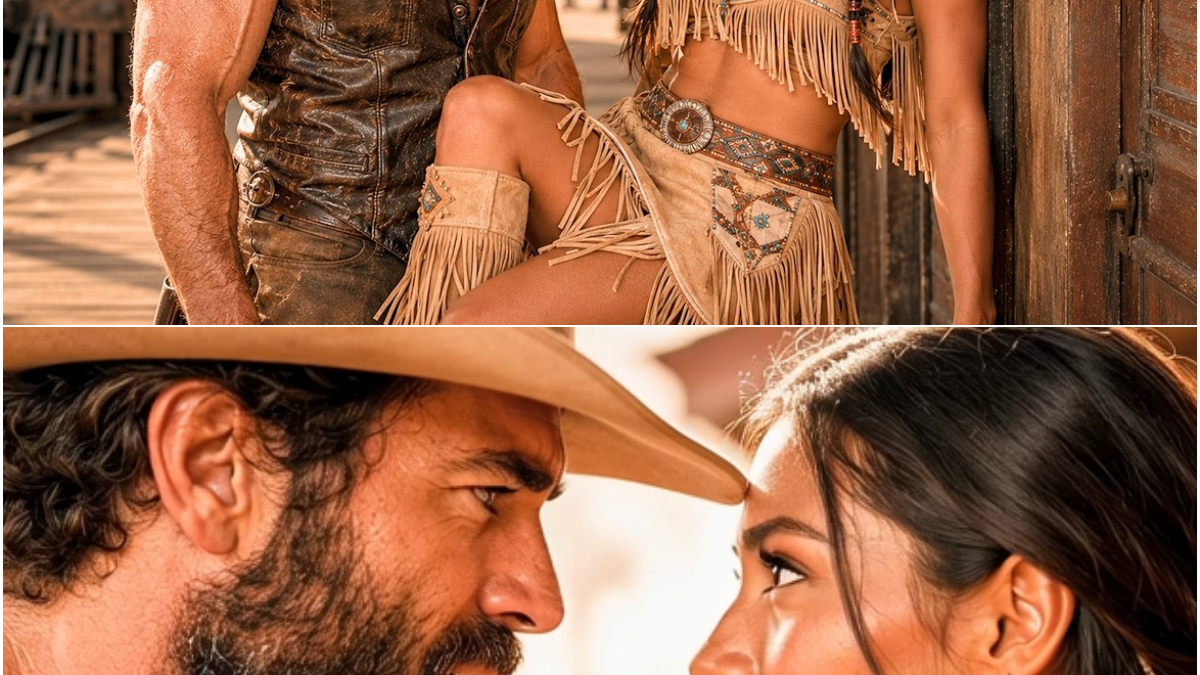
The train was already leaving Benson when Julian Vane realized the woman standing before him was not the bride he had been promised.
Smoke rolled across the platform, the iron wheels shrieked against the rails, and the September sun beat down upon the Arizona town with a merciless heat.
Julian held a crumpled letter in one hand and his hat in the other. For months, he had imagined the woman who would arrive to share his ranch, someone plain, practical, and willing to endure a life of dust, drought, and silence.
He had expected a stranger who would ask little of him and never make him question the quiet existence he had built.
Instead, Elara stood before him with dark eyes, a small leather trunk, and a bruise fading beneath her jaw.
She carried herself with a stillness that made the noise of the station seem distant.
She had traveled across a continent to marry a man she had never met, and now that man was staring at her as though she had arrived by mistake.
“You’re far too beautiful to be my wife,” Julian said before he could stop himself.
Elara did not look away. She did not apologize for the face she had been born with, nor did she soften her expression to make his embarrassment easier.
“If you are Julian Vane,” she replied, “then I have crossed a continent to marry you.”
He had imagined that a wife would make his life simpler. He had no idea that this woman would soon force him to decide what kind of man he intended to be.
And when the people who believed they owned the law came riding toward his door, would he still have the courage to stand beside her?
Julian tightened his fingers around the letter. The matrimonial agency had described Elara as hardworking, sturdy, and accustomed to hardship.
They had not mentioned her striking appearance, her steady gaze, or the quiet authority in her voice.
They had certainly not mentioned that she had already learned to recognize the difference between a man’s promise and his intentions.
“I meant no insult,” he said, putting on his hat and then immediately removing it again.
“The agency described you differently.” “Plain and useful?” Elara asked. Julian winced. “Something close to that.”
For the first time, a faint trace of amusement touched her eyes. “Then perhaps, mr. Vane, you should learn not to trust every promise written on paper.”
The train whistle sounded once more before the last carriage disappeared beyond the station. Elara’s journey had ended, and there was no convenient way to reverse it.
She had one trunk, a little money, and no familiar face waiting in town. Julian reached for her luggage.
Elara kept one hand firmly on the handle. “Before we leave, there is something you should understand.”
“What is that?” “I came here to become your wife, not your servant.” Julian released the handle at once.
“Then we understand each other.” They walked toward his wagon beneath the curious eyes of travelers and station workers.
Julian felt their attention following them, but Elara seemed determined not to give anyone the satisfaction of seeing her discomfort.
She climbed into the wagon without waiting for his assistance and settled her trunk beside her.
The road out of Benson stretched toward the open country, where saguaros stood like silent sentinels and ocotillo branches reached into the pale sky.
Julian drove with the reins held loosely in his hands. For a long while, neither spoke.
At last he said, “The agency told me you could handle the heat.” “I have lived through fires you cannot imagine, mr. Vane.”
There was something in her voice that made him glance at her. He sensed a history behind those words, but he did not ask her to explain it.
He had seen the bruise near her jaw, and the thought of someone having put it there stirred an anger he did not understand.
He had spent years avoiding entanglements, yet the sight of her made him feel responsible for a safety she had not asked him to guarantee.
“You don’t have to tell me anything you don’t want to,” he said. Elara watched the road.
“The man I left believed marriage made me his property.” Julian’s hands tightened around the reins.
“He was wrong,” she continued. “I know that now.” “At my ranch, you’ll have your own room and your own key,” Julian said.
“You can lock the door from the inside. No one will touch you without your consent.
Not even me.” Elara turned her face toward him. Her expression did not change much, but something in her eyes shifted.
It was not truSt. Trust was not something she could hand over simply because a stranger had spoken kindly.
But the possibility of it had appeared, small and fragile, like a green shoot pushing through hard ground.
They rode for hours through the wide Arizona country. Julian pointed out the distant ridges and the dry creek beds that sometimes carried water after a storm.
He told her where the cattle grazed and where the northern fence needed repairs. Elara listened carefully, asking only a few questions.
When they reached the ranch, the sun was sinking behind the mountains and the sky had turned violet and orange.
The house was small, built from adobe and timber, with a porch that had weathered more seasons than Julian cared to count.
The roof leaked above the kitchen, the well ran low by August, and the north fence had a habit of falling whenever the wind changed direction.
The barn leaned slightly to one side, and the yard was mostly hard-packed earth. “It isn’t much,” Julian said as he lowered her trunk from the wagon.
Elara looked beyond the house toward the valley. The mountains rose around the property, their rocky slopes catching the last light.
A faint breeze carried the scent of sage and dry grass. “It is quiet here,” she said, taking a deep breath.
“That it is.” Julian led her inside and down the hall. At the far end stood a modest room with a narrow bed, a washstand, a small window, and a wardrobe.
The curtains were faded, but the floor was clean. He placed a key in her open palm.
“You can lock it whenever you like.” Elara studied the key for several seconds before closing her fingers around it.
“Thank you,” she said. Julian understood that she was not thanking him for the room alone.
He had offered her a choice, and she had recognized the difference. The first days of their marriage were cautious and uncertain.
They were two people who had entered the same house carrying different expectations and private fears.
Julian was accustomed to making every decision himself. Elara was accustomed to watching for the moment when kindness turned into a demand.
She was no stranger to hard country. She knew how to read a dry creek bed, how to recognize certain desert plants, and how to treat a shallow cut with what the land provided.
But ranch work was new to her, and during her first week she left a gate unlatched.
By the time Julian noticed, half the herd had wandered beyond the lower pasture. Elara stood beside the open gate, her face pale with frustration.
She expected him to shout. Instead, he looked toward the distant cattle and reached for his saddle.
“Come on,” he said. “We’ll bring them back together.” They spent the rest of the day riding across the rough ground, following the herd through brush and shallow ravines.
The sun climbed high, the dust rose around their horses, and their patience wore thin.
Yet Julian never blamed her. When they finally drove the last steer through the gate, the light was already fading.
Julian dismounted beside a patch of wet ground near the water trough. His boot slipped, and he landed flat on his back in the mud.
For one startled moment, Elara stared at him. Then she laughed. It was a clear, genuine laugh, unexpected and bright.
Julian remained where he was, looking up at her, and did not immediately get to his feet.
He wanted to hear it again. He wanted to remember what it sounded like in a place where laughter had been scarce for years.
“What are you doing?” She asked, still smiling. “Considering whether the ground is comfortable enough to sleep on.”
“It looks as though it has already claimed you.” He laughed too, and the sound surprised them both.
After that day, the ranch began to change in small ways. A woven cloth appeared on the scarred kitchen table.
Elara hung lavender to dry beside the window and arranged her few belongings in the room at the end of the hall.
She cleaned the kitchen, mended a torn curtain, and began preparing meals that made the house smell of herbs and warm bread.
At night, she sometimes hummed while she worked. The melodies were old, passed down through her mother’s family, and Julian could not understand the words.
He found himself listening from the doorway, careful not to interrupt. At first, Elara stopped whenever she noticed him.
He never asked her to continue. Weeks later, she forgot to stop. Julian began lingering in the kitchen after supper, pretending to examine a broken tool or search for something in a cupboard.
Elara knew what he was doing but did not mention it. She simply kept humming, letting the sound settle into the house.
One evening, while they sat on the porch and watched the stars emerge, she told him about her family.
Her mother had been White Mountain Apache. Her father had been a white trader who disappeared when Elara was still a child.
She had grown up learning that the world could change without warning and that people who claimed authority often expected others to obey without question.
Julian listened without interrupting. She spoke of her mother’s songs, the stories told beside a fire, and the places she remembered from childhood.
She did not offer every detail, and Julian did not press her. He understood that some memories were not doors a person could simply open for someone else.
The quiet between them grew easier. It became possible to sit together without feeling that one of them must fill the silence.
Julian learned when Elara wanted conversation and when she needed the freedom to think. Elara learned that Julian’s quiet was not always anger and that his bluntness sometimes concealed uncertainty rather than pride.
But beyond the ranch, the territory was changing in ways neither of them could ignore.
The year was 1887. Geronimo had surrendered only months earlier, yet the promise of peace had not brought security to Apache families.
Military and federal authorities continued to control communities, and Chiricahua prisoners were being transported far from their homeland to confinement in the EaSt. Families faced displacement, separation, and pressure to abandon their ways of life.
Elara knew what those policies meant in human terms. They were not distant matters discussed in newspapers.
They touched the lives of people she knew, the cousins and elders whose names she carried in her memory, and the families who had little power to decide where they would live.
The passage of the Dawes Act added another weight to her thoughts. The federal policy aimed to divide communally held reservation lands into individual allotments and encourage assimilation.
To Elara, it was another declaration from distant men that they had the right to determine how Native people should live.
She did not speak of it every day, but Julian began to notice the nights when she sat awake long after the lamp should have been extinguished.
Sometimes she looked toward the dark valley as though she were listening for a sound beyond the reach of the wind.
One evening, a rider appeared in the distance. Julian saw him firSt. His hand moved instinctively toward the Winchester leaning against the adobe wall.
The rider wore a coat bearing the mark of the Copper Crown Mining Company. For months, the company’s survey stakes had been creeping closer to Julian’s northern boundary.
The man rode up to the porch and stopped without dismounting. “Julian Vane,” he called.
“We heard you brought an Apache woman onto this property. The sheriff wants her name and wants to know where she came from.”
Elara’s fingers tightened around the porch rail. Her face lost some of its color, but she did not step back.
Julian moved in front of her. “This woman is my wife,” he said. “Her name is Elara Vane.
Use it.” The rider’s eyes narrowed. “The sheriff has questions.” “If he has lawful business here, he can bring a warrant.
Until then, get off my land.” The man glanced toward the northern ridge, where three fresh survey stakes stood against the fading sky.
“This isn’t only about the woman, Vane. Copper Crown wants a road through this valley.
You’ve been making yourself inconvenient.” He turned his horse toward Tombstone. “Next time, I won’t come alone.”
As the rider wheeled around, a small leather-bound ledger slipped from his coat and fell into the dust near the gate.
He did not notice. Julian was watching the man ride away, his attention fixed on the threat.
Elara saw the ledger land. She waited until the rider disappeared beyond the ridge, then stepped down from the porch and picked it up.
Its cover was worn, and the binding had begun to loosen. She opened it just enough to glimpse columns of names, parcels, and payments.
Julian turned toward her. “What is it?” “Something he dropped.” She closed the ledger and held it against her side.
Julian looked toward the road. “You should have let him take it.” “Why?” “Because men like that don’t lose things without looking for them.”
“And men like that should not be allowed to decide what happens to everyone else.”
He studied her. “You know what this could mean?” “I know what it already means.”
Julian rested the rifle against the wall. He had wanted to protect her, but the encounter had made him realize how little protection a promise could offer against men who carried weapons and badges.
“You should not have threatened them for me,” Elara said. “I didn’t threaten him.” “You challenged men who have the sheriff in their pocket.
That is threat enough.” Julian looked at her. “Would you rather I had sent you away?”
“I would rather you understood what it may cost to let me stay.” “I know exactly what it may cost,” he replied.
“But I gave you my word that this would be your home.” “A word isn’t worth much if a man keeps it only when keeping it is easy.”
She turned and went inside. That night, for the first time, she left the door to her room unlocked.
Winter came early to the valley. The first hard storm swept across the ranch with freezing rain and a wind that rattled the shutters.
A calf disappeared beyond the northern wash, and Julian went out to search for it.
He found the animal trapped between two rocks, frightened and shivering. He freed it, but the calf kicked wildly as he tried to lead it back.
One hoof struck his ribs, and Julian lost his footing, tumbling into a flooded creek.
By the time Elara found him, he was soaked and struggling to stand. She helped him reach higher ground and kept him awake during the long ride home.
His face had gone pale, and his breathing was uneven. She knew the danger of letting him drift into silence, so she kept speaking to him, asking simple questions and making him answer.
When they reached the house, she helped him into bed and sent for no one.
The storm had made the road nearly impassable, and she knew she would have to manage until help could reach them.
For three days, fever held Julian to his bed. Elara sat beside him, changed the cloth on his forehead, and made sure he drank water whenever he could.
She slept in the chair in short stretches, waking whenever his breathing changed. On the fourth morning, Julian opened his eyes and found her asleep beside him, her hand still wrapped around his.
“You stayed,” he whispered. Elara woke and slowly withdrew her hand. “You would have done the same.”
“Yes,” he said. “But I would not have done it as gently.” She looked at him for a long moment.
Then she smiled, not the guarded half-smile from the station, but something warm and unafraid.
Julian understood that he was no longer waiting for a wife to share his labor.
He was waiting for this particular woman to choose him. They spent the rest of the winter repairing fences, tending cattle, and learning the habits that made two guarded people feel less alone.
Elara taught Julian which clouds carried rain and which only made promises. Julian learned to recognize the herbs she gathered and to keep the kitchen stocked with the things she used most often.
Their affection did not arrive as a sudden declaration. It grew through ordinary moments: a cup of coffee set beside a cold hand, a blanket placed over sleeping shoulders, a shared glance when a storm passed without damaging the roof.
They began to plan the ranch together. When Julian spoke of repairing the northern fence, he asked how she thought it should be done.
When Elara considered planting a larger garden in spring, he offered to clear the ground.
Somewhere between difficult mornings and lamplight conversations, the ranch stopped feeling like his home alone.
Then, one night, Elara came to the kitchen while Julian sat beside the fire. Her face was serious.
“A widow and her two children are hiding near the dry riverbed,” she said. “Riders have been searching the road behind them.”
Julian looked up. “They need shelter,” she continued. He stared into the fire. The company had already made its interest in the valley clear.
The sheriff had asked about Elara, and the mining men had threatened him openly. If he brought more people onto the ranch, they would have another excuse to search his property or accuse him of interfering with the law.
“If we bring them here,” he said, “Copper Crown will have the excuse it needs.
They’ll call me an outlaw and take the ranch.” Elara watched him. “Then say what you mean.
You are afraid.” His jaw tightened. “Yes,” he said. “I am.” She looked toward the dark window.
“So were they when they came looking for us.” She took her cloak from the peg and walked toward the door.
“Where are you going?” Julian asked. “To help them.” He did not follow at once.
He remained beside the fire, listening to the wind press against the walls of the house he had spent ten years building.
He thought of the fences he had repaired, the cattle he had raised, and the years he had spent believing that keeping his land was the same as keeping his life.
Then he saw the key to Elara’s room lying on the table. He had placed it in her palm on her first night, promising that no one would take away her right to choose.
A home meant little if its door remained closed to everyone who needed one. Julian stood, took his coat and rifle, and caught up with her before she reached the barn.
“How many people?” He asked. “Three.” “Then we’ll need another horse.” They found the widow and her children near the dry riverbed.
The mother was exhausted, and the children were frightened by every distant sound. Julian helped them onto the wagon while Elara spoke softly to them, assuring them that they would be safe for the night.
They were the first people the couple sheltered. They were not the laSt. Over the following months, others found their way to the ranch.
An injured elder arrived with a young man guiding him through the hills. Two brothers, separated from their family, came by a dry wash after traveling for days.
A young mother carried an infant beneath her cloak and asked only for a place to reSt.
Elara guided them through the terrain, choosing routes that left few tracks and avoiding the roads watched by the sheriff’s men.
Julian carried food and blankets after dark. They used an abandoned line shack beyond the eastern ridge as a temporary refuge, keeping the people there hidden while they considered where they could go next.
The work was tiring and frightening. Each new arrival brought another risk, another mouth to feed, and another reminder that the valley was no longer a place where the couple could pretend the world ended at their fence.
Yet Julian found that the ranch had become more meaningful than it had ever been.
The land was still difficult, the well still ran low, and the northern fence still needed repairs.
But now the house had a purpose beyond protecting the things he owned. Meanwhile, Elara studied the ledger by lamplight.
Its pages contained names, land parcels, and payments made to men who were supposed to enforce the law.
Some entries appeared to record money given to the sheriff. Others referred to property claims and agreements that had never been made openly.
Elara could not prove every meaning at first, but she understood that the ledger was more than a list of ordinary business transactions.
She copied every page carefully. One set of copies she kept hidden. Another she sent quietly to the editor of the Tombstone newspaper, whose reputation for asking difficult questions had made him a person worth trusting.
For weeks, she waited. Then one morning, Julian stepped outside and found a Copper Crown survey stake driven into the ground ten feet from his front door.
A strip of blue cloth had been wrapped around it. The color matched the feather Elara had worn when she stepped off the train.
Elara stood beside him in the pale morning light, watching the cloth move in the wind.
“They know,” she said. Julian pulled the stake from the earth and broke it across his knee.
“No,” he replied. “They suspect.” But suspicion was enough to put everyone in danger. For the next three nights, neither of them slept for more than an hour at a time.
Julian checked the barn, the fence, and the road. Elara made sure the hidden family beneath the barn floor had enough water and blankets.
She sent word to the people in the line shack to remain quiet and avoid the main trail.
On the fourth day, the riders came at dawn. The sheriff rode at the front, flanked by two deputies and four armed men wearing Copper Crown coats.
Behind them rolled an empty prison wagon. Julian watched them approach from the porch. He could feel the rifle’s weight in his hand, but he did not lift it.
The sheriff dismounted and held out a paper. “We have a warrant to search this property.”
Julian unfolded it and read it slowly. The document named stolen company property. He looked past the sheriff toward the mining superintendent, who sat straight-backed in the saddle.
“You won’t find any here,” Julian said. “Then you have nothing to fear.” Julian did fear.
The widow and her two children were hidden beneath the barn floor. Eight more people waited in the abandoned line shack beyond the eastern ridge.
A search could expose them all. Elara stepped onto the porch beside him. “Go inside,” Julian murmured.
“No.” “Elara, this could turn dangerous.” “You once promised no one would make decisions for me on this land.
Do not become the firSt.” Julian looked at her. For a moment, he saw the woman from the station, holding her trunk and refusing to let a stranger decide what her life would be.
He lowered his hand from the rifle. “Search the property,” the sheriff ordered. The deputies entered the house and began overturning beds, emptying cupboards, and pulling clothing from Elara’s trunk.
They found nothing in the rooms. They found no hidden papers, no weapons beyond the ordinary tools of a ranch, and no sign of anyone else living there.
Then the search moved to the barn. One of the Copper Crown men stopped above the hidden trapdoor.
Beneath the floor, a child coughed. Every man in the barn went still. The deputies raised their weapons.
The sheriff turned toward Julian. “Move aside.” “No.” “You would lose your ranch for people you barely know?”
Julian glanced toward Elara. She stood near the barn entrance, her shoulders straight and her eyes fixed on him.
“A year ago,” he said, “I thought this land was the only thing keeping me alive.
Turns out it was only waiting to become worth something.” The sheriff drew his revolver.
Before he could raise it, another voice came from the road. “You may want to lower that weapon, sheriff.”
The Tombstone newspaper editor stood beside a wagon carrying six ranchers from the valley. He held a copy of the ledger, its pages protected beneath a leather cover.
The sheriff’s expression changed. The editor stepped forward. “This record contains evidence of payments, land seizures, and agreements that deserve examination.
Copies are already on their way to the territorial court.” Elara moved beside Julian. “I have kept copies of every page,” she said.
“If you arrest us, the whole territory will know why.” The mining superintendent looked from the ledger to the ranchers gathering along the road.
They were not soldiers, and they did not pretend to be. They were neighbors who had seen the survey stakes advance across the valley and understood that the company’s plans might eventually reach their own properties.
One by one, the Copper Crown men lowered their rifles. The sheriff did not apologize.
Men like him rarely did. He holstered his weapon, climbed onto his horse, and left the valley without another word.
The mining superintendent followed, his expression hard and unreadable. The ranchers remained until the deputies had gone.
The editor promised to keep the documents safe and to report what had happened. No one claimed that the matter was settled forever, but the immediate danger had passed.
Only then did Julian realize that his hands were shaking. Elara took one of them between hers.
“You were afraid,” she said. “Terrified.” “And you stayed.” Julian looked at the broken barn door, the overturned house, and the frightened family slowly emerging into the morning light.
The widow held her children close. The youngest child clung to her skirt, looking from the strangers to Julian and Elara as though trying to understand why the adults had raised their voices.
“I was wrong about you the day you stepped off that train,” Julian said. Elara’s tired expression softened.
“You have been wrong about many things, mr. Vane.” A weary smile crossed his face.
“I thought you were too beautiful for this life. Now I know I was too blind to see how much courage it took for you to choose it.”
She held his hand a little tighter. “And I thought you were a man who wanted a wife because he needed someone to work beside him,” she said.
“I did not know you could become a man who would stand beside people who had nothing to offer you.”
Julian looked at the family, then toward the valley. “I’m still learning.” “So am I.”
In the days that followed, the people sheltered at the ranch helped repair the damage from the search.
The widow and her children stayed until they could travel safely. The elder rested near the kitchen fire, and the two brothers helped Julian mend a section of the northern fence.
The young mother cared for the infant while Elara prepared meals and tended the household.
The ranch did not become a place without fear. There were still riders on distant roads, still rumors from Tombstone, and still uncertainty about what the authorities might do next.
But the couple no longer faced those uncertainties alone. The newspaper editor continued investigating the ledger.
The evidence prompted questions that could not easily be dismissed, and the Copper Crown men became less willing to ride openly through the valley.
The company still wanted a road, and the sheriff still held his office, but the ranchers had begun to understand the value of standing together.
Julian and Elara continued their work. He repaired the northern fence every spring, and she planted lavender beside the porch.
She expanded the garden and learned which plants could survive the long dry months. He built another shelf in the kitchen for her jars and bundles, and she filled it with herbs gathered from the slopes.
Their marriage grew into something neither had expected at the station. It was not built on the agency’s promises or on Julian’s first idea of what a wife should be.
It was built on the choices they made when those promises were tested. Julian learned that protecting someone did not mean deciding everything for them.
Elara learned that accepting help did not require surrendering her independence. They disagreed sometimes, and the old habits of caution did not vanish in a single season.
But they learned to speak honestly, to listen without preparing an answer, and to remember that love was not a claim of ownership.
Years later, travelers through the San Pedro Valley began to speak of the Vane Ranch in lowered voices.
They said its doors were never closed to someone in need. They said a lamp burned in the eastern window on the darkest nights, guiding frightened people across the desert.
Some called Julian an outlaw. Others called Elara dangerous. Neither cared much for names given by people who had never stood in their place.
Whenever a train whistle carried across the valley, Julian remembered the afternoon Elara arrived with one small trunk and nowhere else to go.
He remembered the smoke rolling across the platform, the letter in his hand, and the foolish words that had escaped his mouth before he understood who stood before him.
Sometimes he would find her in the kitchen, humming one of her mother’s songs while the evening light rested on the table.
He never again told her she was too beautiful to be his wife. He had finally understood that beauty was not what made Elara remarkable.
It was the fact that after everything the world had tried to take from her, she still chose to build rather than destroy, to shelter rather than abandon, and to trust a man who had once been foolish enough to judge her before he knew her name.
And Elara understood something about Julian too. He had not been born fearless or wise.
He had been a lonely man who thought that keeping his land safe was enough to give his life meaning.
When the moment came, he had been afraid, and he had nearly let that fear close the door.
But he had chosen to open it. Long after Julian and Elara were no longer there to welcome travelers themselves, the lamp remained in the ranch window.
The house weathered storms, the garden spread along the porch, and the valley continued to change.
People remembered the couple not because they had been untouched by hardship, but because they had refused to let hardship decide what kind of people they would become.
The history of the West was often written in the language of conflict and possession.
The story of the Vane Ranch was written in promises kept, in hands extended, and in a door that stayed open when closing it would have been easier.
Disclaimer: This content may be created by Al for entertainment purposes. Any resemblance to real persons, events, or places is coincidental.








