“You’d Better Pray,” the Gunslinger Told Calamity Jane… She Smiled: “I Don’t Pray for Dead Men”
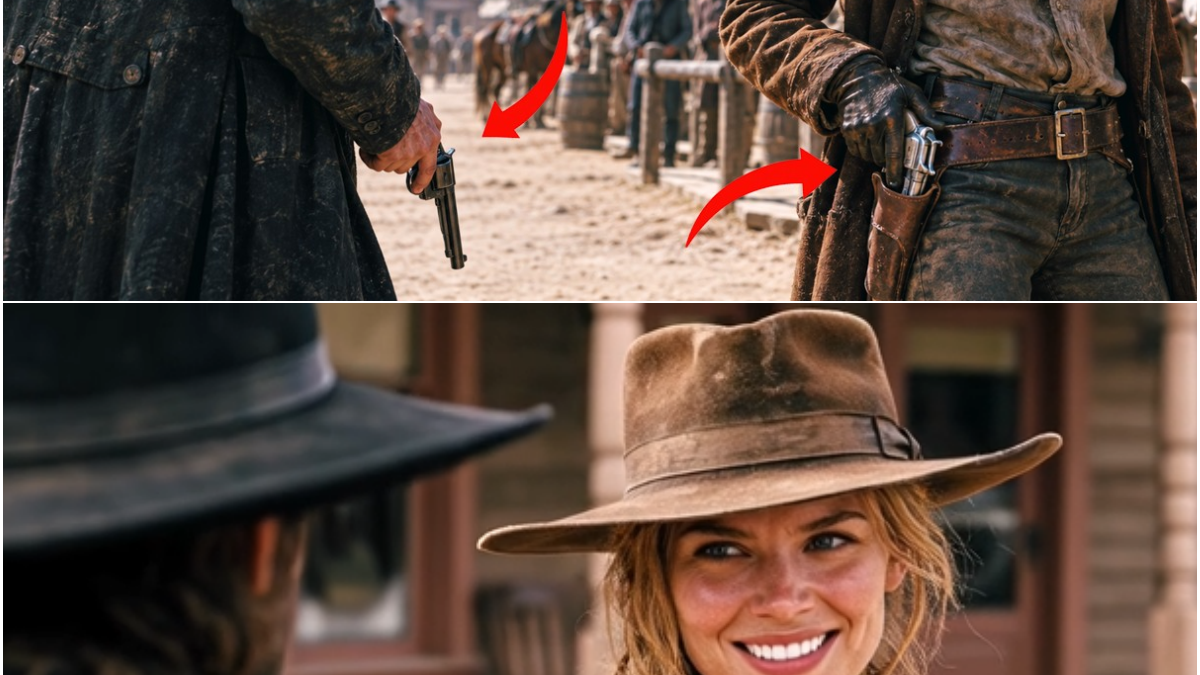
A rifle crack broke the June morning a little after 9, so clean and sudden that Martha Jane Canary stopped in the middle of the road and every one of the six yoke of oxen stopped with her.
The wagon chains went quiet. The leather harness creaked once. Beyond the rise, the prairie stretched beneath a hard blue sky, empty enough to make the single shot seem impossible.
Jane tightened her hand around the coiled whip and climbed the rise on foot. Four hundred yards ahead, the northbound coach stood crooked across the road with its door hanging open.
The horses were still harnessed, blowing hard. Beside the front wheel lay Ben Toiver, the driver Jane had nodded to more times than she could count.
A man on a gray horse sat over the express box. He lifted a canteen to his mouth, drank slowly, and lowered it.
Even at four hundred yards, Jane knew he was looking directly at her. His eyes moved to the wagon behind her.
Then they moved to the long Sharps rifle lying across the wagon box. The stranger screwed the cap onto his canteen.
He could have ridden toward her. Instead, he turned the gray horse north and walked away.
Jane watched him disappear beyond the next rise. She understood what that slow walk meant.
He was not running from her. He was giving her three days to wonder where he would wait.
With six yoke of oxen, a heavy wagon, one rifle, one revolver, and a road that offered a hundred places for a man to hide, how far could Martha Jane Canary travel before the rider on the gray horse decided the waiting was over?
Jane stood there for another moment, then walked down toward the coach. She already knew she was going after him.
She simply did not know where the road would force them to meet. The driver’s name was Ben Toiver, and Jane knew him.
Everybody who worked the road between Cheyenne and the Black Hills knew most of the regular drivers, freighters, stock tenders, and teamsters by sight.
The Cheyenne to Black Hills line had been running a little more than a year, and the same people crossed paths so often that names had almost become unnecessary.
A nod across a dusty road could say enough. Ben had nodded at Jane perhaps 40 times.
The previous autumn, at the Hat Creek crossing, his coach had dropped a wheel into a deep hole.
Six passengers had complained while Ben climbed into the mud and helped Jane pull her own wagon free.
He had laughed at the complaints and kept working. That was the sort of man he had been.
Now he lay beside the coach with one hand near the scatter gun that had fallen beneath the front wheel.
Jane removed her hat. She stood quietly for a while. There were things people said at moments like that, words meant to make a hard thing softer, but Jane had never been much good at saying them.
The prairie did not seem to require speeches either. The wind moved through the grass.
The horses breathed. The wagon behind her settled on its springs. She finally turned toward the express box.
It was open. Empty. The mail pouches had been cut, and letters lay scattered across the grass.
Whoever had come for the coach had found a little money and taken it, but the real prize had not been much.
Jane looked back toward the northern road. The man on the gray horse had not stayed to search for anything else.
He had seen her. That seemed to matter more. Jane unbuckled the lead horses and led the whole team off the road so they could graze.
A team left standing in harness beneath the June sun would suffer for no reason, and those animals had done nothing wrong.
She took Ben Toiver’s coat and laid it over him, weighing the corners with stones so the wind would not pull it away.
The next southbound coach would come through by evening. They would find him. Jane had done what she could.
Now she needed to do what only she could do. Stay alive long enough to tell someone with a badge about the man on the gray horse.
Her own situation was not exactly favorable. She was somewhere in her early 20s that summer, depending on which of the stories she had told about herself a person chose to believe.
Her name was Martha Jane Canary, though most people knew her as Calamity Jane. She had been hauling freight into the Black Hills since the Gold Rush opened the region.
She was a bullhacker. That meant she did not sit comfortably on a horse while someone else handled the freight.
She walked beside six yoke of oxen for mile after mile, carrying a 16 ft whip that she usually cracked above their heads instead of against them.
On a good day, she could manage 15 mi. On a bad day, the road seemed to stretch forever.
The man ahead of her had a horse. Jane had a Sharps rifle. It was a heavy single shot weapon, the kind of rifle men used on buffalo.
In open country, it could reach farther than a man on horseback might expect. Jane knew how to use it.
She also carried a Colt revolver at her hip, though she trusted the Sharps much more.
Behind her was a wagon loaded with flour, nails, and window glass for a store in Kuster City.
Three days north. That was the distance she had to cover. The rider had an advantage.
He had a horse. She had six yoke of oxen. But there was something else Jane had learned while watching him ride away.
He had seen the Sharps. He had seen the open grass between them. And he had decided not to cross it.
That told her something. He was dangerous, but he was not foolish. He would not ride straight toward a rifle that could reach him before he could reach her.
He would wait. Jane looked toward the Cheyenne River. The regular crossing was 6 mi ahead.
There was a stage station there, built the year before, with a stock tender, a corral, and a solid roof.
Every freighter used it. That was precisely why Jane decided not to. She knew the river.
A mile and a half upstream was an old buffalo ford. The bottom was gravel, and even during the June rise the water usually came only to the oxen’s bellies.
The road had moved to the station. Few people remembered the ford. Jane did. She brought the team toward the cottonwoods, left the main road, and followed the riverbank upstream.
A little before noon, she crossed. She walked in the water beside the lead yoke, whip over her shoulder, while the oxen pushed through the current.
The wagon rocked behind them. When they reached the north bank, Jane waited until the wheels were dry.
Then she lifted the Sharps from the wagon box. She stood beside the rear wheel.
She waited. About 20 minutes later, the gray horse appeared along the south bank. It was moving at a hard trot.
The rider had waited at the station. He had expected the freight wagon to arrive there.
When it did not, he had come looking. Now he saw Jane. He saw the wagon already across the river.
He saw the dry ground beneath its wheels. And he made the mistake Jane had been expecting.
He did not search for the old ford. He put the gray horse straight into the river.
The current caught them almost immediately. Three strides in, the bottom disappeared. The horse began swimming.
The rider held a Winchester in one hand and the reins in the other. Jane watched him come.
At first, she could not see his face clearly. Then the distance closed. Sixty yards.
Now she could. He was younger than she had expected, though hard years on the road had put a permanent severity into his expression.
His name was Luther Crane. Jane would remember his face for the rest of the journey.
He raised his rifle. “You’d better pray.” Jane brought the Sharps to her shoulder. She smiled.
“I don’t pray for men who have already made up their minds.” Luther Crane stared at her.
The river rolled between them. His horse was swimming. His rifle moved with every motion of the animal beneath him.
Jane could see the problem immediately. He could not plant his feet. He could not steady the rifle.
He could not turn quickly. If he tried to dismount, he would be in the river.
She stood on dry ground. He sat sixty yards away on a swimming horse. The advantage belonged entirely to her.
But Jane did not fire. She could have explained it afterward in several ways, but the simplest answer was the horse.
The gray’s head was stretched forward over the water. Its eyes were wide, and it was doing everything it could to reach the opposite bank.
At 60 yards, with both horse and rider moving, Jane could not guarantee where the shot would land.
She would not risk the animal. Crane watched her for about 3 seconds. Then he turned the gray horse around.
The animal seemed relieved to change direction. It swam back toward the south bank. Crane climbed out soaked to the chest and sat there looking across the river.
Neither spoke. Neither needed to. He knew he could not cross open ground against her rifle.
Jane knew he could not remain on that side forever. Crane finally turned the gray downstream toward the regular station.
Jane lowered the Sharps. Her hands were perfectly steady. They began shaking about a mile later.
She made camp in the open that afternoon, keeping the wagon between herself and every direction she could not see.
She slept very little. At first light, she started north. The second day was worse because nothing happened.
For 6 hours, nothing happened. Jane walked beside the oxen through rolling country. Every dip in the land looked like a place where a man might be lying.
Every cutbank looked like a place where someone might be watching. She kept looking. Nothing moved.
That did not comfort her. It only meant she had not found him. By the middle of the afternoon, she reached the last rise above Dry Fork.
Two hundred yards below stood a road ranch belonging to Anders LinkfiSt. It was a simple place with a log house, a corral, a well, and a shed.
Jane had stopped there a dozen times. Anders always came outside when a freight wagon appeared.
Hay was how he made his living. But this time Anders did not come out.
Jane stopped the team. She studied the ranch for a full minute. Smoke rose from the chimney.
Two relay horses stood in the corral. Everything looked ordinary. Except for the closed door.
And the absence of the gray horse. Jane understood. Luther Crane had gotten there firSt.
She did not move. Instead, she sat down in the grass at the top of the rise and placed the Sharps across her knees.
She waited. Later, Jane learned exactly what had happened. Crane had arrived around noon. He had been polite.
He had asked for coffee. Two travelers were already inside. One was Merritt Oaks, a salesman carrying patent medicine in a sample case.
The other was Yeum, who was heading toward Deadwood to open a laundry on Main Street.
Crane had placed a revolver on the table and told everyone to sit against the back wall.
He said he was a practical man. He did not want trouble. He only wanted the freight wagon to approach the house the way it normally did.
He expected the woman walking beside it to come within 6 ft. Six feet was his chosen distance.
Jane never gave it to him. She remained on the rise. The longest hour of Luther Crane’s life began.
He waited. She waited. The oxen grazed behind the rise, safely away from the line of fire.
A little after 4, Crane finally moved. He came from the back of the house and ran toward the shed.
The Sharps cracked. The bullet struck the shed wall about a foot from his face.
Crane dropped behind a wood pile. For a while, the two exchanged fire across 200 yards.
Jane had one shot at a time. Crane had a Winchester. He could work the lever rapidly.
His rounds struck the grass, the wagon, and the flour sacks. White flour puffed into the air whenever a bullet tore through a sack.
Jane stayed low behind the wagon and a flat shelf of rock near the creSt.
She had no intention of wasting ammunition. Before taking her position, she had released the oxen from the chain and sent them down the far side of the rise.
They grazed a quarter mile away, completely unconcerned with the argument between the humans. Yeum changed everything.
While Crane watched the rise, Yeum stood up inside the house. He walked to the front door.
Then he opened it. He stepped outside with his hands empty and held away from his sides.
He did not run. He walked. Crane saw him. He did not fire. Yeum reached the wagon and crouched beside Jane.
“The man loaded 11 cartridges into that rifle,” he said calmly. Jane looked at him.
“How do you know?” “I watched him.” Yeum glanced toward the wood pile. “He fired three.”
Jane kept her eyes on Crane. “How many remain?” “Eight.” Yeum looked toward the house.
“Anders Linkfist is hurt in the shoulder. Merritt Oaks fainted.” Jane gave him a brief look.
“Why did you come out?” “I want to reach Deadwood,” Yeum said. “I intend to open a laundry on Main Street.
That man is standing between me and it.” Jane almost smiled. “Then you picked a poor road.”
Yeum nodded. “Apparently.” Jane looked at the wood pile. “Eight.” She needed to make those eight disappear.
She knew she could not outshoot a Winchester with a single shot rifle if she gave Crane a clear target.
So she gave him false ones. She showed him her hat at one end of the wagon and fired from the other.
She shifted her position. She made him believe she was moving down the slope. She stayed behind cover.
Each time Crane fired, Yeum quietly counted. “Seven.” Another exchange. “Six.” Another. “Five.” The count continued.
Crane began to understand. He was no longer simply shooting at a woman. He was spending the ammunition he needed to reach her.
“Four.” Jane waited. “Three.” Crane stopped firing. Two rounds remained. The silence lasted several seconds.
Then the gray horse moved behind the shed. Crane made his choice. He ran. He fired both remaining rounds as he crossed toward the horse.
One struck Jane above the elbow. The other went high into the open sky. Jane dropped behind the wagon.
Crane reached the gray horse, mounted, and disappeared north through the draw before Jane could reload.
Yeum immediately tore a sleeve from his own shirt and tied it around Jane’s arm.
He did it carefully. Merritt Oaks eventually woke. Anders Linkfist came outside holding his shoulder and speaking rapidly in Swedish.
Jane listened to him for a moment. Then she laughed softly. That was the most cheerful thing she had heard in two days.
Nobody at Dry Fork was going anywhere that afternoon. Neither was Jane. But Luther Crane was still ahead.
And he still had whatever he had carried in the saddle bags. The next morning, Jane tied her injured arm against her body and started north.
The road stretched beneath a bright sky. She was about 2 hours short of noon when the land narrowed toward Red Canyon.
There was no easy way around it. The road passed between tall red walls, with dozens of places where a man could stand above the trail and wait.
Jane knew Crane was there. She stopped the team a quarter mile from the canyon mouth.
The wagon stood broadside to the opening. Jane sat behind the wheel with the Sharps.
She understood what Crane was waiting for. The northbound coach was due through Red Canyon in the middle of the afternoon.
It would carry a driver and probably a shotgun messenger. Once that coach arrived, Jane would no longer be alone.
Crane could not wait inside the canyon. He had learned at the river what an open quarter mile meant.
But he had also learned something at Dry Fork. Jane had only one good arm.
A Sharps could fire once. Then it had to be opened, loaded, closed, and brought back into position.
Crane believed he could make her waste that shot. If she missed, he would have enough time to cross the remaining distance.
By noon, the red canyon walls threw heat back toward the wagon. Jane’s sleeve was damp around the bandage.
Her arm throbbed. The Sharps seemed heavier than it had on the first day. Then Luther Crane appeared.
He walked out of the canyon on foot. He led the gray horse. He tied it to a cedar well back from the road.
Then he began walking toward her with a revolver in his hand. Jane kept the Sharps resting against the wagon wheel.
Three hundred yards. Crane kept walking. Two hundred. He raised the revolver. Jane did not move.
One hundred fifty yards. He fired. The bullet struck the dirt well short of the wagon.
Jane did not fire. One hundred yards. He fired again. The shot passed somewhere to her right.
Jane waited. Eighty yards. Another shot. This one struck the wagon box a foot from her head.
Wood splintered across her cheek. Still she did not fire. Seventy yards. Crane stopped. For the first time, Jane saw uncertainty in his face.
He stood in the open grass beneath the June sun. The revolver remained in his hand.
The Sharps remained against the wagon wheel. “You told me you don’t pray for men who have already made up their minds,” he called.
Jane looked at him. “That is what I said.” “Then who is going to pray for you?”
Jane’s expression did not change. Crane raised the revolver. Jane raised the Sharps. The rifle cracked.
The sound traveled through Red Canyon and returned from the rock walls. Crane fell into the grass.
He did not rise. Jane kept the rifle trained on him for several seconds. Then she lowered it.
The gray horse stood quietly beneath the cedar. Jane walked toward it. She brought the animal water from her own barrel.
The northbound coach arrived a little before 3. The driver was Hal Bristo. He had known Ben Toiver for 8 years.
A shotgun messenger sat beside him. The coach slowed when they saw the freight wagon standing broadside across the road.
Hal climbed down. His eyes went to Jane’s arm. Then to the gray horse. Then to the man lying in the grass.
Jane pointed toward the horse. “The horse is fine.” Hal looked at her. “Of course that is what you noticed.”
Jane shrugged. “The horse did not do anything.” The messenger helped Hal bring Crane away from the road.
The gray horse remained calm. Then the coach door opened. Yeum stepped down. He had waited at Dry Fork for exactly this coach.
He looked at Jane’s arm. Then he looked at the gray horse. He nodded once.
“I am still going to Deadwood,” he said. Jane looked at him. “I never doubted it.”
They traveled toward Kuster City together. Jane walked beside her oxen. The gray horse followed behind the wagon.
The coach moved slowly behind them. Hal Bristo refused to leave Jane alone on the road.
By evening, they reached Kuster City. The stage agent took Jane’s statement the next morning.
Word traveled down the line about Ben Toiver and Luther Crane. The road would remember the gray horse.
It would remember the Sharps. It would remember the woman who had walked beside six yoke of oxen for three days while a rider on horseback tried to find a place where the rifle could not reach him.
Weeks later, after the stage company had confirmed what had happened, $200 reached Jane as a reward.
She used part of it to pay for Ben Toiver’s burial in Cheyenne. What remained went to his sister in Nebraska.
Jane never told anyone exactly how much. Years passed. Stories gathered around Martha Jane Canary.
Some came from other people. Some came from newspapers. Some came from dime novels. Some came from Jane herself.
She encouraged certain stories because she understood what a story could do for a person who had spent years on the road.
The legend grew. But the work behind the legend was much simpler. Walking beside an ox team.
Mile after mile. A 16 ft whip over one shoulder. A Sharps rifle across the wagon box.
A Colt revolver at her hip. Three days of open country ahead. And a man on horseback somewhere beyond the next rise.
The road itself had been dangerous long before Luther Crane appeared. The Cheyenne to Deadwood stage line opened in 1876, connecting Cheyenne with the gold camps of the Black Hills.
Coaches carried mail and gold. Road agents watched the route. Stage stations became important because travelers needed fresh horses, food, water, and shelter.
The Cheyenne River crossing had its station. Dry Fork had its ranch. Red Canyon narrowed the road.
Every place that offered protection could also become a place where someone waited. That was why Jane trusted open ground.
She understood what distance meant. At the river, she had watched Crane enter deep water because he was impatient.
She could have fired. She did not. The gray horse had been struggling beneath him.
Jane would not risk the animal simply to end the confrontation sooner. That choice allowed Crane to continue.
It also forced her to face him again. At Dry Fork, she discovered something else.
A rifle did not make a person invincible. Her Sharps gave her distance, but only if she could control that distance.
Crane’s Winchester gave him speed, but only while he had ammunition. Yeum understood that. So did Jane.
Together, without planning it, they turned eight cartridges into the longest stretch of road Crane had ever faced.
By Red Canyon, Jane’s arm was injured and the Sharps was difficult to handle. Crane believed that gave him the advantage.
He was wrong. The advantage was patience. Jane had learned it on the first rise.
She had seen the man on the gray horse turn away. She had understood why.
He was not afraid of her. He was careful of her rifle. That difference mattered.
A reckless man would have crossed the open grass. A careful man would search for another way.
Luther Crane was careful until impatience forced him to become reckless. And Jane waited for that moment.
The afternoon coach carried her away from Red Canyon. Hal Bristo drove slowly. Yeum sat nearby.
The gray horse followed. The road behind them seemed strangely quiet. Jane looked back once.
Then she faced north. She had three days of road behind her. The danger that had followed her was finally finished.
What remained was the long distance toward Kuster City and whatever came after it. For a woman like Jane, that was enough.
She had never needed the road to promise anything. She only needed it to give her somewhere to put the next foot.
The stories that came later would make her larger than life. They would turn Martha Jane Canary into Calamity Jane, a frontier figure surrounded by tales of scouting, riding, romances, danger, and adventure.
But there was another side to the story. The woman walking beside six yoke of oxen.
The woman who knew how far a Sharps could reach. The woman who could look at a river and remember an old ford nobody else used.
The woman who could sit for an hour on a rise rather than walk into a trap.
The woman who understood that sometimes the strongest answer was simply to wait. And perhaps that was what the road had taught her better than anything else.
Distance can protect a person. Distance can threaten a person. Distance can turn a rifle into a shield.
It can turn a horse into an advantage. It can turn three days into an eternity.
And sometimes the person who controls the distance controls everything. Jane had started that morning with six yoke of oxen, a freight wagon, a Sharps rifle, a Colt revolver, and a road leading north.
She reached Kuster City with the same wagon. The oxen were tired but steady. The gray horse was unharmed.
Her arm was bandaged. And the road behind her had become a story she would carry for years.
Ben Toiver’s name remained with the people who had known him. Yeum eventually reached Deadwood.
He still intended to open his laundry on Main Street. Anders Linkfist returned to his road ranch.
Merritt Oaks went back to selling patent medicine. Hal Bristo kept driving coaches. Jane kept working the roads.
The West kept changing around them. Railroads pushed farther into the territory. Gold brought more travelers.
Freight wagons continued north. Coaches continued carrying mail. And riders continued watching from distant hills.
But the story of the gray horse became one of those road stories that traveled farther than the people who first lived it.
A man on horseback. A woman beside a wagon. A river between them. A canyon waiting ahead.
And a rifle that only needed one clear moment. Years later, if someone asked Jane about that June journey, she might tell it in a few plain words.
A man told her she ought to pray. She told him she did not pray for men who had already made up their minds.
Then she would probably change the subject. Because the real story was never only about Luther Crane.
It was about the road. It was about the three days between one stage station and the next.
It was about six yoke of oxen moving steadily while a rider searched for an opening.
It was about knowing the land well enough to leave the road when everyone else stayed on it.
It was about knowing when to wait. And it was about a woman named Martha Jane Canary who kept walking north even when the entire road seemed determined to make her stop.
That morning, a little after 9, she had seen a man ride away from her at a walk.
By evening, she understood that he intended to be somewhere ahead. By the river, she had forced him back.
At Dry Fork, she had waited him out. At Red Canyon, she had faced him again.
And when the last rifle shot echoed between the red walls, the road finally belonged to her again.
She gathered the reins. The oxen leaned into their harness. The wagon wheels began turning.
The gray horse followed. And Martha Jane Canary continued toward Kuster City beneath the wide Wyoming sky, leaving the canyon behind and carrying with her one more story that the frontier would never quite manage to forget.
Disclaimer: This content may be created by Al for entertainment purposes. Any resemblance to real persons, events, or places is coincidental.








