“You Saved Me,” the Apache Woman Whispered—What She Offered the Cowboy That Night Stunned Him
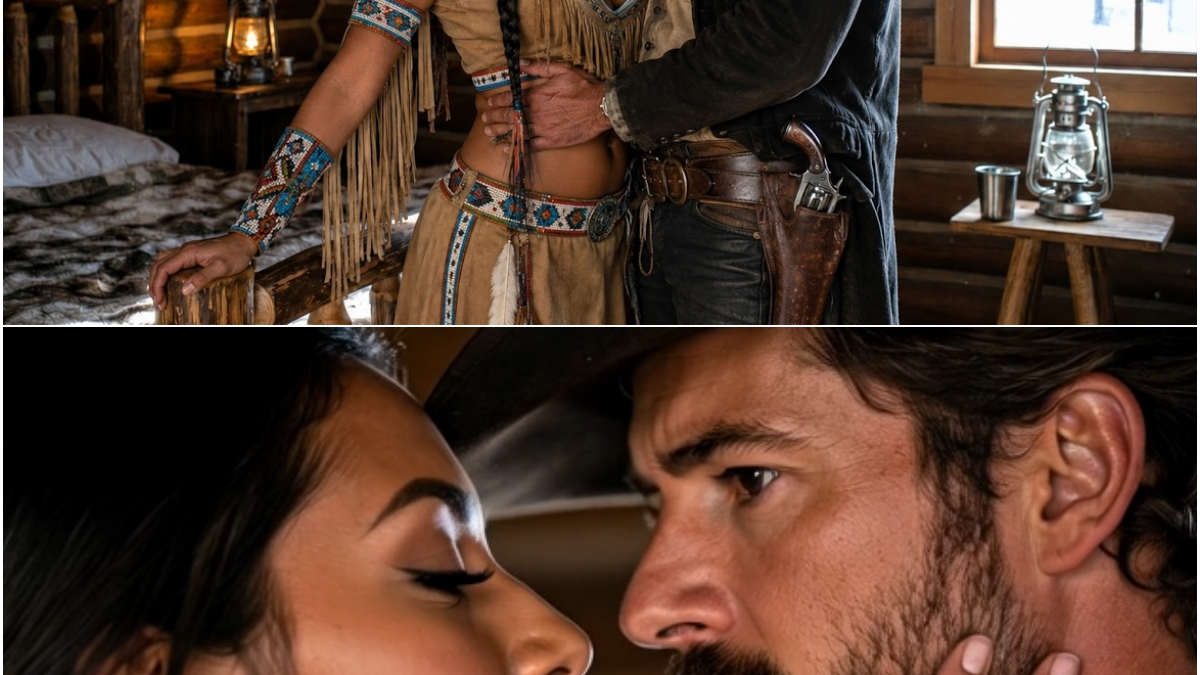
The wind had buried the road, swallowed the fence posts, and covered every track that might have led a traveler to safety.
Inside a lonely cabin in the Arizona high country, Caleb Rusk stood with a Winchester in his hands, listening to three armed men waiting outside his door.
They had come for a woman named Nearly, and they carried papers that claimed they had every right to take her.
Caleb knew better. He had worn a badge once, believed in the law, and learned how easily a man could use its words to disguise his own greed.
Now, at forty-eight, he had little left to protect except a small ranch, a few memories, and the fragile peace he had built in the years since his family’s illness had changed his life.
Behind him, Nearly leaned against the bedpost, wrapped in his late wife’s quilt. Her wrists still bore the marks of the ropes that had held her, and a knife lay hidden beneath the blanket.
She was exhausted, but her eyes remained alert. Outside, the bounty rider Deacon Vale promised money for her capture, living or dead.
The lantern flame bent sideways in the draft, and the cabin smelled of coffee, wet wool, cedar smoke, and fear.
Caleb had one old law book on the shelf and one old regret in his cheSt. He could hand her over and call it obedience.
Or he could stand between her and the men who had come to claim her.
What would a man choose when the law itself had become the threat? The winter of 1886 did not arrive gently.
It descended on the high country north of Tre Alamos, Arizona Territory, with a hard, relentless cold that turned the hills white and made the cattle huddle beneath whatever shelter they could find.
The wind swept through the valleys and drove snow against the cabin walls. It buried the hitching post, covered the woodpile, and erased the tracks of anyone who had crossed the ranch during the night.
People in the territory would later speak of winters like that as the big die up.
Cattle froze where they stood, wagons became trapped on mountain roads, and men who had spent their lives believing money could solve anything discovered that a storm did not care about their accounts.
Caleb Rusk had lived through difficult winters before. He knew that cold could humble a proud man faster than any argument.
He was forty-eight years old, though grief had made him look closer to sixty. His ranch, Bitter Creek, stood alone among the rough hills.
It consisted of a cabin, a small corral, a smokehouse, and a barn that complained whenever the wind pressed against its walls.
The nearest telegraph line lay forty miles south. Even if Caleb could reach it, a message would not bring help quickly enough to matter.
Once, he had been a deputy marshal along the Santa Fe route. He had worn a badge for eight years and believed that a man could make a difference by standing where trouble began.
He had learned to recognize the sound of a frightened horse, the false confidence of a liar, and the silence that followed a difficult decision.
Then fever had taken his wife, Anna, and their little boy, Jonah, in the same week.
Afterward, Caleb had folded his tin star into a handkerchief, left it on a courthouse desk, and ridden north without saying goodbye.
He did not leave because he had stopped believing that right and wrong mattered. He left because the work had asked him to keep standing long after he felt he had any strength left.
For five years, Bitter Creek had been a place where he could avoid questions. He worked from dawn until dark, repaired whatever broke, and spoke to the few people who passed through only when necessary.
Anna’s quilt remained folded on the bed. A framed tintype of her and Jonah stood near a Bible he had not opened in years.
Their belongings stayed where he had left them, as though the house itself had agreed not to move forward without him.
That winter morning, Caleb rode out looking for three missing steers. Any sensible rancher would have assumed the animals had already succumbed to the cold, but Caleb could not sit still while there was still a chance of finding them.
His buckskin horse, Moses, pushed through drifts that reached nearly to his cheSt. The air smelled of frozen mesquite, old leather, and the sharp breath of cattle struggling somewhere beyond the hills.
Every sound seemed magnified. The creak of the saddle, the faint clink of a spur, the low groan of cottonwoods along Bitter Creek.
By noon, the sky had turned the color of gunmetal, and another storm was gathering beyond the ridge.
Caleb considered turning back. He should have done so. But a man who has spent years trying to outrun his own memories sometimes keeps moving simply because stopping leaves too much room for thought.
Near a frozen wash, Moses stopped abruptly. His ears pointed forward, and his body stiffened beneath the saddle.
Caleb slipped the Winchester from its scabbard. Something moved beneath a bent willow. At first, he thought it was a wolf, but then he saw a hand, small and brown, trembling against the snow.
He dismounted so quickly that his bad knee nearly gave way. Limping through the crusted snow, he kept the rifle ready until he could see clearly.
A woman lay half hidden beneath the branches, her black hair tangled with ice and dead leaves.
She wore buckskin, silver earrings, and a torn piece of blue trader cloth around her shoulders.
Her wrists were marked by rope burns. One side of her face was bruised, and her lips moved without producing a sound.
Caleb knelt beside her and touched two fingers to her throat. For a moment, he felt nothing.
Then there it was, a faint, stubborn beat. “Well,” he muttered, “you’re still arguing with the cold.”
Her eyes opened. They were dark and sharp with terror. Her hand searched for a weapon that was no longer within reach.
“Easy,” Caleb said, raising one palm. “I’m not here to sell you, and I’m not here to hand you over.”
It was an unusual thing to say to a stranger lying in the snow. But Caleb had learned that a plain truth could sometimes do more good than a comforting lie.
She tried to speak. Only one name emerged. “Vale.” Caleb knew it. Deacon Vale was a bounty rider who carried papers with wax seals.
Some were legitimate, some had been bought, and others had appeared after a few drinks and a convenient conversation with a crooked clerk.
Vale hunted whoever people in town had been taught to fear. Sometimes he pursued outlaws.
Sometimes he pursued runaways. Sometimes he went after people whose only offense was living on land that someone richer wanted.
Since Geronimo’s surrender that September, newspapers and town conversations had been full of claims that the troubles involving Apache communities were finally over.
Yet the people who lived closest to the consequences knew that surrender had not brought safety.
Families were still being displaced, and authorities continued to exercise control over Native communities. Men like Vale understood how easily fear could be turned into profit.
Caleb looked toward the ridge. Snow was already beginning to drift across his trail. He had a choice.
The simplest legal course would be to ride to Tre Alamos, report the woman to Sheriff Lyall, and allow the authorities to decide what to do with her.
It would keep Caleb from attracting attention. It might even preserve the quiet life he had spent five years protecting.
The other choice was harder. He lifted her into his arms. She weighed less than a wet saddle blanket.
Moses snorted when Caleb laid her across the saddle, but the old horse held steady.
“Don’t start judging me,” Caleb told him. “I’ve had enough of that from respectable men.”
The storm struck before they reached Bitter Creek. Snow came sideways, swallowing the trail and covering the distant hills.
Caleb led Moses by the reins with one hand and held the woman steady with the other.
Twice he slipped and fell. Twice he forced himself upright, refusing to leave her exposed to the storm.
By the time the cabin lantern appeared through the blowing snow, his beard had frozen stiff and his hands barely closed around the reins.
He carried her inside and kicked the door shut. Warmth rose from the iron stove.
The cabin smelled of ashes, coffee grounds, and cedar. A narrow bed stood against the far wall, a table rested beneath the window, and a rifle rack hung beside the door.
On the shelf, the framed tintype of Anna and Jonah seemed to watch him. Caleb laid the woman on the bed, then stopped.
It was Anna’s quilt. For five years, no one had touched it except him. He had kept it folded, protected from dust and sunlight, as though preserving the fabric could somehow preserve the life that had once filled the cabin.
He stood there, breathing hard, with melting snow running from his coat. The past seemed to have followed him inside.
Then the woman shivered so violently that the bed frame knocked against the logs. That settled it.
Memories could wait. A living person needed warmth. Caleb fed the stove, boiled water, and used his belt knife to cut away the frozen cloth around her sleeves.
He worked carefully, taking care not to pull at her injured wrists. The rope had left deep marks, and one ankle had been rubbed raw by a shackle.
Beneath the torn blue cloth, he found a small leather pouch tied with sinew. He did not open it.
A man who had lost nearly everything ought to know better than to take another person’s last sacred possession.
He wrapped her in Anna’s quilt and placed a cup of warm water beside the bed.
Then he sat in a chair nearby, keeping watch while the storm battered the cabin.
Near midnight, the woman woke with a gasp and drove a hidden knife toward his ribs.
Caleb caught her wrist, firm enough to stop the blade but careful not to twist her injured arm.
“Easy,” he said. “That’s my only good shirt.” Her eyes searched his face. The lantern painted a soft gold line along her cheek, and the blizzard pushed against the shutters like someone trying to force the door open.
“Where am I?” She whispered. “Bitter Creek. My place.” “Why?” That single word carried more suspicion than a long speech could have.
Caleb released her wrist and stepped back. “Because you were freezing.” She watched him without lowering the knife.
“White men don’t save Apache women for nothing.” “No,” Caleb replied. “Mostly they don’t.” The answer seemed to trouble her more than a lie would have.
She lowered the blade slightly but kept it in her hand. “Good,” Caleb said. “I’ve never trusted a person who surrendered too easily.”
Her name was Naq Chi, daughter of a Chiricahua healer. She told him that much before the night ended, though she offered little else.
Her strength was returning slowly, and every word seemed to cost her something. She had been taken near Black Mesa Wash with two others after army scouts and bounty men swept through the country searching for supposed holdouts.
The men who captured her wore old campaign coats and carried papers stamped by a clerk whose loyalty could be purchased.
Deacon Vale had led them. Naq Chi had become a target because she had seen where Vale buried a ledger stolen from an army sutler.
The book contained names of men selling captives, horses, blankets, and government rations through a trading post near Tre Alamos.
Sheriff Lyall’s name appeared in it. So did the name of a judge and two ranchers who attended church every Sunday and spoke loudly about honesty.
Naq Chi had escaped before Vale could take her into town. She had run barefoot through snow for part of the journey, hiding when she heard riders and moving again whenever the wind covered her tracks.
By the time Caleb found her, her strength had nearly failed. He listened without interrupting.
The coffee pot ticked on the stove, and the wind dragged its nails along the roof.
When she finished, Caleb looked toward the window, where frost had formed pale patterns on the glass.
“The law won’t help you,” he said. “My people are north of here.” “How far?”
“If the snow opens, I can reach Black Mesa Wash in two days.” “You can barely sit upright.”
“Then I will take longer.” Caleb almost smiled. Not because her answer was funny, but because courage often sounded like a stubborn statement made by someone who had no strength left to prove it.
He poured coffee into a tin cup, cooled it with a little water, and handed it to her.
She took it in both hands. “You saved me,” she whispered. Then she untied the leather pouch from her neck and held it toward him.
Caleb shook his head. “What’s that?” “My mother’s medicine pouch.” “I’m not taking it.” “It is a gift.”
“No.” Her expression hardened. “This is not payment.” The room fell quiet. Naq Chi glanced at the tintype on the shelf.
She looked at the woman and child in the picture, then back at Caleb. “It is a promise,” she said.
“If I live, my people will remember your name.” Caleb swallowed. The words seemed to press against something inside him.
“I don’t need remembering.” “No,” she said softly. “You need forgiving.” The words struck him harder than he expected.
He turned away and pretended to check the stove. Old pride could survive even in a man who knew he had made mistakes.
“I wore a badge,” he said after a while. “I did things because I was told they were lawful.
I let men hide behind papers when I knew they were hurting people. I told myself there was nothing I could do.”
Naq Chi held the pouch in her palm. “Then tonight, choose different.” She was not offering gold or demanding a promise that he could not keep.
She was offering him a chance to act like the man he might have been before he learned to look away.
Caleb finally took the pouch and placed it on the shelf beside Anna’s tintype. Not above it, not below it.
Beside it. By morning, the blizzard had passed. The world outside looked newly made, smooth and white beneath the pale sky.
The barn roof sagged beneath the snow, and a frozen saddle blanket hung stiff over the rail.
Caleb stepped onto the porch with his Winchester and saw the first sign. Horse tracks.
Three riders had circled the corral before dawn. One had stopped near the woodpile. Another had ridden close enough to peer through the cabin window.
Near the chopping block lay a cigarette stub, still soft from someone’s mouth. “They were close,” Caleb said.
Naq Chi had risen from the bed. She stood near the doorway, wrapped in Anna’s quilt, weak but steady.
In daylight she seemed smaller than she had in the dark, yet there was something formidable in the way she held herself.
“They found us,” she said. “They found the cabin,” Caleb replied. “Not you.” She picked up the knife from the table.
“I will not be taken again.” “No,” Caleb said. “You won’t.” He moved quickly. He barred the shutters, stacked flour sacks beneath the front window, and brought extra cartridges from a coffee tin.
He checked the back door latch and moved the table away from the wall so he could reach the window more easily.
The cabin had two windows, one door, and a stove pipe that rattled whenever the wind rose.
It was not much of a fortress, but Caleb had spent enough years working around danger to know that a good position and a clear mind could matter more than thick walls.
Naq Chi watched him prepare. “You have fought many times.” “Enough to know fighting is usually what happens after thinking fails.”
“Will they hurt you for helping me?” “They might try.” “Then let me go before they come.”
Caleb looked at her. Morning light touched the side of her face, revealing the bruise that had begun to fade.
“You go out there alone, and they’ll run you down before you reach the wash.”
“You owe me nothing.” “That’s where you’re wrong.” He nodded toward the shelf. “I owed Anna and Jonah better than I gave them.
I can’t change what happened. But I can decide what I do now.” Naq Chi’s voice softened.
“Your wife and your son.” The names came out of Caleb almost too quietly to hear.
“I couldn’t help them.” “No,” she said. “But you can help me.” Outside, a horse snorted.
Both of them froze. Then came the sound of spurs on the porch steps, slow and confident.
Three taps struck the door, followed by a voice that Caleb recognized immediately. “This is Deacon Vale, acting under territorial authority.
Open up, Rusk.” Caleb moved to the window, where a narrow gap between the shutters gave him a view of the yard.
Deacon Vale sat on a gray horse near the hitching poSt. He wore a buffalo coat, a black hat, and a smile that had never warmed a room.
Two men flanked him. One held a shotgun. The other carried a carbine across his lap.
“Morning, Vale,” Caleb called. “Cold day for paperwork.” Vale laughed. “I hear you’ve got property inside that doesn’t belong to you.”
“She’s not property.” “She’s Apache.” “She’s a woman.” “That’s a pretty distinction,” Vale said. “But the sheriff won’t pay for pretty distinctions.”
Naq Chi stood behind Caleb, silent as stone. The knife remained in her hand. Vale lifted a folded paper.
“I’ve got an order.” “I’ve seen orders.” “This one has a seal.” “I’ve seen seals, too.”
Vale’s smile thinned. “Rusk, you always were difficult when you wore a badge.” Caleb felt the old life reach for him.
He remembered courthouse halls, long rides, and the feeling of being watched by men who expected him to obey because they had found a way to make their wishes look official.
Vale leaned forward in his saddle. “Hand her over, and I’ll tell Lyall you’re confused by the storm.”
“I’m not confused.” “Then you’re obstructing lawful custody.” Caleb almost laughed. The words tasted rotten.
“I know about the ledger.” The yard went still. Even the horses seemed to hear him.
Vale’s eyes changed firSt. It was a small shift, but Caleb had spent years learning to recognize the moment a man’s confidence began to crack.
“You don’t know anything,” Vale said. “I know you took her because she saw where you buried it.”
“Old man, you’re standing between me and money that could buy this county twice.” “No,” Caleb replied.
“I’m standing between you and a woman you tied with rope.” Vale looked toward the shutter.
“Naq Chi,” he called. “These white men won’t risk everything for you forever.” She stepped closer to the door.
“One did,” she answered. Vale spat into the snow. “Last chance, Rusk.” Caleb raised the Winchester.
“Mine too, I reckon.” The shotgun man moved firSt. Caleb fired through the shutter, striking the weapon from his hands.
The shotgun fell into the snow, and the man cried out as his horse reared sideways.
The carbine man fired back. A round tore through the cabin wall and knocked a tin cup from the table.
Naq Chi ducked and moved toward the hearth. She kicked a small pile of ash into the lantern light, dimming the room and making the smoke thicken near the ceiling.
Vale cursed and wheeled his horse toward the barn for cover. Caleb fired again, striking the saddle horn close enough to make Vale understand that the next shot might not be so carefully placed.
Then came a sound from the back of the cabin. Snow crunching beneath another pair of boots.
Caleb turned, but Naq Chi was already moving. She grabbed the coffee pot from the stove with a thick rag and threw its contents through the rear window just as the latch began to lift.
The man outside shouted and stumbled backward into the snow. His pistol discharged harmlessly into the sky.
Caleb looked at her. She looked back for half a second. “That was good coffee,” he said.
“Almost,” she replied. Vale had seen enough. He fired twice into the cabin and shouted for his men to pull back.
The horses thundered away toward the ridge, throwing snow behind them. Caleb waited until the hoofbeats faded before lowering the Winchester.
Only then did he sag against the wall. Naq Chi crossed the room and saw the torn sleeve on his left arm.
Blood had darkened the cloth near his shoulder. “You are hurt.” “I’ve been hurt worse by church ladies.”
She ignored the joke and pressed a clean cloth against the wound. Her hands were steady now, though her face had gone pale again.
“You should have let me go,” she said. Caleb looked at her. “It would have been legal.”
“That is not what I asked.” He studied the woman standing before him, wrapped in his wife’s quilt, holding pressure against his arm as though his safety mattered as much as her own.
“That’s the trouble with legal,” he said at laSt. He did not finish the thought.
Some truths did not improve when a man polished them into speeches. They both knew Vale would return.
He would go to Sheriff Lyall, gather more men, and come back with enough paper to make almost anything look official.
The cabin could not withstand another attack, and the people waiting north of the ranch would be safer if Naq Chi reached them.
They left before noon. Caleb saddled Moses and a small gray mare named Pearl. Naq Chi was too weak to ride hard, but she refused to remain behind.
She would rather risk falling from the saddle than wait for Vale to return. They rode north through cedar breaks, across frozen creek beds, and beneath black cliffs where ravens watched from the rocks.
Caleb kept them away from the main trail. Once, they passed the rusted wire of an abandoned army camp.
Later, they saw smoke from a patrol fire and turned west before the riders could notice them.
Naq Chi guided the way by recognizing stone shapes, broken branches, and the slopes of distant hills.
The country looked much the same to Caleb in every direction, but she read it like a page she had known since childhood.
By dusk, they reached Black Mesa Wash. The snow was thinner there, and red rock showed through the wet ground.
Caleb’s shoulder ached, his knee burned, and Moses breathed heavily beneath the saddle. Naq Chi swayed as she pointed toward a narrow passage between the rocks.
“There,” she said. At first, Caleb saw nothing. Then a figure stepped from behind a boulder with a rifle aimed at his cheSt. Another appeared above them.
Two more emerged from the shadows, silent and watchful. Naq Chi spoke in her language.
The men listened. One lowered his rifle. An older man came forward, wrapped in a dark blanket.
His hair was gray, and his face carried the patience of someone who had lived through more broken promises than he cared to count.
Naq Chi slid from the saddle and nearly fell. The old man caught her. For the first time since Caleb had found her beneath the willow, she wept.
It was not a loud or showy sound. It came from somewhere deep, as though she had held it inside for every mile she had traveled.
The old man held her with both arms, his expression changing as he looked over her injuries.
Other members of the community gathered around them, speaking quietly and touching her shoulder as if to reassure themselves that she had truly returned.
Caleb looked away. A man ought to know when a moment does not belong to him.
After a while, Naq Chi came back toward him. She carried the leather medicine pouch he had placed beside Anna’s tintype, and in her other hand was a small turquoise stone wrapped in red cloth.
“My father says you carried me through the cold,” she told him. “Your father gives too much credit.”
“He gives what is owed.” Caleb shook his head. “I don’t take payment for doing what I should have done sooner in life.”
Naq Chi stepped closer. “This is not payment.” He had heard those words before, but this time they carried a different meaning.
She placed the turquoise in his palm. “It means you are not alone on this land.”
Caleb stared at the stone. For five years, he had lived as though loneliness were a sentence he had to serve.
Now this woman, hunted by men with official papers, was offering him a place in the memory of her people.
The gift unsettled him more than any praise could have. Naq Chi touched the edge of Anna’s quilt, still wrapped around her shoulders.
“I will return this.” “No,” Caleb said. “You keep it until spring.” Her eyes searched his face.
“Why?” He looked toward the wash, where her people waited. “Because winter isn’t done with any of us.”
She nodded. Then she leaned close enough that her words were meant only for him.
“You saved me, Caleb Rusk.” His throat tightened. “No, ma’am,” he said. “You reminded me I was still living.”
Caleb remained with the community long enough to make sure Naq Chi had shelter and that her injuries were being cared for.
Her father thanked him without ceremony. There were no grand speeches, only a firm hand on his shoulder and a look that conveyed more than Caleb could have answered.
When he finally rode back toward Bitter Creek, the mountains were already darkening. He carried the turquoise stone in his pocket and the memory of Naq Chi’s return with him.
Two days later, Vale came back to the ranch with Sheriff Lyall and six armed men.
They found an empty cabin, a cold stove, and a yard swept clean by the wind.
The only thing waiting for them was a copy of the ledger pages nailed to the door.
The pages had been sent south by a Mexican trader before dawn, along with a note identifying the men whose names appeared in the records.
Vale had expected to find a frightened man alone in his cabin. Instead, he found evidence that could not be dismissed as a private quarrel.
By spring, Lyall was gone from his office. Vale found that some of the men he had once paid were no longer willing to stand beside him.
The ledger had traveled farther than he could follow, and questions about the payments and land dealings reached people who could not be persuaded to forget them.
Tre Alamos learned that a wax seal could not make a dishonest claim righteous. Caleb stayed at Bitter Creek.
He repaired the barn roof, replaced the broken shutter, and mended the section of fence that had been damaged during the storm.
He cleaned the Winchester and put it back in its place. For the first time in five years, he opened the Bible on the shelf.
He did not read far, but he left it open on the table instead of closing it and returning it to the duSt.
He placed the turquoise stone beside Anna’s tintype, Jonah’s little wooden horse, and the medicine pouch.
The objects did not make the cabin feel crowded. They made it feel less empty.
Spring came slowly to the high country. Snow withdrew from the lower slopes, and the first green shoots appeared along the creek.
The days grew longer, and the ranch began to sound like a place waking after a long sleep.
Naq Chi returned when the grass turned green. She came with members of her family and stayed long enough to help Caleb plant a small garden near the cabin.
She showed him which herbs could endure the dry season and which needed shade. He built a low fence around the garden to keep the cattle from trampling it, and she laughed when he made the posts uneven.
They spoke of the winter without pretending it had been easy. They spoke of Vale, the ledger, and the people who had been forced to leave familiar places.
Caleb did not offer promises he could not guarantee. Naq Chi did not ask him to become someone he was not.
Their friendship deepened through visits and shared work. She returned again when the weather cooled, and again after another season had passed.
Some people in the territory began to say that the Apache woman visited Bitter Creek every winter.
Others said Caleb had become a different man after the storm. Caleb never confirmed every part of the stories.
Old tales grow taller when they cross a campfire, and he had no interest in correcting people who had never seen the snow that buried his yard.
But he remembered the night clearly. He remembered the three riders outside the door, the law book on the shelf, and the fear that had made his hands shake.
He remembered the woman behind him, refusing to surrender her right to choose, and the moment he understood that keeping the cabin safe meant little if he had to abandon everything decent inside himself to do it.
He had once believed that leaving the law meant leaving responsibility behind. Naq Chi had shown him that a man could put away his badge and still be accountable for what he chose.
The law could tell a man who was permitted to stand outside a door. It could place a seal on a paper and call an order official.
But it could not tell him whether the person waiting beyond that door deserved kindness.
That choice belonged to him. And sometimes, when a man opened the door to someone the world had decided to reject, he saved more than the stranger standing in the snow.
He saved what remained of himself.
Disclaimer: This content may be created by Al for entertainment purposes. Any resemblance to real persons, events, or places is coincidental.








