“You Brought 4 Gunslingers to Kill Me? You’ll Need 4 Coffins,” Said the Nameless Gunman.
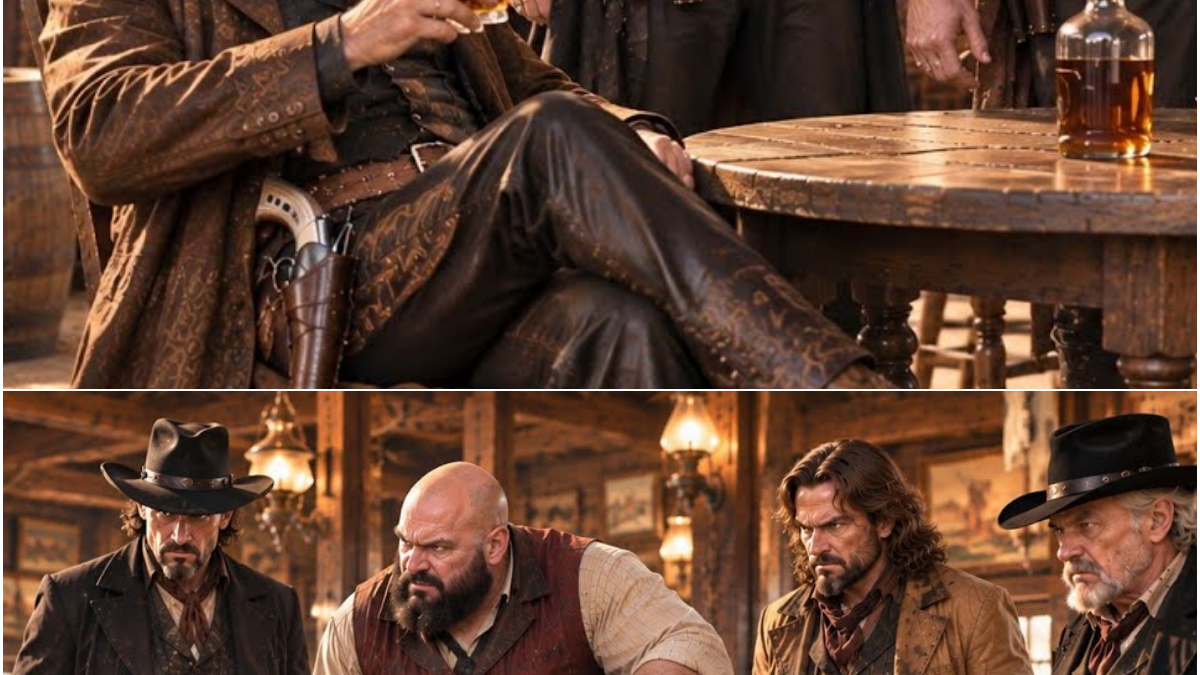
The first man through the saloon doors wore a black coat and carried his revolver low against his hip.
The second looked strong enough to tear a wagon wheel from its axle. The third had earned a reputation from Texas to Wyoming, where men whispered that his hands were quicker than most eyes could follow.
The fourth was an old gunfighter with a gray beard and a reputation for never missing when he decided to fire.
They had been paid five hundred dollars each to remove one quiet stranger from Mercy Creek before sundown.
Yet when the four men surrounded the stranger sitting alone beneath the western window of the Silver Lantern, he did not reach for his revolver.
He did not stand. He did not even appear surprised. He simply rested one boot against the edge of the table, lifted his coffee, and studied them as if they were four travelers who had taken a wrong turn.
Then he smiled. “You brought four gunslingers to handle me. You’ll need four coffins.” The room went still.
Nobody in Mercy Creek knew the stranger’s name. Nobody knew why he had arrived. Nobody knew why the powerful Silus Vain had become so nervous about one rider on a gray horse.
But one old gunfighter knew. He had seen those eyes before. He had seen them twenty-two years earlier, on a night that changed everything in the territory.
And when Gideon Shaw finally whispered the name Daniel Veil, the stranger looked directly at him and said something that made the old gunfighter take a step backward.
“You saw a house burn. You never saw me leave.” What had really happened twenty-two years ago, and why had Daniel returned to Mercy Creek after all that time?
Nobody in Mercy Creek could answer that question. Not yet. The stranger had arrived before the town was fully awake.
Some said they had seen him riding through the eastern road just before sunrise. Others insisted his tall gray horse had been tied outside the Silver Lantern since midnight.
The bartender claimed he had heard hoofbeats sometime during the darkest hour, but he had been too tired to look.
By eleven that morning, the stranger was sitting alone at a round wooden table near the western window.
He wore a weathered brown duster over a dark waistcoat and faded black shirt. His boots were covered in road dust, and his flat brimmed hat rested low enough to shade most of his face.
He looked around forty. There was nothing remarkable about his clothing. Nothing flashy about the silver revolver resting in its worn leather holster.
Nothing about his posture suggested he was waiting for trouble. That was precisely what made him unsettling.
His hands were relaxed. His breathing was slow. His eyes followed the sunlight moving across the floor while he drank coffee one careful sip at a time.
Mercy Creek had never been a peaceful place. The town had grown around silver, cattle, whiskey, and opportunity.
But for nearly six years, all four had belonged to Silus Vain. Vain owned the largest ranch in the county.
He controlled several businesses along Main Street and had enough influence over the local authorities that most people preferred not to ask questions about the badge worn by the sheriff.
Ranchers who refused Vain’s offers sometimes found their cattle missing. Shopkeepers who complained discovered broken windows.
Men who challenged his authority often decided, quite suddenly, that another town would suit them better.
Everyone understood the arrangement. Silus Vain did not need to stand in the street and threaten people.
His reputation did the work for him. Then, three weeks earlier, Vain had received a letter.
It contained only seven words. “I’m coming back for what you buried.” Vain had read the sentence several times.
He had asked where the letter came from. Nobody knew. He had asked who delivered it.
Nobody could give him an answer. Then his scouts reported that a lone rider had entered Mercy Creek.
Tall gray horse. Brown coat. Dark shirt. Silver revolver. Vain knew immediately that the past had found its way back to him.
He did not send ordinary ranch hands. He hired four professionals. Rafe Calder arrived firSt.
He was tall and narrow faced, dressed almost entirely in black. He had built his reputation by provoking men into drawing first, then ending the confrontation before anyone else could understand what had happened.
Amos Pike came next. Amos was enormous, bald, and heavily bearded, with shoulders that seemed too wide for ordinary doorways.
His fists were nearly as famous as his revolver. Elias Crow followed in a sand colored coat.
He carried two pistols and liked to remind people that he could use either hand.
The fourth was Gideon Shaw. Gideon was sixty years old, gray bearded, quiet, and known from Abilene to Tombstone.
His reputation had followed him for decades. He was the only one who did not seem pleased when Silus Vain explained the assignment.
He had asked one question. “Who is the man?” Vain had answered with a name.
Daniel Veil. Gideon had gone completely still. Vain noticed. “What is it?” “Nothing.” “You know him?”
“No.” Vain had stared at him for several seconds. Then he had placed five hundred dollars on the table.
“You know enough.” By shortly after noon, the four men entered the Silver Lantern. The room changed immediately.
Conversation stopped. The bartender lowered the glass he had been polishing. The piano player removed his hands from the keys.
A rancher near the stove quietly shifted his chair backward. Only the stranger continued drinking coffee.
Rafe Calder walked toward him. “You’re sitting in mr. Vain’s chair.” The stranger looked down.
He examined the chair as though seeing it for the first time. Then he looked back at Rafe.
“Seems comfortable enough.” Amos laughed. “Maybe he didn’t hear you.” “I heard him.” The stranger raised his eyes.
“I just didn’t hear anything worth standing up for.” A nervous murmur passed through the room.
Nobody talked to Vain’s men that way. Elias moved around the right side of the table.
Gideon remained behind the others. He was studying the stranger. Not the revolver. Not the coat.
The hands. That was what bothered him. Men who pretended to be calm usually revealed themselves somehow.
Their fingers tightened. Their shoulders stiffened. Their eyes moved too quickly. This man showed none of those signs.
His hands remained loose. His breathing remained steady. His eyes were calm. Rafe leaned closer.
“Silus Vain wants you outside.” The stranger took another drink. “Then Silus Vain knows where the door is.”
Amos planted one enormous boot against the edge of the table. “Maybe we should carry him outside.”
The stranger looked at the boot. Then he looked at Amos. “That table belonged to you?”
Amos frowned. “What?” “No?” “I never said it did.” “Then why are you treating it poorly?”
Elias laughed. Rafe did not. His hand drifted toward his revolver. “We weren’t paid to entertain you.”
The stranger finally leaned back. His eyes moved from Rafe to Amos. From Amos to Elias.
Then to Gideon. “Five hundred dollars each?” Amos grinned. “Exactly.” Gideon’s expression hardened. He clearly wished Amos had kept quiet.
The stranger smiled faintly. “Silus must be worried.” Rafe stepped closer. “You have ten seconds.”
The stranger waited. “Then four guns against one.” The stranger glanced at each man again.
“You brought four gunslingers to handle me.” His smile returned. “You’ll need four coffins.” The room became so quiet that the old clock behind the bar could be heard ticking.
Once. Twice. Three times. Then Gideon spoke. “What’s your name?” The stranger looked directly at him.
“You already know it.” Something changed in Gideon’s face. For a moment, twenty-two years seemed to disappear from the old gunfighter’s eyes.
Recognition replaced suspicion. Then came something else. Fear. “No,” Gideon whispered. Rafe looked over his shoulder.
“What?” Gideon ignored him. “I saw you die.” The stranger placed his coffee cup carefully on the table.
“You saw a house burn.” Gideon took one slow step backward. The sentence meant nothing to Rafe, Amos, or Elias.
But Gideon understood every word. Twenty-two years earlier, before Mercy Creek had grown into the town it had become, Silus Vain had traveled through the territory with six men.
They had discovered silver beneath land owned by a rancher named Nathan Vale. Nathan refused to sell.
Vain made another offer. Nathan refused again. Soon afterward, his barn burned. Even then, Nathan would not give up his land.
The house burned next. The story that spread afterward was simple. Nathan Vale and his wife had been lost in the fire.
Their twelve year old son had disappeared. The property passed into Vain’s hands. A rich silver vein was discovered beneath it.
Silus Vain became wealthy. Mercy Creek grew. And nobody talked about the Vale family anymore.
Except Gideon Shaw. Because Gideon had been there. He had not started the fire. But he had stood nearby.
He had watched. He had done nothing. He had convinced himself for twenty-two years that there was a difference between committing a wrong and standing silently while someone else committed it.
Now he knew better. “Daniel Veil,” Gideon whispered. The stranger’s expression became cold. Rafe looked between them.
“You know this man?” Gideon swallowed. “That boy was twelve.” Daniel looked at him. “I was.”
“You were supposed to be gone.” “That was the story.” Gideon’s eyes dropped. “How?” Daniel did not answer.
He did not need to. Rafe had already lost patience. “I don’t care who he is.”
Daniel slowly turned toward him. “You should.” Rafe’s hand moved. Daniel was already watching his shoulder.
The instant the muscles tightened, Daniel moved. He overturned the table. Rafe’s first shot struck the wooden floor.
Daniel shifted sideways. His silver revolver appeared in his hand almost before anyone realized he had drawn.
But he did not fire at Rafe. Instead, he aimed upward. One sharp shot struck the chain holding the brass lamp.
The chain snapped. The lamp dropped. It crashed across the overturned table and sent chairs sliding in every direction.
Rafe stumbled. Daniel kicked his revolver across the floor. Amos charged. He came forward like a wagon rolling downhill.
Daniel stepped aside. He caught Amos by the vest, turned with his momentum, and sent the larger man over the overturned table.
Elias reached for both pistols. “Don’t,” Gideon shouted. Elias ignored him. Two sharp shots followed.
Elias froze. His pistols had been knocked from his hands before he could raise either one.
One bullet had struck the first weapon. Another had struck the second. Daniel’s revolver was already aimed at Elias.
“That’s three mistakes.” Rafe reached toward the weapon lying near his hand. Daniel shifted his revolver toward him.
“Fourth one is yours.” Rafe froze. Nobody moved. Daniel could have ended the confrontation right there.
Everyone in the saloon understood it. More importantly, the four men understood it. Daniel slowly lowered his revolver.
“Tell Vain I’m coming.” Amos pushed himself upright. “You think he’ll let us walk back after this?”
“That sounds like your problem.” Gideon stared at Daniel. “No.” Daniel looked toward him. “It’s his plan.”
Gideon took a breath. “Vain has riflemen outside.” Daniel said nothing. “Rooftops,” Gideon continued. “Around the saloon.”
Rafe moved toward the window. “Why?” Gideon grabbed him. “Because you were never supposed to walk back.”
Rafe cautiously looked through the curtain. Across the street, sunlight flashed against a rifle barrel.
Gideon pulled him down. A shot shattered the window. Everyone dropped. Daniel remained behind a thick support beam.
“Now you understand.” Rafe looked at him. Daniel continued. “Vain didn’t hire four killers.” He glanced toward the broken window.
“He bought four distractions.” The realization moved through the group. Vain had never intended to reward them.
He had expected them to confront Daniel. The riflemen would make sure nobody left. The four professionals were expendable.
Gideon stared at the floor. “He planned to remove every witness.” Daniel nodded. “Exactly.” For the first time that afternoon, the four men understood something they had not expected.
The man they had been sent to confront might be the reason they were still standing.
Daniel moved toward the rear hallway. Gideon caught his arm. “There’s something else.” Daniel stopped.
Gideon reached inside his coat and removed a folded document. “I’ve carried this for twenty-two years.”
Daniel looked at it. “What is it?” “A land deed.” Gideon unfolded it carefully. “Nathan Vale signed it before the fire.”
Daniel stared at the paper. Gideon continued. “There’s another statement with it.” He pulled out a second sheet.
“One of Vain’s original men wrote down what happened that night.” Daniel looked up. “Why keep it?”
“I told myself it was insurance.” Gideon’s voice became quieter. “Truthfully, I was afraid.” Daniel reached for the documents.
“Why give them to me now?” Gideon looked toward the shattered window. “Because I spent twenty-two years telling myself that standing there while something terrible happened made me less responsible than the men who caused it.”
He shook his head. “It didn’t.” Daniel folded the papers. “Will you testify?” Gideon nodded.
Rafe stared at him. “You’re finished if Vain finds out.” Gideon looked at him. “Maybe.”
He took a slow breath. “But I would rather spend the rest of my years doing one honest thing than spend another day pretending I did.”
Daniel studied him. Then he nodded. “Nobody needs to lose anything today.” They escaped through the saloon cellar.
An old delivery tunnel ran beneath part of Main Street and emerged behind the livery stable.
Daniel could have taken his horse and left Mercy Creek. Instead, he headed toward the county telegraph office.
The four gunmen followed. They had not exactly become friends. They had not forgotten why they had entered the saloon.
But the arrangement had changed. They were no longer hunting Daniel. They were trying to survive Silus Vain.
They had nearly reached the telegraph office when rifle shots struck barrels and porch posts around them.
Townspeople scattered. Daniel moved behind a freight wagon. Rafe crouched beside him. “You still think nobody needs to lose anything?”
Daniel checked his revolver. “That depends on how badly everyone wants to keep making mistakes.”
He looked toward the general store. A large water barrel sat above the awning. Daniel raised his revolver.
He fired. The barrel burSt. Water poured across the walkway, knocking one rifleman from his position.
Elias moved immediately. He fired toward another rooftop. The rifleman dropped his weapon and disappeared from view.
Gideon covered the telegraph office. Daniel crossed the street. Inside, the operator stared at him.
“You have something to send?” “Yes.” Daniel placed the documents on the desk. “Names. Dates.
Property records.” The operator looked at Gideon. “And a witness.” Gideon nodded. The message was prepared quickly.
Copies of the land deed, the written statement, property records, mining claims, and Gideon’s testimony were sent toward the territorial marshall’s office.
For the first time in twenty-two years, the truth had left Mercy Creek. Silus Vain arrived before the reply.
His black stallion came down Main Street with twelve armed ranch hands behind him. Vain wore an expensive charcoal coat.
He looked confident. He looked angry. Most of all, he looked certain that his influence would carry him through whatever was happening.
The townspeople watched from windows. Daniel stepped onto the boardwalk. The four gunmen stood behind him.
Vain stopped his horse. His eyes moved toward them. “I paid you men to handle him.”
Rafe gave him a bitter smile. “Turns out you paid us to discover you were planning to handle us, too.”
Vain’s expression hardened. “I’ll double your money.” Nobody moved. “Triple it.” Amos folded his arms.
“You should have offered that before putting rifles on us.” Vain looked toward Daniel. “You came for revenge.”
“No.” Daniel held up the folded document. “I came for the truth.” Vain’s expression changed.
Gideon stepped forward. “I kept it.” Vain stared at him. “Gideon.” “I should have given it up years ago.”
“You fool.” Gideon nodded. “Probably.” He looked directly at Vain. “But I’m not your fool anymore.”
Vain’s hand moved toward his revolver. Daniel saw it. So did everyone else. “Don’t,” Daniel said.
Vain hesitated. Then the church bell rang. Once. Twice. Three times. Every head on Main Street turned.
Horses appeared at the northern end of the road. A territorial marshall rode into Mercy Creek with eight deputies.
The telegraph operator stepped onto the boardwalk. “Fast reply.” Vain looked around. His ranch hands lowered their weapons.
One after another, they stepped away from him. None wanted to carry responsibility for what Vain had done.
The marshall dismounted. He read the documents. He listened to Gideon. He reviewed the property records.
Then he placed Silus Vain under arrest pending charges involving the Vale property, intimidation, fraudulent records, and the coercive seizure of land and businesses.
Vain stared at Daniel as the handcuffs closed around his wrists. “Twenty-two years?” Daniel said nothing.
“You waited twenty-two years for this?” Daniel shook his head. “No.” He looked toward the old silver mine.
“I spent twenty-two years learning that putting a man in the ground would only bury the truth with him.”
Vain said nothing. For the first time since his arrival in Mercy Creek, he had no answer.
By evening, the town felt different. Not peaceful. Not yet. But possible. The sheriff quietly removed his badge before the marshall could question him too closely.
Several ranch hands began giving statements. Shopkeepers brought out ledgers showing years of forced payments.
Ranchers produced old agreements. Families brought letters and property records they had been too frightened to show anyone before.
One person spoke. Then another. Then another. For years, Vain’s power had depended on keeping everyone isolated.
Each person believed they were alone. Now they discovered they were not. The Silver Lantern reopened before sunset.
The broken table had been replaced. Rafe, Amos, Elias, and Gideon sat together near the western window.
Four untouched glasses rested before them. Rafe looked toward Daniel. “So what happens to us?”
Daniel sat across from them. “That depends.” “On what?” “What kind of men you decide to be tomorrow.”
Amos laughed. “You always talk like that?” “Only when people ask foolish questions.” Even Gideon smiled.
The door opened. The town undertaker stepped inside carrying a notebook. He looked around the saloon.
“Somebody ordered four coffins this morning.” Everyone turned toward Daniel. Daniel raised an eyebrow. “Wasn’t me.”
The undertaker checked his book. “Silus Vain paid in advance.” Silence filled the room. Vain had not simply expected Daniel to be defeated.
He had planned for the four men he hired to vanish along with the evidence.
Amos slowly shook his head. “Four coffins.” Daniel lifted his coffee. “Told you they’d be needed.”
Rafe frowned. “But nobody is in them.” Daniel looked toward the window. “Coffins don’t always have to hold bodies.”
The next morning, the people of Mercy Creek carried those four empty coffins to the abandoned Vale mine.
They filled them with forged deeds, intimidation notices, false contracts, old payment records, and other reminders of the system that had controlled the town for so long.
Then they buried them. Four simple wooden markers stood above the ground. The names carved into them were not names of people.
They represented the things Mercy Creek wanted to leave behind. Greed. Fear. Silence. And control.
Gideon remained in town to testify. Amos found work protecting freight wagons instead of taking money from men who wanted trouble.
Elias eventually became a deputy in another county. Rafe disappeared weSt. Years later, travelers would tell stories that he stopped accepting money to frighten strangers and began working as a trail guard.
And Daniel Veil? When the marshall offered to restore his father’s property, Daniel kept only the small ranch where his childhood home had once stood.
Much of the remaining land was divided among families who had been cheated out of their property.
Daniel did not make speeches. He did not hold celebrations. He simply repaired the old fence.
He rebuilt the barn. He planted new posts where the old ones had stood. Three mornings later, the people of Mercy Creek discovered that the nameless gunman had gone.
His gray horse was no longer tied outside the Silver Lantern. His room was empty.
On the table sat a single coin beside an unfinished cup of coffee. Nobody knew where he had gone.
Some said he rode north. Others said he went weSt. A few claimed they saw him near the mountains.
Nobody could prove any of it. Years passed. Travelers still told the story differently. Some claimed Daniel Veil had been the fastest gunfighter in the territory.
Others insisted he had once worked with marshalls under another name. A few believed Daniel Veil was not even his real name.
But the bartender who had witnessed the confrontation always corrected them. “You’re missing the point.”
Whenever someone asked what he meant, the bartender pointed toward the old table beneath the western window.
“That morning, four dangerous men walked into my saloon expecting a confrontation.” He would pause there.
Then he would smile. “The bravest man in the room was the one who could have ended the whole thing and chose another way.”
Sometimes a traveler would ask what became of the four coffins. The bartender would answer that they remained beneath the old mine.
Sometimes another traveler would ask whether Daniel ever returned. The bartender would look toward the road.
“No one knows.” And sometimes, when the afternoon light crossed the floor in exactly the right way, he would remember the stranger sitting alone with one boot resting against the table, drinking coffee as four armed men surrounded him.
Then the bartender would repeat the words that became part of Mercy Creek forever. “You brought four gunslingers to handle me.”
He would pause. “You’ll need four coffins.” And that was how Mercy Creek remembered the nameless gunman, not because of how quickly he could draw, but because when the entire town expected him to answer fear with more fear, he chose something far more difficult.
He chose to let the truth speak firSt.
Disclaimer: This content may be created by Al for entertainment purposes. Any resemblance to real persons, events, or places is coincidental.








