“Women Don’t Hunt Outlaws,” the Sheriff Laughed… Calamity Jane Dropped Eight Colts—and His Badge
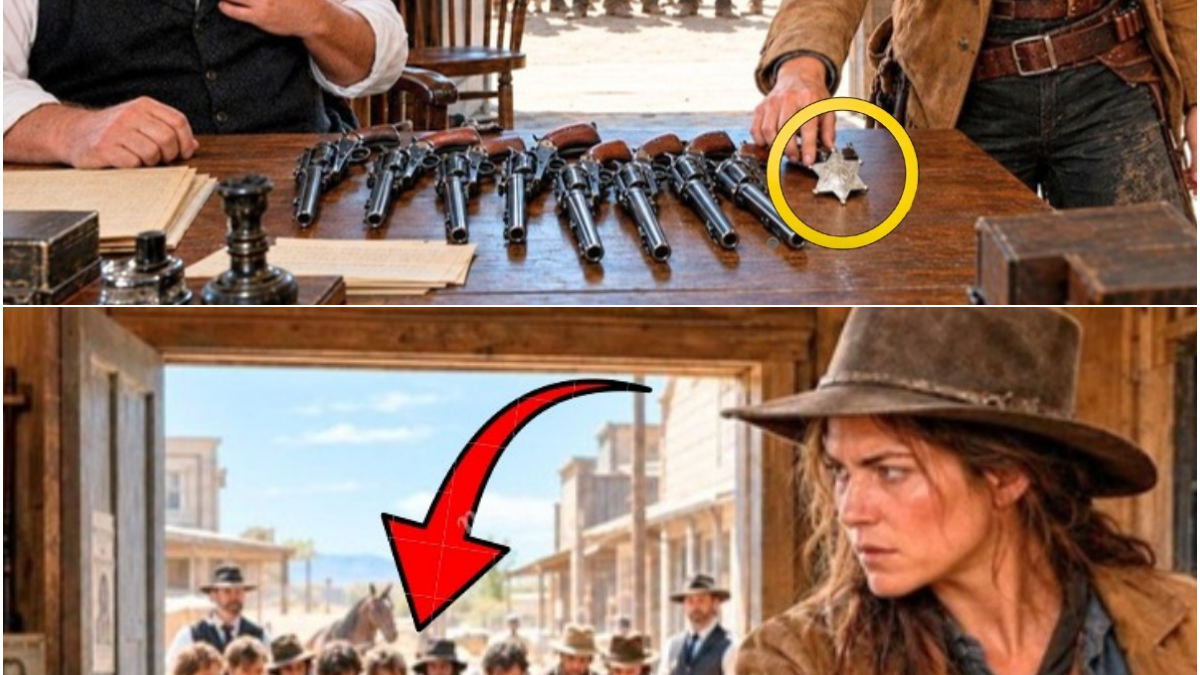
The first time Jane walked into Sheriff Otis Puit’s office, she carried a canvas sack so heavy it pulled one shoulder lower than the other.
She looked as though she had spent days riding through dust and cold, yet there was nothing hurried about the way she crossed the room.
Puit barely noticed her. He was bent over a ledger, adding figures beneath the weak yellow light that came through the window.
He had seen travelers arrive in worse condition, bounty hunters with louder voices, and men with more impressive stories.
Then Jane dropped the sack onto his desk. Eight revolvers struck the wood in a succession of heavy metallic thuds.
Puit looked up. His first instinct was to laugh. His second disappeared when he saw the silver kestrel carved into one walnut grip.
He knew that gun. Every lawman in the territory knew it. It belonged to Silas Kestrel, the leader of a gang that had stayed ahead of every posse sent after them.
Eight men had vanished into the canyon country, and now eight of their revolvers lay on the sheriff’s desk.
Puit slowly stood. “Where are the men who carried these?” Jane looked at him without the slightest trace of pride.
“Tied to cottonwoods beside the north road.” The sheriff stared at her. “Who are you?”
Jane adjusted the canvas sack. “You can learn the rest on the ride.” Puit followed her outside, still convinced there had to be something he was missing.
By the time he saw eight bound outlaws waiting beneath the trees, he understood that the strangest part of the story was not that Jane had found them.
It was that she had apparently walked into their camp alone. And as Silas Kestrel lifted his pale eyes toward her and smiled without humor, Puit realized the eight guns on his desk might not be the most important thing Jane had brought back from the mountains.
What had those men been protecting so carefully that one woman had been willing to risk everything to uncover it?
Four days earlier, Jane had been nowhere near Sheriff Otis Puit’s office. She had been watching a canyon.
For three nights she had studied the same stretch of rock from a narrow shelf high above the ground.
The wind came through the canyon after sunset and carried every sound upward. Horses shifted in the darkness.
Men spoke around their fire. Metal clicked whenever one of them checked a weapon. Jane had learned their routine.
Two men stayed awake late. Around four in the morning, those two became careless. That was when she planned to move.
The camp belonged to Silas Kestrel and seven other men. Their horses were kept in a rough enclosure near the eastern wall of the canyon.
Spare rifles rested beneath blankets beside a stone outcrop. Ammunition was stored in saddlebags. Kestrel slept nearest the fire, where he could see anyone approaching from below.
He believed the canyon protected him. Jane believed habits protected her. Before she entered the camp, she had already weakened three saddle cinches.
She had loosened the rope around the horse enclosure. She had moved the spare rifles into a patch of scrub above the wash.
She had studied which men carried their revolvers on the right side and which carried them on the left.
Nothing about her plan depended on strength. It depended on making eight men lose control of the situation at exactly the same time.
At four ten in the morning, one of the guards rose from beside the fire.
He walked several steps away. Jane came down behind him. When he turned, he found a Winchester pointed directly at his cheSt.
“Quiet.” The man froze. Jane took his revolver. Then she motioned toward the camp. “Wake the horse guard.”
The man obeyed. The second guard reached for his weapon before he was fully awake.
His hand closed around an empty holster. Jane held the Colt in front of him.
“Looking for this?” The man stared. Then someone shouted. The canyon erupted. Blankets were thrown aside.
Boots struck stone. One outlaw rushed toward the rifles and discovered they were gone. Another ran toward the horses.
His damaged saddle cinch snapped the moment he mounted. The horse panicked. It tore through the loose rope and scattered the others into the wash.
For three seconds, every man in the camp looked in a different direction. Jane needed only three seconds.
She climbed onto a flat stone above them and shouldered the Winchester. “Hands where I can see them.”
Silas Kestrel rose slowly. He was the first to understand. His gaze moved from the missing rifles to the empty holsters, then toward the canyon walls.
“You alone?” Jane did not answer. One of his men looked upward. “There could be rifles up there.”
“There aren’t,” Kestrel said. His confidence sounded weaker than he intended. Jane tossed a coil of rope into the dirt.
“Bind each other.” A younger outlaw laughed. “You expect eight men to tie themselves up for one woman?”
Jane shifted the rifle slightly. “No. I expect seven of you to do it because none of you knows whether you’re the one I shoot firSt.”
The laughter stopped. Kestrel studied her. There was something different in his expression now. Not fear.
Calculation. Twenty minutes later, eight men sat bound beneath the canyon wall. Jane collected their Colts one by one and placed them inside a canvas sack.
Kestrel watched her. “You think you caught the whole gang?” Jane pulled the sack closed.
“I caught the men carrying the guns.” “That is not what I asked.” “I know.”
Kestrel leaned back against the tree. “You think you understand what you found here?” Jane looked at him.
“You seem determined to tell me.” A faint smile appeared. “You caught the birds.” Jane waited.
“You didn’t catch the man feeding them.” At the time, she thought it was arrogance.
Now she knew it was a warning. The following morning, Jane rode into Larker with eight revolvers hanging from her saddle.
The town changed the moment people saw her. Men stopped outside the saloon. A stable hand came out of the livery.
Two boys followed her down the street until an older woman called them back. Jane paid little attention.
She walked straight into Sheriff Otis Puit’s office. Puit was bent over his ledger. “Help you?”
“I’m here to collect a bounty.” The sack struck his desk. One Colt rolled free.
Then another. By the time the eighth gun appeared, Puit was standing. One revolver had a silver kestrel worked into the walnut grip.
Puit recognized it immediately. “Silas Kestrel.” Jane nodded. “Where is he?” “North road.” Puit stared at her.
“You caught him?” “Yes.” “How many men?” “Eight.” Puit looked toward the revolvers. “You brought them in yourself?”
Jane adjusted one glove. “You can look for yourself.” Puit brought two deputies. Jane rode ahead.
She did not explain the canyon. She did not tell him how she had done it.
She simply guided them along the north road until the cottonwoods appeared. Then Puit saw them.
Eight men. Eight pairs of wrists bound with rawhide. Eight exhausted faces. Silas Kestrel sat in the center.
His pale eyes found Jane before they found the sheriff. “There’s your hunter,” Kestrel said.
Puit dismounted. “You have had my picture on the wanted wall for two years.” Kestrel smiled.
“I know.” Puit looked at Jane. “How did you manage this?” “Ask him.” Puit turned back toward Kestrel.
The outlaw laughed softly. “Go on, sheriff.” He nodded toward Jane. “Ask how one woman walked into our camp and walked out with every gun we owned.”
Before Puit could answer, one deputy began searching the prisoners. He found cartridges. A knife.
A small pouch of coins. Then he reached into Kestrel’s boot. Kestrel stopped smiling. The deputy unfolded a paper.
Puit took it. There were dates. Amounts. Initials. At the bottom was a stamped name.
H Greer Cattle Company. Puit read it twice. Jane noticed the change in his face.
“You know that name?” “Everybody in Larksburgh knows Hollis Greer.” Kestrel looked away. Jane watched him.
“What did Greer pay you for?” Kestrel said nothing. For the first time since she had captured him, he seemed less interested in challenging her than in avoiding her eyes.
Jane understood. The eight men beneath the cottonwoods were not the end of the trail.
They were the beginning. Hollis Greer owned more land than most men could cross before dark.
He had thousands of cattle, a large white house overlooking the valley, and influence that reached into places where ordinary ranchers could never reach.
For nearly a year, small ranches around Greer’s spread had been disappearing from the local map.
Puit had heard the complaints. He had investigated some. He had found burned fences, damaged wells, missing livestock, disputed surveys, and families suddenly willing to sell land they had owned for generations.
The trouble was that suspicion could not put a man in prison. “You believe Greer hired Kestrel?”
Jane asked. Puit rubbed his jaw. “I believe the paper says Greer’s company paid him.”
“And that is not enough?” “It proves money changed hands. It does not prove what the money was for.”
“Then we find out.” Puit looked at her. “You make that sound easy.” “No.” She gathered the paper.
“I make it sound necessary.” That afternoon, Jane returned to the sheriff’s office. Puit was still studying the payment slip.
She placed it beside his ledger. “What do you know about the ranches?” “More than I want to.”
“Then tell me.” Puit hesitated. “Whitlock. Baines. Cooper. Hail. All had boundary disputes with Greer.”
“And all lost?” “All loSt.” “Why?” Puit leaned back. “Paperwork. Survey changes. Missing records. People deciding it was easier to leave.”
“People do not abandon good land without a reason.” “No.” Puit looked tired. “Sometimes they do when they believe no one will help them.”
Jane studied him. The sheriff had laughed at her when she first walked into his office.
Now he looked less like a man who doubted her and more like a man who had been fighting a problem he could not see clearly enough to strike.
Jane tapped the payment slip. “Where is the Whitlock place?” “Eighteen miles eaSt.” “I am going there.”
Puit stood. “I will send a deputy.” Jane looked at him. “Which one?” He paused.
Then he named Nathan Cole. Jane remembered the man. “He is yours?” “Five years.” Jane said nothing.
Puit frowned. “What?” “Nothing.” She walked out. The Witlock Ranch sat beneath a low ridge where the grass had gone pale under the winter sun.
Jane arrived near sunset. A section of fence leaned toward the road. The well stood several yards from the house.
A thin sheen covered its surface. A boy of ten stood on the porch holding a kitchen knife much too large for his hands.
The door opened. A tired woman stepped out. “Put it down, Eli.” The boy lowered the knife but kept it in his hand.
Jane dismounted. “Martha Whitlock?” The woman nodded. “If the sheriff sent you, tell him I have nothing to say.”
“He didn’t send me.” Martha studied her. “That supposed to make me feel safer?” “No.”
That answer seemed to surprise her. Jane looked toward the well. “How long since you used that?”
“Six days.” “What happened six days ago?” Martha looked toward the road. “Nothing.” Jane waited.
Eventually, Martha spoke. “My husband challenged one of Greer’s surveys.” Jane looked at the house.
“What happened?” “The south pasture suddenly appeared on Greer’s map.” “Did your husband have the original survey?”
“Yes.” “And he took it to the land office?” “Yes.” Martha’s hands tightened around the edge of her shawl.
“He said he could prove someone had changed the filing.” “What happened after that?” Martha looked down.
“Three weeks later, they found him at the bottom of a ravine.” Jane said nothing.
Martha continued. “The sheriff called it an accident.” Jane looked toward the western ridge. A rider stood there.
Too far to identify. Close enough to be watching. “How long has he been there?”
Martha turned. Her face went pale. “You saw him?” “How long?” “Since before you arrived.”
The rider turned his horse and disappeared beyond the ridge. Martha lowered her voice. “They know who comes here.”
“Good.” Martha stared at her. “Good?” “If they are watching you, they are afraid of what you know.”
Martha disappeared inside. She returned with an old survey wrapped in cloth. Jane opened it.
The boundary line did not match the newer county record. Jane compared them carefully. Different ink.
Different handwriting. Same official seal. At the bottom of the newer document was the signature of Abel Mercer, the county land clerk.
Jane memorized the markings. Before leaving, she crouched beside Eli. “What do I do if they come back?”
“Stay inside.” “I can help Mama.” “You can help by staying inside.” He frowned. Jane pointed toward the door.
“Use the doorbar. Let grown people carry what is too heavy for you.” The boy nodded.
Jane mounted her horse. She rode away from the ranch. Ten minutes later, she realized someone was following her.
She did not return to town. She turned south. Then eaSt. Then west through a dry wash.
The rider followed. Jane left her horse behind a bank and climbed the wash on foot.
She waited. The rider passed beneath her. Moonlight revealed his face. Nathan Cole. One of Puit’s deputies.
Jane watched him disappear into the darkness. She did not confront him. Instead, she reached Puit’s office before sunrise.
He was asleep in a chair with his boots still on. Jane placed coffee on his desk.
“If that is another sack of guns,” he muttered, “I am resigning.” “It is worse.”
Puit opened his eyes. Jane told him about Cole. Puit stood. “You are certain?” “Yes.”
“He has worked for me five years.” “That gave him five years to hear every complaint.”
Puit’s face hardened. Jane placed three folded notes on his desk. “One names the land office.”
She placed another beside it. “One names an abandoned church.” Then the third. “This says I will take the Whitlock evidence to the stage station before dawn.”
Puit stared at the papers. “You want me to give one to each deputy.” “Yes.”
“And Cole gets the stage station.” “Yes.” “What are you planning?” “To find out who he reports to.”
The next morning, Jane waited inside the stage station. The building was dark. The road outside was empty.
Then she heard horses. Three riders approached. The last man dismounted beneath the lamp. Nathan Cole.
He looked toward the station. Then toward the road. Jane slipped through the rear window before the men entered.
By sunrise, she was back with Puit. She placed Cole’s deputy star on the desk.
Puit stared at it. “How?” “He lost it climbing through the window.” Puit picked it up.
“This is why witnesses stopped talking.” “Partly.” Puit looked at her. “What else?” “Someone above him.”
Cole had been the leak. But he was not necessarily the source. That same day, Abel Mercer vanished.
His desk at the land office was empty. His room had been stripped. Jane and Puit searched his office again.
They looked at drawers. Shelves. Cabinets. Then Jane noticed one drawer had a clean rectangle in the duSt.
Something had been removed. She ran her fingers beneath the drawer. A false wooden panel shifted.
Underneath was a torn sheet. Names filled the page. Whitlock. Baines. Cooper. Hail. Beside each name was a date and an amount.
At the bottom, in another hand, were three words. Kestrel. Final work. Puit stared at the page.
“Mercer took the ledger.” “Or someone took it from him.” They found Mercer two days later in an abandoned line shack.
He looked exhausted. When Puit entered, Mercer backed against the wall. Then he saw Jane.
“You brought her?” Jane frowned. “Who?” “Kestrel’s woman.” The rumor had already begun changing. Jane stepped closer.
“I am not Kestrel’s woman.” Mercer swallowed. “I know that now.” He reached beneath a blanket and pulled out a ledger wrapped in oilcloth.
“If I give you this, I need protection.” “You will have it,” Puit said. Mercer shook his head.
“Not from your office.” He looked at Jane. She understood. Mercer believed the corruption reached farther than the sheriff had admitted.
Puit accepted the ledger. Jane opened it. Payments. Names. Dates. Officials. Kestrel. Nathan Cole. Land transfers.
Then she found the entry that mattered moSt. T Whitlock refuses transfer. Kestrel to settle before survey hearing.
Below it was a payment dated two days after Whitlock’s death. Puit’s face became pale.
Jane closed the ledger. Then she heard a horse outside. Another followed. Smoke drifted through the cracks in the shack.
Mercer stared toward the door. “They found me.” Jane shook her head. “They found the shack.”
Fire moved through the dry grass. Jane kicked the rear door. The first blow weakened the hinge.
The second broke it. They ran. Smoke filled the air. A shot cracked from the ridge.
Dirt jumped beside Jane’s boot. They dropped behind a shallow cut. Across the smoke, two riders turned away.
One wore Nathan Cole’s hat. The other rode a horse carrying Greer’s brand. Jane pressed the ledger beneath her coat.
Now they had the records. They had Mercer. And Hollis Greer knew they had both.
Four days later, a sealed territorial warrant arrived in Larker. Six deputy marshals were supposed to meet Puit at Greer’s ranch the following afternoon.
Puit read the order. “This ends tomorrow.” Jane shook her head. “Tomorrow decides whether it ends.”
That evening, Jane copied the most important pages from the ledger. One copy went with the marshal courier.
Another went to Martha Whitlock. “If I do not return tomorrow night, take this to the Territorial Gazette.”
Martha held the envelope tightly. “Will they come after you?” Jane looked toward the dark road.
“They already are.” The next afternoon, Jane and Puit rode toward Greer’s ranch. The marshals were supposed to be hidden on the northern ridge.
When they reached the last rise, Jane looked up. The ridge was empty. Puit saw it too.
Neither spoke. Seven armed men waited near Greer’s porch. Nathan Cole stood among them. Hollis Greer came down the steps wearing a clean black coat.
“Sheriff.” His eyes moved toward Jane. “And the famous Miss Jane.” He looked toward the empty ridge.
“You brought a remarkably small group.” Puit removed the warrant. “Hollis Greer, you are under arrest for fraud, conspiracy, bribery, intimidation of witnesses, and involvement in the Whitlock case.”
Greer laughed softly. “Suspected involvement.” His eyes shifted toward Jane. “A useful phrase.” “We have the ledger,” Jane said.
For half a second, his confidence disappeared. Then it returned. “You have paper.” “We have names.”
Greer smiled. “You have nothing that will survive a proper hearing.” Jane looked at the men surrounding him.
“You should ask them whether they want to spend the next year explaining why they pointed rifles at a sheriff serving a territorial warrant.”
One of the hired men shifted. Greer noticed. “Do not listen to her.” Jane continued.
“The ledger names officials. It names payments. It names Kestrel. It names Cole.” Cole stepped forward.
“Enough.” Jane looked directly at him. “You followed me to the Whitlock ranch.” Cole’s jaw tightened.
“You watched Martha.” He said nothing. “You were at the stage station.” Cole raised his revolver.
“Hands away from your belt, Otis.” Puit froze. Cole reached for the sheriff’s badge. He tore it from Puit’s vest and threw it into the dirt.
“Five years,” Cole said. “I wore one of these for thirty dollars a month while men like Greer bought half the county.”
Jane looked at the badge. Then at Cole. “No.” Cole frowned. Jane bent slowly and picked up the star.
“That badge was not the problem.” Greer stepped closer. “Put it down.” Jane slipped it into her coat.
“No.” The hired men exchanged glances. Seven guns remained pointed toward Puit and Jane. Greer looked confident again.
“Money,” he said. “Land. A comfortable future. Tell me what you want.” Jane looked at him.
“What about Mercer?” Greer’s expression hardened. “He testifies.” “And then?” Greer said nothing. Jane turned toward the hired men.
“The ledger does not only name the people paying for this. It names the people doing the work.”
One man lowered his rifle. Greer spun toward him. “Keep that weapon up.” The man shook his head.
“I did not sign up for this.” His rifle hit the dirt. A second man followed.
Cole shouted. “Pick it up.” The second man did not move. Jane kept her voice calm.
“You still have a choice.” Greer looked toward the ridge. “You think the marshals are coming?”
“They are.” “No.” Cole looked at Jane. “You sent the message?” Jane smiled faintly. “I sent more than one.”
Greer’s face changed. He no longer knew what she had arranged. That was enough. A rider appeared on the ridge.
Then another. Then four more. Six territorial marshals rode into view against the pale sky.
Greer stared. Jane lowered her gun slightly. “You are out of time.” The remaining men surrendered their weapons.
Puit tackled Cole before he could react. Both men crashed into the duSt. The warrant was read again.
This time, no one laughed. Greer was taken away. Cole went with him. Mercer testified.
Martha Whitlock testified. Silas Kestrel eventually decided that protecting Greer was no longer worth what it would cost him.
He admitted that Greer had paid his gang to intimidate ranchers, damage property, interfere with surveys, and force disputed land into Greer’s hands.
The land records were reopened. Families returned to properties they had been pushed away from.
Some waited months before the paperwork was corrected. Others had to prove claims that had been deliberately buried.
But the records were finally being examined. The truth was no longer hidden behind polished offices and respectable names.
On the morning the verdict was announced, Martha brought her children into town. Eli stood beside her.
Jane noticed immediately that he no longer carried the oversized kitchen knife. “You were right,” he said.
“About what?” “Some things are too heavy for children.” Jane crouched beside him. “That does not mean children are not strong.”
Eli smiled. Across the street, people were already talking about Jane. Some called her a bounty hunter.
Some called her a deputy. Others simply called her the woman who brought in Kestrel.
Jane ignored them. Puit found her near the hitching rail. His shirt still showed the torn place where Cole had taken his badge.
“You still have something of mine.” Jane touched her coat. “I know.” “When do I get it back?”
“Later.” Puit shook his head. “You enjoy making things difficult.” “Maybe.” She mounted her horse.
Then she rode out of town. Three months later, Jane walked into Sheriff Otis Puit’s office again.
The same scarred desk stood beneath the window. The same wall clock ticked above the door.
The eight Colt revolvers were now locked inside an evidence case. Puit looked up immediately.
“Help you?” Jane recognized the words. “So do I.” She reached into her coat. Puit leaned back.
“If you put eight more guns on this desk, I am leaving town.” Jane dropped his badge beside the ledger.
The star struck the wood with a small metallic click. Puit stared at it. Dust still clung inside one point from the day Cole had thrown it into the dirt.
“You kept the dirt.” “Felt important.” Puit picked up the badge. He rubbed his thumb across the scratched metal.
“The first day you came in here, I told you women did not hunt outlaws.”
“You did.” “You remember.” “I remember.” Puit sighed. “I was wrong.” Jane nodded. “Again.” He gave her a tired look.
“Again.” He opened a drawer. Inside was another badge. Not a sheriff’s star. A working deputy badge.
Jane looked at it. “The territorial office authorized a special deputy for cases crossing county lines.”
She did not touch it. “Why me?” Puit looked at her. “Because you notice what other people miss.”
Jane remained silent. “Because frightened people talk to you.” Still she said nothing. “Because you know the difference between a gun and evidence.”
A faint smile appeared on her face. “And?” Puit shook his head. “And because eight armed men somehow ended up tied to trees while you still had enough patience left to fill out the paperwork.”
Jane picked up the badge. “Does it come with rules?” “Several.” “I may already regret this.”
Puit smiled. “You could wear it outside.” “I could.” “But you won’t.” “No.” “Why?” Jane slipped the badge inside her coat.
“Men who need to see a badge before they tell the truth are usually the men I am least interested in talking to.”
She walked toward the door. “Jane.” She looked back. Puit nodded toward the evidence case.
“Eight guns.” Then he touched his badge. “One star.” Jane followed his gaze. The guns had proved that she could capture dangerous men.
The badge meant something different. Authority could open a door. It could not guarantee judgment.
It could not create courage. And it could not make a person right. Jane tipped her hat.
“Try not to lose it again.” Then she stepped into the bright Wyoming afternoon. This time, nobody laughed.
The woman who had once walked into Sheriff Otis Puit’s office carrying eight Colt revolvers had returned carrying something more valuable than proof of what she could do.
She carried the trust of people who had learned that silence could protect powerful men almost as effectively as a weapon.
Silas Kestrel had been easy to recognize because he looked like the kind of man everyone expected to fear.
Hollis Greer had been harder to see because money, clean clothes, and a respected name had hidden what he was doing.
Nathan Cole had been harder still because he had worn the badge of the very office meant to protect the people he was betraying.
Jane had learned that the most important part of hunting criminals was not always finding the person holding the gun.
Sometimes it was finding the person who had convinced everyone else that there was no reason to look.
And Sheriff Otis Puit had learned something too. The day Jane first entered his office, he had laughed because he believed he already understood the limits of the world around him.
Three months later, he placed a deputy badge on his desk because Jane had shown him how wrong that assumption could be.
Jane picked up the badge. She did not need it to prove who she was.
She only needed it to remind everyone else that she had earned the right to walk into places where people once assumed she did not belong.
Outside, horses waited beneath the wide Wyoming sky. The road stretched toward another town, another dispute, another frightened family, and perhaps another man who believed his money could keep his secrets safe.
Jane mounted her horse. She looked once toward the distant ridge. Then she rode. The dust rose behind her.
The badge remained hidden beneath her coat. And somewhere ahead, another trail was already waiting.
Disclaimer: This content may be created by Al for entertainment purposes. Any resemblance to real persons, events, or places is coincidental.








