Wild Servals Are Invading America — And Nobody Can Explain Where They Came From
At 2 in the morning in late January of 2023, a strange report reached officials in Cincinnati.
Someone had seen what looked like a leopard sitting high in a tree. The animal was not a leopard.
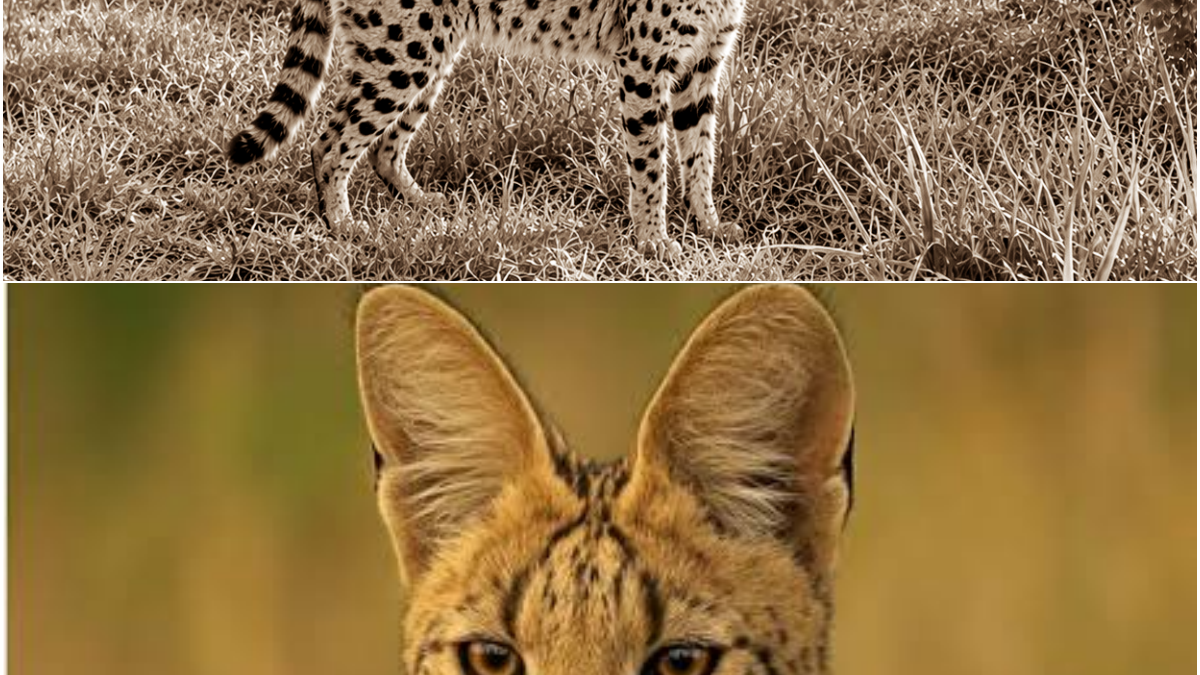
It was pale gold, covered in dark spots, and built in a way that made it look almost unreal.
Its legs were extraordinarily long. Its head appeared surprisingly small. Its enormous ears turned toward every sound below as traffic passed and porch lights glowed across the quiet neighborhood.
And there was another problem. The animal belonged thousands of miles away. It was a serval, an African wild cat from the grasslands and wetlands south of the Sahara.
Somehow, one had ended up in an Ohio neighborhood in the middle of winter. His name was Amiri.
He had jumped from a car during a traffic stop and immediately climbed the nearest tree.
When the ground no longer felt safe, he had done exactly what his instincts told him to do.
Go up. During the rescue, Amiri fell and broke a leg. Eventually he was taken to the Cincinnati Zoo, where his story became an unusual piece of local news.
But the strange part was not simply that an African wild cat had appeared in Cincinnati.
It was that Amiri was not alone. Other servals had appeared in New Hampshire, Georgia, Illinois, Washington, California, and Ohio.
Some were found wandering neighborhoods. Some were discovered inside homes. Others were mistaken for native animals until someone looked closely.
Each incident seemed separate. Each had an explanation. But when the stories were placed beside one another, a much larger question appeared.
If these animals were never supposed to be living in American neighborhoods, why did they keep turning up?
To understand that question, it helps to understand the animal itself. Most people have never seen a serval in person.
They may have seen photographs. They may have seen videos. They may have mistaken one for another spotted cat.
But standing beside a normal house cat, a serval looks almost like something assembled from different animals.
Its legs are exceptionally long compared with the rest of its body. Its ears are enormous.
Its body is relatively slim. Its coat is pale gold marked with dark spots and stripes.
A serval can stand close to 2 feet at the shoulder and generally weighs between 20 and 40 lb.
That makes it considerably larger and more powerful than the average house cat. The long legs have a purpose.
Servals evolved in African grasslands and wetlands where tall vegetation can hide small prey. A short cat disappears inside the grass.
A serval can rise above it. The animal can remain almost completely still while listening.
Its ears are among its most remarkable features. They are extremely large for the size of its head and can rotate toward tiny sounds.
A serval may sit quietly with its eyes partly closed while listening for movement beneath grass or inside a burrow.
Then everything can happen at once. The cat rises. Its body launches upward. All four feet can leave the ground.
The animal comes down from above. Wildlife researchers have recorded servals with remarkably high hunting success compared with many other cats.
That efficiency makes sense when the animal’s entire body is designed for the environment where it evolved.
Long legs. Large ears. Strong jumping ability. A patient hunting style. The ability to move through water.
The ability to dig for prey. The ability to climb when necessary. Nothing about the animal suggests that it was designed for an American suburban backyard.
Yet that is where some of them have appeared. A serval is not a monster.
There is no reason to imagine one as a creature searching for people. But it remains a wild predator.
In an American neighborhood, that can create serious problems. A household cat may look like prey.
A small dog may look like prey. Chickens, rabbits, and other small animals can become targets.
Even a large backyard can become inadequate when the animal has evolved to leap, climb, mark territory, and hunt independently.
And that creates a strange situation. A person can live beside a serval without knowing it.
If the animal is kept inside a converted garage or a private enclosure, neighbors may never see it.
If it is taken outside only after dark, the secret can remain intact. The owner may have a reason to hide it.
In many parts of the country, keeping a serval privately is restricted or prohibited. So the animal that has some of the most distinctive ears in the world can spend months listening to an American neighborhood that has no idea it exists.
Then one gate opens. One door is left unsecured. One leash breaks. And suddenly an animal from Africa is walking through a place where people expect to see raccoons, dogs, deer, or ordinary stray cats.
That is what happened to Spartacus. In September of 2020, a family in Marramac, New Hampshire, opened their front door to let their dog inside.
A 40 lb serval named Spartacus went out. He was four years old and neutered.
Then he disappeared into the New England woods. The recovery effort revealed just how unusual the situation was.
The people looking for Spartacus knew that ordinary methods might not work. They used live chickens as bait.
The strategy made sense because they were not dealing with a domestic cat. They were trying to bring back an African predator that still understood hunting.
Eventually, Spartacus returned. The story could have ended there. A strange animal. A strange escape.
A strange rescue. But other incidents kept appearing. In the summer of 2023, a woman near a country club in Buckhead, the wealthy district of Atlanta, woke to an extraordinary surprise.
A serval had entered her house. The animal jumped onto her bed while she was asleep.
The Georgia Department of Natural Resources spent days searching the surrounding neighborhood before the animal was captured.
The owner eventually had to surrender it. Then came another case. In the autumn of that same year, in Decar, Illinois, a serval named Ree escaped from an apartment.
Ree remained loose for roughly a month. Animal control eventually brought the animal in. A few weeks later, another report emerged from Vernon Hills, a suburb of Chicago.
Residents believed they had seen a bobcat. Police issued warnings. People kept reporting the animal.
One witness described it as roughly the size of a 75 lb pitbull. Then the Illinois Department of Natural Resources examined a photograph.
It was not a bobcat. It was a serval. The owners were already searching for it.
The animal was eventually caught after suffering injuries during the effort. Then there was Clark County, Washington.
In April of 2021, firefighters responded to a house fire. Inside the property was a serval.
One firefighter was bitten while dealing with the animal. Again, the story looked like an isolated incident.
A private owner. A wild animal. An unexpected encounter. Then California. In the fall of 2021, a serval near Incinas repeatedly targeted a family’s chickens.
The animal returned three times. The neighborhood began sharing sightings through a phone application. Residents were suddenly trying to identify an animal that had never belonged in their community.
Then eastern Ohio. In the spring of 2024, the Washington County sheriff’s office warned residents that a serval was loose.
The state agriculture department opened an investigation into where the animal had come from. And Cincinnati had already seen another unusual case back in 2010.
A serval was discovered inside a barn. The animal had been standing over a domestic cat.
The incident was another reminder that these were not oversized house cats behaving unusually. They were wild animals retaining the instincts that had made them successful hunters.
Then came a case that showed something else. The animals were not simply appearing randomly.
There was a source. Over one Fourth of July weekend, wildlife officials connected with World Animal Protection raided a home in Buffalo, New York.
Inside were seven exotic wild kittens. Four baby servals. Two baby caracals. One Savannah hybrid.
Most were between 2 and 6 months old. The animals were reportedly malnourished and unwell.
A serval kitten named Sammy required emergency fluids. Seven wild cats had been collected inside one house, apparently connected to an effort to sell them as pets.
That changes the picture. One escaped animal might be an unusual mistake. Seven exotic kittens in one house suggest a market.
A supply chain. People acquiring animals. People transporting them. People paying large sums for them.
People believing that an African wild cat can become an exotic version of an ordinary pet.
And that leads back to the beginning. Why would anyone want a serval? The answer partly comes from a cat named Savannah.
In 1986, in Philipsburg, Pennsylvania, a male African serval was bred with a domestic Siamese.
The resulting kitten was named Savannah. She became the beginning of a hybrid line that eventually developed into the Savannah cat.
By 2001, the breed was formally registered. Over the next two decades, Savannah cats became increasingly desirable.
They had the appearance people wanted. Spots. Long legs. Large ears. A wild silhouette. But they were marketed as something closer to a domestic companion.
As social media expanded, exotic cats became increasingly visible online. People could watch videos of spotted cats walking on leashes.
They could see them sitting in kitchens. They could watch them playing in living rooms.
The animals looked beautiful. Unusual. Exclusive. A pet that did not look like everyone else’s pet.
The same general idea exists with other hybrid breeds. The Bengal developed from the Asian leopard cat.
The Chausie traces its ancestry to the jungle cat. Other breeds have incorporated wild-cat ancestry in different ways.
The attraction is easy to understand. People see an animal that looks wild but lives in a house.
The distance between the two worlds appears smaller than it really is. And that can create a dangerous assumption.
If a hybrid cat can live beside a family, perhaps the wild parent can as well.
But a serval is not a hybrid. It is the original wild animal. That distinction matters.
A hybrid may inherit some traits from a wild ancestor while also carrying generations of domestic-cat behavior.
A pure serval has not been transformed into a house cat simply because someone raises it from a kitten.
Its instincts remain. Its physical needs remain. Its hunting behavior remains. Its territorial behavior remains.
And those instincts can eventually overwhelm the fantasy of owning an exotic pet. The result is often predictable.
A cat becomes difficult to contain. It sprays. It jumps. It damages property. It becomes difficult to keep around smaller pets.
The owner realizes that the animal is not behaving like an ordinary cat. Then the owner faces a decision.
Find a sanctuary. Sell it. Hide it. Or, in some cases, simply let it go.
That is where the strange reports begin. The serval on the suburban road. The serval in the tree.
The serval in the woods. The serval in the bedroom. The serval near the chicken coop.
Each story looks like an accident. But the accidents are produced by the same system.
The animal was wanted. The animal was purchased. The animal was kept privately. And eventually something went wrong.
Sanctuaries across the country have reported receiving exotic cats surrendered by owners who could no longer manage them.
The problem is that there is no simple way to turn a serval into an ordinary house pet.
A serval needs substantial space. It can jump remarkably high. A fence that would contain a domestic dog may not contain a serval.
The animal also marks territory. It has powerful instincts that do not disappear because it sleeps beside a sofa.
And when it is frightened, it does not necessarily respond the way a domestic cat would.
The people who buy these animals may discover that too late. There is another problem.
The animals are expensive. A male serval kitten can sell for $12,000 to $16,000. That price itself creates an incentive for breeding and trading.
The serval is listed on Appendix 2 of the international wildlife trade convention, meaning international trade can occur under regulations and documentation requirements.
But regulation is not the same thing as perfect tracking. Animals move between breeders. Kittens change owners.
Documents can be incomplete. Laws differ between states. And a wild animal can be described as something else.
That last point matters enormously. A pure serval and a Savannah hybrid can look similar to someone who has never studied either.
An ordinary animal control officer responding to a report at night may not have the equipment or expertise necessary to distinguish them immediately.
The owner may insist that the animal is a legal hybrid. The neighbors may believe it is a large house cat.
The officer may leave. The animal disappears again. And the record becomes incomplete. Ohio, for example, classifies servals as dangerous wild animals.
That creates a powerful incentive for someone keeping one illegally to claim that the animal is a Savannah hybrid instead.
A sanctuary in Minnesota has reported that owners sometimes describe pure servals as Savannah cats.
The reason is obvious. One may be legal where the other is not. That means the official record can become smaller than reality.
A serval that is successfully passed off as a hybrid may disappear from the statistics.
It does not receive the correct label. It may never enter the state database. It becomes an invisible animal.
The problem can also work in the opposite direction. People misidentify what they see. Cincinnati received a report of a leopard.
Vernon Hills received reports of a bobcat. In Patterson, New Jersey, a witness compared an animal in the street to a puma.
People naturally identify unfamiliar animals using familiar categories. If you live in an area with bobcats, you expect bobcats.
If you see something with spots and a long body, your brain searches for the closest explanation it already knows.
But there is no mental category for African serval in most American neighborhoods. So people choose something else.
That means some sightings may disappear into ordinary reports. A strange cat becomes a bobcat.
A large animal becomes a stray. A shape in the distance becomes a trick of the light.
Then the animal is gone. And nobody knows what it really was. There is, however, one important fact that keeps the story from becoming something it is not.
There is no confirmed wild breeding population of servals in the United States. The escaped animals have demonstrated that they can survive for periods of time.
They can hunt. They can move through unfamiliar terrain. They can find shelter. But no established wild population has been confirmed.
That distinction matters. The story is not about an African cat invasion spreading across the country.
It is about something much stranger. A constant supply of wild animals entering private hands.
Some remaining hidden. Some escaping. Some being surrendered. Some being misidentified. And some appearing suddenly in places where they should never have been.
Amiri was one example. Spartacus was another. Ree was another. The serval in Buckhead was another.
The animal in Vernon Hills was another. The incidents came from different states. Different climates.
Different communities. Different owners. Yet they all involved essentially the same animal. That makes the pattern difficult to ignore.
But there are still questions that cannot be answered confidently. How many servals are privately owned in America?
How many are registered correctly? How many are being described as Savannah hybrids? How many live in states where ownership is prohibited?
How many are surrendered to sanctuaries? How many escape? And how many are never reported at all?
There is no national registry that can provide a reliable answer. State laws differ. Local enforcement differs.
Definitions differ. Even the people responding to a sighting may not know exactly what they are looking at.
That creates a strange blind spot. The animals exiSt. The owners exiSt. The breeders exiSt.
The sanctuaries exiSt. The sightings exiSt. But the total number remains uncertain. And uncertainty becomes especially important in warm parts of the United States.
A serval escaping into a northern winter faces conditions very different from one escaping into a warm, wet region.
The Gulf states have long growing seasons. They have abundant small prey. They contain wetlands, grasslands, drainage areas, and thick vegetation.
Those environments are not African savannahs. But they may provide enough food and shelter for an escaped serval to survive longer than people expect.
No confirmed wild breeding population has been established there. That is the important fact. Still, wildlife officials cannot simply assume that every escaped animal disappears immediately.
The natural world is often less predictable than a map suggests. Other exotic animals have survived after being released or escaping from captivity.
Some have established populations where nobody expected them. Others disappeared. The difference can depend on climate, food, habitat, and chance.
Servals have some traits that make them especially difficult to detect. They are solitary. They can remain motionless for long periods.
They hunt primarily during dawn and dusk. They can move quietly through vegetation. They can climb.
They can leap. They do not need to announce their presence. A person could walk past one without knowing it was there.
That is why the idea of a hidden population is so difficult to investigate. Finding one does not prove many others exiSt.
But failing to find them does not prove they do not exiSt. The only confirmed explanation is the one supported by the known cases.
Privately held servals escape or are surrendered. The exotic-pet trade creates the supply. Weak tracking creates uncertainty.
Misidentification makes the official numbers even less reliable. Everything else remains a possibility that requires evidence.
And perhaps that is the most important part of the story. It is tempting to look at the Cincinnati cat and imagine a mysterious invasion.
But the reality is stranger because it is human. The wild animal did not cross the Atlantic by itself.
Someone brought it. Someone purchased it. Someone transported it. Someone decided that a wild African predator belonged in an American home.
Amiri did not choose Cincinnati. He did not choose the car. He did not choose the neighborhood.
He did not choose the tree. He simply responded to the world around him using the instincts he was born with.
When the ground became unsafe, he climbed. That was exactly what a serval does. The same was true of Spartacus.
When the door opened in Marramac, he walked through it. Then he disappeared into the woods.
His owners knew how to search for him because they knew what he was. They used chickens as bait.
Eventually, they brought him home. That sounds almost like a story from another continent. But it happened in New Hampshire.
The Buckhead serval brought the same contradiction into an expensive American neighborhood. A wild African cat had entered a bedroom.
It had not come from the savannah. It had come from someone’s private collection. The animal in Illinois stayed loose for roughly a month.
The animal in California repeatedly returned to the same neighborhood. The Washington serval was encountered during a house fire.
The Ohio animal prompted a public warning. The Buffalo kittens revealed that the supply could involve several animals at once.
The pattern was not created by wild cats migrating. It was created by people moving wild cats.
That distinction changes everything. The animal is not the central mystery. The human desire to own it is.
Why would someone spend $12,000 to $16,000 on a wild African cat? Because it looks extraordinary.
Because owning something rare can feel special. Because social media makes unusual animals appear normal.
Because videos show the beautiful moments without necessarily showing the years of responsibility behind them.
And because the distance between a Savannah hybrid and a pure serval can look smaller than it really is.
The image is seductive. A spotted cat walking through a house. A long-legged animal sitting beside a window.
A wild-looking pet sleeping near a family. But the camera does not show everything. It does not show the enclosure required.
It does not show the territorial marking. It does not show the prey drive. It does not show what happens when the animal becomes difficult to contain.
It does not show the sanctuary that may eventually receive it. And it certainly does not show the moment when an open door turns an exotic pet into a wild animal moving through a neighborhood.
That is why Amiri’s story matters. Not because he was dangerous. Not because he was mysterious.
And not because a serval is secretly taking over America. His story matters because he revealed a system that was already operating quietly.
A system in which African wild cats could move from breeders into private homes, from private homes into sanctuaries, and sometimes from private homes into streets, fields, woods, and neighborhoods.
Amiri ended up at the Cincinnati Zoo. His leg healed. The cocaine that had been found in his bloodstream was no longer part of his life.
He became an animal people could visit safely behind proper care and containment. Spartacus returned home after being recovered in New Hampshire.
Ree was eventually brought in after roughly a month in Illinois. The Buckhead serval was captured and surrendered.
Other animals were placed into sanctuaries or removed from private ownership. Each case had an ending.
But the system that produced the cases continued. That is the part that does not have a simple ending.
As long as people want wild animals as pets, there will be people willing to sell them.
As long as laws differ from state to state, there will be gaps. As long as hybrids and pure wild cats can be confused, there will be uncertainty.
As long as no national registry exists, nobody can point to a definitive number. And as long as animals remain hidden, there will be animals nobody knows about until someone finally sees one.
Perhaps that is why the image of the serval in the Cincinnati tree remains so strange.
A pale gold body against winter branches. Huge ears turning toward distant sounds. An African predator looking down at an American street.
The scene seems impossible. Yet the explanation is remarkably ordinary. Someone wanted a wild animal.
Someone brought it home. Eventually, the animal found its way outside. The wild did not arrive at the neighborhood by crossing an ocean alone.
The wild was carried there. And that means the most important question is not where the next serval will appear.
It is how many people are keeping them right now, behind doors and fences, in garages and private enclosures, in places where nobody is looking.
Nobody can give a reliable national number. Nobody can say exactly how many remain hidden.
Nobody can prove that every escaped animal has been found. What can be said is simpler.
Servals continue to appear. The documented cases continue to come from different parts of the country.
The exotic-pet market continues to exiSt. And every new sighting begins with the same impossible moment.
Someone looks outside. Something moves through the grass. It has the body of a cat, but the legs are too long.
The ears are too large. The spots look familiar, but not quite right. For a few seconds, the person watching has no idea what they are seeing.
Then the animal turns its head. The ears rotate. And suddenly an African predator is standing in an American backyard.
Maybe it is Amiri’s story repeating itself. Maybe it is another escaped pet. Maybe it is an animal someone has been hiding for years.
And somewhere in the warm grass of a state where nobody expects to find one, another serval may be doing what servals have done for thousands of years.
Standing perfectly still. Listening. Waiting. Watching a world that was never supposed to become its home.
Disclaimer: This content may be created by Al for entertainment purposes. Any resemblance to real persons, events, or places is coincidental.








