Wild Gaur Are Turning Up in America And They’re More DANGEROUS Than You Think
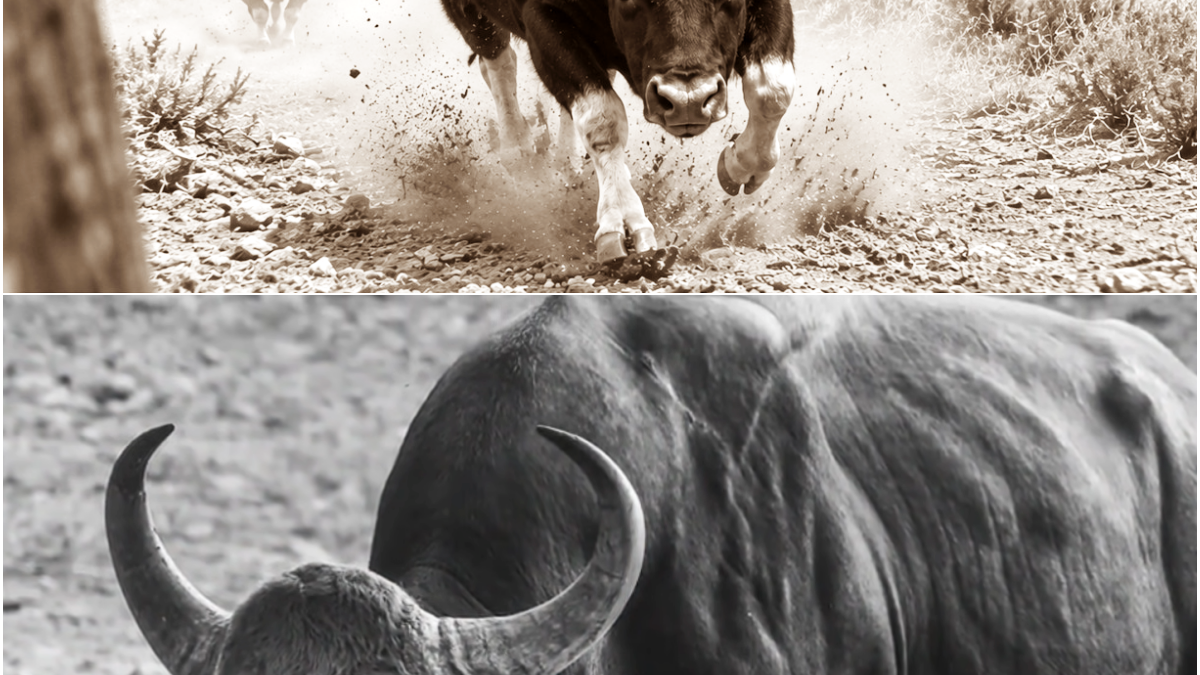
At dusk in the Texas Hill Country, behind a fence built to keep the world on one side and something enormous on the other, an animal may be standing perfectly still in the gathering darkness.
Its shoulders rise higher than the hood of a pickup. Its body carries the weight and strength of a small hill, and four pale legs descend from its dark coat like bone-white pillars.
It has horns that curve upward and inward, a powerful neck, and a presence that makes the familiar cattle of an ordinary pasture seem suddenly small.
It is a gower, the largest wild cattle on Earth, an animal whose natural home lies thousands of miles away in the forests of India and Southeast Asia.
It was never meant to wander through the cedar and scrub of Texas. Yet its kind has crossed oceans, entered American laboratories, settled into California enclosures, and become part of a private ranching industry that has been moving exotic animals across the continent for generations.
Somewhere behind those fences is a creature that belongs to another world, living under the care of people who may understand its needs, or may simply understand its value.
And the strangest part is that the gower is becoming harder to find in the forests where it evolved, even as it finds a place in a country where it never belonged.
How did the largest wild bovine on the planet end up here, and what happens when the fences built to protect it become the very things that put it at risk?
The first time someone sees a gower, the animal often seems too large to be real.
It stands with the massive, sloping shoulders of a creature designed to push through thick vegetation, and a ridge runs along its back like the crest of a low mountain.
Its coat is usually dark, sometimes almost black, and its legs are pale below the knees.
Its horns rise from the sides of its head and sweep upward, giving the animal a silhouette that is unmistakable once it has been seen.
A full-grown bull can reach seven feet at the shoulder and weigh well over a ton.
Its strength is not merely a matter of size. It can move through woodland with surprising speed, turn abruptly, and cover uneven ground that would slow an ordinary farm animal.
It is a member of the cattle family, but it is not domesticated cattle. It is not an American bison, and it is not an African buffalo.
It is a wild Asian bovine with a history that stretches back through forests and grasslands long before anyone in Texas imagined keeping one behind a fence.
In its native range, gowers live in herds that may contain ten to forty animals.
The group is often organized around mature females, while the largest bulls may spend long periods alone or at the edges of the herd.
They feed on grasses, leaves, shoots, and other vegetation, moving between forest clearings and wooded slopes.
They visit mineral-rich places where they can obtain salts, cross rivers, and climb steep ground with a confidence that seems impossible for such a heavy animal.
Their size offers protection, but it does not make them careless. Gowers are alert and can react quickly to unfamiliar movement.
Their principal natural predator is the tiger, and even that powerful hunter must choose its opportunities carefully.
When a herd senses danger, the animals may gather closely, presenting a wall of bodies and horns rather than scattering in panic.
A tiger approaching a healthy adult is confronting an animal that can defend itself with immense force.
Yet the gower’s strength has not protected it from the changes taking place across Asia.
Forests have been cleared, roads have divided old habitats, and expanding human activity has brought domestic livestock into contact with wild herds.
The species has lost much of its former range, and its numbers have declined sharply over the last century.
Estimates vary by region and method, but the surviving population is only a fraction of what once moved through its native forests.
That is the contradiction at the center of the gower’s story. It is an animal built to dominate its environment, yet it is increasingly dependent on protected places and carefully managed populations.
In Asia, it faces pressures that are difficult to solve. In America, it has found a different kind of refuge, one created not by wilderness but by people who have the land, the resources, and the interest to keep exotic animals.
The story of how it arrived begins with another Asian animal, one that was smaller, more adaptable, and easier to manage.
In the 1920s and early 1930s, Caesar Kleberg, a foreman associated with the enormous King Ranch in South Texas, acquired a small herd of nilgy antelope.
Nilgy came from India, where they are among the largest antelope on the subcontinent. They were unfamiliar to Texas, but Kleberg arranged for them to be brought through the San Diego Zoo and released onto the coastal plain.
The experiment was simple. The animals were placed in a landscape with open space, vegetation, and few of the dangers they encountered in their native range.
There were no tigers waiting in the brush, no leopards moving through the grass, and no predators that had learned how to hunt them.
The nilgy adapted, reproduced, and spread beyond the original expectations. At first, their presence was an unusual feature of private ranch life.
But Texas was changing, and the idea of keeping foreign animals began to find a larger audience.
In 1929, San Antonio businessman Richard Friedrich fenced off part of his Hill Country property and began stocking it with surplus animals from the San Antonio Zoo.
His property helped establish a model that would become familiar across the region. A tall fence could turn a piece of ranchland into a controlled space for animals that did not belong to the local ecosystem.
Later, the property came into the hands of Eddie Rickenbacher, a World War I fighter pilot who became associated with charging visitors to hunt exotic animals inside the enclosure.
The idea had shifted. What began as a curiosity could now generate income. A ranch could offer a visitor the chance to see animals from distant continents, and for some customers, the attraction was the opportunity to hunt them.
Then the droughts of the 1950s changed the economic calculation. Texas endured severe dry conditions that strained traditional cattle operations.
Springs failed, feed became expensive, and ranchers who had depended on familiar herds found themselves searching for other sources of income.
Exotic animals began to look less like expensive novelties and more like a possible business.
Charles Shriner III, who operated the well-known Yo Ranch in the Hill Country, began acquiring surplus animals from the San Antonio Zoo.
His collection included axis deer from India, blackbuck from the Indian subcontinent, and aoudad from the mountains of North Africa.
Other ranchers followed similar paths. In 1967, the people involved organized into a trade group that would continue to represent the exotic animal industry.
The arrangement made sense to those who participated. Zoos sometimes had animals they could not keep, while ranchers had land that traditional cattle alone could not always make profitable.
A rancher could purchase animals, build a high fence, and charge visitors to observe them or arrange hunts.
Over time, more than one hundred non-native species passed through this system and onto private Texas land.
The industry did not begin with the gower. For years, the animal was largely associated with major zoological collections.
It was difficult to handle, expensive to transport, and powerful enough to make ordinary livestock procedures impractical.
Its needs were more demanding than those of smaller exotic species, and a mistake around an adult bull could have serious consequences.
But the gower was not entirely beyond human management. In parts of northeastern India and Myanmar, communities have long kept a partly domesticated form known as the mithun or gayal.
These animals are valued less as dairy cattle than as living wealth. They can be exchanged, inherited, and used as a store of value, with their size and horns making them a visible measure of prosperity.
The existence of the mithun showed that people could raise and manage animals related to the wild gower.
It did not mean that every gower could be handled safely, or that a wild-born animal would behave like a domesticated one.
Still, the distinction mattered. The species could be bred and transported by people with experience, and it could survive under human care when its needs were met.
In America, one of the institutions with the resources and expertise to work with gowers was the San Diego Zoo.
Its role would eventually reach beyond keeping living animals. It would also become part of an effort to preserve the biological material of species that were becoming increasingly rare.
Within the zoo’s collection was a male gower that died at the age of five.
Before the animal was lost from the living collection, a small sample of its skin had been preserved.
The cells were placed into storage at extremely low temperatures, where they could remain available for future scientific work.
The collection became known as the Frozen Zoo, a library of living cells from animals that might one day need another chance.
The sample remained there for eight years. It was not alone. Other endangered animals had biological material stored in the same facility, each representing a possibility that scientists could not yet fully realize.
At the time, the idea of using frozen cells to produce a living animal was still an emerging field, and the challenges were enormous.
Meanwhile, the fences across Texas were becoming part of a much larger story. The people who managed exotic ranches often described their animals as insurance populations.
If a species disappeared from its natural habitat, they argued, captive groups might preserve enough animals to support a future recovery.
The idea was not without merit. Zoos and conservation organizations had demonstrated that carefully managed breeding programs could help prevent some species from vanishing entirely.
Accredited zoos maintain records of each animal’s ancestry and coordinate breeding across institutions. These programs are designed to preserve genetic diversity and reduce the risks that come from breeding too closely related individuals.
Some facilities also store cells and other biological materials for research and possible future use.
The work requires long-term planning, cooperation, and an understanding that a population is more than the number of animals visible in an enclosure.
There are examples in which captive populations have made a difference. The Arabian oryx, once gone from the wild, survived through animals maintained in human care and was later returned to parts of its former range.
Père David’s deer, which disappeared from its native Chinese habitat, survived through a small population maintained elsewhere.
These stories show that captive conservation can sometimes provide a bridge across a period when wild populations are no longer secure.
But the same word, conservation, can describe very different operations. A carefully coordinated zoo program is not the same as a private ranch that buys and sells exotic animals without maintaining detailed breeding records.
Some ranches may contribute to the preservation of species, while others may primarily operate as businesses.
From the road, the fences can look identical. The animals inside them may be part of entirely different systems.
And a fence is only useful while it holds. The history of the nilgy offers a warning.
The animals brought to South Texas were initially intended to remain within private ranches. But over time, some escaped or were released, and the species established itself in the wild.
Today, free-ranging nilgy live across parts of South Texas and have spread into northeastern Mexico.
They breed without depending on the original ranches, and they have become a lasting feature of the region.
The nilgy are not the only example. Axis deer, originally brought in as exotic stock, have also spread across parts of Texas.
Blackbuck have established free-ranging populations, and aoudad have adapted to mountainous areas in West Texas.
Animals that once existed only as curiosities behind fences have become part of the landscape.
This transformation is difficult to reverse. Once a species has established breeding populations across private properties and open country, there may be no practical way to gather every animal and return it to its original range.
A fence cannot contain animals that have already moved beyond it. Hunting and other forms of population management may reduce numbers, but they do not necessarily eliminate an established population.
The fences themselves are vulnerable. Floodwater can undermine posts and flatten sections of wire. Severe storms can damage long stretches of enclosure, and a gate can be left open through an ordinary mistake.
When a large animal escapes, it may not return simply because the opening is repaired.
It can move into brush, cross property boundaries, and begin using the surrounding landscape. For a small or familiar species, the consequences may be manageable.
A gower is a different proposition. A mature bull can weigh many times more than a nilgy and carries a level of strength that would challenge almost any ordinary ranch infrastructure.
It can move quickly, turn sharply, and defend itself with horns and sheer mass. There are no native North American predators that have evolved to hunt gowers.
The species would arrive without the ecological relationships that shape its behavior in Asia. That does not mean it would automatically become aggressive toward people, but it would be an unfamiliar large wild animal in a landscape where people, roads, livestock, and other wildlife are not adapted to its presence.
A startled gower could be dangerous, especially if it felt trapped or threatened. The animal’s size alone would make any close encounter a serious matter.
And a gower raised behind a fence would not necessarily be tame. Captivity does not erase wild instincts, particularly in an animal that has not been handled from a young age.
That is why the question of whether gowers are already roaming freely in America needs a careful answer.
There is no documented free-ranging herd of gowers moving through the Texas Hill Country. The dramatic image of a wild herd crossing the brush is not an established reality.
The species is present in America, but its presence takes several different forms. The first is the most unusual, and it happened in a barn in Iowa.
On January 8th, 2001, at 7:30 in the evening, in the small town of Sioux Center, Iowa, a domestic cow named Bessie gave birth to a calf that was genetically a gower.
The calf was named Noah. He was produced through a process known as interspecies nuclear transfer, an experimental technique that uses the genetic material of one species inside an egg cell from another.
The procedure was a striking departure from the cloning work that had captured public attention only a few years earlier.
Dolly the sheep had been cloned from an adult cell of her own species. Noah was different.
His genetic material came from an endangered Asian bovine, while the egg and the pregnancy that supported his development came from domestic cattle.
Scientists had taken cells preserved from the male gower at the San Diego Zoo. A company called Advanced Cell Technology, based in Worcester, Massachusetts, thawed the cells and used their genetic material to create embryos.
The nuclei from the gower cells were placed into cow eggs whose own nuclear material had been removed.
The resulting embryos were then implanted into surrogate cows. Around forty embryos were transferred into thirty-two cows.
Eight became pregnant. Bessie carried the calf that reached the end of gestation, a period of 283 days.
For the first time, a gower had been brought into the world through a domestic cow in the American MidweSt.
Noah’s birth demonstrated that the technique could work. It also exposed the limits of the achievement.
The calf lived for roughly forty-eight hours before developing a severe intestinal illness. The researchers involved regarded the illness as a common calf infection rather than a direct consequence of the cloning procedure, but the loss made clear how far the work still had to go.
Philip Damiani, one of the researchers involved in raising Noah, described the experience as devastating.
The calf had been walking the night before, and the team had seen signs that he was active and difficult to manage.
Then, within a short time, the experiment that had produced a living gower ended. The project had not restored a population.
It had produced one calf, and that calf had not survived long enough to grow into an adult.
Yet the result was scientifically important. It showed that preserved cells from an endangered species might be used to create an animal even when the available living population was limited.
That possibility brought a difficult question into focus. Could cloning become a meaningful conservation tool, or would it draw attention and resources away from the harder work of protecting forests, preventing habitat loss, and keeping wild populations connected?
A clone is not a substitute for an ecosystem. Even if scientists can produce an animal from preserved cells, they still need suitable habitat, appropriate care, and a population structure that allows the species to continue.
A single calf cannot replace a herd. A herd behind a fence cannot automatically replace a functioning wild population.
Still, Noah’s birth was one of the first times the gower had existed on American soil outside the usual context of a zoo enclosure.
He had not been captured in Asia and shipped across the ocean. He had been created from cells preserved in California and carried by a domestic cow in Iowa.
The second form of American gower is easier to see. At the San Diego Zoo Safari Park, the species lives in a large area of open ground known as the Asian Savannah.
The habitat is designed to give visitors a view of animals from the region, including gowers, Indian rhinoceroses, and Asian deer.
The gowers graze under the California sun while visitors travel through the landscape and observe them from a distance.
The Safari Park is not a wild forest in India. It is a managed environment, with boundaries, veterinary care, feeding plans, and staff responsible for the animals.
But it can offer space and conditions that allow large animals to display some of their natural behaviors.
The presence of a group also makes it possible to observe social interactions that a single animal would not show.
The third form is the one that connects the gower to the Texas exotic industry.
Private ranches have developed markets for rare and unusual animals, and gowers have been part of the wider movement of exotic species into American collections and breeding operations.
Some may be held for conservation or educational purposes. Others may be kept as valuable animals in a business built around exotic livestock.
The important distinction is that being present in Texas does not mean being established in the wild.
A gower behind a high fence is not the same thing as a free-ranging population.
But the history of other species shows that private enclosures do not guarantee permanent containment.
That is where the question becomes larger than one animal. The gower’s presence in America reflects a system that moves wildlife across the planet for different reasons.
Some of those reasons are scientific and conservation-focused. Others are commercial, recreational, or driven by the desire to own something unusual.
These purposes can overlap, but they do not always lead to the same outcomes. The hopeful interpretation is that America could provide a backup population for animals facing difficult conditions in their native range.
A well-managed group might preserve genetic material, support research, and help keep the species alive while conservation work continues elsewhere.
The Frozen Zoo offers one kind of insurance, while coordinated breeding programs offer another. The cautionary interpretation is that an insurance population can become a liability if it is not managed responsibly.
A population that exists mainly as a commercial asset may not have the same safeguards as a carefully coordinated conservation program.
Records may be incomplete, breeding may be driven by market demand, and the long-term needs of the species may receive less attention than immediate financial returns.
The escape history of the nilgy and other exotic animals makes that concern more than theoretical.
Texas has already experienced the long-term consequences of species spreading beyond their original enclosures. Their presence has altered local wildlife communities and created new management questions that did not exist when the first animals were imported.
The gower would present a different set of challenges. Its size, strength, and behavior would make it unlike the smaller antelope and deer that have established themselves in parts of the state.
The concern is not that a single escaped animal would instantly transform the entire ecosystem.
It is that a species with no native range in North America could establish itself under conditions where there are few natural checks and no established management framework.
That possibility makes the design and maintenance of enclosures important. High fences need regular inspection.
Gates need secure systems. Animals need appropriate space and care, and operators need plans for emergencies.
If an animal escapes, the response must be swift and coordinated, with people who understand how to handle the species and where it might move.
There is also a broader question about what it means to save an animal. A population kept alive in captivity may preserve a species in one sense, but the species’ ecological role and natural behavior depend on more than survival alone.
Gowers evolved in complex Asian landscapes, where they interact with plants, predators, other herbivores, and seasonal conditions.
A managed pasture cannot reproduce all of those relationships. The difference matters especially when a captive population is described as an ark.
An ark is a refuge from a storm, but it is not a permanent replacement for the world outside.
It can carry a species through a crisis, yet the purpose of conservation is usually to preserve the conditions that allow the species to live in its own environment.
The gower’s situation in Asia remains the central issue. Protecting forests, maintaining corridors between habitats, reducing conflict with people, and managing contact with domestic livestock are all part of the work needed to support wild populations.
A secure American enclosure may help preserve animals, but it cannot solve the pressures that are shrinking the species’ native range.
The cloning story adds another layer. Noah showed that a frozen cell could become the starting point for a living animal, but the process did not create a future for the species by itself.
It created a possibility. The hard work of building a healthy population, ensuring genetic diversity, and maintaining suitable habitat remained.
Two years after Noah’s birth, the same broad approach was used with another endangered Asian bovine, the banteng.
In the spring of 2003, a cloned banteng was born alive in California. The calf was delivered by cesarean section and raised by hand in a special isolation unit at the San Diego Zoo’s facilities.
Unlike Noah, the banteng survived its first days and grew up in captivity. It became another example of the possibilities and limitations of cloning endangered animals.
The animal lived behind glass and fences, a living result of a scientific effort to recover genetic material from a species under pressure.
Before reaching seven years of age, however, it died following an injury in captivity. The two cases revealed both the ambition and the uncertainty of the work.
Scientists had demonstrated that cells stored in a freezer could contribute to the creation of living animals.
But producing an animal and maintaining a healthy life for it are different challenges. A successful birth is a milestone, not the completion of conservation.
The same distinction applies to ranches. Buying an animal, breeding it, and keeping it alive are not necessarily the same as preserving a species.
Long-term conservation requires attention to the needs of the population as a whole, including ancestry, health, behavior, habitat, and the future of the animals after they leave the care of a particular owner.
The Texas industry has made exotic animals visible in places where they would otherwise be absent.
It has also made them part of an economy in which animals can be traded, bred, displayed, or hunted.
Those activities have different implications, and the presence of a species in the industry does not tell us, by itself, whether its future is secure.
For the gower, the stakes are unusually high because the animal is so large and so specialized.
Its natural range is far from Texas, and its survival depends on forests and landscapes that cannot be recreated simply by planting grass inside a fence.
Yet its ability to survive under human care offers a potential safeguard if managed with long-term planning.
The question is whether the safeguards will be strong enough. A fence can protect an animal from immediate threats, but it can also create a false sense of certainty.
It may hold for decades, until a storm, a damaged section, or a human mistake creates an opening.
The history of exotic species in Texas shows that containment is not an abstract promise.
It is a practical responsibility that must be maintained every day. And there is a responsibility beyond the fence.
People who bring animals across oceans make decisions that affect more than the animals they purchase.
Those decisions can influence local ecosystems, neighboring ranches, public safety, and conservation priorities. The animal itself has no say in the arrangement.
It follows the conditions humans create. That is perhaps the quietest part of the gower’s story.
It did not choose Texas. It did not choose California, a laboratory, or a surrogate cow in Iowa.
People made those choices, motivated by scientific curiosity, conservation concerns, business opportunities, and the attraction of possessing an extraordinary animal.
The gower has been one of the largest wild cattle on Earth for a very long time.
Its shape, its strength, and its place in Asian forests were established long before American ranchers began importing exotic species.
Its current situation is not the result of any plan the animal made. It is the result of human decisions about land, trade, science, and the value of wildlife.
So return to the Texas Hill Country at dusk. Imagine the pale legs beneath a dark body, the horns rising above the brush, and the animal watching a pickup move along a county road.
The image is striking because it brings together two worlds that were never meant to meet.
One belongs to the forests of Asia. The other is the ranchland of Texas, shaped by fences, roads, livestock, and private ownership.
In India, a wild gower may be moving along a forest track, feeding at the edge of a clearing while a tiger keeps its distance.
In California, other gowers may be grazing in a managed savannah, surrounded by the routines of a zoological park.
In Texas, an animal of the same species may be standing behind a high fence, its future tied to the decisions of the people responsible for it.
These are not three versions of the same life. One is wild, one is managed for conservation and public education, and one may be part of a private exotic animal operation.
Each represents a different relationship between humans and a species that evolved far beyond the American continent.
The first relationship depends on protecting the places where the gower belongs. The second depends on careful animal management, scientific planning, and the possibility that captive populations can support broader conservation goals.
The third depends on the choices of individual owners and on a system whose history includes both successful containment and animals that have spread beyond it.
None of these relationships can be understood by looking only at the animal’s size. The gower may be powerful enough to make people step back, but its future is shaped by forces that strength cannot overcome.
Habitat loss does not care how large an animal is. Roads do not move aside because a herd is approaching.
A fence does not become secure because the animal behind it is rare. The gower’s presence in America is therefore not simply a story about an exotic animal appearing in an unexpected place.
It is a story about the ways people attempt to manage the natural world, and about the distance between an intention and its consequences.
A rancher may intend to create a profitable collection. A zoo may intend to preserve a species.
A scientist may intend to recover a lost genetic possibility. Each action can have a different result, and none can be judged only by the moment it begins.
The strongest conservation efforts are those that recognize that survival is a long process. They require careful records, sound animal care, cooperation among institutions, and protection of natural habitat.
They also require honesty about uncertainty. A population behind a fence may be useful, but it is not automatically safe forever.
A successful clone may be scientifically important, but it is not automatically a recovered species.
An escaped animal may survive, but survival alone does not mean it has found a suitable place in the ecosystem.
The gower’s story leaves us with a question that is harder than whether the animal is dangerous or whether it belongs in Texas.
It asks what people mean when they say they are saving wildlife. Is the goal simply to keep an animal alive somewhere, or is it to preserve the world in which that animal evolved and the relationships that make its life possible?
There may be room for both approaches. Captive populations and stored cells can provide options that would otherwise be loSt. But those options have the greatest value when they support, rather than replace, the protection of wild populations and their habitats.
Without that connection, the ark risks becoming a collection of living reminders of places that no longer exiSt.
And if the gower is ever seen beyond a Texas fence, the most important question will not be how astonishing it looks against the cedar trees.
It will be how it got there, who was responsible for containing it, and what happens next.
The animal will be doing what its body and instincts have prepared it to do.
The responsibility for the situation will belong to the people who moved it, kept it, and built the fence.
For now, the gower remains an animal of several worlds, but not yet a free-ranging giant of the American landscape.
It lives in the careful spaces people have made for it, while its native forests face pressures that those spaces cannot solve.
Its future depends on whether people can learn to distinguish a refuge from a replacement, and whether they can take responsibility for the consequences of moving wildlife across the planet.
The largest wild cattle on Earth did not ask to become an American curiosity. It did not ask to be a scientific breakthrough or a private asset.
It was already extraordinary in the forests where it belonged. The challenge now is to ensure that the human fascination with its size and rarity does not become another force making its future more uncertain.
Disclaimer: This content may be created by Al for entertainment purposes. Any resemblance to real persons, events, or places is coincidental.








