Why The Galaxy’s Angriest Alien Woman Suddenly Wants To Be My Private Commander
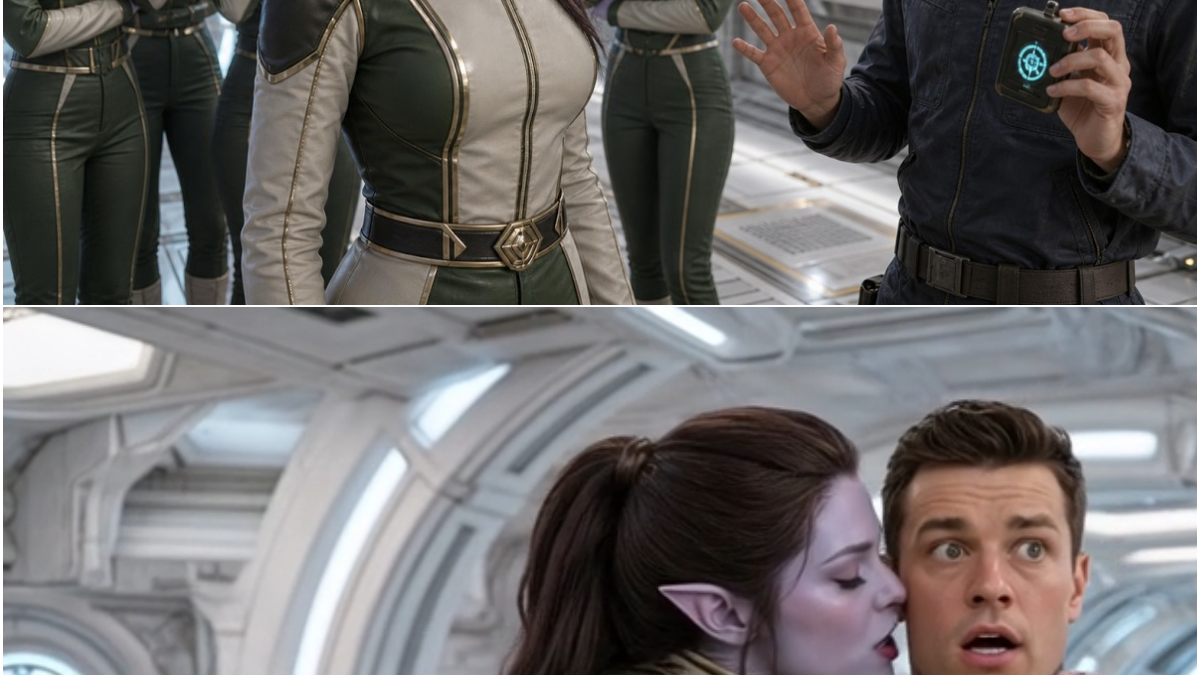
Private Whis Harlon had been on garrison call for exactly 11 days when he accidentally called the most feared military commander in the quadrant love.
The word escaped him at the worst possible moment, in the middle of a failing gravity plate, beneath a two ton coolant manifold that had begun to tear itself loose from its mountings.
War commander Draasa Vhen stood directly beneath it, her back turned, completely unaware of what was happening above her.
Whis had less than a second to decide whether to freeze, shout, or move. He moved.
He grabbed the commander, pulled her backward, and threw both of them clear just before the enormous manifold crashed onto the deck where she had been standing.
Then, with his heart pounding and his judgment nowhere to be found, Whis had shouted the one word that would become the strangest secret in the entire garrison.
“I’ve got you, love, stay down.” The crash shook the engineering bay. The silence afterward was somehow worse.
Whis slowly realized that his arms were still around Draasa Vhen, that two thousand soldiers served under her authority, and that every person in the maintenance detail was staring at him as if he had just committed the greatest breach of military protocol anyone had ever witnessed.
Then he remembered what he had called her. Love. Why had that single accidental word reached somewhere that thirty one years of military discipline never had?
To understand that, you have to understand Draasa Vhen. The Coroni were a martial people, famous across the settled quadrant for discipline, endurance, and an almost uncomfortable devotion to duty.
Draasa Vhen was considered formidable even among them. She had risen through the mixed defense forces with astonishing speed and had eventually taken command of Garrison Call, one of the frontier installations responsible for protecting thousands of soldiers and civilians across a difficult region of space.
She had never lost a garrison. She had never failed an objective. She had never needed anyone to remind her twice of a regulation.
And she had developed a reputation for being so severe that soldiers spoke about her in lowered voices even when she was nowhere nearby.
She was tall even for a Coroni, with pale eyes and a hard expression that rarely changed.
When she walked through the garrison, conversations stopped. When she entered an inspection bay, soldiers suddenly remembered every regulation they had ever learned.
When she looked at someone who had made a serious mistake, she did not shout.
That was what frightened people moSt. Draasa Vhen simply looked at them. Her cold gaze seemed to examine every detail, measure every failure, and quietly decide what would happen next.
Soldiers who performed badly under her command were not humiliated with shouting. They were quietly reassigned.
Officers who submitted careless reports found themselves removed from important duties. Those who ignored procedure discovered that Draasa Vhen remembered everything.
Stories about her traveled through the garrison constantly. There was the supply officer who had falsified a readiness report and had received nothing more than one long look from the commander before requesting a transfer within a week.
There was the platoon ordered into a brutal night exercise after repeated equipment mistakes, after which nobody in that unit ever treated maintenance casually again.
There was a visiting general who had questioned Draasa Vhen’s methods and found himself facing a calm, precise account of her record compared with his own, after which he left the installation considerably earlier than planned.
The lesson was always the same. Do your job. Do it correctly. Do not attract Draasa Vhen’s attention.
Veterans understood this instinctively. New arrivals needed time to learn it. Private Whis Harlon had been at Garrison Call for only 11 days.
That was his problem. He had heard the stories, of course. Everyone had. But Whis had not yet developed the particular kind of fear that came from living under someone’s command for months or years.
To him, Draasa Vhen was frightening in the abstract, like a dangerous storm described in a briefing.
He had not yet experienced the weather. Whis was 22 years old, newly trained, earnest, slightly clumsy, and stubbornly determined to be useful.
He was not a remarkable soldier. He had no extraordinary family history and no famous achievements.
He simply wanted to serve, see the wider galaxy, and make himself useful wherever he was assigned.
His bunkmate, Corporal Austin, had served under Draasa Vhen for three years. Austin considered Whis’s insufficient fear a serious problem.
“You are going to learn,” Austin told him during their second night together, “that there are two kinds of soldiers in this garrison.”
Whis looked up from his meal. “What kinds?” “The ones Draasa Vhen has noticed and the ones she has not.”
Whis smiled. “That seems exaggerated.” Austin stared at him. “You are going to get transferred.”
“Why?” “Because you smiled.” Whis laughed. Austin did not. The strange thing was that Whis had already noticed something the veterans had forgotten to look for.
Whenever he saw Draasa Vhen walking alone through the garrison, she never looked comfortable. She looked burdened.
Not physically. Her posture was perfect. Her uniform was immaculate. Her movements were controlled. But there was something in the way she walked through the corridors after everyone stepped aside.
Whis could not explain it. She looked lonely. He never said that aloud. Austin would have thought he had completely lost his judgment.
Then came the engineering inspection. The lower engineering bay was crowded with maintenance crews, tools, machinery, coolant pipes, gravity regulators, and enough heavy equipment to make a small mistake extremely expensive.
Whis had been assigned there because new soldiers were often given maintenance work. Draasa Vhen entered the bay without warning.
Every soldier immediately became rigid. Whis tried to imitate them. The commander moved slowly through the room, examining equipment and reading reports.
Whis kept his eyes down. Then he heard a sharp metallic crack. He looked upward.
The gravity plate beneath a massive coolant manifold flickered. The mounting brackets shuddered. One bracket snapped.
Whis looked across the bay. Draasa Vhen was standing directly underneath it. She was reading a fault report.
She had not heard the bracket. Nobody else had either. Whis did. He had less than a second.
He did not think about rank. He did not think about protocol. He did not think about his career.
He ran. He reached the commander, grabbed her around the shoulders, and pulled backward with everything he had.
Draasa Vhen barely had time to turn before they both fell. The manifold came down behind them.
The impact shook the deck. Tools jumped from their racks. Several soldiers shouted. Then everything went silent.
Whis lay on the floor, breathing hard. Draasa Vhen was beside him. His arms were still around her.
He released her immediately. “I’m sorry, Commander.” She did not answer. Whis sat up. “I saw the bracket.
I wasn’t thinking. I just saw it coming down and I…” He stopped. Everyone was staring.
Then he remembered the word. His stomach dropped. “I’ve got you, love, stay down.” He had actually said that.
Out loud. To Draasa Vhen. In front of everyone. Whis stared at the floor. “I am so sorry.”
Draasa Vhen slowly sat upright. For several seconds she simply looked at him. There was no anger on her face.
That frightened Whis more than anger would have. Finally, she spoke. “You called me love.”
Whis closed his eyes. “Yes, Commander.” “You pulled me away from a two ton manifold.”
“Yes, Commander.” “And you called me love.” “I know.” The commander continued looking at him.
Nobody in the bay moved. Draasa Vhen seemed unable to decide what expression belonged on her face.
Then she stood. “You are dismissed from this detail, Private Harlon.” Whis swallowed. “Yes, Commander.”
“Report to my office at the change of watch.” “Yes, Commander.” She walked away. Whis remained on the deck.
Austin found him later. Austin looked at him for a long time. “I am very sorry.”
Whis frowned. “For what?” Austin sighed. “I always knew this day would come.” “What day?”
“The day you got noticed.” The story traveled through Garrison Call before the next meal.
By evening, there were already several versions. In one version, Whis had openly challenged Draasa Vhen.
In another, he had proposed marriage. In another, he had been thrown across the engineering bay.
Someone claimed the commander had personally ordered his reassignment. Austin listened to every version with increasing disbelief.
Then he returned to their bunk. “If you have any personal belongings you want sent home,” he said, “tell me where they are.”
Whis stared at him. “I am not going anywhere.” Austin looked unconvinced. The summons came at the change of watch.
Whis walked to the commander’s office expecting the worst possible outcome. Instead, the door opened.
“Enter.” He stepped inside. Draasa Vhen stood beside the window. For several seconds she did not turn.
Then she spoke. “In 31 years of service, nobody has ever called me that.” Whis said nothing.
She turned toward him. Her expression was controlled, but something beneath it was different. “Do you understand what I am telling you, Private Harlon?”
“Yes, Commander.” “No.” Her voice softened. “You do not.” Whis waited. She walked toward her desk and sat down.
“Two thousand soldiers serve in this garrison. I have commanded other installations before this one.
For 31 years, people have followed my orders because they know I will not tolerate carelessness.”
Whis nodded. “I have made myself feared,” she continued. “It was deliberate.” She folded her hands.
“A commander who is feared is difficult to manipulate. Difficult to distract. Difficult to compromise.”
She paused. “I believed that was strength.” Whis remained silent. Draasa Vhen looked toward the window again.
“But there is something nobody tells you about being feared by everyone.” “What is that?”
She looked at him. “You become very alone.” The words seemed almost painful for her to say.
Whis realized that this was not the commander he had seen in the engineering bay.
This was the person beneath the uniform. Draasa Vhen continued. “I have spent 31 years being spoken to because of my rank.
People salute me. People obey me. People avoid me. People ask me for decisions. Nobody speaks to me simply because they want to speak to me.”
Whis lowered his eyes. She took a breath. “Then today, a young private who had barely learned my name pulled me out of the path of a falling machine and called me love.”
“I did not mean to say it.” “I know.” “I am sorry.” “I am not asking you to apologize.”
Whis looked up. Draasa Vhen seemed almost uncomfortable. “I am trying to understand why I cannot stop thinking about it.”
Whis had no answer. Then, after several seconds, he said something that surprised even him.
“For what it is worth, Commander, I do not think the word was completely accidental.”
She stared at him. “It came out accidentally,” he continued. “But I think it came out because, for that moment, I was not thinking about your rank.
I was thinking about a person standing under something dangerous.” Her expression changed slightly. “I do not know you well enough to say anything more than that,” Whis said.
“But I do know that 31 years is a very long time to go without hearing a kind word.”
Draasa Vhen said nothing. Whis suddenly realized what he had done. He had just told the most feared commander in the quadrant that she deserved kindness.
He should have stopped. Instead, he continued. “And I am not sorry that I was the one who said it.”
Something changed in her expression. It was not a smile. Not yet. But the fortress around her seemed to loosen.
Draasa Vhen sat quietly for a long moment. Then she said, “Sit down, Private.” Whis sat.
They talked for nearly an hour. Not about the manifold. Not about regulations. Not about Whis’s duties.
They talked about loneliness. They talked about command. They talked about what it meant to spend decades being strong for everyone else and having nowhere to place the parts of yourself that became tired.
When Whis finally returned to the barracks, Austin was waiting. “Well?” Whis put his uniform jacket away.
“She talked to me.” Austin stared. “For how long?” “Almost an hour.” Austin sat down.
“What happened?” “Nothing.” Austin shook his head. “That is somehow more frightening.” But something had happened.
A door had opened. Neither of them knew where it led. Their conversations continued. At first, Draasa Vhen summoned Whis under ordinary duty pretexts.
Then the reasons became increasingly unnecessary. They talked after the change of watch. Sometimes they discussed maintenance.
Sometimes they discussed command decisions. Sometimes they sat in silence. Eventually Whis asked her a question that stopped her completely.
“What do you do for enjoyment?” Draasa Vhen looked at him as though he had spoken an unfamiliar language.
“I do not understand.” “What do you enjoy?” “I command a garrison.” “That is a duty.”
“Yes.” “That was not my question.” She stared at him. “I do not know.” Whis looked genuinely horrified.
“You do not have anything you do just because you enjoy it?” “No.” “That is terrible.”
For the first time, Draasa Vhen looked offended. Then Whis realized she was trying not to laugh.
A tiny sound escaped her. Whis froze. The commander looked equally startled. Then she laughed again.
It was quiet and unfamiliar, as if the sound had not been used in years.
Whis smiled. “There you are.” Draasa Vhen gave him a warning look. “Do not become arrogant, Private.”
“Yes, Commander.” She almost smiled. After that, he discovered her humor. It was dry and precise and unexpectedly devastating.
She could reduce a pompous visiting officer to absurdity with one perfectly calm sentence. Whis began bringing her small gifts.
A better mug. A book. A ridiculous carved object from a frontier market. Draasa Vhen did not know how to receive gifts.
She examined the mug for nearly a minute. “It is unnecessary.” “I know.” “Why did you buy it?”
“Because I thought you might like it.” She looked at him. Nobody had given her something simply because they thought she might like it.
She kept the mug. She kept everything. Over the following months, the two of them became quietly important to each other.
But there was a problem they could not ignore. Draasa Vhen was a war commander.
Whis was a private. The difference in rank was enormous. Their feelings could not become public without threatening the trust placed in her command.
Draasa Vhen understood that better than anyone. One evening, she finally said what they had both been avoiding.
“I will not risk this garrison for my own happiness.” Whis nodded. “I know.” “Two thousand soldiers depend upon my judgment.”
“I know.” “If I favor you, even once, everything we have built becomes questionable.” “I know.”
She looked away. “You are young, Whis.” It was the first time she had used his name without rank.
“You have years ahead of you. You should not spend them waiting for someone who cannot give you an ordinary life.”
Whis studied her. “Are you asking me to leave?” “I am giving you the opportunity to leave.”
“Why?” “Because I care about you.” He smiled faintly. “That is not going to work.”
Her expression tightened. “What?” “You are offering me the exit because you are afraid I will eventually want it.”
She said nothing. Whis leaned back. “I am not going anywhere.” “You cannot know that.”
“I know enough.” “You may change.” “So may you.” “That is not an answer.” “It is the only honest answer I have.”
Draasa Vhen looked at him. Whis continued. “I did not accidentally find the person behind the commander and then decide I wanted to walk away because it was complicated.”
Her expression softened. “You should not have to wait.” “I am not waiting because I have to.”
He smiled. “I am waiting because I choose to.” She looked down. “And if I offer you the choice again?”
“I will decline again.” “Why?” “Because someone has to teach you that people can stay.”
For a long time she said nothing. Then she whispered, “You make everything difficult.” Whis smiled.
“You were already difficult.” A quiet laugh escaped her. It was the sound that mattered moSt.
They agreed on patience. Whis would earn every promotion himself. Draasa Vhen would never advance him because of their private connection.
There would be no special assignments. No favors. No secret influence. Nothing that could compromise either of them.
Whis accepted the challenge. He became a better soldier. Years passed. He learned to command small teams.
He learned logistics, engineering, strategy, and diplomacy. Every promotion came through his own work. Draasa Vhen sometimes held him to a higher standard than everyone else.
Whis understood why. She wanted him to become someone who could stand beside her without owing his position to her.
The garrison slowly noticed changes in its commander. Draasa Vhen remained strict. She remained formidable.
But she became less cold. She began asking soldiers whether they needed assistance rather than merely asking whether a task was complete.
She listened more. She occasionally laughed. Nobody knew why. The answer remained hidden in her office, where an old mug sat beside her reports.
Several years after the coolant bay incident, Whis had become a sergeant. One evening he entered her office without a duty reason.
She looked up. “You are late.” “I was not summoned.” “That has never stopped you before.”
He smiled. They sat together in silence. After a while Draasa Vhen spoke. “For 31 years, I thought loneliness made me strong.”
Whis looked at her. “I was wrong.” She stared at the mug. “It did not make me strong.
It made me hard.” She reached across the desk. “I understand that now.” Whis took her hand.
It was the first time they had touched since the coolant bay. Draasa Vhen looked down at their joined hands.
Neither spoke. They did not need to. The moment was enough. More years passed. Then came the crisis that finally proved how far Whis had come.
A cascade failure struck the garrison’s main atmosphere plant. Several sections had to be evacuated.
Dozens of soldiers were trapped behind failing seals. Whis was the senior officer nearest the affected sector.
He did not panic. He organized the evacuation. He assigned teams. He improvised a temporary seal.
He kept communication open. He moved from one section to another until every person under his responsibility was accounted for.
Then he sealed the damaged section. The crisis ended. The investigation confirmed that Whis had handled everything according to procedure while making several difficult decisions under pressure.
His field commission followed. Draasa Vhen had not influenced it. In fact, she had removed herself from the discussion.
Whis learned that later. It mattered more to him than any congratulation. Eventually, the distance between them became something that could be crossed honorably.
Whis was no longer the rookie private who had stumbled into an impossible situation. He was an experienced officer with his own record, his own reputation, and his own command responsibilities.
Draasa Vhen was still the same formidable war commander. But she was no longer alone.
When they finally made their relationship public, Garrison Call reacted with disbelief. Austin, now Sergeant Austin, simply stared at Whis.
“You actually survived.” Whis laughed. “I told you I would.” Austin shook his head. “I once offered to send your belongings home.”
“I remember.” “I was very wrong.” “You were.” Austin considered this. “Then I want it recorded that I supported the relationship from the beginning.”
“You absolutely did not.” “Details.” The garrison eventually accepted the truth. Some soldiers were surprised.
Others were delighted. Many had noticed that Draasa Vhen had changed without understanding why. Now they knew.
The commander they had feared for years had a private life. She had humor. She could laugh.
She could accept a gift. She could sit quietly with someone she trusted. And she could be loved without surrendering her authority.
Whis and Draasa Vhen married quietly. There were no grand speeches. No public spectacle. Just the two of them, a small gathering of people they trusted, and a promise built from years of patience.
Draasa Vhen kept the old mug. It became chipped with time. Whis offered to replace it.
She refused. “It has history.” “What history?” She looked at him. “You know what history.”
He smiled. “Yes, Commander.” She raised an eyebrow. “Do not call me Commander.” Whis leaned closer.
“Yes, love.” She smiled. It was still a small smile. But it belonged entirely to her.
They grew older together. Whis never let a day pass without offering her some ordinary kindness.
A question about her morning. A joke. A cup of something warm. A hand held quietly across a table.
Nothing dramatic. Nothing heroic. Just the small things she had spent 31 years without. Years later, a young officer finally asked Draasa Vhen about the story.
They were sitting in a quiet room overlooking the garrison. The officer had heard every version.
Some said Whis had been reckless. Some said the commander had secretly fallen for him immediately.
Some said the entire relationship had begun because of one strange word. “Commander, is it true that your whole happiness began when a rookie accidentally called you love?”
Draasa Vhen considered the question carefully. “It is true,” she said. The young officer smiled.
“So the accident changed everything?” Draasa Vhen shook her head. “You have the lesson backward.”
The officer waited. “The word was an accident.” She looked toward the old mug sitting beside her.
“What mattered was what he did afterward.” The young officer listened. “When I summoned him, he expected punishment.
He expected me to make him afraid. He expected me to force him to take the word back.”
She paused. “He did not.” “What did he do?” “He looked at me as a person.”
Draasa Vhen’s voice softened. “He told me that 31 years was too long for anyone to go without a kind word.
He told me he was not sorry it had been him.” The young officer remained silent.
“That was the courageous part,” Draasa Vhen said. She looked directly at the officer. “Anyone can say something without thinking.
The difficult part is choosing kindness after you understand the consequences.” The young officer nodded.
Draasa Vhen continued. “I had built a fortress around myself. I believed it protected me.
I did not understand that I had also locked myself inside it.” She touched the old mug.
“He did not break the fortress down. He simply stood outside it and kept offering warmth until I understood that I could open the gate myself.”
The officer smiled. “Was that difficult?” “For me, yes.” “Why?” “Because accepting kindness requires truSt.”
She looked toward the stars beyond the window. “And trust was the one thing I had spent 31 years avoiding.”
The officer thought for a moment. “Would you say that one word changed your life?”
Draasa Vhen smiled. “No.” The officer looked surprised. “The word opened a door,” she said.
“He changed my life by choosing to remain after the door opened.” She returned her gaze to the young officer.
“That distinction matters.” The officer nodded slowly. Draasa Vhen leaned back. “If you ever meet someone everyone else has decided is impossible to approach, do not assume the hardest face in the room contains the hardest heart.”
She paused. “Sometimes people become difficult because they have spent too long protecting something vulnerable.”
The young officer asked, “And what should someone do?” Draasa Vhen looked toward the door.
“Be kind.” She smiled faintly. “And if they turn away, give them time.” The officer left with those words.
Draasa Vhen remained beside the window. Whis entered a few minutes later carrying two cups.
He placed one beside her. She looked at it. “Another mug?” “No.” He smiled. “Just tea.”
She picked it up. “You are late.” “I was delayed.” “Excuse?” “Important military business.” “What business?”
“I had to find tea.” She stared at him. “That is your excuse?” “Yes.” For several seconds her face remained completely serious.
Then she laughed. Whis smiled. Outside, Garrison Call continued its endless rhythm of patrols, maintenance checks, reports, inspections, and changing watches.
Thousands of soldiers continued to serve beneath the commander once known as the galaxy’s angrieSt.
She remained strict. She remained formidable. She still had the ability to silence an entire room with one look.
But now, when the corridors emptied and the official work was finished, there was someone waiting for her.
And the difference between being feared and being known had become the difference between the woman she had once been and the woman she finally allowed herself to become.
All of it had begun in an engineering bay. A failing gravity plate. A falling manifold.
A rookie with 11 days of service. And one word that had escaped before he could stop it.
Love. The word itself had been accidental. Everything afterward had been a choice. And sometimes that was all it took to change a life.
Not a grand declaration. Not a battlefield victory. Not an act designed to become a legend.
Just one person seeing another person beneath the armor and choosing, despite fear, rank, distance, and uncertainty, to remain kind.
Draasa Vhen had spent 31 years believing that strength meant never allowing anyone close enough to hurt her.
Whis Harlon taught her something different. Strength could also mean opening the door. It could mean accepting a hand.
It could mean letting someone see the person beneath the uniform. And sometimes the strongest thing a person could do was simply allow themselves to be cared for.
That was the secret the garrison never understood during those first years. The commander had never truly been made gentler.
She had simply discovered that she no longer needed to be hard every moment of every day.
She had finally found one place where she could put down the weight. And whenever someone asked how it began, Draasa Vhen always gave the same answer.
“It began with an accident.” Then she would look at Whis. “And continued because he refused to take the kindness back.”
Disclaimer: This content may be created by Al for entertainment purposes. Any resemblance to real persons, events, or places is coincidental.








