While Everyone’s Distracted Something Massive Was Just Filmed At The Sun.
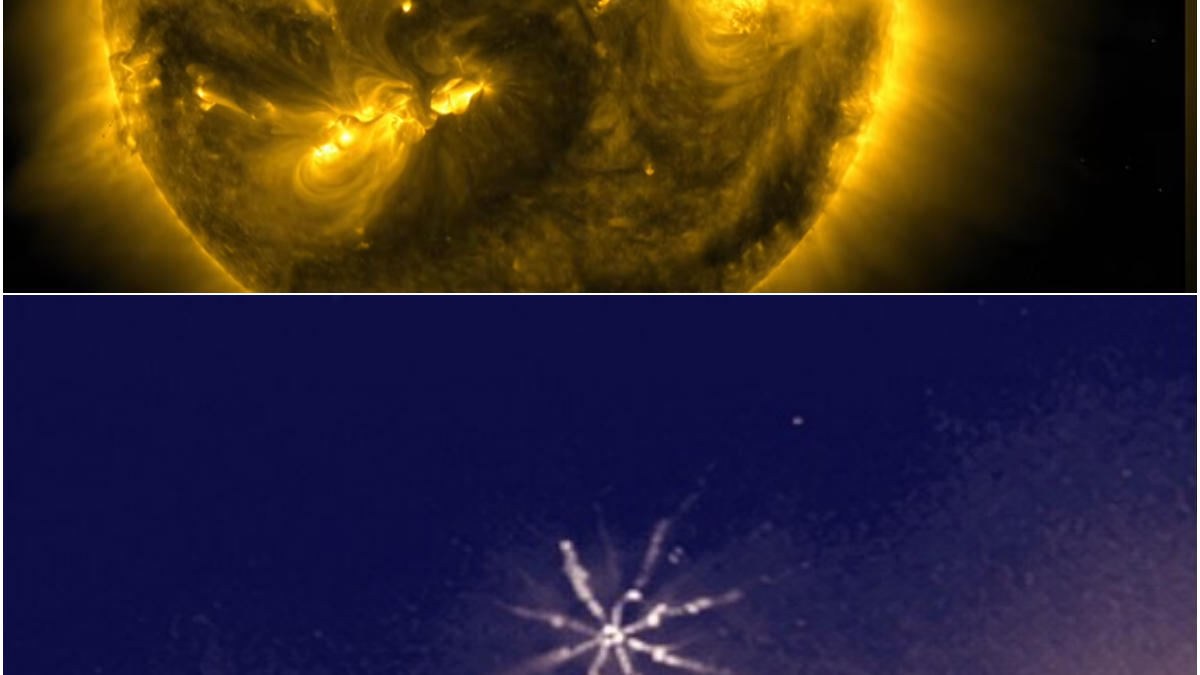
The Sun has been watched for generations, yet every so often an image emerges that makes the familiar star appear strangely unfamiliar.
Against the darkness surrounding it, a peculiar shape seems to hang near the brilliant solar disk.
It has a bright center, a collection of narrow extensions, and an arrangement so remarkably balanced that it resembles something designed rather than something formed by chance.
At first glance, it could be mistaken for an enormous wheel, a mechanical hub, or an intricate antenna suspended in space.
Its proportions seem almost deliberate, as though every projecting arm has been positioned with a purpose.
The photograph offers no explanation, only an extraordinary pattern that invites the imagination to fill in the missing details.
For anyone who has spent time looking at solar imagery, the Sun is already a place of astonishing activity.
Its surface churns, its atmosphere glows, and magnetic forces shape enormous structures that can extend far beyond the visible disk.
Yet this particular image seems to suggest a different kind of organization, one that looks strangely familiar to anyone who has ever examined a machine.
Enlarged, the apparent symmetry becomes even more striking. A central region appears surrounded by several outward-reaching components, each contributing to the impression of a complete structure.
The image raises an unsettling possibility, but also a simple scientific question. Is this an extraordinary object in the solar environment, or an unusual product of the instruments used to observe it?
And what would it mean if the apparent machinery were real? The photograph began attracting attention because it seemed to show something that did not belong in the usual pictures of the Sun.
It was shared within an online community devoted to unusual discoveries involving Mars, the Sun, and other parts of the solar system.
People enlarged it, examined the outlines, and compared the different components. The more closely they looked, the more the object appeared to have a recognizable arrangement.
Rather than a random collection of bright pixels or a single streak of light, it seemed to possess a center and a series of structures extending away from it.
The central region appeared almost circular. Around it, several narrow projections seemed to reach outward at different angles.
Their arrangement created the impression of a radial system, like spokes extending from the center of a wheel.
Some appeared longer than others, while the overall composition still seemed balanced. In certain enlarged versions, the shape brought to mind an antenna array, a rotating mechanism, or a machine built around a central control unit.
It was an unusual appearance, especially against the darkness of space. But a photograph, however compelling, cannot establish what an object is simply by showing a shape that resembles something familiar.
The image did not provide a confirmed distance, physical dimensions, material composition, or reliable evidence that the apparent structure existed as a solid object.
It presented an image that people could interpret, but interpretation was only the beginning of the investigation.
The location made the speculation especially dramatic. The Sun is not an ordinary place for machinery.
It is an enormous sphere of hot plasma, producing energy through nuclear fusion and surrounded by a complex atmosphere shaped by powerful magnetic fields.
Its visible surface reaches temperatures of approximately 5,500 degrees Celsius. Above that surface, the corona can reach temperatures of millions of degrees, creating one of the most remarkable puzzles in solar physics.
The environment surrounding the Sun is also filled with radiation and streams of charged particles.
Solar eruptions can release enormous amounts of energy, while the solar wind continuously carries particles outward through the solar system.
Magnetic fields twist, reconnect, and reorganize, sometimes producing structures that extend across distances far larger than Earth.
A machine operating close to the Sun would therefore face challenges that are difficult to imagine using ordinary engineering experience.
It would need to withstand intense radiation, manage heat, and remain functional amid a changing electromagnetic environment.
Its systems would need to survive conditions that can damage spacecraft designed specifically for solar research.
Humanity has already demonstrated that it is possible to send specialized machines into the Sun’s neighborhood.
The Parker Solar Probe was designed to investigate the solar environment from exceptionally close range.
It uses advanced thermal protection and carefully planned trajectories to survive repeated encounters with intense sunlight.
Even so, it operates within carefully calculated limits and does not resemble the enormous structure suggested by the unusual photograph.
If the apparent object were genuinely a large, solid construction positioned close to the Sun, its existence would raise questions far beyond the capabilities of current spacecraft.
It would require some means of dealing with extraordinary heat and radiation, maintaining its position, and functioning within a highly active environment.
That is why the image has inspired speculation about advanced technology. One interpretation imagines that the object could be part of a system designed to collect energy from the Sun.
The idea belongs to a much larger family of theoretical concepts involving stellar engineering. Scientists have considered what a civilization might eventually build if its technology advanced far beyond the systems currently available to humanity.
Today, people capture sunlight using panels on rooftops, in deserts, and aboard spacecraft. These technologies collect only a tiny fraction of the energy produced by the Sun.
Even enormous solar installations on Earth intercept a relatively small portion of the total sunlight radiated in every direction.
A civilization with technology thousands or millions of years beyond ours might approach the problem differently.
Instead of gathering sunlight only after it has traveled across space, it might construct systems designed to operate much closer to the star itself.
Such a civilization could potentially capture energy on a scale that would make planetary energy resources appear comparatively limited.
The central idea is not that a particular machine has been discovered. It is that stellar energy collection is a subject that can be considered within discussions of advanced civilizations, even though no such structure has been confirmed.
One familiar theoretical concept is the Dyson sphere, an imagined structure or collection of structures designed to capture a substantial portion of a star’s energy.
The popular image of a solid shell completely surrounding a star is not generally considered a practical engineering design.
A more plausible version, within the speculative framework, would involve numerous independent collectors or habitats operating in orbit.
Such a system might resemble a vast network rather than a single enormous object. Individual components could follow separate trajectories, collecting energy and transmitting it elsewhere.
The entire arrangement might occupy a region of space around a star, rather than forming a rigid shell.
The object in the solar photograph has prompted comparisons with these ideas because of its apparent central hub and radial extensions.
If it were artificial, someone might imagine the outward structures functioning as collectors, sensors, or supports.
The central region might contain control systems, power distribution equipment, or other machinery. The symmetry would also invite questions about stability.
A system extending outward in several directions might distribute certain forces around a central structure.
It could potentially be designed to maintain a particular orientation or interact with the surrounding environment in a controlled way.
But those possibilities are imaginative interpretations, not observations established by the photograph. There is no confirmed evidence that the apparent arms are physical components, that the central region is a hub, or that the shape has any connection to energy collection.
Still, the idea captures an important feature of scientific speculation. When researchers consider what an advanced civilization might do, they often begin with the needs that any technological society could face.
Energy is one of the most fundamental of those needs. A civilization capable of operating across interstellar distances might require resources on a scale far beyond those of a planet-bound society.
The Sun would be an obvious place to consider in such a scenario. It contains almost all the mass in our solar system and supplies nearly all the energy that supports life on Earth.
Its influence extends across the planetary system, shaping the environment through gravity, radiation, and the solar wind.
A civilization investigating a neighboring star might therefore place sophisticated equipment around the star itself.
Such equipment could monitor activity, collect energy, or support other operations. A star would not merely be a bright object in the background.
It could be the most important resource in the entire system. There is another interpretation that has attracted attention: the possibility that the apparent object could be an automated probe.
Humanity has already sent robotic spacecraft far beyond the regions where people can travel directly.
Voyager 1 and Voyager 2 have explored the outer solar system and continued outward into interstellar space.
New Horizons traveled through the outer solar system and provided close observations of Pluto and other distant objects.
Parker Solar Probe was designed to investigate the Sun itself. These missions demonstrate a basic principle.
A machine does not need a human passenger to perform a meaningful scientific mission. It can carry instruments, follow instructions, collect measurements, and transmit information over enormous distances.
An advanced civilization might extend that principle much further. Instead of sending biological travelers between stars, it could send autonomous machines capable of navigating, observing, and operating independently.
These probes might travel for centuries before reaching their destinations, then continue working for thousands of years.
A machine designed for such a mission would need to function without regular maintenance from its creators.
It might rely on durable materials, redundant systems, and the ability to make limited decisions based on changing conditions.
It could be programmed to observe a particular star, search for planets, monitor radiation, or collect information about the surrounding environment.
If such a probe were positioned near the Sun, its central structure might support several instruments.
Different extensions could theoretically hold sensors pointed in different directions. Some might monitor magnetic fields, others might examine solar radiation, and still others could measure the charged particles flowing away from the star.
A radial arrangement could be useful if the machine needed to observe several directions simultaneously.
It might also allow instruments to be separated physically, reducing interference between certain components. Yet the same caution applies.
These are examples of functions that a hypothetical machine might perform. The photograph does not establish that any of them are present.
An autonomous probe might also be designed to use local resources. If it could gather energy from sunlight, it might operate for an exceptionally long period without needing fuel from its point of origin.
It could remain in place, continue gathering observations, and transmit information when communication conditions allowed.
Such a machine might outlast the civilization that created it. That possibility is especially strange when considered from a human perspective.
Modern technology changes rapidly. A spacecraft launched today may still be functioning when its designers have retired, but its instruments and computing systems belong to a particular technological era.
A probe built by a civilization with a history thousands of times longer than ours might be designed around a very different expectation of time.
Its mission could continue after its creators had changed their priorities, relocated, or disappeared from the region.
It might preserve an original instruction for an unimaginably long period, quietly carrying out its task.
If humanity ever discovered such a machine, it might not be accompanied by a message or an obvious indication of its origin.
It could simply be an unfamiliar object following a trajectory or performing an operation that did not match natural behavior.
That is one reason the idea of ancient probes appears in discussions of extraterrestrial intelligence.
A civilization does not necessarily need to be present when its technology is discovered. Its machines might persist long after the society that produced them has changed.
The solar environment would be an interesting place to search for such evidence, at least in theory.
The Sun is a major source of energy and a central reference point for the entire planetary system.
A probe positioned there could monitor a broad range of phenomena while remaining close to an abundant source of power.
But there is a substantial difference between imagining a plausible mission and identifying an actual probe.
A genuine discovery would require measurements that establish the object’s physical reality and distinguish it from known natural and instrumental effects.
The photograph alone cannot do that. There is also a more ordinary explanation for why an image from a solar observatory might appear to contain an unusual object.
Solar instruments operate in a challenging observational environment. They must record an extremely bright and active source while detecting faint features and changes around it.
The detectors can be affected by energetic particles. When high-energy particles strike sensitive imaging equipment, they can create bright marks, streaks, or other unexpected signals.
Depending on the instrument and the processing method, these effects may resemble objects that are not actually present in space.
Image processing can introduce additional complexity. Scientific images are often assembled, filtered, adjusted, or combined to reveal features that would otherwise be difficult to see.
Those procedures are valuable, but they can also make unusual artifacts more apparent, especially when a small region is enlarged dramatically.
A bright mark that looks like a tiny point in an original image may become an intricate shape when expanded.
Edges can appear sharper than they really are, and noise can resemble fine structural detail.
Compression may create patterns or remove subtle information. A sequence of images can sometimes help determine whether a feature is real.
If a genuine object moves relative to the background in a way consistent with its position and the observing spacecraft, researchers can investigate its trajectory.
If a mark appears only in one frame or remains fixed relative to the detector, an instrumental explanation may become more likely.
The apparent geometry also needs to be evaluated carefully. Nature produces symmetrical forms in many circumstances.
Crystals develop orderly structures. Snowflakes form repeating patterns. Planetary rings can create strikingly organized arrangements, while magnetic fields can shape plasma into loops and arcs.
The Sun itself produces elaborate patterns that can look almost engineered. Magnetic activity can create loops, streamers, and bright regions with surprisingly regular outlines.
Solar eruptions can stretch material into enormous arcs. Structures that appear unusual in a still photograph may become understandable when examined as part of a changing process.
A shape that resembles a machine is therefore not automatically evidence of machinery. The human brain is especially good at recognizing familiar patterns.
It can identify faces in clouds, animals in rock formations, and geometric designs in random arrangements.
This ability is useful for navigating the world, but it can also lead people to interpret ambiguous images too confidently.
When a photograph appears to show a central hub with evenly distributed arms, the mind naturally compares it with objects it already understands.
Wheels, antennas, turbines, and mechanical assemblies become reference points. Those comparisons can help generate questions, but they cannot establish what is actually in the image.
A careful investigation would begin with the original data. Researchers would want to know which observatory recorded the image, which instrument was used, what processing had been applied, and whether the feature appeared in other observations.
They would examine the timing, viewing geometry, detector behavior, and surrounding solar activity. They would also compare the feature with known artifacts.
Some instruments produce characteristic marks when energetic particles strike the detector. Other imaging systems have recurring patterns associated with their optics, electronics, or processing pipelines.
If the apparent object appeared in multiple independent instruments, that would be a useful clue.
If it moved consistently with a physical object rather than remaining tied to a detector, that would provide another.
If measurements revealed a distinct spectrum or a measurable shape across several observations, the case could become more interesting.
The key would be independent evidence. A single photograph can inspire a mystery, but multiple observations can begin to constrain it.
Researchers would need to establish whether the feature was genuinely located near the Sun, whether it had measurable dimensions, and whether it behaved in a way that natural processes or known instrument effects could explain.
Without that information, its apparent scale remains uncertain. An object photographed close to the solar disk may look enormous, but its true size cannot be determined from appearance alone.
A small object near the observing instrument can create an image comparable in apparent size to a much larger object farther away.
Distance is essential to calculating dimensions. So is an understanding of the instrument’s field of view, resolution, and viewing angle.
Even an apparently clear outline can be misleading if the image has been enlarged or processed.
This uncertainty is particularly important when people describe the structure as gigantic. The photograph may give the impression of a vast construction, but that impression is not a measurement.
If a real structure were located in the solar environment and genuinely extended across an enormous distance, the engineering implications would be extraordinary.
It would require a sophisticated method of construction, materials capable of surviving the environment, and some means of maintaining its operation.
The apparent radial form might then become an important clue. Engineers studying a real machine would ask why its components were arranged that way.
Would the extensions distribute loads? Would they support instruments? Would they interact with a magnetic field?
Would they allow the system to rotate, stabilize, or change orientation? Those questions would be meaningful only after confirming that the extensions existed as physical components.
There is another possibility that makes the idea of a solar machine particularly compelling to people interested in extraterrestrial intelligence.
Perhaps an advanced civilization would not be interested in the Sun for energy alone. It might be interested in observation.
The Sun is the central object in a planetary system that contains several worlds, countless smaller bodies, and a vast region of space shaped by its gravity and magnetic influence.
A civilization examining the system as a whole might find the star an ideal place to establish an observation platform.
From there, it could monitor solar activity and perhaps study the planets orbiting around it.
A sophisticated network might use several instruments positioned at different locations to build a detailed picture of the entire system.
Earth would be only one component in that picture. Human beings often imagine extraterrestrial contact as a dramatic event involving a spacecraft arriving above a major city or an unknown vehicle entering the atmosphere.
But that expectation reflects our own cultural imagination more than any established rule about how an advanced civilization would behave.
A technologically sophisticated society might have little reason to approach a planet directly. It could observe from a distance, using instruments that do not disturb the environment.
It might prefer long-term monitoring over sudden contact. Human researchers already use a similar principle in certain studies of wildlife.
Cameras, sensors, and observation equipment allow scientists to collect information while reducing the need for direct interaction.
Remote observation can reveal patterns that might be disrupted if researchers repeatedly approached the animals.
An advanced civilization could conceivably apply an analogous strategy to a developing planet. It might monitor atmospheric changes, surface conditions, or technological activity from a distant platform.
That remains speculation, of course. There is no evidence in the photograph that the apparent object is observing Earth, much less that it is part of an extraterrestrial monitoring system.
Still, the thought leads to an interesting question about where humanity might expect to find evidence of other intelligence.
We tend to look toward distant stars, hoping to detect unusual signals or signs of planets with conditions that might support life.
We also search for chemical clues in atmospheres and examine astronomical observations for unexplained behavior.
But if another civilization had already sent machines into the solar system, the evidence might not resemble a signal from a distant star.
It might be a physical object, a recurring pattern, or an unexpected feature in data gathered by our own instruments.
That possibility does not make every strange image evidence of an artificial visitor. It simply illustrates why careful observation and verification matter.
The solar system is full of phenomena that were once poorly understood. Human knowledge has advanced because scientists have learned to separate an intriguing appearance from a reliable explanation.
Sometimes an unfamiliar feature leads to a new discovery. Sometimes a more detailed measurement reveals that the original impression was mistaken.
Both outcomes are part of the process. The unusual solar photograph is therefore best understood as a starting point rather than a conclusion.
Its symmetrical appearance invites questions about structure, scale, and purpose, but the answers depend on information that cannot be extracted from visual resemblance alone.
If the feature is an imaging artifact, it can still teach us something about the instruments used to study the Sun and the ways scientific images can be misunderstood.
If it is a natural solar structure, a closer examination could reveal details about magnetic activity or the behavior of plasma.
If future independent observations ever established that it was a physical object with characteristics unexplained by natural processes, researchers would have a much more substantial mystery to investigate.
And if it were somehow shown to be artificial, the implications would be extraordinary. A confirmed machine operating near the Sun would immediately raise questions about its origin, materials, energy source, and function.
Scientists would want to determine whether it followed a stable orbit, whether it emitted signals, and whether its structure changed over time.
They would examine its relationship to the solar environment and search for evidence of propulsion or active control.
They would also need to consider whether the object was human-made, naturally occurring but unfamiliar, or genuinely associated with another civilization.
The distinction would require evidence, not assumptions. The discovery of an artificial object would not automatically establish that it was extraterrestrial.
Human spacecraft and discarded equipment already occupy parts of the solar system, although none are known to resemble the structure suggested by this photograph.
Any serious investigation would need to rule out known human activity and ordinary physical explanations.
A discovery of extraterrestrial technology would also require extraordinary care in communicating the findings. The public would understandably want immediate answers, but the scientific process would need time to establish what had actually been observed.
A photograph that resembles a machine is not the same as a machine. A machine is not necessarily extraterrestrial.
And an extraterrestrial machine is not necessarily a message or a sign of direct interest in Earth.
Each conclusion would require a separate body of evidence. The most useful way to approach the image is to hold two ideas at once.
The first is that the appearance is genuinely intriguing. Its apparent center and radial components create a striking visual impression, and it is reasonable to ask what produced them.
The second is that an intriguing appearance does not remove the need for verification. The Sun is already extraordinary without the addition of an unexplained machine.
It is a dynamic star whose magnetic fields and streams of charged particles shape the space around it.
Its corona remains an important subject of research, and spacecraft continue to reveal details that cannot be obtained from Earth alone.
Every new observation contributes to a larger understanding of how stars behave. Some images capture familiar processes in unfamiliar ways.
Others expose limitations in instruments or analysis methods. Occasionally, unexpected patterns prompt researchers to investigate a phenomenon more deeply.
The apparent structure in this photograph belongs, for now, to that category of questions. Its resemblance to an enormous wheel or antenna array makes it memorable.
Its apparent location near the Sun makes the speculation more dramatic. But the most important mystery is still the simplest one: what exactly produced the shape?
The answer may eventually come from examining the original image, identifying the instrument, and comparing the feature with other observations.
It may be explained by detector behavior, image processing, or a natural solar phenomenon. Until those details are established, interpretations involving stellar engineering or autonomous probes remain imaginative possibilities rather than demonstrated discoveries.
Yet there is something valuable about the questions the image inspires. It encourages people to think beyond the familiar scale of human engineering and consider what technology might look like after enormous periods of development.
It invites them to imagine civilizations that use stars as resources, build machines that operate for millennia, or send autonomous explorers across interstellar distances.
Those ideas belong to the broader conversation about humanity’s place in the universe. They are not proof that such civilizations exist, but they help define the kinds of evidence scientists might someday search for.
For now, the Sun continues its ordinary, extraordinary work. Its light crosses space, its magnetic field shapes the solar system, and its activity changes from day to day.
Around it, spacecraft gather information, recording details that earlier generations could only imagine seeing. Somewhere in those observations, an unusual pattern caught people’s attention.
It looked organized, almost mechanical, and strange enough to become the subject of speculation. Perhaps the most interesting part is not the possibility that something enormous is operating beside our star.
It is the reminder that even the most familiar object in our sky can still surprise us when we learn to look at it in a new way.
The photograph does not yet tell us that an unknown civilization has built a machine around the Sun.
It does, however, give us a reason to ask what careful observation can reveal, what our instruments might misunderstand, and what evidence would be needed to recognize something genuinely unfamiliar.
And if a real object were ever found where we least expected it, the first task would not be to decide what it was supposed to mean.
It would be to find out what it actually was.
Disclaimer: This content may be created by Al for entertainment purposes. Any resemblance to real persons, events, or places is coincidental.








