What They Found Clearing the Holloway Homestead in 1931 — Why the Survey Crew Walked Off
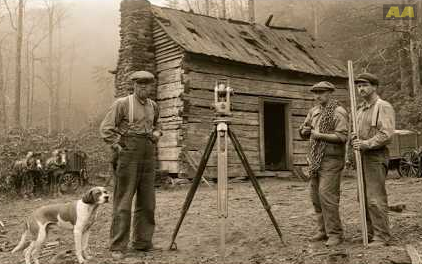
There are places a man remembers because something happened there, and there are places he remembers because something seemed to happen to the world itself while he was standing there.
Sable Hollow was that second kind of place. In the summer of 1931, Hollis Vane walked into the mountains with four men, a transit, a chain, a field book, and a dog named Cuff.
He expected six days of ordinary surveying. He expected old property lines, broken markers, rough country, and perhaps a little trouble finding corners that had been lost for decades.
What he found instead was a piece of land that seemed to have its own arithmetic.
A stone marker disappeared without a track. A cleared path closed itself overnight. Footsteps circled the camp without ever growing nearer or farther away.
A spring showed a face where no person stood. Then, on the fifth evening, Hollis Vane looked across the fire and counted the men around him.
There should have been five. For one brief moment, he counted six. The extra figure stood just beyond the firelight, shaped like one of his own crew.
Then the count became five again. Vane said nothing. He was a surveyor, and surveyors trusted measurements more than feelings.
But the next morning, the number was wrong again. This time, the extra face belonged to someone who was already standing somewhere else.
So what exactly had Hollis Vane walked into when he crossed that old boundary, and why had the people of Cane Fork spent 58 years refusing to enter it?
The year was 1931, and the country was worn thin by hard times. Banks had folded, farms had changed hands, and families who had held the same acres for generations were finding themselves forced to bargain with men who had money ready when nobody else did.
In the lowlands, a timber concern began looking north toward the mountains. They had found a tract that seemed almost too good to ignore.
It was land that had belonged to the Holloway family, deep behind the Tanager Ridge Road, three ridges into the mountains, in a fold of country known on old maps as Sable Hollow.
The property had gone to the county after years of unpaid taxes. The timber company saw nothing mysterious about it.
They saw 160 acres of mountain timber and bottom land that could be acquired cheaply.
The county records showed the Holloways had settled there in the 1840s. Erastus Holloway and his brother Absalom had built a home of squared chestnut logs, put up a barn, established a springhouse, dug a well, and fenced their fields.
A county surveyor had marked the boundaries in 1851, setting down a clean square on the official plat.
For nearly 30 years, the Holloways remained there. Then, sometime during the winter of 1873, they stopped coming into Cane Fork.
At first, nobody found that unusual. Mountain families could disappear into their own hollows for months at a time.
But spring passed. Then summer arrived. Still there was no sign of Erastus, Absalom, or the elderly aunt who kept their household.
Two men eventually rode up to the property. Whatever they found, they did not put into writing.
The county record contained only a dry statement saying that the Holloway household was absent from the homestead, with no person remaining there, and that the property would revert to the county if the taxes remained unpaid.
They did. For 58 years, the taxes went unpaid. That alone was strange enough. Mountain land rarely remained untouched for long.
Men would fight over springs, pasture, timber, and fence lines. A young couple with no money might gladly take land that nobody else wanted.
But nobody moved onto the Holloway property. Nobody built a cabin there. Nobody brought cattle into the bottom fields.
Nobody even seemed interested in cutting firewood. The land slowly disappeared beneath brush and trees, yet the people living within half a day’s walk avoided it.
There was an old saying in Cane Fork. An elderly man at the feed store repeated it to Hollis Vane before the survey crew left for the mountains.
He said, “Up our way, we don’t say a place is haunted. We say a place is full.”
Then he told Vane that Sable Hollow had been full for longer than anyone in town could remember.
Vane thanked him, bought his supplies, and went on with his preparations. He had heard mountain stories before.
He had measured land where people insisted strange things happened. He had crossed old battlefields, swamps, burned timber, and steep country where a wrong step could send a man tumbling down a slope.
He trusted measurements. That was why the timber company wanted him. Hollis Vane was 46 years old that summer.
He had been working with a transit and chain since he was 19, first under his father and later on his own.
His reputation was simple. His lines closed. Give Hollis Vane a boundary and he would return with the same boundary, properly measured.
He was tall and lean, with a weathered face and pale eyes that seemed to remain fixed on whatever he was studying.
His right palm carried a white scar from an accident with a chain when he was young.
After that, he checked everything twice. His crew consisted of four men. Linwood Carrick was past 50 and had carried a chain for Vane longer than anyone else.
He was quiet, practical, and difficult to impress. Burl Aldus was the other chainman. He was large, powerful, and usually cheerful, although he possessed a private superstition he would never admit to.
Otho Wren was the youngeSt. He had not yet reached 30 and served as rodman and field clerk.
His mind was precise and literal. If Otho Wren wrote something in a field book, it had been measured, counted, or directly observed.
The fifth man was not Vane’s employee. Cleon Marsh represented the timber company. Marsh was there to protect his employer’s interests and make certain the survey crew did not overstate the acreage.
He came from the lowlands, had soft hands, a sharp manner, and little patience for mountain stories.
Vane also brought Cuff, a liver and white hound who had traveled with him for 6 years.
Cuff had been through storms, rough camps, strange houses, and difficult country. He had never caused Hollis Vane concern.
Until Sable Hollow. They left on Monday, the last Monday in AuguSt. The Tanager Ridge Road took most of the day.
The trail climbed through steep country, crossed several rough sections, and twisted along the mountain face.
About 2 hours before the turnoff, they passed the last cabin. An elderly woman sat outside stripping beans into her apron.
Linwood Carrick stopped the lead wagon and asked for directions. The woman looked at the equipment, then at the men.
“You boys are for the Holloway Hollow,” she said. It was not a question. Linwood told her they were.
She stopped working. Her people, she explained, had lived on that ridge for a hundred years.
In all that time, none of them had ever needed to go down into that fold of ground.
Then she gave them directions. She did not make a mistake. Every turn was exact.
Before they left, she said, “Whatever you find down there, do not bring it back to my cabin.”
Cleon Marsh laughed once they were out of earshot. He called it mountain foolishness. But the laughter faded before the next bend.
The old trace toward Sable Hollow was surprisingly open. For a road supposedly unused for 58 years, it had very little brush across it.
The vegetation stopped along both sides as though something had kept the passage clear. Only the road remained open.
Otho Wren recorded the time when they entered the hollow. 4:00 in the afternoon. He also recorded something else.
The temperature dropped sharply. It was late AuguSt. The men had been sweating on the ridge less than 20 minutes earlier.
Yet when they entered Sable Hollow, the air became cold enough for the sweat on their shirts to dry.
Otho wrote, “Temp dropped sharp, no breeze.” Then he added, “No birds.” That silence affected all of them.
Linwood Carrick stopped the wagon and listened. There was nothing. No birds. No insects. No distant animal calls.
The forest simply seemed to have gone quiet. They continued. The Holloway house was still standing.
That surprised Vane. The roof had mostly collapsed. The barn was gone. The springhouse was partly ruined.
But the main chestnut structure remained upright. What disturbed him was the ground around it.
An abandoned mountain house normally disappears slowly beneath vegetation. Briars enter the windows. Trees rise through floors.
Grass and brush cover the old paths. The Holloway house was different. The yard was clear.
Not maintained. Not clean. Simply clear. The vegetation stopped about 20 ft from the walls.
Inside that boundary, the earth was bare and packed. Hollis Vane stared at it. He had seen abandoned homes before.
This did not look abandoned. They camped beside the wagons, away from the house. Burl Aldus made a large fire.
Cleon Marsh complained about the cold. Linwood tended the mules. Otho organized the equipment. Cuff refused to settle.
The dog remained beside a wagon wheel, ears lowered, watching the house. When Hollis called him, Cuff came reluctantly.
Then he sat with his back to the fire so he could continue watching the dark house.
Vane slept badly that night. He had never been a man who slept badly. In the morning, they began the survey.
The 1851 plat showed a clean rectangle. The northeast corner was marked by a stone.
Vane found it quickly. The stone was flat, moss covered, and had a cross cut into its surface.
He was pleased. A found corner was valuable. He placed his transit over it. Otho took the rod.
Linwood and Burl handled the chain. They began the north line. The work was ordinary.
66 ft to a chain. Measure. Mark. Measure again. Record the count. By noon they had reached the place where the northwest corner should have been.
There was no marker. No stone. No poSt. Nothing. The brush simply stopped at the same strange boundary.
Vane was not concerned. Corners disappeared over decades. He made a note and began running the west line.
The line should have measured 40 chains. They reached 40. No corner. Vane ordered them to continue.
41. 42. 43. He stopped. The chain was correct. The count was correct. The field book was correct.
Yet the line was too long. Vane checked the chain himself. He examined every link.
Nothing was wrong. They returned to the northeast corner to begin again. The stone was gone.
Vane stood silently. They searched the ground. Their own boot prints remained. The circular marks made by the transit were still visible.
But the stone had vanished. There was a shallow depression exactly where it had stood.
No drag marks. No footprints leading away. No disturbed earth. Burl Aldus said someone must have moved it.
Vane did not answer. He knew how a stone moved. It left evidence. He drove an iron pin into the empty spot and tied a red cloth to it.
The next morning, the pin was 40 ft away. It stood firmly in undisturbed soil.
The red cloth was still attached. The original depression remained empty. That was when the survey stopped feeling ordinary.
By the fourth day, the lines still would not close. Each attempt produced a slightly different result.
The property seemed to become larger. Not dramatically. A chain here. Half a chain there.
Just enough to make the measurements impossible. Otho Wren continued recording everything. His handwriting became smaller.
His lines became closer together. The brush began behaving strangely. When they cleared a path, it was open that afternoon.
By morning, the brush had returned. Burl began marking cut stems with white paint. The paint remained.
But the cuts disappeared. The branches stood whole again. Then came the smell. It appeared after sunset.
It was sweet and heavy, like damp earth and old fruit, with something beneath it that none of them wanted to identify.
Cuff noticed it before the men did. Whenever the smell appeared, the dog lifted his head and made a low sound.
On the third night, they heard footsteps. Hollis Vane first assumed it was one of the mules.
Then he realized the sound was outside the camp. Slow steps. Even steps. They seemed to circle the fire.
Vane listened. The footsteps never came closer. They never moved farther away. They remained the same distance from the light.
Vane began counting. The steps continued around the camp. He counted one circuit. Then another.
The number was identical. He understood what bothered him. The footsteps were not behaving like a person walking around the camp.
They remained the same distance away from the fire the entire time. It was as though something were pacing around the edge of a boundary.
Burl Aldus heard them too. The next morning he painted a circle around the camp.
There were no footprints outside it. The leaves were untouched. Whatever had walked through the night had left no sign.
On the fourth day, Linwood Carrick went into the ruined springhouse to collect water. He came back without the cans.
He sat on the wagon tongue and refused to speak. Two days later, Otho finally persuaded him to explain.
Linwood said the spring water had been perfectly still. He had knelt to fill the cans.
He saw his own reflection. Then he saw another face behind his shoulder. He did not turn around.
He said he knew there was no room behind him for another person. He also knew that if he turned around, he might find nothing.
So he simply stood and walked out. The reflection remained in the water. Linwood never used that spring again.
Then Otho tested the well. The Holloway well was deep and uncovered. He dropped a stone into it.
They listened. The stone should have struck water quickly. It did not. Otho kept counting.
So did Linwood. The sound never came. Otho wrote in his field book, “Well does not bottom.”
Nobody tested it again. The fifth evening brought the count. There were five men in Sable Hollow.
Hollis Vane. Linwood Carrick. Burl Aldus. Otho Wren. Cleon Marsh. Vane looked around the fire.
He counted six. He counted again. Five. He told himself he had made a simple mistake.
Then he remembered the sixth figure. It had stood at the edge of the firelight.
It looked like a member of the crew. Nothing unusual. Nothing threatening. Just another man standing outside the circle of warmth.
Then it was gone. Vane said nothing. That night he listened to the camp breathing.
He counted five. Then six. He stayed awake until morning. At sunrise, Burl Aldus refused to cross into the yard.
He stood at the edge of the clear ground with the chain over his shoulder.
He told Vane that he could feel something pulling gently at his boots toward the house.
Vane did not argue. Cuff would not cross the boundary either. The dog had known from the first morning.
There was an invisible line around the house, and Cuff understood it better than any of them.
On the sixth day, Hollis Vane entered the house. He went alone. Marsh laughed at the idea.
Linwood stayed with the mules. Burl refused. Otho was ordered to remain outside. Vane entered because he wanted records.
An old house usually kept its history in books. He found a family Bible. Behind it was a household ledger.
The entries went back to the 1840s. Erastus Holloway had written about weather, crops, livestock, repairs, debts, and ordinary family matters.
For years, everything looked normal. Then the entries began to change. Erastus wrote about fences that would not remain where he placed them.
He wrote about corner posts moving. He wrote about measuring his fields and finding them larger each time.
He wrote that Absalom refused to work near the upper field after sunset. Then he wrote about feeling watched.
But he corrected himself. He wrote that watching was the wrong word. Watching came from outside.
This feeling came from everywhere. He compared it to standing inside someone else’s calculation. Then he wrote about the aunt leaving an extra place at the table.
When asked about it, she reportedly said it was simply polite. Erastus wrote that the household had always had room.
Then he wondered why. The final winter entries were shorter. Tighter. The handwriting became increasingly compressed.
One entry explained that the land was not growing. Erastus had misunderstood. The land had always been the size it needed to be.
The measuring had not been measuring the property. It had been measuring the people standing upon it.
Then came the final entry. Erastus wrote that the household had finally reached the correct count.
For 30 years, he said, the number had been wrong. There were three people living there, but the land had room for more.
The ground had been patient. It had waited while the count remained incomplete. The final line said that the count would remain correct as long as nobody came and tried to draw a boundary around something that could not be bounded.
Hollis Vane closed the ledger. He returned it exactly where he had found it. He did not take anything.
He did not want anything from that house. Outside, Cuff immediately pressed against his legs.
Vane looked across the camp. Linwood stood near the mules. Burl was beside the wagon.
Marsh was watching him. Otho stood near the field book. Vane counted. Four. He counted again.
Four. Something was wrong. He looked toward the wagon. Otho was there. Then he looked beyond the wagon.
Another Otho stood near the far edge of the clearing. Two Othos. One beside the wagon.
One near the invisible boundary. The one farther away held the field book. Vane froze.
The figure near the wagon moved firSt. It seemed to lose its shape. Not fall.
Not collapse. Simply become indistinct, like smoke thinning in still air. Then it was gone.
The other Otho remained. He took one slow step backward. Toward the boundary. Vane shouted his name.
The young man stopped. Vane ran. He caught Otho by the back of his coat and pulled him forward.
Otho stumbled across the invisible line. The cold returned immediately. The birds vanished. The smell filled the hollow.
Nobody waited to understand it. Hollis Vane shouted one word. “Out.” Linwood released the mules.
Burl grabbed what equipment he could reach. Marsh ran. They left the transit. They left the chains.
They left everything that could slow them down. Vane had spent 30 years protecting his instruments.
He left a $40 transit standing over an unfinished line in Sable Hollow. None of them stopped until they reached the ridge.
The moment they climbed out of the hollow, the temperature changed. Warm August air surrounded them.
Birds began calling again. The ordinary sounds of the forest returned. They counted themselves. Five.
Vane. Carrick. Aldus. Wren. Marsh. Five. Nobody celebrated. They simply kept walking. The timber company never purchased the Holloway property.
Cleon Marsh returned to the lowlands and submitted his report. Nobody knows what he wrote.
But the company abandoned the purchase. Hollis Vane went to the courthouse at Cane Fork.
He asked that the property be marked unsurveyed and unsurveyable. The county surveyor listened. He had grown up hearing stories about Sable Hollow.
He accepted Vane’s field book. The entries in Otho’s handwriting grew smaller toward the end and then stopped.
On the old plat, the surveyor refused to redraw the boundaries. Instead, he left the property blank.
Across the old square, he wrote one warning. “Survey not closed. Do not reattempt.” The Holloway land remained on the county records.
But nobody tried to measure it again. Hollis Vane never surveyed another property. He lived for more than 20 years after leaving Sable Hollow.
People who knew him later described him as quiet and easy company. But there was one habit they remembered.
He counted. At dinner, his eyes moved from person to person. One. Two. Three. Four.
Then back again. He counted guests. He counted people on porches. He counted people entering rooms.
He counted without realizing he was doing it. Linwood Carrick changed in another way. He stopped drinking from wells.
He had a cistern built at his home and collected rainwater instead. When people asked why, he would say he had lost his taste for water that sat still in darkness long enough to hold a reflection.
Burl Aldus left survey work. He eventually entered the timber trade, but he refused to be the last man out of the woods.
He always made sure somebody was ahead of him on the trail. Otho Wren recovered.
Mostly. He never carried a rod again. He continued keeping field notes for the rest of his life.
He recorded weather. He recorded measurements. He recorded ordinary events. But he never wrote down the number of people in a room.
There was another habit his family remembered. If someone called Otho’s name from behind him while he was outdoors, he would not turn around.
The caller had to come around where Otho could see them. Only then would he answer.
It was not fear, according to the people who knew him. It was caution. He had learned that a voice was not always enough to tell him where someone stood.
Years later, a younger surveyor heard the story. He was a college educated man with modern equipment and little patience for old tales.
He decided that Hollis Vane had simply made a chain error. He intended to visit Sable Hollow and prove it.
The old county surveyor tried to discourage him. When that failed, he sent word to Hollis Vane.
Vane was an old man by then. He did not travel much. But he agreed to meet the young surveyor in Cane Fork.
They sat together for a long time. The younger man entered the room confident. He left looking pale.
He never went to Sable Hollow. Nobody learned exactly what Vane told him. One old man claimed he heard part of the conversation through a window.
He said Vane leaned across the table and spoke quietly. “Son, you’ve got your idea backwards.
You think you’d be going up there to measure that ground. You wouldn’t be. You’d be going up there to be measured.”
Then Vane told him to leave the place alone. The younger surveyor listened. For once, he followed an old man’s advice.
The Holloway property remained untouched. The old trace behind the Tanager Ridge Road gradually disappeared beneath vegetation.
The gray house remained somewhere beyond it. The bottom land stayed unused. The county map kept the blank space.
And the warning stayed written across the old plat. There are many ways to explain what happened there.
A cold pocket of mountain air can make men uncomfortable. Silence can make ordinary sounds seem strange.
Old maps can contain errors. Survey chains can be misread. Tired men can miscount. A nervous dog can refuse to cross an invisible boundary for reasons nobody understands.
A reflection in dark water can become another face when the light is poor. Those explanations are available.
They are reasonable. But they do not explain everything. They do not explain why the original corner stone vanished and left no trail.
They do not explain why the replacement marker appeared 40 ft away. They do not explain why the survey lines became longer each time.
They do not explain why five men sometimes counted six. They do not explain why Otho Wren appeared in two places at once.
And they do not explain why the county surveyor, a practical man whose entire profession depended upon drawing boundaries accurately, chose to leave 160 acres blank rather than try again.
Perhaps the story is nothing more than a chain of strange coincidences preserved because people enjoy a mystery.
Perhaps Sable Hollow was simply an isolated place where tired men allowed their fears to shape what they saw.
Or perhaps the Holloway family understood something about that land that Erastus tried to explain in the final pages of his ledger.
Maybe some places do not fit neatly inside lines. Maybe there are places where measuring something changes the relationship between the person measuring and the thing being measured.
Maybe Hollis Vane discovered that the hard way. The most unsettling detail is not the missing stone.
It is not the footsteps. It is not the reflection in the spring. It is the count.
Five men entered Sable Hollow. At different moments, they saw six. Then four. Then five again.
And when Hollis Vane finally understood what the extra figure represented, he did not try to solve the mystery.
He ran. That may be the only reason the story exists at all. Because Hollis Vane knew something that his younger replacement did not.
There are questions a man can answer by measuring. There are questions a man can answer by returning to the same place.
And there are questions where the wisest answer is to stop asking. So if you ever find yourself somewhere that suddenly becomes cold without reason, somewhere where the ordinary sounds disappear, somewhere where a familiar path seems unfamiliar beneath your feet, remember the old warning from Cane Fork.
Do not draw the line firSt. Count your people. Count them carefully. And if the number comes back wrong, even once, do not keep counting until you get the number you expected.
Leave while leaving is still a choice. Because somewhere in the mountains, behind an old road and three ridges, there is a blank space on a county map where 160 acres should have been measured and recorded.
The Holloway name is still there. The old warning is still there. And if the story is true, the land is still waiting.
Not angry. Not rushing. Just patient. Waiting for someone to walk through the old trace again.
Waiting for someone to unfold a map. Waiting for someone to place a transit on the ground and begin measuring.
And perhaps the strangest question of all is not what happened to Hollis Vane and his crew, but what the Holloway land might count if someone ever gives it another chance to begin?
Disclaimer: This content may be created by Al for entertainment purposes. Any resemblance to real persons, events, or places is coincidental.








