Unknown Cryptids Caught On Camera In 2026 That Should Not Exist
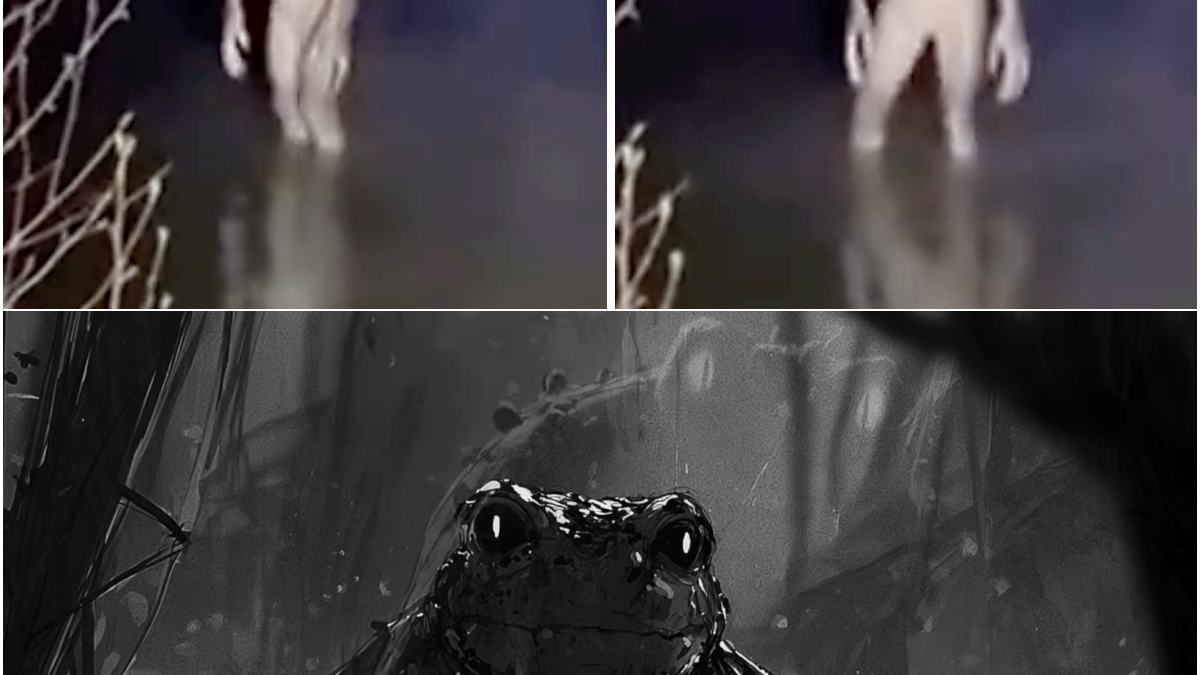
The swamp was almost completely silent when the fishermen first saw the figure standing in the water.
Their airboat moved through the darkness, its engine echoing across the bayou as the narrow beam of a powerful spotlight swept over the reeds and tangled trees.
At first, the shape ahead looked like an ordinary person, someone standing knee-deep in the shallow water, perhaps waiting beside the bank or searching for something beneath the surface.
But the longer they watched, the less human it appeared. Its arms seemed far too long, its shoulders were hunched beneath an oddly rounded head, and its pale body reflected the light with a slick, unfamiliar shine.
Then the figure appeared to turn toward them. For a moment, the fishermen could make out its face, its motionless posture, and the strange brightness of its eyes.
Nobody aboard could explain what they were looking at. The boat continued forward, but the creature did not call out, wave, or behave like someone surprised to find strangers approaching.
Instead, it seemed to watch them in complete silence before slipping away into the black water.
By the time the spotlight reached the place where it had stood, there was nothing left to see except ripples spreading between the reeds.
The fishermen had images, but images could not tell them what the creature was. Was it an unknown animal, a person distorted by darkness, or something that belonged to the strange stories told about the swamps?
The fishermen had traveled into an isolated stretch of Louisiana’s wetlands, a landscape where water and land seemed to exchange places without warning.
During daylight, the bayou could appear deceptively peaceful, with cypress trees rising from the shallows and curtains of vegetation hanging above dark channels.
After nightfall, however, the same environment became difficult to recognize. The water reflected almost no light, the trees formed dense silhouettes, and the smallest movement could seem enormous when seen through a spotlight.
Their journey had not begun as an expedition in search of anything unusual. They were simply traveling through the swamp, moving across familiar waterways under conditions that made careful navigation essential.
The late hour had left the surrounding landscape almost empty. There were no visible camps, no obvious fishing equipment, and no lanterns marking another person’s position.
When the shape appeared in the distance, the simplest explanation seemed to be that someone had wandered into the shallows.
The first impression was convincing enough that the fishermen did not immediately consider anything extraordinary.
A person standing in water might look strangely proportioned when viewed from a moving boat.
Reeds could conceal the lower body, shadows could alter the apparent width of the shoulders, and reflections could distort the shape of a face.
Yet as they drew closer, the figure seemed increasingly difficult to explain. Its arms were the first detail that caught their attention.
They appeared to extend unusually far down the sides of its body, almost reaching the surface of the water.
Its upper body seemed broad and rounded, while its shoulders curved forward into a pronounced hunch.
The figure did not stand with the familiar posture of someone waiting for a boat.
It seemed more like an animal that had temporarily raised itself upright. Then came the skin.
Under the spotlight, the visible surface of the creature appeared pale and smooth, with a shine that reminded the witnesses of something wet.
The brightness made it difficult to judge its natural color, but the contrast against the dark water gave the figure an almost ghostly appearance.
Its head seemed unusually rounded, without the familiar outline of a human face. The fishermen directed the spotlight more carefully, trying to understand what they were seeing.
The creature remained visible long enough for several images to be captured. In one, it appeared to face almost directly toward the boat.
Its arms hung beside its torso, and its legs disappeared beneath the surface. In another, it seemed to have turned sideways, revealing a hunched back and the unusual length of its upper limbs.
The images became the center of the story because they appeared to preserve several details that the witnesses struggled to describe.
They did not provide a clear explanation, and the darkness left plenty of room for uncertainty.
Still, the photographs seemed to show a figure with a distinctly unusual silhouette. According to the fishermen, the creature eventually turned toward the approaching airboat.
Its eyes appeared to reflect the spotlight brightly, creating two points of light against the shadowed head.
The moment was brief, but it changed the atmosphere aboard the boat. What had begun as curiosity became a tense attempt to understand whether the figure was watching them or simply reacting to the light.
The creature did not behave like a startled person. It did not shout, raise its hands, or attempt to move toward the boat.
Instead, it reportedly slipped into the dark water and disappeared. The movement was quiet, and the surrounding surface showed remarkably little disturbance.
Within moments, the spotlight revealed only the place where the figure had been standing. The fishermen continued looking, but the swamp offered no clear sign of where it had gone.
The dark channels branched into vegetation, and the water concealed everything beneath its surface. There was no reliable way to follow the creature without risking the boat in unfamiliar shallows.
Eventually, the group had to accept that the encounter was over. When the images began circulating, comparisons with the American Frogman quickly followed.
The name is most closely associated with a legendary amphibian-like humanoid reported around Loveland, Ohio.
Stories about the creature have appeared in different forms over the decades, but many descriptions share a few striking characteristics.
The Frogman is often portrayed as a small upright being with a broad face, unusual hands and feet, and skin that resembles the surface of an amphibian.
Traditional accounts commonly place the creature at approximately three to four feet tall. It is said to move on two legs and to possess a body that appears neither entirely human nor entirely animal.
Some witnesses have described leathery skin, while others emphasize its broad facial features and strange posture.
The details vary, but the association with water has remained one of the most persistent parts of the legend.
The best-known early account dates to May 1955, when a businessman traveling near Loveland reportedly encountered three strange humanoid beings beside a road.
The creatures were described as short, upright figures with leathery skin and broad, frog-like faces.
One allegedly held a small metallic object that produced a brief display of sparks. The beings then disappeared into nearby vegetation, leaving the witness with a story that would become part of the region’s folklore.
The account was unusual enough to attract attention, but it did not settle the question of what had been seen.
The description could be interpreted in different ways, and the reported metallic object added another mysterious detail without providing a clear explanation.
Over time, the story became part of the wider collection of strange encounters associated with the Loveland area.
The mystery resurfaced in March 1972, when police officers reported encounters with unusual creatures around Loveland and the Little Miami River.
One account described an animal moving across a roadway before rising upright and disappearing over a guardrail toward the water.
The reported movement reinforced the connection between the Frogman and rivers, streams, and wet environments.
Later stories continued to associate similar figures with lakes and waterways. In 2016, witnesses near Lake Isabella reportedly saw a large frog-like being moving upright close to the water.
As with earlier accounts, the report added another location and another description, but it did not establish the existence of an unknown species.
The Louisiana photographs have drawn interest because they seem to echo several of these familiar features.
The figure appears upright, its arms seem unusually long, and its body has a pale, amphibian-like appearance beneath the spotlight.
Its apparent ease in the water also fits the setting that has become closely associated with Frogman stories.
Yet the Louisiana encounter is separated from Loveland by a considerable distance. The landscapes are different, the reported circumstances are different, and the images do not establish that the two stories concern the same kind of being.
The resemblance may be meaningful to people who study these legends, but it may also reflect the way unfamiliar shapes are interpreted through stories that are already familiar.
Louisiana’s wetlands provide a setting where unusual sightings can be difficult to investigate. The state’s network of swamps, bayous, marshes, and isolated waterways stretches across an enormous area.
Some places are accessible only by boat, and others become especially difficult to navigate after dark.
Dense vegetation can conceal animals and people, while the black surface of the water can make distances almost impossible to judge.
A spotlight creates a narrow island of visibility within that darkness. Anything outside the beam remains difficult to identify, and objects inside it can appear distorted by the contrast between bright illumination and deep shadow.
A creature standing in water might seem taller or broader depending on how much of its body is submerged.
Reflections can exaggerate the apparent brightness of eyes, skin, or wet vegetation. These possibilities do not explain the fishermen’s encounter by themselves.
They simply illustrate why a photograph taken at night may preserve an unusual appearance without revealing the identity of whatever was present.
A clear image of a familiar animal can sometimes be more useful than a blurred image of an unfamiliar one, because the latter leaves so many details uncertain.
The photographs also invite a basic question about the figure’s proportions. If the arms were genuinely as long as they appeared, the creature would have an unusual body structure.
If the water concealed more of its torso or legs than the witnesses realized, the apparent proportions could be misleading.
Without reliable scale, a stable view, and additional evidence, the images cannot settle the issue.
The fishermen’s account nevertheless became another chapter in the wider collection of American amphibian legends.
The Frogman remains an unusual figure because its descriptions combine familiar animal characteristics with a distinctly human posture.
It is neither simply a frog nor an ordinary person. Its imagined appearance occupies a strange space between the two, making it easy to recognize in a silhouette but difficult to define in detail.
The Louisiana figure seemed to occupy that same uncertain space. It stood like a person, but its posture appeared wrong.
Its arms looked like limbs, but their length seemed unnatural. Its pale surface suggested wet skin, yet the spotlight could have transformed an ordinary texture into something unfamiliar.
The creature vanished before the witnesses could learn anything more. Far from Louisiana, another mysterious image has reportedly emerged from the remote floodplains and sparse forests surrounding the Mamoré River basin in Rondônia, Brazil.
This time, the figure is not pale or amphibian-like. It appears large, heavily built, and covered in brown or reddish-brown hair.
The footage is extremely blurred, but the shape moving across the landscape has drawn comparisons with one of the Amazon’s oldest mysterious beings, the Mapinguari.
The setting is a vast region where rivers, forests, and seasonal wetlands create a complicated landscape.
The Mamoré River basin is part of a wider system of waterways and forest habitats that can be difficult to explore comprehensively.
From the edges of clearings, the forest may appear quiet, but beyond the visible ground lies a dense network of vegetation, fallen branches, and shaded pathways.
The footage reportedly shows a large figure moving through this environment. Its body appears rounded and powerful, with long upper limbs hanging low beside its torso.
The movement seems lumbering, as though the creature carries considerable weight. A reddish-brown covering is visible across its outline, although the poor image quality makes it difficult to distinguish hair from shadow or vegetation.
The comparison with the Mapinguari comes from traditions preserved by Indigenous communities throughout the western Amazon.
For generations, accounts have described an enormous forest being that should be approached with caution.
The creature is often portrayed as powerful, shaggy, and difficult to follow. Some descriptions emphasize its enormous claws, heavy body, and unusual way of moving through dense vegetation.
The stories differ between communities and over time. In some versions, the Mapinguari is described as having backward-facing feet, a feature said to make its tracks confusing.
Other accounts emphasize its strength or its ability to move through the forest with surprising ease.
Some descriptions include an overwhelming smell or strange cries that carry through the trees. The figure in the Rondônia footage appears to share a few of these reported characteristics.
Its body seems unusually large and rounded, and its arms appear to hang close to the ground.
The reddish-brown outline resembles the shaggy covering often associated with the Mapinguari. But the footage is too blurred to establish whether those details are genuine physical features or visual effects created by distance and movement.
The Mapinguari has also become part of a wider discussion about prehistoric animals and the possibility that old traditions may preserve memories of creatures that once lived in the region.
One particular comparison involves the giant ground sloths that inhabited South America during prehistoric times.
Some species grew much larger than the sloths living today, with powerful bodies, immense claws, and the ability to raise themselves upright on their hind limbs.
A giant ground sloth would have looked dramatically different from most animals familiar to people today.
Its massive frame and long claws could have made it an imposing presence in a forest environment.
Its ability to stand upright may also have contributed to descriptions of a large, powerful being moving through the trees.
This resemblance has led some people to suggest that Mapinguari traditions could preserve ancient memories of giant ground sloths.
The idea is intriguing because it connects a longstanding cultural tradition with an animal known from fossils.
However, a resemblance does not establish a direct connection, and the survival of a prehistoric species into modern times would require evidence beyond folklore or unclear footage.
A more extraordinary possibility proposes that an isolated population of giant ground sloths somehow survived far longer than currently recognized, hidden within the enormous wilderness of the Amazon.
The region’s size and complexity make it easy to understand why people find the idea compelling.
Vast forests, seasonal wetlands, and remote river systems can make travel difficult, while dense vegetation limits visibility even in daylight.
But the Amazon is not an untouched blank space. People live throughout the region, travel its rivers, study its wildlife, and maintain deep knowledge of local environments.
A large animal population would leave signs that could potentially be studied, including tracks, feeding evidence, hair, remains, and repeated observations.
Without such evidence, the footage remains an uncertain image rather than confirmation of a surviving prehistoric animal.
Still, the Mapinguari story endures because it brings together several powerful elements: the mystery of the forest, the memory of enormous prehistoric mammals, and the possibility that familiar landscapes may contain animals that have not yet been properly understood.
The Rondônia footage has become interesting to viewers because it seems to offer a glimpse of a large, shaggy figure in precisely the kind of environment where such a legend belongs.
The image does not reveal a face clearly. It does not provide a reliable view of the feet, and it offers little opportunity to measure the creature against nearby objects.
Its movement is difficult to interpret because the body shifts between patches of shadow and lighter ground.
A person viewing the footage may see a massive animal, while another may see a familiar animal or an ordinary object distorted by distance.
Even so, the shape invites comparison with the Mapinguari. Its broad body and low-hanging limbs create an impression of great strength.
The reddish covering makes it look shaggy, and the slow movement gives it a heavy, deliberate appearance.
Those features are enough to encourage speculation, even if they are not enough to identify the figure.
The third mysterious image circulating through online Bigfoot communities presents a different possibility. Instead of an enormous adult creature, the figure appears remarkably small.
It stands among trees in a remote forest, partially concealed by the surrounding vegetation. Its compact body, reddish-brown covering, and upright posture have led some viewers to suggest that the image might show a juvenile Bigfoot.
The photograph includes a deer in the foreground, an important detail because it offers a familiar point of reference.
The animal stands closer to the camera, while the mysterious figure appears farther back between several large tree trunks.
The surrounding landscape is filled with mature trees, fallen branches, and thick forest debris. Natural cover breaks up the view, making the background difficult to examine.
At first glance, the deer attracts attention because it is recognizable and relatively clear. Beyond it, however, the small humanoid shape appears to stand upright.
Its body is covered in dark reddish-brown hair, and its arms seem long enough to extend toward its knees.
Its shoulders appear broad in relation to its height, while its head seems to sit low against the upper body.
The hair around the head appears lighter and more reddish than the covering on the torso and legs.
This contrast gives the figure an unusual outline. Its small size is the detail that has attracted the greatest intereSt. Bigfoot encounters are generally associated with enormous beings, often described as towering figures moving through forests.
This individual appears much shorter than the adults usually discussed in those reports. Using the deer and surrounding trees as rough visual references, some viewers have suggested that the figure could be substantially shorter than an adult human.
Yet perspective makes this kind of comparison uncertain. The deer and the humanoid are positioned at different distances from the camera, and the photograph does not provide a reliable scale.
The trees may also distort the viewer’s sense of proportion, especially when the figure is partly concealed.
Nevertheless, the possibility of a juvenile Sasquatch has become central to the discussion. If Bigfoot represented an undiscovered population of large primates living in North American forests, young individuals would necessarily be part of that population.
Their presence would be an expected part of any breeding community, even though reports of juvenile creatures are considerably less common than reports of enormous adults.
A young animal might be harder to recognize at a distance. Its body would be smaller, its movements might be less deliberate, and its proportions could differ from those of a mature individual.
It might also remain close to protective adults, limiting the likelihood that witnesses would encounter it alone.
If such animals were naturally cautious, their behavior could make them especially difficult to photograph.
The figure in the photograph appears positioned within natural cover rather than standing openly in the middle of a clearing.
Its dark coloring blends with the surrounding woodland, and the tree trunks interrupt its outline.
It does not seem to be approaching the camera. Instead, it appears to be standing still, perhaps watching the deer or looking toward something outside the frame.
The deer introduces another question. Was the smaller figure observing the animal, following it, or simply sharing the same stretch of forest?
The image does not establish a connection between them. The deer might have been moving through its normal habitat, while the figure stood in the background for an unrelated reason.
Yet the arrangement has encouraged viewers to imagine a quiet moment in which an unusual creature watches a familiar animal.
If the figure were a young Bigfoot, the photograph might represent an encounter rarely described in the wider tradition.
Many reports focus on large, intimidating silhouettes, enormous footprints, or figures seen crossing roads and clearings.
A small individual would offer a different kind of story, one centered on the possibility of a hidden family group rather than a solitary adult.
The photograph also raises the possibility that an adult might have remained nearby. The juvenile, if that is what the figure represents, could have been traveling with a larger creature concealed beyond the camera’s view.
Dense vegetation would make it easy for another figure to remain hidden. The image provides no evidence that an adult was present, but the possibility is often raised when people discuss what a young animal might be doing alone.
There is, however, another explanation that deserves attention. The figure might be a person, an animal seen from an unusual angle, or an object whose outline has been altered by distance and the surrounding vegetation.
A photograph can make an ordinary subject appear unfamiliar when details are obscured. Enlarging an image may reveal more pixels without revealing more genuine information, and viewers can unconsciously fill in missing features according to what they expect to see.
That is particularly relevant to Bigfoot photographs because the subject is already surrounded by strong cultural expectations.
People who believe in Sasquatch may recognize a familiar shape in a blurry image, while skeptical viewers may interpret the same outline as a person or a stump.
The disagreement does not necessarily mean that either viewer is deliberately misrepresenting what they see.
It illustrates how easily uncertain visual information can invite different interpretations. The most useful details would be those that could be checked independently.
A clear view of the figure’s face, hands, feet, or movement could help establish whether it was human, animal, or something else.
Reliable measurements, an identifiable location, and the original unedited image would also make the photograph easier to examine.
Without those details, the juvenile Bigfoot interpretation remains speculation. The three encounters share a striking feature despite their different settings.
Each presents a figure that seems to occupy the boundary between the familiar and the unknown.
The Louisiana creature resembles a person but appears strangely amphibian. The Rondônia figure resembles a large shaggy animal but recalls a legendary forest being.
The small figure among the trees resembles a primate but has been interpreted as a young member of a creature whose existence remains unconfirmed.
Each story also depends on the environment in which the image was reportedly captured. The Louisiana bayou hides its waterways beneath darkness and vegetation.
The Amazonian landscape offers vast stretches of forest and floodplain where distant shapes can be difficult to identify.
The North American woodland conceals its background behind trunks, branches, and layers of foliage. In all three cases, the images provide a starting point rather than a final answer.
The fishermen may have encountered an unusual animal, a person, or a misleading shape created by light and water.
The Rondônia footage may show a large animal, an ordinary subject distorted by blur, or something that viewers have interpreted through the Mapinguari tradition.
The small forest figure may be a juvenile Sasquatch, but the photograph does not establish that identity.
The legends themselves remain important parts of the stories. The Frogman connects modern reports with decades of accounts around Loveland and other waterways.
The Mapinguari connects a mysterious forest figure with Indigenous traditions and the memory of prehistoric animals.
Bigfoot stories connect the possibility of an undiscovered primate with the immense forests of North America and the many reports gathered over generations.
Folklore can preserve local knowledge, cultural memory, and ways of interpreting unusual experiences. It can also influence what people expect to see when something unfamiliar appears.
A witness who knows the Frogman stories may recognize amphibian features in an uncertain silhouette.
Someone familiar with the Mapinguari may see a shaggy giant in a blurred recording. A Bigfoot enthusiast may interpret a small humanoid shape as a young Sasquatch.
That influence does not make the witnesses dishonest, nor does it automatically make their accounts meaningless.
It simply means that interpretation and observation are not the same thing. A person may accurately describe a strange shape while remaining uncertain about what produced it.
The challenge is to preserve the distinction between what the image visibly shows and what people believe it might represent.
For the fishermen in Louisiana, the most memorable moment may have been the creature’s apparent turn toward the spotlight.
In the darkness, the figure seemed to look directly at the approaching boat. Its eyes reflected the light, and then it vanished into the water.
Whether the movement belonged to an unknown animal or a familiar one seen under unusual conditions, the experience left them with an image that could not answer their questions.
For viewers of the Rondônia footage, the most striking detail is the creature’s apparent size.
The broad body and low-hanging limbs suggest a powerful animal, while the reddish covering recalls descriptions of the Mapinguari.
But the forest provides no clear scale, and the blur makes the outline difficult to interpret.
The image can inspire a theory without proving it. For those examining the small figure in the woodland photograph, the most intriguing possibility is that it might represent a young creature rather than a mature one.
The deer gives the image a recognizable point of reference, and the figure’s compact proportions distinguish it from the towering beings described in many Bigfoot accounts.
Yet perspective and concealment make the apparent size uncertain, and the photograph does not show whether another creature was nearby.
The mysteries are therefore different, but they share the same unresolved question. What happens when an unfamiliar shape appears in a place where people already expect the unexpected?
The answer may depend on better photographs, independent witnesses, physical evidence, and careful examination. Until then, the images remain fragments of encounters whose full circumstances are unknown.
The swamp, the Amazon, and the forest all hold their own secrets, but darkness and distance can make ordinary things look extraordinary.
A spotlight can transform a person standing in water into an amphibian silhouette. A blurred figure crossing a floodplain can resemble a legendary giant.
A small shape between tree trunks can appear to be an animal that has never been documented.
That uncertainty is part of what keeps these stories alive. The photographs offer something tangible to look at, while leaving enough unanswered questions for imagination to fill the gaps.
They invite viewers to consider possibilities without requiring them to accept any single explanation. And somewhere beyond the limits of the images, the real identities of the figures remain unknown.
Perhaps the Louisiana encounter involved an animal that had simply never been seen clearly in those conditions.
Perhaps the Rondônia footage captured a familiar creature distorted by distance. Perhaps the small figure in the forest was only a trick of perspective.
Or perhaps each image records an event that deserves a closer investigation. For now, the figures remain where the photographs left them: one in the black water of a Louisiana bayou, one moving through the remote landscape of Rondônia, and one standing quietly among the trees beside a deer.
Each appears for a moment, invites a question, and then leaves the viewer with the same uneasy uncertainty.
What, exactly, was looking back?
Disclaimer: This content may be created by Al for entertainment purposes. Any resemblance to real persons, events, or places is coincidental.








