Unknown Creatures Have Been Filmed Across the Australian Outback
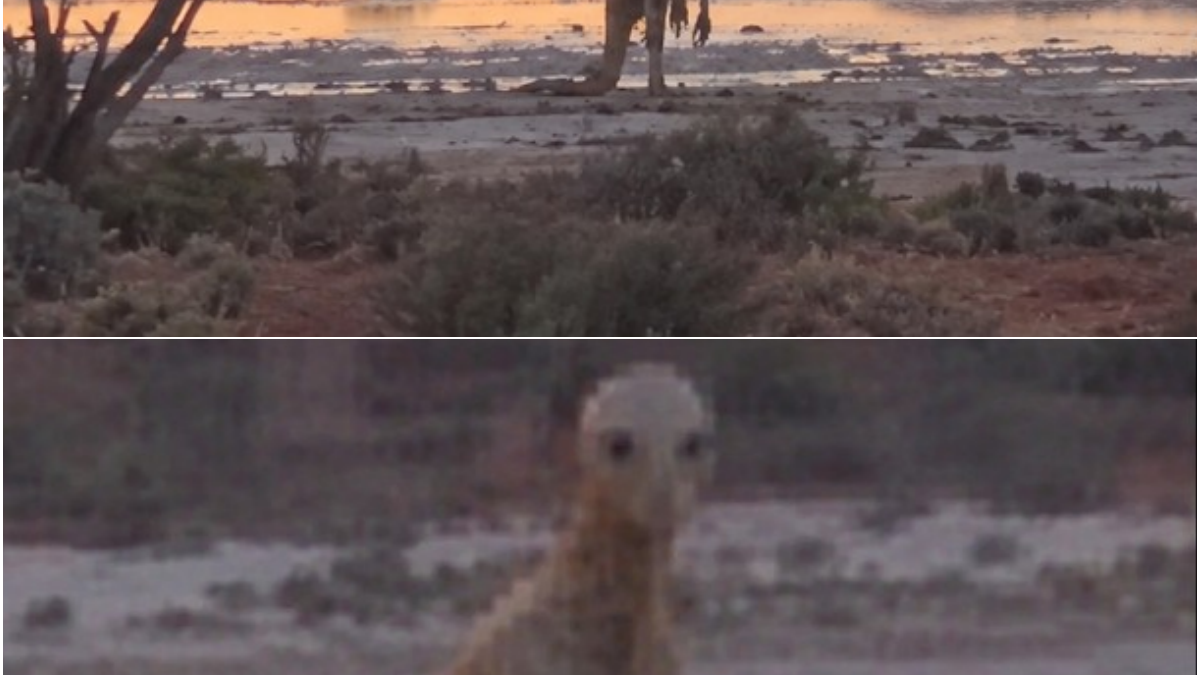
Australia is a land where the wilderness still holds secrets that seem almost impossible to explain.
Across its enormous stretches of forest, remote farmland, rugged mountains, and deep blue coastline, strange creatures have appeared in photographs, videos, and eyewitness accounts, leaving people wondering whether they witnessed an ordinary animal behaving unusually or something that science has yet to identify.
Some sightings last only a few seconds. Others leave behind photographs that are examined for years, with no agreement about what they actually show.
In 1973, a couple driving through South Australia filmed an animal whose unusual movement reminded viewers of the long vanished Tasmanian tiger.
Decades later, a shadow drifting beneath the waves off Western Australia sparked speculation about enormous marine creatures.
In the forests of Queensland, a mysterious figure appeared near a pile of apples, while a bushwalker in the mountains captured footage of something tall, dark, and apparently struggling to walk.
Then there were the discoveries beneath the ocean, where a strange blue organism appeared in footage recorded thousands of feet below the surface, and the photographs of a bizarre carcass washed onto a Queensland beach that some people thought resembled a mermaid.
Each story begins with a simple question. What exactly did someone see? The answers are not always extraordinary.
Some footage is too blurry to identify, some sightings have plausible explanations, and some stories have grown more mysterious as they have circulated online.
But taken together, they reveal something fascinating about the Australian wilderness and the human imagination.
What follows is a journey through these unusual encounters, beginning with a sighting that has continued to attract attention for more than half a century.
In 1973, Gary and Liz Doyle were traveling along a remote dirt road in South Australia when something unexpected appeared beside their vehicle.
The landscape around them was quiet and open, with thick vegetation bordering parts of the road and long stretches of wilderness extending beyond the places they could easily see.
At first, the animal was simply another movement in the surrounding brush. But as it began running alongside their car, Gary realized there was something unusual about its appearance.
He reached for his camera and started recording. The resulting footage lasted approximately ten seconds, but it became one of the most discussed pieces of supposed evidence connected to sightings of the Tasmanian tiger on mainland Australia.
The animal appeared slender, with an elongated snout, a relatively low body, and a thick tail extending behind it.
Its movement was particularly striking. Rather than displaying the familiar running pattern of a dog or fox, it seemed to bounce awkwardly, with a stiff posture and an unusual rhythm.
For people familiar with historical descriptions of the thylacine, those details were intriguing. The thylacine, commonly known as the Tasmanian tiger, was a distinctive carnivorous marsupial with a long tail, narrow head, and characteristic stripes across its back.
Although it had once inhabited mainland Australia, it became associated primarily with Tasmania in its later history.
The last widely recognized individual died in captivity during the 1930s, and the species has since been regarded as extinct.
Nevertheless, reports of possible sightings have continued to emerge over the years. Some witnesses describe an animal resembling an old illustration of a thylacine.
Others report unusual tracks, strange calls, or fleeting movements in remote areas. The Doyle footage became especially interesting to enthusiasts because it appeared to show an animal moving rather than simply standing at a distance.
Its supporters have pointed to the tail, body shape, and unusual gait as features worth examining.
Skeptics, however, have questioned whether the footage provides enough detail to identify the animal reliably.
Without clear images, measurements, or independent examination of the original recording, the creature’s identity remains uncertain.
It could have been an unfamiliar animal seen under unusual circumstances. It could have been a misidentified dog or another species.
Or it could be one of those rare recordings that continues to attract attention precisely because it does not provide a definitive answer.
What makes the sighting memorable is not simply the possibility of a thylacine appearing decades after its disappearance from public view.
It is the difficulty of separating what the camera actually captured from what viewers hope it captured.
And while the Doyle footage came from the land, another unusual recording would eventually turn attention toward the ocean.
In March 2026, viewers watching a surf camera near Scarborough in Western Australia noticed something strange moving beneath the water.
The camera was part of the local surf observation system, which allowed people to monitor coastal conditions and wave activity.
On a rainy Saturday, the footage revealed a large, dark shape drifting through the water.
It was difficult to determine its size or precise outline, but the shadow appeared substantial enough to attract immediate attention.
When Small Net, an Australian surf forecasting site, shared the clip, viewers began offering possible explanations.
Some suggested it was a large shark. Others wondered whether it might be a whale shark, an oarfish, or even a crocodile.
One particularly imaginative suggestion compared it to a small submarine. The recording offered very little certainty.
Rain, distance, and the camera’s limited detail made it difficult to distinguish the creature’s outline from the surrounding water.
Still, the shape appeared to move in a way that encouraged speculation. A shark would ordinarily be expected to produce recognizable body movements, although its appearance can change considerably depending on its position and the camera angle.
A whale or other large marine animal could also create an unusual shadow when seen from above.
The possibility of an oarfish attracted attention because of the species’ unusual length and distinctive body shape.
These deepwater fish can look remarkably unfamiliar when encountered near the surface, although the footage alone did not establish that one was present.
The mystery became a familiar online spectacle. People paused the recording, enlarged individual frames, and debated whether the dark shape was an animal or simply an optical effect created by the conditions.
Without a clearer recording or independent identification, none of the proposed explanations could be confirmed.
Yet the clip demonstrated how quickly an ordinary coastal camera could become the center of an unusual mystery.
The ocean hides most of its inhabitants from everyday observation. Even familiar species can look strange when filmed from unexpected angles, and large areas of the marine environment remain difficult to observe continuously.
That uncertainty makes underwater sightings particularly fascinating. But Australia’s mysterious creatures are not limited to the sea.
Some of the country’s most persistent stories concern a supposed giant that is said to inhabit the forests.
The creature is known as the Yowie. For generations, stories of a large, hairy, humanlike figure have circulated in different parts of Australia.
Descriptions vary, but the creature is commonly imagined as tall, heavily built, covered in dark hair, and capable of moving through thick vegetation without being easily seen.
Some people compare it to the North American Bigfoot. Others regard the Yowie as part of Australia’s broader tradition of wilderness stories, where unfamiliar sounds, distant silhouettes, and encounters with wildlife become part of local folklore.
In March 2014, two Yowie researchers, Jason Heal and Jason Dunn, attempted to capture evidence of the creature in South Queensland.
Their method was simple. They selected an area of bushland, positioned a hidden camera, and placed a pile of apples nearby as bait.
They hoped that a large animal might approach the food and remain within the camera’s field of view long enough to be recorded.
When they later reviewed the footage, they found something they considered unusual. They called it the morning visitor.
The recording showed a dark figure moving near the apples, partially concealed by vegetation. Its shape appeared broad and heavy, and some viewers interpreted its head and upper body as resembling those of a large, hairy creature.
At certain moments, the figure seemed to face the camera. Its eyes appeared bright in the available footage, although the image quality made it difficult to establish exactly what was producing the reflection.
For Yowie enthusiasts, the recording offered another intriguing example of a possible encounter. The figure’s size and posture became subjects of discussion, particularly because the camera had been positioned specifically to capture movement near the bait.
However, the recording did not provide a clear view of the creature’s features. Vegetation obscured important details, and the darkness of the image made it difficult to establish its actual proportions.
An ordinary animal moving close to the camera could potentially appear much larger or stranger than it really was.
Even so, the footage continued to circulate among people interested in unexplained wildlife sightings. The apples had been placed there to attract an unknown visitor.
Something had appeared. But whether it was the creature the researchers hoped to find remained an open question.
The next encounter came from a place where ordinary explanations become increasingly difficult to apply: the deepest parts of the ocean.
In 2019, during the Five Deeps expedition, marine scientist Alan Jamieson and his team explored the Java Trench, an enormous underwater region where the pressure is immense and sunlight cannot reach.
The expedition was designed to investigate some of the deepest environments on Earth. Its equipment allowed researchers to record footage in places that few people had ever observed directly.
Among the unusual discoveries was a strange, gelatinous organism attached to a long stalk. The creature appeared almost plantlike.
Its body was translucent, with a rounded structure at the top and a long, narrow attachment extending downward.
In the recorded images, its coloration appeared strikingly blue, making it stand out against the dark underwater environment.
The team believed the organism might be a stalked ascidian, commonly known as a sea squirt.
Sea squirts are marine invertebrates that can attach themselves to surfaces and filter particles from the surrounding water.
Some species have unusual shapes, and their appearance can change considerably depending on their environment and the way they are filmed.
However, the footage raised questions about the exact identity of the organism. Jamieson suggested that it might represent a species not previously documented by researchers, although the recording alone could not establish that it was entirely new to science.
That distinction matters. An animal can look unfamiliar without being undiscovered. Deepwater species often have unusual appearances because they have adapted to environments very different from those found near the surface.
At nearly 24,000 feet below the ocean, the environment is unlike anything people experience on land.
Pressure, temperature, and the absence of sunlight shape the lives of organisms in ways that can make them seem almost alien.
The creature’s appearance invited comparisons to fictional underwater worlds, including the strange landscapes of Pandora in Avatar.
Its delicate body seemed suspended in the darkness, almost like a tiny underwater plant waiting for a current to carry something toward it.
Yet the most remarkable part of the footage was not simply its appearance. It was the reminder that even after decades of scientific exploration, the deepest ocean continues to reveal organisms that challenge people’s expectations.
A strange shape in a forest might turn out to be an ordinary animal. A shadow beneath the waves might be a familiar species filmed under unusual conditions.
But deep underwater, researchers sometimes encounter creatures whose identities genuinely require careful investigation. And unlike many mysterious wildlife recordings, this one came from a scientific expedition equipped to document the environment in which the organism lived.
From the deepest ocean, attention returned to Australia’s forests, where another recording had attracted interest because of the way its subject moved.
A bushwalker named Steve Piper was hiking through the Brindabella mountain range near Canberra when he noticed something moving among the trees.
The mountains contain extensive areas of forest, with steep slopes, thick vegetation, and remote sections where visibility can be limited.
For a person walking through such terrain, an animal can appear suddenly and disappear just as quickly.
Piper managed to record approximately twenty seconds of footage using his camcorder. The recording showed a tall, dark, bipedal figure moving through the vegetation.
Its upper body appeared broad, while its arms seemed unusually long. The figure was partly concealed by the trees, but its movement was visible for several moments before it disappeared farther into the foreSt.
What particularly attracted attention was its apparent limp. Rather than moving with an even rhythm, the figure seemed to drag one side of its body as it walked.
Each step appeared deliberate and heavy, creating an impression of an animal struggling to move comfortably through the terrain.
For people who believed in the Yowie, the recording seemed to offer another possible example of the creature.
The broad shoulders, dark appearance, and apparent bipedal movement matched several traditional descriptions. But there were important uncertainties.
The footage did not provide a clear view of the figure’s face, hands, or feet.
Its apparent size was difficult to determine without a reliable reference point, and the uneven ground could have affected the way an ordinary animal moved.
A person wearing dark clothing could also appear unusual when partially obscured by trees, especially when filmed from a distance.
The apparent limp could have been an actual movement pattern, an effect of the terrain, or an artifact of the recording.
Without independent evidence, the identity of the figure could not be established. Still, the recording remains interesting to people who follow reports of unexplained creatures because it captures a movement pattern rather than simply presenting a distant silhouette.
A stationary shadow can be difficult to interpret. A moving figure offers more information, but it can also create new uncertainties when the camera is unable to capture enough detail.
The Brindabella footage therefore became another example of the complicated relationship between eyewitness observation and video evidence.
And while the Yowie stories concern a creature that people imagine inhabiting Australia’s forests, another mystery involves animals that are supposed to belong somewhere else entirely.
Reports of large black cats have appeared in different parts of Australia for decades. The animals are sometimes described as panthers, although the term is often used loosely to describe any large, dark feline seen in the countryside.
Australia does not have an established wild population of panthers. Nevertheless, people have reported seeing unusually large cats in rural areas, forests, and near farmland.
Some sightings are attributed to escaped or released exotic animals. Others are thought to involve unusually large domestic cats or feral cats seen under misleading conditions.
The stories have become particularly familiar in parts of New South Wales, Victoria, and other regions where people regularly report mysterious animals moving through the countryside.
In 2024, prospector Angus James recorded a large black cat near Ballarat in Victoria. He spotted the animal from his truck and described it as considerably larger than an ordinary house cat.
The footage spread online, where viewers debated whether it showed an exotic feline or an unusually large domestic animal.
Some people interpreted the animal’s proportions and movement as evidence of a much larger species.
Others were less convinced. Big cat expert Vaughan King examined the footage and suggested that the animal was almost certainly a healthy black feral cat with a thick winter coat.
That explanation reflected one of the central difficulties surrounding Australian big cat reports. A cat can appear surprisingly large when its fur is thick, its body is partially concealed, or there is no reliable object nearby to establish its size.
Perspective can also distort proportions, especially when a camera is positioned inside a vehicle and records an animal moving at a distance.
But the reports have continued. The Blue Mountains and Lithgow regions of New South Wales have been associated with numerous sightings, and accounts of large black cats have circulated for decades.
Some reports describe animals with long tails and muscular bodies. Others involve creatures moving through paddocks, crossing roads, or disappearing into thick vegetation.
The number of reports has attracted attention from people interested in wildlife management, although individual sightings are not equivalent to verified evidence of an established population.
A report may be sincere without identifying the animal correctly. A photograph may capture a real creature while leaving its species uncertain.
And a collection of sightings may contain several different explanations rather than one mysterious animal appearing repeatedly.
The possibility of escaped exotic cats has also been discussed in connection with these reports, although a sighting by itself cannot establish an animal’s origin.
In some areas, the stories have become part of local identity. People discuss them around campsites, share photographs, and compare accounts from different parts of the countryside.
For some residents, the possibility of a large unfamiliar predator creates concern about pets and livestock.
For others, the reports are an intriguing reminder of how easily an animal can remain unidentified when it is seen only briefly.
The mystery persists partly because the evidence varies so widely. Some recordings are blurry. Some sightings are based entirely on memory.
Others provide enough detail to identify an ordinary cat, dog, or other animal. Yet a few accounts remain difficult to assess because the available information is incomplete.
And then there is the question of what people might encounter in the water, where unfamiliar shapes can appear even more extraordinary than anything found on land.
One of the strangest recordings associated with Australia’s coastline has circulated online since October 12, 2007.
It was uploaded to YouTube by a channel called Marginal Media, whose uploader claimed to have filmed the footage while diving in the Great Barrier Reef.
According to the account accompanying the video, the diver had been testing a new underwater camera when something appeared to move behind him.
At the time, he assumed it was probably a fish. He briefly turned the camera in that direction, then returned to adjusting its settings.
Only later, while reviewing the recording on his laptop, did he notice something unusual in the background.
The footage appeared to show a large, humanoid figure swimming through the water. Its body seemed to have a long, flowing tail, while the upper portion appeared to move with something resembling arms.
The figure passed through the water with a smooth, graceful motion before disappearing into the darker surroundings.
The uploader insisted that the footage was genuine and had not been staged. Naturally, that claim attracted attention from people interested in mermaids and other mysterious aquatic creatures.
The idea of a mermaid has existed in folklore for centuries, appearing in stories from different parts of the world.
Descriptions vary, but the familiar image is that of a humanlike upper body joined to a fishlike tail.
The Great Barrier Reef recording appeared to resemble that familiar image closely enough to attract widespread curiosity.
But there is a significant difference between a figure resembling a mermaid and evidence of an unknown aquatic species.
The video does not provide the clarity needed to establish the creature’s anatomy. Its distance, movement, and the conditions of the water make it difficult to determine whether the figure is an animal, an object, or an unusual visual effect.
A diver’s equipment, a passing marine animal, or an interaction between light and water could potentially produce misleading images.
The uploader’s confidence in the recording does not independently establish what it depicts. Nevertheless, the clip remains memorable because of its unusual shape and the apparently fluid movement of the figure.
Unlike a photograph, which freezes a single moment, a video gives viewers the opportunity to watch the subject move and form their own interpretations.
That can make an ambiguous recording seem more convincing, even when the details remain difficult to verify.
And the Great Barrier Reef is an environment where unfamiliar marine life is entirely possible.
It contains an extraordinary variety of fish, invertebrates, and other organisms, many of which can look remarkably strange to someone unfamiliar with their appearance.
But an unfamiliar animal is not necessarily an undiscovered one. The final mystery in this collection began not underwater, but on a beach in Queensland.
In July 2023, a woman named Bobbie Lee Oats was driving along Keppel Sands while looking for a place to camp.
The coastline was quiet, and the beach offered the kind of open landscape where unusual objects washed in by the tide could remain unnoticed for some time.
Then she spotted something lying on the sand. It was a large, heavily deteriorated carcass, approximately six feet long.
Its shape was strange enough that she decided to stop and examine it more closely.
The remains appeared to have a rounded structure at one end, followed by what looked like a ribcage and a long spine extending toward a narrow, taillike section.
Because the lower portions were missing or difficult to distinguish, the overall shape looked surprisingly human to some observers.
Oats photographed the remains and shared the images. The photographs quickly attracted speculation. Some people suggested that the carcass might be a mermaid.
Others thought it resembled a kangaroo or the remains of a marine mammal. The unusual proportions encouraged comparisons with several different animals, but the photographs did not provide enough detail to settle the question.
Marine mammals can look remarkably different after prolonged exposure to the elements. As soft tissue deteriorates, the remaining bones can become visible in arrangements that are difficult to recognize without anatomical knowledge.
A skull that originally belonged to a dolphin or porpoise may look unfamiliar when viewed without the surrounding tissue.
Similarly, the shape of a spine and ribcage can become misleading when portions of the body are missing or displaced.
Some marine biologists who examined the photographs reportedly considered a dolphin or porpoise a plausible explanation.
That interpretation would account for the marine setting and the general structure of the remains, although a photograph alone could not confirm the species.
The carcass was not collected for laboratory examination or DNA testing, so there was no definitive identification.
As a result, the supposed mermaid remains became another unusual Australian mystery without a confirmed extraordinary explanation.
The photographs were compelling enough to encourage discussion, but their limitations were equally important. Without a physical specimen, reliable measurements, and a scientific examination, it was impossible to establish exactly what had washed ashore.
The story nevertheless demonstrated how quickly an unusual discovery can become associated with folklore. A strange shape on a beach can inspire extraordinary theories, particularly when the remains are incomplete and the original animal is no longer recognizable.
But the most useful question is not always whether something resembles a creature from a legend.
Sometimes the more revealing question is which ordinary biological processes could have created such an unfamiliar appearance.
Taken together, these encounters reveal several different kinds of mystery. The 1973 recording from South Australia raises questions about the identification of an unusual animal and the persistence of thylacine sightings.
The 2026 Scarborough surf camera captures a shadow whose size and identity remain uncertain. The Queensland Yowie footage and the Brindabella mountain recording demonstrate how difficult it can be to interpret distant figures moving through dense vegetation.
The Ballarat black cat video highlights the difference between an extraordinary sighting and evidence of an unfamiliar species.
The deepwater footage from the Java Trench, meanwhile, shows that genuine scientific discoveries can sometimes look as strange as creatures from fiction.
And the Great Barrier Reef video and Keppel Sands photographs illustrate how easily unusual images can become connected to stories of mermaids and other legendary beings.
There is no single explanation that accounts for all these encounters. Some may involve ordinary wildlife.
Some may be affected by poor lighting, camera limitations, distance, or perspective. Others may remain unresolved because the evidence is too incomplete to support a confident identification.
That uncertainty does not make every extraordinary interpretation equally likely, but it does explain why these stories continue to attract attention.
Australia’s enormous landscapes provide plenty of opportunities for brief encounters with unfamiliar animals, and its surrounding waters contain a remarkable variety of life.
The wilderness can be genuinely surprising without every mystery requiring a new species or a supernatural explanation.
Perhaps the most interesting part of these stories is the moment before an answer becomes available.
A driver sees something running beside a road. A camera records a shadow beneath the waves.
A researcher discovers an unexpected figure moving near a pile of apples. A scientist encounters a strange organism thousands of feet below the ocean.
And a traveler finds unfamiliar remains on a quiet beach. In each case, the first reaction is the same.
Something is there. But what is it? Sometimes the answer comes through careful examination, additional footage, or a closer look at the surrounding environment.
Sometimes the evidence disappears before anyone can investigate it properly. And sometimes the mystery survives because the recording simply does not contain enough information to distinguish between several possibilities.
That is what makes unexplained wildlife footage so fascinating. It gives us a glimpse of something we do not immediately recognize, then leaves us to consider what the evidence can actually tell us.
The next strange creature could be an ordinary animal caught from an extraordinary angle, an unusual species rarely seen by people, or simply an image that looks far more mysterious than the reality behind it.
Until someone obtains clearer evidence, the stories remain open to investigation. And if another strange figure appears on an Australian camera tomorrow, the first question will probably be the same one people have been asking for generations.
What exactly are we looking at?
Disclaimer: This content may be created by Al for entertainment purposes. Any resemblance to real persons, events, or places is coincidental.








