Unknown Creatures Caught on Camera That Should Not Exist
The strangest figures do not always appear in remote forests, abandoned buildings, or places where people expect the unexplained to hide.
Sometimes they seem to emerge in the middle of ordinary events, standing beside powerful people, appearing in photographs taken by teenagers, or moving quietly through landscapes where generations of witnesses have searched for something extraordinary.
Three unusual images have recently drawn attention to that possibility. One shows a bald man standing among security personnel during a major political conference in Washington DC, his unfamiliar facial appearance inspiring theories about the mysterious men in black.
Another supposedly captures a small metallic humanoid beside a smooth, spherical craft in North Carolina, a photograph attributed to a 14-year-old boy named Ronnie Hill in July 1967.
The third, reportedly taken somewhere in the Pacific Northwest during 2026, appears to show an enormous dark-haired figure walking between trees.
The images belong to different decades and different kinds of mystery, yet each has become memorable for the same reason.
Something in the frame seems almost familiar, but not quite. A face looks strangely shaped, a figure appears beside an object that should not be there, or a creature moves with proportions that seem difficult to explain.
Their stories have traveled through discussions, investigations, and online communities, gathering interpretations along the way.
But what can these images actually tell us about the figures they appear to reveal?
The first image became widely discussed in March 2013, when footage from an earlier political event began circulating across the internet.
The recording had reportedly been made the previous year, during President Barack Obama’s appearance at the 2012 American Israel Public Affairs Committee conference in Washington DC.
The event itself was an ordinary subject for cameras and news coverage. A major political conference brought together prominent figures, security personnel, and large audiences, creating an environment where people were constantly being recorded from different angles.
Yet, when viewers began examining the footage, their attention shifted away from the stage. Among the security personnel stood a bald man whose appearance seemed unusual to some people watching the recording.
He was positioned among others who appeared to be carrying out security duties, observing the surrounding crowd.
Nothing about the scene initially suggested that he would become the focus of an extraordinary discussion.
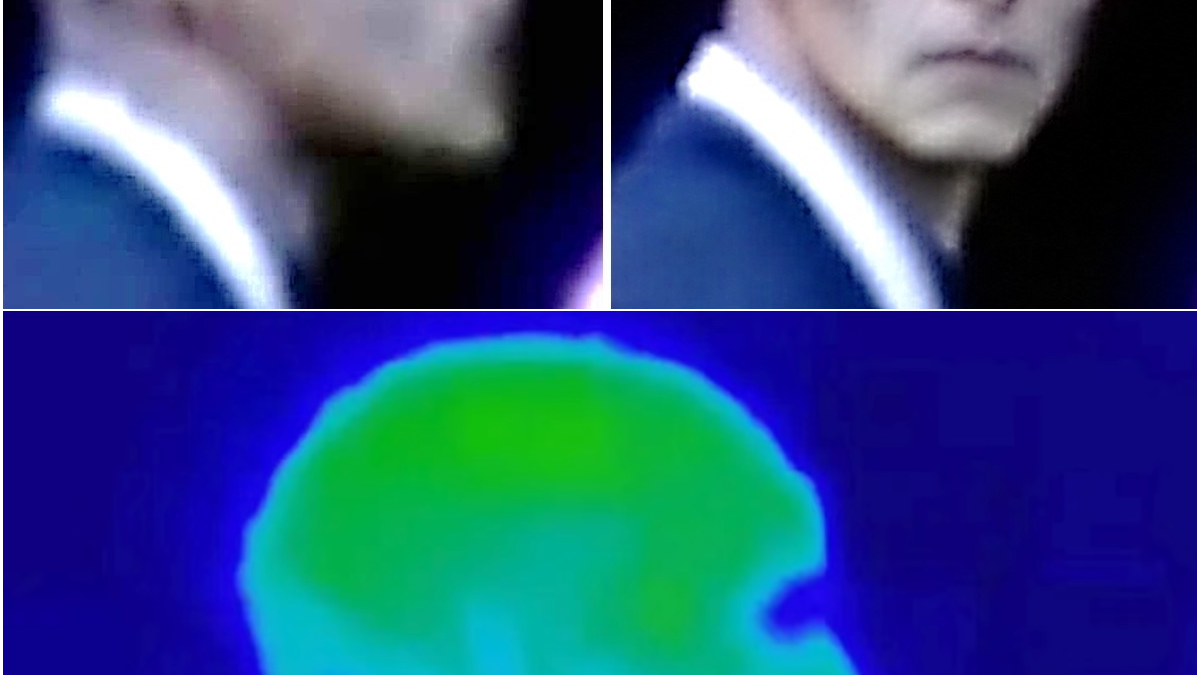
Then viewers began looking closely at his face. The footage showed him mainly from the side, making the outline of his head especially noticeable.
His skull appeared unusually elongated, while his facial structure seemed different from the faces of people standing nearby.
His eyes appeared recessed, and his jaw seemed pronounced. The combination of these features gave his profile an unfamiliar appearance that some viewers described as almost otherworldly.
The camera was distant, and the lighting was not ideal for examining fine details. The recording was not created as a close-up portrait of the man.
Instead, he appeared as one person among many in a crowded security environment. His head and face were captured at an angle, with limited resolution and little opportunity to distinguish subtle features.
Those limitations might ordinarily have made the image less interesting. In this case, they helped the speculation grow.
As enlarged versions of the footage circulated, viewers began studying individual frames and debating the shape of the man’s head.
The more closely they looked, the more unusual his appearance seemed to some of them.
A normal recording can become strangely persuasive when it is enlarged beyond the detail originally captured.
Pixelation, compression, shadows, and motion blur can change the apparent shape of a face. Features that look ordinary at full speed may appear exaggerated when paused and magnified.
Yet the enlarged frames gave online researchers an opportunity to focus on precisely those details that seemed most mysterious.
Some viewers believed the man looked like an ordinary security agent whose appearance had been distorted by the camera.
Others considered his profile so unusual that they proposed something much stranger. Theories began circulating that the recording might have captured a non-human humanoid operating openly within an exceptionally secure political environment.
For those who believed that interpretation, the location was the most remarkable part of the story.
The man was not supposedly standing alone in a distant forest or appearing in a poorly lit photograph taken by an unknown witness.
He was visible among security personnel at an event attended by one of the world’s most closely protected political leaders.
The setting made the idea of an unusual security operative seem especially provocative. If the figure really were something non-human, supporters of the theory wondered how such a being could have been present in such a public and tightly controlled environment without attracting immediate attention.
One explanation connected the man with the legendary men in black. These mysterious figures have appeared in UFO stories for decades, usually described as strangely behaved individuals who arrive after reports of unidentified aerial objects.
Witnesses have traditionally portrayed them as men dressed in dark suits, often with pale complexions, unusual facial features, and an emotionless or artificial manner.
The stories vary considerably, but certain details recur. The men may reportedly appear unexpectedly, ask questions about a sighting, or warn witnesses against discussing what they observed.
Their behavior is sometimes described as stiff, formal, or strangely unnatural. In some accounts, they seem unfamiliar with ordinary human customs, while in others they appear to know far more about an encounter than they should.
The mysterious bald man in Washington attracted comparisons with those descriptions because viewers thought his face looked unfamiliar and his movements seemed rigid.
His presence among security personnel added to the impression that he might have been operating in an official capacity.
For people already interested in the men in black tradition, the footage seemed to offer a possible modern image of one of the strange figures described in older accounts.
Other theories became even more unusual. Some online researchers suggested that the man might be a reptilian humanoid concealing his true appearance.
Others proposed that he could represent an advanced artificial or biological security operative, perhaps designed to blend into human environments while possessing unusual physical characteristics.
The elongated appearance of his head became central to these interpretations. When enlarged, the outline seemed different from what viewers expected of an ordinary human profile.
Some believed the skull was too narrow or too extended, while others focused on the shape of the jaw and the position of the eyes.
But a face seen from a distance can be difficult to interpret accurately. The angle of the head, the direction of the light, and the movement of the camera can change the apparent proportions of the skull and jaw.
A person’s expression can also affect the appearance of the eyes and facial muscles. Without a clear, direct view, an unusual profile does not establish an unusual identity.
The man’s posture became another subject of discussion. Some viewers interpreted his movements as stiff or mechanical, comparing them with the artificial mannerisms often attributed to men in black stories.
Yet a security worker standing in a crowded environment may naturally keep his body relatively still while observing the people around him.
A short recording may also capture only one limited portion of a person’s movement. The footage itself did not establish that the man was connected with UFO investigations, extraterrestrial activity, or any hidden organization.
It showed a bald individual among security personnel during a political event. The extraordinary interpretations emerged from the way viewers understood his appearance and the traditions they associated with it.
Eventually, the story became sufficiently widespread that government representatives were asked about the unusual figure.
The administration responded with humor, joking about secret extraterrestrial and robotic security programs and government budget restrictions.
The response became another memorable part of the story, although it did not provide evidence supporting the extraordinary theories.
For people who already believed that the footage showed something unusual, the humorous answer did little to settle the matter.
Some interpreted the response as an attempt to dismiss the discussion. Others regarded it as an ordinary reaction to an implausible question about a person whose identity and role were not established by the recording.
The image continued circulating because it offered an unusual combination of familiarity and uncertainty. The man was visible in a real political setting, surrounded by people who appeared to have ordinary roles.
Yet his profile looked strange enough to inspire theories about beings that supposedly lived among humans without revealing their true nature.
The men in black tradition has always depended heavily on this kind of uncertainty. A witness encounters an unfamiliar person after an unexplained event.
The person behaves in a way that seems unnatural, asks unexpected questions, or appears to know details that were never shared publicly.
The witness then interprets the encounter through the possibility that the visitor was not an ordinary human being.
The Washington footage reversed that familiar sequence. Instead of a witness reporting a strange visitor after a UFO sighting, viewers first encountered a recording of a man whose appearance reminded them of the stories.
They then attempted to fit the image into the tradition. That difference is important. The older accounts generally depend on a witness’s description of an encounter, while the Washington story began with a video that viewers could repeatedly examine.
But the recording’s limited quality meant that the central evidence was still open to interpretation.
The man might have been an ordinary individual whose profile looked unusual under the circumstances.
The footage might have exaggerated his features through perspective and image quality. Or the image might remain difficult to interpret because viewers lacked the information needed to identify him and understand the circumstances of his appearance.
The story nevertheless became part of modern unexplained folklore. It demonstrated how a brief moment captured during a public event could acquire a second life online, separated from its original purpose and transformed into a mystery about hidden identities.
A very different photograph emerged from North Carolina, where the story of Ronnie Hill reached back to July 1967.
Unlike the Washington footage, which showed a man among security personnel, the Hill account described a teenager encountering a mysterious object and a small humanoid near his home.
Ronnie Hill was reportedly 14 years old when he noticed a strange spherical object descending in Pamlico County.
According to his account, the object appeared smooth and metallic, with an egg-like shape and no recognizable wings, propellers, or conventional means of propulsion.
The craft supposedly descended quietly before settling close to the ground. Hill remembered an overpowering smell surrounding the object, an unusual detail that made the encounter more vivid in later descriptions.
The experience was not presented as something he observed from a great distance. Instead, the story placed him close enough to notice the object’s shape and the atmosphere around it.
Then, according to the account, a small humanoid emerged. The being was described as short and dressed in a reflective metallic suit.
The material appeared to catch the available light, making parts of its body seem almost luminous.
Its presence beside the spherical object transformed the sighting from a report of an unidentified craft into an account of a possible encounter with its occupant.
The image associated with the case reportedly showed both elements. A slender humanoid figure stood against the surrounding vegetation, while a large pale sphere appeared immediately beside it.
The sphere contained a prominent dark opening, which became one of the most noticeable features in the photograph.
The being’s reflective appearance created a strange contrast with the natural environment. The vegetation around it looked ordinary, while the figure seemed to belong to a different setting entirely.
The nearby spherical object added to the impression that the photograph captured a moment that did not fit familiar expectations.
Hill reportedly managed to photograph the scene before the humanoid returned to the craft. The object then rose from the area and disappeared into the sky, leaving him with an image that would later become the center of an unusual story.
The photograph’s apparent simplicity was part of its appeal. It seemed to show a small figure standing beside a large object, rather than presenting a distant light or an ambiguous silhouette.
The two shapes were placed close enough together to invite viewers to interpret them as parts of the same event.
Yet the image’s meaning depended on the reliability of the accompanying account. A photograph can show shapes that resemble a craft and a humanoid, but identifying those shapes requires more than recognizing familiar outlines.
Without independently verified details about the camera, the location, the original negative, and the circumstances in which the image was taken, its interpretation remains uncertain.
The case became particularly interesting to some researchers because it did not achieve the fame of many better-known aerial encounters.
Hill and his family were not presented in the story as people seeking widespread attention or financial success.
Instead, the image reportedly remained relatively obscure, circulating mainly among people interested in unexplained phenomena.
That obscurity eventually became part of the mystery. Some researchers wondered why an image apparently showing both a strange craft and a humanoid occupant had not become one of the defining photographs of the 1960s.
They questioned whether it had simply been overlooked or whether the lack of wider attention might have reflected a broader effort to keep extraordinary encounters away from the public.
The possibility of a cover-up was connected to the period in which the photograph was supposedly taken.
During the 1960s, reports of unidentified aerial objects attracted considerable public intereSt. Military involvement, official investigations, and uncertainty about unusual sightings formed part of the wider cultural environment.
An image showing a possible occupant beside a craft would have been particularly remarkable if it could be authenticated.
It would appear to offer something beyond a distant light or an unexplained object in the sky.
It would seem to show a being associated directly with the craft. But the historical setting does not establish that the image was suppressed.
A photograph can remain obscure for many ordinary reasons, including limited distribution, incomplete documentation, or a lack of reliable information about its origins.
The absence of widespread attention is not evidence by itself that anyone deliberately concealed it.
The image also invited comparisons with later reports of egg-shaped aerial objects. Smooth, rounded craft have appeared in numerous witness accounts, sometimes described as silent and lacking visible engines or external machinery.
People interested in those reports have often focused on the apparent simplicity of the shapes, which seem unlike conventional aircraft.
Hill’s photograph, if accurately described, appeared to capture a similar configuration decades before many modern discussions brought comparable objects into public attention.
The spherical form and dark opening created a visual impression that could be compared with later stories about rounded or egg-like craft.
But similarities between descriptions do not establish that witnesses observed the same kind of object.
A sphere or oval is a simple geometric shape, and many unrelated objects can appear rounded when seen from a distance or photographed at an angle.
A photograph that seems to show a spherical craft cannot independently establish its method of propulsion or origin.
The dark opening in the pale object also remains difficult to interpret from the description alone.
It might be a feature of the object, a shadow, or a dark area created by the lighting and camera.
Without clearer documentation, viewers cannot reliably determine its function or even its exact physical form.
The humanoid figure presents similar questions. Its reflective appearance could be consistent with a metallic suit, but the photograph would need to show enough detail to establish the material.
A bright surface may reflect light in ways that resemble metal, especially when the image has limited resolution or strong contraSt.
Even the reported smell, though vivid in the account, cannot be evaluated through the photograph.
It remains part of Hill’s alleged experience rather than a detail independently preserved by the image.
Despite these limitations, the story has remained memorable because it combines several elements rarely found together in a single account.
There is a named witness, a specific age, a particular month and year, a described craft, a supposed occupant, and an image said to record the encounter.
The combination makes the story easy to retell. It also makes the questions about authenticity and documentation especially important.
If the original photograph and reliable records could be examined, researchers might be able to establish more about when and how the image was produced.
Without that information, the photograph remains a subject of speculation rather than a confirmed record of an extraordinary encounter.
The third image brings the story into the present. Reportedly captured somewhere in the Pacific Northwest during 2026, it has attracted attention because it appears to show a large upright creature moving naturally through a densely wooded landscape.
Very little information has been released about the encounter. The precise location has not been identified publicly, and the identity of the hiker responsible for taking the photograph remains unknown in the account.
There is no accompanying sequence showing the creature’s movements before or after the moment captured.
Yet the image itself has been described as unusually clear compared with many alleged Bigfoot photographs.
The creature appears between trees, partly framed by the surrounding woodland, and seems unaware that someone is photographing it.
Its body is covered in extremely dark brown or black hair. The upper body appears broad and powerful, narrowing slightly toward the waist before connecting with two substantial legs.
Its arms seem unusually long, hanging far below the waist, with one apparently extending toward the knee.
The creature’s posture is one of the most noticeable details. It does not appear to stand perfectly upright like a person posing for a photograph.
Instead, its upper body seems to lean forward slightly as it moves across uneven terrain.
The head appears positioned low between the shoulders, creating the almost neckless profile that has appeared in many historical Bigfoot descriptions.
The combination of a broad upper body, long arms, and a low head gives the figure a compact but powerful appearance.
There is no obvious clothing, backpack, or equipment visible anywhere on the creature. Its outline appears to be formed by its body and hair rather than by the recognizable shapes of ordinary hiking gear.
That absence has encouraged viewers to compare the image with traditional Bigfoot reports. Witness descriptions collected over decades frequently portray the creature as an enormous bipedal being covered in dark brown, black, or reddish hair.
Reports often emphasize broad shoulders, exceptionally long arms, a head that seems low between the shoulders, and a distinctive walking motion.
The 2026 photograph, as described, appears to share several of those characteristics. Its creature looks heavily built, dark-haired, and unusually proportioned.
Its posture suggests movement rather than a deliberate pose, giving the impression that the photographer happened upon it while it was traveling through the foreSt.
The setting contributes strongly to that impression. The Pacific Northwest includes extensive forests across Washington, Oregon, and surrounding regions, along with mountainous terrain and large areas where human activity is limited.
Dense woodland can obstruct visibility, while uneven ground and thick vegetation make it difficult to observe animals from a distance.
The region also has a long history of Bigfoot reports. Stories of enormous hairy beings moving through remote forests have been repeated for generations, becoming part of modern popular culture as well as discussions of older regional traditions.
Indigenous traditions from the broader region include accounts of powerful wild beings associated with remote landscapes.
Those traditions are diverse and belong to distinct communities and histories, so they should not be treated as interchangeable versions of the modern Bigfoot legend.
Nevertheless, they form part of the wider cultural background against which later reports of mysterious forest beings have been discussed.
The photograph’s apparent naturalism is another reason it has attracted attention. The creature does not seem to be looking directly at the camera.
Its body is angled as though it is moving through the trees, and its posture appears adapted to the uneven woodland terrain.
That is different from many familiar alleged Bigfoot images, where the subject appears at a distance, partially concealed, or positioned in a way that makes its movement difficult to assess.
A photograph showing more of the body can seem more informative, especially when the figure’s limbs and torso are visible at the same time.
But a single image still captures only one moment. It cannot establish how the creature entered the scene, how it moved afterward, or whether its apparent proportions are accurate.
Without a sequence of photographs or video, the viewer cannot determine whether the posture represents an ordinary step, a crouch, or an unusual angle of observation.
The absence of a publicly identified location also limits the possibility of independent investigation. If the precise forest were known, researchers might be able to examine the surrounding vegetation, estimate the distance to the subject, and compare the photograph with the landscape.
Without that information, the image remains difficult to place in a verifiable setting. The identity of the hiker matters for similar reasons.
A reliable account could provide details about the camera, the time of day, the distance to the creature, and the circumstances in which the photograph was taken.
Original files might also preserve information that could help establish when the image was created and whether it had been altered.
None of those details, as presented in the account, is currently available. The photograph may look compelling, but its origin and context remain uncertain.
The creature’s apparent size is another issue that cannot be resolved by appearance alone. Trees can provide a rough visual reference, but the distance between the subject and the camera can change the apparent relationship between them.
A creature close to the lens may appear much larger than it would beside a tree farther away.
The same problem affects judgments about arm length and body proportions. A partly concealed limb may seem longer or shorter depending on where it disappears behind vegetation.
Dark hair can obscure the boundary between the arm and torso, making the body’s outline difficult to distinguish.
Still, the image has a recognizable relationship to the traditional Bigfoot silhouette. Its broad shoulders, long arms, dark covering, and forward-leaning posture are the same features that have shaped many accounts of the creature over the decades.
For people already familiar with Bigfoot reports, the photograph may seem immediately recognizable. For others, the same outline might suggest a person wearing a dark costume, an unusually positioned animal, or a figure distorted by distance and perspective.
The image alone cannot decide between those possibilities. What makes the photograph especially interesting within the larger collection of mysteries is the way it contrasts with the Washington and North Carolina images.
The bald man in Washington was recorded in a familiar public environment, surrounded by people and security personnel.
Ronnie Hill’s story placed a small humanoid beside a supposed craft in a North Carolina landscape during July 1967.
The 2026 image appears to show a massive, dark-haired creature moving through a modern wilderness.
Their physical descriptions are dramatically different. One figure is bald and human-sized, with a face that some viewers interpret as strangely shaped.
Another is small and supposedly dressed in reflective material. The third is enormous, heavily built, and covered in dark hair.
Yet all three have been drawn into discussions about beings that may not fit familiar expectations.
Each image seems to offer a glimpse of something that viewers struggle to classify, and each has inspired interpretations that reach beyond the visible evidence.
The Washington footage became connected with the men in black because of its subject’s appearance and setting.
The Hill photograph became associated with stories of aerial visitors because it supposedly showed a humanoid beside a craft.
The Pacific Northwest image became part of Bigfoot discussions because its creature appeared to match a familiar description of a large, hairy, upright being.
These connections reveal how strongly existing stories influence the interpretation of new images. A strange face can evoke one tradition, a metallic figure another, and a dark silhouette a third.
The image provides the starting point, but the story surrounding it shapes what viewers believe they are seeing.
The process can work in both directions. A person who knows the men in black legend may notice unusual features in the Washington footage that another viewer would ignore.
Someone familiar with reports of egg-shaped craft may interpret the North Carolina object through those accounts.
A viewer who has studied Bigfoot descriptions may recognize the posture and proportions of the 2026 creature as familiar signs.
That does not mean the viewers are being dishonest or careless. Human perception naturally draws on memory and expectation.
When an image is ambiguous, people often rely on what they already know to make sense of it.
The challenge is separating the visible details from the interpretation. The Washington footage shows a bald man, but it does not establish that he was non-human.
The North Carolina photograph is said to show a small figure beside a spherical object, but the image description does not prove that either was extraterrestrial.
The 2026 photograph reportedly shows a large dark-haired figure, but it cannot independently establish that the subject was an unknown species.
Each account contains a different level of uncertainty. The Washington footage was made during a known public event, but the man’s identity and role are not established by the description.
The Hill story includes a specific date and witness, but the photograph’s origin and authenticity require independent examination.
The Bigfoot image is described as recent and visually striking, yet its location and photographer remain undisclosed.
Those distinctions matter because a mystery can become more persuasive through repetition even when the underlying evidence remains unchanged.
A claim repeated in several online discussions may appear independently confirmed, although all the discussions may trace back to one original source.
The images can still be examined carefully. The Washington footage could be assessed at its original resolution, with attention to the camera angle, lighting, and the man’s movements.
The Hill photograph could be compared with any surviving original materials and contemporaneous documentation. The 2026 Bigfoot image could be evaluated using its original file, metadata, and information about the surrounding foreSt.
Independent evidence would be particularly valuable. For the North Carolina account, records from the period might help establish how the photograph first circulated and whether it was documented close to July 1967.
For the modern Bigfoot image, additional photographs, video, or a detailed account from the hiker could provide context.
For the Washington footage, reliable identification of the man and information about his role could clarify why he was standing among security personnel.
Without such information, the stories remain open to competing interpretations. That openness is one reason they continue to attract attention, but it is also why they should not be treated as established discoveries.
The men in black image illustrates how an ordinary public recording can become extraordinary through close scrutiny.
A man who might otherwise have remained an anonymous figure in the background became the subject of theories about artificial beings and hidden identities.
The setting added drama, but the recording itself did not reveal anything about his nature beyond his visible appearance.
The Ronnie Hill story illustrates how a photograph can acquire significance through the details of an accompanying account.
The date, location, age of the witness, description of the craft, and reported occupant create a vivid narrative.
Yet the more extraordinary the interpretation, the more important it becomes to establish the original evidence and its history.
The 2026 Bigfoot photograph illustrates the power of a familiar silhouette. The creature’s apparent proportions seem to echo descriptions that have circulated for decades.
But a match with folklore is not the same as an identification, and an unusually clear image still needs reliable context before it can support a conclusion about an unknown animal.
There is also an important difference between an image that looks strange and an image that provides strong evidence.
A strange image may deserve attention because it raises questions. Strong evidence must also withstand alternative explanations and independent examination.
That distinction does not remove the fascination from these stories. It gives the fascination somewhere useful to go.
Instead of deciding immediately that a figure must be supernatural or entirely ordinary, viewers can ask what the image actually shows, what information is missing, and what observations could distinguish between possible explanations.
In the Washington footage, the most useful questions concern the recording conditions and the man’s identity.
Was the unusual profile caused by the angle and resolution? Was the apparent rigidity simply the result of his position and duties?
Can the original recording show his movements more clearly than the enlarged versions circulating online?
In the Hill account, the most important questions concern the original photograph and its history.
Can the image be traced to July 1967? Is there reliable documentation of Ronnie Hill’s account from that period?
Can the apparent spherical object and humanoid be examined in enough detail to determine what the photograph actually depicts?
For the 2026 Bigfoot image, the key questions concern the photographer, location, and original file.
Can the surrounding trees and terrain be identified? Is there a sequence of images or a recording showing the creature moving?
Can the apparent proportions be assessed using reliable reference points? These questions may not produce immediate answers, but they offer a way to move beyond speculation.
They also make it possible to preserve the distinction between an intriguing story and a confirmed event.
The three images remain compelling for different reasons. The Washington man is mysterious because his face appears unfamiliar in a setting where everything else seems ordinary.
The North Carolina figure is mysterious because it is supposedly shown alongside a craft in a photograph attributed to a young witness.
The Pacific Northwest creature is mysterious because its size, hair, and posture seem to match a figure that has been described for generations without being conclusively documented.
Their stories also span a remarkable period. The Hill account reaches back to July 1967.
The Washington footage was recorded during the 2012 conference and began spreading in March 2013.
The Bigfoot image is reportedly associated with 2026. Different technologies, different witnesses, and different cultural contexts connect the accounts, but each became a subject of attention because an image seemed to preserve an encounter with something unfamiliar.
Perhaps the most revealing feature of all three stories is how much meaning can gather around a single frame.
A face becomes a possible hidden identity. A small figure beside a sphere becomes a possible visitor from somewhere beyond Earth.
A dark shape between trees becomes a possible unknown animal. In each case, the photograph or video seems to hold the promise of an answer.
Yet the closer viewers look, the more they encounter the limits of what the image can establish.
The Washington recording does not explain the man’s identity. The Hill photograph does not independently verify the encounter.
The Bigfoot image does not reveal the creature’s true nature or even the precise circumstances of its capture.
For now, the images remain part of modern unexplained folklore, occupying the space between visual evidence and the stories people build around it.
They may eventually become easier to understand if additional documentation emerges. They may also remain unresolved because the original circumstances cannot be reliably reconstructed.
The questions they leave behind are different, but they share one essential uncertainty. What exactly was captured, and how much of the mystery comes from the image itself rather than the interpretation that followed?
The answer may depend on whether the images can be separated from the expectations surrounding them.
A viewer who approaches the Washington footage expecting to find a man in black may notice every feature that resembles the legend.
Someone approaching it without that background might see an ordinary person whose profile looks unusual because of the camera angle.
Both viewers are responding to the same recording, but they are not necessarily asking the same question.
The same difference appears in the Ronnie Hill account. Someone familiar with reports of small humanoids and rounded craft may interpret the photograph as part of a much larger pattern.
Another viewer may concentrate on the possibility of a staged scene or an ordinary object photographed under unusual conditions.
The photograph’s significance depends heavily on whether its origins and circumstances can be established. The Bigfoot image presents an especially familiar challenge.
The creature’s apparent build seems to match traditional descriptions so closely that viewers may feel they recognize it immediately.
Yet recognition is not verification. A convincing resemblance can make a photograph memorable without demonstrating that it depicts the being people believe it shows.
There is a reason these three stories continue to invite attention. They do not simply present strange shapes.
They place those shapes in settings that create additional questions. The bald man appears during a major political event, where security and public visibility make his presence seem significant.
The small humanoid supposedly appears beside a mysterious craft, turning a sighting into a story about an occupant.
The enormous hairy figure appears in a landscape associated with generations of reports, connecting a modern photograph with a long-running mystery.
Each setting supplies a different kind of expectation. A political conference suggests official authority and security.
A quiet rural location in 1967 suggests an isolated encounter outside ordinary public attention. A dense forest in the Pacific Northwest suggests a place where a large animal might remain difficult to observe.
Those expectations can make the stories more engaging, but they can also make it harder to assess the evidence independently.
A person standing beside security personnel is not automatically part of a secret program. A spherical object is not automatically an aircraft from another world.
A large, dark figure in a forest is not automatically an unknown species. The strongest questions are therefore not necessarily the most dramatic ones.
They are the questions that can be answered through evidence. What was the camera recording?
How far away was the subject? What was the lighting like? Is there an original image rather than a copy?
Are there independent witnesses or records that support the account? For the Washington footage, even a clear identification of the man would change the story considerably.
If his role were established, the unusual appearance that inspired the mystery could be considered alongside the ordinary circumstances of his work.
If the original recording showed more detail, viewers might be able to understand how the angle and lighting affected his profile.
The footage could then be discussed as a recording of a person at a public event rather than as an unexplained figure whose identity had to be guessed.
For Ronnie Hill, the most useful evidence would be documentation close to the reported encounter.
A dated photograph, records describing how it was developed or circulated, and a consistent account from the people involved would help establish the image’s history.
That would not automatically prove the extraordinary interpretation, but it would provide a stronger foundation for examining what the photograph depicts.
For the 2026 Bigfoot image, the most valuable information would likely come from the hiker who reportedly captured it.
The exact location, the time of the photograph, the camera used, and any additional images could help establish whether the subject was moving through the forest as described.
A sequence might reveal details that a single still image cannot preserve, including how the figure walked, whether it reacted to the photographer, and how it moved relative to the surrounding trees.
Until such information becomes available, the images remain incomplete records. They offer enough detail to inspire questions, but not enough to resolve them.
The Washington man remains a mysterious-looking individual in a recording from a political conference. The Ronnie Hill image remains a photograph associated with an extraordinary account from July 1967.
The Pacific Northwest figure remains an alleged 2026 photograph of a large, dark-haired creature whose exact location and photographer have not been publicly identified in the story.
There is no need to force these accounts into a single explanation. Their similarities are interesting, but they do not demonstrate a shared cause.
The figures may have nothing to do with one another beyond the fact that people have interpreted their images through the language of unexplained phenomena.
What connects them most clearly is the moment when an ordinary image becomes the center of an extraordinary claim.
A person in the background becomes a possible non-human visitor. A photograph from a teenager’s encounter becomes a possible record of a craft and its occupant.
A figure moving between trees becomes a possible glimpse of an animal that has remained outside established scientific documentation.
That transformation can happen quickly. Once an image begins circulating, viewers may add descriptions, comparisons, and theories that become inseparable from the original material.
Later audiences may encounter the interpretation before they ever see the recording itself. They may remember the claim that a man was a reptilian humanoid, rather than the more limited fact that a bald man appeared in the footage.
They may remember that Ronnie Hill photographed an extraterrestrial, rather than that a photograph was attributed to his account.
They may remember that the 2026 image showed Bigfoot, rather than that it reportedly showed a large figure in a foreSt.
The distinction between the image and the story is therefore essential. An image can be examined.
A story can be compared with other accounts. But the story should not replace the evidence that supposedly supports it.
The mystery surrounding the three figures may eventually change as more information becomes available. The Washington footage might be clarified through identification and better-quality material.
The North Carolina account might gain or lose credibility depending on the surviving documentation. The modern forest photograph might become more understandable if its original source and setting are established.
Or the images may remain unresolved, preserved as examples of how easily uncertainty can become folklore.
Their significance may lie less in what they prove than in the way they reveal people’s continuing interest in unfamiliar faces, unusual encounters, and the possibility that the visible world contains things not yet understood.
For now, each image leaves a different figure standing at the edge of explanation. The bald man remains among the security personnel, his profile frozen in a recording from 2012.
The small humanoid remains beside the pale sphere in the story attributed to Ronnie Hill.
The dark-haired figure remains between the trees in the reported photograph from 2026. The images invite viewers to look again, but looking again cannot supply information that was never recorded.
Until reliable evidence fills in the missing details, the most important mystery may not be whether these figures belong to some hidden world.
It may be how much can truly be known from a single image, and how easily the unknown can begin to look like an answer.
Disclaimer: This content may be created by Al for entertainment purposes. Any resemblance to real persons, events, or places is coincidental.








