Unknown Creatures Caught on Camera That Should Not Exist
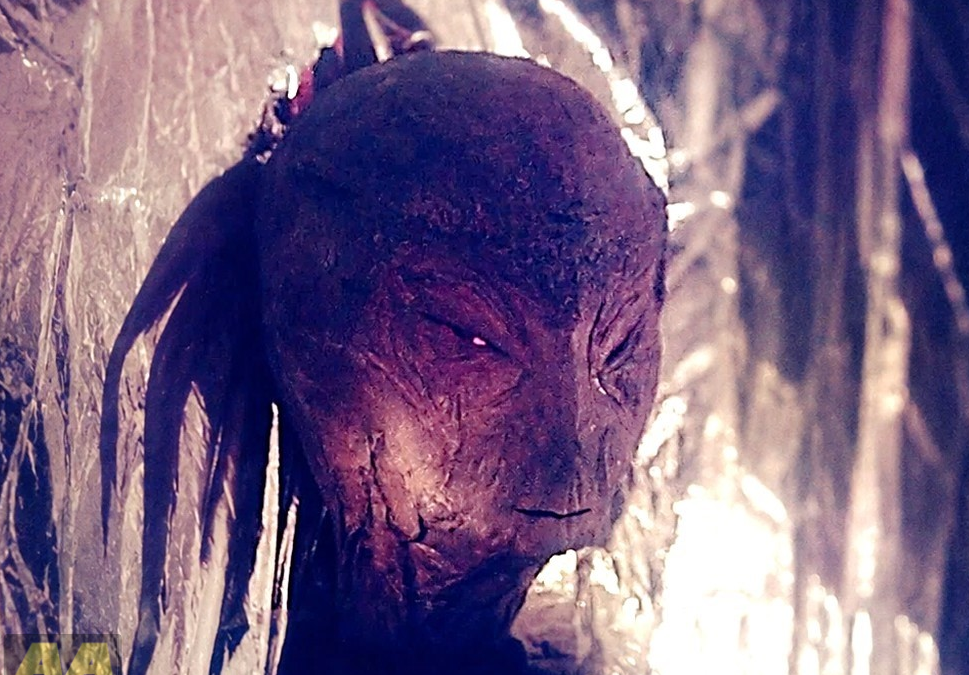
In the autumn of 1996, Jonathan Reed entered a forest with his dog Susie expecting nothing more than an ordinary walk among wet trees and falling leaves.
The Pacific Northwest was quiet that afternoon, wrapped in the kind of gray light that made the forest seem deeper than it really was.
Then Susie ran ahead. Jonathan followed her between the trunks, calling her name, until the familiar sounds of the woods began to disappear.
No birds. No insects. No movement in the branches. Even the wind seemed to stop at the edge of the clearing.
Something dark was hovering among the trees, shaped unlike any machine Jonathan had ever seen.
It was smooth, black, and strangely still, suspended just above the ground without a visible source of power.
Then he noticed the figure beside it. It was small and upright, with a strangely enlarged head, narrow body, and enormous dark eyes that seemed fixed upon Susie.
Within moments, an ordinary walk had become an encounter Jonathan would spend years attempting to explain.
He would later present photographs, video recordings, and a strange metallic object he said came from the being itself.
But if those pieces were genuine, what exactly had Jonathan Reed found beneath the trees that autumn afternoon?
Jonathan had entered the forest expecting the familiar rhythm of an afternoon outdoors. The trees were thick enough that the daylight reached the ground in scattered patches, and the damp earth softened every step.
Susie moved ahead of him with the restless energy of a dog exploring a place she already believed belonged to her.
Then she disappeared behind a group of trees. Jonathan heard branches moving and assumed she had found something interesting.
He called for her once, then again. There was no answer except the faint sound of his own voice fading between the trunks.
He walked faster. A few more steps brought him into a section of forest that seemed strangely isolated from everything around it.
The silence was what he noticed firSt. The forest had not simply become quiet. It seemed as if every ordinary sound had been removed.
Jonathan later described that sensation as entering a place where the rules of the surrounding forest no longer seemed to apply.
Then he saw the object. It was dark, almost completely black, and shaped somewhat like a narrow obelisk.
It hovered only slightly above the ground. There were no obvious wheels, supports, engines, wings, or other features that could explain how it remained suspended.
Jonathan stood still. The object appeared perfectly smooth. Beside it stood something even more difficult to understand.
The figure was small and humanoid, but its proportions were unlike those of an ordinary person.
Its head appeared unusually large compared with its narrow body. Its face was pale and smooth, while the eyes appeared dark and disproportionately large.
Susie was nearby. Whatever Jonathan believed about the object or the strange figure changed when he saw the being interacting with his dog.
His reaction was immediate. He reached for a heavy branch and moved toward Susie. What happened next became one of the most disputed parts of the entire story.
Jonathan maintained that he struck the creature in an attempt to protect his companion. The being then collapsed near the strange black object.
For a few moments, Jonathan stood alone among the trees, staring at a scene that seemed impossible.
He had not simply seen something in the sky. He believed he was standing beside something physical.
Instead of leaving, Jonathan began documenting what he had encountered. According to his later account, he wrapped the figure in a thermal blanket and transported it to his residence.
He then placed it inside a large freezer while trying to determine what he was dealing with.
The decision would eventually transform a strange encounter into an international mystery. Photographs began circulating that appeared to show the being at close range.
The images were unlike the distant lights and blurry silhouettes usually associated with unexplained sightings.
They seemed to show a face only inches from the camera. The head was rounded and unusually large.
The lower face was narrow. The mouth was small. The eyes appeared dark and deeply set.
Other images showed different angles of the same unusual form. Reflective material surrounded portions of the figure, consistent with Jonathan’s explanation that he had wrapped it after the forest encounter.
The photographs became the centerpiece of the case. Then came the recordings. Jonathan released video material that he said documented the forest where the encounter occurred.
Other footage appeared to show the strange black object among the trees and closer views of the humanoid figure.
Every new piece of material raised another question. If the images showed an ordinary person in some unusual costume, why had the proportions appeared so strange?
If the object was a conventional device, what mechanism allowed it to hover without producing the sounds associated with machinery?
And if the creature was simply an animal viewed under unusual circumstances, why did the photographs appear so different from any familiar animal?
Jonathan eventually introduced another piece of evidence. He called it the link artifact. The object resembled a metallic bracelet or narrow band.
Jonathan claimed it had been recovered from the being and possessed unusual properties. According to his account, it appeared to react when worn by a person.
The artifact added another layer to the story. There was now the forest, the black object, the photographs, the video, the humanoid figure, and the metallic band.
By the late 1990s, Jonathan was appearing in interviews and speaking at conferences. The story reached audiences far beyond the region where the encounter had reportedly taken place.
It was a period when home video equipment was becoming increasingly common, while the growing internet was allowing unusual photographs to travel rapidly between researchers and curious viewers.
The Reed case arrived at exactly the right moment for such material to spread. Copies of photographs could move from one person to another.
Video recordings could be duplicated. People who had never heard of Jonathan Reed could suddenly examine the images themselves.
But Jonathan later claimed that the attention brought another problem. He said unidentified individuals began taking an interest in his activities and in the evidence connected with the encounter.
According to his account, important materials eventually disappeared from his possession. For those who believed his story, the missing evidence became part of the mystery itself.
For skeptics, the disappearance made independent examination even more difficult. What remained were the photographs, recordings, copies, and Jonathan’s own account of what had happened.
The face in those photographs continued to attract attention because it did not resemble a distant shape hidden behind branches.
It appeared close enough for viewers to examine its features. The story might have remained an unusual case from one forest in the Pacific NorthweSt.
Instead, it became part of a much larger collection of unexplained encounters involving strange beings, unidentified objects, and photographs that seemed to offer more questions than answers.
Years later, another set of images emerged from a very different foreSt. This time there was no hovering object.
There was no metallic artifact. There was only a witness standing on a large rock above a wooded slope somewhere in the American MidweSt.
The witness had been watching the forest when movement below caught their attention. At first, the shape seemed completely ordinary.
It looked like a person. Perhaps a hiker was moving between the trees. The witness continued watching.
The figure moved closer. Something about its proportions began to look wrong. The upper body appeared extremely broad, while the arms seemed unusually long.
The figure remained upright as it moved through the woodland, but its head appeared to project forward from the body in a way that made the silhouette difficult to identify.
The witness took photographs. In one frame, the figure was partly hidden behind a tree.
In another, more of its body could be seen. Then it disappeared behind vegetation before appearing again farther down the slope.
The sequence became more interesting because the same general shape appeared repeatedly. It was not simply one dark mark in one photograph.
The images seemed to follow a moving form. When the photographs eventually reached online communities interested in unexplained creatures, viewers began studying the silhouette.
The head attracted the greatest attention. From certain angles, it seemed to extend forward like a muzzle.
The body, however, appeared distinctly humanoid. That combination reminded many viewers of a creature known in reports as the Dogman.
Descriptions of the Dogman vary, but many accounts portray a large upright creature with canine features.
Witnesses have described enormous bodies, broad shoulders, long limbs, and thick dark hair. Some reports place such creatures between 7 and 9 ft tall.
Others describe pointed ears, reflective eyes, and a head resembling that of a large wolf or powerful dog.
The forest photographs seemed to contain several of those characteristics. The apparent snout was especially important.
A normal person seen from a distance can produce strange silhouettes when partially hidden by trees.
Clothing can distort proportions. Shadows can make a head appear larger or smaller. But the images continued to attract attention because the form seemed consistent from one frame to another.
The creature moved naturally through the forest, apparently unaware that it was being watched. That detail became part of the fascination.
It was not standing in an open clearing posing for the camera. It was moving between trees, using the landscape as cover.
The witness remained elevated on the rock and continued observing. For a brief period, the forest seemed to contain two worlds.
Above the trees stood an unseen observer. Below them moved a figure that appeared almost human until its proportions were examined more carefully.
Then the figure disappeared. The photographs remained. They were blurred by distance, vegetation, and movement, but that did not stop people from examining them.
Some believed they showed a Dogman. Others believed the shape could be explained by an ordinary person, unusual clothing, perspective, or a combination of shadows and branches.
The photographs themselves could not settle the argument. They could only preserve what the camera had captured.
Another image would later emerge from a forest where the surroundings were even more remote.
On the 14th of October, 2012, a game camera stood against an old pine tree in the remote forests of Blackwood Creek, Montana.
The camera had been installed to monitor wildlife. Its intended subjects were elk and other animals moving through the area.
The camera remained in place while the forest changed around it. During the daylight hours, branches shifted in the wind and animals passed through the vegetation.
At night, the world became almost completely dark. Then, shortly after 2:00 in the morning, the camera recorded something unexpected.
Standing among the vegetation was a large, dark figure. It appeared upright. It appeared heavily built.
And it appeared to be covered in thick dark hair. The image quickly attracted attention among people interested in Bigfoot and other unexplained creatures.
Unlike many alleged Sasquatch photographs, the figure did not appear to be an impossibly distant speck.
It seemed relatively close to the camera. Its proportions were immediately striking. The torso looked massive.
The shoulders were extremely broad. The arms appeared unusually long. The head seemed to rise directly from the shoulders, with little visible neck.
The hair covered much of the visible body, making it difficult to identify individual features.
The upper part of the head appeared slightly conical. That shape had particular significance because similar descriptions have appeared in reports associated with Bigfoot for decades.
Estimates placed the creature at close to 8 ft tall. The vegetation made exact measurement impossible, but even without knowing its precise height, the figure appeared substantially larger than an average person.
The location added another dimension to the mystery. Montana contains enormous stretches of woodland and mountainous terrain.
There are regions where roads are scarce, human settlements are widely separated, and forests extend for miles.
Large animals can travel considerable distances without encountering people. A creature that avoided human activity could theoretically remain hidden for long periods.
That possibility has always been central to stories surrounding Sasquatch. The creature does not need to appear every day.
It does not need to walk into a town. It only needs to remain within a landscape large enough to conceal it.
The Blackwood Creek image seemed to capture precisely that possibility. A camera had been placed there to record elk.
Instead, it appeared to record something much larger. The figure stood among the vegetation for only a moment in the recorded sequence.
Then the forest returned to its ordinary appearance. No explanation accompanied the image. There was no clear second photograph showing the creature from another angle.
There was no measurement that could establish its exact size. There was only the frame.
That limitation made the image both fascinating and frustrating. A photograph can preserve an instant, but it cannot explain everything that existed outside the frame.
The camera could not show what happened seconds before the image was taken. It could not reveal what happened after the figure moved away.
It could not tell the viewer whether the shape was an unknown animal, a person viewed under unusual conditions, or something that had never been properly identified.
The same problem followed the Dogman photographs. And it had followed Jonathan Reed since the autumn of 1996.
Three stories. Three forests. Three different kinds of evidence. One involved a strange black object hovering above the ground and a humanoid figure with an enlarged head and dark eyes.
Another appeared to show a large canine shaped humanoid moving between trees. The third presented an enormous dark figure standing upright in the Montana wilderness shortly after 2:00 in the morning on the 14th of October, 2012.
The stories were separated by geography and time, yet they shared one detail. The forest was always present.
That mattered because forests conceal as much as they reveal. A camera pointed down a trail records only a narrow section of the world.
A witness standing on a rock sees only what the trees allow. A person walking with a dog can enter a quiet section of woodland and suddenly find themselves somewhere that feels completely different from the trail they left behind.
Jonathan Reed’s story demonstrated that most dramatically. Before the encounter, he was simply walking with Susie.
Afterward, every object connected with that afternoon became evidence. The photographs became evidence. The video became evidence.
The metallic link artifact became evidence. Even the missing material became part of the story.
The Dogman photographs created a similar transformation. A distant figure became a potential creature. The shape of a head became a clue.
Long arms became a clue. The way the figure moved between trees became a clue.
The Blackwood Creek photograph followed the same pattern. A game camera designed for wildlife recorded something that viewers interpreted as a massive humanoid.
The image could be enlarged. It could be examined. It could be compared with other alleged Bigfoot photographs.
But no amount of zooming could reveal what stood outside the frame. That was the strange power of these stories.
They offered enough detail to make the unknown feel close. Yet they withheld enough information to keep it unknown.
Jonathan had a face. The Dogman images had a silhouette. Blackwood Creek had a figure.
None provided a complete explanation. And perhaps that is why the stories survived. A distant light can be dismissed.
A strange sound can be forgotten. But an image changes the nature of a mystery.
Once something has been photographed, people begin asking what the camera actually captured. Was Jonathan Reed looking at something unknown in the forest during the autumn of 1996?
Was the dark figure in the Midwest an unusual animal, a person, or something matching the old descriptions of the Dogman?
What exactly stood in front of the Blackwood Creek camera shortly after 2:00 in the morning on the 14th of October, 2012?
The photographs cannot answer those questions by themselves. They can only show what appears to be there.
And that may be the most unsettling part of all. The forests remain. The trees continue growing.
The trails continue disappearing beneath leaves and snow. Cameras continue recording empty paths until, every once in a while, something crosses the frame.
Sometimes it is an animal. Sometimes it is a person. And sometimes the shape seems to belong to something that has no obvious place in the world we recognize.
Perhaps the most important question is not whether every mysterious photograph represents a creature unknown to science.
Perhaps it is whether we have become so accustomed to believing that we understand the wilderness that we forget how little of it we actually see?
If another figure were moving between the trees tonight, would anyone notice before it disappeared?
Disclaimer: This content may be created by Al for entertainment purposes. Any resemblance to real persons, events, or places is coincidental.








