Unknown Creatures Caught On Camera Science Cannot Explain
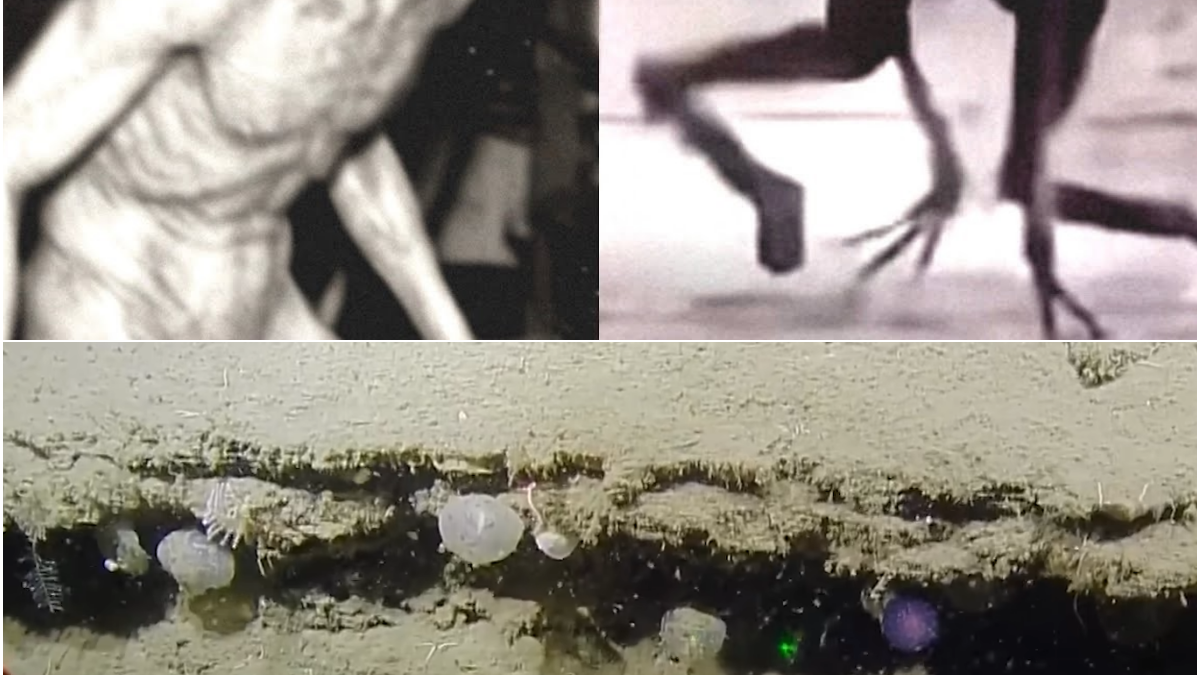
Far beneath the surface of the ocean, where sunlight has vanished and the pressure is powerful enough to challenge almost anything that enters, a pale creature drifted through the darkness at a depth of 9,131 meters.
It had a strange shape, a ghostly body, and two stiff projections that seemed to belong to an animal nobody could confidently identify.
Somewhere in the forests of Africa, another mystery was moving high above the ground, hidden among the leaves where few people had ever managed to see it.
And in a dry corner of Spain, a spider barely three millimeters long had remained so elusive that scientists had described it before anyone had captured its movements on camera.
These discoveries might sound like fragments from different worlds, but they share one remarkable detail.
Each reveals how much of the natural world can remain beyond our understanding, even when cameras, research vessels, and determined scientists are searching for answers.
Some of these animals may represent species never formally described. Others have been recorded but remain difficult to study.
And a few are strange enough that even the footage itself raises more questions than it answers.
What else might be moving through the darkness, the treetops, and the smallest hidden corners of the planet without anyone realizing it?
The first mystery begins off the coast of Japan, deep inside the ocean trenches. Researchers operating far below the surface recorded footage of an unusual creature drifting at 9,131 meters.
It was pale, almost completely colorless, and seemed to float without any obvious effort. Its appearance was so unfamiliar that the research team struggled to determine where it belonged on the tree of life.
The creature was officially labeled Anamalia inserta sedis, a designation that reflected the uncertainty surrounding its classification.
Rather than placing it confidently into a known group, researchers were left with an animal whose identity remained unresolved.
At first, the team considered whether it might be a nudibranch. These marine animals are a type of sea slug, and some have distinctive projections on their heads that resemble antennae.
The creature in the footage appeared to have two symmetrical halves, with a pair of structures extending outward in a way that seemed consistent with that possibility.
Its pale body also brought to mind the alabaster nudibranch, a strange white sea slug with a similarly unusual appearance.
But the resemblance did not settle the question. Experts examining the footage noticed that the two projections seemed far too stiff to be ordinary sea slug antennae.
Some believed the animal might still be a mollusk, but the available images did not provide enough detail to establish that conclusion.
Its location made the mystery even more difficult. The creature had been recorded more than 9,000 meters below the surface, a depth far beyond the known range of the deepest recorded nudibranch, which had been found at around 4,000 meters.
That enormous difference raised doubts about the original identification. The animal was moving through an environment where very few familiar creatures could survive, and its unusual structure offered no easy explanation.
The footage captured a moment of discovery, but not a complete answer. Without a specimen or additional observations, scientists could not confidently determine what the creature was, how it lived, or how it was related to other animals.
The pale figure continued to occupy an uncertain place in scientific knowledge, an example of how even advanced deep-sea exploration can reveal something that resists classification.
Far from Japan, another small white creature attracted attention in the Pacific Ocean. In 2016, NOAA’s remotely operated vehicle Deep Discoverer was exploring more than 4,000 meters beneath the surface, northeast of Hawaii’s Necker Island.
Its cameras were designed to observe a world that humans could not easily visit, documenting animals and geological features in the deep ocean.
During the exploration, the cameras picked up a tiny octopus floating in the water. It was almost entirely white, with very little visible pigment.
Its body appeared nearly translucent, giving it an appearance that reminded researchers of a ghost drifting through the darkness.
The team began calling it Casper. The nickname suited the animal’s pale appearance, but its identity remained a much more serious question.
The researchers could not match it to any known species of octopus. Its unusual coloring and delicate appearance made it stand out, but the footage alone did not provide enough information to establish its exact classification.
NOAA concluded that Casper was almost certainly an undiscovered species. Yet the animal could not be formally named because scientists had not been able to collect a specimen.
A video recording can reveal a creature’s shape, movements, and behavior, but describing a new species often requires physical evidence that allows researchers to examine its anatomy in detail.
That missing specimen has kept Casper in a scientific waiting room. Ten years after the 2016 observation, the octopus still had no scientific name.
Researchers had seen it, recorded it, and recognized that it did not appear to match any known species, but they had not gathered the evidence needed to complete the process.
The footage nevertheless offered a rare glimpse of an animal that might otherwise have remained entirely unknown.
Casper’s pale body drifted against the dark water, making it seem almost detached from the world around it.
Its appearance raised questions about how it survived at such depths, what it ate, and how widespread it might be.
For now, the little octopus remains known primarily through the images that first brought it to public attention.
It is a reminder that a creature can be discovered on camera and still remain scientifically incomplete.
Seeing an animal is not always the same as understanding it. The next mystery is not hidden beneath the sea.
It appeared on a rooftop, where a person looking out into the night noticed a silhouette that seemed to move in a way that was difficult to explain.
The footage was posted to Reddit by a user named oil_no8161. According to the description, the person had noticed something unusual on a neighboring building during a couple of nights in a row.
The sightings took place between 10:00 and 11:00 p.m., when the surrounding area was dark and the rooftop was difficult to see clearly.
At first, the figure did not seem particularly unusual. The writer assumed it was probably a satellite dish or another ordinary object standing against the night sky.
From a distance, its outline could easily have been mistaken for equipment attached to the roof.
But the longer the person watched, the less certain that explanation became. The silhouette began to resemble a person standing completely still behind the object.
Its upper shape suggested a head and shoulders, while the lower portion appeared to remain fixed in place.
The observer kept looking, trying to understand what they were seeing. Then the shape began to move.
Its head and upper body appeared to sway slowly from side to side. The lower portion remained motionless, creating the impression that only the top half of the figure was moving.
The motion seemed unnatural to the person watching, particularly because it did not appear to involve the entire silhouette.
The person recorded the scene, although the distance and darkness made the footage grainy. The movement was reportedly much clearer in person than it appeared in the video.
Even so, the recording preserved enough of the unusual shape and its apparent motion to make the incident interesting to viewers.
The following morning, the uploader decided to investigate the neighboring building. They returned to the exact angle from which they had watched the figure and examined the rooftop.
They also looked around the back of the building, checking for objects that might have created the strange outline.
There was no satellite dish. There were no trees, poles, or water tanks that could account for the silhouette.
Nothing obvious seemed to match the shape that had appeared during the previous nights. The writer also reported seeing the same figure twice, at roughly the same time on consecutive nights.
That detail made the experience more difficult for them to dismiss as a passing visual mistake.
Yet the available footage could not establish what the object actually was, and the description alone could not rule out every ordinary explanation.
Distance, darkness, and perspective can make familiar objects appear unfamiliar. A shadow can look like a person, and movement can be difficult to interpret when the viewer cannot see the surrounding structure clearly.
The absence of an obvious object during the morning inspection did not necessarily mean that nothing ordinary had been responsible.
Still, the video captured a moment that the uploader could not easily explain. A rooftop that seemed empty in daylight had appeared to hold a strange, swaying figure at night.
The mystery was not that the footage proved something extraordinary. It was that the image left enough uncertainty for people to keep asking what they were looking at.
In 2016, researchers exploring the seafloor around California’s Channel Islands encountered a mystery of a very different kind.
The scientists were aboard a research vessel called the EV Nautilus, using remotely operated equipment to investigate the underwater environment.
Their cameras revealed a tiny purple object resting on the seafloor. It looked like a small ball, with a vivid color that made it stand out against the surrounding landscape.
Nobody on the team immediately recognized it. The researchers considered several possibilities, including the idea that it might be some kind of sea slug, but they could not settle on an identification from the footage alone.
Rather than leaving it behind, the team decided to collect it and examine it more closely.
An ROV reached down toward the strange object and used a suction device to bring it aboard.
Once the creature was back on the ship, its appearance began to change. The purple ball opened, revealing a fleshy foot underneath.
That movement provided an important clue. The object was not simply a strange piece of material or an unfamiliar lump on the seafloor.
It was a living animal, and its structure suggested that it belonged to a group of snails.
The researchers sent the specimen to experts for further examination. The specialists determined that it belonged to the volutined family, a group of marine snails.
But identifying the family did not solve the mystery completely. The particular animal could not be matched to a known species.
Further examination indicated that the team had collected a species that had never been formally described before.
The tiny purple ball was not merely an unusual individual of a familiar animal. It represented a previously unrecognized form of marine life.
The discovery showed why collecting unfamiliar creatures can be so valuable. From the ROV’s camera, the animal had appeared as little more than a purple sphere.
Its identity became clearer only after researchers brought it to the surface and observed how it behaved and how its body was structured.
The animal’s transformation from an apparently featureless ball into a recognizable snail was a small but striking example of how little a single image can reveal.
The seafloor is full of organisms that look unlike the animals people usually imagine when they think of marine life.
Some remain difficult to identify until researchers can study them directly. And while the purple snail was discovered through an underwater expedition, another remarkable animal was found by searching high above the ground in the forests of the Congo.
Local people had a name for it: lekwele. But the monkey had not been formally documented by scientists.
Its existence was known within the region, yet it had remained largely outside the scientific record.
Finding it was a major undertaking. The animal lived in the forests of Lomami National Park, where dense vegetation and a high canopy made observation difficult.
These monkeys spent much of their time in the tallest trees, often moving in small groups of about six.
From the forest floor, they could be almost impossible to see. A team of local wildlife experts spent years hiking through the bush in search of the animal.
They also spoke with people living in nearby villages, trying to learn where the monkey might be found and whether anyone had seen it before.
The researchers questioned more than 50 villages in the surrounding area. In only eight of them did people report having seen the animal.
That response offered a sense of how rarely the monkey was encountered, even by people who lived close to its habitat.
The search was not simply a matter of walking into the forest and looking upward.
The team needed to understand the animal’s habits, identify areas where it might travel, and find opportunities to observe it without disturbing its movements.
The dense canopy made every sighting valuable, and the monkeys’ tendency to remain high above the ground made the work especially challenging.
When researchers finally got a closer look, several features helped distinguish the animal from other local monkeys.
It had bright patches around its nose and mouth, along with a white patch beneath its tail.
These markings gave it a distinctive appearance, but the differences went beyond its coloring. DNA testing showed that the monkey had separated from its closest relatives around 5 million years ago.
That finding suggested a long and distinct evolutionary history. It was not simply a slightly unusual population of a familiar species.
Its genetic history marked it as a separate branch. Researchers also found that its skull was built differently from those of related monkeys.
Its vocalizations were distinctive as well, including a roaring sound that set it apart from other animals in the area.
These characteristics helped establish that lekwele was a separate species rather than a variation of a known monkey.
The discovery was significant because it represented only the fifth new monkey species discovered in Africa over the previous 75 years.
The finding demonstrated that even among mammals as familiar and closely studied as monkeys, important discoveries could still be waiting in remote forests.
Scientists finally obtained proof they could study in person in 2021, after park rangers confiscated three specimens from poachers.
The specimens gave researchers an opportunity to examine the animals directly and gather evidence that had been difficult to obtain through observations alone.
But the discovery also raised concerns about the monkey’s future. The species occupied a relatively small area of forest, and hunting remained a continuing threat.
Researchers warned that it might already be endangered before scientists had a chance to study it in depth.
The difficulty of finding lekwele was therefore not only a scientific challenge. It also revealed how easily a species with a restricted habitat could remain poorly understood.
An animal might be familiar to a few communities and still be almost invisible to the wider world.
By the time researchers formally documented it, its population could already be under pressure. The forest had kept the monkey hidden for generations, but its discovery did not mean the mystery was over.
Scientists still needed to learn more about its behavior, its population, and the conditions it required to survive.
The footage and specimens provided a starting point, not a complete portrait. In Tanzania, another small mammal came to scientific attention through a camera trap.
The discovery began in 2005, when Italian zoologist Francesco Rovero was studying wildlife and reviewing photographs taken in the foreSt.
Among the images was a strange little animal that did not seem to match anything he recognized.
At first glance, it looked somewhat like a mouse, except that it had a remarkably long nose.
Its body and proportions suggested a familiar small mammal, but the elongated snout made it difficult to identify.
Rovero could not find a known species that matched the photograph. He sent the images to mammologist Galen Rathbun, hoping that another expert might recognize the animal.
Rathbun also struggled to identify it. Instead of relying on the photographs alone, the two scientists decided to search for the animal in the foreSt. The camera trap had shown that something unusual was moving through the area, but a photograph could not answer every question about its anatomy or behavior.
Eventually, they managed to find the creature. It turned out to be a type of sengi, a group of small African mammals that are sometimes called elephant shrews.
Their appearance can be misleading. They may look like mice or other small rodents, but they are actually more closely related to elephants than to rodents.
The long nose that had made the animal look so unusual was part of the feature that connected it to its wider group.
Yet the particular animal Rovero and Rathbun had found was not a known sengi species.
After studying the animals, the scientists concluded that they had discovered a species that nobody had formally described before.
They gave it a scientific name, while many people came to know it as the gray-faced sengi.
The discovery illustrated how a familiar-looking animal could conceal a surprising evolutionary identity. The first photograph had suggested something mouse-like, but the animal’s true relationships were far removed from what its appearance might lead a casual observer to expect.
It also demonstrated the value of camera traps in wildlife research. A camera placed in the right location can record animals that researchers might otherwise never encounter.
Yet the photographs are only the beginning. Scientists may still need to locate the animal, observe it directly, and compare its physical features with those of related species before they can understand what the images have captured.
For Rovero and Rathbun, the strange photograph became an invitation to explore. A single unfamiliar outline led to a search through the forest and ultimately to the recognition of a new species.
In southeastern Spain, a much smaller creature presented a different challenge. Researchers had discovered and described a spider species called Cryptodrasis michaeli in 2024.
The spider was tiny, measuring only about 3 millimeters long, and its appearance made it difficult to distinguish from the ground around it.
The species lived in a dry, desert-like area along the Spanish coaSt. Its brown and black body blended into dirt, rocks, and dead leaves.
For an animal only a few millimeters in length, that camouflage provided an effective way to remain unnoticed.
Scientists had formally described the species in 2024, but a scientific description did not mean that researchers understood how it moved.
The spider’s appearance could be documented, and its identity could be established, while many aspects of its behavior remained unknown.
That changed when video footage was released in April 2026. For the first time, researchers and the wider public could see the tiny spider moving on camera.
Capturing the footage required careful work. Researchers spent hours turning over rocks and sifting through leaves, searching for an animal that could easily disappear into the surrounding material.
They needed to find a specimen and bring it back to the laboratory, where it could be recorded and examined.
The challenge was partly a matter of scale. A spider measuring just 3 millimeters long can be difficult to notice even when someone is actively looking for it.
Its camouflage made the search more demanding, and its small size meant that every movement took place on a scale that could be easy to overlook.
The released footage offered a new kind of evidence. Scientists could now observe the spider’s movement rather than relying entirely on physical specimens and still images.
Even so, the recording did not answer every question about the species. Researchers still knew very little about what Cryptodrasis michaeli ate, how many individuals existed, or how the spider reproduced.
The discovery and filming of the species had opened a door, but the animal’s natural history remained largely unexplored.
Its story was different from that of Casper, the pale octopus. Casper had been recorded in the deep ocean but could not be formally named because researchers lacked a specimen.
Cryptodrasis michaeli had been formally described, yet scientists had only recently obtained footage showing how it moved.
One was an animal seen on camera whose scientific identity remained unresolved. The other was a named species whose behavior had remained unseen.
Both cases showed that discovery happens in stages. Recognizing a creature, describing it, filming it, and understanding its life are separate achievements.
Sometimes scientists accomplish one of these tasks long before they can complete the others. The final animal in this series of discoveries lives in the forests along the China-Myanmar border.
In 2017, scientists announced that they had discovered a new species of ape and named it the Skywalker Hoolock Gibbon.
The name was inspired by Star Wars, giving the species a connection to popular culture while identifying a creature that had remained little known outside its home region.
The gibbon’s discovery was remarkable because apes are among the animals most closely related to humans, yet this particular species had remained largely hidden from the wider scientific community.
Researchers estimated that fewer than 150 individuals remained in the wild. The animals spent nearly all their lives high in the forest canopy, where they moved through the trees and rarely came down to the ground.
Their movements made them difficult to observe. A gibbon could travel between branches and disappear into the foliage before researchers on the forest floor had a clear view.
Their habitat was also challenging to navigate, making repeated observations a demanding task. The Skywalker gibbons communicated with loud calls that could carry for miles through the foreSt. These vocalizations helped researchers detect their presence, but locating an animal by sound was not the same as obtaining a clear view of it.
The dense canopy still concealed much of their daily lives. A film crew spent two years following the animals through difficult terrain.
The work required patience and repeated efforts to remain close enough to record them without losing sight of their movements.
Over time, the crew managed to capture some of the first high-quality footage of the newly discovered species in the wild.
The resulting images revealed animals moving through their forest environment, swinging between trees and communicating across the canopy.
Their behavior made the forest seem less like an empty landscape and more like a world filled with movement and sound, much of it occurring beyond the view of anyone standing below.
The footage was valuable because it gave researchers and viewers a clearer sense of what these rare apes looked like in their natural habitat.
It also helped bring attention to a species that had only recently been recognized and that was believed to have a very small remaining population.
The estimate of fewer than 150 individuals made the discovery particularly urgent. Scientists had identified a distinct ape, but they were still working to understand its needs and the conditions required for its survival.
The species’ restricted range and limited numbers meant that researchers had much to learn about it, while the opportunity to study it remained narrow.
The Skywalker Hoolock Gibbon was a reminder that even animals closely related to humans can remain difficult to observe.
The fact that a species is an ape does not mean that it lives in a place that is easy to reach or that its behavior is simple to document.
A forest canopy can conceal an entire community of animals, allowing them to move through the world largely unseen.
Across these discoveries, the same pattern appears again and again. The deep-sea creature off Japan was filmed at an extraordinary depth, yet its place in the animal kingdom remained uncertain.
Casper was recorded by NOAA in 2016, but without a collected specimen, it still lacked a scientific name ten years later.
The purple snail required an ROV collection before researchers could recognize its unusual identity. Lekwele took years of searching and local knowledge to document, while the gray-faced sengi emerged from a photograph that two specialists could not initially identify.
The Spanish spider had already been described before researchers released the first footage of its movement in April 2026.
The Skywalker Hoolock Gibbon had been announced as a new species in 2017, but obtaining high-quality images required a film crew to follow it for two years through difficult terrain.
Each animal represents a different stage in the process of discovery. Some were unfamiliar because scientists had never formally documented them.
Others were known to researchers but remained poorly understood. Some could be identified only after being collected and examined, while others required long periods of observation to reveal even basic details about their behavior.
And not every strange image necessarily reveals a new species or an extraordinary creature. The rooftop silhouette, for example, remains an unexplained recording rather than confirmed evidence of an unknown animal.
The figure’s apparent movement may have been affected by darkness, distance, and perspective. Its unusual appearance is interesting precisely because the available footage does not provide a definitive answer.
That uncertainty is part of the larger story. Cameras can show us things that would otherwise remain hidden, but a recording does not automatically explain what it contains.
A shape may look unfamiliar, a creature may appear unlike anything a team has seen before, or an animal may be recorded in a place where researchers did not expect to find it.
The next step is to gather enough evidence to separate an intriguing possibility from a reliable scientific conclusion.
The natural world is full of environments that are difficult to explore. The deepest ocean trenches are places of extreme pressure and darkness.
Tropical forests can hide animals in their highest branches, far from the ground where researchers walk.
Dry landscapes can conceal tiny spiders beneath rocks and among dead leaves. Even an ordinary rooftop can become difficult to interpret when viewed from a distance at night.
The discoveries also show how important it is to look beyond the most obvious clues.
A creature that resembles a sea slug may not be one. A mammal that looks like a mouse may be related to elephants.
A tiny purple ball on the seafloor may open to reveal the body of a snail.
A monkey known to local people may represent a distinct evolutionary branch that scientists have not formally recognized.
Sometimes the most important clue is not the animal’s appearance but its anatomy, DNA, vocalizations, or behavior.
The genetic evidence for lekwele revealed that it had separated from its closest relatives around 5 million years ago.
The gray-faced sengi’s unusual nose pointed toward a group of mammals with surprising evolutionary relationships.
The Skywalker Hoolock Gibbon’s movements and calls offered a glimpse of an ape living almost entirely in the forest canopy.
Yet each discovery leaves new questions behind. How many other animals live in the same environments?
How many remain unknown because they are difficult to observe? How many have already been photographed without being recognized?
And how many known species are still represented by only a handful of observations? For Casper, the missing specimen remains an obstacle to formal naming.
For the creature recorded at 9,131 meters, even the broad classification is uncertain. For the purple snail, the initial collection solved one question while opening the possibility of many more.
For the gray-faced sengi, the discovery revealed a species whose existence had not been formally documented, but it did not mean that every detail of its life was understood.
The same is true of the newly filmed spider and the rare gibbon. A camera can capture a moment, but understanding an animal requires time.
Researchers must learn where it lives, how it behaves, what it needs, and how it fits into the larger ecosystem around it.
The animals in these recordings may seem like visitors from another world, but they are part of the same planet that people inhabit.
Their lives continue in places that are difficult to reach, often beyond ordinary human attention.
The cameras give us brief windows into those places, and the discoveries remind us that the world is not fully known simply because it has been mapped or photographed.
Some of the mysteries may eventually be solved through better equipment, additional specimens, genetic research, or more extensive fieldwork.
Others may remain uncertain for years. A new recording might provide the missing clue, or a researcher might encounter an animal in a place where nobody thought to look.
For now, the ghostly creature in the Japanese trench, the tiny white octopus called Casper, the unidentified rooftop silhouette, the purple snail, lekwele, the gray-faced sengi, Cryptodrasis michaeli, and the Skywalker Hoolock Gibbon each tell a different part of the same story.
There are still creatures we have not properly met, animals we have seen but cannot yet name, and species we have named but barely begun to understand.
And somewhere beyond the reach of the cameras already operating, another unfamiliar shape may be moving through the darkness, waiting for the moment when someone finally notices it.
Disclaimer: This content may be created by Al for entertainment purposes. Any resemblance to real persons, events, or places is coincidental.








