Unexplained Creatures Filmed in the Amazon That Shocked Scientists
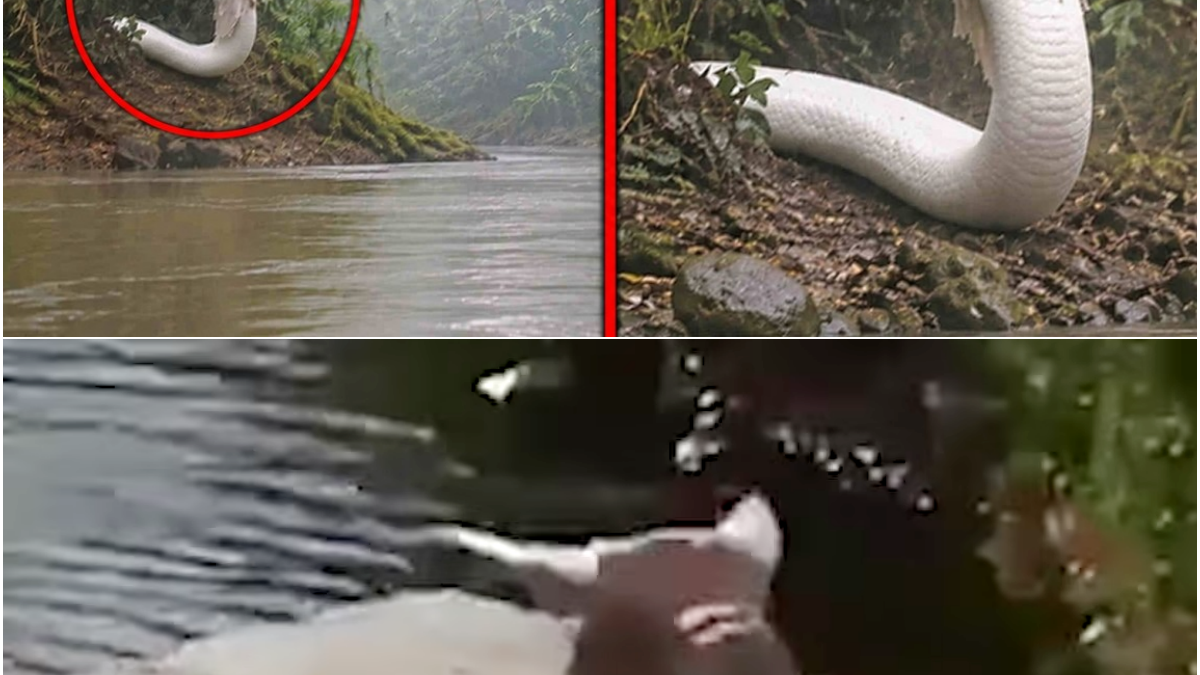
The Amazon has always been a place where the ordinary can become strange in a matter of seconds.
A calm stretch of river can hide movement beneath the surface that no one expects.
A quiet forest canopy can conceal a shape that looks completely out of place. Even creatures that scientists already know can behave in ways that seem almost impossible when first captured on camera.
Over the years, explorers, tourists, fishermen, researchers, and conservationists have recorded moments in the Amazon that left viewers staring at their screens, trying to decide whether they were watching an ordinary animal behaving strangely or something far more mysterious.
One kayaker found himself surrounded by violent movement in the water without ever seeing exactly what was beneath his boat.
A drone operator later noticed a strange gray figure standing among trees, its shape resembling the classic image of something not quite human.
Elsewhere, a fisherman was suddenly pulled toward dark water while witnesses struggled to see what had caused the movement.
Then there were reports of mermaid like creatures, dinosaur like animals, and tiny species with astonishing defenses that seem almost invented.
Some of these stories have reasonable explanations. Others remain uncertain. And hidden among them are genuine scientific discoveries that are every bit as strange as the legends surrounding them.
So what really lives beneath the rivers, inside the forest, and beyond the places where cameras rarely reach?
The first strange encounter begins not deep in the forest, but on the Amazon River itself.
A kayaker was moving along the water, apparently expecting nothing more than an ordinary trip through one of the largest river systems on Earth.
The surface around him looked calm enough, and there was no obvious sign that anything unusual was nearby.
Then a large shape appeared beside the kayak. At first glance, the movement looked almost like a thick serpent passing beneath the surface.
It was difficult to determine where one creature ended and another began. The water distorted everything beneath it, turning shadows and movement into something almost impossible to identify.
Then the river erupted into motion. Water began splashing around the kayak from several directions at once.
Foam spread across the surface while multiple shapes seemed to move underneath. Instead of one large animal, the footage appeared to show a group of creatures suddenly becoming extremely active.
The kayaker remained remarkably calm. He continued sitting in the boat while the water churned around him, apparently trying to understand what was happening without making any sudden movements.
Later, he posted the footage to Instagram and asked people to explain what they believed he had encountered.
One of the most common suggestions was that the animals could have been manatees. A group resting in relatively shallow water might have become startled by something nearby and reacted together.
That explanation, however, did not satisfy everyone. Some viewers pointed out that the animals appeared to be moving much faster than they would normally expect from manatees.
Others focused on the strange shape visible beneath the surface and argued that the footage could represent something entirely different.
As often happens when an unusual animal video reaches the internet, theories quickly became more imaginative than the evidence.
Some viewers suggested a gigantic unknown creature. Others imagined several large animals moving together beneath the kayak.
But the footage never clearly reveals what was responsible. There is no clean view of a face, no unmistakable body shape, and no moment where the animals rise completely above the water.
That leaves the encounter exactly where many Amazon mysteries begin. The camera captured something unusual.
It simply did not capture enough to identify it with confidence. Then, on April 23rd, 2024, another piece of footage appeared to show something even stranger.
A group of conservationists was operating a drone over an undisclosed part of the Amazon in Brazil.
From the ground, the forest looked like an endless wall of green, with enormous trees rising above layers of vegetation.
The drone saw something the people below had not noticed. High between several trees was a small gray figure.
When the footage was examined, the shape appeared to have a large rounded head, a narrow body, and dark areas where eyes might have been.
The resemblance to the familiar image of a gray alien was immediate. Once the footage reached the internet, viewers began debating what they were seeing.
The figure seemed to be standing upright between the trees, which made it look even more unusual.
Its proportions appeared strangely humanlike, but the image was distant and the camera resolution was limited.
The footage was eventually featured on an episode of The Proof Is Out There, where experts examined possible explanations.
One possibility was a monkey. At a considerable distance, a monkey positioned against branches could easily produce an unusual silhouette.
Shadows, leaves, and compression from the camera could also distort its proportions. Another suggestion was a bird.
The harpy eagle, one of the largest and most powerful eagles in the world, is native to the Amazon and can look remarkably unusual when viewed from an unexpected angle.
A bird perched between branches could potentially create a silhouette that looked completely different from what it really was.
Still, the image remained memorable because of its resemblance to something from science fiction. The Amazon already has a long history of stories involving unexplained lights and unusual aerial observations.
That history made the footage even more intriguing to viewers who were already interested in unexplained phenomena.
But an intriguing image is not the same as proof of an unknown creature. The figure remains unidentified in the available footage.
And that uncertainty is precisely what made the clip spread so widely. The next video involved no distant silhouette.
It involved a fisherman. The footage shows him near the water when, without an obvious warning, he is suddenly pulled toward the river.
The movement happens quickly. The camera does not clearly reveal what caused it. There is no unmistakable creature visible beneath the surface, yet the sudden movement immediately encouraged speculation.
The footage began spreading across social media in July 2025, with some people claiming the fisherman had encountered a creature from Brazilian folklore known as the Niko Dagua.
According to the stories surrounding the creature, it is associated with rivers and smaller waterways across northern Brazil.
Traditional accounts describe it as an entity capable of creating whirlpools and disrupting boats. Fishermen who behave disrespectfully toward the river or become excessively focused on their catch are sometimes said to be especially vulnerable to its attention.
Whether the creature exists as anything beyond folklore is another matter entirely. There is no clear evidence in the video identifying what pulled the fisherman toward the water.
The footage could have a straightforward explanation that is simply hidden by the camera angle.
Yet that does not make watching it any less unsettling. The most striking part is not what viewers see.
It is what they cannot see. Something happens. The water moves. The fisherman is suddenly pulled away from his position.
And the camera never gives the audience a clear answer. Another unusual recording came from the Manaus region of Brazil, where two British tourists were filming indigenous children.
At first, the recording seems ordinary. Then something bright appears between the trees. A silvery light flashes through the vegetation.
It is easy to miss, but once noticed, it becomes difficult to ignore. Then, near one of the trees, a small humanoid shape appears.
The figure seems to stand sideways with its back curved. Once again, the image immediately reminded viewers of the familiar gray alien.
The footage later came to the attention of paranormal writer Michael Cohen, who connected it to the long history of unusual sightings reported in the region.
The same general area has also been associated with Operation Prato, a Brazilian government investigation into reports of strange lights and UFO sightings in the Amazon during the 70s.
For years, the Brazilian government denied that the operation had taken place. Eventually, officials acknowledged that the investigation had occurred.
That historical background has contributed to the continuing fascination with unusual footage from the Amazon.
But the recording itself still has the same problem as many mysterious videos. The camera captures something.
The camera does not capture enough. Distance, vegetation, movement, lighting, and image quality can turn ordinary animals into strange silhouettes.
That does not mean every unusual recording is fake. It means the evidence has to be separated from the story people build around it.
Then came one of the strangest creatures ever presented online as a mermaid. The video appears to show a large, lumpy, fishlike creature lying on a dock.
At first glance, it looks unusual enough to attract attention. Then viewers notice what appear to be humanoid arms.
Suddenly, the ordinary explanation becomes much harder to see. The clip was shared as supposed footage of a mermaid filmed somewhere in the Amazon and quickly spread across Brazilian social media.
On June 3rd, 2020, a Facebook page called TV Mascade, which claimed to be a television station from Manaus, shared the footage with a dramatic caption describing it as a mermaid creature.
The post received more than 17 million views and 69,000 shares. From there, the footage was repeatedly uploaded to TikTok and YouTube.
The creature was certainly unlike the elegant mermaids commonly shown in modern stories. Instead, the figure looked heavy, awkward, and almost unfinished.
That difference made the footage even more memorable. But a strange appearance does not establish what an animal is.
Without reliable information about where the footage was recorded, what the creature actually was, or how the video was produced, the recording remains difficult to verify.
The Amazon, however, does not need a mythical creature to produce something extraordinary. Sometimes the real animals are stranger than the legends.
In November of 2025, researchers documented remarkable behavior from a tiny spider in Peru. The spider belonged to the genus Cyclosa, which was already known to science.
What surprised researchers was not the existence of the spider. It was what the spider was building.
Inside its web, the tiny animal constructed a much larger object that resembled a spider.
The decoy was assembled using materials available around it. Plant fragments. Dead prey. Silk. Piece by piece, the spider created an enormous imitation of itself.
The actual spider measured only about 2 and 1/2 mm. The artificial spider was dramatically larger.
To a passing predator, the structure could potentially appear to be another creature. Researchers believe these giant decoys may serve several purposes.
They could help frighten away predators such as birds and lizards. They might also allow the real spider to blend into surrounding debris.
But the most remarkable part happens when something approaches. The spider can hide within or near the decoy and shake its abdomen.
The movement causes the artificial spider to vibrate. From a distance, the fake creature can appear to move as though it were alive.
Researchers had previously observed unusual behavior from Cyclosa spiders, but the specific construction of these large spider shaped decoys had not been formally documented and studied in this way before.
This is one of the clearest reminders that the Amazon can produce discoveries that sound fictional while being completely grounded in biology.
The next mystery is much larger. For years, stories have circulated about creatures described as neodinosaurs.
A video that has been making the rounds online has been presented as recently recovered footage from an Amazon expedition in the 60s.
According to the claims surrounding the recording, it supposedly shows a dinosaurlike creature deep within the rainforeSt.
There have been reports of creatures described in similar terms from several parts of the Amazon basin, including Bolivia, Colombia, Peru, and Brazil.
The stories vary considerably. Some accounts describe a large amphibious animal with a long neck and body resembling a sauropod.
Other reports describe animals compared with iguanodons. There are also less common descriptions involving bipedal reptiles that resemble allosaurs.
The idea is fascinating because the Amazon contains enormous areas of difficult terrain where visibility can be limited for miles.
But fascination and evidence are two different things. Some reports involve alleged tracks that resemble dinosaur footprints.
Others are based entirely on eyewitness accounts. Among the stories are secondhand reports connected to Percy Fawcett.
A friend of Fawcett reportedly described finding three toed tracks in Brazil and claimed to have seen a large long necked reptile near the Brazil Bolivia border.
Another account involved an alleged iguanodon sighting in Colombia in 1921. A Brazilian named Alvaro Mosquito also reportedly described encountering a creature compared with a capsaurike animal on the shore of a swampy lake between the Purus River and the Jurora River.
Then there was an account from as recently as 1995. Geology students in Brazil’s Sora Mountains reportedly said they saw two large creatures measuring about 30 ft long, with necks and tails measuring around 8 ft, bathing in a river.
These stories have remained part of Amazonian mystery culture because they describe something that would completely change our understanding of the region if independently confirmed.
But no verified evidence in the footage establishes that the animals are surviving dinosaurs. The video itself has not provided enough information to demonstrate that conclusion.
That leaves the neodinosaur stories in a strange place between folklore, eyewitness testimony, and scientific curiosity.
The Amazon has one more surprise, and this time there is no enormous creature involved.
Instead, it is tiny. In the Peruvian Amazon, biological science reporter Aaron Pomerance of Rainforest Expeditions encountered a small brown caterpillar resting on a branch.
At first, there was nothing particularly unusual about it. It looked like a normal caterpillar.
Then something nearby made a sound. The caterpillar reacted almost instantly. Four long structures shot outward from its body.
They seemed to spring into the air before slowly curling back into tight shapes. The movement was so sudden that it looked less like ordinary animal behavior and more like a miniature mechanical device activating.
But the structures were biological. They formed part of the caterpillar’s defense system. The animal appears to react to vibrations caused by nearby movement or voices.
When it senses something approaching, it launches the structures outward. The sudden display may startle a potential predator or make the caterpillar appear more difficult to approach.
Once the disturbance passes, the structures slowly curl back toward the body. This is exactly the kind of creature that can make the Amazon seem almost unreal without requiring any mystery at all.
The rainforest has been producing these surprises for millions of years. And researchers continue finding organisms that have never been formally described.
In 2022, a research team spent 38 days exploring the Alto Mayo region of northwestern Peru.
They surveyed forests, rivers, and swamps, documenting the wildlife they encountered. During that expedition, researchers identified 27 species considered completely new to science.
Among the discoveries was a particularly strange fish. It became known informally as the blob headed fish.
The reason was immediately obvious. The animal had an enormous unusual structure covering much of the front of its head.
It looked almost as if someone had attached a soft blob to the fish’s face.
Even researchers were not immediately certain what the structure did. Expedition leader Tron Larson admitted that he still did not know exactly what purpose the strange feature served.
One possibility was that it helped the fish locate or capture food. But that remained only one idea.
The strange fish was just one part of an enormous biological survey. Researchers recorded around 2,000 species in the area.
Among them was another animal that sounded unusual enough to belong in a mystery story.
An amphibious mouse with webbed toes. The adaptation immediately raised questions about how the mouse uses its unusual feet and how closely its lifestyle is connected to the water.
Yet unlike the mysterious videos circulating online, this was not a creature identified from a blurry recording.
It was a genuine scientific discovery made during systematic exploration. That distinction matters. The Amazon contains plenty of footage that seems to show something extraordinary.
A shape in the trees can resemble an alien. A disturbance in the water can look like an enormous unknown animal.
A strange figure on a dock can become a mermaid story within hours. A distant silhouette can become a dinosaur report.
But the rainforest also contains animals whose real biology is stranger than almost anything people invent.
A tiny spider can build a giant imitation of itself. A caterpillar can launch defensive structures from its body.
A fish can carry a bizarre formation on its head that researchers are still trying to understand.
A mouse can have webbed toes that help it move through an environment most people would never associate with mice.
And somewhere beneath the enormous canopy, there are almost certainly countless creatures that cameras have never recorded.
That may be the most fascinating part of all. The Amazon is not mysterious simply because people claim to see impossible things there.
It is mysterious because the real ecosystem is so vast that science is still uncovering its ordinary inhabitants.
Every expedition adds another piece. Every new species forces researchers to reconsider what they thought they knew.
Every strange recording raises another question. Sometimes the answer is a familiar animal behaving in an unfamiliar way.
Sometimes the footage is too poor to establish anything. Sometimes folklore supplies the explanation long before science has enough information to provide one.
And sometimes, hidden among the confusion, researchers discover something genuinely new. The river continues moving beneath the rainforest canopy.
The trees continue stretching across the horizon. The creatures continue moving through water, branches, mud, leaves, and darkness beyond the reach of most cameras.
For every strange figure captured on video, there may be thousands of real animals that have never appeared on a screen at all.
So when the next mysterious Amazon recording emerges, perhaps the most interesting question is not whether it shows an alien, a monster, a mermaid, or a surviving dinosaur.
Perhaps the better question is what ordinary explanation we have not considered yet? And if the rainforest has already surprised researchers with creatures like the blob headed fish, the amphibious mouse, and the tiny spider capable of constructing a giant imitation of itself, what else could be waiting beyond the edge of the next camera’s view?
Disclaimer: This content may be created by Al for entertainment purposes. Any resemblance to real persons, events, or places is coincidental.








