Trail Cameras Across America Just Captured a Saber-Toothed Predator — And It Shouldn’t Be Possible
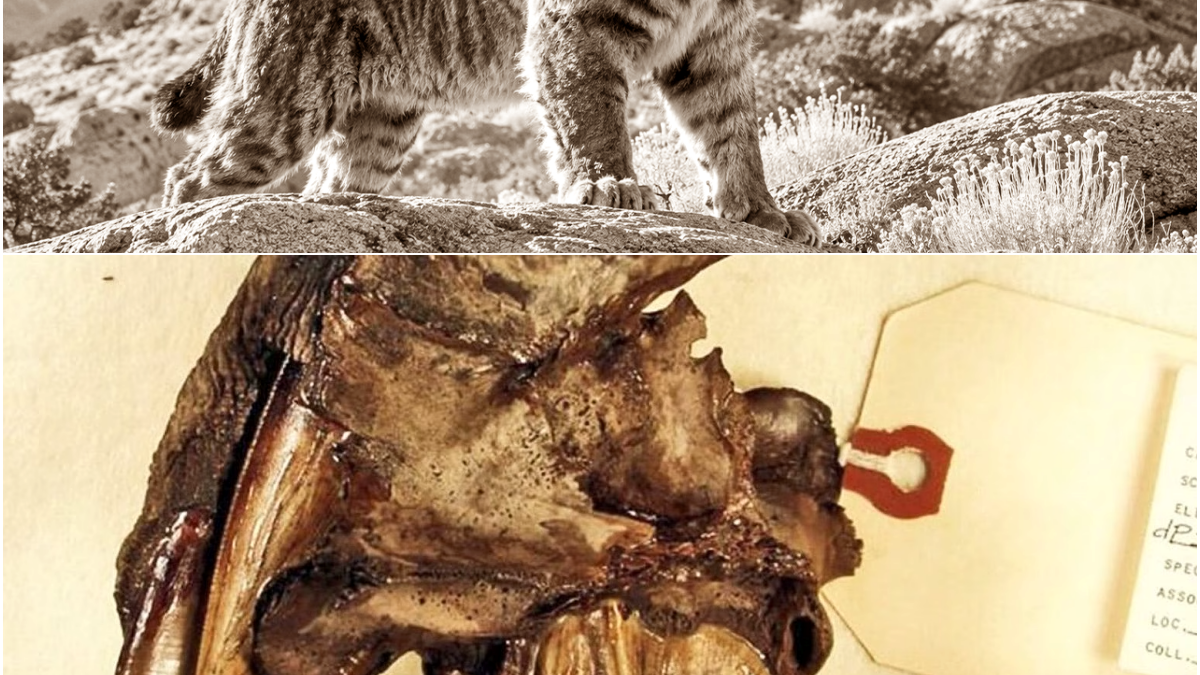
Somewhere in America, a trail camera is pointed toward a dark stretch of foreSt. The trees are still.
The moon is hidden behind clouds. Nothing seems unusual until the camera captures a shape moving between the trunks.
It is low to the ground, broad across the shoulders, and built unlike any cat alive today.
Then the animal turns its head toward the lens. Two enormous curved teeth extend beyond its jaw.
For a moment, the picture looks like evidence from another age. A caption appears beneath it claiming the photograph was taken only last week.
Thousands of people share it. Some insist the creature has returned. Others call the image an obvious fake.
Yet the strangest part is that the animal itself was once completely real. It walked across North and South America thousands of years ago, hunted enormous prey, and left behind thousands of bones beneath what is now one of the busiest cities in the United States.
Its name was Smilodon. Its teeth could reach nearly 7 in long. Its body was built for strength rather than speed, and its fossils have revealed injuries, strange growth patterns, and clues about how it may have lived.
So why does this ancient predator keep appearing in modern photographs, and what would it mean if one day a camera really did capture something looking back?
The pictures arrive in waves. A blurry frame from a road in the southern United States.
A trail camera image supposedly taken somewhere in the Ozarks. A photograph attributed to a hunter who claims he found something unusual moving through the trees.
A short video appears online, gathers enormous attention, disappears, and then returns months later with a different location attached to it.
The details change. The animal usually does not. It is always some variation of the same shape.
A heavy body. Powerful shoulders. A low stance. And two long teeth hanging beneath the upper jaw.
The arguments begin almost immediately. One side says the image is obviously fabricated. Another asks why people keep seeing the same creature in different places.
Some suggest a cougar photographed from an unusual angle. Others propose a jaguar, a large cat with an injury, or an animal distorted by darkness and camera compression.
And increasingly, there is another explanation. Artificial intelligence can now create realistic wildlife photographs without a real animal ever standing in front of a camera.
A few years ago, producing a convincing photograph of an extinct predator required a skilled artiSt.
Now a person can describe a creature in a few words and receive a remarkably convincing image.
That makes the modern mystery much harder to investigate. But before asking whether Smilodon could still exist, it helps to understand what Smilodon actually was.
The first surprise is that there was not just one saber toothed cat. Scientists recognize several species within the genus Smilodon.
The smallest, Smilodon gracilis, was approximately the size of a modern jaguar. The species most people imagine when they hear the words saber toothed cat is Smilodon fatalis.
It lived across large portions of what is now the American West and could weigh as much as 600 lb.
Then there was the enormous South American species, which reached even greater sizes. Some estimates place the largest individuals above 800 lb, with the heaviest potentially approaching 1,000 lb.
Standing beside a reconstruction makes the fossils suddenly feel different. A skull on a museum shelf can look like an ordinary scientific specimen.
A full reconstruction reveals the animal that once occupied the landscape. This was not a small predator hiding beneath the trees.
It was a powerful ambush hunter living among some of the largest mammals ever to inhabit the Americas.
And one of the greatest records of its existence sits in the middle of Los Angeles.
The La Brea Tar Pits are surrounded today by roads, buildings, traffic, and one of the largest urban areas in the United States.
But beneath that modern landscape is something far older. Natural asphalt has been rising from the ground for tens of thousands of years.
The sticky material created a trap for animals moving through the landscape. One animal became caught.
Its movements attracted attention. Predators approached. Some of those predators became trapped as well. Over enormous spans of time, the remains accumulated.
More than 3 and 1/2 million fossils have been recovered from the La Brea deposits.
Among them are the remains of more than 2,000 individual saber toothed cats. That is not simply a collection of bones.
It is an enormous record of an animal that once lived here in substantial numbers.
The fossils made Smilodon fatalis the state fossil of California. They also revealed something important about how the animal moved.
Smilodon was not designed like a long distance runner. Its body was compact and extremely muscular.
Its front limbs were particularly powerful. Instead of pursuing prey over long distances, the cat appears to have relied heavily on surprise and physical control.
The massive forelimbs could help restrain large prey. Then came the famous teeth. At first glance, they look like weapons designed for crushing.
They were not. The elongated canines were surprisingly delicate compared with the rest of the animal.
A careless bite against struggling prey could potentially damage them. The cat therefore needed precision.
It likely used its strength to control the prey first, then positioned the enormous teeth carefully.
The jaws could open extraordinarily wide, allowing the long canines to reach vulnerable areas. The image of Smilodon becomes different when you understand that.
It was not simply a monster with giant teeth. It was an animal built around a very specific hunting strategy.
Its body provided the strength. Its jaws provided the precision. Its teeth provided the final specialized tool.
The fossils reveal another strange detail. Young Smilodon did not simply grow their adult teeth in the same straightforward way that a modern kitten develops permanent teeth.
Researchers have found evidence that the young cats retained their milk canines while their permanent saber teeth developed.
The adult tooth could grow through a groove associated with the earlier tooth. For part of adolescence, the young animal could therefore possess an unusual transitional arrangement.
The enormous weapons did not simply appear overnight. They developed through a complicated process. That alone tells us how specialized the animal had become.
But perhaps the most fascinating question concerns how Smilodon lived. The fossils contain evidence of serious injuries.
Thousands of bones recovered from the La Brea deposits show signs of trauma or disease.
Some animals had damaged legs. Others had injuries involving joints, ribs, or the spine. Yet many of those injuries had healed.
That means the animals survived for considerable periods after receiving injuries that would have made hunting extremely difficult.
This created one of the longest debates surrounding Smilodon. How could a large predator survive if it was unable to hunt normally?
One possibility is social behavior. If Smilodon lived in groups, an injured animal might have received access to food from other members.
Young animals could have remained with adults. An injured hunter might have survived because the group continued providing opportunities to feed.
That interpretation makes the La Brea fossils seem almost like fragments of a family history.
Another interpretation is more cautious. A predator does not necessarily need human style cooperation to survive an injury.
Animals can sometimes endure remarkable physical hardship. They can survive on stored energy. They can recover slowly.
And the large number of injured fossils at La Brea may partly reflect the unusual circumstances of the tar deposits themselves.
Animals were attracted to the same dangerous locations repeatedly, creating a record that does not necessarily represent the normal structure of Smilodon society.
The debate remains unresolved. But the injuries tell us something important. These were not simple creatures.
They had complex lives. They grew. They hunted. They experienced injuries. They recovered. They lived long enough for their bones to record parts of their history.
And then the world around them changed. Toward the end of the last ice age, North America experienced a dramatic reduction in its large mammals.
Mammoths disappeared. Mastodons disappeared. Giant ground sloths disappeared. The American lion disappeared. Dire wolves disappeared.
Native horses and camels disappeared. The continent had once supported a tremendous variety of large animals.
The landscape was filled with giants. Then that world became much quieter. Researchers studying the La Brea deposits have attempted to establish when different species disappeared from the record.
The final representatives of a species are sometimes called endlings. Eventually, the large predators and prey that had shaped the ice age ecosystem were gone.
The precise reasons remain debated. One explanation emphasizes climate change. The ice age was ending.
Temperatures were rising. Habitats were shifting. Vegetation changed. The large herbivores that supported giant predators faced an increasingly different environment.
Another explanation emphasizes human activity. As people expanded across the continent, skilled hunters encountered large animals that had evolved without the same pressure.
The overkill hypothesis proposes that hunting contributed significantly to the rapid disappearance of many large species.
There is also another hypothesis involving a major environmental event around 12,900 years ago. According to that idea, an extraterrestrial impact or airburst may have contributed to abrupt environmental changes.
Other research has emphasized fire and changing landscapes, including large fires occurring in a climate that was already becoming drier in some regions.
The most reasonable interpretation may involve several factors interacting. Climate changed. Habitats changed. Human populations expanded.
Large animals faced new pressures. The ecosystem that had supported Smilodon was transformed. The saber toothed cat did not simply lose a contest with another predator.
Its world changed around it. When the enormous prey disappeared, a predator specialized for controlling those animals faced a fundamental problem.
There was less and less of the world it had evolved to inhabit. Eventually, the fossil record stops.
Smilodon fatalis is no longer found. The enormous South American form disappears as well. The species that had survived across enormous distances and environments became part of the fossil record.
For a long time, that seemed like the end of the story. The saber toothed cat was gone.
There were fossils. There were reconstructed skeletons. There were museum displays. There were no living animals.
Then the stories began. Reports of mysterious large cats have circulated for generations. Some are connected to the work of cryptozoologist Karl Shuker, who has collected accounts of unusual animals and unexplained sightings.
Among those reports are stories describing large cats with unusually long teeth. Some accounts have been associated with the southern United States and Mexico.
One story claims that two such animals were encountered by cavalrymen in Arizona around 1913.
Another concerns a businessman who supposedly arrived outside a newspaper office in Oregon in 1928 with a covered cage and a remarkable claim about what was inside.
There have also been reports from northern Mexico, including one dated as recently as 1994.
None of these accounts has produced a verified specimen. None has provided scientists with a confirmed skull.
None has produced DNA that could establish the existence of a surviving Smilodon population. That distinction matters.
A story can be old without being true. A witness can be sincere and still misidentify an animal.
A memory can become more dramatic each time it is retold. A photograph can be misunderstood.
And an extraordinary claim requires evidence that can survive careful examination. The strongest legends are not always the strongest evidence.
Then the story moves farther south. In the cloud forests of Venezuela, Colombia, Ecuador, and Peru, there are traditions involving a mysterious cat sometimes called the Tigra Dantero.
The name has been translated roughly as a tapir eating tiger. Descriptions vary, but some accounts describe a shy cat about the size of a jaguar or slightly smaller.
It is sometimes said to have a short tail, heavy front legs, and long teeth extending below the jaw.
One account involved a French traveler named P sometime before 1966. The American writer and naturalist Peter Matisson heard the story and considered the traveler sincere, but he also believed the animal had probably been misidentified.
Then, in 1991, near the Carau River in Venezuela, a hunter from the Pemon people reportedly described seeing an animal that sounded remarkably similar.
A tan body. A short tail. Powerful front legs. Long teeth. The account was intriguing.
It was not proof. That difference has followed almost every story about a surviving saber toothed cat.
There is another story associated with Paraguay in 1975. According to the tale, an unusual animal was found in the bush and was supposedly identified by a zoologist as a genuine Smilodon.
Later, the animal was reportedly reclassified as an ordinary jaguar with a malformed jaw. The problem is that the original source of the story is difficult to establish.
There is no confirmed specimen available for examination. The body cannot be studied. The account therefore remains another piece of folklore rather than scientific evidence.
Then come the stories of the water tiger. Some traditions from remote river regions describe a large feline creature associated with water and equipped with prominent teeth.
Similar stories have appeared in other parts of the world. That similarity has encouraged some cryptozoologists to argue that different cultures may have encountered a real animal.
Skeptics offer a simpler interpretation. People in different regions can create similar legends because large cats, water, and dangerous predators are universal themes.
The similarity does not necessarily demonstrate a biological connection. But there is one fact about saber toothed animals that makes the discussion unexpectedly interesting.
Nature has evolved the basic design more than once. Smilodon was not the only animal with elongated saber like teeth.
Thylacosmilus was an entirely different creature. It was not a true cat. It belonged to a distant branch of the mammal family tree associated with marsupials.
Yet it developed an astonishingly similar appearance. A large predator. Powerful jaws. Enormous canine teeth.
A body adapted to hunting. The two animals reached a similar solution through completely separate evolutionary paths.
This phenomenon is called convergent evolution. It means that nature can arrive at similar designs when unrelated animals face similar ecological challenges.
That is important because it shows that the saber toothed shape was not some impossible accident.
It was an evolutionary strategy that appeared more than once. The giant teeth were useful in certain environments.
The powerful body was useful. The specialized hunting style was useful. The design disappeared from North America.
But the basic evolutionary idea had appeared elsewhere before. That brings the question of survival back into focus.
Could a smaller saber toothed predator have survived somewhere remote? Karl Shuker has suggested a possibility along those lines.
A full sized Smilodon would have required large prey. Modern ecosystems no longer contain the same collection of enormous herbivores.
A giant saber toothed cat would therefore have difficulty finding enough food. But perhaps, in theory, a smaller descendant could have adapted.
A smaller body would require less food. It could potentially hunt deer or other modern prey.
A remote forest or cloud forest could provide cover. It is an interesting hypothesis. It is not evidence.
No confirmed living population has been found. No museum possesses a verified modern Smilodon skull.
No genetic sample has established that the animal survives. And this is where the mystery normally ends.
The fossils say extinct. The stories say perhaps. The evidence available to science says there is no verified living Smilodon.
Then technology changed the argument. Today, anyone can create an image of an extinct animal.
Artificial intelligence can generate a trail camera photograph with realistic lighting, blur, shadows, vegetation, and animal anatomy.
A creator can ask for an ancient cat standing in a forest at night. The result can look convincing enough to fool someone scrolling quickly through a social media feed.
That has changed the nature of cryptid photographs. In the past, a strange photograph was at least evidence that something had stood in front of a camera.
Now that assumption cannot always be made. A modern image can look like wildlife photography without any wildlife ever being present.
Fact checking organizations such as Snopes have increasingly encountered AI generated animal images presented as genuine photographs.
There have even been cases in which police departments had to address bizarre animal reports that were apparently inspired by AI generated images.
The problem is not that every unusual photograph is artificial. The problem is that photographs alone have become less decisive.
A trail camera frame can be fabricated. A video can be manipulated. A location can be falsely attached to an old recording.
A genuine cougar can be presented as something else. A real image can be combined with a false story.
The modern internet gives every mystery a way to travel. And that brings us to something that did not exist when many of the old saber toothed stories were collected.
The possibility of reconstructing extinct animals. In the spring of 2025, Colossal Biosciences announced that it had produced animals intended to resemble the extinct dire wolf.
The animals were named Romulus, Reheis, and Khesi. The announcement attracted enormous attention because the company described the project as bringing an extinct animal back.
But the scientific discussion quickly became more complicated. Researchers used ancient DNA from dire wolf fossils, including a tooth from Ohio and a skull fragment from Idaho.
They then made 20 genetic changes across 14 genes in cells derived from living gray wolves.
Those edited cells were cloned and used to produce the animals. The result was visually striking.
The pups looked much larger and more heavily built than ordinary gray wolves. Their appearance reminded people of artistic reconstructions of the ancient predator.
But many scientists questioned whether the animals should truly be called dire wolves. Dire wolves separated from the evolutionary line leading to modern wolves nearly 6 million years ago.
They were distinct enough to belong to their own genus. A gray wolf modified at 20 genetic locations is therefore not necessarily the same thing as recreating the extinct species.
Colossal’s own chief scientist acknowledged that an identical recreation of the original animal was not possible.
The animals were living gray wolves with genetic edits. Critics made the distinction even more strongly.
Some described the result as genetically modified gray wolves rather than resurrected dire wolves. That debate matters because it reveals how complicated the word extinct has become.
For most of human history, extinction meant the end of a biological lineage. Once the last individual was gone, there was no practical way to reverse the process.
Now biotechnology has begun challenging that assumption. Not perfectly. Not completely. But enough to change the conversation.
And that creates an unexpected connection to Smilodon. Nobody has announced a plan to recreate a saber toothed cat.
A project like that would face enormous scientific challenges. Smilodon has no close living relative comparable to the gray wolf’s relationship with the dire wolf.
Its evolutionary branch separated from living cats a very long time ago. Researchers would need extraordinarily detailed ancient DNA.
They would need a living species capable of serving as a biological starting point. They would need to determine which genetic changes controlled the animal’s unique anatomy.
And even if all of those problems could somehow be solved, the result would raise another question.
Would a recreated animal truly be Smilodon, or would it simply be a modern cat engineered to resemble one?
That distinction is at the center of the current debate surrounding de extinction technology. But the bigger change has already happened.
The idea that an extinct animal could be reconstructed is no longer pure science fiction.
It is now being discussed in laboratories, universities, companies, museums, and scientific publications. That does not mean a saber toothed cat is about to walk through an American foreSt.
It does not mean the mysterious photographs are genuine. It does not mean the old sightings have been proven.
It simply means that one assumption has changed. Extinction is still permanent for species that vanish from the natural world.
But humanity now has tools that may someday allow scientists to recreate some characteristics of animals that no longer exiSt.
That possibility gives the old photographs an entirely different meaning. Imagine the familiar image again.
A trail camera. A dark foreSt. A broad shouldered animal. Two long teeth. If the photograph is fake, then it is simply another internet mystery.
If it shows a misidentified cougar, then the mystery has an ordinary answer. If it is generated by artificial intelligence, then it is an image of something that never existed.
And if, against every expectation, it ever shows a real living animal with unmistakable Smilodon anatomy, the consequences would be enormous.
Scientists would need physical evidence. Hair. DNA. Tracks. Bones. A reliable location. Repeated observations. Something that could survive examination by independent researchers.
One blurry photograph would never be enough. One video would not be enough. One eyewitness would not be enough.
The standard would have to be extraordinary because the claim would overturn more than a century of paleontology.
There is also another possibility. Perhaps Smilodon truly disappeared thousands of years ago and will never return naturally.
Perhaps the mysterious photographs will always be mistakes and fabrications. Perhaps the legends will remain legends.
That is currently the explanation supported by the evidence. Yet the natural world has surprised scientists before.
The coelacanth was known from fossils until a living specimen was discovered off the coast of South Africa in 1938.
Species once believed to have vanished have occasionally been rediscovered in remote environments. Those examples do not prove that Smilodon survived.
They simply remind us that science remains open to new evidence. There is an important difference between saying that something is possible and saying that it has happened.
At present, there is no verified evidence of a surviving saber toothed cat. That should not be confused with a claim that one is impossible.
The distinction is what keeps the mystery interesting without turning it into fact. And perhaps that is why the image keeps returning.
People are fascinated by the possibility that something ancient might still be walking through the modern world.
The idea reaches deeper than a simple monster story. It connects the present to a landscape that existed long before highways, skyscrapers, suburbs, and cities.
Imagine standing somewhere in California thousands of years ago. There would be no traffic. No buildings.
No streetlights. No cameras. Instead, enormous herbivores would move across the landscape. Predators would watch from cover.
Among them would be Smilodon. Powerful. Heavy. Silent. Its long teeth hidden until the moment they were needed.
Then imagine that world changing. The climate shifts. The vegetation changes. Large prey becomes harder to find.
Humans spread across the continent. The old ecosystem disappears. Eventually, the saber toothed cat disappears with it.
Thousands of years later, humans uncover its bones beneath a modern city. We reconstruct its skeleton.
We place it behind museum glass. We give it a scientific name. Then someone creates a photograph of one standing in a foreSt.
The image spreads across the world in minutes. For a brief moment, the boundary between the past and present becomes difficult to see.
But perhaps the most remarkable part of the story is not whether a Smilodon is secretly living in the woods.
It is that humans have become capable of doing something the animal itself could never have imagined.
We can recover its bones. Read traces of its DNA. Reconstruct its body. Study injuries that happened thousands of years ago.
Create digital versions of it. And now, at least in limited ways, experiment with rebuilding traits from animals that no longer exiSt.
The saber toothed cat has not returned. There is no verified evidence that it has survived in secret.
But its shape continues to appear everywhere. In museums. In scientific reconstructions. In folklore. In photographs.
In computer generated images. And perhaps one day, in a laboratory. That is why the old creature refuses to remain entirely in the paSt.
Its fossils tell us what it was. Its legends tell us what people imagine. Modern technology tells us what we might someday be able to recreate.
And somewhere between those three things is a question that remains unanswered. If a future camera captures a cat with a broad chest, powerful forelimbs, and 7 in teeth standing beneath the trees, will we dismiss it as another fake?
Or will someone finally have the evidence to prove that the animal looking back at the lens is not a legend, not a reconstruction, and not a machine generated image, but something real?
For now, the answer remains in the fossils. More than 2,000 Smilodon individuals beneath Los Angeles.
Ancient bones preserving a vanished world. A predator perfectly adapted to a landscape that no longer exists.
The real saber toothed cats are still there, exactly where science knows they should be.
And the next time a mysterious photograph appears from the darkness, perhaps the most important thing will not be how frightening the animal looks.
It will be whether anyone can prove what stood in front of the camera.
Disclaimer: This content may be created by Al for entertainment purposes. Any resemblance to real persons, events, or places is coincidental.








